Drive belt Hyundai Matrix 2005 User Guide
[x] Cancel search | Manufacturer: HYUNDAI, Model Year: 2005, Model line: Matrix, Model: Hyundai Matrix 2005Pages: 407, PDF Size: 10.31 MB
Page 76 of 407

DRIVING YOUR HYUNDAI
2- 4 C050B03S-EAT
NORMAL CONDITIONS The Starting Procedure:
1. Insert key, and fasten the seat belt.
2. Depress the clutch pedal fully and place the gearshift lever (manual transaxle) inneutral or the selector lever (automatic transaxle) in "P" (park) position.
3. After turning the ignition key to the "ON" position, make certain all warning lightsand gauges are functioning properly be- fore starting the engine.
4. On vehicles equipped with the diesel pre- heat indicator light, turn the ignition key tothe "ON" position. The diesel pre-heat indi- cator light will first illuminate in amber, and then after a short time, the amber illumina- tion will goes off, indicating that preheating is completed. SC060B1-E FUEL ECONOMY
The following suggestions are made to assist
in achieving the greatest degree of fuel economy.
o Maintaining a constant check on fuel con- sumption will enable the most economical use pattern and driving style to be adopt- ed.
o Avoid using the vehicle for very short jour- neys if possible, particularly when a coldstart is involved.
o Ensure that tyre pressures are maintained
at the correct level.
o Use only the recommended grade of fuel.
o Avoid carrying unnecessary weight, and if a roof rack is in use, remove it as soon aspossible after use.
NOTE: If the engine does not start 10 secondsafter the preheating is completed, turn the ignition key once more to the "LOCK" position, and then to the "ON" position, in order to preheat again. WARNING: Be sure that the clutch is fully depressed when starting a manual transaxle vehicle. This will prevent sudden movement should the vehicle be started in gear without the clutch depressed. Otherwise there is the potential to cause damage to the vehicle or injury to a person inside or outside of the vehicle as a result of this sudden vehicle movement.
5. Turn the ignition key to the "Start" position and release it when the engine starts.
C055B01B-GAT STARTING AND STOPPING THE EN- GINE FOR TURBO CHARGER INTER-COOLER (DIESEL ENGINE)
(1) Do not race the engine or suddenly accel- erate the engine immediately after starting it. If the engine is cold, allow the engine to idle for several seconds before it is driven to ensure sufficient lubrication of the turbo charger unit. (2) After high speed or extended driving, re-
quiring a heavy engine load, the engineshould be allowed to idle about 1 minute before turning it off.This idle time will allow the turbo charger to cool prior to shutting the engine off.
WARNING: Do not turn the engine off immediately after it has been subjected to a heavy load. Doing so may cause severe damage to the engine or turbo charger unit.
C050B01HP
Amber lamp ON Amber lamp OFF
Page 77 of 407
DRIVING YOUR HYUNDAI 2- 5
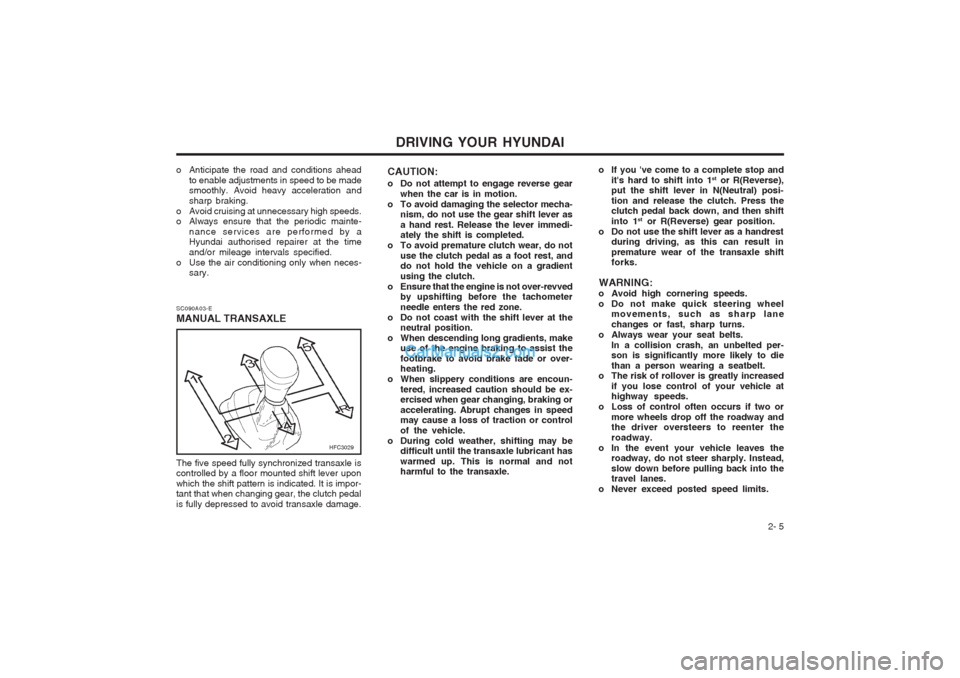
SC090A03-E MANUAL TRANSAXLE
HFC3029
The five speed fully synchronized transaxle is controlled by a floor mounted shift lever upon which the shift pattern is indicated. It is impor- tant that when changing gear, the clutch pedal is fully depressed to avoid transaxle damage. CAUTION:
o Do not attempt to engage reverse gear
when the car is in motion.
o To avoid damaging the selector mecha- nism, do not use the gear shift lever as a hand rest. Release the lever immedi- ately the shift is completed.
o To avoid premature clutch wear, do not use the clutch pedal as a foot rest, anddo not hold the vehicle on a gradient using the clutch.
o Ensure that the engine is not over-revved by upshifting before the tachometerneedle enters the red zone.
o Do not coast with the shift lever at the neutral position.
o When descending long gradients, make use of the engine braking to assist thefootbrake to avoid brake fade or over- heating.
o When slippery conditions are encoun- tered, increased caution should be ex-ercised when gear changing, braking or accelerating. Abrupt changes in speed may cause a loss of traction or control of the vehicle.
o During cold weather, shifting may be difficult until the transaxle lubricant haswarmed up. This is normal and not harmful to the transaxle.
o Anticipate the road and conditions ahead
to enable adjustments in speed to be madesmoothly. Avoid heavy acceleration and sharp braking.
o Avoid cruising at unnecessary high speeds.
o Always ensure that the periodic mainte- nance services are performed by aHyundai authorised repairer at the time and/or mileage intervals specified.
o Use the air conditioning only when neces- sary.
o If you 've come to a complete stop and
it's hard to shift into 1 st
or R(Reverse),
put the shift lever in N(Neutral) posi- tion and release the clutch. Press the clutch pedal back down, and then shift into 1 st
or R(Reverse) gear position.
o Do not use the shift lever as a handrest during driving, as this can result inpremature wear of the transaxle shift forks.
WARNING:
o Avoid high cornering speeds.
o Do not make quick steering wheel movements, such as sharp lanechanges or fast, sharp turns.
o Always wear your seat belts. In a collision crash, an unbelted per- son is significantly more likely to die than a person wearing a seatbelt.
o The risk of rollover is greatly increased
if you lose control of your vehicle at highway speeds.
o Loss of control often occurs if two or
more wheels drop off the roadway andthe driver oversteers to reenter the roadway.
o In the event your vehicle leaves the roadway, do not steer sharply. Instead,slow down before pulling back into the travel lanes.
o Never exceed posted speed limits.
Page 81 of 407
DRIVING YOUR HYUNDAI 2- 9
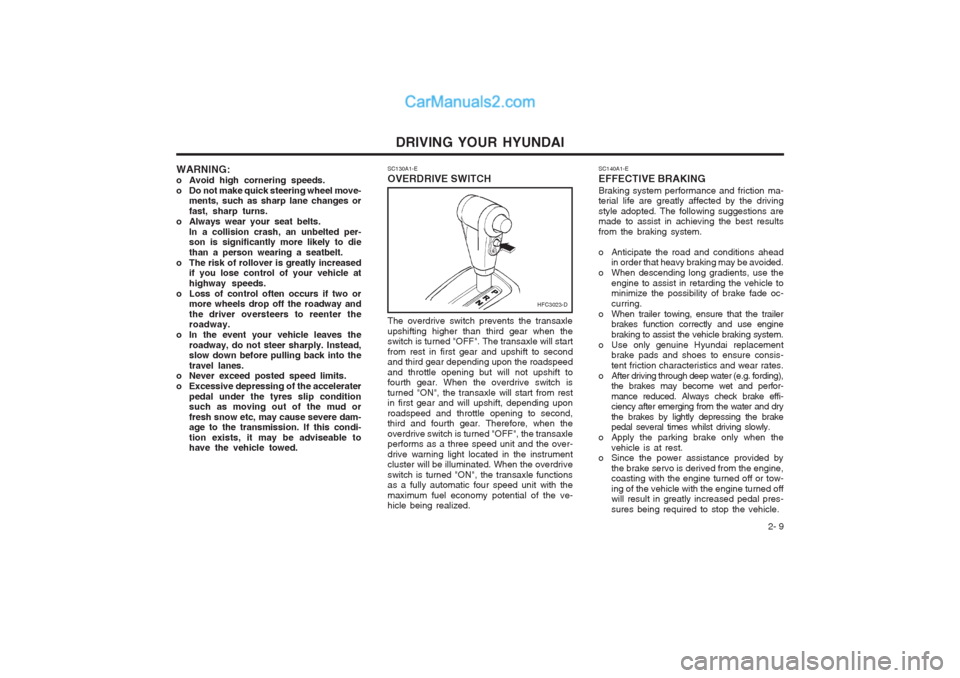
SC130A1-E OVERDRIVE SWITCH
The overdrive switch prevents the transaxle upshifting higher than third gear when the switch is turned "OFF". The transaxle will start from rest in first gear and upshift to second and third gear depending upon the roadspeed and throttle opening but will not upshift to fourth gear. When the overdrive switch is turned "ON", the transaxle will start from rest in first gear and will upshift, depending upon roadspeed and throttle opening to second, third and fourth gear. Therefore, when the overdrive switch is turned "OFF", the transaxle performs as a three speed unit and the over- drive warning light located in the instrument cluster will be illuminated. When the overdrive switch is turned "ON", the transaxle functions as a fully automatic four speed unit with the maximum fuel economy potential of the ve- hicle being realized.
SC140A1-E EFFECTIVE BRAKINGBraking system performance and friction ma- terial life are greatly affected by the driving style adopted. The following suggestions are made to assist in achieving the best results from the braking system.
o Anticipate the road and conditions ahead
in order that heavy braking may be avoided.
o When descending long gradients, use the engine to assist in retarding the vehicle to minimize the possibility of brake fade oc- curring.
o When trailer towing, ensure that the trailer brakes function correctly and use enginebraking to assist the vehicle braking system.
o Use only genuine Hyundai replacement brake pads and shoes to ensure consis-tent friction characteristics and wear rates.
o After driving through deep water (e.g. fording), the brakes may become wet and perfor-mance reduced. Always check brake effi- ciency after emerging from the water and dry the brakes by lightly depressing the brake pedal several times whilst driving slowly.
o Apply the parking brake only when the
vehicle is at rest.
o Since the power assistance provided by
the brake servo is derived from the engine,coasting with the engine turned off or tow- ing of the vehicle with the engine turned off will result in greatly increased pedal pres- sures being required to stop the vehicle.
HFC3023-D
WARNING:
o Avoid high cornering speeds.
o Do not make quick steering wheel move-ments, such as sharp lane changes orfast, sharp turns.
o Always wear your seat belts. In a collision crash, an unbelted per- son is significantly more likely to die than a person wearing a seatbelt.
o The risk of rollover is greatly increased if you lose control of your vehicle athighway speeds.
o Loss of control often occurs if two or more wheels drop off the roadway andthe driver oversteers to reenter the roadway.
o In the event your vehicle leaves the roadway, do not steer sharply. Instead,slow down before pulling back into the travel lanes.
o Never exceed posted speed limits.
o Excessive depressing of the accelerater
pedal under the tyres slip condition such as moving out of the mud or fresh snow etc, may cause severe dam- age to the transmission. If this condi- tion exists, it may be adviseable to have the vehicle towed.
Page 84 of 407
DRIVING YOUR HYUNDAI
2- 12 ZC170D1-E
Door Locks Should the door lock mechanism become frozen, a proprietary lock de-icer should be used. Alternatively, warming the door key may thaw the door lock. However, the key should be handled carefully to avoid burning the fingers. Never attempt to thaw a frozen door lock using hot water, since the water will eventu- ally freeze and compound the problem. NOTE: The proper temperature for using the immobiliser key is from -40°F to 176°F (- 40°C to 80°C). If you heat the immobiliser key over 176°F (80°C) to open the frozen lock, it may cause damage to the tran- sponder in its head.
SC170E1-E Windscreen Washers and Wipers The windscreen washer bottle should be filled
with a solution of water and a proprietary winter screen wash additive. The windscreen wipers should not be used if the blades are frozen to the windscreen or if they are cov- ered with snow, before this is removed.
ZC170B1-E
Electrical System Winter conditions impose severe demandsupon vehicle electrical systems, particularly the charging circuit. The battery condition and performance along with the alternator perfor- mance and drive belt condition should be checked prior to the onset of winter. ZC170C1-E Anti-freeze/Corrosion inhibitorThe cooling system must always contain an Ethylene-Glycol based anti-freeze solution. The system is filled during manufacture with solution of the correct strength which should be checked before the onset of winter and adjusted or changed as required. NOTE: The anti-freeze solution contains a corro- sion inhibitor to prevent degradation of the aluminum castings contained within the engine. Therefore, never, drain the system and refill with water only. In addition, anti-freeze solution must ALWAYS be used in vehicles fitted with air conditioning, to prevent the heater matrix from freezing and subsequently bursting with the refrigeration system in use.
o Don't "lug" or "over-rev" the engine. Lug-
ging is driving too slowly in too high a gearresulting in the engine bucking. If this happens to you, shift to a lower gear.Over-revving is racing the engine beyond its safe limit. This can be avoided by shifting at the recommended speeds.
o Use your air conditioning sparingly. The air
conditioning system is operated by the engine power so your fuel economy is reduced when you use it.
SC160A1-F SMOOTH CORNERINGAvoid braking or gear changing in corners, especially when roads are wet. Ideally, cor- ners should always be taken under gentle acceleration. If you follow these suggestions, tyre wear will be held to a minimum. SC170A1-E WINTER MOTORINGThe onset of winter conditions subject motor vehicles to greater operating demands. There- fore, the following suggestions will assist in maintaining peak performance and reliability during these periods:
Page 89 of 407
IN CASE OF EMERGENCY
3-2
CAUTION: Personal injury and damage to the vehicle may occur if jump starting is not per- formed correctly. If any doubt exists as to how this operation should be performed, seek assistance from qualified personnel. WARNING: Motor vehicle batteries contain sulphuric acid and emit hydrogen gas. Protective clothing should be worn and care exer- cised to prevent the acid from coming into contact with skin or clothing and the ve- hicle. Naked lights should not be permitted in the vicinity of the battery. Care should be exercised to prevent sparks occurring during connection. If acid accidentally comes into contact with skin or eyes, the affected area should immediately be flushed CAUTION: If the jump cable are incorrectly installed,
damage to the vehicle electrical system may occur, in particular the electronic components such as the Fuel Injection system computer and the Automatic
Transaxle computer. The battery must never be disconnected whilst the engine is running. SD040A2-E IF THE ENGINE OVERHEATS
If the temperature gauge indicates overheat- ing:
1. Pull off the road and stop as soon as it is safe to do so.
2. Place the gear selector lever in "P" (auto- matic), or neutral (manual transaxle) and set the parking brake. If the air condition- ing is on, turn it off.
3. If coolant is running out under the car or
steam is coming out from under the bonnet stop the engine. Do not open the bonnet until the coolant has stopped running or the steaming has stopped. If there is no visible loss of coolant and no steam, leave the engine running and check to be sure the engine cooling fan is operating.If the fan is not running, turn the engine off.
4. Check to see if the water pump drive belt is broken. If it is not missing, check to seethat it is tight.
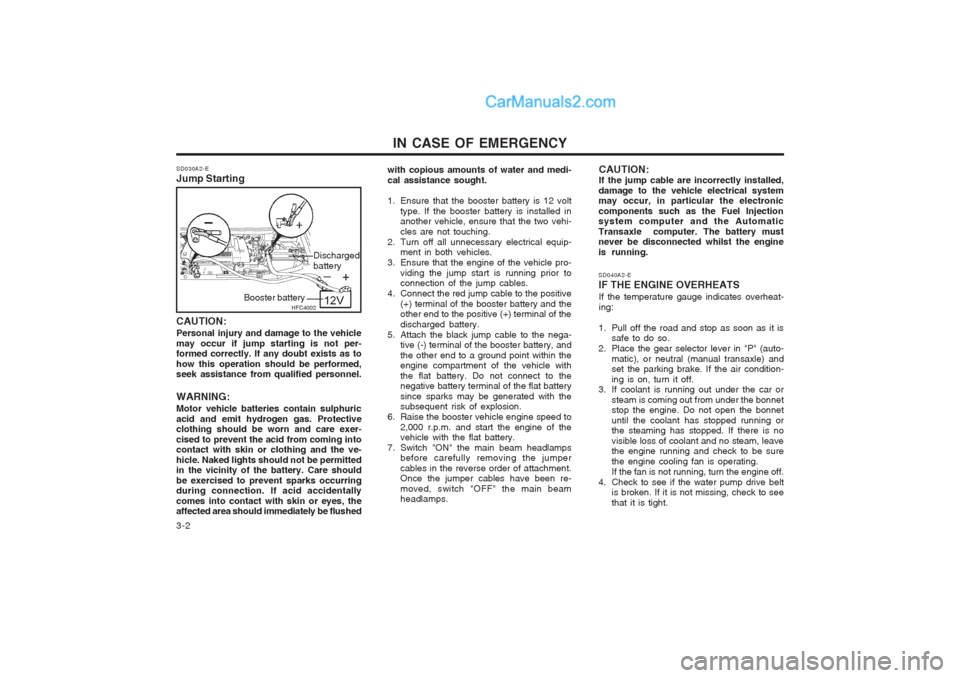
SD030A2-E Jump Starting
with copious amounts of water and medi- cal assistance sought.
1. Ensure that the booster battery is 12 volt
type. If the booster battery is installed in another vehicle, ensure that the two vehi- cles are not touching.
2. Turn off all unnecessary electrical equip- ment in both vehicles.
3. Ensure that the engine of the vehicle pro- viding the jump start is running prior to connection of the jump cables.
4. Connect the red jump cable to the positive (+) terminal of the booster battery and theother end to the positive (+) terminal of the discharged battery.
5. Attach the black jump cable to the nega- tive (-) terminal of the booster battery, andthe other end to a ground point within the engine compartment of the vehicle with the flat battery. Do not connect to the negative battery terminal of the flat battery since sparks may be generated with the subsequent risk of explosion.
6. Raise the booster vehicle engine speed to 2,000 r.p.m. and start the engine of thevehicle with the flat battery.
7. Switch "ON" the main beam headlamps before carefully removing the jumper cables in the reverse order of attachment. Once the jumper cables have been re- moved, switch "OFF" the main beam headlamps.
HFC4002
Booster battery Discharged battery
Page 90 of 407
3-3
IN CASE OF EMERGENCY
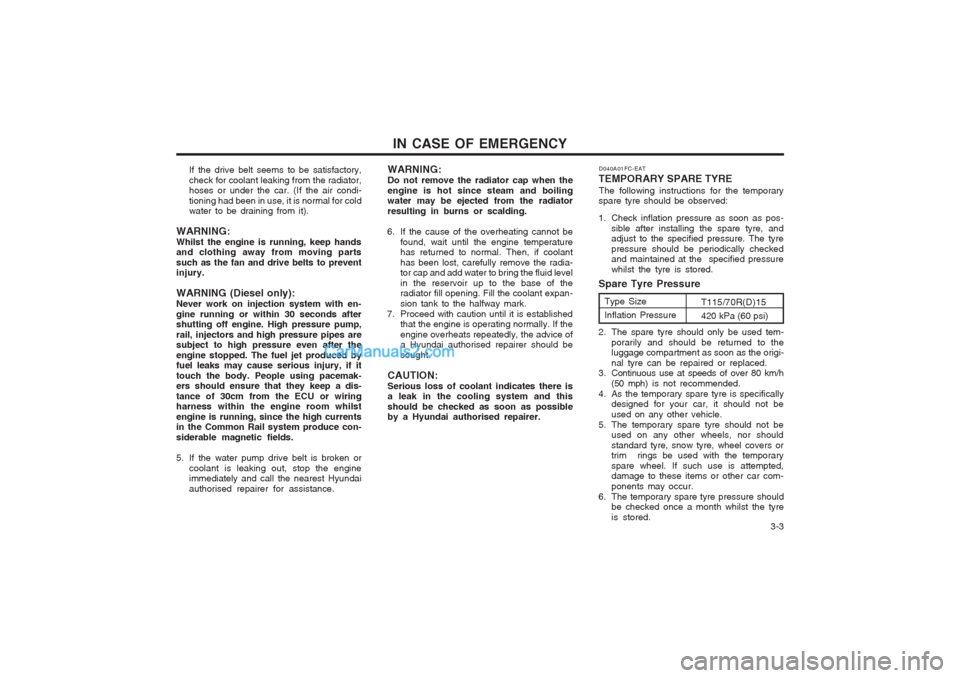
If the drive belt seems to be satisfactory, check for coolant leaking from the radiator, hoses or under the car. (If the air condi- tioning had been in use, it is normal for cold water to be draining from it).
WARNING: Whilst the engine is running, keep hands and clothing away from moving parts such as the fan and drive belts to prevent injury. WARNING (Diesel only): Never work on injection system with en-gine running or within 30 seconds after shutting off engine. High pressure pump, rail, injectors and high pressure pipes are subject to high pressure even after the engine stopped. The fuel jet produced by fuel leaks may cause serious injury, if it touch the body. People using pacemak- ers should ensure that they keep a dis- tance of 30cm from the ECU or wiring harness within the engine room whilst engine is running, since the high currents in the Common Rail system produce con- siderable magnetic fields.
5. If the water pump drive belt is broken or coolant is leaking out, stop the engine immediately and call the nearest Hyundai authorised repairer for assistance. WARNING:Do not remove the radiator cap when theengine is hot since steam and boiling water may be ejected from the radiator resulting in burns or scalding.
6. If the cause of the overheating cannot be found, wait until the engine temperature has returned to normal. Then, if coolant has been lost, carefully remove the radia- tor cap and add water to bring the fluid level in the reservoir up to the base of the radiator fill opening. Fill the coolant expan- sion tank to the halfway mark.
7. Proceed with caution until it is established that the engine is operating normally. If theengine overheats repeatedly, the advice of a Hyundai authorised repairer should be sought.
CAUTION:Serious loss of coolant indicates there is a leak in the cooling system and this should be checked as soon as possible by a Hyundai authorised repairer. D040A01FC-EAT
TEMPORARY SPARE TYRE The following instructions for the temporary
spare tyre should be observed:
1. Check inflation pressure as soon as pos-
sible after installing the spare tyre, and adjust to the specified pressure. The tyre pressure should be periodically checked and maintained at the specified pressure whilst the tyre is stored.
2. The spare tyre should only be used tem- porarily and should be returned to the luggage compartment as soon as the origi- nal tyre can be repaired or replaced.
3. Continuous use at speeds of over 80 km/h
(50 mph) is not recommended.
4. As the temporary spare tyre is specifically designed for your car, it should not beused on any other vehicle.
5. The temporary spare tyre should not be used on any other wheels, nor shouldstandard tyre, snow tyre, wheel covers or trim rings be used with the temporary spare wheel. If such use is attempted, damage to these items or other car com- ponents may occur.
6. The temporary spare tyre pressure should be checked once a month whilst the tyreis stored.
Spare Tyre Pressure
Type Size Inflation Pressure T115/70R(D)15420 kPa (60 psi)
Page 101 of 407
VEHICLE MAINTENANCE REQUIREMENTS
5- 2 YF010A2-E
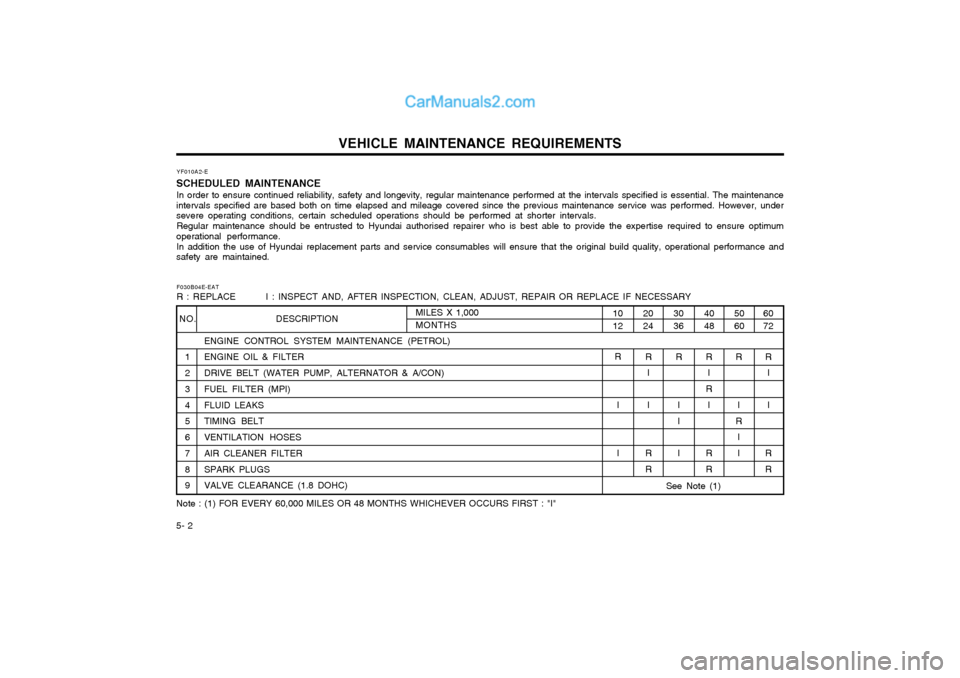
SCHEDULED MAINTENANCE In order to ensure continued reliability, safety and longevity, regular maintenance performed at the intervals specified is essential. The maintenance
intervals specified are based both on time elapsed and mileage covered since the previous maintenance service was performed. However, under severe operating conditions, certain scheduled operations should be performed at shorter intervals.
Regular maintenance should be entrusted to Hyundai authorised repairer who is best able to provide the expertise required to ensure optimum
operational performance.
In addition the use of Hyundai replacement parts and service consumables will ensure that the original build quality, operation al performance and
safety are maintained.
F030B04E-EAT R : REPLACE I : INSPECT AND, AFTER INSPECTION, CLEAN, ADJUST, REPAIR OR REPLACE IF NECESSARY
Note : (1) FOR EVERY 60,000 MILES OR 48 MONTHS WHICHEVER OCCURS FIRST : "I" ENGINE CONTROL SYSTEM MAINTENANCE (PETROL)
1 ENGINE OIL & FILTER
2 DRIVE BELT (WATER PUMP, ALTERNATOR & A/CON)
3 FUEL FILTER (MPI)
4 FLUID LEAKS
5 TIMING BELT
6 VENTILATION HOSES
7 AIR CLEANER FILTER
8 SPARK PLUGS
9 VALVE CLEARANCE (1.8 DOHC)
NO. DESCRIPTION60 72
5060
4048
3036
2024
1012
MILES X 1,000 MONTHS
R
I I
R R
R
I
R I I
R
I
R I
R R
R
I I I
R
II
R R
R
I I
See Note (1)
Page 102 of 407
VEHICLE MAINTENANCE REQUIREMENTS 5-3
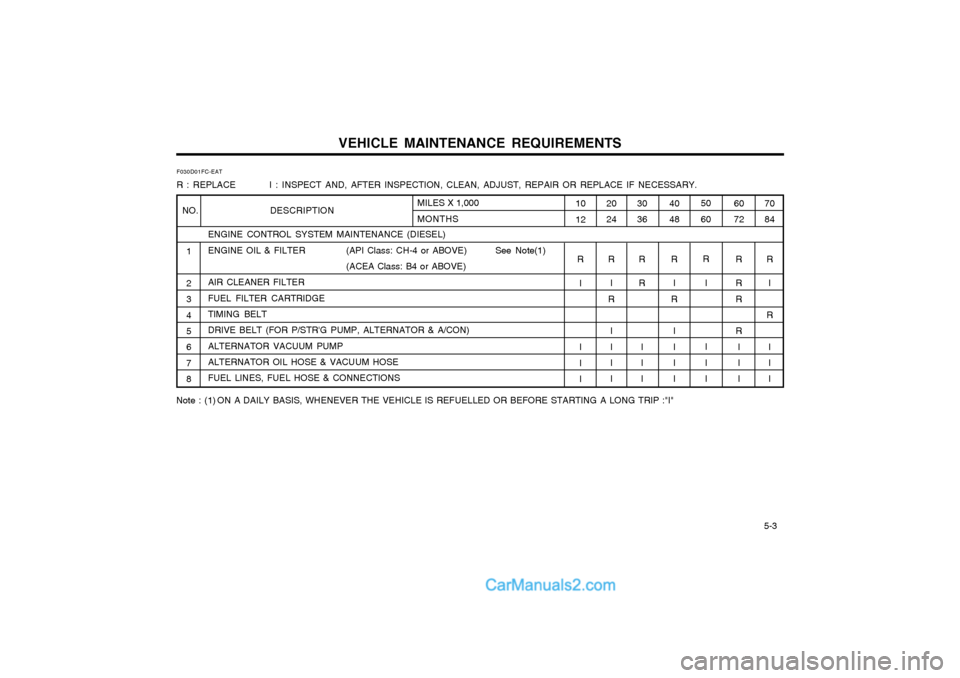
F030D01FC-EAT R : REPLACE I : INSPECT AND, AFTER INSPECTION, CLEAN, ADJUST, REPAIR OR REPLACE IF NECESSARY.
ENGINE CONTROL SYSTEM MAINTENANCE (DIESEL)
ENGINE OIL & FILTER (API Class: CH-4 or ABOVE) See Note(1)
(ACEA Class: B4 or ABOVE)
AIR CLEANER FILTERFUEL FILTER CARTRIDGETIMING BELT DRIVE BELT (FOR P/STR'G PUMP, ALTERNATOR & A/CON) ALTERNATOR VACUUM PUMPALTERNATOR OIL HOSE & VACUUM HOSE FUEL LINES, FUEL HOSE & CONNECTIONS
NO. DESCRIPTION
1 2 34 5 67 8 60 72
R R R R I I I50 60
R I I I I40 48
R I
R
II I I30 36
R R
I I I20 24R I
R
II I I
1012
R I I I IMILES X 1,000 MONTHS70 84
R I
R I I I
Note : (1) ON A DAILY BASIS, WHENEVER THE VEHICLE IS REFUELLED OR BEFORE STARTING A LONG TRIP :"I"
Page 105 of 407
VEHICLE MAINTENANCE REQUIREMENTS
5- 6 6ZF060D2-A
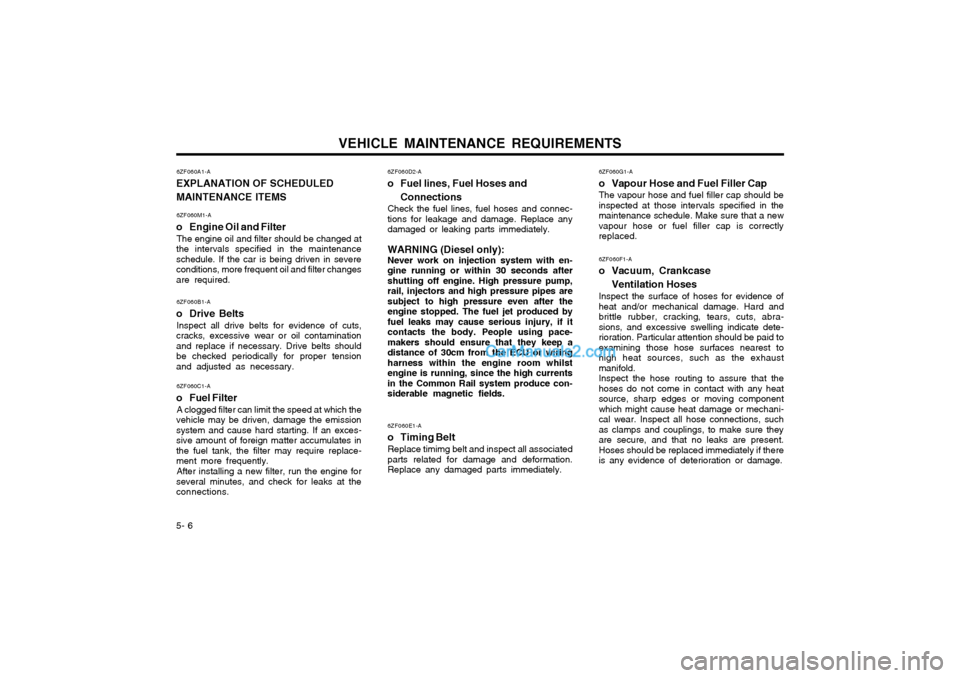
o Fuel lines, Fuel Hoses and
Connections
Check the fuel lines, fuel hoses and connec- tions for leakage and damage. Replace anydamaged or leaking parts immediately.
WARNING (Diesel only): Never work on injection system with en-gine running or within 30 seconds aftershutting off engine. High pressure pump,rail, injectors and high pressure pipes aresubject to high pressure even after theengine stopped. The fuel jet produced byfuel leaks may cause serious injury, if itcontacts the body. People using pace-makers should ensure that they keep adistance of 30cm from the ECU or wiringharness within the engine room whilstengine is running, since the high currentsin the Common Rail system produce con-siderable magnetic fields. 6ZF060E1-A
o Timing Belt Replace timimg belt and inspect all associated parts related for damage and deformation.Replace any damaged parts immediately. 6ZF060G1-A
o Vapour Hose and Fuel Filler Cap The vapour hose and fuel filler cap should be inspected at those intervals specified in themaintenance schedule. Make sure that a newvapour hose or fuel filler cap is correctlyreplaced. 6ZF060F1-A
o Vacuum, Crankcase
Ventilation Hoses
Inspect the surface of hoses for evidence of heat and/or mechanical damage. Hard andbrittle rubber, cracking, tears, cuts, abra-sions, and excessive swelling indicate dete-rioration. Particular attention should be paid toexamining those hose surfaces nearest tohigh heat sources, such as the exhaustmanifold.Inspect the hose routing to assure that thehoses do not come in contact with any heatsource, sharp edges or moving componentwhich might cause heat damage or mechani-cal wear. Inspect all hose connections, suchas clamps and couplings, to make sure theyare secure, and that no leaks are present.Hoses should be replaced immediately if thereis any evidence of deterioration or damage.
6ZF060A1-A
EXPLANATION OF SCHEDULED MAINTENANCE ITEMS
6ZF060M1-A
o Engine Oil and Filter The engine oil and filter should be changed at
the intervals specified in the maintenance schedule. If the car is being driven in severeconditions, more frequent oil and filter changesare required.
6ZF060B1-A
o Drive Belts Inspect all drive belts for evidence of cuts,
cracks, excessive wear or oil contaminationand replace if necessary. Drive belts shouldbe checked periodically for proper tensionand adjusted as necessary.
6ZF060C1-A
o Fuel Filter A clogged filter can limit the speed at which the
vehicle may be driven, damage the emissionsystem and cause hard starting. If an exces-sive amount of foreign matter accumulates inthe fuel tank, the filter may require replace-ment more frequently.
After installing a new filter, run the engine for
several minutes, and check for leaks at theconnections.
Page 107 of 407

VEHICLE MAINTENANCE REQUIREMENTS
5- 8 6ZF070P1-A
o Driveshafts and Boots Check the drive shafts, boots and clamps for cracks, deterioration, or damage. Replaceany damaged parts and, if necessary, repackthe grease. 6ZF070Q1-A
o Air conditioning Refrigerant Check the air conditioning lines and connec- tions for leakage and damage. Check airconditioning performance according to therelevant shop manual if necessary.
6ZF070L1-A
o Suspension Mounting Bolts Check the suspension connections for loose-
ness or damage. Retighten to the specifiedtorque. 6ZF070M1-A
o Steering Gear Box, Linkage & Boots/
Lower arm Ball Joint
With the vehicle stopped and engine off, check for excessive freeplay in the steering wheel. Check the linkage for bends or damage. Check the dust boots and ball joints for dete-rioration, cracks, or damage. Replace anydamaged parts. 6ZF070N1-A
o Power Steering Pump, Belt and Hoses Check the power steering pump and hoses for leakage and damage. Replace any dam-aged or leaking parts immediately. Inspect thepower steering belt for evidence of cuts,cracks, excessive wear, oil contaminationand proper tension. Replace or adjust it ifnecessary.