Drive belt Hyundai Matrix 2005 Owner's Guide
[x] Cancel search | Manufacturer: HYUNDAI, Model Year: 2005, Model line: Matrix, Model: Hyundai Matrix 2005Pages: 407, PDF Size: 10.31 MB
Page 111 of 407
OWNER MAINTENANCE
6-4 SG020B1-E
DAILY OPERATING CHECKS
The following items should be checked on a
daily basis or whenever the vehicle is refuelled, whichever occurs sooner.
o Engine oil level.
o Engine coolant level.
o Power steering fluid level.
o Brake fluid level.
o Windscreen washer fluid level.
o Battery condition.
o Tyre condition and pressures.
o Operation and cleanliness of all lighting equipment.
o Windscreen wiper and washer operation.
o Horn operation.
o Warning light operation.
o Adjustment and cleanliness of mirrors.
o Seat and seat belt adjustment and opera- tion.
o Fluid leakage.
The vehicle must not be driven if the daily
operating checks indicate that any item of equip- ment related to the safety or roadworthiness ofthe vehicle is not functioning correctly. G030A01FC-EAT
ENGINE OIL
The correct engine oil level is of paramount
importance. An excessively high or low oil levelmay result in irreparable damage being sus-tained by the engine. The engine oil levelmust be checked on a daily basis, wheneverthe vehicle is refuelled or before starting along trip, whichever occurs sooner.
In addition, it is imperative that only an ap-
proved grade and specification of oil is used toavoid the possibility of serious engine damageand premature wear. The use of "budget price"oil is a false economy that must be avoided ifthe maximum reliability and useful life is to beobtained from the vehicle. G030B02O-EAT
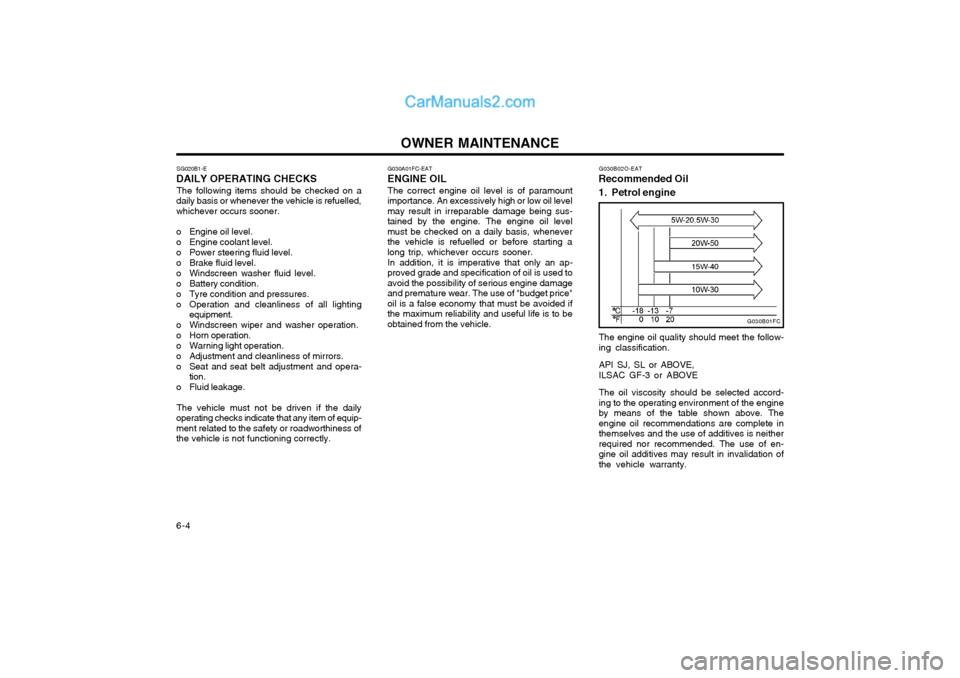
Recommended Oil
1. Petrol engine
G030B01FC
The engine oil quality should meet the follow- ing classification. API SJ, SL or ABOVE, ILSAC GF-3 or ABOVE The oil viscosity should be selected accord- ing to the operating environment of the engineby means of the table shown above. Theengine oil recommendations are complete inthemselves and the use of additives is neitherrequired nor recommended. The use of en-gine oil additives may result in invalidation ofthe vehicle warranty.
Page 125 of 407

OWNER MAINTENANCE
6-18 SG140C1-E
Checking the Refrigerant
1. Start the engine and run at idle for several minutes with the refrigeration system run- ning at the coldest setting.
2. Open the bonnet and inspect the sight glass on the top of the receiver dryer.
3. If the refrigerant charge is insufficient, a flow of bubbles will be observed through the sightglass.
4. If the refrigerant charge is satisfactory, no bubbles will be observed through the sightglass.
CAUTION: Running the air conditioning system with a low refrigerant level may damage the com-pressor. SG140D1-E
Off Season Maintenance The air conditioning must be run for ten minutes or so weekly during periods when the systemwould not normally be used to ensure that thecompressor and seals are lubricated. If thisprecaution is not observed the compressor sealsmay become stuck to the compressor shaft anddamaged when the system is next used result-ing in a loss of refrigerant and damage to thecompressor.
SG140B1-E
Compressor Drive Belt
The air conditioning compressor drive belt
should be checked to ensure freedom fromdamage or excessive wear and correct ten-sion. The belt tension is correct when the beltdeflects by about 0.3 inches (8 mm) when aforce of 98 N is applied to the belt halfwaybetween the compressor and crankshaftpulleys.
Adjustment of the belt should be entrusted to
a Hyundai authorised repairer.
SG140A1-E
AIR CONDITIONING SYSTEM
MAINTENANCE
Condenser Ensure that the condenser is periodicallyinspected and that accumulations of dirt, deadinsects and leaves etc, are removed to ensurethat the efficiency of the system is not impaired.Care must be exercised to ensure that thecondenser fins are not damaged during clean-ing.
G140D01A
A/C
CRANK PULLEY
TENSION PULLEY0.315 in. (8mm)
Page 127 of 407
OWNER MAINTENANCE
6-20 SG200A1-E
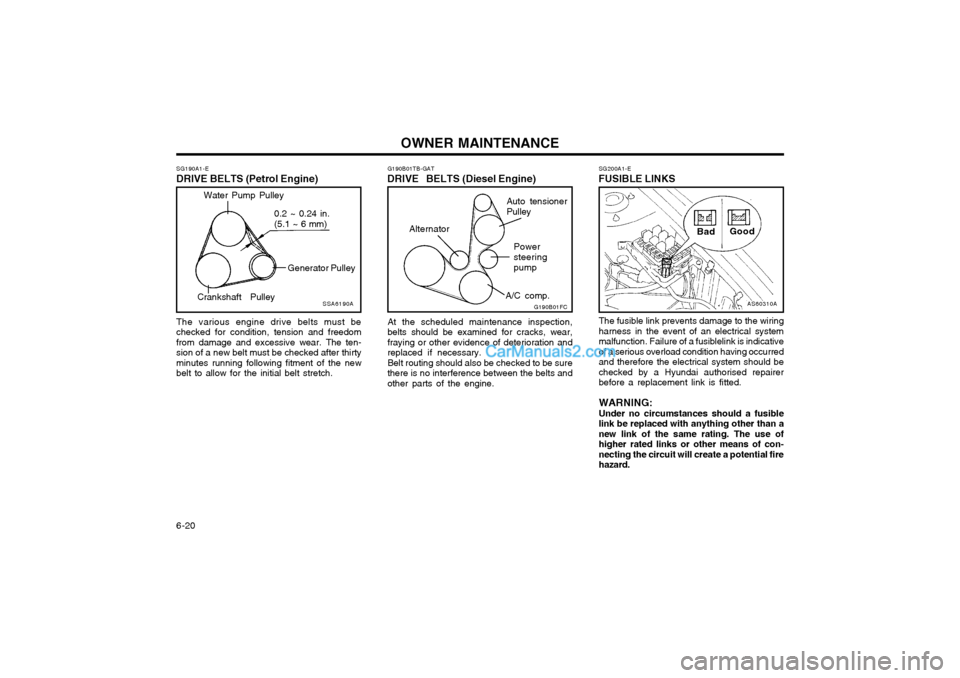
FUSIBLE LINKS
AS60310A
Bad
Good
The fusible link prevents damage to the wiring harness in the event of an electrical systemmalfunction. Failure of a fusiblelink is indicativeof a serious overload condition having occurredand therefore the electrical system should bechecked by a Hyundai authorised repairerbefore a replacement link is fitted. WARNING: Under no circumstances should a fusible link be replaced with anything other than anew link of the same rating. The use ofhigher rated links or other means of con-necting the circuit will create a potential firehazard.
G190B01TB-GAT
DRIVE BELTS (Diesel Engine)
At the scheduled maintenance inspection,belts should be examined for cracks, wear,fraying or other evidence of deterioration andreplaced if necessary.Belt routing should also be checked to be surethere is no interference between the belts andother parts of the engine.G190B01FC
Auto tensioner Pulley Powersteeringpump
A/C comp.
Alternator
SG190A1-E
DRIVE BELTS (Petrol Engine)
SSA6190A
Water Pump Pulley
Generator Pulley
Crankshaft Pulley 0.2 ~ 0.24 in. (5.1 ~ 6 mm)
The various engine drive belts must be checked for condition, tension and freedomfrom damage and excessive wear. The ten-sion of a new belt must be checked after thirtyminutes running following fitment of the newbelt to allow for the initial belt stretch.
Page 147 of 407

INDEX10-1
A ACCESSORY TRAY
........................................................................ 1-50
AIR CONDITIONING SWITCH ........................................................ 1-60
AIR CONDITIONING SYSTEM MAINTENANCE ...........................6-18
AIR CLEANER ELEMENT REPLACEMENT ..................................6-12
ANTENNA ......................................................................................... 1-64
ANTI-THEFT ALARM SYSTEM .... .......................................... 1-5 ~ 1-7
AUTO FUEL CUT SWITCH ............................................................. 1-53
AUTOMATIC TRANSAXLE ............................................................... 2-6
AUTOMATIC TRANSAXLE FLUID ................................................ 6-14
B BATTERY MAINTENANCE ............................................................. 6-21
BEFORE STARTING THE ENGINE ................................................. 2-2
BLEEDING THE FUEL SYSTEM ....................................................6-23
BONNET RELEASE ......................................................................... 1-51
BRAKE PEDAL FREEPLAY .................................... ........................ 6-19
BRAKE TRACTION CONTROL SYSTEM ................... ................... 2-10
BRAKE SYSTEM CHECKING ........................................................ 6-16CCARE OF SEAT
BELTS ................................................................. 1-14
CARGO AREA COVER ................................................................... 1-53
CATALYTIC CONVERTOR OPERATING PRECAUTIONS ............. 7-1
CENTRE VENTILATOR ................................................................... 1-55
CENTRAL DOOR LOCKS ................................................................. 1-5
CHANGING A FLAT TYRE ............................................................... 3-4
CHECKING THE CLUTCH FLUID.................................................. 6-17
CHILD-PROOF REAR DOOR LOCK ................................................ 1-4
CHILD RESTRAINT SYSTEM ............................................. 1-17 ~ 1-22
CIGAR LIGHTER ............................................................................. 1-42
CLUTCH PEDAL FREEPLAY ......................................................... 6-19
COMBINATION IGNITION SWITCH AND STEERING LOCK ........ 2-2
COOLANT TEMPERATURE GAUGE .............................................1-35
D DAILY OPERATING CHECKS .......................................................... 6-4
DIGITAL CLOCK .............................................................................. 1-42
DOOR LOCKS ................................................................................... 1-3
DOOR WINDOWS ............................................................................. 1-7 DRINK HOLDER .............................................................................. 1-43
DRIVE BELTS .................................................................................. 6-20
DRIVING FOR ECONOMY ............................................................. 2-11
JK000A1-A 10. INDEX
10
Page 171 of 407

1
FEATURES OF YOUR HYUNDAI
7
NOTE: If the engine dies while driving after limp home procedure, you can start your engine within 8 seconds with-out limp home procedure again.
5. If the immobilizer indicator blinks for
five seconds, you have to try the limp home procedure again from the beginning.
After doing the limp home procedure,you have to consult with your autho-rized Hyundai dealer as soon as pos- sible.
! CAUTION:
o If you fail to try the limp home procedure with the sequence of three times, you have to wait for about one hour to do the limphome procedure again.
o If you cannot start your engine in
spite of limp home procedure,have your vehicle towed by an authorized Hyundai dealer.
!
DOOR
B040A02Y-AAT DOOR LOCKS
WARNING:
o Unlocked doors can be danger- ous. Before you drive away (es- pecially if there are children in the car), be sure that all the doorsare securely closed and locked so that the doors cannot be inad- vertently opened from the inside.This helps ensure that the doors will not be opened accidentally. Also, when combined with theproper use of seat belts, locking the doors helps keep occupants from being ejected from the carin case of an accident.
o Before opening the door, always
look for and avoid oncoming traf-fic.
o In case of accident the door is
unlocked automatically (If in-stalled) UNLOCK
LOCK
HFC2004
B040B01A-AAT Locking and Unlocking Front Doors With a Key
o The door can be locked or unlocked
with a key.
o Lock the door by turning the key toward the front of the vehicle and unlock it by turning the key towardthe rear.
Page 179 of 407
1
FEATURES OF YOUR HYUNDAI
15
!
!WARNING:
To minimize risk of severe injury in the event of a collision or a sudden stop, both the driver and passen-ger seatbacks should always be in an upright position while the ve- hicle is in motion. The protectionprovided by the seat belts and airbags in a frontal collision may be reduced significantly when the seatbacks are reclined. There is greater risk that the driver and pas-senger will slide under the seat belt which may result in serious injury if a crash occurs when the seatbacksare reclined. The seat belt cannot provide full protection to an occu- pant if the seat back is reclined.
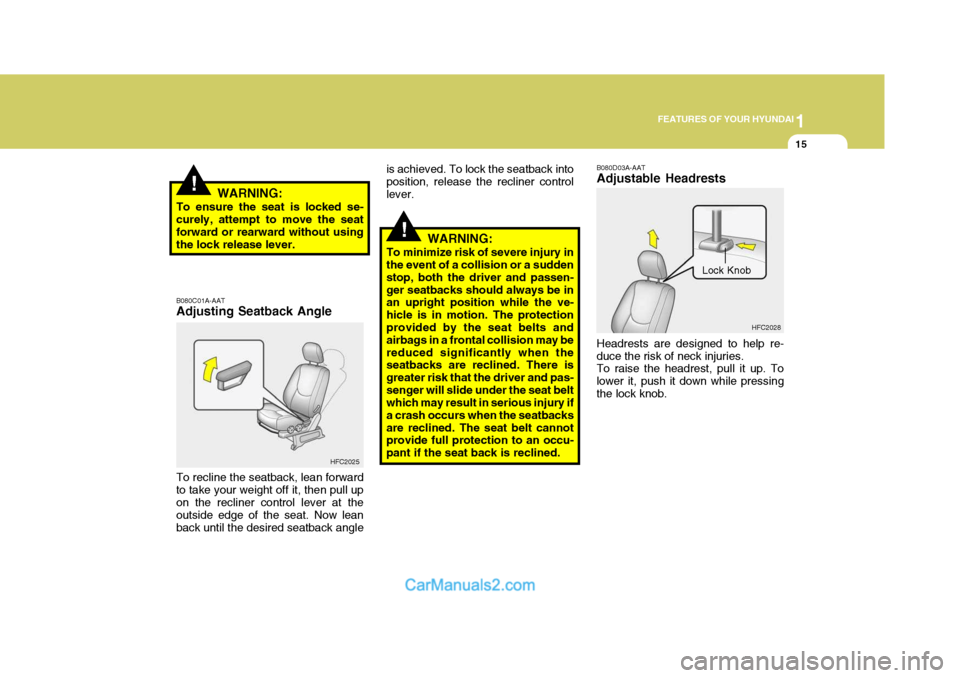
To recline the seatback, lean forwardto take your weight off it, then pull up on the recliner control lever at the outside edge of the seat. Now leanback until the desired seatback angle HFC2025
B080C01A-AAT Adjusting Seatback Angle
WARNING:
To ensure the seat is locked se- curely, attempt to move the seat forward or rearward without using the lock release lever. is achieved. To lock the seatback intoposition, release the recliner controllever.
Lock KnobHFC2028
B080D03A-AAT Adjustable Headrests Headrests are designed to help re- duce the risk of neck injuries. To raise the headrest, pull it up. To lower it, push it down while pressingthe lock knob.
Page 183 of 407
1
FEATURES OF YOUR HYUNDAI
19
!WARNING:
o When you return the folded down seat back to its upright position, make sure the seat belts are in position to be accessible and tofunction properly.
o The purpose of the fold down
rear seat back and the fold for-ward rear seat cushion is to in- crease cargo space. Do not allow passengers to sit in the cargoarea while the car is moving. This is not a proper seating position and no seat belts are available for use when the seat back is folded down. Passengers whoare not properly seated and wear- ing seat belts could sustain seri- ous injuries or death in case ofan accident or a sudden stop.
o Objects should not extend higher
than the top of the frontseatbacks. This could allow cargo to slide forward and cause injury or damage during sudden stops.
CAUTION:
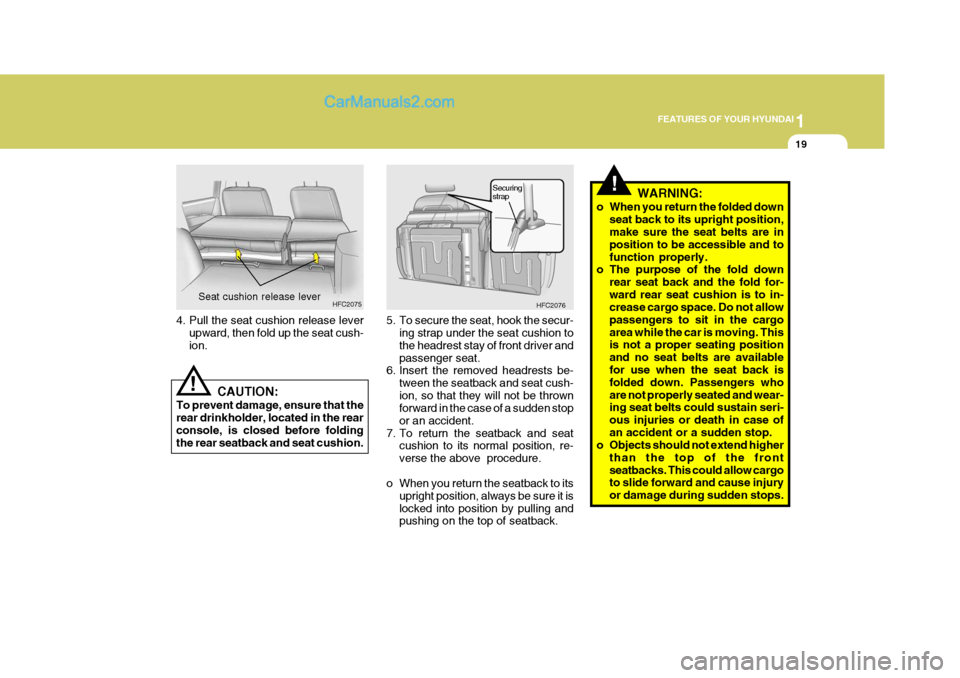
To prevent damage, ensure that therear drinkholder, located in the rearconsole, is closed before folding the rear seatback and seat cushion. 5. To secure the seat, hook the secur-
ing strap under the seat cushion tothe headrest stay of front driver and passenger seat.
6. Insert the removed headrests be-
tween the seatback and seat cush-ion, so that they will not be thrown forward in the case of a sudden stop or an accident.
7. To return the seatback and seat cushion to its normal position, re-verse the above procedure.
o When you return the seatback to its upright position, always be sure it islocked into position by pulling and pushing on the top of seatback.
! HFC2075
4. Pull the seat cushion release lever upward, then fold up the seat cush- ion. HFC2076
Seat cushion release lever Securing strap
Page 188 of 407
1FEATURES OF YOUR HYUNDAI
24
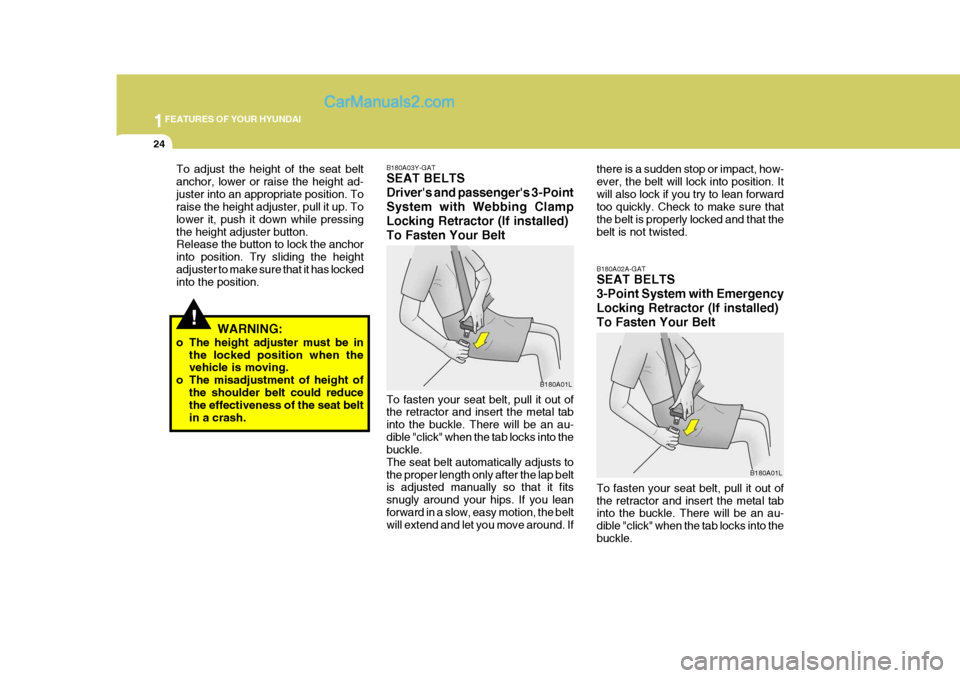
B180A03Y-GAT SEAT BELTS Driver's and passenger's 3-PointSystem with Webbing ClampLocking Retractor (If installed)To Fasten Your Belt To fasten your seat belt, pull it out of the retractor and insert the metal tab into the buckle. There will be an au-dible "click" when the tab locks into the buckle. The seat belt automatically adjusts tothe proper length only after the lap belt is adjusted manually so that it fits snugly around your hips. If you leanforward in a slow, easy motion, the belt will extend and let you move around. If B180A02A-GAT SEAT BELTS 3-Point System with Emergency Locking Retractor (If installed) To Fasten Your Belt
B180A01L
B180A01L there is a sudden stop or impact, how- ever, the belt will lock into position. Itwill also lock if you try to lean forward too quickly. Check to make sure that the belt is properly locked and that thebelt is not twisted.
!
To adjust the height of the seat belt anchor, lower or raise the height ad-juster into an appropriate position. To raise the height adjuster, pull it up. To lower it, push it down while pressingthe height adjuster button. Release the button to lock the anchor into position. Try sliding the heightadjuster to make sure that it has locked into the position.
WARNING:
o The height adjuster must be in the locked position when thevehicle is moving.
o The misadjustment of height of
the shoulder belt could reducethe effectiveness of the seat belt in a crash.
To fasten your seat belt, pull it out ofthe retractor and insert the metal tab into the buckle. There will be an au- dible "click" when the tab locks into thebuckle.
Page 199 of 407
1
FEATURES OF YOUR HYUNDAI
35
forward too quickly, the seat belt re- tractor will lock into position. In certainfrontal collisions, the pre-tensioner will activate and pull the seat belt into tighter contact against the occupant'sbody.
HXG229
B180B01A-GAT Pre-tensioner Seat Belt (If Installed) Your Hyundai vehicle is equipped with driver's and front passenger's pre-tensioner seat belts. The purpose of the pre-tensioner is to make sure that the seat belts fit tightly against theoccupant's body in certain frontal col- lisions. The pre-tensioner seat belts can beactivated with the airbags. The pre-tensioner seat belt operates in a similar same way as an Emer- gency Locking Retractor (ELR) type ofseat belt. When the vehicle stops sud- denly, or if the occupant tries to lean
B180B01O
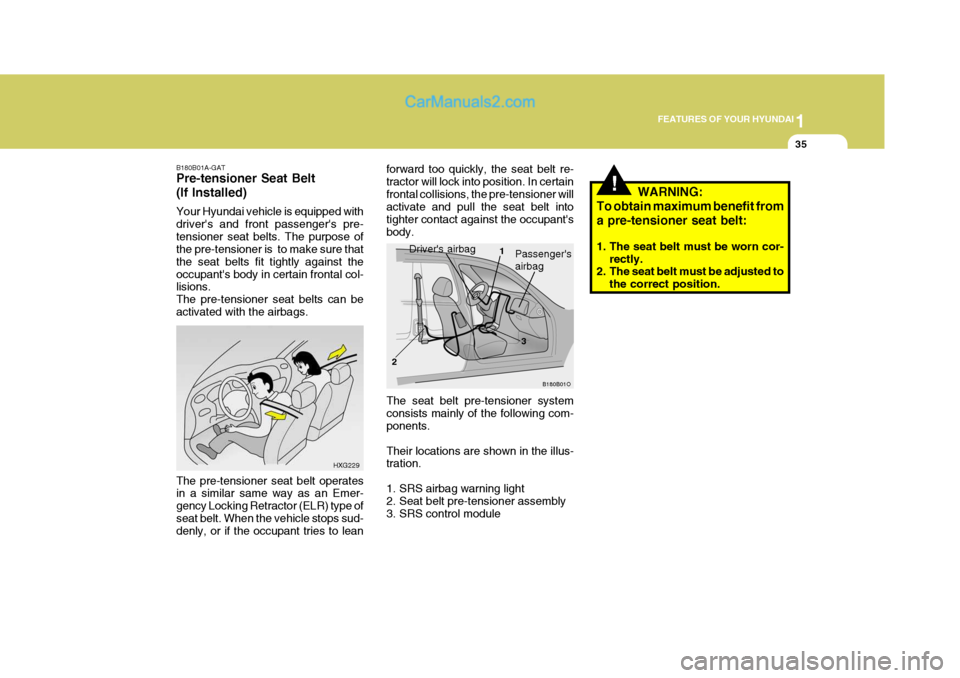
Driver's airbag1
2 3Passenger's airbag
The seat belt pre-tensioner system consists mainly of the following com- ponents. Their locations are shown in the illus- tration.
1. SRS airbag warning light
2. Seat belt pre-tensioner assembly
3. SRS control module
!WARNING:
To obtain maximum benefit from a pre-tensioner seat belt:
1. The seat belt must be worn cor- rectly.
2. The seat belt must be adjusted to
the correct position.
Page 200 of 407
1FEATURES OF YOUR HYUNDAI
36
!WARNING:
o Pre-tensioners are designed to operate only one time. After acti- vation, pre-tensioner seat belts must be replaced. All seat belts,of any type, should always be replaced after they have been worn during a collision.
o The pre-tensioner seat belt as- sembly mechanisms become hotduring activation. Do not touchthe pre-tensioner seat belt as- semblies for several minutes af- ter they have been activated.
o Do not attempt to inspect or re- place the pre-tensioner seat beltsyourself. This must be done byan authorized Hyundai dealer.
o Do not strike the pre-tensioner
seat belt assemblies.
o Do not attempt to service or re- pair the pre-tensioner seat beltsystem in any manner.
CAUTION:
o Because the sensor that activates the SRS airbag is connected withthe pre-tensioner seat belt, theSRS airbag warning light on the instrument panel will blink for approximately 6 seconds af-ter the ignition key has been turned to the "ON" position, and then it should turn off.
o If the pre-tensioner seat belt is not working properly, this warn-ing light will illuminate even ifthere is no malfunction of the SRS airbag system . If the SRS airbag warning light does notilluminate when the ignition key is turned to "ON", or if it remains illuminated after blinking for ap-proximately 6 seconds, or if it illuminates while the vehicle is being driven, please have an au-thorized Hyundai dealer inspect the pre-tensioner seat belts and SRS airbag system as soon aspossible.!
AIR
BAG
NOTE:
o Both the driver's and front
passenger's pre-tensioner seat belts will be activated in certainfrontal collisions. The pre- tensioner seat belts can be acti- vated with the airbags. The pre-tensioners will be activated un- der these conditions even if the seat belts are not being worn atthe time of the collision.
o When the pre-tensioner seat belts
are activated, a loud noise maybe heard and fine dust, which may appear to be smoke, may be visible in the passenger compart-ment. These are normal operat- ing conditions and are not haz- ardous.
o Although it is harmless, the fine dust may cause skin irritationand should not be breathed forprolonged periods. Wash your hands and face thoroughly after an accident in which the pre-tensioner seat belts were acti- vated.