clutch Hyundai Matrix 2005 User Guide
[x] Cancel search | Manufacturer: HYUNDAI, Model Year: 2005, Model line: Matrix, Model: Hyundai Matrix 2005Pages: 407, PDF Size: 10.31 MB
Page 109 of 407
OWNER MAINTENANCE
6-2 HFC003
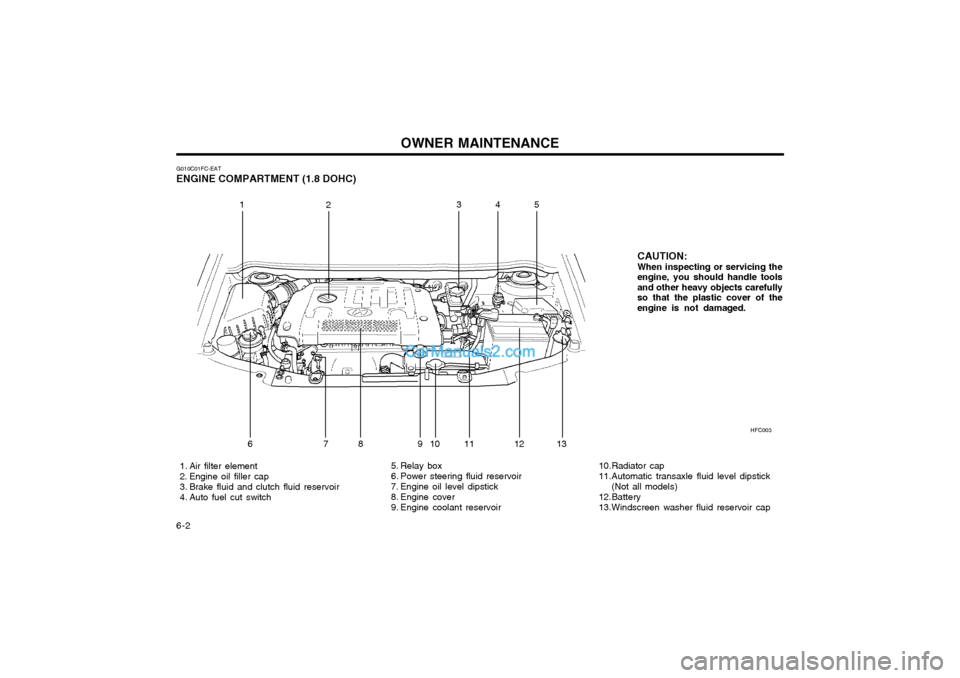
CAUTION: When inspecting or servicing the engine, you should handle toolsand other heavy objects carefullyso that the plastic cover of theengine is not damaged.
G010C01FC-EAT ENGINE COMPARTMENT (1.8 DOHC)
1. Air filter element
2. Engine oil filler cap
3. Brake fluid and clutch fluid reservoir
4. Auto fuel cut switch
5. Relay box
6. Power steering fluid reservoir
7. Engine oil level dipstick
8. Engine cover
9. Engine coolant reservoir10.Radiator cap
11.Automatic transaxle fluid level dipstick
(Not all models)
12.Battery
13.Windscreen washer fluid reservoir cap
1 2 345
6 7 8 9 10 11 12 13
Page 110 of 407
OWNER MAINTENANCE 6-3
G010E02FC
G010E02FC-EAT
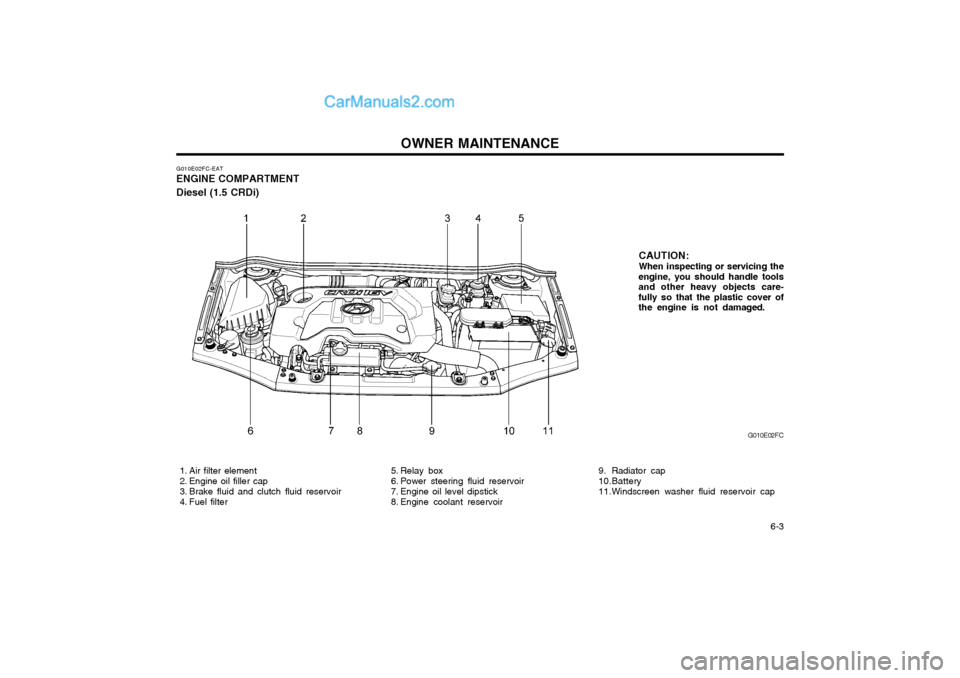
ENGINE COMPARTMENT Diesel (1.5 CRDi)
1. Air filter element
2. Engine oil filler cap
3. Brake fluid and clutch fluid reservoir
4. Fuel filter 5. Relay box
6. Power steering fluid reservoir
7. Engine oil level dipstick
8. Engine coolant reservoir
9. Radiator cap
10.Battery
11.Windscreen washer fluid reservoir capCAUTION:When inspecting or servicing the
engine, you should handle tools and other heavy objects care-fully so that the plastic cover ofthe engine is not damaged.
Page 124 of 407

OWNER MAINTENANCE 6-17
WARNING: Brake fluid is hygroscopic and should never be stored in an unsealed container.The presence of water in the brakingsystem will cause vapour locks and in-crease the possibility of brake fade alongwith promoting corrosion within the brak-ing system. The brake fluid must bechanged at the specified time or mileageinterval to ensure continued safe opera-tion of the system. Brake fluid will causerapid and serious damage to paintwork. Ifaccidental spillage occurs, the affectedarea must be rinsed with water immedi-ately. Do not allow brake fluid to comeinto contact with the eyes or to be in-gested and ensure that fluid is safelystored away form the reach of children.
G120D02FC
Diesel engineSG130A1-C
CHECKING THE CLUTCH FLUID To Check the Clutch Fluid
SG130B2-E
Adding Fluid
Recommended brake fluid conforming to DOT 3
or DOT 4 should be used. The reservoir cap must be fully tightened to avoid contaminationfrom foreign matter or moisture.
CAUTION: Brake fluid is hygroscopic and should
never be stored in an unsealed container. Do not allow petroleum base fluid tocontaminate the brake fluid since damageto the rubber seals of the system mayresult.
WARNING: Brake fluid will cause rapid and serious
damage to paintwork. If accidental spillage occurs, the affected area must be rinsedwith water immediately. Do not allow brakefluid to come into contact with the eyes or tobe ingested and ensure that fluid is safelystored away form the reach of children.
HFC5005
Petrol engine
The clutch fluid level in the master cylinder
should be checked when performing other un- der bonnet checks. The system should bechecked for leakage at the same time.
G120D02FC
Diesel engine Ensure that the clutch fluid level is always
between the "MAX" and "MIN" level markings on the fluid reservoir. Fill as required. Fluidloss indicates a leak in the clutch systemwhich should be inspected and repaired im-mediately.
Page 126 of 407

OWNER MAINTENANCE 6-19
SG150A1-E STEERING WHEEL FREEPLAY
Steering wheel freeplay should be checked to
ensure that the specified value is not exceeded.
G150A01FC
1.18 in. (30 mm)
The clutch pedal freeplay should be checked
against the specified value. If the freeplay is not correct, the clutch should be adjusted by aHyundai authorised repairer. SG160A1-E
CLUTCH PEDAL FREEPLAY
G160A01E
0.24 ~ 0.51 in. (6 ~ 13 mm)
SG170A1-E
BRAKE PEDAL FREEPLAY
SSA6170A
0.12 ~ 0.31 in. (3 ~ 8 mm)
The brake pedal freeplay should be checked
with the engine turned off. The pedal to floor clearance should be checked with the enginerunning and a load of 490 N applied to thepedal. If either value is incorrect, the necessaryadjustment should be performed by a Hyundaiauthorised repairer. Pedal to floor clearance:1.97 in. (50 mm)
Page 147 of 407

INDEX10-1
A ACCESSORY TRAY
........................................................................ 1-50
AIR CONDITIONING SWITCH ........................................................ 1-60
AIR CONDITIONING SYSTEM MAINTENANCE ...........................6-18
AIR CLEANER ELEMENT REPLACEMENT ..................................6-12
ANTENNA ......................................................................................... 1-64
ANTI-THEFT ALARM SYSTEM .... .......................................... 1-5 ~ 1-7
AUTO FUEL CUT SWITCH ............................................................. 1-53
AUTOMATIC TRANSAXLE ............................................................... 2-6
AUTOMATIC TRANSAXLE FLUID ................................................ 6-14
B BATTERY MAINTENANCE ............................................................. 6-21
BEFORE STARTING THE ENGINE ................................................. 2-2
BLEEDING THE FUEL SYSTEM ....................................................6-23
BONNET RELEASE ......................................................................... 1-51
BRAKE PEDAL FREEPLAY .................................... ........................ 6-19
BRAKE TRACTION CONTROL SYSTEM ................... ................... 2-10
BRAKE SYSTEM CHECKING ........................................................ 6-16CCARE OF SEAT
BELTS ................................................................. 1-14
CARGO AREA COVER ................................................................... 1-53
CATALYTIC CONVERTOR OPERATING PRECAUTIONS ............. 7-1
CENTRE VENTILATOR ................................................................... 1-55
CENTRAL DOOR LOCKS ................................................................. 1-5
CHANGING A FLAT TYRE ............................................................... 3-4
CHECKING THE CLUTCH FLUID.................................................. 6-17
CHILD-PROOF REAR DOOR LOCK ................................................ 1-4
CHILD RESTRAINT SYSTEM ............................................. 1-17 ~ 1-22
CIGAR LIGHTER ............................................................................. 1-42
CLUTCH PEDAL FREEPLAY ......................................................... 6-19
COMBINATION IGNITION SWITCH AND STEERING LOCK ........ 2-2
COOLANT TEMPERATURE GAUGE .............................................1-35
D DAILY OPERATING CHECKS .......................................................... 6-4
DIGITAL CLOCK .............................................................................. 1-42
DOOR LOCKS ................................................................................... 1-3
DOOR WINDOWS ............................................................................. 1-7 DRINK HOLDER .............................................................................. 1-43
DRIVE BELTS .................................................................................. 6-20
DRIVING FOR ECONOMY ............................................................. 2-11
JK000A1-A 10. INDEX
10
Page 292 of 407

2
DRIVING YOUR HYUNDAI
3
!
TO START THE ENGINEBEFORE STARTING THE ENGINE
C020A01O-GAT Before you start the engine, you should always:
1. Look around the vehicle to be sure
there are no flat tires, puddles of oil, water or other indications of pos- sible trouble.
2. After entering the car, check to be sure the parking brake is engaged.
3. Check that all windows, and lights are clean.
4. Check that the interior and exterior
mirrors are clean and in position.
5. Check your seat, seatback and headrest to be sure they are in theirproper positions.
6. Lock all the doors.
7. Fasten your seat belt and be sure
that all other occupants have fas- tened theirs.
8. Turn off all lights and accessories
that are not needed. C030A01A-GAT COMBINATION IGNITION SWITCH Before starting the engine:
o If your Hyundai is equipped with a
manual transaxle, place the shift lever in neutral and depress theclutch pedal fully.
o If your Hyundai has an automatic
transaxle, place the shift lever in "P"(park).
o To start the engine, insert the igni-
tion key and turn it to the "START"position. Release it as soon as the engine starts. Do not hold the key in the "START" position for more than15 seconds.
NOTE: For safety, the engine will not start if the shift lever is not in "P" or "N"Position (Automatic Transaxle).
WARNING: (DIESEL ENGINE)
To ensure that sufficient vacuum exists within the brake system dur- ing cold weather start-up condi-tions, it is necessary to run the engine at idle for several seconds after starting the engine.
9. When you turn the ignition switch to
"ON", check that all appropriatewarning lights are operating and that you have sufficient fuel.
10.Check the operation of warning lights and all bulbs when key is inthe "ON" position.
Page 294 of 407

2
DRIVING YOUR HYUNDAI
5
!
STARTING
C050A01A-GAT Starting for the gasoline engine
C050A01E
WARNING:
Never run the engine in a closed or poorly ventilated area any longerthan is needed to move your car in or out of the area. The carbon mon- oxide gas emitted is odorless andcan cause serious injury or death. C050B02S-GAT NORMAL CONDITIONS The Starting Procedure:
1. Insert key, and fasten the seat belt.
2. Depress the clutch pedal fully and
place the gearshift lever (manual transaxle) in neutral or the selector lever (automatic transaxle) in "P" (park) position.
3. After turning the ignition key to the "ON" position, make certain all warn-ing lights and gauges are function-ing properly before starting the en- gine.
4. On vehicles equipped with the die- sel preheat indicator light, turn theignition key to the "ON" position. The diesel pre-heat indicator lightwill first illuminate in amber, and then after a short time, the amber illumination will goes off, indicatingthat preheating is completed.
C051A01O-GAT Starting for the diesel engine ENGINE COLD
o Turn the ignition key to position
"ON" and wait for the pre-heat indi- cator light to go out.
o Operate the starter until the engine runs.
ENGINE WARM Operate the starter. If the engine does not respond on the first attempt, wait several seconds and try again usingthe pre-heat.
Page 295 of 407

2 DRIVING YOUR HYUNDAI
6
!
!WARNING:
Be sure that the clutch is fully de- pressed when starting a manualtransaxle vehicle. Otherwise there is the potential to cause damage to the vehicle or injury to someoneinside or outside the vehicle as a result of the forward or backward movement of the vehicle that willoccur if the clutch is not depressed when the vehicle is started.
NOTE: If the engine was not started 10 seconds after the preheating is com- pleted, turn the ignition key oncemore to the "LOCK" position, and then to the "ON" position, in order to preheat again. C050B01HP
Amber lamp ON Amber lamp OFF
5. Turn the ignition key to the "START"position and release it when the engine starts. C055B01B-GAT STARTING AND STOPPING THE ENGINE FOR TURBO CHARGERINTERCOOLER(DIESEL ENGINE)
(1) Do not race the engine or sudden
accelerate the engine immediately after start it. If the engine is cold,allow the engine to idle for several seconds before it is driven to en- sure sufficient lubrication of theturbo charger unit.
(2) After high speed or extended driv-
ing, requiring a heavy engine load,the engine should be allowed to idle about 1 minute before turning it off. This idle time will allow the turbocharger to cool prior to shutting the engine off.
WARNING:
Do not turn the engine off immedi-ately after it has been subjected to a heavy load. Doing so may causesevere damage to the engine or turbo charger unit.
Page 296 of 407

2
DRIVING YOUR HYUNDAI
7OPERATING THE TRANSAXLE
NOTE:
o To shift into reverse, rest the le-ver in neutral for at least 3 sec- onds after your car is completelystopped. Then move the lever into the reverse position.
o During cold weather, shifting may be difficult until the transaxle lu-bricant has warmed up. This is normal and not harmful to thetransaxle.
o If you've come to a complete stop
and it's hard to shift into 1st orR(Reverse), put the shift lever in N(Neutral) position and release the clutch. Press the clutch pedalback down, and then shift into 1st or R(Reverse) gear position.
o Do not use the shift lever as a handrest during driving, as thiscan result in premature wear of the transaxle shift forks.
C070A02A-AAT OPERATING THE MANUAL TRANSAXLE
HFC3029
Your Hyundai's manual transaxle has a conventional shift pattern. This shift pattern is imprinted on the shift knob. The transaxle is fully synchronized inall forward gears so shifting to either a higher or a lower gear is easily accom- plished. CAUTION:
When downshifting from fifth gearto fourth gear, caution should betaken not to inadvertently press the gear shift lever sideways in such a manner that second gear is en-gaged. Such a drastic downshift may cause the engine speed to in- crease to the point that the tachom-eter will enter the red zone. Such over-revving of the engine may possibly cause engine damage.
!
Page 297 of 407

2 DRIVING YOUR HYUNDAI
8
C070D02A-AAT Good Driving Practices
o Never take the car out of gear andcoast down a hill. This is extremely hazardous. Always leave the car in gear.
o Don't "ride" the brakes. This can cause them to overheat and mal-function. Instead, when you are driv- ing down a long hill, slow down andshift to a lower gear. When you do this, engine braking will help slow the car.
o Slow down before shifting to a lower gear. This will help avoid over-rev-ving the engine, which can causedamage.
o Slow down when you encounter
cross winds. This gives you muchbetter control of your car.
o Be sure the car is completely stopped
before you attempt to shift into re-verse. The transaxle can be dam- aged if you do not. To shift into reverse, depress the clutch, movethe shift lever to neutral, wait three seconds, then shift to the reverse position.
C070E03A-GAT RECOMMENDED SHIFT POINTS The shift points as shown above are recommended for optimum fueleconomy and performance.
C070B01A-AAT Using the Clutch The clutch should be pressed all the way to the floor before shifting, thenreleased slowly. The clutch pedal should always be used after fully re- turning to the original position. Do notrest your foot on the clutch pedal while driving. This can cause unnecessary wear. Do not partially engage the clutchto hold the car on an incline. This causes unnecessary wear. Use the parking brake to hold the car on anincline. Do not operate the clutch pedal rapidly and repeatedly.
Shift
from-to 1-2 2-33-4 4-5 Recommended
20 km/h (15 mph)40 km/h (25 mph) 55 km/h (35 mph)75 km/h (45 mph)