clutch Hyundai Matrix 2005 Owner's Guide
[x] Cancel search | Manufacturer: HYUNDAI, Model Year: 2005, Model line: Matrix, Model: Hyundai Matrix 2005Pages: 407, PDF Size: 10.31 MB
Page 305 of 407

2 DRIVING YOUR HYUNDAI
16DRIVING FOR ECONOMY
C140A01A-GAT You can save fuel and get more kilo- meters from your car if you follow these suggestions:
o Drive smoothly. Accelerate at a moderate rate. Don't make "jack- rabbit" starts or full-throttle shiftsand maintain a steady cruising speed. Don't race between stop- lights. Try to adjust your speed tothat of the other traffic so you don't have to change speeds unneces- sarily. Avoid heavy traffic wheneverpossible. Always maintain a safe distance from other vehicles so you can avoidunnecessary braking. This also re- duces brake wear.
o Drive at a moderate speed. The faster you drive, the more fuel yourcar uses. Driving at a moderate speed, especially on the highway, isone of the most effective ways to reduce fuel consumption.
o Don't "ride" the brake or clutch pedal. This can increase fuel consumptionand also increase wear on these components. In addition, driving with
gear (manual transaxle). If your caris facing downhill, turn the frontwheels into the curb to help keep the car from rolling. If your car is facing uphill, turn the front wheels awayfrom the curb to help keep the car from rolling. If there is no curb or if it is requiredby other conditions to keep the car from rolling, block the wheels.
o Under some conditions your park- ing brake can freeze in the engagedposition. This is most likely to hap- pen when there is an accumulationof snow or ice around or near the rear brakes or if the brakes are wet. If there is a risk that the parkingbrake may freeze, apply it only tem- porarily while you put the gear se- lector lever in "P" (automatic) or infirst or reverse gear (manual transaxle) and block the rear wheels so the car cannot roll. Then releasethe parking brake.
o Do not hold the vehicle on the up-
grade with the accelerator pedal.This can cause the transmission to overheat. Always use the brake pedal or parking brake.
o Don't coast down hills with the car
out of gear. This is extremely haz-ardous. Keep the car in gear at all times, use the brakes to slow down, then shift to a lower gear so thatengine braking will help you main- tain a safe speed.
o Don't "ride" the brake pedal. Rest- ing your foot on the brake pedalwhile driving can be dangerous be- cause it can result in the brakesoverheating and losing their effec- tiveness. It also increases the wear of the brake components.
o If a tire goes flat while you are driving, apply the brakes gently andkeep the car pointed straight aheadwhile you slow down. When you are moving slowly enough for it to be safe to do so, pull off the road andstop in a safe place.
o If your car is equipped with an auto-
matic transaxle, don't let your carcreep forward. To avoid creeping forward, keep your foot on the brake pedal when the car is stopped.
o Use caution when parking on a hill. Engage the parking brake and placethe gear selector lever in "P" (auto-matic transaxle) or in first or reverse
Page 346 of 407

Engine Compartment ................................................... 6-2
General Checks ........................................................... 6-5
Checking the Engine Oil .............................................. 6-6
Changing the Oil and Filter ......................................... 6-9
Checking and Changing the Engine Coolant ...........6-12
Spark Plugs ................................................................ 6-15
Changing the Air Cleaner Filter ................................ 6-17
Checking the Transaxle Oil (Manual) ....................... 6-19
Checking the Transaxle Fluid (Automatic) ................ 6-20
Checking the Brakes ................................................. 6-22
Checking the Clutch Fluid ......................................... 6-24
Air Conditioning Care ................................................ 6-25
Changing the Air Conditioner Filter
(In Front of Blower Unit) .......................................... 6-26
Checking Drive Belts ................................................. 6-28
Checking and Replacing Fuses ................................ 6-29
Checking The Battery ................................................ 6-31
Checking The Eclectric Cooling Fans ....................... 6-32
Power Steering Fluid Level ....................................... 6-32
Headlight Aiming Adjustment .................................... 6-35
Replacing headlight Bulbs ......................................... 6-36
Bulb Wattage ............................................................. 6-38
Fuse Panel Description ............................................. 6-39
DO-IT-YOURSELF MAINTENANCE
6
6
Page 347 of 407
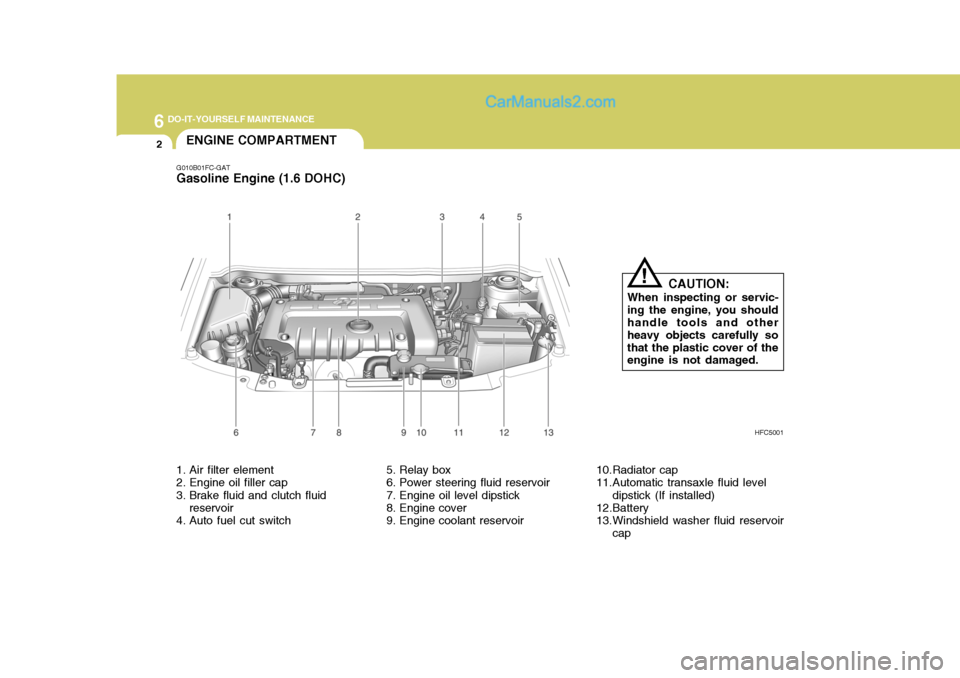
6 DO-IT-YOURSELF MAINTENANCE
2
1. Air filter element
2. Engine oil filler cap
3. Brake fluid and clutch fluid
reservoir
4. Auto fuel cut switch 5. Relay box
6. Power steering fluid reservoir
7. Engine oil level dipstick
8. Engine cover
9. Engine coolant reservoir10.Radiator cap
11.Automatic transaxle fluid level
dipstick (If installed)
12.Battery
13.Windshield washer fluid reservoir cap HFC5001
G010B01FC-GAT Gasoline Engine (1.6 DOHC)
CAUTION:
When inspecting or servic-
ing the engine, you should handle tools and other heavy objects carefully sothat the plastic cover of the engine is not damaged.
!
ENGINE COMPARTMENT
Page 348 of 407
6
DO-IT-YOURSELF MAINTENANCE
3
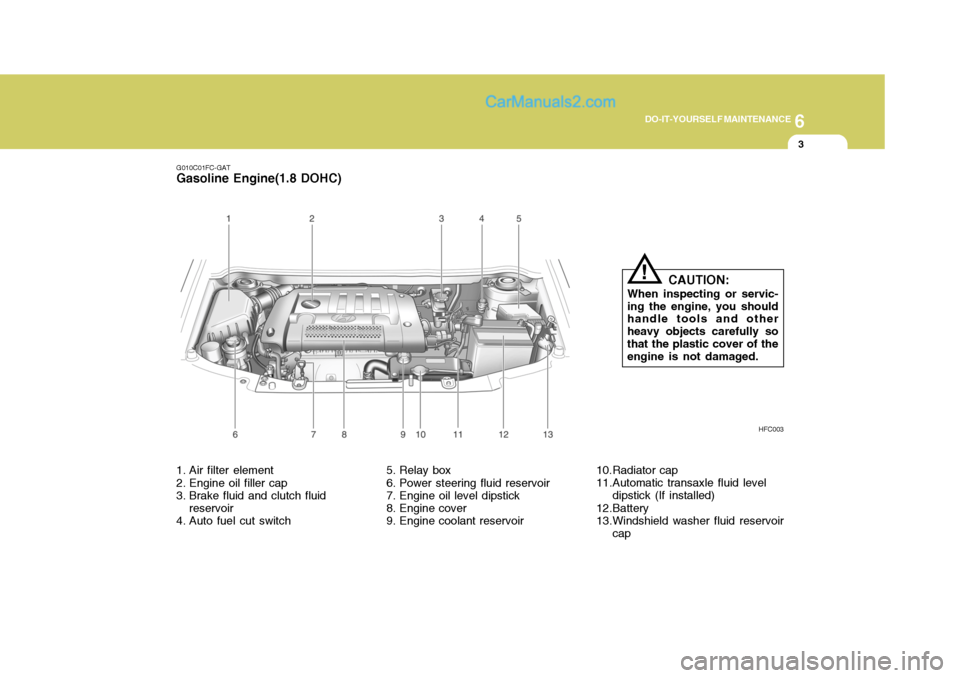
G010C01FC-GAT
Gasoline Engine(1.8 DOHC)
HFC003
1. Air filter element
2. Engine oil filler cap
3. Brake fluid and clutch fluid reservoir
4. Auto fuel cut switch 5. Relay box
6. Power steering fluid reservoir
7. Engine oil level dipstick
8. Engine cover
9. Engine coolant reservoir10.Radiator cap
11.Automatic transaxle fluid level
dipstick (If installed)
12.Battery
13.Windshield washer fluid reservoir cap CAUTION:
When inspecting or servic-ing the engine, you should handle tools and other heavy objects carefully so that the plastic cover of the engine is not damaged.
!
Page 349 of 407

6 DO-IT-YOURSELF MAINTENANCE
4
1. Air filter element
2. Engine oil filler cap
3. Brake fluid and clutch fluidreservoir
4. Fuel filter 5. Relay box
6. Power steering fluid reservoir
7. Engine oil level dipstick
8. Engine coolant reservoir
9. Radiator cap
10.Battery
11.Windshield washer fluid reservoir
cap G010E02FC
G010E02FC-GAT
Diesel Engine (1.5 CRDi)
CAUTION:
When inspecting or servic-
ing the engine, you shouldhandle tools and otherheavy objects carefully so that the plastic cover of the engine is not damaged.
!
Page 350 of 407
6
DO-IT-YOURSELF MAINTENANCE
5GENERAL CHECKS
G020A01A-AAT
Engine Compartment
The following should be checked regu- larly:
o Engine oil level and condition
o Transaxle fluid level and condition
o Brake fluid level
o Clutch fluid level
o Engine coolant level
o Windshield washer fluid level
o Accessory drive belt condition
o Engine coolant hose condition
o Fluid leaks (on or below components)
o Power steering fluid level
o Battery condition
o Air filter condition o Defroster, heating system opera-
tion (and air conditioning, if in- stalled)
o Steering operation and condition
o Mirror condition and operation
o Turn signal operation
o Accelerator pedal operation
o Brake operation, including parking brake
o Manual transaxle operation, includ-
ing clutch operation
o Automatic transaxle operation, in- cluding "PARK" mechanism opera-tion
o Seat control condition and opera-
tion
o Seat belt condition and operation
o Sunvisor operation If you notice anything that does not operate correctly or appears to be functioning incorrectly, inspect it care- fully and seek assistance from yourHyundai dealer if service is needed.
G020B01A-AAT
Vehicle Exterior
The following should be checked
monthly:
o Overall appearance and condition
o Wheel condition and wheel nut
torque
o Exhaust system condition
o Light condition and operation
o Windshield glass condition
o Wiper blade condition
o Paint condition and body corrosion
o Fluid leaks
o Door and hood lock condition
o Tire pressure and condition (including spare tire)
G020C01A-AAT
Vehicle Interior
The following should be checked each
time when the vehicle is driven:
o Lights operation
o Windshield wiper operation
o Horn operation
Page 369 of 407

6 DO-IT-YOURSELF MAINTENANCE
24CHECKING THE CLUTCH FLUID
The system should be checked for leakage at the same time. Check tomake certain that the clutch fluid level is always between the "MAX" and "MIN" level markings on the fluid res-ervoir. Fill as required. Fluid loss indi- cates a leak in the clutch system which should be inspected and re-paired immediately. Consult your Hyundai dealer.
G130A01S-AAT
To Check the Clutch Fluid
Gasoline engine
Diesel engine
!
G120E02A-AAT Adding Brake Fluid WARNING:
Handle brake fluid carefully. It can damage your vision if it gets into your eyes. Use only DOT 3 or DOT4 specification fluid from a sealed container. Do not allow the fluid can or reservoir to remain openany longer than required. This will prevent entry of dirt and moisture which can damage the brake sys-tem and cause improper opera- tion. To add brake fluid, first wipe away any dirt then unscrew the fluid reser-voir cap. Slowly pour the recom- mended fluid into the reservoir. Do not overfill. Carefully replace the capon the reservoir and tighten. HFC5005
G120D02FC
The clutch fluid level in the master
cylinder should be checked when performing other under hood services.
Page 372 of 407

6
DO-IT-YOURSELF MAINTENANCE
27CHECKING THE FREEPLAY
G160A01A-GAT
Clutch pedal
G160A01E
6 ~ 13 mm (0.24 ~ 0.51 in.)
With the engine off, press lightly onthe clutch pedal until you feel a change in resistance. This is the clutch pedalfreeplay. The freeplay should be within the limits specified in the illustration. If it is not, have it inspected by yourHyundai dealer and adjusted or re- paired if necessary.
G150A01A-GAT
Steering wheel
G150A01FC
To check the steering wheel freeplay,
stop the car with the wheels pointed straight ahead and gently move the steering wheel back and forth. Use very light finger pressure and be sen-sitive to changes in resistance that mark the limits of the freeplay. If the freeplay is greater than specified, haveit inspected by your Hyundai dealer and adjusted or repaired if neces- sary. 30 mm (1.18 in.)
3. Replace the air conditioner filter with a new one.
4. Installation is the reverse order of disassembly.
CAUTION:
Be sure to install the air condi- tioner filter in the direction of thearrow sign. Otherwise, it may cause noise or deterioration.
! KQNA020B
Page 403 of 407

10INDEX
2
A Accessory Tray ......................................................... 1-71
Air Bag ...................................................................... 1-37
Air Cleaner Filter ....................................................... 6-17
Air Conditioning
Care ....................................................................... 6-25
Operation ............................................................... 6-25
Switch ..................................................................... 1-88
Air Conditioner Filter ................................................. 1-90
Antenna ................................................................... 1-124
Ashtray ...................................................................... 1-65
Audio System ............................................................ 1-93
Auto Fuel Cut Switch ................................................ 1-80
B
Battery ............................................................. 2-19, 6-31
Bleeding The Fuel System ....... ................................6-33
Brake Anti-lock system ..................................................... 2-13
Brake traction control system ................................ 2-14
Checking the brakes .............................................. 6-22
Fluid ....................................................................... 6-23
Pedal clearance ..................................................... 6-28
Pedal free play ....................................................... 6-28
Practices ................................................................ 2-15
Brake Pad Wear Warning Sound .............................1-52
Brake Traction Control System ................................ 2-14
Breaking-In your new Hyundai ................................... 1-3
Bulbs Wat tage ........................................................... 6-38C
Care of Cassette Tapes ....................
..................... 1-123
Care of Disc ............................................................ 1-122
Cargo Area Cover ..................................................... 1-79
Cassette Tape Player Operation (H220, H280) ............. .
................................................................... 1-99, 1-113
Catalytic Converter ..................................................... 7-3
CD Auto changer ...................................................... 1-77
CD Auto Changer (H 260, H280) ................ 1-107, 1-118
Child-Protector Rear Door Lock ................................. 1-9
Child Restraint S ystem ................................. 1-28 ~ 1-34
Cigarette Lighter ....................................................... 1-64
Clock ....................................................................... 1-64
Clutch Checking fluid ...................................................... 6-24
Pedal free play ..................................................... 6-17
Combination Light
Headlight flasher .................................................... 1-59
Headlight swi tch ..................................................... 1-58
High-beam swi tch .................................................. 1-59
Lane change si gnal ................................................ 1-58
Turn signal oper ation............................................. 1-58
Compact Disc Player Operation (H260, H280) .............. .
................................................................. 1-104, 1-115
Cooling Fans ............................................................. 6-32
Corrosion Protection Cleaning the interior ................................................. 4-5
Protecting your Hyundai from corrosion .................. 4-2
Washing and waxing ................................................ 4-4