coolant level Hyundai Matrix 2005 User Guide
[x] Cancel search | Manufacturer: HYUNDAI, Model Year: 2005, Model line: Matrix, Model: Hyundai Matrix 2005Pages: 407, PDF Size: 10.31 MB
Page 118 of 407
OWNER MAINTENANCE 6-11
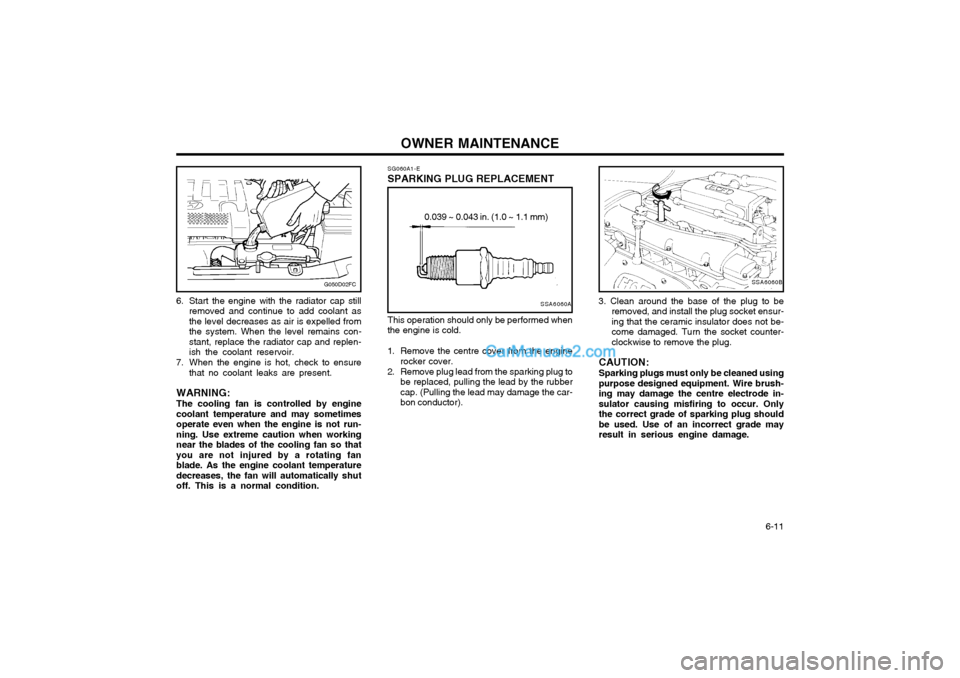
6. Start the engine with the radiator cap still
removed and continue to add coolant as the level decreases as air is expelled fromthe system. When the level remains con-stant, replace the radiator cap and replen-ish the coolant reservoir.
7. When the engine is hot, check to ensure that no coolant leaks are present.
WARNING: The cooling fan is controlled by engine coolant temperature and may sometimesoperate even when the engine is not run-ning. Use extreme caution when workingnear the blades of the cooling fan so thatyou are not injured by a rotating fanblade. As the engine coolant temperaturedecreases, the fan will automatically shutoff. This is a normal condition.
G050D02FCSSA6060B
3. Clean around the base of the plug to be removed, and install the plug socket ensur- ing that the ceramic insulator does not be-come damaged. Turn the socket counter-clockwise to remove the plug.
CAUTION: Sparking plugs must only be cleaned using purpose designed equipment. Wire brush-ing may damage the centre electrode in-sulator causing misfiring to occur. Onlythe correct grade of sparking plug shouldbe used. Use of an incorrect grade mayresult in serious engine damage.
SG060A1-E
SPARKING PLUG REPLACEMENT
SSA6060A
0.039 ~ 0.043 in. (1.0 ~ 1.1 mm)
This operation should only be performed when
the engine is cold.
1. Remove the centre cover from the engine rocker cover.
2. Remove plug lead from the sparking plug to be replaced, pulling the lead by the rubber cap. (Pulling the lead may damage the car-bon conductor).
Page 120 of 407
OWNER MAINTENANCE 6-13
G080A01A-EAT
WINDSCREEN WIPER BLADES CAUTION:
o The air flow sensor is a precision engi- neered electronic measuring device and therefore care should be exercised thatthe air flow sensor is not damagedduring replacement of the element.
o When removing the air cleaner ele- ment, be careful that dust or dirt doesnot enter the air intake. These mayresult in damage to the air cleanerelement.
To ensure maximum filtration performance
and continued engine performance, only genu-ine Hyundai replacements should be used.
HEF-119-E
The wiper blades should be carefully in-
spected from time to time and cleaned to remove accumulations of road film or otherdebris. When the fluid is to be replenished, only aproprietary screen wash additive should beused and in the concentration recommendedby the manufacturer. The windscreen washerreservoir has a total capacity of 3 litres. CAUTION: Engine coolant anti freeze must not be used in the windscreen washer systemsince damage to the paintwork may result. Undiluted windscreen washer additive must not be allowed to come into contact with thepaintwork. If spillage occurs, flush the af-fected area immediately with water. Do notoperate the windscreen washer for morethan 15 seconds continuously or whenthe reservoir is empty since damage tothe washer pump will result.
To clean the wiper blades and arms, use a
clean sponge or cloth with a mild soap ordetergent and water. If the wipers continue tostreak or smear the glass, replace them withgenuine Hyundai replacement.
CAUTION:
o Do not operate the wipers on dry glass since rapid wear and damage to thewindscreen glass may result.
o Keep the blade rubber out of contact with petroleum products such as en-gine oil, petrol, etc.
SG090A2-E
WINDSCREEN WASHER RESERVOIR
REPLENISHMENT
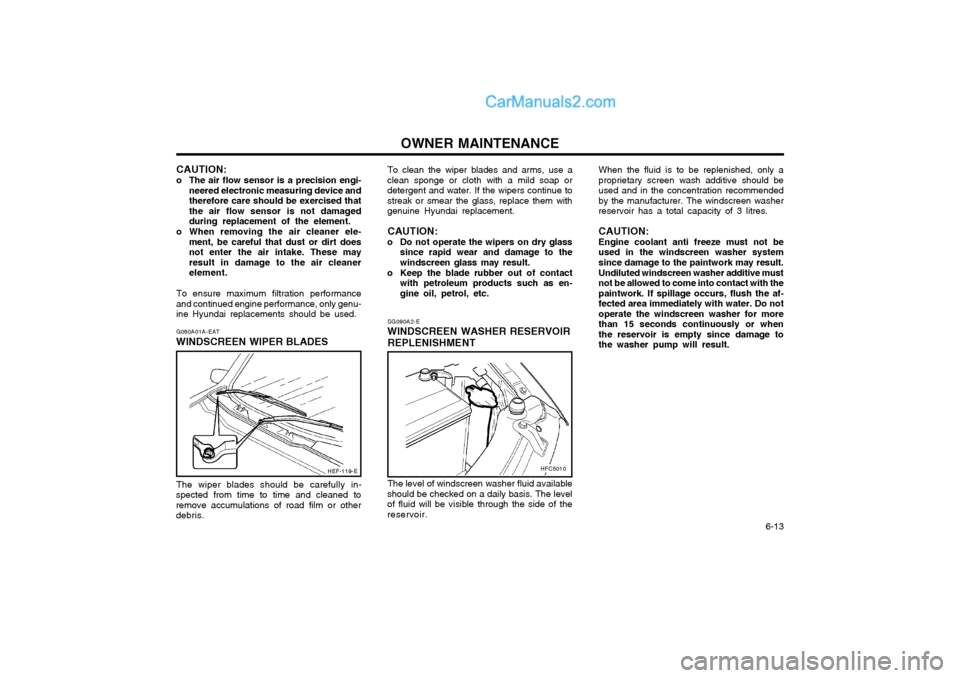
The level of windscreen washer fluid available
should be checked on a daily basis. The level of fluid will be visible through the side of thereservoir.
HFC5010
Page 123 of 407
OWNER MAINTENANCE
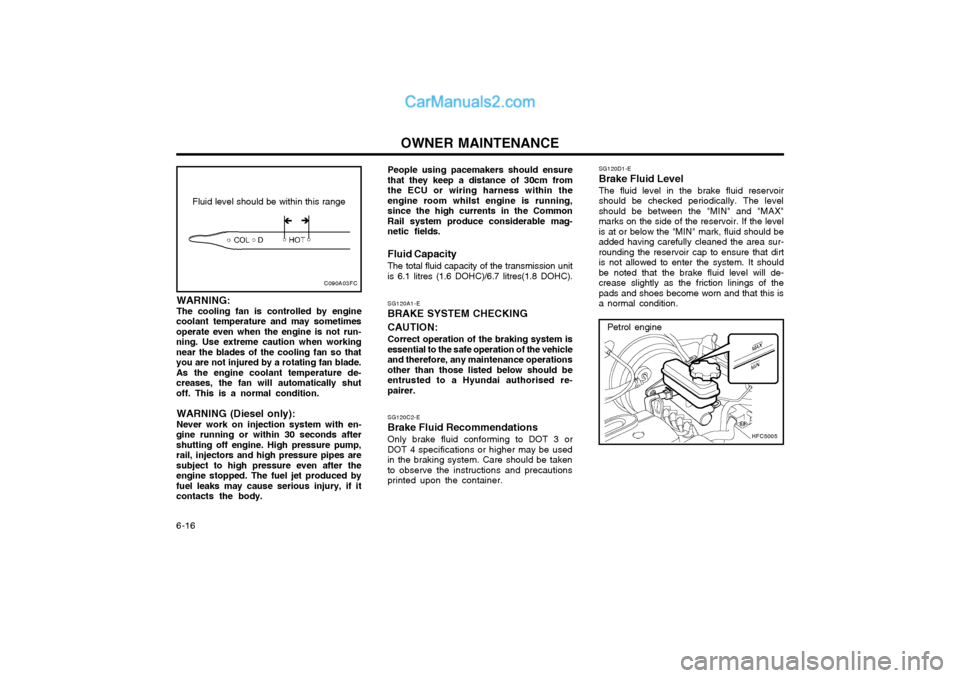
6-16 SG120D1-E Brake Fluid Level The fluid level in the brake fluid reservoir should be checked periodically. The levelshould be between the "MIN" and "MAX"marks on the side of the reservoir. If the levelis at or below the "MIN" mark, fluid should beadded having carefully cleaned the area sur-rounding the reservoir cap to ensure that dirtis not allowed to enter the system. It shouldbe noted that the brake fluid level will de-crease slightly as the friction linings of thepads and shoes become worn and that this isa normal condition.
SG120A1-E
BRAKE SYSTEM CHECKING CAUTION:
Correct operation of the braking system is
essential to the safe operation of the vehicle and therefore, any maintenance operationsother than those listed below should beentrusted to a Hyundai authorised re-pairer.
SG120C2-E
Brake Fluid Recommendations
Only brake fluid conforming to DOT 3 or
DOT 4 specifications or higher may be usedin the braking system. Care should be takento observe the instructions and precautionsprinted upon the container.
HFC5005
Petrol engine
People using pacemakers should ensure that they keep a distance of 30cm fromthe ECU or wiring harness within theengine room whilst engine is running,since the high currents in the CommonRail system produce considerable mag-netic fields. Fluid Capacity The total fluid capacity of the transmission unit is 6.1 litres (1.6 DOHC)/6.7 litres(1.8 DOHC).
Fluid level should be within this range
C090A03FC
ÎÎ
WARNING: The cooling fan is controlled by engine
coolant temperature and may sometimes operate even when the engine is not run-ning. Use extreme caution when workingnear the blades of the cooling fan so thatyou are not injured by a rotating fan blade.As the engine coolant temperature de-creases, the fan will automatically shutoff. This is a normal condition.
WARNING (Diesel only): Never work on injection system with en-
gine running or within 30 seconds after shutting off engine. High pressure pump,rail, injectors and high pressure pipes aresubject to high pressure even after theengine stopped. The fuel jet produced byfuel leaks may cause serious injury, if itcontacts the body.
Page 129 of 407

OWNER MAINTENANCE
6-22 SG230A1-E POWER STEERING FLUID LEVEL
HFC5004
G230A02FC
Petrol engine
Diesel engine
The power steering fluid level should be checked daily.
SG220A1-E ELECTRIC COOLING FANS WARNING: The cooling fan is controlled by engine coolant temperature and may sometimesoperate even when the engine is not run-ning. Use extreme caution when workingnear the blades of the cooling fan so thatyou are not injured by a rotating fan blade.As the engine coolant temperature decreas-es, the fan will automatically shut off. Thisis a normal condition. The engine cooling fan should operate before the temperature gauge reaches the upper por-tion of the scale and the condenser fan shouldoperate whenever the air conditioning is in use.
o Batteries must only be charged in well
ventilated areas from which naked lights orsources of sparks are excluded.
o Ensure that children, pets or other unauthorised persons are kept away frombatteries.
o Do not allow anything to bridge the positive (+) and negative (-) terminals of the battery.
o Never invert the battery. The battery fitted during production is of the "Maintenance Free" type.
Page 132 of 407
OWNER MAINTENANCE 6-25
5. Push the bulb spring for removing the
headlight bulb.
6. Remove the protective cap from the re- placement bulb and install the new bulb by matching the plastic base with the headlighthole. Install the dust cover after retighteningthe bulb spring and reconnect the powercord.
7. Use the protective cap and carton to dis- pose of the old bulb.
8. Check for proper headlight aim.
WARNING The halogen bulb contains gas under
pressure and if impacted could shatter, resulting in flying fragments. Always weareye protection when servicing the bulb.
G270A02FC
3. Disconnect the power cord from the bulb base in the back of the headlight.
4. Remove the dust cover.
5. Open the bonnet.
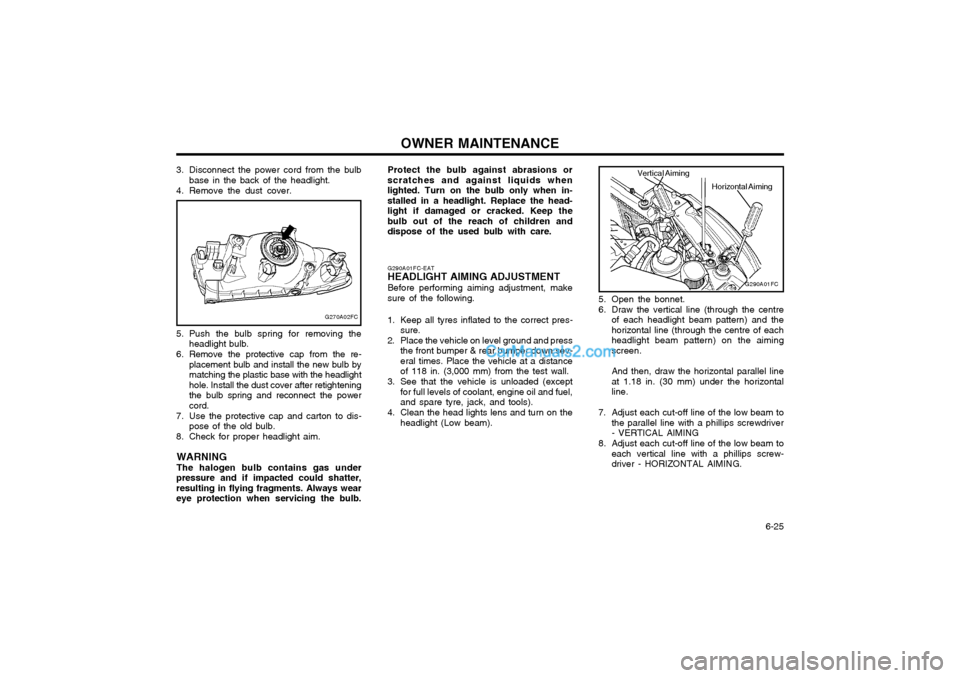
6. Draw the vertical line (through the centreof each headlight beam pattern) and the horizontal line (through the centre of eachheadlight beam pattern) on the aimingscreen. And then, draw the horizontal parallel line at 1.18 in. (30 mm) under the horizontalline.
7. Adjust each cut-off line of the low beam to the parallel line with a phillips screwdriver- VERTICAL AIMING
8. Adjust each cut-off line of the low beam to each vertical line with a phillips screw-driver - HORIZONTAL AIMING.
G290A01FC-EAT
HEADLIGHT AIMING ADJUSTMENT
Before performing aiming adjustment, makesure of the following.
1. Keep all tyres inflated to the correct pres- sure.
2. Place the vehicle on level ground and press the front bumper & rear bumper down sev-eral times. Place the vehicle at a distanceof 118 in. (3,000 mm) from the test wall.
3. See that the vehicle is unloaded (except for full levels of coolant, engine oil and fuel,and spare tyre, jack, and tools).
4. Clean the head lights lens and turn on the headlight (Low beam).
G290A01FC
Horizontal Aiming
Vertical Aiming
Protect the bulb against abrasions or scratches and against liquids whenlighted. Turn on the bulb only when in-stalled in a headlight. Replace the head-light if damaged or cracked. Keep thebulb out of the reach of children anddispose of the used bulb with care.
Page 139 of 407
EMISSION CONTROL SYSTEM 7-1
SH000A1-E
7. EMISSION
CONTROL SYSTEM
SH010A1-E EMISSION CONTROL SYSTEMS (Not all models) Depending upon the market for which the ve-hicle is destined, the emission control systemwill comprise one or more of the followingemission control devices. (1) Crankcase emission control system (2) Evaporative emission control system (3) Exhaust emission control system In order that the proper functioning of the emis- sion control systems may be ensured, it isrecommended that the vehicle is inspected andmaintained by an Hyundai authorised repairerin accordance with the maintenance schedulein this manual. SH010B1-E 1. CRANKCASE EMISSION CONTROL SYSTEM
The positive crankcase ventilation system is employed to prevent air pollution caused byblow-by gases being emitted from the crank-case by introducing fresh air to the crankcase through the air cleaner where this mixes withblow-by gases and then passes through thePCV valve into the intake manifold from whereit subsequently enters the combustion cham-ber and is burned.
SH010D1-E 3. EXHAUST EMISSION CONTROL SYSTEM The exhaust emission control system is a highlyeffective system which controls exhaust emis-sion whilst maintaining good vehicle perfor-mance.
SH010C1-E
2. EVAPORATIVE EMISSION
CONTROL SYSTEM
The Evaporative Emission Control System is designed to prevent fuel vapours from escap-ing into the atmosphere through the fuel tankventilation system.Whilst the engine is not running, fuel vapoursgenerated inside the fuel tank are absorbedand stored in a charcoal canister. When theengine is started, the vapours stored in thecanister are drawn into the induction systemthrough the purge control solenoid valve andare subsequently burned.The purge control solenoid valve is controlledby the ECU; when the engine coolant tempera-ture is low or the engine is idling, the purgecontrol valve is closed and fuel vapours remainstored in the canister. Under normal runningconditions when the engine is warm, the valveopens and the vapours are drawn into the inlettract and subsequently burned in the combus-tion chamber. SH020A1-E
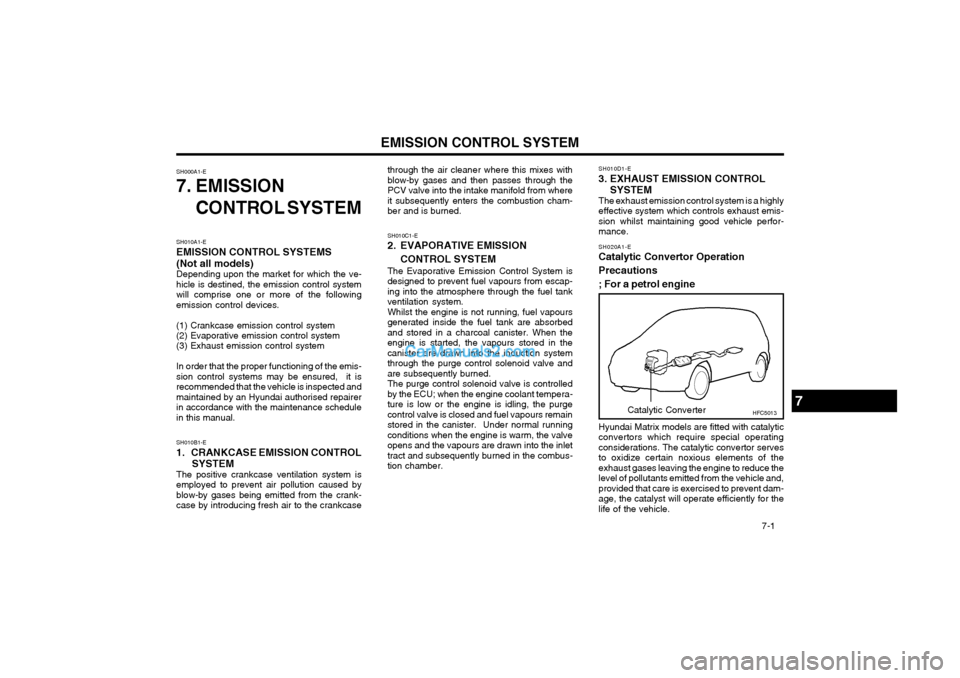
Catalytic Convertor Operation Precautions; For a petrol engine Hyundai Matrix models are fitted with catalytic convertors which require special operatingconsiderations. The catalytic convertor servesto oxidize certain noxious elements of theexhaust gases leaving the engine to reduce thelevel of pollutants emitted from the vehicle and,provided that care is exercised to prevent dam-age, the catalyst will operate efficiently for thelife of the vehicle.
7HFC5013
Catalytic Converter
Page 148 of 407
INDEX
10-2
E EFFECTIVE BRAKING
...................................................................... 2-9
ELECTRIC COOLING FANS ........................................................... 6-22
EMERGENCY TOWING ................... ...............................................3-10
EMISSION CONTROL SYSTEM ...................................................... 7-1
ENGINE COMPARTMENT ...................................................... 6-1 ~ 6-3
ENGINE COOLANT CHECKING AND REPLACING ....................... 6-9
ENGINE OIL AND FILTER REPLACEMENT ................................... 6-6
ENGINE OIL CONSUMPTION .......................................................... 6-6
ENGINE OIL REPLENISHMENT ...................................................... 6-5
ENGINE OIL ....................................................................................... 6-4
EXTERIOR REAR VIEW MIRR OR ................................................. 1-47
FFOLDING REAR SEATBACK AND SEAT CUSHION .......1-11 ~ 1-12
FOLD-UP TRAY ............................................................................... 1-50
FRONT ASHTRAY ........................................................................... 1-42
FRONT FOG LIGHT SWITCH ........................................................ 1-41
FUEL ECONOMY .............................................................................. 2-4
FUEL GAUGE .................................................................................. 1-35
FUEL RECOMMENDATIONS ........................................................... 1-1
FUSE PANEL DESCRIPTION ......................................................... 6-28
FUSIBLE LINKS ............................................................................... 6-20G GLOVE BOX
.................................................................................... 1-47
H HAZARD WARNING SYSTEM ........................................................ 1-40
HEADLIGHT AIMING ADJUSTEMENT ..........................................6-25
HEADLIGHT BULB ......................................................................... 6-24
HEADLIGHT LEVELING DEVICE SYSTEM ..................................1-44
HEAD RESTRAINT ADJUSTMENT ........................................ 1-9, 1-11
HEATED REAR WINDOW .............................................................. 1-41
HEATING CONTROL ....................................................................... 1-58
HEIGHT ADJUSTABLE FRONT SEAT SHOULDER BELT .......... 1-14
HORN ............................................................................................... 1-54
I
IF THE ENGINE CANNOT BE CRANKED ...................................... 3-1
IF THE ENGINE WILL NOT START ................................................ 3-1
IF THE EVENT OF A PUNCTURE ................................................... 3-4
IF YOUR VEHICLE MUST BE TOWED ........................................... 3-8
IMMOBILISER SYSTEM ......................................................... 1-2 ~ 1-3
INDIVIDUAL CIRCUIT FUSES ........................................................ 6-21
INSTRUMENT CLUSTER AND INDICATORS .............................. 1-30
INSTRUMENTS AND CONTROLS .................................................1-29
INTERIOR LIGHT ............................................................................ 1-46
INTERIOR REAR VIEW MIRROR .................................................. 1-49
Page 217 of 407
1
FEATURES OF YOUR HYUNDAI
53
!
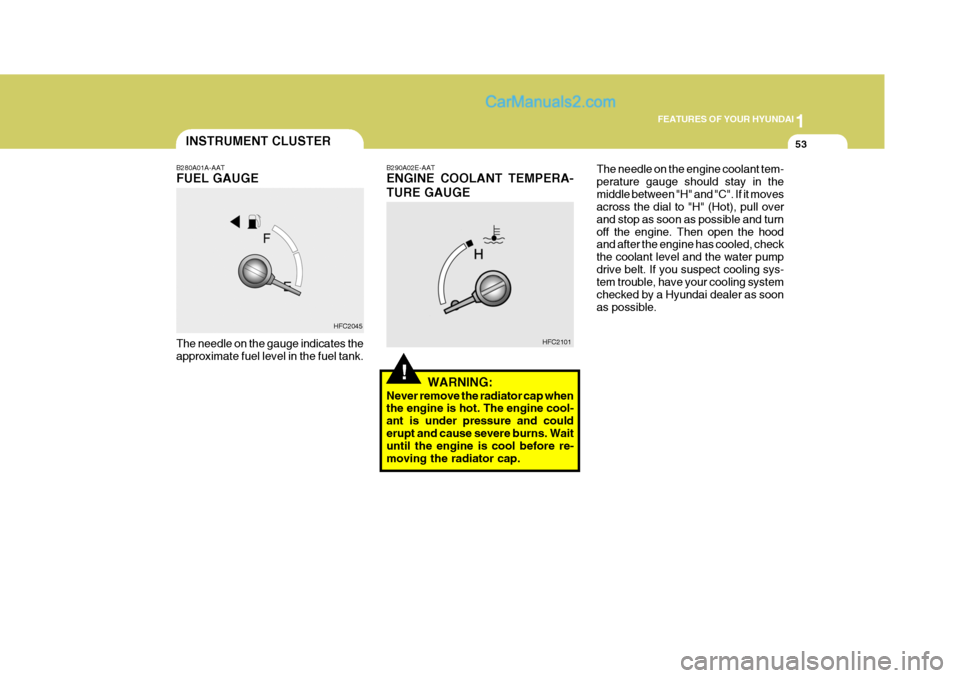
B280A01A-AAT FUEL GAUGE The needle on the gauge indicates the approximate fuel level in the fuel tank. B290A02E-AAT ENGINE COOLANT TEMPERA- TURE GAUGE
HFC2045 HFC2101
WARNING:
Never remove the radiator cap when the engine is hot. The engine cool- ant is under pressure and coulderupt and cause severe burns. Wait until the engine is cool before re- moving the radiator cap. The needle on the engine coolant tem-perature gauge should stay in themiddle between "H" and "C". If it moves across the dial to "H" (Hot), pull over and stop as soon as possible and turnoff the engine. Then open the hood and after the engine has cooled, check the coolant level and the water pumpdrive belt. If you suspect cooling sys- tem trouble, have your cooling system checked by a Hyundai dealer as soonas possible.
INSTRUMENT CLUSTER
Page 308 of 407

2
DRIVING YOUR HYUNDAI
19
C160H01A-AAT Use Approved Anti-Freeze in Window Washer System To keep the water in the window washer system from freezing, add an approvedanti-freeze solution in accordance with instructions on the container. Window washer anti-freeze is available fromHyundai dealers and most auto parts outlets. Do not use engine coolant or other types of anti-freeze as thesemay damage the finish.
C160G02A-GAT To Keep Locks from Freezing To keep the locks from freezing, squirt an approved de-icer fluid or glycerineinto the key opening. If a lock is cov- ered with ice, squirt it with an approved de-icing fluid to remove the ice. If thelock is frozen internally, you may be able to thaw it out by using a heated key. Handle the heated key with careto avoid injury. NOTE: The proper temperature for using the immobilizer key is from -40°C (-40°F) to 80°C(176°F). If you heat the immobilizer key over 80°C toopen the frozen lock, it may cause damage to the transponder in its head.
C160D01A-AAT Check Battery and Cables Winter puts additional burdens on the battery system. Visually inspect thebattery and cables as described in Section 6. The level of charge in your battery can be checked by your Hyundaidealer or a service station.
C160F01A-AAT Check Spark Plugs and Ignition System Inspect your spark plugs as described in Section 6 and replace them if neces-sary. Also check all ignition wiring and components to be sure they are not cracked, worn or damaged in any way.
C160E01A-AAT Change to "Winter Weight" Oil if Necessary In some climates it is recommended that a lower viscosity "winter weight" oil be used during cold weather. See Section 9 for recommendations. If youaren't sure what weight oil you should use, consult your Hyundai dealer.
C160I01A-AAT Don't Let Your Parking Brake Freeze Under some conditions your parking brake can freeze in the engaged posi- tion. This is most likely to happenwhen there is an accumulation of snow or ice around or near the rear brakes or if the brakes are wet. If there is a riskthe parking brake may freeze, apply it only temporarily while you put the gear selector lever in "P" (automatic) or infirst or reverse gear (manual transaxle) and block the rear wheels so the car cannot roll. Then release the parkingbrake.
Page 318 of 407

3
WHAT TO DO IN AN EMERGENCY
5
!
!
!
check for coolant leaking from the radiator, hoses or under the car. (Ifthe air conditioning had been in use, it is normal for cold water to be draining from it when you stop).
WARNING (Diesel only):
Never work on injection system with engine running or within 30 sec- onds after shutting off engine. Highpressure pump, rail, injectors and high pressure pipes are subject to high pressure even after the enginestopped. The fuel jet produced by fuel leaks may cause serious in- jury, if it touch the body. Peopleusing pacemakers should not move than 30cm closer to the ECU or wiring harness within the engine 5. If the water pump drive belt is bro-
ken or coolant is leaking out, stopthe engine immediately and call the nearest Hyundai dealer for assis- tance. CAUTION:
Serious loss of engine coolant indi- cates there is a leak in the cooling system and this should be checkedas soon as possible by a Hyundai dealer.
room while engine is running, since the high currents in the CommonRail system produce considerable magnetic fields.
6. If you cannot find the cause of the
overheating, wait until the engine temperature has returned to nor- mal. Then, if the engine coolant hasbeen lost, carefully add coolant to the reservoir (page 6-14) to bring the fluid level in the reservoir up tothe halfway mark.
WARNING:
While the engine is running, keephair, hands, and clothing away from moving parts such as the fan and drive belts to prevent injury.
WARNING:
Do not remove the radiator cap whenthe engine is hot. This can allowcoolant to be blown out of the open- ing and cause serious burns. 7. Proceed with caution, keeping alert
for further signs of overheating. If overheating happens again, call a Hyundai dealer for assistance.
!