heating Hyundai Matrix 2005 User Guide
[x] Cancel search | Manufacturer: HYUNDAI, Model Year: 2005, Model line: Matrix, Model: Hyundai Matrix 2005Pages: 407, PDF Size: 10.31 MB
Page 69 of 407
1- 61
CONTROLS AND EQUIPMENT
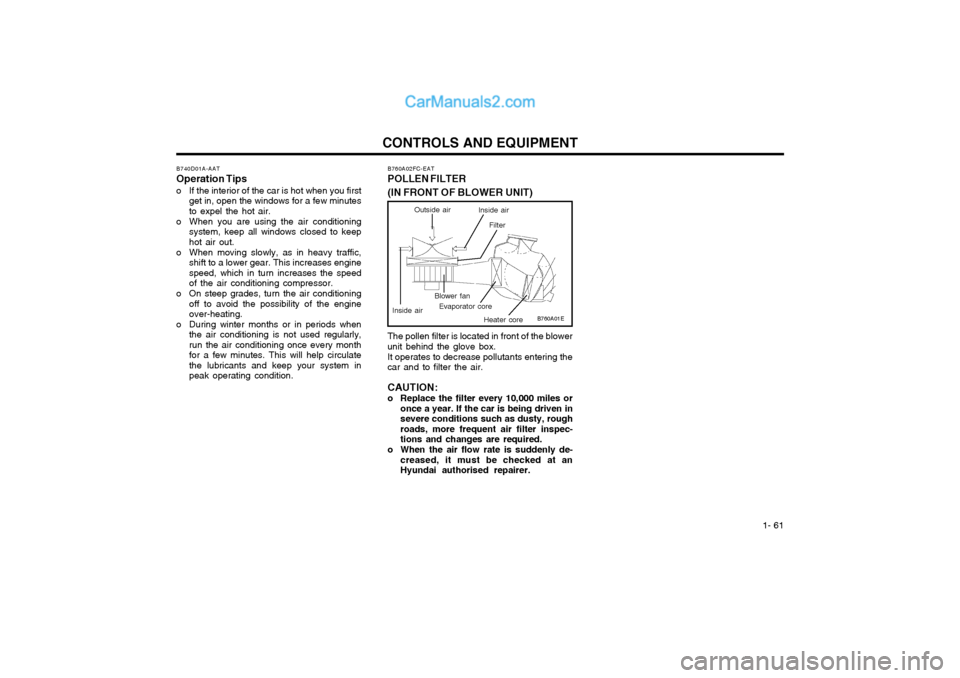
B760A01E
The pollen filter is located in front of the blower unit behind the glove box. It operates to decrease pollutants entering the car and to filter the air. CAUTION:
o Replace the filter every 10,000 miles oronce a year. If the car is being driven in severe conditions such as dusty, roughroads, more frequent air filter inspec-tions and changes are required.
o When the air flow rate is suddenly de- creased, it must be checked at anHyundai authorised repairer.
Evaporator coreBlower fan
Heater core
B760A02FC-EAT POLLEN FILTER (IN FRONT OF BLOWER UNIT)
Outside air
Filter
Inside air
Inside air
B740D01A-AAT
Operation Tips
o If the interior of the car is hot when you first get in, open the windows for a few minutes to expel the hot air.
o When you are using the air conditioning system, keep all windows closed to keephot air out.
o When moving slowly, as in heavy traffic, shift to a lower gear. This increases enginespeed, which in turn increases the speedof the air conditioning compressor.
o On steep grades, turn the air conditioning off to avoid the possibility of the engineover-heating.
o During winter months or in periods when the air conditioning is not used regularly,run the air conditioning once every monthfor a few minutes. This will help circulatethe lubricants and keep your system inpeak operating condition.
Page 73 of 407
DRIVING YOUR HYUNDAI 2- 1
SC000A1-E
2. DRIVING YOUR HYUNDAI
SC020A1-E
WARNING: ENGINE EXHAUST CAN BE DANGEROUS!
Engine exhaust gases are potentially lethal. If at any time engine exhaust gas is detected within the passenger compartment, move the vehicle to an open area and open all windows. o Never inhale exhaust gas. Exhaust gases contain Carbon Monoxide which is colourless and odourless. Carbon Monoxide is poisonous and can cause unconsciousness and death by asphyxiation. o Exhaust System Maintenance. Ensure that the exhaust system is maintained in good condition and is free from excessive corrosion and damage which may result in leakage. If the vehicle is driven over an object which strikes the exhaust system, ensure that the exhaust system is inspected at the first available opportunity to ensure that no leakage exists. o Confined Areas. Do not run the engine in confined spaces, allowing the engine to idle in a garage, even when the doors are open is dangerous practice. Only start the engine immediately prior to moving the vehicle out of the garage. o Prolonged Idling. If it is necessary to allow the vehicle to idle for prolonged periods, ensure that the heating system air intake control is set to the "Fresh" position, the blower is set to high speed operation and that the vehicle is standing in an open area. o Load Carrying. If it is necessary to carry long objects which do not permit the boot lid to be fully closed, the side windows must remain closed and the heating air intake control set to the "Fresh" position with the blower running at the highest speed setting. To ensure correct operation of the heater system, the air intake grilles at the base of the windscreen must not be obstructed by snow leaves etc..
2
Page 76 of 407

DRIVING YOUR HYUNDAI
2- 4 C050B03S-EAT
NORMAL CONDITIONS The Starting Procedure:
1. Insert key, and fasten the seat belt.
2. Depress the clutch pedal fully and place the gearshift lever (manual transaxle) inneutral or the selector lever (automatic transaxle) in "P" (park) position.
3. After turning the ignition key to the "ON" position, make certain all warning lightsand gauges are functioning properly be- fore starting the engine.
4. On vehicles equipped with the diesel pre- heat indicator light, turn the ignition key tothe "ON" position. The diesel pre-heat indi- cator light will first illuminate in amber, and then after a short time, the amber illumina- tion will goes off, indicating that preheating is completed. SC060B1-E FUEL ECONOMY
The following suggestions are made to assist
in achieving the greatest degree of fuel economy.
o Maintaining a constant check on fuel con- sumption will enable the most economical use pattern and driving style to be adopt- ed.
o Avoid using the vehicle for very short jour- neys if possible, particularly when a coldstart is involved.
o Ensure that tyre pressures are maintained
at the correct level.
o Use only the recommended grade of fuel.
o Avoid carrying unnecessary weight, and if a roof rack is in use, remove it as soon aspossible after use.
NOTE: If the engine does not start 10 secondsafter the preheating is completed, turn the ignition key once more to the "LOCK" position, and then to the "ON" position, in order to preheat again. WARNING: Be sure that the clutch is fully depressed when starting a manual transaxle vehicle. This will prevent sudden movement should the vehicle be started in gear without the clutch depressed. Otherwise there is the potential to cause damage to the vehicle or injury to a person inside or outside of the vehicle as a result of this sudden vehicle movement.
5. Turn the ignition key to the "Start" position and release it when the engine starts.
C055B01B-GAT STARTING AND STOPPING THE EN- GINE FOR TURBO CHARGER INTER-COOLER (DIESEL ENGINE)
(1) Do not race the engine or suddenly accel- erate the engine immediately after starting it. If the engine is cold, allow the engine to idle for several seconds before it is driven to ensure sufficient lubrication of the turbo charger unit. (2) After high speed or extended driving, re-
quiring a heavy engine load, the engineshould be allowed to idle about 1 minute before turning it off.This idle time will allow the turbo charger to cool prior to shutting the engine off.
WARNING: Do not turn the engine off immediately after it has been subjected to a heavy load. Doing so may cause severe damage to the engine or turbo charger unit.
C050B01HP
Amber lamp ON Amber lamp OFF
Page 77 of 407
DRIVING YOUR HYUNDAI 2- 5
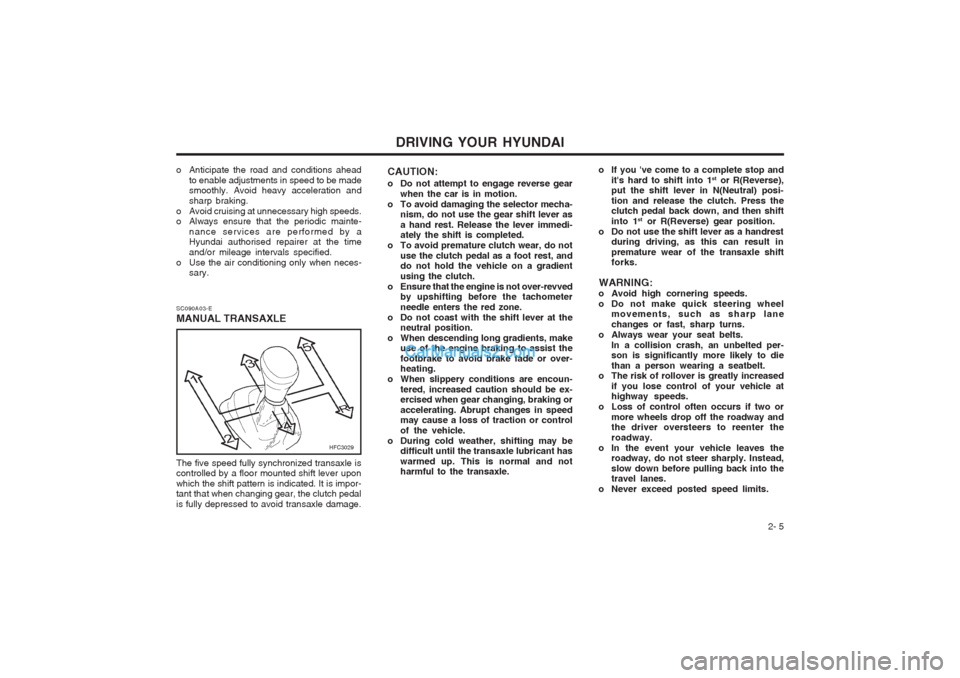
SC090A03-E MANUAL TRANSAXLE
HFC3029
The five speed fully synchronized transaxle is controlled by a floor mounted shift lever upon which the shift pattern is indicated. It is impor- tant that when changing gear, the clutch pedal is fully depressed to avoid transaxle damage. CAUTION:
o Do not attempt to engage reverse gear
when the car is in motion.
o To avoid damaging the selector mecha- nism, do not use the gear shift lever as a hand rest. Release the lever immedi- ately the shift is completed.
o To avoid premature clutch wear, do not use the clutch pedal as a foot rest, anddo not hold the vehicle on a gradient using the clutch.
o Ensure that the engine is not over-revved by upshifting before the tachometerneedle enters the red zone.
o Do not coast with the shift lever at the neutral position.
o When descending long gradients, make use of the engine braking to assist thefootbrake to avoid brake fade or over- heating.
o When slippery conditions are encoun- tered, increased caution should be ex-ercised when gear changing, braking or accelerating. Abrupt changes in speed may cause a loss of traction or control of the vehicle.
o During cold weather, shifting may be difficult until the transaxle lubricant haswarmed up. This is normal and not harmful to the transaxle.
o Anticipate the road and conditions ahead
to enable adjustments in speed to be madesmoothly. Avoid heavy acceleration and sharp braking.
o Avoid cruising at unnecessary high speeds.
o Always ensure that the periodic mainte- nance services are performed by aHyundai authorised repairer at the time and/or mileage intervals specified.
o Use the air conditioning only when neces- sary.
o If you 've come to a complete stop and
it's hard to shift into 1 st
or R(Reverse),
put the shift lever in N(Neutral) posi- tion and release the clutch. Press the clutch pedal back down, and then shift into 1 st
or R(Reverse) gear position.
o Do not use the shift lever as a handrest during driving, as this can result inpremature wear of the transaxle shift forks.
WARNING:
o Avoid high cornering speeds.
o Do not make quick steering wheel movements, such as sharp lanechanges or fast, sharp turns.
o Always wear your seat belts. In a collision crash, an unbelted per- son is significantly more likely to die than a person wearing a seatbelt.
o The risk of rollover is greatly increased
if you lose control of your vehicle at highway speeds.
o Loss of control often occurs if two or
more wheels drop off the roadway andthe driver oversteers to reenter the roadway.
o In the event your vehicle leaves the roadway, do not steer sharply. Instead,slow down before pulling back into the travel lanes.
o Never exceed posted speed limits.
Page 87 of 407
DRIVING YOUR HYUNDAI 2- 15
YC200E2-E
Trailer or Vehicle Towing Tips
1. Before towing, check towbar ball and safe- ty cable connections as well as proper operation of the trailer running lights, brake lights, and turn signals.
2. Always drive your vehicle at a moderate speed (Less than 60 MPH)
3. Trailer towing requires more fuel than nor- mal conditions.
4. To maintain engine braking efficiency and electrical charging performance, do not usefifth gear (manual transaxle) or overdrive (automatic transaxle). 5. Always secure items in the trailer to pre-
vent load shift whilst driving.
6. Check the condition and air pressure of all tyres on the trailer and your car. Low tyrepressure can seriously affect the handling. Also check the spare tyre.
7. The vehicle/trailer combination is more af- fected by crosswind and buffeting. When being passed by a large vehicle,keep a constant speed and steer straight ahead. If there is too much wind buffeting slow down to get out of the other vehicle's air turbulence.
8. When parking your car and trailer, espe- cially on a hill, be sure to follow all thenormal precautions. Turn your front wheels into the curb, set the parking brake firmly, and put the transaxle in 1st or Reverse (manual) or Park (automatic). In addition, place wheel chocks at each of the trailer's tyres.
9. If the trailer has electric brakes, start your vehicle and trailer moving, and then applythe trailer brake controller by hand to be sure the brakes are working. This lets you check your electrical connection at the same time.
10.During your trip, check occasionally to be sure that the load is secure, and that thelights and any trailer brakes are still work- ing. 11.Avoid jerky starts, sudden acceleration or
sudden stops.
12.Avoid sharp turns and rapid lane changes.
13.Avoid holding the brake pedal down too long or too frequently. This could causethe brakes to overheat, resulting in re- duced braking efficiency.
14.When going down a hill, shift into a lower gear and use the engine braking effect. When ascending a long grade, downshiftthe transaxle to a lower gear and reduce speed to reduce chances of engine over- loading and/or overheating.
15.If you have to stop whilst going uphill, do not hold the vehicle in place by pressing onthe accelerator. This can cause the auto- matic transaxle to overheat. Use the park- ing brake or footbrake.
NOTE:When towing check transaxle fluid more
frequently.
CAUTION:If overheating should occur when towing,
(temperature gauge reads near red zone), taking the following action may reduce or eliminate the problem.
1. Turn off the air conditioner.
2. Reduce highway speed.
3. Select a lower gear when going uphill.
4. While in stop and go traffic, place the gear selection in park or neutral andidle the engine at a higher speed.
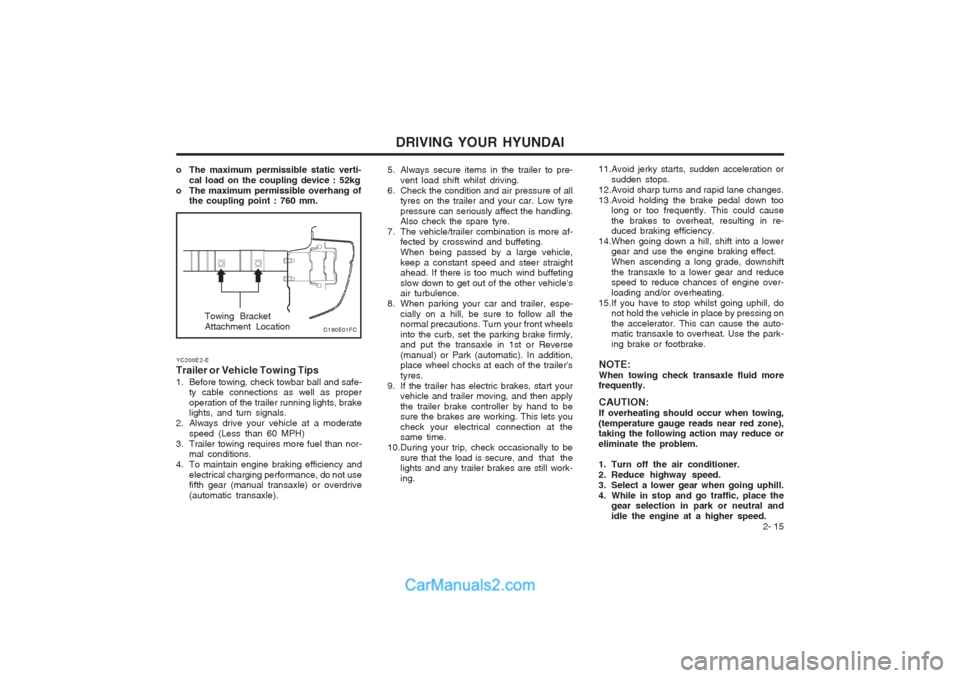
Towing BracketAttachment Location
o The maximum permissible static verti-
cal load on the coupling device : 52kg
o The maximum permissible overhang of the coupling point : 760 mm.
C190E01FC
Page 90 of 407
3-3
IN CASE OF EMERGENCY
If the drive belt seems to be satisfactory, check for coolant leaking from the radiator, hoses or under the car. (If the air condi- tioning had been in use, it is normal for cold water to be draining from it).
WARNING: Whilst the engine is running, keep hands and clothing away from moving parts such as the fan and drive belts to prevent injury. WARNING (Diesel only): Never work on injection system with en-gine running or within 30 seconds after shutting off engine. High pressure pump, rail, injectors and high pressure pipes are subject to high pressure even after the engine stopped. The fuel jet produced by fuel leaks may cause serious injury, if it touch the body. People using pacemak- ers should ensure that they keep a dis- tance of 30cm from the ECU or wiring harness within the engine room whilst engine is running, since the high currents in the Common Rail system produce con- siderable magnetic fields.
5. If the water pump drive belt is broken or coolant is leaking out, stop the engine immediately and call the nearest Hyundai authorised repairer for assistance. WARNING:Do not remove the radiator cap when theengine is hot since steam and boiling water may be ejected from the radiator resulting in burns or scalding.
6. If the cause of the overheating cannot be found, wait until the engine temperature has returned to normal. Then, if coolant has been lost, carefully remove the radia- tor cap and add water to bring the fluid level in the reservoir up to the base of the radiator fill opening. Fill the coolant expan- sion tank to the halfway mark.
7. Proceed with caution until it is established that the engine is operating normally. If theengine overheats repeatedly, the advice of a Hyundai authorised repairer should be sought.
CAUTION:Serious loss of coolant indicates there is a leak in the cooling system and this should be checked as soon as possible by a Hyundai authorised repairer. D040A01FC-EAT
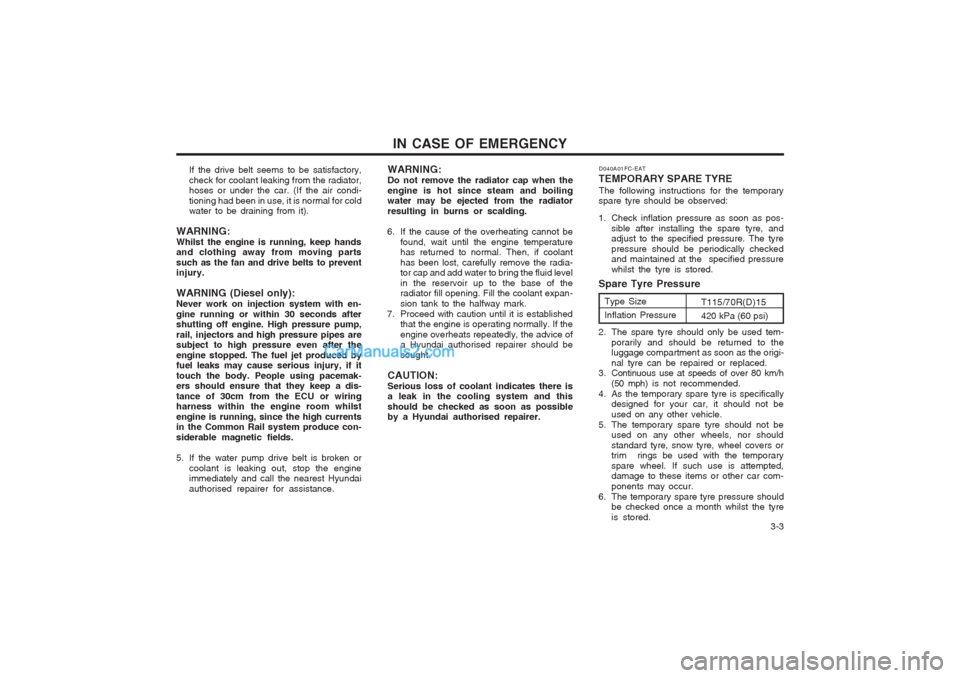
TEMPORARY SPARE TYRE The following instructions for the temporary
spare tyre should be observed:
1. Check inflation pressure as soon as pos-
sible after installing the spare tyre, and adjust to the specified pressure. The tyre pressure should be periodically checked and maintained at the specified pressure whilst the tyre is stored.
2. The spare tyre should only be used tem- porarily and should be returned to the luggage compartment as soon as the origi- nal tyre can be repaired or replaced.
3. Continuous use at speeds of over 80 km/h
(50 mph) is not recommended.
4. As the temporary spare tyre is specifically designed for your car, it should not beused on any other vehicle.
5. The temporary spare tyre should not be used on any other wheels, nor shouldstandard tyre, snow tyre, wheel covers or trim rings be used with the temporary spare wheel. If such use is attempted, damage to these items or other car com- ponents may occur.
6. The temporary spare tyre pressure should be checked once a month whilst the tyreis stored.
Spare Tyre Pressure
Type Size Inflation Pressure T115/70R(D)15420 kPa (60 psi)
Page 99 of 407
APPEARANCE CARE
4-2
Plastic wheel covers should be cleaned using a sponge and water. Cast alloy wheels should be cleaned using a mild soap or neutral deter- gent. Abrasive compounds must not be used since in the event of these damaging the lac- quer coating, oxidization of the aluminium wheel will occur, spoiling the appearance. The use of an a toothbrush will facilitate cleaning between the wheel "spokes".
ensure that accidental spillages are immediately flushed with water. Do not use abrasive cleaning materials which may damage the bumpers. Avoid subjecting the bumpers to high tempera- tures such as may be encountered in high bake paint ovens.
SE040B1-E STAIN/SPOT REMOVAL Should tree sap, dead insects or tar prove to be difficult to remove from the paint film, turpentine or a proprietary paint cutting compound may be used. Ensure that the area to be cleaned is not rubbed intensively to prevent breaking through the colour coat and exposing the under coat. SE040C1-E POLISHINGThe exterior paint work should be polished with a proprietary wax polish when water no longer collects in bead form on the paint work. The instructions of the product manufacturer should be adhered to. SE040E1-E BUMPER MAINTENANCEThe special material from which the bumpers are manufactured warrants special attention to pre- serve the appearance of the bumpers. Avoid contact with battery electrolyte or brake fluid and SE040F1-E ACCIDENT REPAIRSIn the event of the body work sustaining damage, the following points should be noted prior to repairs being undertaken. If body panels are replaced or repaired, anti corrosion treatment must be applied to the repair area. The product used must be compatible withthose used in manufacture. It is recommended that repairs are entrusted to a Hyundai authorised repairer to ensure that replacement parts used are of the same high quality as those used in manufacture of the vehicle and that the correct repair methods and materials will en- sure adequate levels of corrosion protection and the continued validity of the Anti Perforation Warranty. SE050A1-E INTERIORDuring the winter period, it is possible that the passenger compartment flooring may become wet from damp footwear or quantities of snow adhering to footwear. The carpet should not be allowed to remain in this condition since the carpet may begin to create musty smells and will
SE050D1-E SEAT BELTS Seat belts should be cleaned only with a mild soap solution. Strong detergents, solvents or bleaches may damage the belt webbing and therefore reduce the effectiveness of the belt. Belts which display signs of fraying, wear of cuts should be replaced. SE050E1-E WINDOWS A proprietary glass cleaner should be used to clean the inside of the windows. However, the rear heated windshield must only be cleaned using a light horizontal cleaning action. Care should be exercised to avoid the use of abrasive cleaners or contact with items of jewellery which may damage the heating elements.
promote corrosion of the floor pan in addition tothe carpet and under felt beginning to rot. SE050C1-E INTERIOR VALETING The soft trim and carpets should be maintained with the regular use of a vacuum cleaner. Heavy soiling should be removed with a dry cleaning agent recommended for this purpose following the instructions of the product manufacturer. Paint thinner, solvents or other such cleaning materials should not be used since damage to the upholstery may result.
Page 116 of 407
OWNER MAINTENANCE 6-9
SG050A1-E
ENGINE COOLANT CHECKING
AND REPLACING WARNING: Do not remove the radiator cap when the
engine is hot, since the system is pressurised and coolant may be ejectedfrom the radiator resulting in scalding.
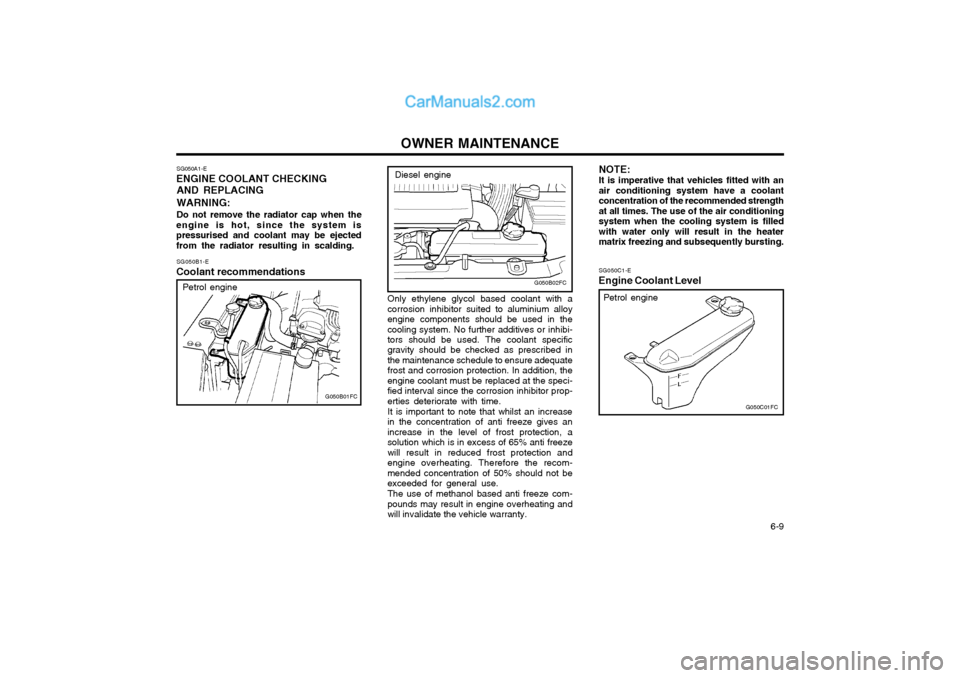
SG050B1-E
Coolant recommendations
Petrol engine
G050B01FC SG050C1-E
Engine Coolant LevelG050C01FC
Petrol engine
NOTE: It is imperative that vehicles fitted with an air conditioning system have a coolantconcentration of the recommended strengthat all times. The use of the air conditioningsystem when the cooling system is filledwith water only will result in the heatermatrix freezing and subsequently bursting.Diesel engine
Only ethylene glycol based coolant with a corrosion inhibitor suited to aluminium alloyengine components should be used in thecooling system. No further additives or inhibi- tors should be used. The coolant specific gravity should be checked as prescribed inthe maintenance schedule to ensure adequatefrost and corrosion protection. In addition, theengine coolant must be replaced at the speci-fied interval since the corrosion inhibitor prop-erties deteriorate with time. It is important to note that whilst an increase in the concentration of anti freeze gives anincrease in the level of frost protection, asolution which is in excess of 65% anti freezewill result in reduced frost protection andengine overheating. Therefore the recom-mended concentration of 50% should not beexceeded for general use. The use of methanol based anti freeze com- pounds may result in engine overheating andwill invalidate the vehicle warranty.
G050B02FC
Page 141 of 407

CONSUMER INFORMATION 8-1
SI010B1-E
Engine Number
SI000A1-E
8. CONSUMER
INFORMATION
I010A01FC-EAT
VEHICLE IDENTIFICATION
NUMBER (VIN) The vehicle identification number (VIN) is
unique to each individual vehicle and is the number (sometimes referred to as chassisnumber) used upon the vehicle registrationdocument to identify the vehicle.
It can be found on the identification plate
attached to apron panel located on the driver'sside of the engine compartment. The engine number is stamped on the engine
block as shown in the drawing. I030A01FC-EAT
TYRE PRESSURES
In modern high-speed motoring, correct tyre
pressures are vitally important. Incorrect tyrepressures can affect vehicle safety by caus-ing reduced adhesion, steering response andtyre failure through overheating. The tyrepressure must only be checked when thetyres are cold. The correct tyre pressuresare indicated on the label affixed to the driver'sside "C" piller outer panel and below.
Diesel engine
I010B02B8
HFC6001
EADA010C
Petrol engine
5.5Jx14 5.5Jx15 6.0Jx15 3.5Jx153.5Jx15
TYRE
SIZE
RIM
SIZE PRESSURE, kPa (PSI)
185/65R14195/55R15 205/55R15
T115/70D15 T115/70R15 REAR
210(30)210(30)210(30)420(60)420(60) FRONT
250(36)250(36) 250(36) 420(60)420(60)
UP TO 2
PERSONS UP TO
MAX. LOAD
REAR
250(36)250(36) 250(36) 420(60)420(60)
FRONT210(30)210(30)210(30) 420(60) 420(60)
I030A01FC-D
Page 148 of 407
INDEX
10-2
E EFFECTIVE BRAKING
...................................................................... 2-9
ELECTRIC COOLING FANS ........................................................... 6-22
EMERGENCY TOWING ................... ...............................................3-10
EMISSION CONTROL SYSTEM ...................................................... 7-1
ENGINE COMPARTMENT ...................................................... 6-1 ~ 6-3
ENGINE COOLANT CHECKING AND REPLACING ....................... 6-9
ENGINE OIL AND FILTER REPLACEMENT ................................... 6-6
ENGINE OIL CONSUMPTION .......................................................... 6-6
ENGINE OIL REPLENISHMENT ...................................................... 6-5
ENGINE OIL ....................................................................................... 6-4
EXTERIOR REAR VIEW MIRR OR ................................................. 1-47
FFOLDING REAR SEATBACK AND SEAT CUSHION .......1-11 ~ 1-12
FOLD-UP TRAY ............................................................................... 1-50
FRONT ASHTRAY ........................................................................... 1-42
FRONT FOG LIGHT SWITCH ........................................................ 1-41
FUEL ECONOMY .............................................................................. 2-4
FUEL GAUGE .................................................................................. 1-35
FUEL RECOMMENDATIONS ........................................................... 1-1
FUSE PANEL DESCRIPTION ......................................................... 6-28
FUSIBLE LINKS ............................................................................... 6-20G GLOVE BOX
.................................................................................... 1-47
H HAZARD WARNING SYSTEM ........................................................ 1-40
HEADLIGHT AIMING ADJUSTEMENT ..........................................6-25
HEADLIGHT BULB ......................................................................... 6-24
HEADLIGHT LEVELING DEVICE SYSTEM ..................................1-44
HEAD RESTRAINT ADJUSTMENT ........................................ 1-9, 1-11
HEATED REAR WINDOW .............................................................. 1-41
HEATING CONTROL ....................................................................... 1-58
HEIGHT ADJUSTABLE FRONT SEAT SHOULDER BELT .......... 1-14
HORN ............................................................................................... 1-54
I
IF THE ENGINE CANNOT BE CRANKED ...................................... 3-1
IF THE ENGINE WILL NOT START ................................................ 3-1
IF THE EVENT OF A PUNCTURE ................................................... 3-4
IF YOUR VEHICLE MUST BE TOWED ........................................... 3-8
IMMOBILISER SYSTEM ......................................................... 1-2 ~ 1-3
INDIVIDUAL CIRCUIT FUSES ........................................................ 6-21
INSTRUMENT CLUSTER AND INDICATORS .............................. 1-30
INSTRUMENTS AND CONTROLS .................................................1-29
INTERIOR LIGHT ............................................................................ 1-46
INTERIOR REAR VIEW MIRROR .................................................. 1-49