light Hyundai Matrix 2005 Owner's Guide
[x] Cancel search | Manufacturer: HYUNDAI, Model Year: 2005, Model line: Matrix, Model: Hyundai Matrix 2005Pages: 407, PDF Size: 10.31 MB
Page 55 of 407
1- 47
CONTROLS AND EQUIPMENT
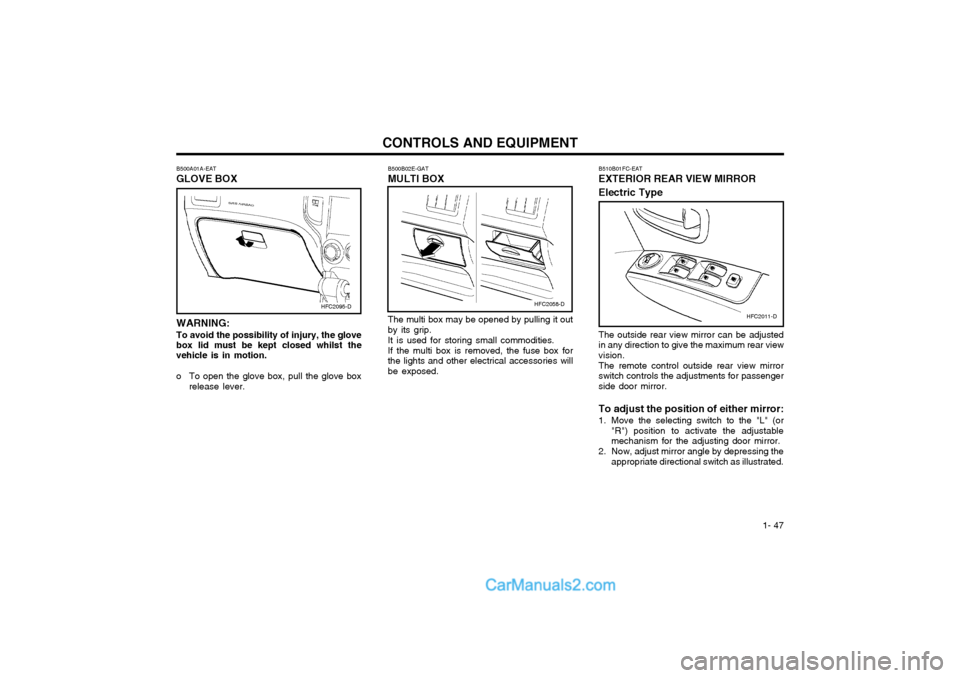
B500A01A-EAT GLOVE BOX WARNING: To avoid the possibility of injury, the glove box lid must be kept closed whilst the vehicle is in motion.
o To open the glove box, pull the glove box release lever. The multi box may be opened by pulling it out by its grip. It is used for storing small commodities.If the multi box is removed, the fuse box for the lights and other electrical accessories willbe exposed.
B500B02E-GAT MULTI BOX
HFC2095-DHFC2058-D
HFC2011-D
B510B01FC-EAT EXTERIOR REAR VIEW MIRROR Electric Type The outside rear view mirror can be adjusted in any direction to give the maximum rear viewvision. The remote control outside rear view mirror switch controls the adjustments for passengerside door mirror. To adjust the position of either mirror:
1. Move the selecting switch to the "L" (or
"R") position to activate the adjustable mechanism for the adjusting door mirror.
2. Now, adjust mirror angle by depressing the appropriate directional switch as illustrated.
Page 57 of 407
1- 49
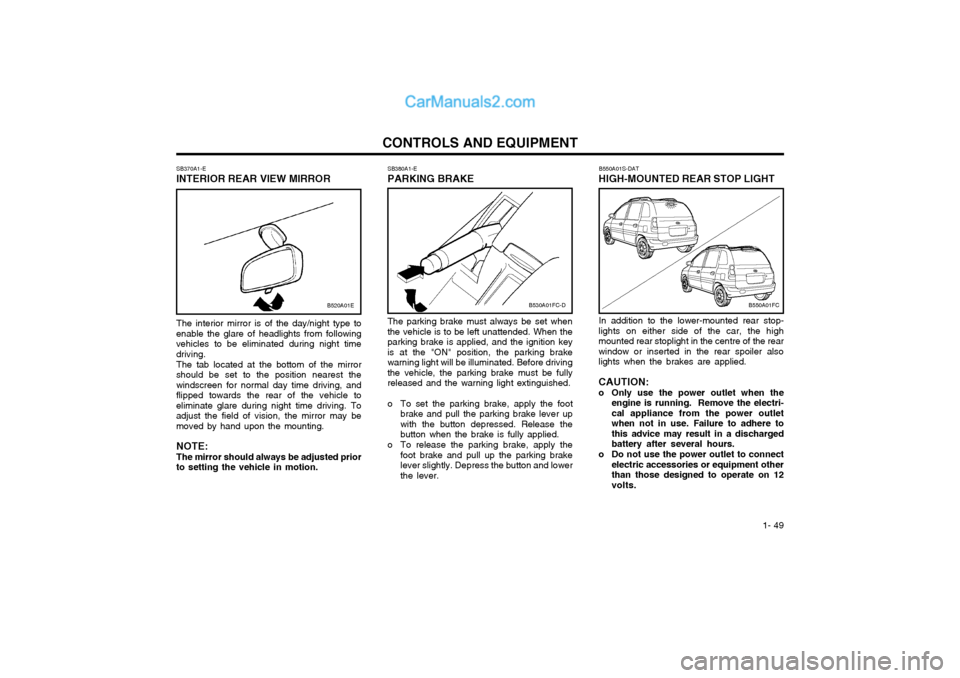
CONTROLS AND EQUIPMENTSB380A1-E PARKING BRAKE The parking brake must always be set when the vehicle is to be left unattended. When theparking brake is applied, and the ignition keyis at the "ON" position, the parking brakewarning light will be illuminated. Before drivingthe vehicle, the parking brake must be fullyreleased and the warning light extinguished.
o To set the parking brake, apply the foot brake and pull the parking brake lever up with the button depressed. Release thebutton when the brake is fully applied.
o To release the parking brake, apply the foot brake and pull up the parking brakelever slightly. Depress the button and lowerthe lever.
SB370A1-E
INTERIOR REAR VIEW MIRROR
The interior mirror is of the day/night type to
enable the glare of headlights from followingvehicles to be eliminated during night timedriving.
The tab located at the bottom of the mirror
should be set to the position nearest thewindscreen for normal day time driving, andflipped towards the rear of the vehicle toeliminate glare during night time driving. Toadjust the field of vision, the mirror may bemoved by hand upon the mounting.
NOTE:The mirror should always be adjusted prior
to setting the vehicle in motion.
B530A01FC-DB550A01FC
B520A01E
B550A01S-DAT
HIGH-MOUNTED REAR STOP LIGHT
In addition to the lower-mounted rear stop-
lights on either side of the car, the high
mounted rear stoplight in the centre of the rearwindow or inserted in the rear spoiler alsolights when the brakes are applied. CAUTION:
o Only use the power outlet when the engine is running. Remove the electri-cal appliance from the power outletwhen not in use. Failure to adhere tothis advice may result in a dischargedbattery after several hours.
o Do not use the power outlet to connect electric accessories or equipment otherthan those designed to operate on 12volts.
Page 59 of 407

1- 51
CONTROLS AND EQUIPMENT
B570A01FC-EAT
BONNET RELEASE
Pull the release lever inside the vehicle to
unlatch the bonnet. At the front of the vehicle, push the safety catch lever sidewards asshown and raise the bonnet by hand. Supportthe bonnet by means of the bonnet prop. Before closing the bonnet, ensure that the
prop is correctly stowed. Lower the bonnet byhand to a position of approximately 30cm fromthe closed position and allow the bonnet todrop. Do not attempt to close the bonnet bylowering the panel to the closed position andpressing upon the panel work since this mayresult in damage to the panel. CAUTION:Ensure that the bonnet prop has beenremoved prior to closing the bonnet. Al-ways check to ensure that the bonnet haslatched prior to setting the vehicle in mo-tion. WARNING: The bonnet prop must be correctly in- serted into the panel to prevent the possi-bility of injury arising from the bonnetfalling.
HFC2019
HFC2018-D
SB440A1-E
REMOTE FUEL FILLER FLAP
RELEASE (Not all models) The fuel filler flap may be opened from inside
the vehicle by pulling up on the fuel filler flap release.
NOTE: If the fuel filler flap will not open because
ice has formed around it, tap lightly or push on it to break the ice and release it.Do not lever the flap. If necessary, sprayaround the flap with an approved deicerfluid (do not use radiator anti-freeze) ormove the vehicle to a warm place andallow the ice to melt.
HFC2015-D
Page 60 of 407
CONTROLS AND EQUIPMENT
1- 52
B540A01FC-GAT
TAIL GATE
B540A01FC
WARNING: The tail gate should always be kept com-
pletely closed whilst the vehicle is in motion. If it is left open or ajar, poisonousexhaust gases may enter the car resultingin serious illness or death to the occu-pants. See additional warnings concerningexhaust gases on page 2-1.
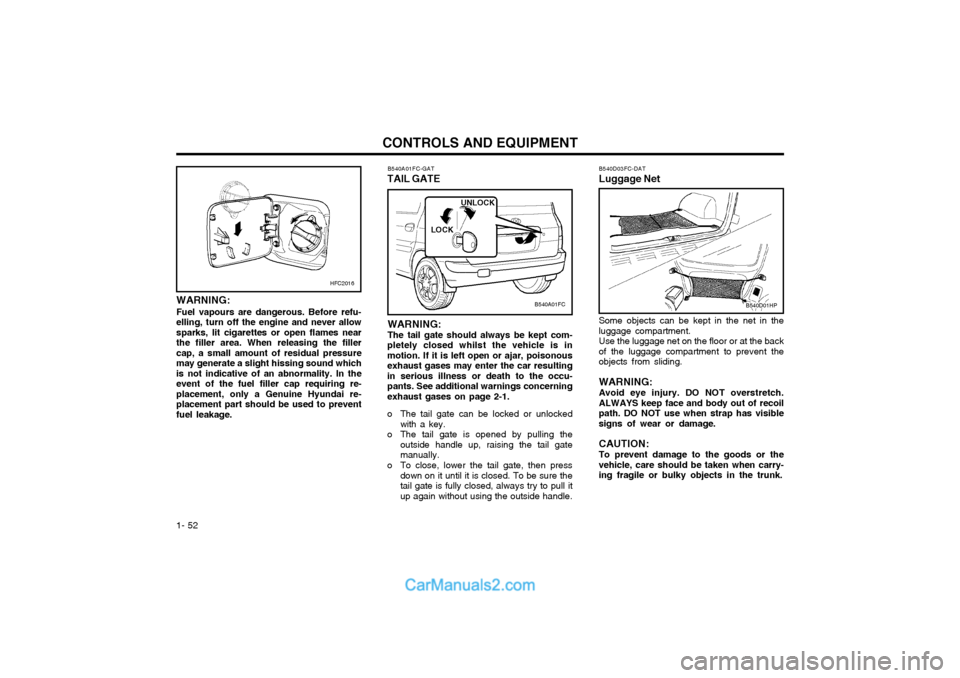
o The tail gate can be locked or unlocked with a key.
o The tail gate is opened by pulling the outside handle up, raising the tail gate manually.
o To close, lower the tail gate, then press down on it until it is closed. To be sure thetail gate is fully closed, always try to pull itup again without using the outside handle. LOCK
UNLOCK
B540D03FC-DAT Luggage Net Some objects can be kept in the net in the luggage compartment.Use the luggage net on the floor or at the backof the luggage compartment to prevent theobjects from sliding. WARNING: Avoid eye injury. DO NOT overstretch. ALWAYS keep face and body out of recoilpath. DO NOT use when strap has visiblesigns of wear or damage. CAUTION: To prevent damage to the goods or the vehicle, care should be taken when carry-ing fragile or bulky objects in the trunk.
B540D01HP
WARNING: Fuel vapours are dangerous. Before refu- elling, turn off the engine and never allowsparks, lit cigarettes or open flames nearthe filler area. When releasing the fillercap, a small amount of residual pressuremay generate a slight hissing sound whichis not indicative of an abnormality. In theevent of the fuel filler cap requiring re-placement, only a Genuine Hyundai re-placement part should be used to preventfuel leakage.
HFC2016
Page 64 of 407
CONTROLS AND EQUIPMENT
1- 56
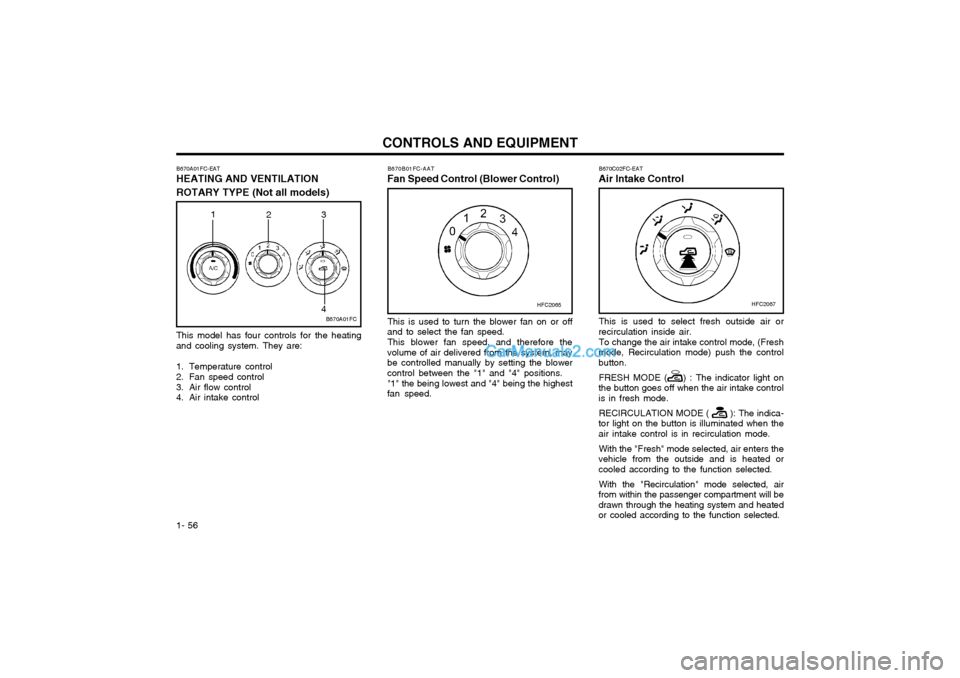
B670A01FC-EAT HEATING AND VENTILATION ROTARY TYPE (Not all models)
B670A01FC
1
23
4
This model has four controls for the heating
and cooling system. They are:
1. Temperature control
2. Fan speed control
3. Air flow control
4. Air intake control B670C02FC-EAT
Air Intake Control
HFC2067
This is used to select fresh outside air or
recirculation inside air.
To change the air intake control mode, (Fresh
mode, Recirculation mode) push the control button.
FRESH MODE (
) : The indicator light on
the button goes off when the air intake control is in fresh mode.
RECIRCULATION MODE (
): The indica-
tor light on the button is illuminated when the air intake control is in recirculation mode.
With the "Fresh" mode selected, air enters the
vehicle from the outside and is heated orcooled according to the function selected.
With the "Recirculation" mode selected, air
from within the passenger compartment will bedrawn through the heating system and heatedor cooled according to the function selected.
B670B01FC-AAT
Fan Speed Control (Blower Control)
HFC2065
This is used to turn the blower fan on or off
and to select the fan speed.
This blower fan speed, and therefore the
volume of air delivered from the system, may be controlled manually by setting the blowercontrol between the "1" and "4" positions.
"1" the being lowest and "4" being the highest
fan speed.
Page 68 of 407
CONTROLS AND EQUIPMENT
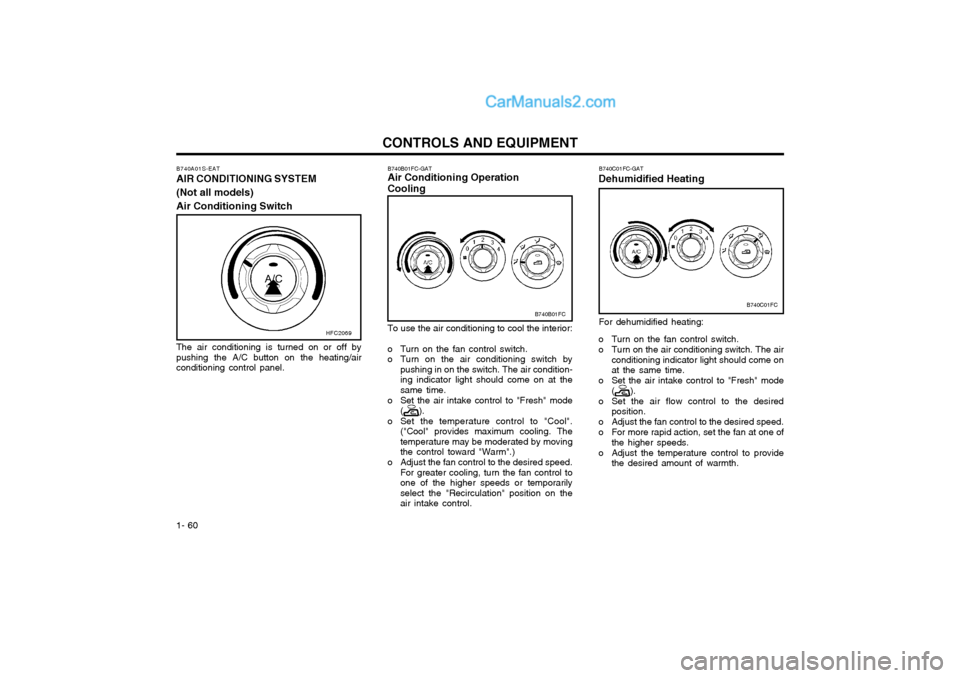
1- 60 B740C01FC-GAT
Dehumidified Heating
B740C01FC
For dehumidified heating:
o Turn on the fan control switch.
o Turn on the air conditioning switch. The air conditioning indicator light should come on at the same time.
o Set the air intake control to "Fresh" mode (
).
o Set the air flow control to the desired position.
o Adjust the fan control to the desired speed.
o For more rapid action, set the fan at one of the higher speeds.
o Adjust the temperature control to provide the desired amount of warmth.
B740B01FC-GAT Air Conditioning Operation Cooling
B740B01FC
To use the air conditioning to cool the interior:
o Turn on the fan control switch.
o Turn on the air conditioning switch by pushing in on the switch. The air condition-ing indicator light should come on at thesame time.
o Set the air intake control to "Fresh" mode (
).
o Set the temperature control to "Cool". ("Cool" provides maximum cooling. The temperature may be moderated by movingthe control toward "Warm".)
o Adjust the fan control to the desired speed. For greater cooling, turn the fan control toone of the higher speeds or temporarilyselect the "Recirculation" position on theair intake control.
B740A01S-EAT AIR CONDITIONING SYSTEM (Not all models)Air Conditioning Switch
The air conditioning is turned on or off by pushing the A/C button on the heating/airconditioning control panel. HFC2069
Page 74 of 407
DRIVING YOUR HYUNDAI
2- 2
C020A01O-EAT BEFORE STARTING THE ENGINEBefore you start the engine, you should al- ways:
1. Look around the vehicle to be sure there
are no flat tyres, puddles of oil or water or other indications of possible trouble.
2. After entering the car, check to be sure the parking brake is engaged.
3. Check that all windows, and lights are clean.
4. Check that the interior and exterior mirrors are clean and in position.
5. Check your seat, seatback and headrestraint to be sure they are in their proper positions.
6. Close all doors.
7. Fasten your seat belt and be sure that all other occupants have fastened theirs.
8. Turn off all lights and accessories that are not needed.
9. When you turn the ignition switch to "ON" check that all appropriate warning lights areoperating and that you have sufficient fuel.
10.Check the operation of warning lights and all bulbs when key is in the "ON" position.
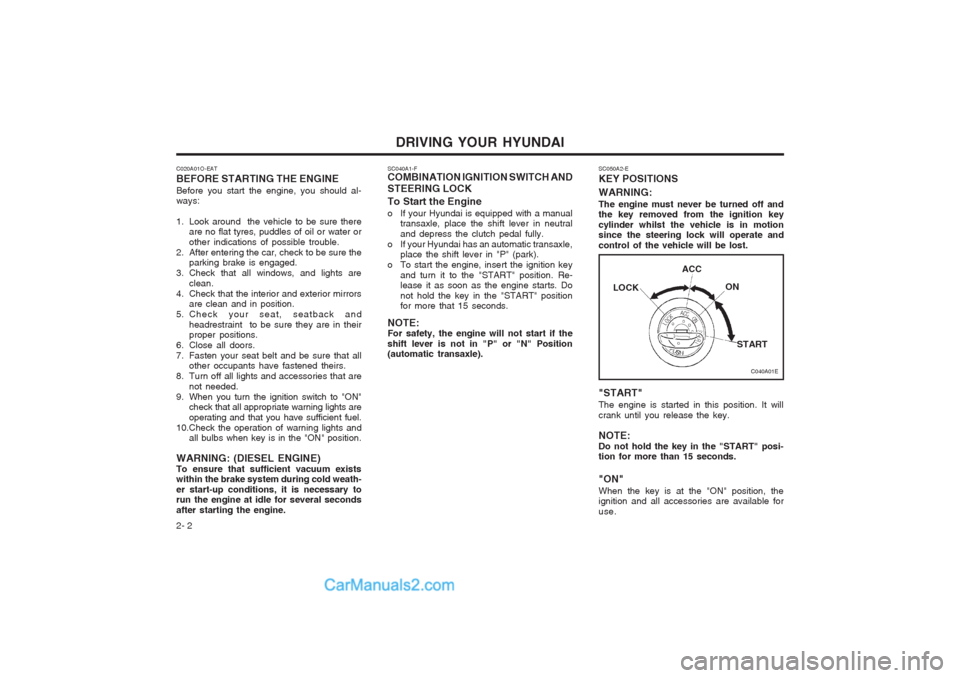
WARNING: (DIESEL ENGINE)To ensure that sufficient vacuum exists within the brake system during cold weath- er start-up conditions, it is necessary to run the engine at idle for several seconds after starting the engine. SC040A1-F COMBINATION IGNITION SWITCH AND STEERING LOCK To Start the Engine
o If your Hyundai is equipped with a manual
transaxle, place the shift lever in neutral and depress the clutch pedal fully.
o If your Hyundai has an automatic transaxle, place the shift lever in "P" (park).
o To start the engine, insert the ignition key and turn it to the "START" position. Re- lease it as soon as the engine starts. Do not hold the key in the "START" position for more that 15 seconds.
NOTE:For safety, the engine will not start if the shift lever is not in "P" or "N" Position (automatic transaxle). SC050A2-E KEY POSITIONS WARNING: The engine must never be turned off and the key removed from the ignition key cylinder whilst the vehicle is in motion since the steering lock will operate and control of the vehicle will be lost. "START" The engine is started in this position. It will crank until you release the key. NOTE: Do not hold the key in the "START" posi- tion for more than 15 seconds. "ON" When the key is at the "ON" position, the ignition and all accessories are available for use.
C040A01E
LOCK
ACC
ON
START
Page 75 of 407
DRIVING YOUR HYUNDAI 2- 3
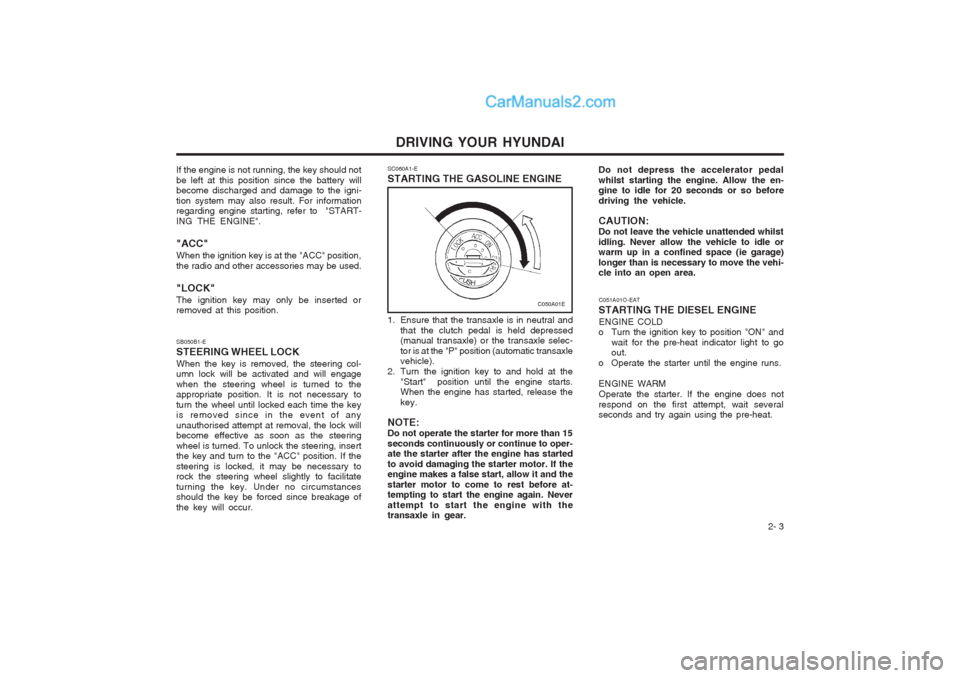
SB050B1-E STEERING WHEEL LOCKWhen the key is removed, the steering col- umn lock will be activated and will engage when the steering wheel is turned to the appropriate position. It is not necessary to turn the wheel until locked each time the key is removed since in the event of any unauthorised attempt at removal, the lock will become effective as soon as the steering wheel is turned. To unlock the steering, insert the key and turn to the "ACC" position. If the steering is locked, it may be necessary to rock the steering wheel slightly to facilitate turning the key. Under no circumstances should the key be forced since breakage of the key will occur. SC060A1-E STARTING THE GASOLINE ENGINE
1. Ensure that the transaxle is in neutral and
that the clutch pedal is held depressed (manual transaxle) or the transaxle selec- tor is at the "P" position (automatic transaxle vehicle).
2. Turn the ignition key to and hold at the "Start" position until the engine starts.When the engine has started, release the key.
NOTE:Do not operate the starter for more than 15seconds continuously or continue to oper- ate the starter after the engine has started to avoid damaging the starter motor. If the engine makes a false start, allow it and the starter motor to come to rest before at- tempting to start the engine again. Never attempt to start the engine with the transaxle in gear.
C050A01E
If the engine is not running, the key should not be left at this position since the battery will become discharged and damage to the igni- tion system may also result. For information regarding engine starting, refer to "START- ING THE ENGINE". "ACC" When the ignition key is at the "ACC" position, the radio and other accessories may be used. "LOCK" The ignition key may only be inserted or removed at this position. Do not depress the accelerator pedal whilst starting the engine. Allow the en- gine to idle for 20 seconds or so before driving the vehicle. CAUTION: Do not leave the vehicle unattended whilstidling. Never allow the vehicle to idle or warm up in a confined space (ie garage) longer than is necessary to move the vehi- cle into an open area.
C051A01O-EAT
STARTING THE DIESEL ENGINE ENGINE COLD
o Turn the ignition key to position "ON" and
wait for the pre-heat indicator light to goout.
o Operate the starter until the engine runs. ENGINE WARM Operate the starter. If the engine does not
respond on the first attempt, wait several seconds and try again using the pre-heat.
Page 76 of 407

DRIVING YOUR HYUNDAI
2- 4 C050B03S-EAT
NORMAL CONDITIONS The Starting Procedure:
1. Insert key, and fasten the seat belt.
2. Depress the clutch pedal fully and place the gearshift lever (manual transaxle) inneutral or the selector lever (automatic transaxle) in "P" (park) position.
3. After turning the ignition key to the "ON" position, make certain all warning lightsand gauges are functioning properly be- fore starting the engine.
4. On vehicles equipped with the diesel pre- heat indicator light, turn the ignition key tothe "ON" position. The diesel pre-heat indi- cator light will first illuminate in amber, and then after a short time, the amber illumina- tion will goes off, indicating that preheating is completed. SC060B1-E FUEL ECONOMY
The following suggestions are made to assist
in achieving the greatest degree of fuel economy.
o Maintaining a constant check on fuel con- sumption will enable the most economical use pattern and driving style to be adopt- ed.
o Avoid using the vehicle for very short jour- neys if possible, particularly when a coldstart is involved.
o Ensure that tyre pressures are maintained
at the correct level.
o Use only the recommended grade of fuel.
o Avoid carrying unnecessary weight, and if a roof rack is in use, remove it as soon aspossible after use.
NOTE: If the engine does not start 10 secondsafter the preheating is completed, turn the ignition key once more to the "LOCK" position, and then to the "ON" position, in order to preheat again. WARNING: Be sure that the clutch is fully depressed when starting a manual transaxle vehicle. This will prevent sudden movement should the vehicle be started in gear without the clutch depressed. Otherwise there is the potential to cause damage to the vehicle or injury to a person inside or outside of the vehicle as a result of this sudden vehicle movement.
5. Turn the ignition key to the "Start" position and release it when the engine starts.
C055B01B-GAT STARTING AND STOPPING THE EN- GINE FOR TURBO CHARGER INTER-COOLER (DIESEL ENGINE)
(1) Do not race the engine or suddenly accel- erate the engine immediately after starting it. If the engine is cold, allow the engine to idle for several seconds before it is driven to ensure sufficient lubrication of the turbo charger unit. (2) After high speed or extended driving, re-
quiring a heavy engine load, the engineshould be allowed to idle about 1 minute before turning it off.This idle time will allow the turbo charger to cool prior to shutting the engine off.
WARNING: Do not turn the engine off immediately after it has been subjected to a heavy load. Doing so may cause severe damage to the engine or turbo charger unit.
C050B01HP
Amber lamp ON Amber lamp OFF
Page 81 of 407
DRIVING YOUR HYUNDAI 2- 9
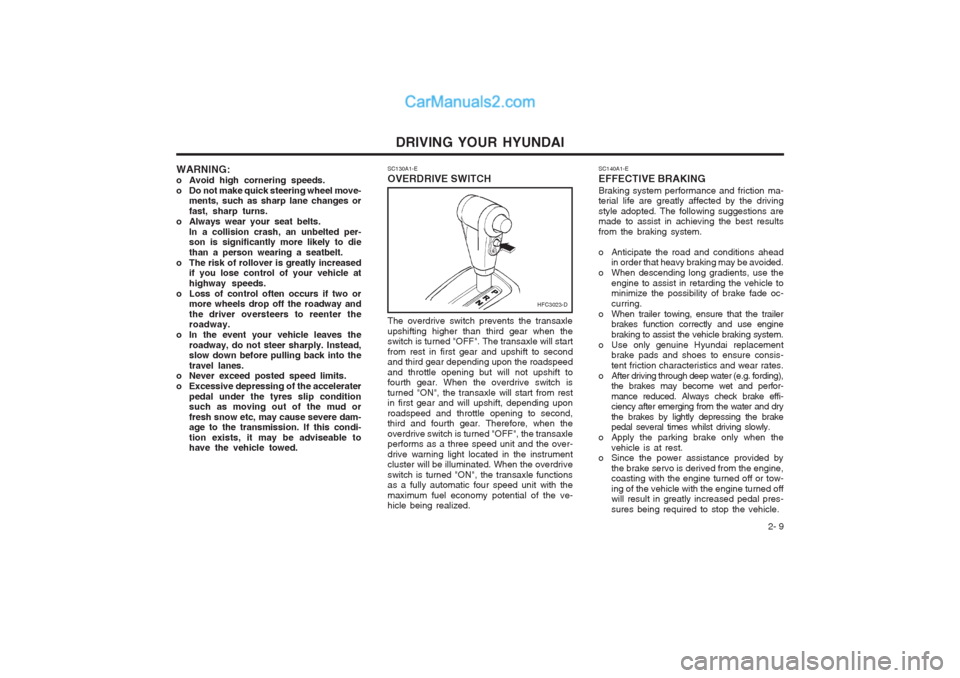
SC130A1-E OVERDRIVE SWITCH
The overdrive switch prevents the transaxle upshifting higher than third gear when the switch is turned "OFF". The transaxle will start from rest in first gear and upshift to second and third gear depending upon the roadspeed and throttle opening but will not upshift to fourth gear. When the overdrive switch is turned "ON", the transaxle will start from rest in first gear and will upshift, depending upon roadspeed and throttle opening to second, third and fourth gear. Therefore, when the overdrive switch is turned "OFF", the transaxle performs as a three speed unit and the over- drive warning light located in the instrument cluster will be illuminated. When the overdrive switch is turned "ON", the transaxle functions as a fully automatic four speed unit with the maximum fuel economy potential of the ve- hicle being realized.
SC140A1-E EFFECTIVE BRAKINGBraking system performance and friction ma- terial life are greatly affected by the driving style adopted. The following suggestions are made to assist in achieving the best results from the braking system.
o Anticipate the road and conditions ahead
in order that heavy braking may be avoided.
o When descending long gradients, use the engine to assist in retarding the vehicle to minimize the possibility of brake fade oc- curring.
o When trailer towing, ensure that the trailer brakes function correctly and use enginebraking to assist the vehicle braking system.
o Use only genuine Hyundai replacement brake pads and shoes to ensure consis-tent friction characteristics and wear rates.
o After driving through deep water (e.g. fording), the brakes may become wet and perfor-mance reduced. Always check brake effi- ciency after emerging from the water and dry the brakes by lightly depressing the brake pedal several times whilst driving slowly.
o Apply the parking brake only when the
vehicle is at rest.
o Since the power assistance provided by
the brake servo is derived from the engine,coasting with the engine turned off or tow- ing of the vehicle with the engine turned off will result in greatly increased pedal pres- sures being required to stop the vehicle.
HFC3023-D
WARNING:
o Avoid high cornering speeds.
o Do not make quick steering wheel move-ments, such as sharp lane changes orfast, sharp turns.
o Always wear your seat belts. In a collision crash, an unbelted per- son is significantly more likely to die than a person wearing a seatbelt.
o The risk of rollover is greatly increased if you lose control of your vehicle athighway speeds.
o Loss of control often occurs if two or more wheels drop off the roadway andthe driver oversteers to reenter the roadway.
o In the event your vehicle leaves the roadway, do not steer sharply. Instead,slow down before pulling back into the travel lanes.
o Never exceed posted speed limits.
o Excessive depressing of the accelerater
pedal under the tyres slip condition such as moving out of the mud or fresh snow etc, may cause severe dam- age to the transmission. If this condi- tion exists, it may be adviseable to have the vehicle towed.