light Hyundai Matrix 2005 Owner's Guide
[x] Cancel search | Manufacturer: HYUNDAI, Model Year: 2005, Model line: Matrix, Model: Hyundai Matrix 2005Pages: 407, PDF Size: 10.31 MB
Page 82 of 407

DRIVING YOUR HYUNDAI
2- 10 C300B01O-GAT TCS ON ModeIn the TCS ON mode, the indicator in the instrument cluster will not be illuminated. NOTE:
1) Turn off the engine. Then restart the
engine, and the TCS mode will auto- matically turn "ON".
2) When the traction control is operating properly, you can feel a slight pulsationin the vehicle. This is only the effect of brake control and indicates nothing unusual.
Driving hints TCS does not actively apply brakes. Be sure to decelerate the car sufficiently before enter- ing curves. CAUTION: When the TCS indicator blinks, SLIP con-trol has been activated. It also means that the road is slippery or your car is acceler- ating excessively. In this situation, release foot pressure from the accelerator pedal and maintain moderate speed. WARNING: Traction control is only a driving aid; all normal precautions for driving in inclem- ent weather and on slippery driving sur- faces should be observed.
The braking distance for cars equipped
with an anti-lock braking system may belonger than for those without it, in the following road conditions.
o Driving on rough, gravel or snow-cov-
ered roads.
o Driving with tyre chains installed.
o Driving on roads where the road sur- face is pitted or has different surfaceheight.
These roads should be driven at reduced
speeds. The safety features of an ABSequipped vehicle should not be tested by high speed driving or cornering. This could endanger the safety of yourself or others. C300A01O-EAT
BRAKE TRACTION CONTROL SYSTEM (BTCS) (Not all models)
On slippery road surfaces, the traction control system (TCS) limits the drive wheels from spinning excessively, thus helping the car to accelerate. It also provides sufficient driving force and steering performance as the car turns at accelerated speeds.
SLIP Control Limits the drive wheels from spinning exces-sively during starting or whilst making accel- erated turns on slippery roads to avoid losing the driving force of the front wheels.
o Do not hold the vehicle on the upgrade with
the accelerator pedal. This can cause the transmission to overheat. Always use the brake pedal or parking brake.
SC140B1-E ANTI-LOCK BRAKE SYSTEM (Not all models) The Anti-Lock Brake System (ABS) is de- signed to prevent wheel lock-up during sud- den braking or on hazardous road surfaces. The ABS control module monitors the wheel speed and controls the pressure applied to each brake. Thus, in emergency situations or on slick roads, ABS will increase vehicle con- trol during braking. NOTE: During ABS operation, a slight pulsation may be felt in the brake pedal when the brakes are applied. Also, a noise may be heard in the engine compartment whilst braking. These conditions are normal and indicate that the anti-lock brake system is functioning properly. WARNING: ABS will not prevent accidents due to im-proper or dangerous driving maneuvers. Even though vehicle control is improved during emergency braking, always maintain a safe distance between you and objects ahead. Vehicle speeds should always be reduced during extreme road conditions.
Page 83 of 407
DRIVING YOUR HYUNDAI 2- 11
SC150A1-F
DRIVING FOR ECONOMY You can save fuel and get more miles from
your car if you follow these suggestions:
o Drive smoothly. Accelerate at a moderate
rate. Don't make "jack-rabbit" starts or full- throttle shifts and maintain a steady cruis- ing speed. Don't race between stoplights. Try to adjust your speed to that of the other traffic so you don't have to change speeds unnecessarily.Avoid heavy traffic whenever possible. Al- ways maintain a safe distance from other vehicles so you can avoid unnecessary braking. This also reduces brake wear.
o Drive at a moderate speed. The faster you drive, the more fuel your car uses. Drivingat a moderate speed, especially on the highway, is one of the most effective ways to reduce fuel consumption.
o Don't "ride" the brake or clutch pedal. This can increase fuel consumption and alsoincrease wear on these components. In addition, driving with your foot resting on the brake pedal may cause the brakes to overheat, which reduces their effective- ness and may lead to more serious con-
sequences.
o Take care of your tyres. Keep them inflated to the recommended pressure. Incorrectinfla-tion, either too much or too little, re- sults in unnecessary tyre wear. Check the tyre pres-sures at least once a month.
C300D02O-GAT Indicator and WarningThe indicator should illuminate when the igni-
tion key is turned to "ON" or "START", but should go out after three seconds.If the indicator does not illuminate, have it checked by an Hyundai authorised repairer. Should there be any unusual conditions in the device, TCS illuminates as a warning.If TCS illuminates, pull your car to a safe place and stop the engine. Then, start the engine again to check if theTCS indicator goes out.If the indicator remains lit even after the engine has been started, have your car checked by an Hyundai authorised repairer. NOTE: When TCS illuminates, traction control isautomatically deactivated for safety. o Be sure that the wheels are aligned cor-
rectly. Improper alignment can result from hitting curbs or driving too fast over irregu- lar surfaces. Poor alignment causes faster tyre wear and may also result in other problems as well as greater fuel consump- tion.
o Keep your car in good condition. For better fuel economy and reduced maintenancecosts, maintain your car in accordance with the maintenance schedule in Section 5. If you drive your car in severe condi- tions, more frequent maintenance is re- quired (see Section 5 for details).
o Keep your car clean. For maximum ser- vice, your car should be kept clean and free of corrosive materials. It is especially important that mud, dirt, ice, etc. not be allowed to accumulate on the underside of the car. This extra weight can result in increased fuel consumption and also con- tribute to corrosion.
o Travel lightly. Don't carry unnecessary
weight in your car. Weight is an enemy ofgood fuel economy.
o Don't let the engine idle longer than neces- sary. If you are waiting (and not in traffic),turn off your engine and restart only when you're ready to go.
o Remember, your car does not require extended warm-up. As soon as the engineis running smoothly, you can drive away. In very cold weather, however, give your engine a slightly longer warm-up period.
3) When the engine starts, a click is heard
from the engine compartment; however, this is only the sound of traction control being checked.
4) When moving out of the mud or fresh snow, pressing the accelerator pedalmay not cause the engine speed to increase.
Page 87 of 407
DRIVING YOUR HYUNDAI 2- 15
YC200E2-E
Trailer or Vehicle Towing Tips
1. Before towing, check towbar ball and safe- ty cable connections as well as proper operation of the trailer running lights, brake lights, and turn signals.
2. Always drive your vehicle at a moderate speed (Less than 60 MPH)
3. Trailer towing requires more fuel than nor- mal conditions.
4. To maintain engine braking efficiency and electrical charging performance, do not usefifth gear (manual transaxle) or overdrive (automatic transaxle). 5. Always secure items in the trailer to pre-
vent load shift whilst driving.
6. Check the condition and air pressure of all tyres on the trailer and your car. Low tyrepressure can seriously affect the handling. Also check the spare tyre.
7. The vehicle/trailer combination is more af- fected by crosswind and buffeting. When being passed by a large vehicle,keep a constant speed and steer straight ahead. If there is too much wind buffeting slow down to get out of the other vehicle's air turbulence.
8. When parking your car and trailer, espe- cially on a hill, be sure to follow all thenormal precautions. Turn your front wheels into the curb, set the parking brake firmly, and put the transaxle in 1st or Reverse (manual) or Park (automatic). In addition, place wheel chocks at each of the trailer's tyres.
9. If the trailer has electric brakes, start your vehicle and trailer moving, and then applythe trailer brake controller by hand to be sure the brakes are working. This lets you check your electrical connection at the same time.
10.During your trip, check occasionally to be sure that the load is secure, and that thelights and any trailer brakes are still work- ing. 11.Avoid jerky starts, sudden acceleration or
sudden stops.
12.Avoid sharp turns and rapid lane changes.
13.Avoid holding the brake pedal down too long or too frequently. This could causethe brakes to overheat, resulting in re- duced braking efficiency.
14.When going down a hill, shift into a lower gear and use the engine braking effect. When ascending a long grade, downshiftthe transaxle to a lower gear and reduce speed to reduce chances of engine over- loading and/or overheating.
15.If you have to stop whilst going uphill, do not hold the vehicle in place by pressing onthe accelerator. This can cause the auto- matic transaxle to overheat. Use the park- ing brake or footbrake.
NOTE:When towing check transaxle fluid more
frequently.
CAUTION:If overheating should occur when towing,
(temperature gauge reads near red zone), taking the following action may reduce or eliminate the problem.
1. Turn off the air conditioner.
2. Reduce highway speed.
3. Select a lower gear when going uphill.
4. While in stop and go traffic, place the gear selection in park or neutral andidle the engine at a higher speed.
Towing BracketAttachment Location
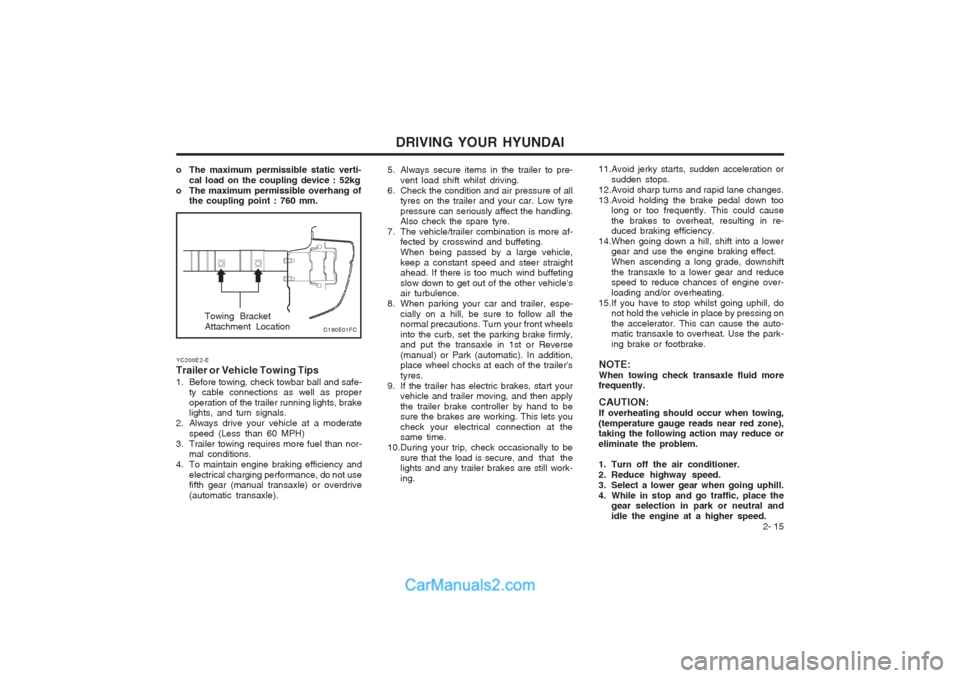
o The maximum permissible static verti-
cal load on the coupling device : 52kg
o The maximum permissible overhang of the coupling point : 760 mm.
C190E01FC
Page 88 of 407
3-1
IN CASE OF EMERGENCY
SD000A1-E
3. IN CASE OF EMERGENCY
SD020A1-E IF THE ENGINE WILL NOT START Seek assistance from the nearest Hyundai authorised repairer with regard to the method of ignition and fuel system diagnosis. CAUTION: If the engine refuses to start, no attemptshould be made to push or tow start the vehicle. Vehicles with automatic transaxle or fuel injection will not be able to be started in this manner since no drive is transmitted through the automatic transaxle whilst the engine is not running, and in the case of fuel injected derivatives, the fuel pump will not operate under tow start con- ditions. In addition, if the vehicle is equipped with an exhaust catalyst, dam- age to the catalyst may result if the vehicle is tow started. SD020B1-E
If the Engine Cannot be Cranked
D010C02A-EAT If Engine Turns Over Normally but Does Not Start
SSA3020C
1. Check fuel level.
2. With the key in the "OFF" position, check all connectors at ignition coils and spark plugs(For Petrol Engine) or check all con- nectors at glow plug and glow plug relay(For Diesel Engine). Reconnect any that may be disconnected or loose.
3. Check fuel line in the engine compartment.
4. If engine still refuses to start, call a Hyundai authorised repairer or seek other qualifiedassistance.
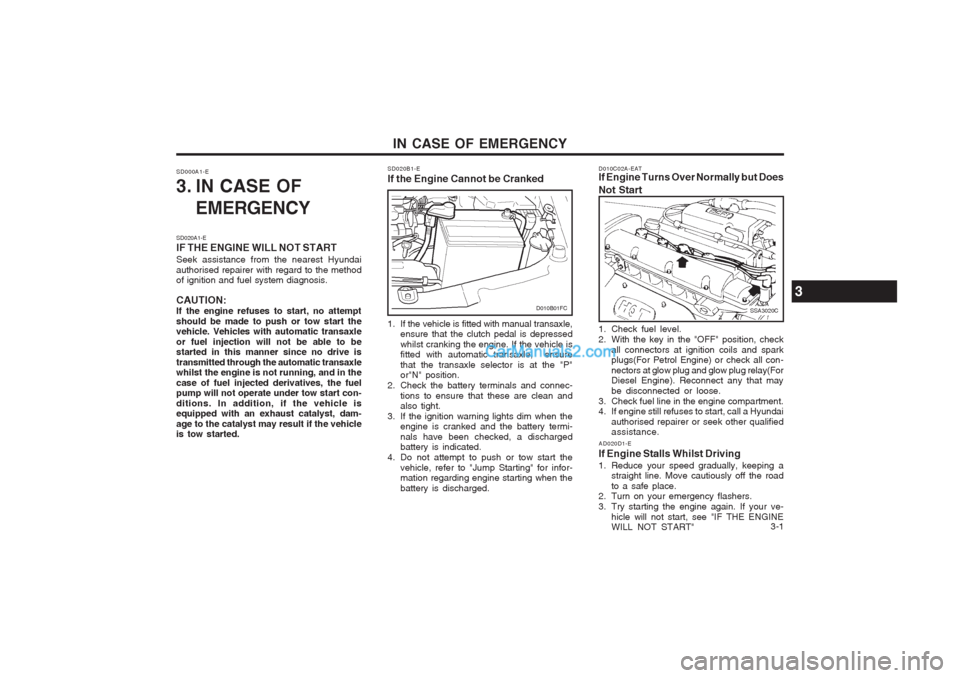
1. If the vehicle is fitted with manual transaxle,
ensure that the clutch pedal is depressed whilst cranking the engine. If the vehicle is fitted with automatic transaxle, ensure that the transaxle selector is at the "P" or"N" position.
2. Check the battery terminals and connec-
tions to ensure that these are clean andalso tight.
3. If the ignition warning lights dim when the engine is cranked and the battery termi- nals have been checked, a discharged battery is indicated.
4. Do not attempt to push or tow start the vehicle, refer to "Jump Starting" for infor-mation regarding engine starting when the battery is discharged. AD020D1-E
If Engine Stalls Whilst Driving
1. Reduce your speed gradually, keeping a straight line. Move cautiously off the road to a safe place.
2. Turn on your emergency flashers.
3. Try starting the engine again. If your ve-
hicle will not start, see "IF THE ENGINE WILL NOT START"
3
D010B01FC
Page 89 of 407
IN CASE OF EMERGENCY
3-2
CAUTION: Personal injury and damage to the vehicle may occur if jump starting is not per- formed correctly. If any doubt exists as to how this operation should be performed, seek assistance from qualified personnel. WARNING: Motor vehicle batteries contain sulphuric acid and emit hydrogen gas. Protective clothing should be worn and care exer- cised to prevent the acid from coming into contact with skin or clothing and the ve- hicle. Naked lights should not be permitted in the vicinity of the battery. Care should be exercised to prevent sparks occurring during connection. If acid accidentally comes into contact with skin or eyes, the affected area should immediately be flushed CAUTION: If the jump cable are incorrectly installed,
damage to the vehicle electrical system may occur, in particular the electronic components such as the Fuel Injection system computer and the Automatic
Transaxle computer. The battery must never be disconnected whilst the engine is running. SD040A2-E IF THE ENGINE OVERHEATS
If the temperature gauge indicates overheat- ing:
1. Pull off the road and stop as soon as it is safe to do so.
2. Place the gear selector lever in "P" (auto- matic), or neutral (manual transaxle) and set the parking brake. If the air condition- ing is on, turn it off.
3. If coolant is running out under the car or
steam is coming out from under the bonnet stop the engine. Do not open the bonnet until the coolant has stopped running or the steaming has stopped. If there is no visible loss of coolant and no steam, leave the engine running and check to be sure the engine cooling fan is operating.If the fan is not running, turn the engine off.
4. Check to see if the water pump drive belt is broken. If it is not missing, check to seethat it is tight.
SD030A2-E Jump Starting
with copious amounts of water and medi- cal assistance sought.
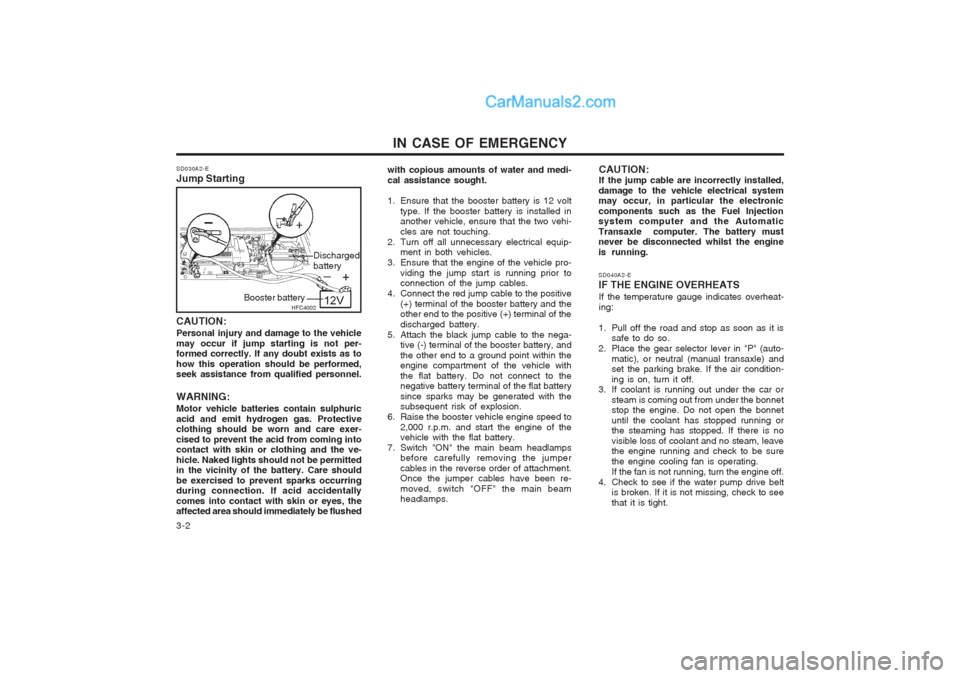
1. Ensure that the booster battery is 12 volt
type. If the booster battery is installed in another vehicle, ensure that the two vehi- cles are not touching.
2. Turn off all unnecessary electrical equip- ment in both vehicles.
3. Ensure that the engine of the vehicle pro- viding the jump start is running prior to connection of the jump cables.
4. Connect the red jump cable to the positive (+) terminal of the booster battery and theother end to the positive (+) terminal of the discharged battery.
5. Attach the black jump cable to the nega- tive (-) terminal of the booster battery, andthe other end to a ground point within the engine compartment of the vehicle with the flat battery. Do not connect to the negative battery terminal of the flat battery since sparks may be generated with the subsequent risk of explosion.
6. Raise the booster vehicle engine speed to 2,000 r.p.m. and start the engine of thevehicle with the flat battery.
7. Switch "ON" the main beam headlamps before carefully removing the jumper cables in the reverse order of attachment. Once the jumper cables have been re- moved, switch "OFF" the main beam headlamps.
HFC4002
Booster battery Discharged battery
Page 93 of 407

IN CASE OF EMERGENCY
3-6 SD070G1-E
5. Raising the Car
After inserting a wrench bar into the wheel nut
wrench, install the wrench bar into the jack as shown in the drawing. To raise the vehicle, turn the wheel nut wrench clockwise. As the jack begins to raise the vehicle, double check that it is properly positioned and will not slip. If the jack is on soft ground or sand, it may be necessary to place a stout piece of timber under the base of the jack to prevent it from sinking.
Raise the car high enough so that the fully
inflated spare wheel can be installed.
WARNING: Do not get under the car when it is support-
ed by the jack! The jack is solely designedfor wheel changing and is not intended to support the vehicle for other purposes. The use of purpose designed supports is neces- sary whilst the vehicle is raised and the operator is required to get underneath.
HFC4022
Wrench bar
Wheel nut wrench
SD070E1-E 3. Loosen Wheel Nuts The wheel nuts should be loosened slightly before raising the car. To loosen the nuts, turn the wheel brace counterclockwise. Ensure that the wheel brace socket is seated properly on the nut and that it cannot slip. Do not remove the nuts at this stage. SD070F1-F
4. Put the Jack in Place
The base of the jack should be placed on firm,level ground. The jack should be positioned as shown in the drawing.
D060D01FC-DHFC4006
Page 98 of 407
APPEARANCE CARE 4-1
garding the retreatment programme must be observed in accordance with the Terms and Conditions outlined in the separate Anti Per- foration Warranty Booklet. NOTE: The underbody should never be steamcleaned since the underbody coating may be removed by this process. During the interim period between powerwashing the underbody, the more vulnera- ble areas such as wheel arches should be hosed off particularly during the winter sea- son to prevent prolonged contact with road salts.Ensure that the various drain points located at the bottom of the door panels and sills are kept clear to prevent water from becom- ing trapped within the cavities. Wherever possible, the parking of the vehicle in a confined, poorly ventilated location (a ga- rage for example) should be avoided when the vehicle is wet or is covered with snow or ice. Under these conditions, the internal cavities of the vehicle will remain damp for prolonged periods of time which will en- courage corrosion. Parking the vehicle where good ventilation exists (outside for example) is preferable.
SE040A1-E VALETING Regular cleaning of the exterior paintwork serves two important functions. Firstly, the removal of abrasive dirt and contaminants will maintain the lustre of the paintwork and will prevent discolouration and dulling due to prolonged con- tact. Secondly, the presence of damage through im- pact or abrasion will be apparent allowing early rectification to be made thus preventing corro- sion from becoming established and spreading beneath the paint film. To avoid "water spotting" the vehicle should not be washed in direct sun- light particularly in the case of vehicles having dark body colours. The heat from the sun rays is absorbed by the paint film increasing the surface temperature. This action causes water used for washing to evaporate quickly leaving behind the deposits from the water and the shampoo used. Use only a shampoo intended for the purpose and ensure that the body work is thoroughly wetted to soften the dirt film prior to attempting to remove this. After removing the dirt film with a soft sponge, the body work should be thoroughly rinsed and then dried with a good quality chamois leather to prevent streaking or spotting of the paint work. Household detergents, solvents and abrasive cleaning materials should not be used in order to avoid damaging the paint film.
SE030A1-E UNDERBODY COATINGSEvery Hyundai passenger car receives a full underbody and cavity injection treatment during production. In order that this treatment may retain maximum effectiveness it is recommend- ed that the underbody receives a power wash and a thorough inspection after each winter season. In doing so any accumulations of mud, which act as moisture traps and com- bine with road salts to accelerate corrosion will be removed. In order to maintain the Anti Perforation Warranty, the requirements re-
SE000A1-E
4. APPEARANCE
CARE
SE020A1-E PROTECTING YOUR HYUNDAI FROM CORROSION By using the most advanced design and con- struction practices, every Hyundai is built to retain the original factory finish for many years. However, long term durability is also greatly dependant upon maintaining the various protec- tion systems and coatings used in manufacture since constant, exposure to the elements will result in a breakdown and loss of effectiveness. The following suggestions are made to assist in the maintenance of the vehicle bodywork.
4
Page 99 of 407
APPEARANCE CARE
4-2
Plastic wheel covers should be cleaned using a sponge and water. Cast alloy wheels should be cleaned using a mild soap or neutral deter- gent. Abrasive compounds must not be used since in the event of these damaging the lac- quer coating, oxidization of the aluminium wheel will occur, spoiling the appearance. The use of an a toothbrush will facilitate cleaning between the wheel "spokes".
ensure that accidental spillages are immediately flushed with water. Do not use abrasive cleaning materials which may damage the bumpers. Avoid subjecting the bumpers to high tempera- tures such as may be encountered in high bake paint ovens.
SE040B1-E STAIN/SPOT REMOVAL Should tree sap, dead insects or tar prove to be difficult to remove from the paint film, turpentine or a proprietary paint cutting compound may be used. Ensure that the area to be cleaned is not rubbed intensively to prevent breaking through the colour coat and exposing the under coat. SE040C1-E POLISHINGThe exterior paint work should be polished with a proprietary wax polish when water no longer collects in bead form on the paint work. The instructions of the product manufacturer should be adhered to. SE040E1-E BUMPER MAINTENANCEThe special material from which the bumpers are manufactured warrants special attention to pre- serve the appearance of the bumpers. Avoid contact with battery electrolyte or brake fluid and SE040F1-E ACCIDENT REPAIRSIn the event of the body work sustaining damage, the following points should be noted prior to repairs being undertaken. If body panels are replaced or repaired, anti corrosion treatment must be applied to the repair area. The product used must be compatible withthose used in manufacture. It is recommended that repairs are entrusted to a Hyundai authorised repairer to ensure that replacement parts used are of the same high quality as those used in manufacture of the vehicle and that the correct repair methods and materials will en- sure adequate levels of corrosion protection and the continued validity of the Anti Perforation Warranty. SE050A1-E INTERIORDuring the winter period, it is possible that the passenger compartment flooring may become wet from damp footwear or quantities of snow adhering to footwear. The carpet should not be allowed to remain in this condition since the carpet may begin to create musty smells and will
SE050D1-E SEAT BELTS Seat belts should be cleaned only with a mild soap solution. Strong detergents, solvents or bleaches may damage the belt webbing and therefore reduce the effectiveness of the belt. Belts which display signs of fraying, wear of cuts should be replaced. SE050E1-E WINDOWS A proprietary glass cleaner should be used to clean the inside of the windows. However, the rear heated windshield must only be cleaned using a light horizontal cleaning action. Care should be exercised to avoid the use of abrasive cleaners or contact with items of jewellery which may damage the heating elements.
promote corrosion of the floor pan in addition tothe carpet and under felt beginning to rot. SE050C1-E INTERIOR VALETING The soft trim and carpets should be maintained with the regular use of a vacuum cleaner. Heavy soiling should be removed with a dry cleaning agent recommended for this purpose following the instructions of the product manufacturer. Paint thinner, solvents or other such cleaning materials should not be used since damage to the upholstery may result.
Page 111 of 407
OWNER MAINTENANCE
6-4 SG020B1-E
DAILY OPERATING CHECKS
The following items should be checked on a
daily basis or whenever the vehicle is refuelled, whichever occurs sooner.
o Engine oil level.
o Engine coolant level.
o Power steering fluid level.
o Brake fluid level.
o Windscreen washer fluid level.
o Battery condition.
o Tyre condition and pressures.
o Operation and cleanliness of all lighting equipment.
o Windscreen wiper and washer operation.
o Horn operation.
o Warning light operation.
o Adjustment and cleanliness of mirrors.
o Seat and seat belt adjustment and opera- tion.
o Fluid leakage.
The vehicle must not be driven if the daily
operating checks indicate that any item of equip- ment related to the safety or roadworthiness ofthe vehicle is not functioning correctly. G030A01FC-EAT
ENGINE OIL
The correct engine oil level is of paramount
importance. An excessively high or low oil levelmay result in irreparable damage being sus-tained by the engine. The engine oil levelmust be checked on a daily basis, wheneverthe vehicle is refuelled or before starting along trip, whichever occurs sooner.
In addition, it is imperative that only an ap-
proved grade and specification of oil is used toavoid the possibility of serious engine damageand premature wear. The use of "budget price"oil is a false economy that must be avoided ifthe maximum reliability and useful life is to beobtained from the vehicle. G030B02O-EAT
Recommended Oil
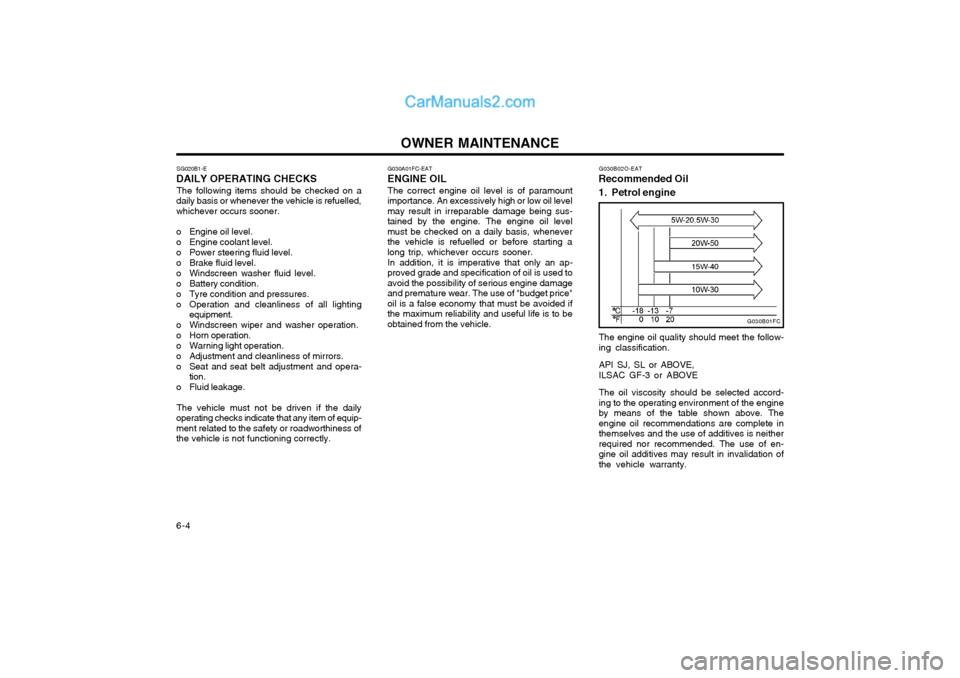
1. Petrol engine
G030B01FC
The engine oil quality should meet the follow- ing classification. API SJ, SL or ABOVE, ILSAC GF-3 or ABOVE The oil viscosity should be selected accord- ing to the operating environment of the engineby means of the table shown above. Theengine oil recommendations are complete inthemselves and the use of additives is neitherrequired nor recommended. The use of en-gine oil additives may result in invalidation ofthe vehicle warranty.
Page 119 of 407

OWNER MAINTENANCE
6-12 G070A01E-EAT AIR CLEANER ELEMENT REPLACEMENT
SSA6062A
5. Replace the plug lead ensuring that the cap is pushed firmly into place. Confirm that the cap is correctly seated by lightlypulling upon it.
NOTE:When replacing the spark plug, alwaysuse the genuine parts recommended. Recommended Spark Plugs
RC10YC4
BKR5ES-11
NGK
CHAMPION
HFC5003
G070A02FC
Petrol engine
Diesel engine
To replace the air cleaner element, remove the air intake ducting from the air flow sensorbody and unfasten the spring clips holding theair flow sensor top to the body. Lift out the airflow sensor followed by the air cleaner ele-ment. Replacement of the element is thereverse of the above.
SSA6061C
Prior to installing a sparking plug, the gap between the centre and outer electrodes mustbe checked and adjusted as necessary.Adjustment is facilitated by bending the outerelectrode towards or away from the centreelectrode. Under no circumstances should at-tempts be made to adjust the position of thecentre electrode.
4. Insert the sparking plug into the cylinder head and using a suitable plug socket, slowly rotate the sparking plug, (beingcareful not to cross-thread) until the plugcontacts the seating area. Tighten the plug with plug socket by a further 1/2 to 3/4 of a furn only.