belt Hyundai Matrix 2005 Workshop Manual
[x] Cancel search | Manufacturer: HYUNDAI, Model Year: 2005, Model line: Matrix, Model: Hyundai Matrix 2005Pages: 407, PDF Size: 10.31 MB
Page 192 of 407
1FEATURES OF YOUR HYUNDAI
28CHILD RESTRAINT SYSTEM
B230A03A-GAT (If Installed) Children riding in the car should sit in the rear seat and must always beproperly restrained to minimize the risk of injury in an accident, sudden stop or sudden maneuver. Accordingto accident statistics, children are safer when properly restrained in the rear seats than in the front seat. Largerchildren not in a child restraint should use one of the seat belts provided. You are required by law to use safetyrestraints for children. If small children ride in your vehicle you must put them in a child restraint system (safety seat).Children could be injured or killed in a crash if their restraints are not properly secured. For small children and ba-bies, a child seat or infant seat must be used. Before buying a particular child restraint system, make sure it fits yourcar and seat belts, and fits your child. Follow all the instructions provided by the manufacturer when installing thechild restraint system.
!WARNING:
o A child restraint system must be placed in the rear seat. Never install a child or infant seat on the front passenger's seat.Should an accident occur and cause the passenger side airbag to deploy, it could severely in-jure or kill an infant or child seated in an infant or child seat. Thus, only use a child restraint in therear seat of your vehicle.
o Since a safety belt or child re-
straint system can become veryhot if it is left in a closed vehicle, be sure to check the seat cover and buckles before placing achild there.
o When the child restraint system
is not in use, fasten it with asafety belt so that it will not be thrown forward in the case of a sudden stop or an accident.
!
B220C02FC
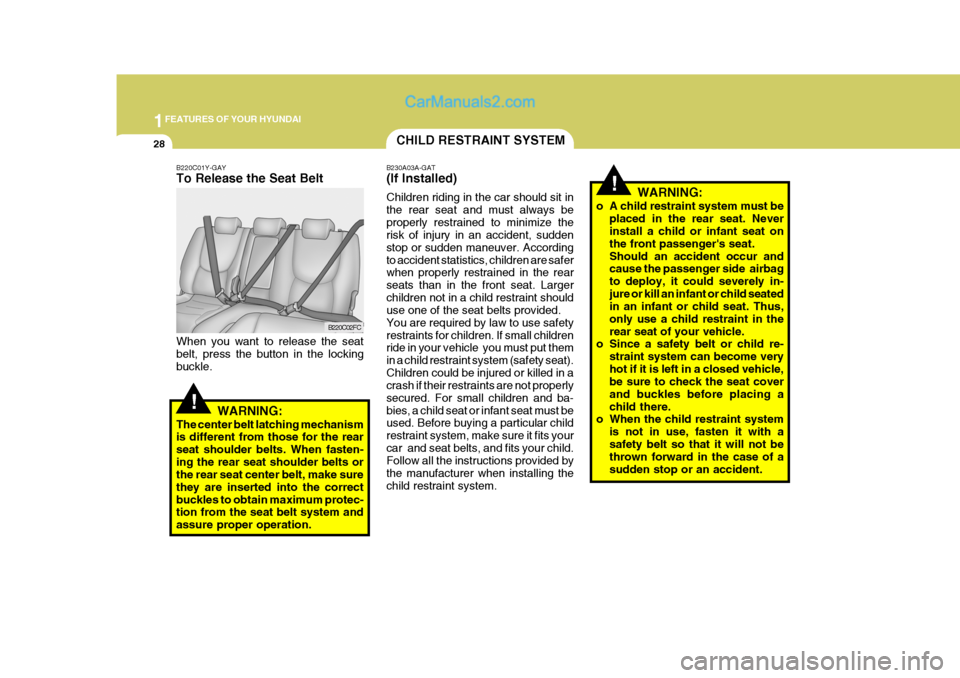
B220C01Y-GAY To Release the Seat Belt When you want to release the seat belt, press the button in the locking buckle.
WARNING:
The center belt latching mechanism is different from those for the rear seat shoulder belts. When fasten-ing the rear seat shoulder belts or the rear seat center belt, make sure they are inserted into the correctbuckles to obtain maximum protec- tion from the seat belt system and assure proper operation.
Page 193 of 407
1
FEATURES OF YOUR HYUNDAI
29
o Children who are too large to be
in a child restraint should will sit in the rear seat and be restrained with the available lap/shoulder belts. Never allow children to ridein the front passenger seat.
o Always make sure that the shoul-
der belt portion of the outboardlap/shoulder belt is positioned midway over the shoulder, never across the neck or behind theback. Moving the child closer to the center of the vehicle may help provide a good shoulder belt fit. The lap belt portion of the lap/ shoulder belt or the center seatlap belt must always be posi- tioned as low as possible on the child's hips and as snug as pos-sible.
o If the seat belt will not properly fit
the child, Hyundai recommendsthe use of an approved booster seat in the rear seat in order to raise the child's seating heightso that the seat belt will properly fit the child.o Never allow a child to stand up orkneel on the seat.
o Never use an infant carrier or child safety seat that "hooks" over a seatback; it may not pro-vide adequate security in an ac- cident.
o Never allow a child to be held in
a person's arms while they are ina moving vehicle, as this could result in serious injury to thechild in the event of an accident or a sudden stop. Holding a child in a moving vehicle does not provide the child with any means of protection during an accident,even if the person holding the child is wearing a seat belt.
o If the child restraint seat is not
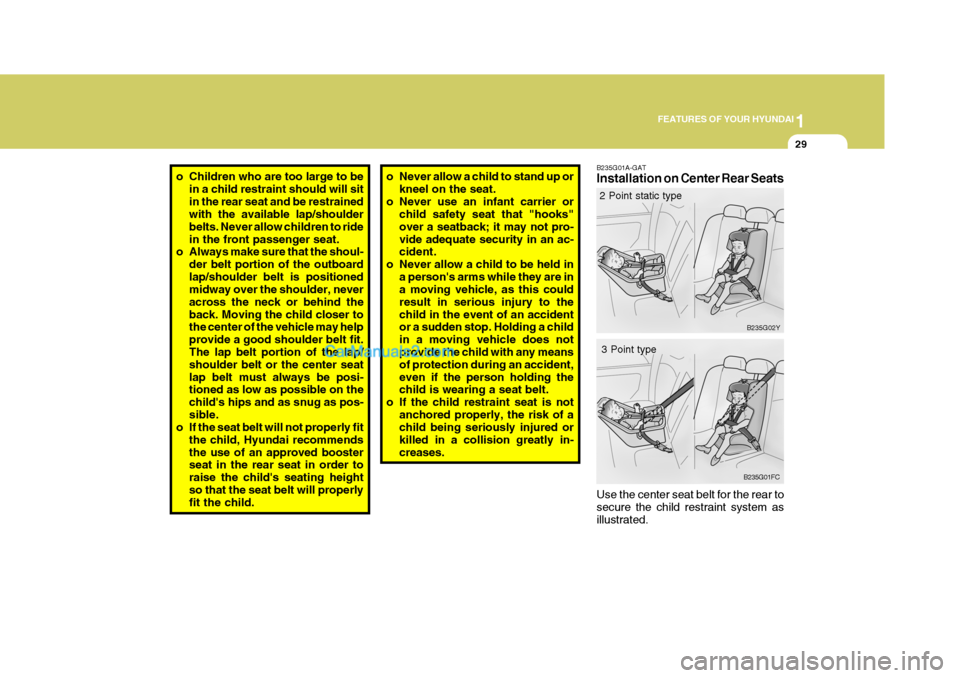
anchored properly, the risk of achild being seriously injured or killed in a collision greatly in-creases. B235G01A-GAT Installation on Center Rear Seats
B235G02Y
B235G01FC
2 Point static type
3 Point type
Use the center seat belt for the rear to secure the child restraint system as illustrated.
Page 194 of 407
1FEATURES OF YOUR HYUNDAI
30
!
If you need to tighten the belt, pull more webbing toward the retractor.When you unbuckle the seat belt and allow it to retract, the retractor will automatically revert back to its normalseated passenger emergency locking usage condition. NOTE:
o Before installing the child re-
straint system, read the instruc- tions supplied by the child re- straint system manufacturer.
o If the seat belt does not operate as described, have the systemchecked immediately by yourauthorized Hyundai dealer.
WARNING:
Do not install any child restraintsystem in the front passenger seat.Should an accident occur and cause the passenger's side airbag to de- ploy, it could severely injure or killan infant or child seated in an infant or child seat. Therefore, only use a child restraint system in the rearseat of your vehicle.
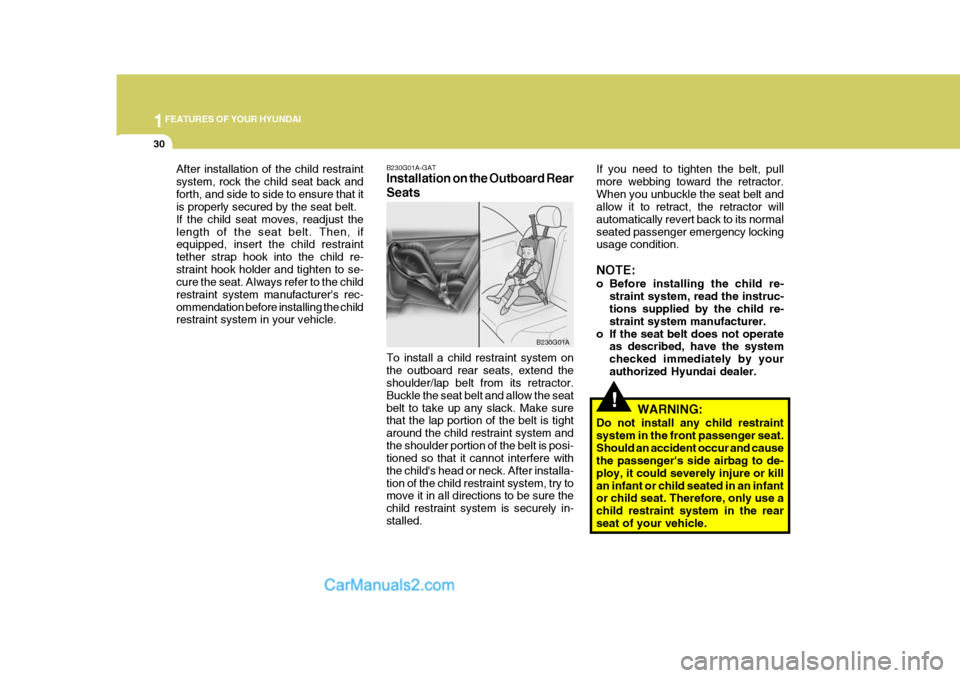
B230G01A-GAT Installation on the Outboard Rear Seats To install a child restraint system on the outboard rear seats, extend the shoulder/lap belt from its retractor. Buckle the seat belt and allow the seatbelt to take up any slack. Make sure that the lap portion of the belt is tight around the child restraint system andthe shoulder portion of the belt is posi- tioned so that it cannot interfere with the child's head or neck. After installa-tion of the child restraint system, try to move it in all directions to be sure the child restraint system is securely in-stalled.
B230G01A
After installation of the child restraintsystem, rock the child seat back andforth, and side to side to ensure that it is properly secured by the seat belt. If the child seat moves, readjust thelength of the seat belt. Then, if equipped, insert the child restraint tether strap hook into the child re-straint hook holder and tighten to se- cure the seat. Always refer to the child restraint system manufacturer's rec-ommendation before installing the child restraint system in your vehicle.
Page 196 of 407
1FEATURES OF YOUR HYUNDAI
32
Römer ISOFIX GR1 and the Römer Duo ISOFIX / Britax Duo ISOFIX isapproved according to the requirement ECE-R44. This seat has been tested extensively by Hyundai and is recom-mended for your Hyundai. NOTE: At present, this seat is the only one complying with that provision. Incase that other manufacturers will furnish proof of a respective certifi- cation, Hyundai is going to evalu-ate this seat carefully and will give a recommendation provided that seat complies to the law. Please askyour Hyundai dealer in this respect.
!
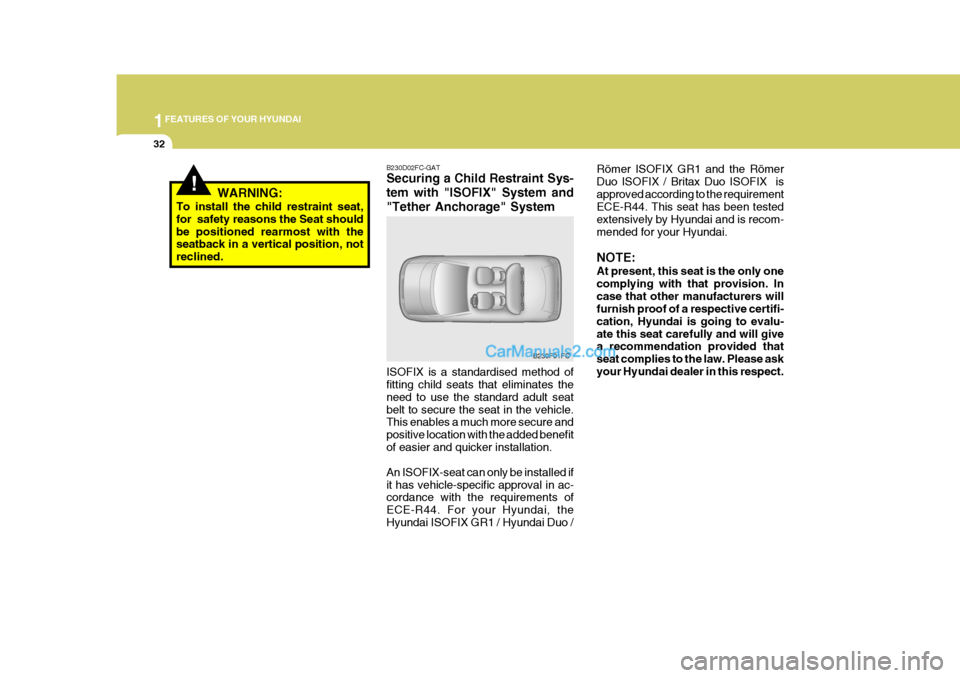
B230D02FC-GAT Securing a Child Restraint Sys- tem with "ISOFIX" System and"Tether Anchorage" System ISOFIX is a standardised method of fitting child seats that eliminates the need to use the standard adult seatbelt to secure the seat in the vehicle. This enables a much more secure and positive location with the added benefitof easier and quicker installation. An ISOFIX-seat can only be installed if it has vehicle-specific approval in ac- cordance with the requirements of ECE-R44. For your Hyundai, theHyundai ISOFIX GR1 / Hyundai Duo / B230F01FC
WARNING:
To install the child restraint seat,for safety reasons the Seat shouldbe positioned rearmost with the seatback in a vertical position, not reclined.
Page 197 of 407
1
FEATURES OF YOUR HYUNDAI
33
2. Connect the tether strap hook to the
child restraint hook holder and tighten to secure the seat. Refer to "Securing a Child Restraint System with the Tether Anchorage System"on page 1-31.
B230D02FC-1
B230D03FC
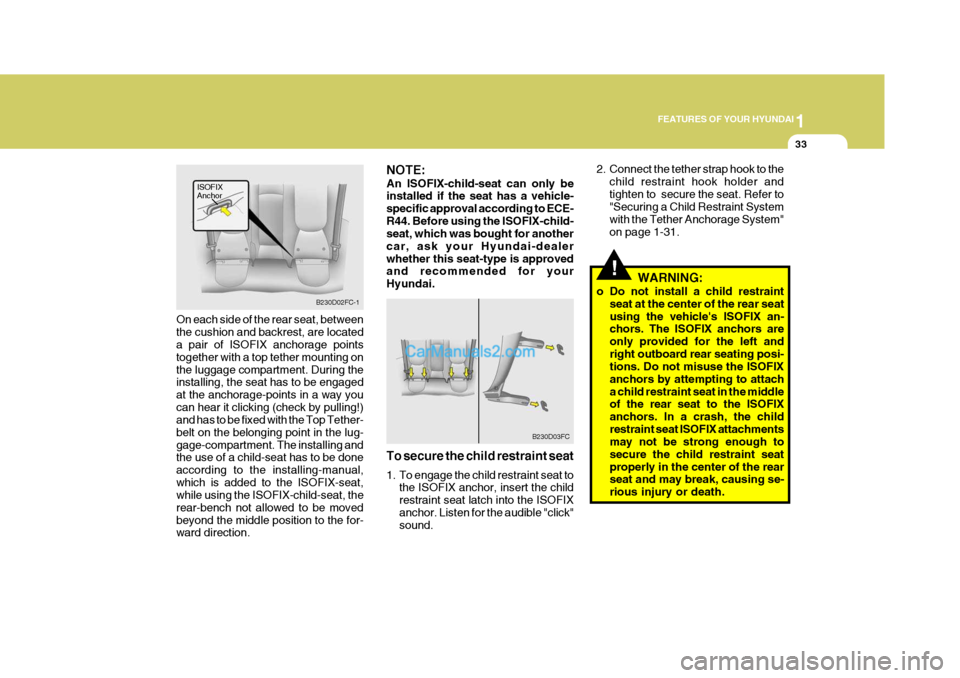
On each side of the rear seat, betweenthe cushion and backrest, are located a pair of ISOFIX anchorage points together with a top tether mounting onthe luggage compartment. During the installing, the seat has to be engaged at the anchorage-points in a way youcan hear it clicking (check by pulling!) and has to be fixed with the Top Tether- belt on the belonging point in the lug-gage-compartment. The installing and the use of a child-seat has to be done according to the installing-manual,which is added to the ISOFIX-seat, while using the ISOFIX-child-seat, the rear-bench not allowed to be movedbeyond the middle position to the for- ward direction. ISOFIX Anchor
!WARNING:
o Do not install a child restraint seat at the center of the rear seat using the vehicle's ISOFIX an- chors. The ISOFIX anchors are only provided for the left andright outboard rear seating posi- tions. Do not misuse the ISOFIX anchors by attempting to attacha child restraint seat in the middle of the rear seat to the ISOFIX anchors. In a crash, the childrestraint seat ISOFIX attachments may not be strong enough to secure the child restraint seatproperly in the center of the rear seat and may break, causing se- rious injury or death.
NOTE: An ISOFIX-child-seat can only be installed if the seat has a vehicle- specific approval according to ECE-R44. Before using the ISOFIX-child- seat, which was bought for another car, ask your Hyundai-dealerwhether this seat-type is approved and recommended for your Hyundai. To secure the child restraint seat
1. To engage the child restraint seat tothe ISOFIX anchor, insert the child restraint seat latch into the ISOFIXanchor. Listen for the audible "click" sound.
Page 199 of 407
1
FEATURES OF YOUR HYUNDAI
35
forward too quickly, the seat belt re- tractor will lock into position. In certainfrontal collisions, the pre-tensioner will activate and pull the seat belt into tighter contact against the occupant'sbody.
HXG229
B180B01A-GAT Pre-tensioner Seat Belt (If Installed) Your Hyundai vehicle is equipped with driver's and front passenger's pre-tensioner seat belts. The purpose of the pre-tensioner is to make sure that the seat belts fit tightly against theoccupant's body in certain frontal col- lisions. The pre-tensioner seat belts can beactivated with the airbags. The pre-tensioner seat belt operates in a similar same way as an Emer- gency Locking Retractor (ELR) type ofseat belt. When the vehicle stops sud- denly, or if the occupant tries to lean
B180B01O
Driver's airbag1
2 3Passenger's airbag
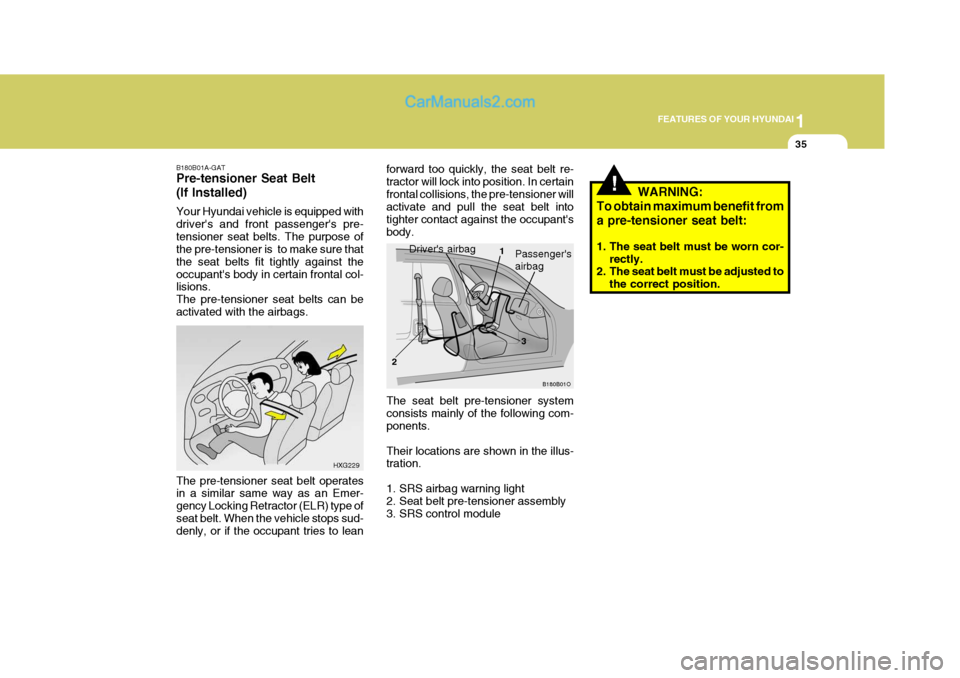
The seat belt pre-tensioner system consists mainly of the following com- ponents. Their locations are shown in the illus- tration.
1. SRS airbag warning light
2. Seat belt pre-tensioner assembly
3. SRS control module
!WARNING:
To obtain maximum benefit from a pre-tensioner seat belt:
1. The seat belt must be worn cor- rectly.
2. The seat belt must be adjusted to
the correct position.
Page 200 of 407
1FEATURES OF YOUR HYUNDAI
36
!WARNING:
o Pre-tensioners are designed to operate only one time. After acti- vation, pre-tensioner seat belts must be replaced. All seat belts,of any type, should always be replaced after they have been worn during a collision.
o The pre-tensioner seat belt as- sembly mechanisms become hotduring activation. Do not touchthe pre-tensioner seat belt as- semblies for several minutes af- ter they have been activated.
o Do not attempt to inspect or re- place the pre-tensioner seat beltsyourself. This must be done byan authorized Hyundai dealer.
o Do not strike the pre-tensioner
seat belt assemblies.
o Do not attempt to service or re- pair the pre-tensioner seat beltsystem in any manner.
CAUTION:
o Because the sensor that activates the SRS airbag is connected withthe pre-tensioner seat belt, theSRS airbag warning light on the instrument panel will blink for approximately 6 seconds af-ter the ignition key has been turned to the "ON" position, and then it should turn off.
o If the pre-tensioner seat belt is not working properly, this warn-ing light will illuminate even ifthere is no malfunction of the SRS airbag system . If the SRS airbag warning light does notilluminate when the ignition key is turned to "ON", or if it remains illuminated after blinking for ap-proximately 6 seconds, or if it illuminates while the vehicle is being driven, please have an au-thorized Hyundai dealer inspect the pre-tensioner seat belts and SRS airbag system as soon aspossible.!
AIR
BAG
NOTE:
o Both the driver's and front
passenger's pre-tensioner seat belts will be activated in certainfrontal collisions. The pre- tensioner seat belts can be acti- vated with the airbags. The pre-tensioners will be activated un- der these conditions even if the seat belts are not being worn atthe time of the collision.
o When the pre-tensioner seat belts
are activated, a loud noise maybe heard and fine dust, which may appear to be smoke, may be visible in the passenger compart-ment. These are normal operat- ing conditions and are not haz- ardous.
o Although it is harmless, the fine dust may cause skin irritationand should not be breathed forprolonged periods. Wash your hands and face thoroughly after an accident in which the pre-tensioner seat belts were acti- vated.
Page 201 of 407
1
FEATURES OF YOUR HYUNDAI
37
o Improper handling of the pre-
tensioner seat belt assemblies, and failure to heed the warnings to not strike, modify, inspect, re-place, service or repair the pre- tensioner seat belt assemblies may lead to improper operationor inadvertent activation and se- rious injury.
o Always wear seat belts when driv-
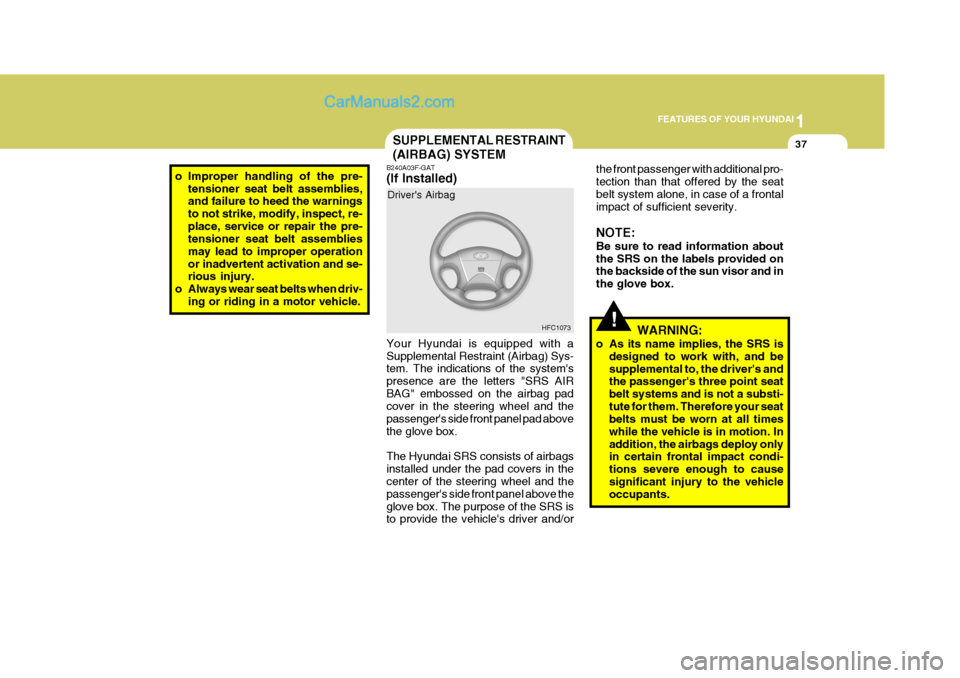
ing or riding in a motor vehicle. B240A03F-GAT (If Installed) Your Hyundai is equipped with a Supplemental Restraint (Airbag) Sys- tem. The indications of the system's presence are the letters "SRS AIRBAG" embossed on the airbag pad cover in the steering wheel and the passenger's side front panel pad abovethe glove box. The Hyundai SRS consists of airbags installed under the pad covers in the center of the steering wheel and the passenger's side front panel above theglove box. The purpose of the SRS is to provide the vehicle's driver and/orHFC1073
Driver's Airbag
SUPPLEMENTAL RESTRAINT (AIRBAG) SYSTEM
!
the front passenger with additional pro- tection than that offered by the seatbelt system alone, in case of a frontal impact of sufficient severity. NOTE: Be sure to read information about the SRS on the labels provided on the backside of the sun visor and in the glove box.
WARNING:
o As its name implies, the SRS is designed to work with, and besupplemental to, the driver's and the passenger's three point seat belt systems and is not a substi-tute for them. Therefore your seat belts must be worn at all times while the vehicle is in motion. Inaddition, the airbags deploy only in certain frontal impact condi- tions severe enough to causesignificant injury to the vehicle occupants.
Page 202 of 407
1FEATURES OF YOUR HYUNDAI
38
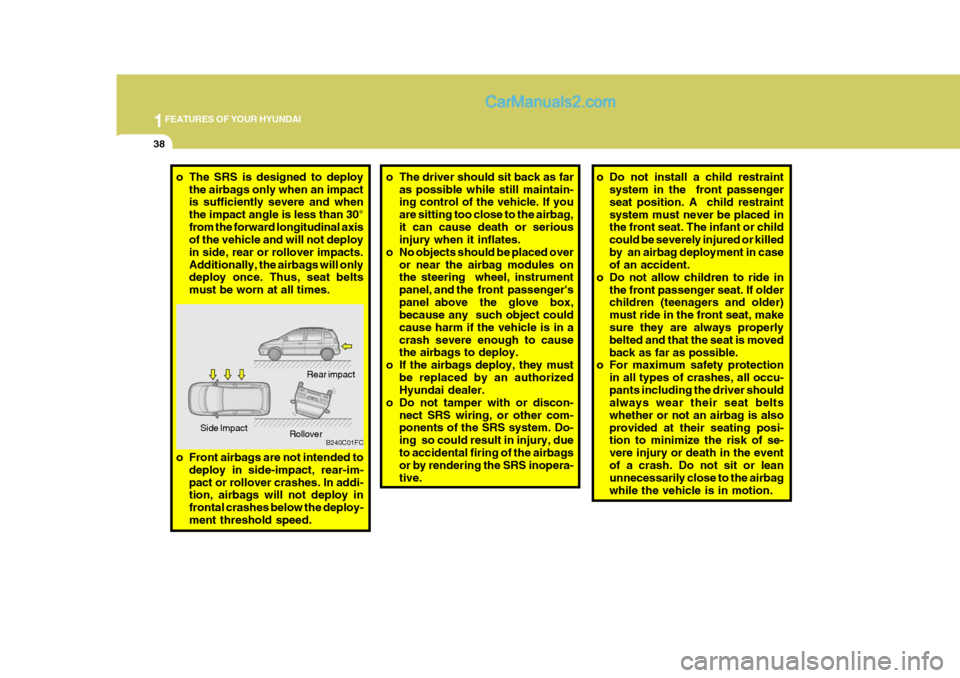
o Front airbags are not intended to
deploy in side-impact, rear-im- pact or rollover crashes. In addi- tion, airbags will not deploy in frontal crashes below the deploy-ment threshold speed.
o Do not install a child restraintsystem in the front passenger seat position. A child restraintsystem must never be placed in the front seat. The infant or child could be severely injured or killedby an airbag deployment in case of an accident.
o Do not allow children to ride in
the front passenger seat. If olderchildren (teenagers and older) must ride in the front seat, makesure they are always properly belted and that the seat is moved back as far as possible.
o For maximum safety protection
in all types of crashes, all occu-pants including the driver should always wear their seat belts whether or not an airbag is alsoprovided at their seating posi- tion to minimize the risk of se- vere injury or death in the eventof a crash. Do not sit or lean unnecessarily close to the airbag while the vehicle is in motion.o The driver should sit back as far
as possible while still maintain- ing control of the vehicle. If you are sitting too close to the airbag,it can cause death or serious injury when it inflates.
o No objects should be placed over or near the airbag modules onthe steering wheel, instrument panel, and the front passenger'spanel above the glove box, because any such object could cause harm if the vehicle is in acrash severe enough to cause the airbags to deploy.
o If the airbags deploy, they must be replaced by an authorizedHyundai dealer.
o Do not tamper with or discon- nect SRS wiring, or other com-ponents of the SRS system. Do- ing so could result in injury, dueto accidental firing of the airbags or by rendering the SRS inopera- tive.
o The SRS is designed to deploy
the airbags only when an impact is sufficiently severe and when the impact angle is less than 30°from the forward longitudinal axis of the vehicle and will not deploy in side, rear or rollover impacts.Additionally, the airbags will only deploy once. Thus, seat belts must be worn at all times.
B240C01FC
Rear impact
Side Impact Rollover
Page 203 of 407
1
FEATURES OF YOUR HYUNDAI
39
o The SRS airbag system must
deploy very rapidly to provide protection in a crash. If an occu-pant is out of position because of not wearing a seat belt, the airbag may forcefully contact theoccupant causing serious or fa- tal injuries. B240B01FC-GAT SRS Components and Functions
B240B01L
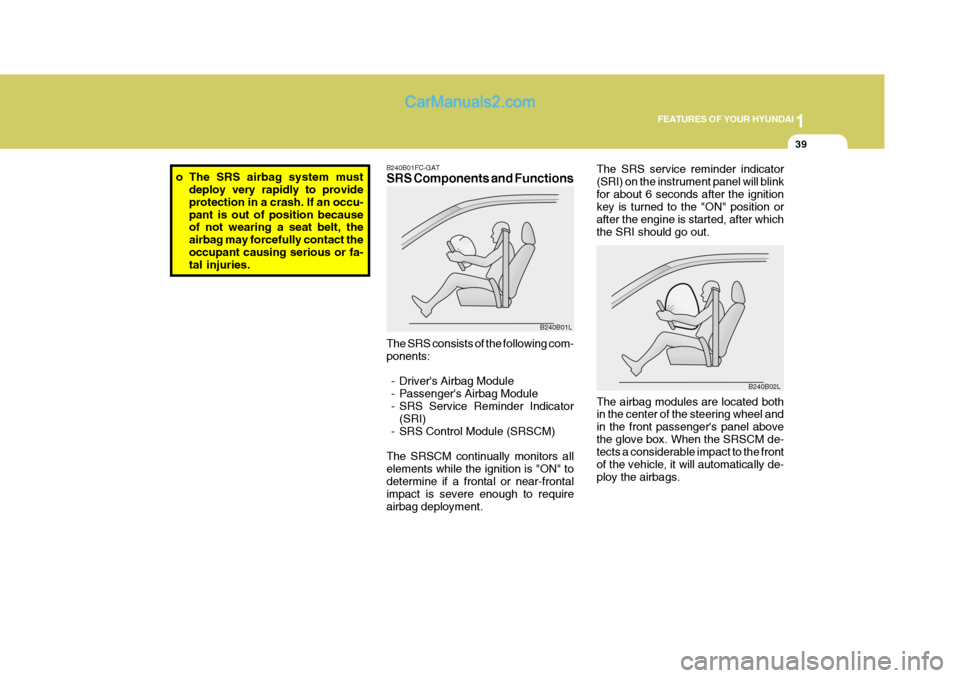
The SRS consists of the following com- ponents:
- Driver's Airbag Module
- Passenger's Airbag Module
- SRS Service Reminder Indicator (SRI)
- SRS Control Module (SRSCM)
The SRSCM continually monitors all elements while the ignition is "ON" to determine if a frontal or near-frontal impact is severe enough to requireairbag deployment. B240B02L
The airbag modules are located both in the center of the steering wheel and in the front passenger's panel abovethe glove box. When the SRSCM de- tects a considerable impact to the front of the vehicle, it will automatically de-ploy the airbags.
The SRS service reminder indicator(SRI) on the instrument panel will blinkfor about 6 seconds after the ignition key is turned to the "ON" position or after the engine is started, after whichthe SRI should go out.