air conditioning Hyundai Matrix 2005 Owner's Manual
[x] Cancel search | Manufacturer: HYUNDAI, Model Year: 2005, Model line: Matrix, Model: Hyundai Matrix 2005Pages: 407, PDF Size: 10.31 MB
Page 37 of 407
1- 29
CONTROLS AND EQUIPMENTHFC002-D
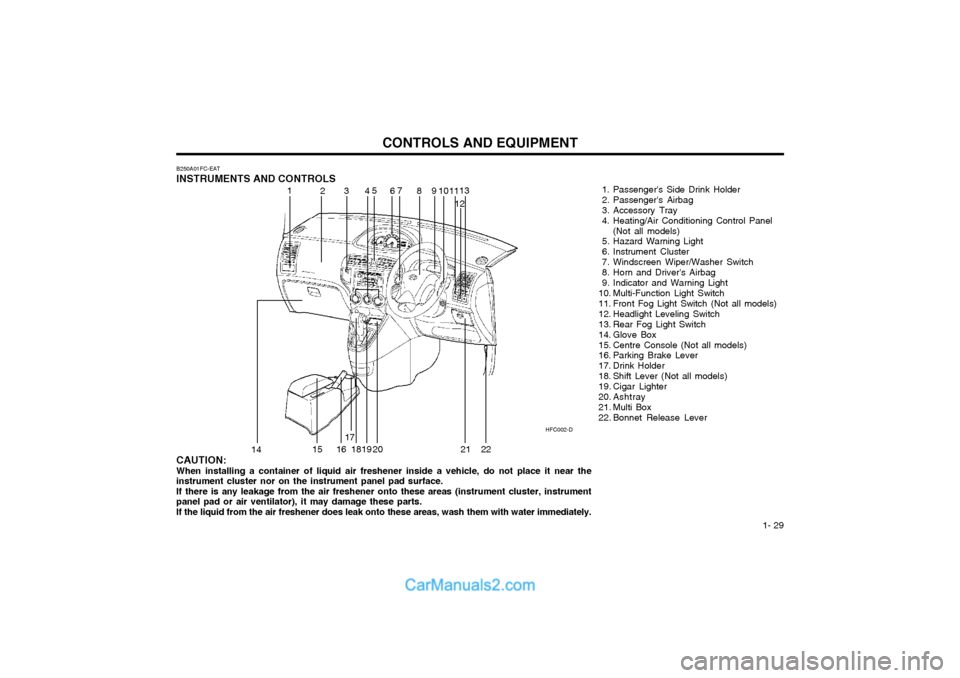
B250A01FC-EAT INSTRUMENTS AND CONTROLS
1. Passenger's Side Drink Holder
2. Passenger's Airbag
3. Accessory Tray
4. Heating/Air Conditioning Control Panel(Not all models)
5. Hazard Warning Light
6. Instrument Cluster
7. Windscreen Wiper/Washer Switch
8. Horn and Driver's Airbag
9. Indicator and Warning Light
10. Multi-Function Light Switch
11. Front Fog Light Switch (Not all models)
12. Headlight Leveling Switch
13. Rear Fog Light Switch
14. Glove Box
15. Centre Console (Not all models)
16. Parking Brake Lever
17. Drink Holder
18. Shift Lever (Not all models)
19. Cigar Lighter
20. Ashtray
21. Multi Box
22. Bonnet Release Lever
CAUTION: When installing a container of liquid air freshener inside a vehicle, do not place it near the instrument cluster nor on the instrument panel pad surface.If there is any leakage from the air freshener onto these areas (instrument cluster, instrumentpanel pad or air ventilator), it may damage these parts. If the liquid from the air freshener does leak onto these areas, wash them with water immediately. 1
2
34 5
67
89 1011
1213
14 15 1617
1819
20 2122
Page 65 of 407
1- 57
CONTROLS AND EQUIPMENT
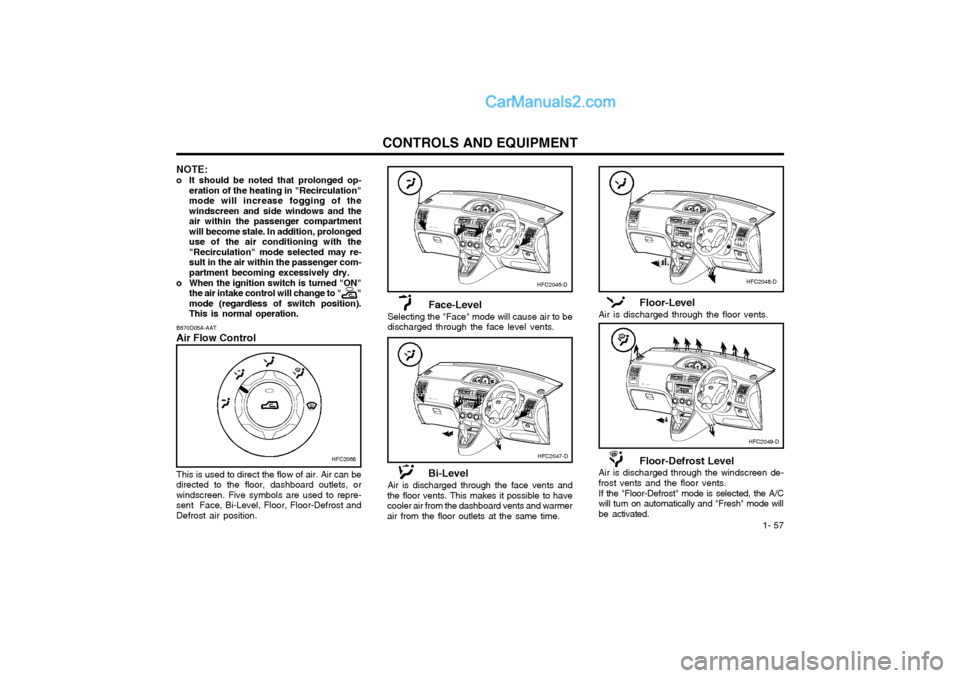
Face-Level
Selecting the "Face" mode will cause air to be discharged through the face level vents.
NOTE:
o It should be noted that prolonged op- eration of the heating in "Recirculation" mode will increase fogging of thewindscreen and side windows and theair within the passenger compartmentwill become stale. In addition, prolongeduse of the air conditioning with the"Recirculation" mode selected may re-sult in the air within the passenger com-partment becoming excessively dry.
o When the ignition switch is turned "ON" the air intake control will change to "
"
mode (regardless of switch position). This is normal operation.
B670D05A-AAT
Air Flow Control
HFC2068
This is used to direct the flow of air. Air can be directed to the floor, dashboard outlets, orwindscreen. Five symbols are used to repre-sent Face, Bi-Level, Floor, Floor-Defrost andDefrost air position.
HFC2046-D
HFC2047-D
HFC2048-D
HFC2049-D
Bi-Level
Air is discharged through the face vents and
the floor vents. This makes it possible to have cooler air from the dashboard vents and warmerair from the floor outlets at the same time. Floor-Level
Air is discharged through the floor vents.
Floor-Defrost Level
Air is discharged through the windscreen de-frost vents and the floor vents. If the "Floor-Defrost" mode is selected, the A/C
will turn on automatically and "Fresh" mode willbe activated.
Page 68 of 407
CONTROLS AND EQUIPMENT
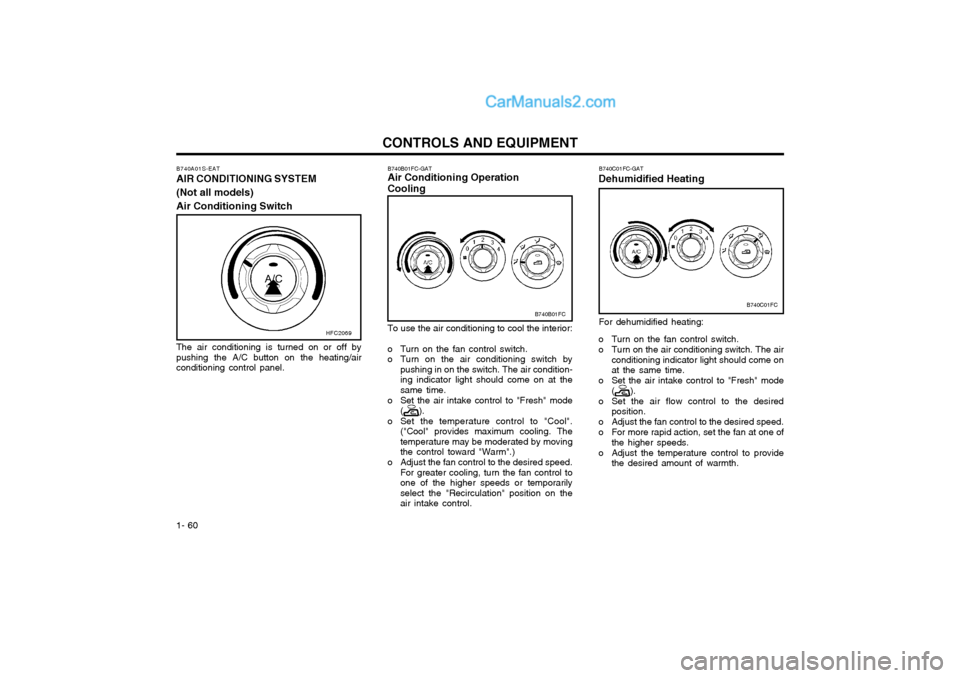
1- 60 B740C01FC-GAT
Dehumidified Heating
B740C01FC
For dehumidified heating:
o Turn on the fan control switch.
o Turn on the air conditioning switch. The air conditioning indicator light should come on at the same time.
o Set the air intake control to "Fresh" mode (
).
o Set the air flow control to the desired position.
o Adjust the fan control to the desired speed.
o For more rapid action, set the fan at one of the higher speeds.
o Adjust the temperature control to provide the desired amount of warmth.
B740B01FC-GAT Air Conditioning Operation Cooling
B740B01FC
To use the air conditioning to cool the interior:
o Turn on the fan control switch.
o Turn on the air conditioning switch by pushing in on the switch. The air condition-ing indicator light should come on at thesame time.
o Set the air intake control to "Fresh" mode (
).
o Set the temperature control to "Cool". ("Cool" provides maximum cooling. The temperature may be moderated by movingthe control toward "Warm".)
o Adjust the fan control to the desired speed. For greater cooling, turn the fan control toone of the higher speeds or temporarilyselect the "Recirculation" position on theair intake control.
B740A01S-EAT AIR CONDITIONING SYSTEM (Not all models)Air Conditioning Switch
The air conditioning is turned on or off by pushing the A/C button on the heating/airconditioning control panel. HFC2069
Page 69 of 407
1- 61
CONTROLS AND EQUIPMENT
B760A01E
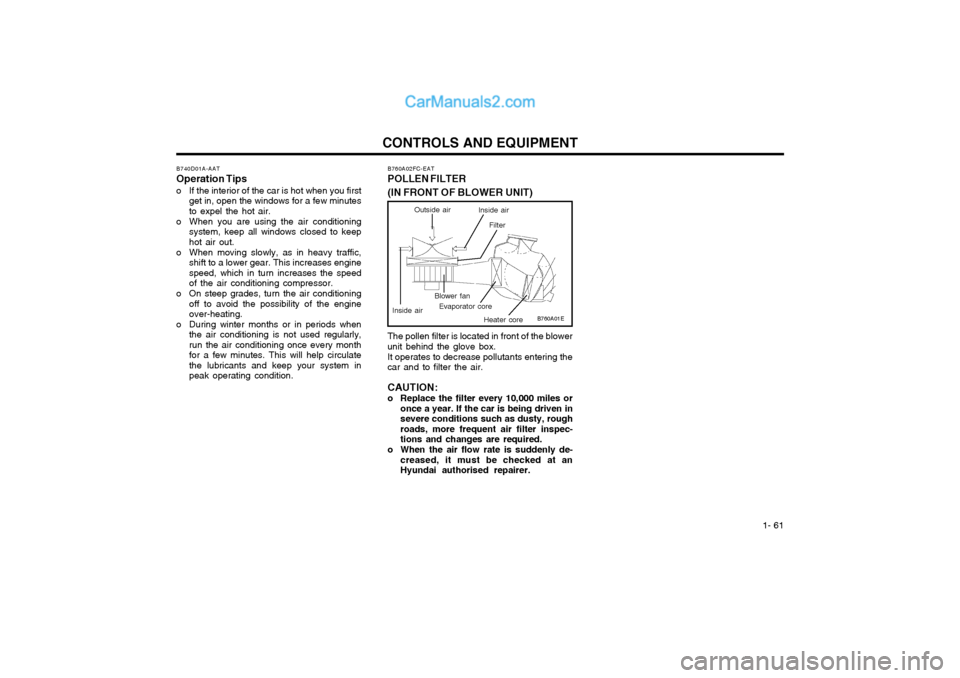
The pollen filter is located in front of the blower unit behind the glove box. It operates to decrease pollutants entering the car and to filter the air. CAUTION:
o Replace the filter every 10,000 miles oronce a year. If the car is being driven in severe conditions such as dusty, roughroads, more frequent air filter inspec-tions and changes are required.
o When the air flow rate is suddenly de- creased, it must be checked at anHyundai authorised repairer.
Evaporator coreBlower fan
Heater core
B760A02FC-EAT POLLEN FILTER (IN FRONT OF BLOWER UNIT)
Outside air
Filter
Inside air
Inside air
B740D01A-AAT
Operation Tips
o If the interior of the car is hot when you first get in, open the windows for a few minutes to expel the hot air.
o When you are using the air conditioning system, keep all windows closed to keephot air out.
o When moving slowly, as in heavy traffic, shift to a lower gear. This increases enginespeed, which in turn increases the speedof the air conditioning compressor.
o On steep grades, turn the air conditioning off to avoid the possibility of the engineover-heating.
o During winter months or in periods when the air conditioning is not used regularly,run the air conditioning once every monthfor a few minutes. This will help circulatethe lubricants and keep your system inpeak operating condition.
Page 77 of 407
DRIVING YOUR HYUNDAI 2- 5
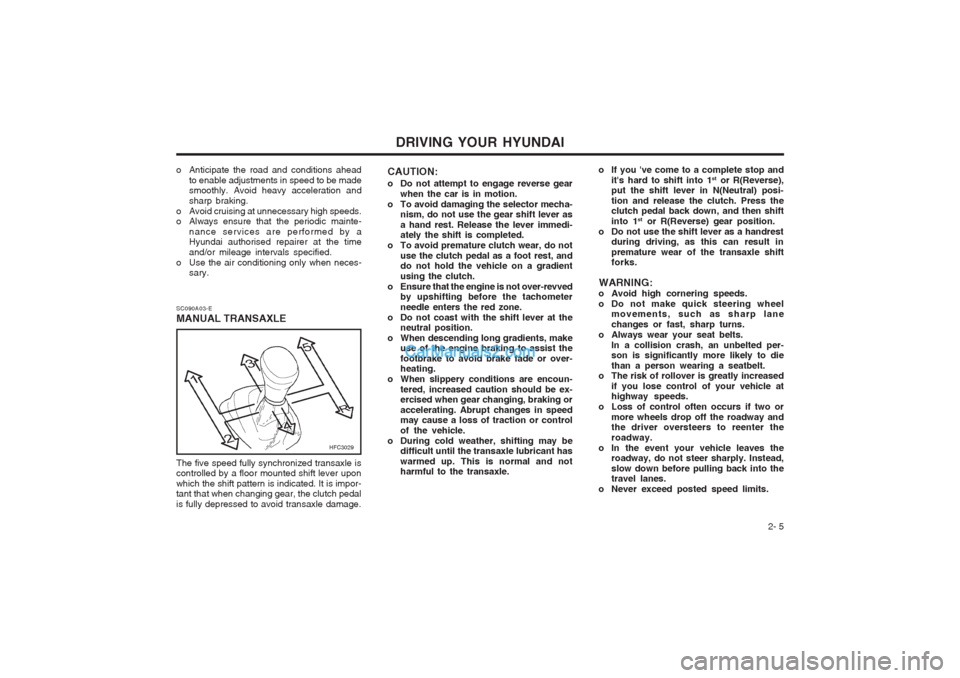
SC090A03-E MANUAL TRANSAXLE
HFC3029
The five speed fully synchronized transaxle is controlled by a floor mounted shift lever upon which the shift pattern is indicated. It is impor- tant that when changing gear, the clutch pedal is fully depressed to avoid transaxle damage. CAUTION:
o Do not attempt to engage reverse gear
when the car is in motion.
o To avoid damaging the selector mecha- nism, do not use the gear shift lever as a hand rest. Release the lever immedi- ately the shift is completed.
o To avoid premature clutch wear, do not use the clutch pedal as a foot rest, anddo not hold the vehicle on a gradient using the clutch.
o Ensure that the engine is not over-revved by upshifting before the tachometerneedle enters the red zone.
o Do not coast with the shift lever at the neutral position.
o When descending long gradients, make use of the engine braking to assist thefootbrake to avoid brake fade or over- heating.
o When slippery conditions are encoun- tered, increased caution should be ex-ercised when gear changing, braking or accelerating. Abrupt changes in speed may cause a loss of traction or control of the vehicle.
o During cold weather, shifting may be difficult until the transaxle lubricant haswarmed up. This is normal and not harmful to the transaxle.
o Anticipate the road and conditions ahead
to enable adjustments in speed to be madesmoothly. Avoid heavy acceleration and sharp braking.
o Avoid cruising at unnecessary high speeds.
o Always ensure that the periodic mainte- nance services are performed by aHyundai authorised repairer at the time and/or mileage intervals specified.
o Use the air conditioning only when neces- sary.
o If you 've come to a complete stop and
it's hard to shift into 1 st
or R(Reverse),
put the shift lever in N(Neutral) posi- tion and release the clutch. Press the clutch pedal back down, and then shift into 1 st
or R(Reverse) gear position.
o Do not use the shift lever as a handrest during driving, as this can result inpremature wear of the transaxle shift forks.
WARNING:
o Avoid high cornering speeds.
o Do not make quick steering wheel movements, such as sharp lanechanges or fast, sharp turns.
o Always wear your seat belts. In a collision crash, an unbelted per- son is significantly more likely to die than a person wearing a seatbelt.
o The risk of rollover is greatly increased
if you lose control of your vehicle at highway speeds.
o Loss of control often occurs if two or
more wheels drop off the roadway andthe driver oversteers to reenter the roadway.
o In the event your vehicle leaves the roadway, do not steer sharply. Instead,slow down before pulling back into the travel lanes.
o Never exceed posted speed limits.
Page 84 of 407
DRIVING YOUR HYUNDAI
2- 12 ZC170D1-E
Door Locks Should the door lock mechanism become frozen, a proprietary lock de-icer should be used. Alternatively, warming the door key may thaw the door lock. However, the key should be handled carefully to avoid burning the fingers. Never attempt to thaw a frozen door lock using hot water, since the water will eventu- ally freeze and compound the problem. NOTE: The proper temperature for using the immobiliser key is from -40°F to 176°F (- 40°C to 80°C). If you heat the immobiliser key over 176°F (80°C) to open the frozen lock, it may cause damage to the tran- sponder in its head.
SC170E1-E Windscreen Washers and Wipers The windscreen washer bottle should be filled
with a solution of water and a proprietary winter screen wash additive. The windscreen wipers should not be used if the blades are frozen to the windscreen or if they are cov- ered with snow, before this is removed.
ZC170B1-E
Electrical System Winter conditions impose severe demandsupon vehicle electrical systems, particularly the charging circuit. The battery condition and performance along with the alternator perfor- mance and drive belt condition should be checked prior to the onset of winter. ZC170C1-E Anti-freeze/Corrosion inhibitorThe cooling system must always contain an Ethylene-Glycol based anti-freeze solution. The system is filled during manufacture with solution of the correct strength which should be checked before the onset of winter and adjusted or changed as required. NOTE: The anti-freeze solution contains a corro- sion inhibitor to prevent degradation of the aluminum castings contained within the engine. Therefore, never, drain the system and refill with water only. In addition, anti-freeze solution must ALWAYS be used in vehicles fitted with air conditioning, to prevent the heater matrix from freezing and subsequently bursting with the refrigeration system in use.
o Don't "lug" or "over-rev" the engine. Lug-
ging is driving too slowly in too high a gearresulting in the engine bucking. If this happens to you, shift to a lower gear.Over-revving is racing the engine beyond its safe limit. This can be avoided by shifting at the recommended speeds.
o Use your air conditioning sparingly. The air
conditioning system is operated by the engine power so your fuel economy is reduced when you use it.
SC160A1-F SMOOTH CORNERINGAvoid braking or gear changing in corners, especially when roads are wet. Ideally, cor- ners should always be taken under gentle acceleration. If you follow these suggestions, tyre wear will be held to a minimum. SC170A1-E WINTER MOTORINGThe onset of winter conditions subject motor vehicles to greater operating demands. There- fore, the following suggestions will assist in maintaining peak performance and reliability during these periods:
Page 107 of 407

VEHICLE MAINTENANCE REQUIREMENTS
5- 8 6ZF070P1-A
o Driveshafts and Boots Check the drive shafts, boots and clamps for cracks, deterioration, or damage. Replaceany damaged parts and, if necessary, repackthe grease. 6ZF070Q1-A
o Air conditioning Refrigerant Check the air conditioning lines and connec- tions for leakage and damage. Check airconditioning performance according to therelevant shop manual if necessary.
6ZF070L1-A
o Suspension Mounting Bolts Check the suspension connections for loose-
ness or damage. Retighten to the specifiedtorque. 6ZF070M1-A
o Steering Gear Box, Linkage & Boots/
Lower arm Ball Joint
With the vehicle stopped and engine off, check for excessive freeplay in the steering wheel. Check the linkage for bends or damage. Check the dust boots and ball joints for dete-rioration, cracks, or damage. Replace anydamaged parts. 6ZF070N1-A
o Power Steering Pump, Belt and Hoses Check the power steering pump and hoses for leakage and damage. Replace any dam-aged or leaking parts immediately. Inspect thepower steering belt for evidence of cuts,cracks, excessive wear, oil contaminationand proper tension. Replace or adjust it ifnecessary.
Page 116 of 407
OWNER MAINTENANCE 6-9
SG050A1-E
ENGINE COOLANT CHECKING
AND REPLACING WARNING: Do not remove the radiator cap when the
engine is hot, since the system is pressurised and coolant may be ejectedfrom the radiator resulting in scalding.
SG050B1-E
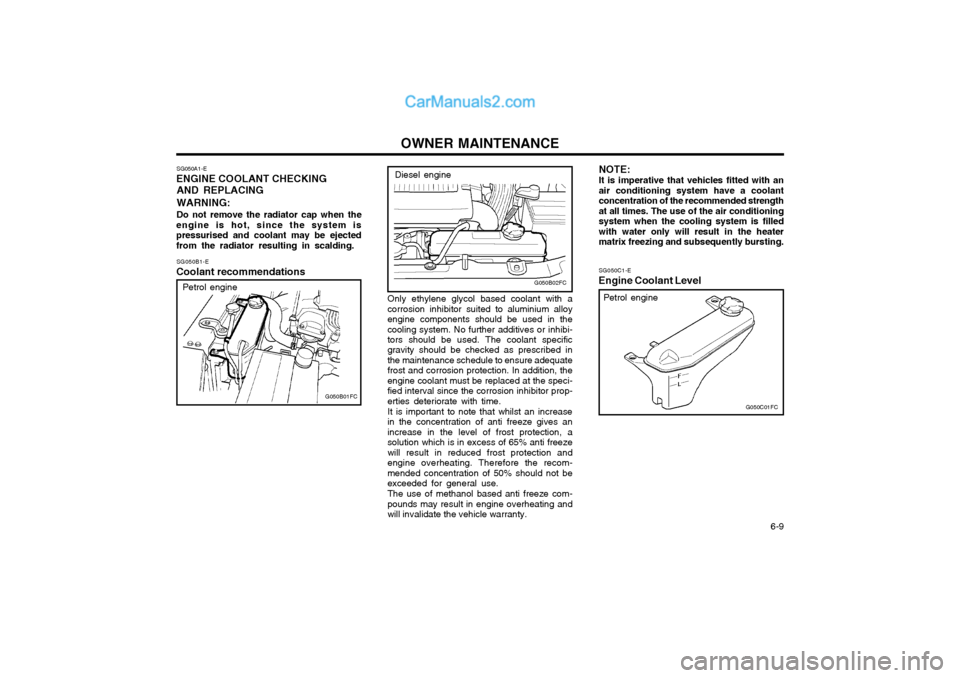
Coolant recommendations
Petrol engine
G050B01FC SG050C1-E
Engine Coolant LevelG050C01FC
Petrol engine
NOTE: It is imperative that vehicles fitted with an air conditioning system have a coolantconcentration of the recommended strengthat all times. The use of the air conditioningsystem when the cooling system is filledwith water only will result in the heatermatrix freezing and subsequently bursting.Diesel engine
Only ethylene glycol based coolant with a corrosion inhibitor suited to aluminium alloyengine components should be used in thecooling system. No further additives or inhibi- tors should be used. The coolant specific gravity should be checked as prescribed inthe maintenance schedule to ensure adequatefrost and corrosion protection. In addition, theengine coolant must be replaced at the speci-fied interval since the corrosion inhibitor prop-erties deteriorate with time. It is important to note that whilst an increase in the concentration of anti freeze gives anincrease in the level of frost protection, asolution which is in excess of 65% anti freezewill result in reduced frost protection andengine overheating. Therefore the recom-mended concentration of 50% should not beexceeded for general use. The use of methanol based anti freeze com- pounds may result in engine overheating andwill invalidate the vehicle warranty.
G050B02FC
Page 125 of 407

OWNER MAINTENANCE
6-18 SG140C1-E
Checking the Refrigerant
1. Start the engine and run at idle for several minutes with the refrigeration system run- ning at the coldest setting.
2. Open the bonnet and inspect the sight glass on the top of the receiver dryer.
3. If the refrigerant charge is insufficient, a flow of bubbles will be observed through the sightglass.
4. If the refrigerant charge is satisfactory, no bubbles will be observed through the sightglass.
CAUTION: Running the air conditioning system with a low refrigerant level may damage the com-pressor. SG140D1-E
Off Season Maintenance The air conditioning must be run for ten minutes or so weekly during periods when the systemwould not normally be used to ensure that thecompressor and seals are lubricated. If thisprecaution is not observed the compressor sealsmay become stuck to the compressor shaft anddamaged when the system is next used result-ing in a loss of refrigerant and damage to thecompressor.
SG140B1-E
Compressor Drive Belt
The air conditioning compressor drive belt
should be checked to ensure freedom fromdamage or excessive wear and correct ten-sion. The belt tension is correct when the beltdeflects by about 0.3 inches (8 mm) when aforce of 98 N is applied to the belt halfwaybetween the compressor and crankshaftpulleys.
Adjustment of the belt should be entrusted to
a Hyundai authorised repairer.
SG140A1-E
AIR CONDITIONING SYSTEM
MAINTENANCE
Condenser Ensure that the condenser is periodicallyinspected and that accumulations of dirt, deadinsects and leaves etc, are removed to ensurethat the efficiency of the system is not impaired.Care must be exercised to ensure that thecondenser fins are not damaged during clean-ing.
G140D01A
A/C
CRANK PULLEY
TENSION PULLEY0.315 in. (8mm)
Page 129 of 407

OWNER MAINTENANCE
6-22 SG230A1-E POWER STEERING FLUID LEVEL
HFC5004
G230A02FC
Petrol engine
Diesel engine
The power steering fluid level should be checked daily.
SG220A1-E ELECTRIC COOLING FANS WARNING: The cooling fan is controlled by engine coolant temperature and may sometimesoperate even when the engine is not run-ning. Use extreme caution when workingnear the blades of the cooling fan so thatyou are not injured by a rotating fan blade.As the engine coolant temperature decreas-es, the fan will automatically shut off. Thisis a normal condition. The engine cooling fan should operate before the temperature gauge reaches the upper por-tion of the scale and the condenser fan shouldoperate whenever the air conditioning is in use.
o Batteries must only be charged in well
ventilated areas from which naked lights orsources of sparks are excluded.
o Ensure that children, pets or other unauthorised persons are kept away frombatteries.
o Do not allow anything to bridge the positive (+) and negative (-) terminals of the battery.
o Never invert the battery. The battery fitted during production is of the "Maintenance Free" type.