roof Hyundai Matrix 2005 Owner's Manual
[x] Cancel search | Manufacturer: HYUNDAI, Model Year: 2005, Model line: Matrix, Model: Hyundai Matrix 2005Pages: 407, PDF Size: 10.31 MB
Page 12 of 407
CONTROLS AND EQUIPMENT
1- 4
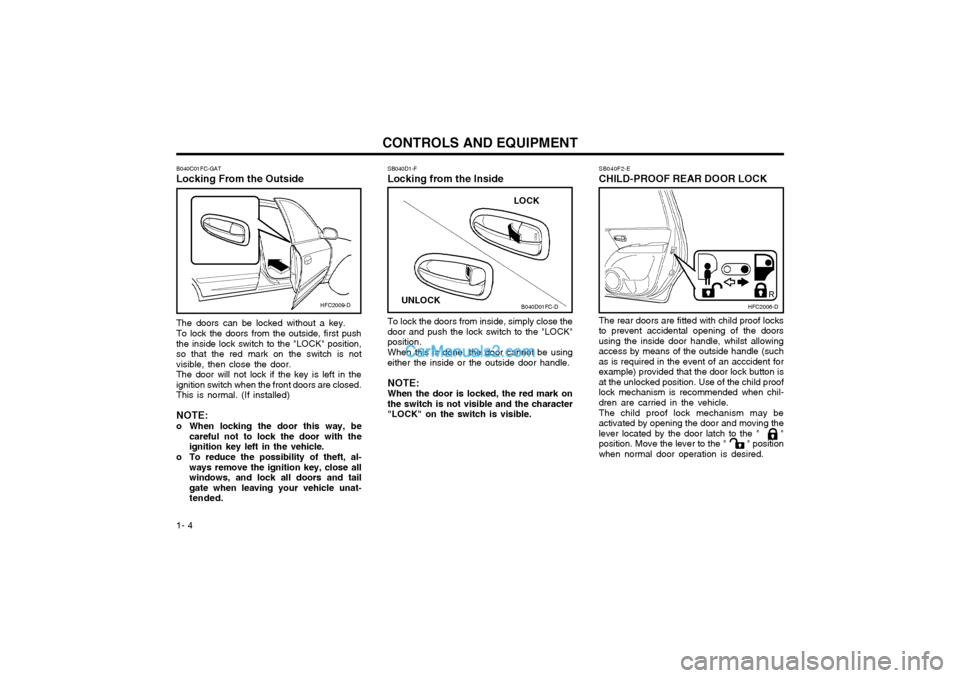
SB040F2-E CHILD-PROOF REAR DOOR LOCK The rear doors are fitted with child proof locks to prevent accidental opening of the doorsusing the inside door handle, whilst allowingaccess by means of the outside handle (suchas is required in the event of an acccident forexample) provided that the door lock button isat the unlocked position. Use of the child prooflock mechanism is recommended when chil-dren are carried in the vehicle. The child proof lock mechanism may be activated by opening the door and moving thelever located by the door latch to the " "position. Move the lever to the " " positionwhen normal door operation is desired.
SB040D1-F Locking from the Inside
B040D01FC-D
To lock the doors from inside, simply close the
door and push the lock switch to the "LOCK" position.
When this is done, the door cannot be using
either the inside or the outside door handle.
NOTE:When the door is locked, the red mark on
the switch is not visible and the character"LOCK" on the switch is visible.HFC2006-D
LOCK
UNLOCK
B040C01FC-GAT Locking From the Outside The doors can be locked without a key. To lock the doors from the outside, first push the inside lock switch to the "LOCK" position,so that the red mark on the switch is notvisible, then close the door.The door will not lock if the key is left in theignition switch when the front doors are closed.This is normal. (If installed) NOTE:
o When locking the door this way, be
careful not to lock the door with the ignition key left in the vehicle.
o To reduce the possibility of theft, al- ways remove the ignition key, close allwindows, and lock all doors and tailgate when leaving your vehicle unat-tended.
HFC2009-D
Page 29 of 407

1- 21
CONTROLS AND EQUIPMENT
B230D02FC-1
ISOFIX Anchor
NOTE:At present, this seat is the only one com-
plying with that provision. In case that other manufacturers will furnish proof ofa respective certification, Hyundai is go-ing to evaluate this seat carefully and willgive a recommendation provided that seatcomplies to the law. Please ask yourHyundai authorised repairer in this re-spect.
On each side of the rear seat, between the
cushion and backrest, are located a pair ofISOFIX anchorage points together with a toptether mounting located in the luggage com-partment. During the installation, the seat hasto be engaged at the anchorage-points insuch a way whereby you can hear it click(check by pulling!) and has to be fixed with theTop Tether-belt to the top tether mountinglocated in the luggage compartment. Theinstalling and the use of a child-seat has to bedone according to the installation manual for the ISOFIX-seat, whilst using the ISOFIX-child-seat, the rear-bench not allowed to bemoved beyond the middle position to theforward direction. NOTE: An ISOFIX-child-seat can only be installed if the seat has a vehicle-specific approvalaccording to ECE-R44. Before using theISOFIX-child-seat, which was bought foranother car, ask your Hyundai authorisedrepairer whether this seat-type is approvedand recommended for your Hyundai. To secure the child restraint seat
2. Connect the tether strap hook to the child
restraint hook holder and tighten to secure the seat. Refer to "Securing a Child Re-straint System with the Tether AnchorageSystem" on page 1-20.
WARNING:
o Do not install a child restraint seat at the centre of the rear seat using thevehicle's ISOFIX anchors. The ISOFIXanchors are only provided for the leftand right outboard rear seating posi-tions. Do not misuse the ISOFIX an-chors by attempting to attach a childrestraint seat in the middle of the rearseat to the ISOFIX anchors. In a crash,the child restraint seat ISOFIX attach-ments may not be strong enough tosecure the child restraint seat properlyin the centre of the rear seat and maybreak, causing serious injury or death.
o Do not mount more than one child restraint to a child restraint lower an-chorage point. Over-loading may causethe anchorage points or tether anchorto break, causing serious injury ordeath.
o Attach the ISOFIX or ISOFIX-compat- ible child restraint seat only to theappropriate locations shown in the il-lustration.
B230D03FC
1. To engage the child restraint seat to theISOFIX anchor, insert the child restraint seat latch into the ISOFIX anchor. Listenfor the audible "click" sound.
Page 52 of 407
CONTROLS AND EQUIPMENT
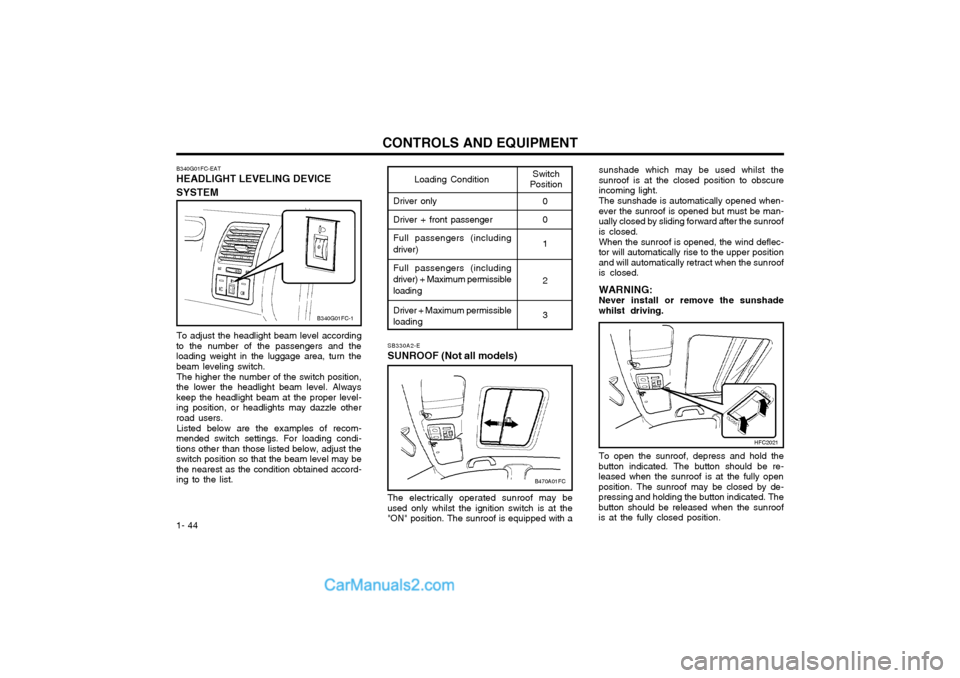
1- 44 SB330A2-E
SUNROOF (Not all models)
To adjust the headlight beam level according
to the number of the passengers and the loading weight in the luggage area, turn thebeam leveling switch.
The higher the number of the switch position,
the lower the headlight beam level. Alwayskeep the headlight beam at the proper level-ing position, or headlights may dazzle otherroad users.
Listed below are the examples of recom-
mended switch settings. For loading condi-tions other than those listed below, adjust theswitch position so that the beam level may bethe nearest as the condition obtained accord-ing to the list.
Switch
PositionLoading Condition
Driver only Driver + front passengerFull passengers (including
driver)
Full passengers (including
driver) + Maximum permissible loading
Driver + Maximum permissible
loading 0 0 1 2 3
B340G01FC-EAT HEADLIGHT LEVELING DEVICE SYSTEM
sunshade which may be used whilst the sunroof is at the closed position to obscureincoming light. The sunshade is automatically opened when- ever the sunroof is opened but must be man-ually closed by sliding forward after the sunroofis closed. When the sunroof is opened, the wind deflec- tor will automatically rise to the upper positionand will automatically retract when the sunroofis closed. WARNING: Never install or remove the sunshadewhilst driving. To open the sunroof, depress and hold the
button indicated. The button should be re- leased when the sunroof is at the fully openposition. The sunroof may be closed by de-pressing and holding the button indicated. Thebutton should be released when the sunroofis at the fully closed position.
HFC2021
B470A01FC
B340G01FC-1
The electrically operated sunroof may be used only whilst the ignition switch is at the"ON" position. The sunroof is equipped with a
Page 53 of 407

1- 45
CONTROLS AND EQUIPMENT
SB330C1-E Tilting the Sunroof SystemThe sunroof can be tilted and closed by de- pressing the button indicated. Release thebutton when the sunroof reaches the up posi-tion. NOTE: The sunroof should not be opened when water or standing rain is on the roof panel.Driving the vehicle for a short distance willallow the water to disperse naturally atwhich point the sunroof may be opened.
2. Turn the hexagonal bolts with a socketwrench counterclockwise to remove thefront overhead console.
3. Insert the hexagonal head wrench pro- vided with the vehicle into the socket. Thiswrench can be found in the vehicle's lug-gage room or glove box.
B460D01FC-EAT Manual Operation of Sunroof
HFC1036
If the sunroof fails to operate:
1. Remove the rectangular plastic interior light lenses in the front overhead console.
HFC1037
4. Turn the wrench clockwise to open or counterclockwise to close.
CAUTION:
o Do not open the sunroof in severe cold
temperature or when it is covered with ice or snow.
o Periodically remove any dirt that may have accumulated on the guide rails.
WARNING:
o Ensure that the sunroof and guide rails are clear of obstructions before closing the sunroof and ensure that nothingmay become entrapped between thesunroof panel and the vehicle bodywhilst the sunroof is being closed.
o Do not stand up or extend any portion of your body out of the opening whilstthe vehicle is moving.
HFC2022HFC1038
Page 54 of 407

CONTROLS AND EQUIPMENT
1- 46 The interior courtesy light has a button of
three positions.
The three positions are:
oDR In the "DR" position, the interior courtesy light
comes on when any door is opened regard- less of the ignition key position. The light goesout when the door is closed.
oON
In the "ON" position, the light stays on at all
times. CAUTION:
Do not leave the switch in this position
for an extended period time when the vehicle is not running. SB340B2-E
Interior Light
B490A01E
With Sunroof
Without Sunroof
B490B01E
B491A02F-EAT
SPECTACLE CASE (Not all models)
HXDOM241
The spectacle case is located on the front
overhead console.
Push the end of the cover to open the spec-
tacle case.
WARNING: Do not open the spectacle case whilst the
vehicle is moving. The rear view mirror of the vehicle can be blocked by an openspectacle case.
B480A01E-EAT INTERIOR LIGHT Map Light The two map lights are located at each side of the interior light. The lights may be operated by depressing the switch to turn on the light and pressing againto turn off the light. This light produces a spotbeam for convenient use as a map light atnight or as a personal light for the driver or thepassenger.
B480A01EB480B01E
With Sunroof Without Sunroof
o OFF In the "OFF" position, the light stays off at all times even though a door is open.
Page 61 of 407
1- 53
CONTROLS AND EQUIPMENT
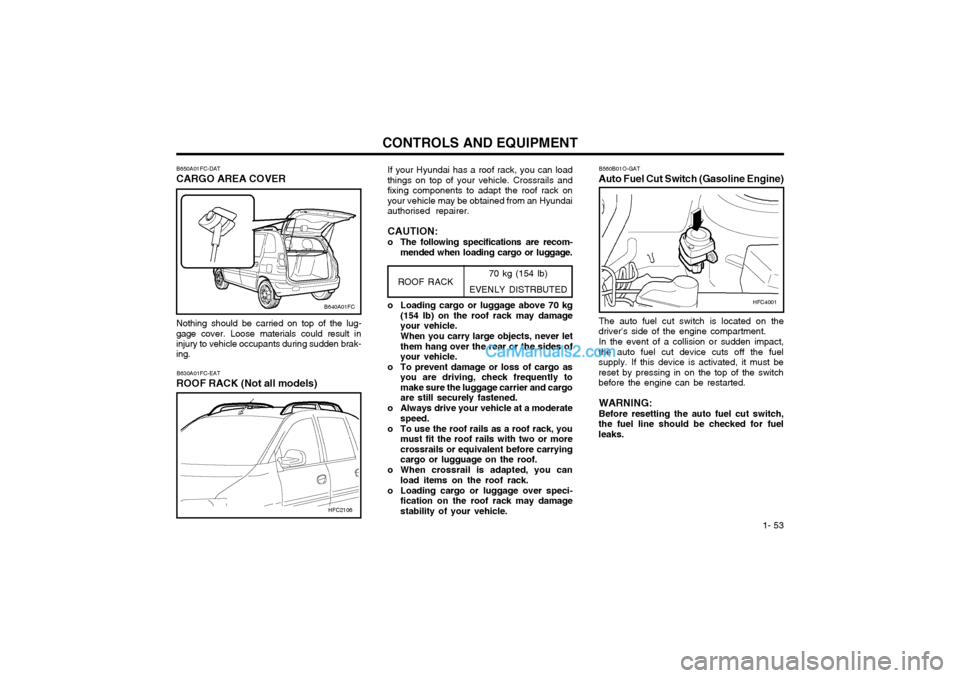
70 kg (154 lb)
EVENLY DISTRBUTED
HFC2106
B630A01FC-EAT
ROOF RACK (Not all models) If your Hyundai has a roof rack, you can load
things on top of your vehicle. Crossrails and fixing components to adapt the roof rack onyour vehicle may be obtained from an Hyundaiauthorised repairer.
CAUTION:
o The following specifications are recom- mended when loading cargo or luggage.
ROOF RACK
o Loading cargo or luggage above 70 kg (154 lb) on the roof rack may damage your vehicle. When you carry large objects, never let them hang over the rear or the sides ofyour vehicle.
o To prevent damage or loss of cargo as you are driving, check frequently tomake sure the luggage carrier and cargoare still securely fastened.
o Always drive your vehicle at a moderate speed.
o To use the roof rails as a roof rack, you must fit the roof rails with two or morecrossrails or equivalent before carryingcargo or lugguage on the roof.
o When crossrail is adapted, you can load items on the roof rack.
o Loading cargo or luggage over speci- fication on the roof rack may damagestability of your vehicle.
B650A01FC-DAT CARGO AREA COVER
B640A01FC
Nothing should be carried on top of the lug-
gage cover. Loose materials could result in injury to vehicle occupants during sudden brak- ing. B560B01O-GAT
Auto Fuel Cut Switch (Gasoline Engine)HFC4001
The auto fuel cut switch is located on the
driver's side of the engine compartment.
In the event of a collision or sudden impact,
the auto fuel cut device cuts off the fuel supply. If this device is activated, it must bereset by pressing in on the top of the switchbefore the engine can be restarted.
WARNING: Before resetting the auto fuel cut switch,
the fuel line should be checked for fuel leaks.
Page 72 of 407

CONTROLS AND EQUIPMENT
1- 64
B870D01FC-GAT ANTENNA Roof Antenna
Your car uses a roof antenna to receive both AM and FM broadcast signals. This antenna is a removable type. To remove the antenna, turn the antenna counterclock-wise. To install the antenna, turn the antennaclockwise. CAUTION:
o Be sure to remove the antenna before
washing the car in an automatic car wash or it may be damaged.
o Before entering a place with a low height clearance, be sure to adjust the roofantenna low.
o When reinstalling your antenna, it is important that it is fully tightened toensure proper reception.
HFC2100
Page 76 of 407

DRIVING YOUR HYUNDAI
2- 4 C050B03S-EAT
NORMAL CONDITIONS The Starting Procedure:
1. Insert key, and fasten the seat belt.
2. Depress the clutch pedal fully and place the gearshift lever (manual transaxle) inneutral or the selector lever (automatic transaxle) in "P" (park) position.
3. After turning the ignition key to the "ON" position, make certain all warning lightsand gauges are functioning properly be- fore starting the engine.
4. On vehicles equipped with the diesel pre- heat indicator light, turn the ignition key tothe "ON" position. The diesel pre-heat indi- cator light will first illuminate in amber, and then after a short time, the amber illumina- tion will goes off, indicating that preheating is completed. SC060B1-E FUEL ECONOMY
The following suggestions are made to assist
in achieving the greatest degree of fuel economy.
o Maintaining a constant check on fuel con- sumption will enable the most economical use pattern and driving style to be adopt- ed.
o Avoid using the vehicle for very short jour- neys if possible, particularly when a coldstart is involved.
o Ensure that tyre pressures are maintained
at the correct level.
o Use only the recommended grade of fuel.
o Avoid carrying unnecessary weight, and if a roof rack is in use, remove it as soon aspossible after use.
NOTE: If the engine does not start 10 secondsafter the preheating is completed, turn the ignition key once more to the "LOCK" position, and then to the "ON" position, in order to preheat again. WARNING: Be sure that the clutch is fully depressed when starting a manual transaxle vehicle. This will prevent sudden movement should the vehicle be started in gear without the clutch depressed. Otherwise there is the potential to cause damage to the vehicle or injury to a person inside or outside of the vehicle as a result of this sudden vehicle movement.
5. Turn the ignition key to the "Start" position and release it when the engine starts.
C055B01B-GAT STARTING AND STOPPING THE EN- GINE FOR TURBO CHARGER INTER-COOLER (DIESEL ENGINE)
(1) Do not race the engine or suddenly accel- erate the engine immediately after starting it. If the engine is cold, allow the engine to idle for several seconds before it is driven to ensure sufficient lubrication of the turbo charger unit. (2) After high speed or extended driving, re-
quiring a heavy engine load, the engineshould be allowed to idle about 1 minute before turning it off.This idle time will allow the turbo charger to cool prior to shutting the engine off.
WARNING: Do not turn the engine off immediately after it has been subjected to a heavy load. Doing so may cause severe damage to the engine or turbo charger unit.
C050B01HP
Amber lamp ON Amber lamp OFF
Page 100 of 407
VEHICLE MAINTENANCE REQUIREMENTS 5-1
SF020A1-E
MAINTENANCE AND SERVICING REQUIREMENTS To ensure the continued reliability and safety
of the vehicle, certain routine maintenance operations are required at specific mileage ortime intervals.
It is the responsibility of the vehicle owner to
ensure that the maintenance schedules shownin both this Owners Manual and the Warrantyand Service Passport are adhered to.
The new vehicle warranty may be invalidated
if the routine maintenance operations are notperformed in line with the recommendationsoutlined and the safety and durability of thevehicle adversely affected.
It is recommended that all maintenance op-
erations with the exception of the daily oper-ating checks are entrusted to a Hyundaiauthorised repairer to ensure that the latestrepair and maintenance procedures andspecialised servicing tools are employed. In addition, the use of genuine Hyundai re-
placement parts will ensure that the vehiclesafety and performance will not be compro-mised. NOTE: The inspection and testing of certain elec-
tronic fuel injection/engine management and automatic transmission control sys-tems require specialised electronic equip-ment specifically designed for Hyundaivehicles. The use of general purpose elec-trical test equipment may result in dam-age to the control unit microprocessors.
SF000A1-E
5. VEHICLE
MAINTENANCE REQUIREMENTS
SF020C2-E
Specified Scheduled Procedures The Specified scheduled procedures are listed
in the maintenance charts beginning at page 5-2. The operations specified must be per-formed at the time or mileage intervals shownirrespective of whether the mileage intervalhas been reached before the specified timeinterval.
Certain lubricants and components degrade
with both time and mileage (e.g. engine oil andbrake fluid) and therefore it is not permissableto base the maintenance schedule upon mile-age alone. It is strongly recommended thatthe maintenance operations are performed bythe factory-trained or distributor-trained tech-nicians at your Hyundai authorised repairer because of the need for specialised knowl-edge and tooling and to ensure that no pos-sibility of invalidating the manufacturers war-ranty exists.
The maintenance schedules relate to ve-
hicles operated under normal conditions, ve-hicles which are operated under adverseconditions will require more frequent mainte-nance which is described at page 5-5. NOTE:
Service schedules may change depend-
ing on individual country needs. Please ask your local Hyundai authorised re-pairer for a copy of the service schedulethat relates to that country.
SF030B1-E
SERVICE HISTORY It is important that all scheduled maintenanceservices are recorded in the warranty andservice passport to ensure that proof of main-tenance is available when warranty service isrequired.
5
Page 104 of 407
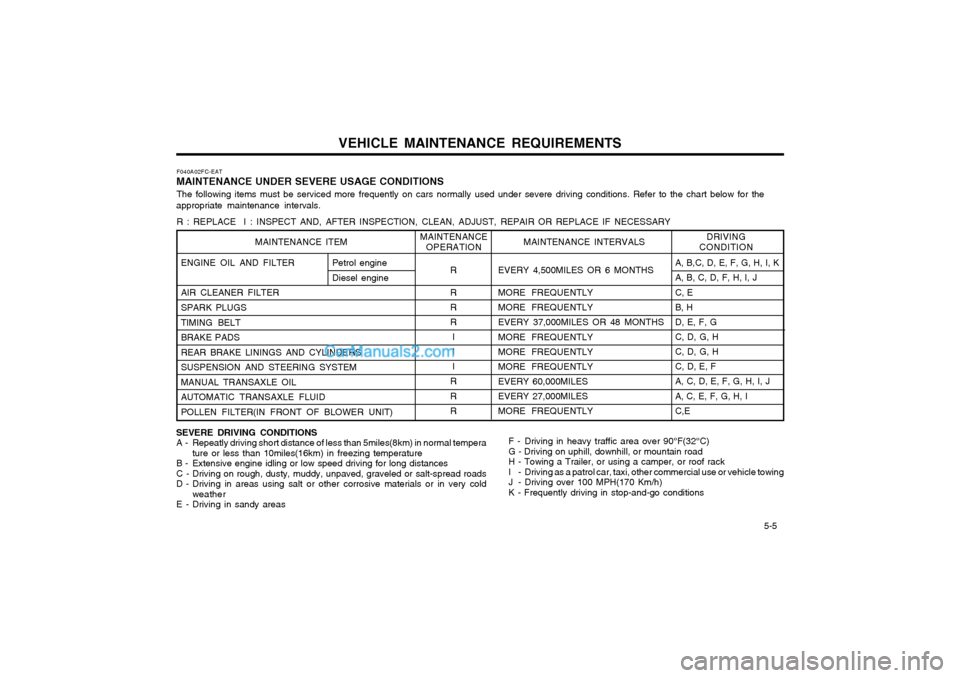
VEHICLE MAINTENANCE REQUIREMENTS 5-5
R R RR
I I I
R R R A, B,C, D, E, F, G, H, I, KA, B, C, D, F, H, I, J C, E B, HD, E, F, GC, D, G, H C, D, G, H C, D, E, FA, C, D, E, F, G, H, I, J A, C, E, F, G, H, I C,E
MAINTENANCE UNDER SEVERE USAGE CONDITIONS
The following items must be serviced more frequently on cars normally used under severe driving conditions. Refer to the chart below for the
appropriate maintenance intervals.
R : REPLACE I : INSPECT AND, AFTER INSPECTION, CLEAN, ADJUST, REPAIR OR REPLACE IF NECESSARY
F040A02FC-EAT
SEVERE DRIVING CONDITIONS
A - Repeatly driving short distance of less than 5miles(8km) in normal tempera ture or less than 10miles(16km) in freezing temperature
B - Extensive engine idling or low speed driving for long distances
C - Driving on rough, dusty, muddy, unpaved, graveled or salt-spread roads
D - Driving in areas using salt or other corrosive materials or in very cold weather
E - Driving in sandy areas ENGINE OIL AND FILTER Petrol engine
Diesel engine
AIR CLEANER FILTER SPARK PLUGS TIMING BELT BRAKE PADSREAR BRAKE LININGS AND CYLINDERSSUSPENSION AND STEERING SYSTEMMANUAL TRANSAXLE OILAUTOMATIC TRANSAXLE FLUIDPOLLEN FILTER(IN FRONT OF BLOWER UNIT) EVERY 4,500MILES OR 6 MONTHS MORE FREQUENTLY MORE FREQUENTLYEVERY 37,000MILES OR 48 MONTHS MORE FREQUENTLY MORE FREQUENTLYMORE FREQUENTLY EVERY 60,000MILES EVERY 27,000MILESMORE FREQUENTLY
MAINTENANCE
OPERATIONMAINTENANCE ITEM MAINTENANCE INTERVALSDRIVING
CONDITION
F - Driving in heavy traffic area over 90°F(32°C) G - Driving on uphill, downhill, or mountain roadH - Towing a Trailer, or using a camper, or roof rack
I - Driving as a patrol car, taxi, other commercial use or vehicle towing
J - Driving over 100 MPH(170 Km/h)K - Frequently driving in stop-and-go conditions