lock Hyundai Matrix 2006 Owner's Manual
[x] Cancel search | Manufacturer: HYUNDAI, Model Year: 2006, Model line: Matrix, Model: Hyundai Matrix 2006Pages: 490, PDF Size: 11.58 MB
Page 380 of 490

2
DRIVING YOUR HYUNDAI
5STARTING
SC060A1-E Starting The Petrol Engine
C050A01E
1. Ensure that the transaxle is in neu- tral and that the clutch pedal is held depressed (manual transaxle) or the transaxle selector is at the "P" posi-tion (automatic transaxle vehicle).
2. Turn the ignition key to and hold at
the "Start" position until the enginestarts. When the engine has started, release the key. NOTE: Do not operate the starter for more than 15 seconds continuously or continue to operate the starter afterthe engine has started to avoid dam- aging the starter motor. If the engine makes a false start, allow it and thestarter motor to come to rest before attempting to start the engine again. Never attempt to start the engine withthe transaxle in gear. Do not depress the accelerator pedal whilst starting the engine. Allow theengine to idle for 20 seconds or so before driving the vehicle.
CAUTION:
Do not leave the vehicle unattended whilst idling. Never allow the vehicleto idle or warm up in a confined space (ie garage) longer than is nec- essary to move the vehicle into anopen area.
!
SC090D1-F To Remove the Ignition Key
C070C01E
1. Turn the ignition key to the "ACC" position.
2. Simultaneously push and turn the
ignition key counterclockwise from the "ACC" position to the "LOCK" position.
3. The key can be removed in the
"LOCK" position.LOCK
ACC
ON
START
Page 381 of 490

2 DRIVING YOUR HYUNDAI
6
!
C050B01HP
Amber lamp ON Amber lamp OFF
C050B03S-EAT NORMAL CONDITIONS The Starting Procedure:
1. Insert key, and fasten the seat belt.
2. Depress the clutch pedal fully and
place the gearshift lever (manualtransaxle) in neutral or the selectorlever (automatic transaxle) in "P" (park) position. NOTE: If the engine does not start 10 sec- onds after the preheating is complet- ed, turn the ignition key once moreto the "LOCK" position, and then to the "ON" position, in order to pre- heat again.
WARNING:
Be sure that the clutch is fully de- pressed when starting a manual transaxle vehicle. This will prevent sudden movement should the ve- hicle be started in gear without theclutch depressed. Otherwise there is the potential to cause damage to the vehicle or injury to a person insideor outside of the vehicle as a result of this sudden vehicle movement.
5. Turn the ignition key to the "START" position and release it when the en- gine starts.
C051A01O-EAT Starting The Diesel Engine ENGINE COLD
o Turn the ignition key to position "ON"
and wait for the pre-heat indicator light to go out.
o Operate the starter until the engine runs.
ENGINE WARM Operate the starter. If the engine does not respond on the first attempt, wait several seconds and try again using thepre-heat. 3. After turning the ignition key to the
"ON" position, make certain all warn-ing lights and gauges are function- ing properly before starting the en- gine.
4. On vehicles equipped with the die- sel preheat indicator light, turn theignition key to the "ON" position.The diesel pre-heat indicator light will first illuminate in amber, and then after a short time, the amberillumination will goes off, indicating that preheating is completed.
Page 385 of 490

2 DRIVING YOUR HYUNDAI
10
!
C090A01A-GAT
NOTE:
Depress the brake pedal and push the button when shifting. Push the button when shifting.The selector lever can be shifted freely.
For optimum fuel economy, accelerate gradually. The transaxle will automati-cally shift to the second, third and overdrive gears.
The highly efficient Hyundai automatic transaxle has four forward speeds and one reverse speed. It has a conven-tional shift pattern as shown in the illustration. At night, with the first posi- tion of the multi-function switch, theappropriate symbol on the shift pattern indicator will be illuminated according to the range selected.
CAUTION:
Never shift into "R" or "P" position whilst the vehicle is moving. AUTOMATIC TRANSAXLE
YC090A1-E Selector Positions o P (Park): With the selector in this position, no drive is transmitted from the engine and the transaxle output and therefore the front wheels locked. The engine may bestarted with the selector in this position.
!CAUTION:
The selector must NEVER be shifted to the "P" position whilst the vehicle is in motion, otherwise serioustransaxle damage will result. DC110C1-E o R (Reverse): With the selector in this position, re- verse gear will be engaged. The enginemay not be started with the selector in this position.
!
CAUTION:
The selector must NEVER be shifted to the "R" position whilst the vehicle is in motion.
DC110D1-E o N (Neutral): With the selector in this position, no gear is selected and no drive is trans- mitted from the engine. The engine maybe started with the selector in this position.
! CAUTION:
Do not coast with the selector at the "N" position.
C090A01FC-D
Page 389 of 490

2 DRIVING YOUR HYUNDAI
14ANTI-LOCK BRAKE SYSTEM (ABS)
SC140B2-E (Not all models) The Anti-Lock Brake System (ABS) is designed to prevent wheel lock-up dur-ing sudden braking or on hazardous road surfaces. The ABS control module monitors the wheel speed and controlsthe pressure applied to each brake. Thus, in emergency situations or on slick roads, ABS will increase vehiclecontrol during braking. NOTE: A click sound may be heard in the engine compartment when the ve- hicle begins to move after the engine is started. These conditions are nor-mal and indicate that the anti-lock brake system (Electronic Stability Program) is functioning properly. During ABS (ESP) operation, a slight pulsation may be felt in the brake pedalwhen the brakes are applied. Also, a noise may be heard in the engine com- partment whilst braking. These condi-tions are normal and indicate that the anti-lock brake system is functioning properly. WARNING:
ABS (ESP) will not prevent accidents due to improper or dangerous driv-ing maneuvers. Even though vehicle control is improved during emer- gency braking, always maintain a safe distance between you and ob- jects ahead. Vehicle speeds should always be reduced during extreme road conditions. The braking distance for cars equipped with an anti-lock braking system may be longer than for those without it, in the following road con- ditions.
o Driving on rough, gravel or snow- covered roads.
o Driving with tyre chains installed.
o Driving on roads where the road surface is pitted or has differentsurface height.
These roads should be driven at reduced speeds. The safety features of an ABS (ESP) equipped vehicle should not be tested by high speed driving or cornering. This could en- danger the safety of yourself or oth- ers.
!
BRAKE TRACTION CON- TROL SYSTEM (BTCS)
C300A01O-EAT (Not all models) On slippery road surfaces, the traction control system (TCS) limits the drive wheels from spinning excessively, thushelping the car to accelerate. It alsoprovides sufficient driving force andsteering performance as the car turns at accelerated speeds. SLIP Control Limits the drive wheels from spinning excessively during starting or whilstmaking accelerated turns on slipperyroads to avoid losing the driving force of the front wheels. Driving hints TCS does not actively apply brakes. Be sure to decelerate the car sufficiently
before entering curves.
Page 392 of 490
2
DRIVING YOUR HYUNDAI
17
C310D01JM-EAT Indicators and Warning The indicators should illuminate when the ignition key is turned to ON orSTART but should go out after three seconds. If the indicators do not illuminate, or theESP or ESP-OFF indicator does not go out after 3 seconds, have the vehicle checked by Hyundai authorised repairer. Should there be any unusual conditions in the device whilst driving, ESP-OFFindicator illuminates as a warning. If ESP-OFF indicator illuminates, pull your car to a safe place and stop theengine. Then, start the engine again to check if the ESP-OFF indicator goes out. If the indicator remains lit even after the engine has been started, have your carchecked by Hyundai authorised repairer.EFFECTIVE BRAKING
SC140A2-E Braking system performance and fric- tion material life are greatly affected by the driving style adopted. The following suggestions are made to assist inachieving the best results from the braking system.
o Anticipate the road and conditions ahead in order that heavy braking may be avoided.
o When descending long gradients, use the engine to assist in retarding thevehicle to minimize the possibility of brake fade occurring.
o When trailer towing, ensure that the trailer brakes function correctly anduse engine braking to assist thevehicle braking system.
o Use only genuine Hyundai replace-
ment brake pads and shoes to en-sure consistent friction characteris- tics and wear rates.
o After driving through deep water (e.g. fording), the brakes may become wetand performance reduced. Always check brake efficiency after emerg-ing from the water and dry the brakes by lightly depressing the brake pedal several times whilst driving slowly. o Apply the parking brake only when
the vehicle is at rest.
o Since the power assistance provided by the brake servo is derived fromthe engine, coasting with the engineturned off or towing of the vehicle with the engine turned off will result in greatly increased pedal pressuresbeing required to stop the vehicle.
o Do not hold the vehicle on the up-
grade with the accelerator pedal. Thiscan cause the transmission to over- heat. Always use the brake pedal or parking brake.
o Use caution when parking on a hill. Engage the parking brake and placethe gear selector lever in "P" (auto-matic transaxle) or in first or reverse gear (manual transaxle). If your car is facing downhill, turn the frontwheels into the curb to help keep the car from rolling. If your car is facing uphill, turn the front wheels awayfrom the curb to help keep the car from rolling. If there is no curb or if it is required by other conditions tokeep the car from rolling, block the wheels.
Page 395 of 490

2 DRIVING YOUR HYUNDAI
20
SC170E1-E Windscreen Washers and Wip- ers The windscreen washer bottle should be filled with a solution of water and aproprietary winter screen wash addi- tive. The windscreen wipers should not be used if the blades are frozen to thewindscreen or if they are covered with snow, before this is removed. NOTE: Never allow undiluted screen washer fluid additive to spill upon the paintwork or use engine coolant anti- freeze since damage to the paintworkmay result.
ZC170D1-E Door Locks Should the door lock mechanism be- come frozen, a proprietary lock de-icershould be used. Alternatively, warming the door key may thaw the door lock. However, the key should be handledcarefully to avoid burning the fingers. Never attempt to thaw a frozen door lock using hot water, since the waterwill eventually freeze and compound the problem. NOTE: The proper temperature for using the immobiliser key is from -40°F to 176°F (-40°C to 80°C). If you heat theimmobiliser key over 176°F (80°C) to open the frozen lock, it may cause damage to the transponder in itshead.
ZC170C1-E Anti-freeze/Corrosion inhibitor The cooling system must always con- tain an Ethylene-Glycol based anti-freeze solution. The system is filled during manufacture with solution of the correct strength which should bechecked before the onset of winter and adjusted or changed as required. NOTE: The anti-freeze solution contains a corrosion inhibitor to prevent degra- dation of the aluminum castingscontained within the engine. There- fore, never, drain the system and refill with water only. In addition, anti-freeze solution must ALWAYS be used in vehicles fitted withair conditioning, to prevent the heater matrix from freezing and subsequently bursting with the refrigeration system inuse.
Page 406 of 490

3 IN CASE OF EMERGENCY
6SPARE WHEELSPARE TYRE
D040A01FC-EAT TEMPORARY SPARE TYRE The following instructions for the tem- porary spare tyre should be observed:
1. Check inflation pressure as soon as possible after installing the spare tyre, and adjust to the specified pres- sure. The tyre pressure should be periodically checked and maintainedat the specified pressure whilst the tyre is stored.
Spare Tyre Pressure
Tyre Size
Inflation PressureT115/70R(D)15
420 kPa (60 psi)
2. The spare tyre should only be used temporarily and should be returned to the luggage compartment as soon as the original tyre can be repaired or replaced.
3. Continuous use at speeds of over 80 km/h (50 mph) is not recommended.
4. As the temporary spare tyre is spe- cifically designed for your car, it should not be used on any other vehicle. 5. The temporary spare tyre should not
be used on any other wheels, norshould standard tyre, snow tyre, wheel covers or trim rings be used with the temporary spare wheel. Ifsuch use is attempted, damage to these items or other car components may occur.
6. The temporary spare tyre pressure should be checked once a monthwhilst the tyre is stored.
! SD050A2-E (Not all models) The spare wheel is stored under the luggage compartment floor and is ac-cessed from within the luggage com- partment by lifting the carpet and the floor panel.To remove the spare wheel, unscrew the retainer, rotating this in an anti clockwise direction and lift out the wheel.To replace the wheel, screw the retainer by hand until tight having located the wheel in the luggage compartment floorwell. The inflation pressure of the spare wheel should be checked at least monthly and whenever the wheel isfitted to the vehicle. Spare Tyre Pressure
Tyre Size
Inflation PressureFull Size
210 kPa (30 psi)
CAUTION:
o Do not use snow chains with your temporary spare tyre.
o Do not use more than one tempo- rary spare tyre at a time.
Page 408 of 490
3 IN CASE OF EMERGENCY
8
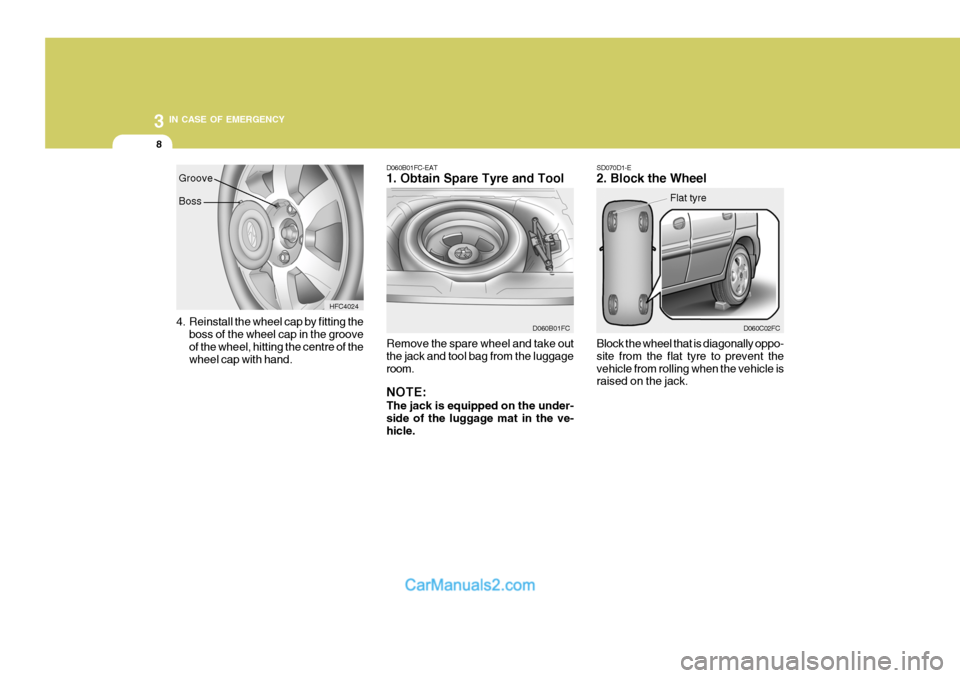
SD070D1-E 2. Block the Wheel Block the wheel that is diagonally oppo- site from the flat tyre to prevent thevehicle from rolling when the vehicle is raised on the jack. D060C02FC
Flat tyre
D060B01FC-EAT 1. Obtain Spare Tyre and Tool Remove the spare wheel and take out the jack and tool bag from the luggageroom. NOTE: The jack is equipped on the under- side of the luggage mat in the ve- hicle. D060B01FC
Boss
Groove
4. Reinstall the wheel cap by fitting the
boss of the wheel cap in the groove of the wheel, hitting the centre of the wheel cap with hand.
HFC4024
Page 409 of 490
3
IN CASE OF EMERGENCY
9
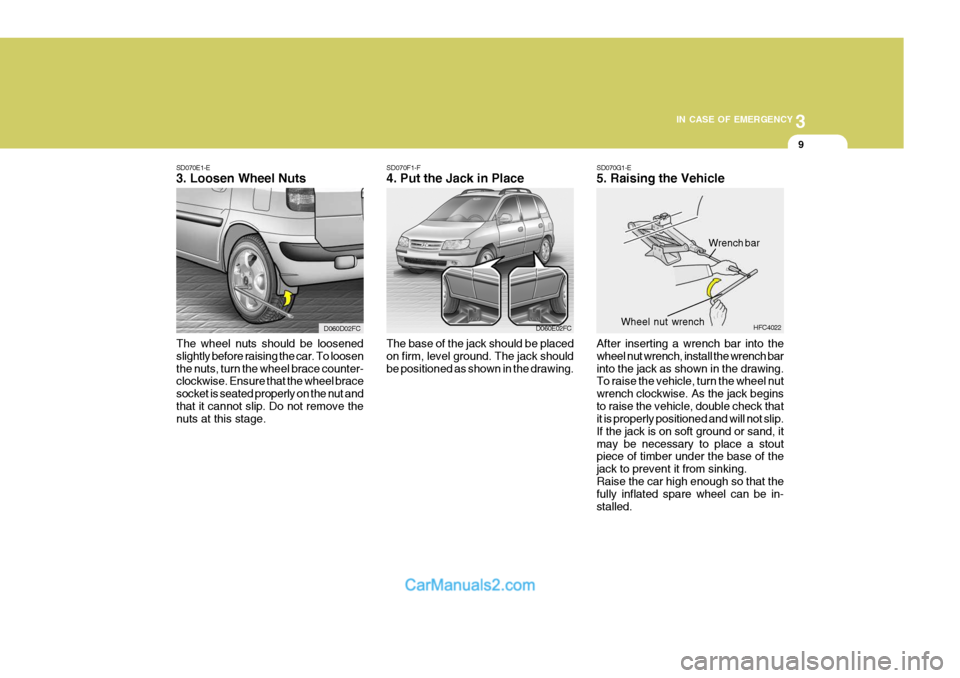
SD070F1-F 4. Put the Jack in Place
The base of the jack should be placed on firm, level ground. The jack shouldbe positioned as shown in the drawing. D060E02FC
SD070E1-E 3. Loosen Wheel Nuts
The wheel nuts should be loosened slightly before raising the car. To loosenthe nuts, turn the wheel brace counter- clockwise. Ensure that the wheel brace socket is seated properly on the nut andthat it cannot slip. Do not remove the nuts at this stage.SD070G1-E 5. Raising the Vehicle After inserting a wrench bar into the wheel nut wrench, install the wrench barinto the jack as shown in the drawing. To raise the vehicle, turn the wheel nut wrench clockwise. As the jack beginsto raise the vehicle, double check that it is properly positioned and will not slip. If the jack is on soft ground or sand, itmay be necessary to place a stout piece of timber under the base of the jack to prevent it from sinking.Raise the car high enough so that the fully inflated spare wheel can be in- stalled. HFC4022
Wrench bar
Wheel nut wrench
D060D02FC
Page 411 of 490
3
IN CASE OF EMERGENCY
11
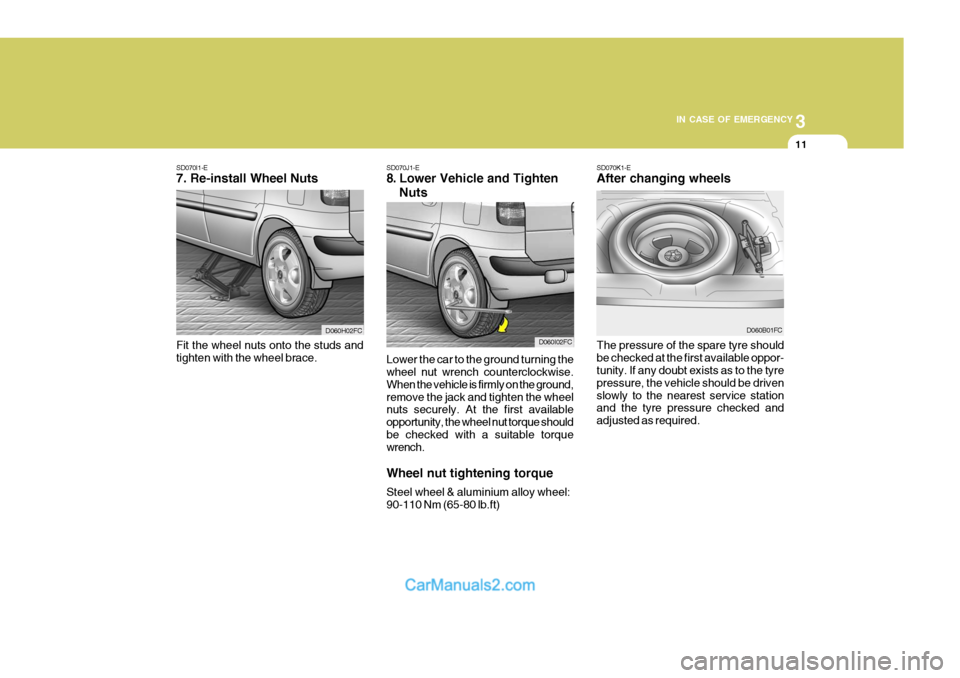
SD070I1-E 7. Re-install Wheel Nuts
Fit the wheel nuts onto the studs and tighten with the wheel brace. Lower the car to the ground turning the wheel nut wrench counterclockwise. When the vehicle is firmly on the ground,remove the jack and tighten the wheel nuts securely. At the first available opportunity, the wheel nut torque shouldbe checked with a suitable torque wrench. Wheel nut tightening torque Steel wheel & aluminium alloy wheel: 90-110 Nm (65-80 lb.ft)
SD070J1-E
8. Lower Vehicle and Tighten
NutsSD070K1-E After changing wheels The pressure of the spare tyre should be checked at the first available oppor- tunity. If any doubt exists as to the tyre pressure, the vehicle should be drivenslowly to the nearest service station and the tyre pressure checked and adjusted as required. D060B01FC
D060H02FCD060I02FC