sel HYUNDAI PALISADE 2022 Owners Manual
[x] Cancel search | Manufacturer: HYUNDAI, Model Year: 2022, Model line: PALISADE, Model: HYUNDAI PALISADE 2022Pages: 663, PDF Size: 15.74 MB
Page 598 of 663
7-39
7
Maintenance
Tire Maintenance
In addition to proper inflation, correct
wheel alignment helps to decrease
tire wear. If you find a tire is worn
unevenly, have your dealer check the
wheel alignment.
When you have new tires installed,
make sure they are balanced. This
will increase vehicle ride comfort and
tire life. Additionally, a tire should
always be rebalanced if it is removed
from the wheel.
Tire Sidewall Labeling
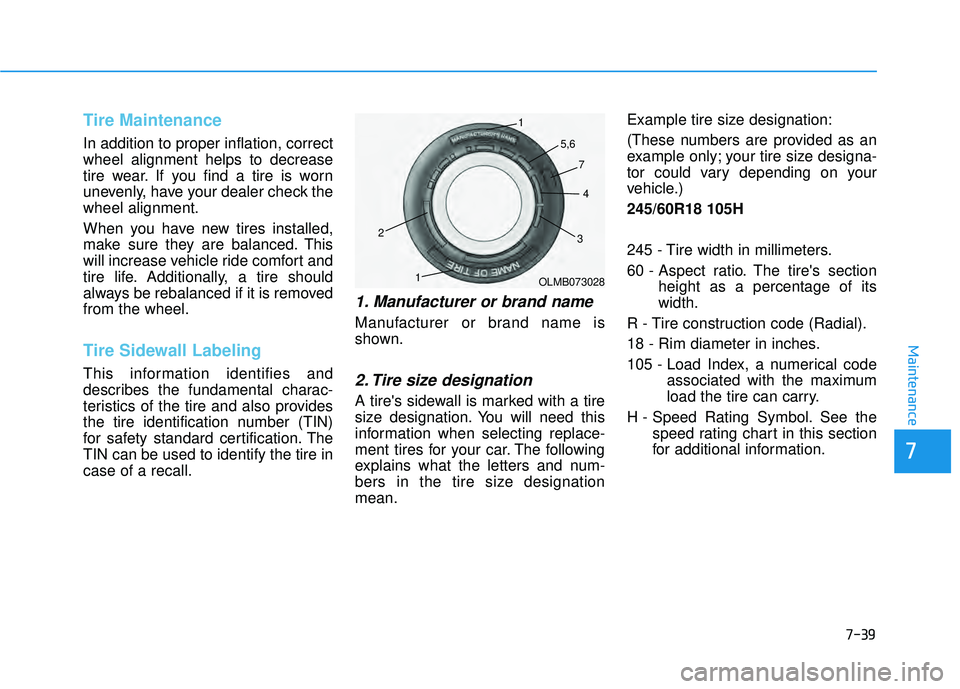
This information identifies and
describes the fundamental charac-
teristics of the tire and also provides
the tire identification number (TIN)
for safety standard certification. The
TIN can be used to identify the tire in
case of a recall.
1. Manufacturer or brand name
Manufacturer or brand name is
shown.
2. Tire size designation
A tire's sidewall is marked with a tire
size designation. You will need this
information when selecting replace-
ment tires for your car. The following
explains what the letters and num-
bers in the tire size designation
mean.Example tire size designation:
(These numbers are provided as an
example only; your tire size designa-
tor could vary depending on your
vehicle.)
245/60R18 105H
245 - Tire width in millimeters.
60 - Aspect ratio. The tire's section
height as a percentage of its
width.
R - Tire construction code (Radial).
18 - Rim diameter in inches.
105 - Load Index, a numerical code associated with the maximum
load the tire can carry.
H - Speed Rating Symbol. See the speed rating chart in this section
for additional information.
OLMB073028
1
1
2
34
5,6
7
Page 605 of 663
7-46
Maintenance
Vehicle Capacity Weight
The number of designated seating
positions multiplied by 150 lbs. (68
kg) plus the rated cargo and luggage
load.
Vehicle Maximum Load on theTire
Load on an individual tire due to curb
and accessory weight plus maximum
occupant and cargo weight.
Vehicle Normal Load on the Tire
Load on an individual tire that is
determined by distributing to each
axle its share of the curb weight,
accessory weight, and normal occu-
pant weight and dividing by 2.
Vehicle Placard
A label permanently attached to a
vehicle showing the original equip-
ment tire size and recommended
inflation pressure.
All Season Tires
HYUNDAI specifies all season tires
on some models to provide good
performance for use all year round,
including snowy road conditions. All
season tires are identified by ALL
SEASON and/or M+S (Mud and
Snow) on the tire sidewall. Snow tires
have better snow traction than all
season tires and may be more
appropriate in some areas.
Snow Tires
If you equip your car with snow tires,
they should be the same size and
have the same load capacity as the
original tires. Snow tires should be
installed on all four wheels; other-
wise, poor handling may result. Snow
tires should carry 4 psi (28 kPa)
more air pressure than the pressure
recommended for the standard tires
on the tire label on the driver’s side of
the center pillar, or up to the maxi-
mum pressure shown on the tire
sidewall, whichever is less. Do not
drive faster than 75 mph (120 km/h)
when your vehicle is equipped with
snow tires.
Radial-Ply Tires
Radial-ply tires provide improved
tread life, road hazard resistance and
smoother high speed ride. The radi-
al-ply tires used on this vehicle are of
belted construction, and are selected
to complement the ride and handling
characteristics of your vehicle.
Radial-ply tires have the same load
carrying capacity, as bias-ply or bias
belted tires of the same size, and use
the same recommended inflation
pressure. Mixing of radial-ply tires
with bias-ply or bias belted tires is
not recommended. Any combina-
tions of radial-ply and bias-ply or bias
belted tires when used on the same
vehicle will seriously deteriorate
vehicle handling. The best rule to fol-
low is: Identical pairs of radial-ply
tires should always be used as a set
for the front tires and a set for the
rear tires.
Page 608 of 663
7-49
7
Maintenance
Instrument Panel Fuse
Replacement
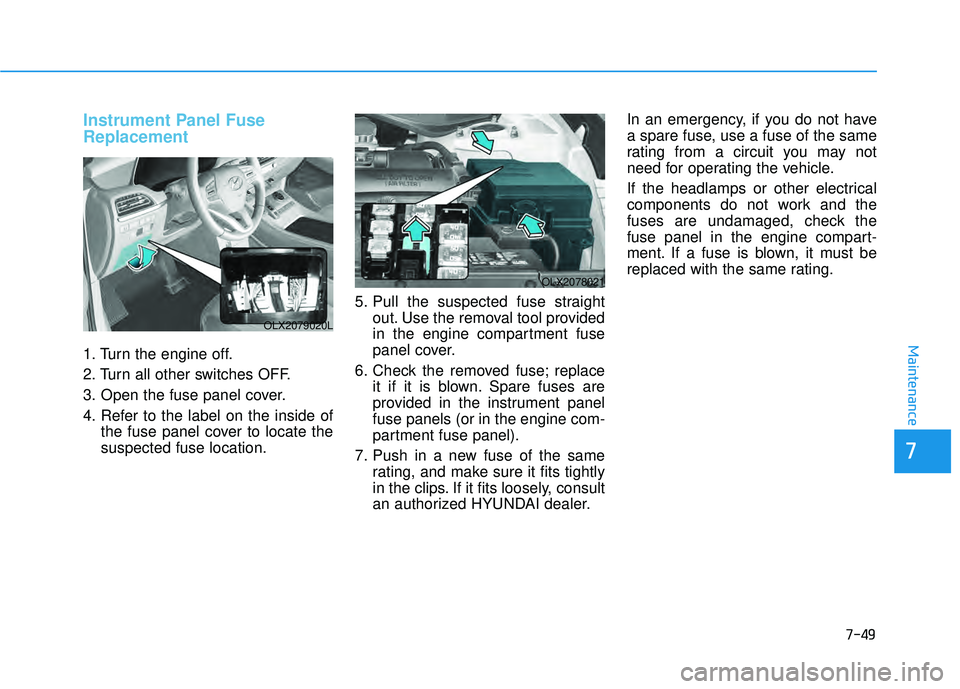
1. Turn the engine off.
2. Turn all other switches OFF.
3. Open the fuse panel cover.
4. Refer to the label on the inside ofthe fuse panel cover to locate the
suspected fuse location. 5. Pull the suspected fuse straight
out. Use the removal tool provided
in the engine compartment fuse
panel cover.
6. Check the removed fuse; replace it if it is blown. Spare fuses are
provided in the instrument panel
fuse panels (or in the engine com-
partment fuse panel).
7. Push in a new fuse of the same rating, and make sure it fits tightly
in the clips. If it fits loosely, consult
an authorized HYUNDAI dealer. In an emergency, if you do not have
a spare fuse, use a fuse of the same
rating from a circuit you may not
need for operating the vehicle.
If the headlamps or other electrical
components do not work and the
fuses are undamaged, check the
fuse panel in the engine compart-
ment. If a fuse is blown, it must be
replaced with the same rating.
OLX2079020L
OLX2078021
Page 609 of 663
7-50
Maintenance
Engine Compartment Panel
Fuse Replacement
1. Turn the engine off.
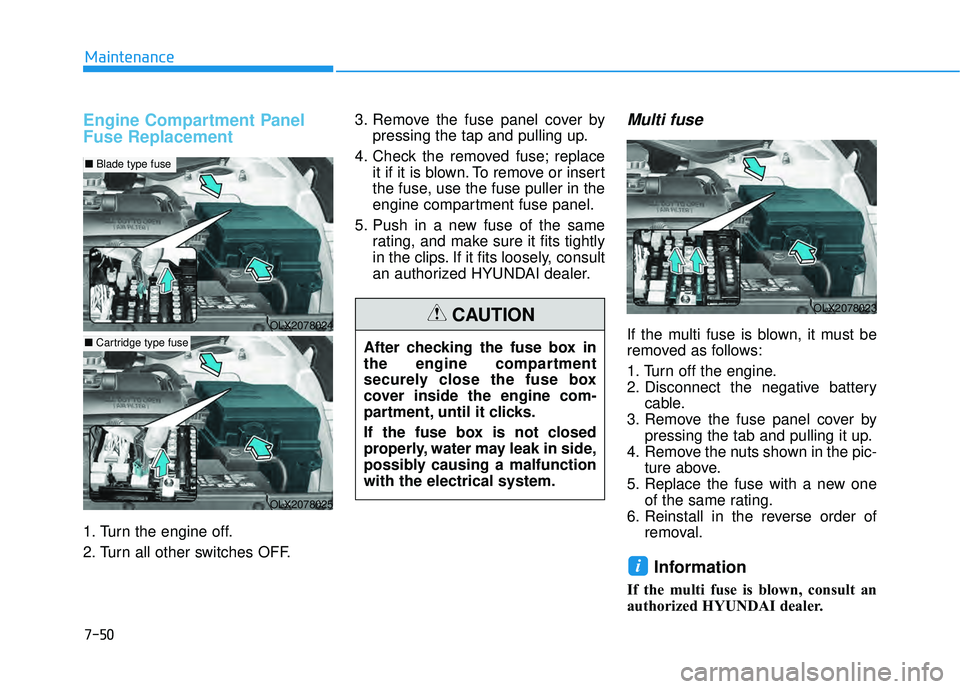
2. Turn all other switches OFF.3. Remove the fuse panel cover by
pressing the tap and pulling up.
4. Check the removed fuse; replace it if it is blown. To remove or insert
the fuse, use the fuse puller in the
engine compartment fuse panel.
5. Push in a new fuse of the same rating, and make sure it fits tightly
in the clips. If it fits loosely, consult
an authorized HYUNDAI dealer.
Multi fuse
If the multi fuse is blown, it must be
removed as follows:
1. Turn off the engine.
2. Disconnect the negative batterycable.
3. Remove the fuse panel cover by pressing the tab and pulling it up.
4. Remove the nuts shown in the pic- ture above.
5. Replace the fuse with a new one of the same rating.
6. Reinstall in the reverse order of removal.
Information
If the multi fuse is blown, consult an
authorized HYUNDAI dealer.
i
After checking the fuse box in
the engine compartment
securely close the fuse box
cover inside the engine com-
partment, until it clicks.
If the fuse box is not closed
properly, water may leak in side,
possibly causing a malfunction
with the electrical system.
CAUTIONOLX2078024
■Blade type fuse
OLX2078025
■Cartridge type fuse
OLX2078023
Page 649 of 663
8-9
88
Specifications, Consumer information and Reporting safety defects
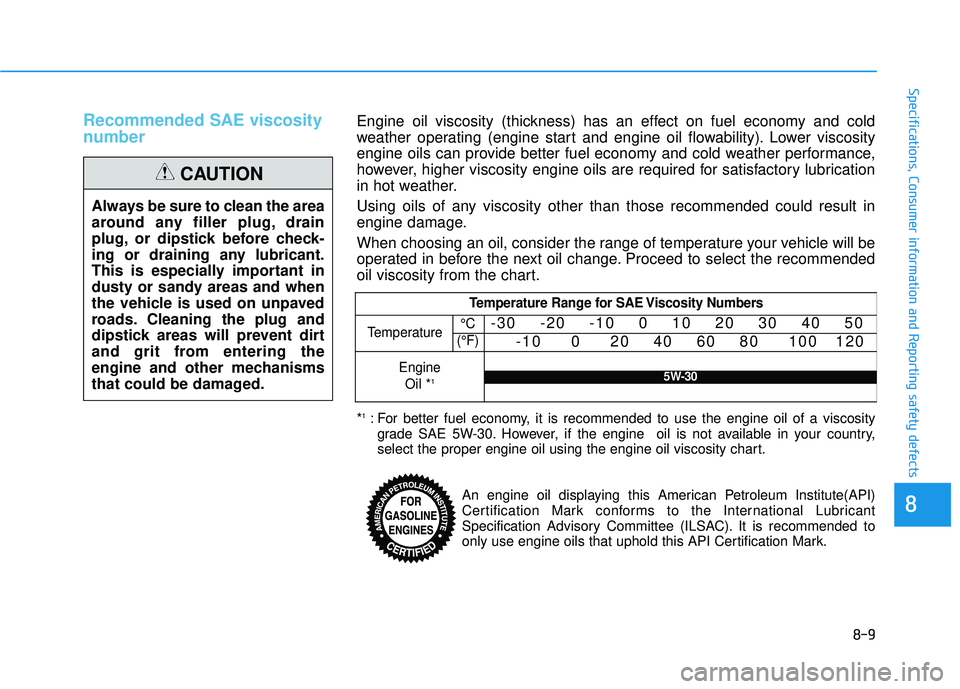
Recommended SAE viscosity
number
Always be sure to clean the area
around any filler plug, drain
plug, or dipstick before check-
ing or draining any lubricant.
This is especially important in
dusty or sandy areas and when
the vehicle is used on unpaved
roads. Cleaning the plug and
dipstick areas will prevent dirt
and grit from entering the
engine and other mechanisms
that could be damaged.
CAUTION
*1: For better fuel economy, it is recommended to use the engine oil of a viscositygrade SAE 5W-30. However, if the engine oil is not available in your country,
select the proper engine oil using the engine oil viscosity chart.
An engine oil displaying this American Petroleum Institute(API)
Certification Mark conforms to the International Lubricant
Specification Advisory Committee (ILSAC). It is recommended to
only use engine oils that uphold this API Certification Mark.
Engine oil viscosity (thickness) has an effect on fuel economy and cold
weather operating (engine start and engine oil flowability). Lower viscosity
engine oils can provide better fuel economy and cold weather performance,
however, higher viscosity engine oils are required for satisfactory lubrication
in hot weather.
Using oils of any viscosity other than those recommended could result in
engine damage.
When choosing an oil, consider the range of temperature your vehicle will be
operated in before the next oil change. Proceed to select the recommended
oil viscosity from the chart.
Temperature Range for SAE Viscosity Numbers
Temperature -30 -20 -10 0 10 20 30 40 50
-10 0 20 40 60 80 100 120
Engine Oil *1
°C
(°F)
5W-30
Page 656 of 663
I-3
Blind-spot Collison Warning(BCW)...............................5-85Blind-Spot Collision Warning malfunction and limitations ..........................................................5-90
Blind-Spot Collision Warning operation ...................5-89
Blind-Spot Collision Warning settings settings .........5-86
Blind-Spot View Monitor (BVM) ...............................3-182 Blind-Spot View Monitor malfunction ....................3-183
Blind-Spot View Monitor operation.........................3-183
Blind-Spot View Monitor settings ...........................3-182
Brake fluid ......................................................................7-\
21 Checking the Brake Fluid Level ................................7-21
Braking system ...............................................................5-23 Anti-lock Brake System (ABS)..................................5-33
Auto Hold ...................................................................5-29
Disc Brakes Wear Indicator........................................5-24
Downhill Brake Control (DBC) ................................5-39
Electronic Parking Brake (EPB) ................................5-24
Electronic Stability Control (ESC).............................5-35
Good Braking Practices ............................................5-42
Hill-Start Assist Control (HAC) .................................5-39
Power Brakes..............................................................5-23
Trailer Stability Assist (TSA) .....................................5-42
Vehicle Stability Management (VSM) .......................5-38
Bulb Wattage .....................................................................8-3\
California perchlorate notice ..........................................7-81
Child Restraint System (CRS) ........................................2-45
Children Always in the Rear ......................................2-45
Installing a Child Restraint System (CRS) ................2-49
Selecting a Child Restraint System (CRS).................2-47
Climate Control Additional Features ............................3-216 Automatic Ventilation...............................................3-216
Cluster ionizer .........................................................3-216
Sunroof Inside Air Recirculation ............................3-216
Climate control air filter .................................................7-24 Filter Inspection..........................................................7-24
Consumer Information ....................................................8-12
Declaration of confirmity .............................................5-200 Front radar ...............................................................5-200
Rear corner radar .....................................................5-200
Dimensions .......................................................................8\
-2
Door Locks .....................................................................3-1\
6 Automatic Door Lock and Unlock Features ..............3-20
Child-Protector Rear Door Locks .............................3-21
Electronic Child Safety Lock System .......................3-21
Operating Door Locks from Inside the Vehicle ........3-17
Operating Door Locks from Outside the Vehicle .....3-16
I
Index
C
D