check engine light Hyundai Santa Fe 2009 Owner's Manual - RHD (UK, Australia)
[x] Cancel search | Manufacturer: HYUNDAI, Model Year: 2009, Model line: Santa Fe, Model: Hyundai Santa Fe 2009Pages: 269, PDF Size: 9.78 MB
Page 60 of 269
1
FEATURES OF YOUR HYUNDAI
49
!
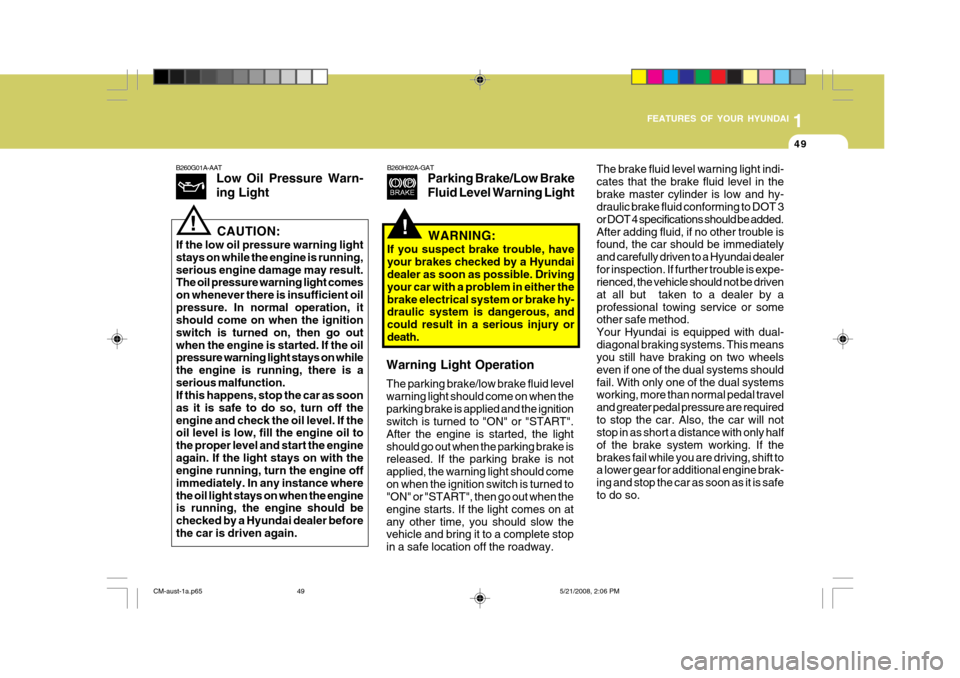
B260G01A-AAT
Low Oil Pressure Warn- ing Light
CAUTION:
If the low oil pressure warning light stays on while the engine is running,serious engine damage may result. The oil pressure warning light comes on whenever there is insufficient oilpressure. In normal operation, it should come on when the ignition switch is turned on, then go outwhen the engine is started. If the oil pressure warning light stays on while the engine is running, there is aserious malfunction. If this happens, stop the car as soon as it is safe to do so, turn off theengine and check the oil level. If the oil level is low, fill the engine oil to the proper level and start the engineagain. If the light stays on with the engine running, turn the engine off immediately. In any instance wherethe oil light stays on when the engine is running, the engine should be checked by a Hyundai dealer beforethe car is driven again.
!
B260H02A-GAT Parking Brake/Low Brake Fluid Level Warning Light
WARNING:
If you suspect brake trouble, have your brakes checked by a Hyundai dealer as soon as possible. Driving your car with a problem in either thebrake electrical system or brake hy- draulic system is dangerous, and could result in a serious injury or death.
Warning Light Operation The parking brake/low brake fluid level warning light should come on when theparking brake is applied and the ignition switch is turned to "ON" or "START". After the engine is started, the lightshould go out when the parking brake is released. If the parking brake is not applied, the warning light should comeon when the ignition switch is turned to "ON" or "START", then go out when the engine starts. If the light comes on atany other time, you should slow the vehicle and bring it to a complete stop in a safe location off the roadway. The brake fluid level warning light indi-cates that the brake fluid level in thebrake master cylinder is low and hy- draulic brake fluid conforming to DOT 3 or DOT 4 specifications should be added.After adding fluid, if no other trouble is found, the car should be immediately and carefully driven to a Hyundai dealerfor inspection. If further trouble is expe- rienced, the vehicle should not be driven at all but taken to a dealer by aprofessional towing service or some other safe method. Your Hyundai is equipped with dual-diagonal braking systems. This means you still have braking on two wheels even if one of the dual systems shouldfail. With only one of the dual systems working, more than normal pedal travel and greater pedal pressure are requiredto stop the car. Also, the car will not stop in as short a distance with only half of the brake system working. If thebrakes fail while you are driving, shift to a lower gear for additional engine brak- ing and stop the car as soon as it is safeto do so.
CM-aust-1a.p65
5/21/2008, 2:06 PM
49
Page 61 of 269
1FEATURES OF YOUR HYUNDAI
50
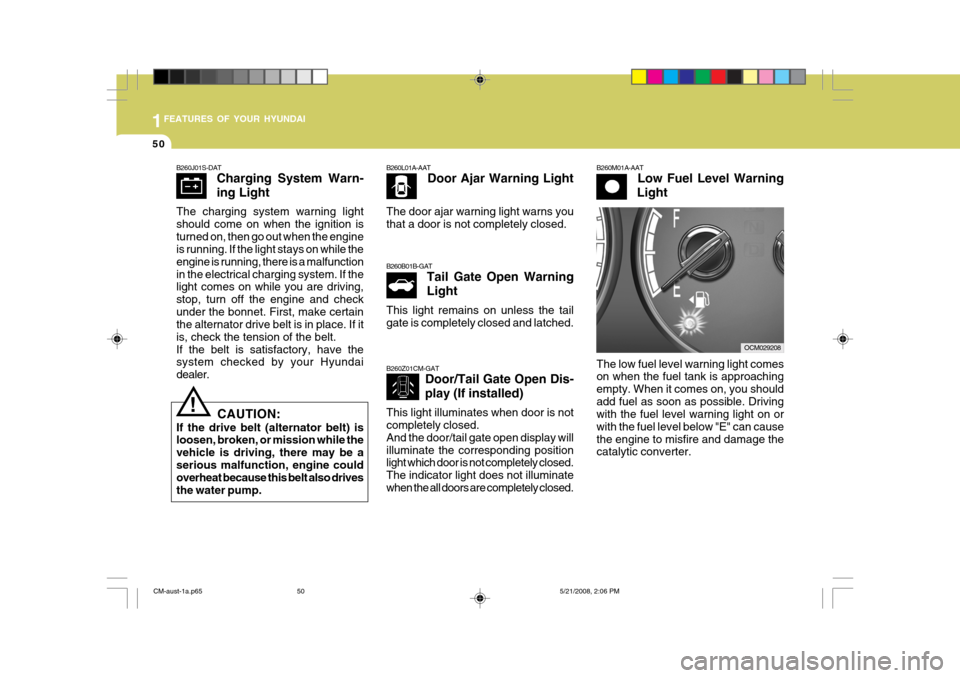
B260J01S-DAT
Charging System Warn- ing Light
The charging system warning light should come on when the ignition isturned on, then go out when the engine is running. If the light stays on while the engine is running, there is a malfunctionin the electrical charging system. If the light comes on while you are driving, stop, turn off the engine and checkunder the bonnet. First, make certain the alternator drive belt is in place. If it is, check the tension of the belt.If the belt is satisfactory, have the system checked by your Hyundai dealer. B260L01A-AAT
Door Ajar Warning Light
The door ajar warning light warns youthat a door is not completely closed. B260M01A-AAT
Low Fuel Level Warning
Light
B260B01B-GAT Tail Gate Open Warning Light
This light remains on unless the tail gate is completely closed and latched.
! CAUTION:
If the drive belt (alternator belt) is loosen, broken, or mission while the vehicle is driving, there may be aserious malfunction, engine could overheat because this belt also drives the water pump. B260Z01CM-GAT
Door/Tail Gate Open Dis- play (If installed)
This light illuminates when door is not completely closed. And the door/tail gate open display willilluminate the corresponding position light which door is not completely closed. The indicator light does not illuminatewhen the all doors are completely closed.
The low fuel level warning light comes on when the fuel tank is approaching empty. When it comes on, you shouldadd fuel as soon as possible. Driving with the fuel level warning light on or with the fuel level below "E" can causethe engine to misfire and damage the catalytic converter.
OCM029208
CM-aust-1a.p65 5/21/2008, 2:06 PM
50
Page 62 of 269
1
FEATURES OF YOUR HYUNDAI
51
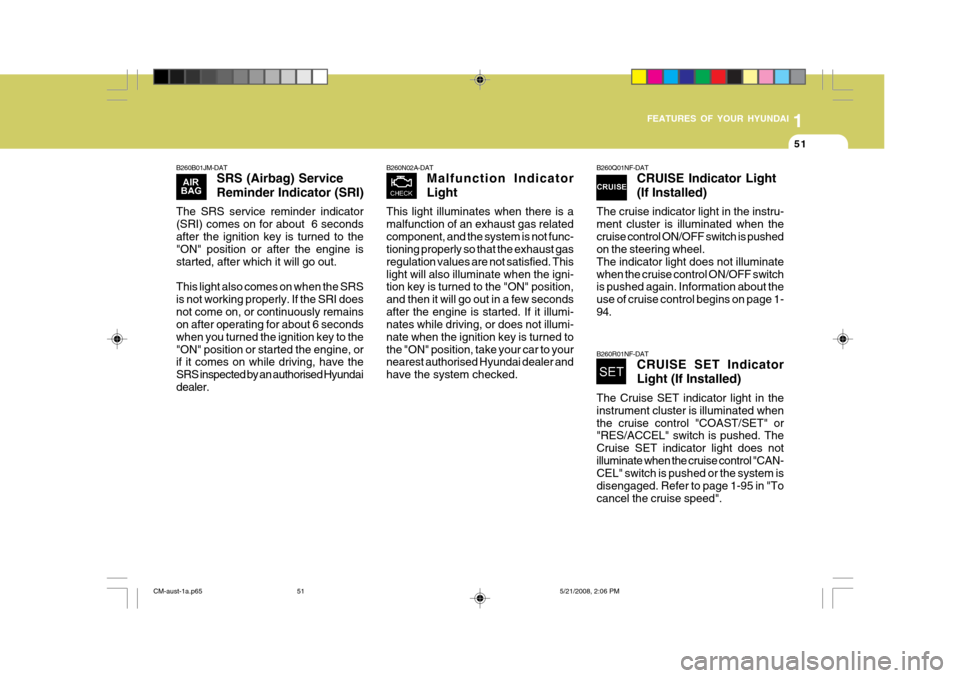
B260B01JM-DAT SRS (Airbag) Service Reminder Indicator (SRI)
The SRS service reminder indicator (SRI) comes on for about 6 secondsafter the ignition key is turned to the "ON" position or after the engine is started, after which it will go out. This light also comes on when the SRS is not working properly. If the SRI doesnot come on, or continuously remains on after operating for about 6 seconds when you turned the ignition key to the"ON" position or started the engine, or if it comes on while driving, have the SRS inspected by an authorised Hyundaidealer.
B260N02A-DAT Malfunction Indicator Light
This light illuminates when there is a malfunction of an exhaust gas relatedcomponent, and the system is not func- tioning properly so that the exhaust gas regulation values are not satisfied. Thislight will also illuminate when the igni- tion key is turned to the "ON" position, and then it will go out in a few secondsafter the engine is started. If it illumi- nates while driving, or does not illumi- nate when the ignition key is turned tothe "ON" position, take your car to your nearest authorised Hyundai dealer and have the system checked. B260Q01NF-DAT
CRUISE Indicator Light (If Installed)
The cruise indicator light in the instru- ment cluster is illuminated when thecruise control ON/OFF switch is pushed on the steering wheel. The indicator light does not illuminatewhen the cruise control ON/OFF switch is pushed again. Information about the use of cruise control begins on page 1-94.
B260R01NF-DAT CRUISE SET Indicator Light (If Installed)
The Cruise SET indicator light in the instrument cluster is illuminated whenthe cruise control "COAST/SET" or "RES/ACCEL" switch is pushed. The Cruise SET indicator light does notilluminate when the cruise control "CAN- CEL" switch is pushed or the system is disengaged. Refer to page 1-95 in "Tocancel the cruise speed".
CM-aust-1a.p65 5/21/2008, 2:06 PM
51
Page 63 of 269
1FEATURES OF YOUR HYUNDAI
52
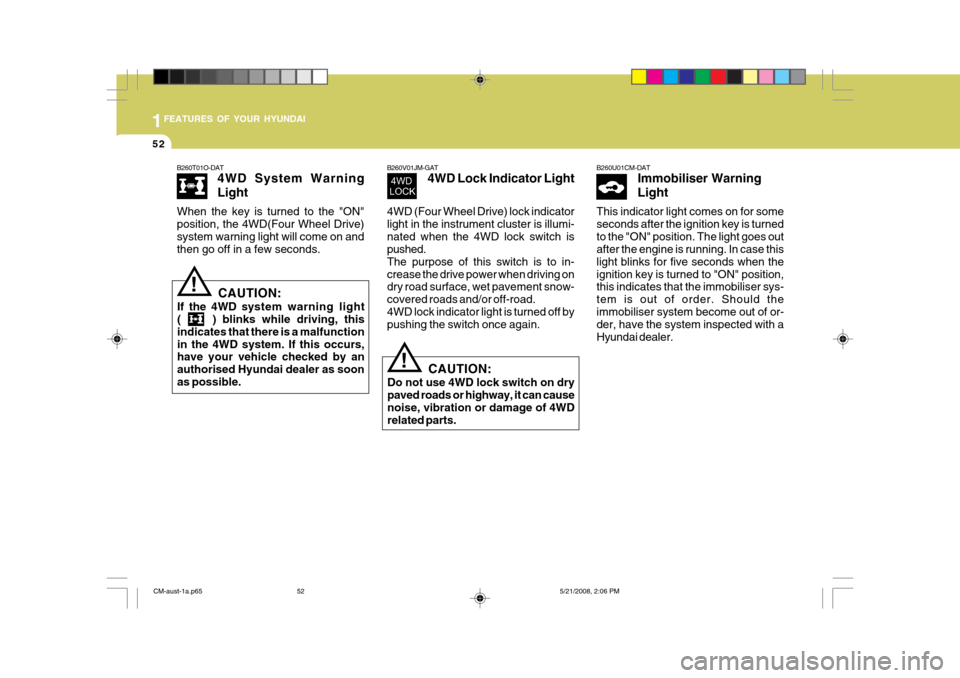
B260T01O-DAT 4WD System Warning Light
When the key is turned to the "ON" position, the 4WD(Four Wheel Drive)system warning light will come on and then go off in a few seconds.
CAUTION:
If the 4WD system warning light ( ) blinks while driving, this indicates that there is a malfunction in the 4WD system. If this occurs, have your vehicle checked by an authorised Hyundai dealer as soonas possible.! B260V01JM-GAT
4WD Lock Indicator Light
4WD (Four Wheel Drive) lock indicator light in the instrument cluster is illumi-nated when the 4WD lock switch is pushed. The purpose of this switch is to in-crease the drive power when driving on dry road surface, wet pavement snow- covered roads and/or off-road.4WD lock indicator light is turned off by pushing the switch once again.
CAUTION:
Do not use 4WD lock switch on dry paved roads or highway, it can cause noise, vibration or damage of 4WD related parts.
!
B260U01CM-DAT Immobiliser Warning Light
This indicator light comes on for some seconds after the ignition key is turnedto the "ON" position. The light goes out after the engine is running. In case this light blinks for five seconds when theignition key is turned to "ON" position, this indicates that the immobiliser sys- tem is out of order. Should theimmobiliser system become out of or- der, have the system inspected with a Hyundai dealer.
CM-aust-1a.p65 5/21/2008, 2:06 PM
52
Page 100 of 269
1
FEATURES OF YOUR HYUNDAI
89
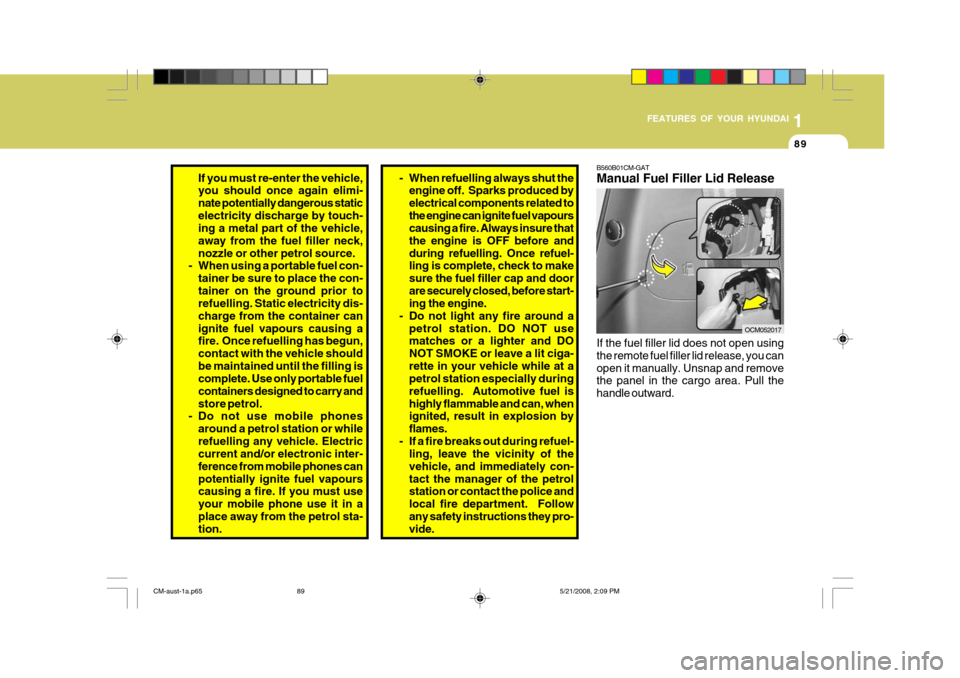
B560B01CM-GAT Manual Fuel Filler Lid Release If the fuel filler lid does not open using the remote fuel filler lid release, you canopen it manually. Unsnap and remove the panel in the cargo area. Pull the handle outward.
OCM052017
If you must re-enter the vehicle, you should once again elimi- nate potentially dangerous staticelectricity discharge by touch- ing a metal part of the vehicle, away from the fuel filler neck,nozzle or other petrol source.
- When using a portable fuel con-
tainer be sure to place the con-tainer on the ground prior to refuelling. Static electricity dis- charge from the container canignite fuel vapours causing a fire. Once refuelling has begun, contact with the vehicle shouldbe maintained until the filling is complete. Use only portable fuel containers designed to carry andstore petrol.
- Do not use mobile phones
around a petrol station or whilerefuelling any vehicle. Electric current and/or electronic inter- ference from mobile phones canpotentially ignite fuel vapours causing a fire. If you must use your mobile phone use it in aplace away from the petrol sta- tion.- When refuelling always shut theengine off. Sparks produced by electrical components related tothe engine can ignite fuel vapours causing a fire. Always insure that the engine is OFF before andduring refuelling. Once refuel- ling is complete, check to make sure the fuel filler cap and doorare securely closed, before start- ing the engine.
- Do not light any fire around a petrol station. DO NOT usematches or a lighter and DO NOT SMOKE or leave a lit ciga-rette in your vehicle while at a petrol station especially during refuelling. Automotive fuel ishighly flammable and can, when ignited, result in explosion by flames.
- If a fire breaks out during refuel- ling, leave the vicinity of thevehicle, and immediately con-tact the manager of the petrol station or contact the police and local fire department. Followany safety instructions they pro- vide.
CM-aust-1a.p65 5/21/2008, 2:09 PM
89
Page 148 of 269
2
DRIVING YOUR HYUNDAI
3
!
BEFORE STARTING THE ENGINE
C020A01CM-DAT Before you start the engine, you should always:
1. Look around the vehicle to be sure
there are no flat tyres, puddles of oil, water or other indications of possible trouble.
2. After entering the car, check to be sure the hand brake is engaged.
3. Check that all windows, and lights are clean.
4. Check that the interior and exterior
mirrors are clean and in position.
5. Check your seat, seatback and head- rest to be sure they are in their properpositions.
6. Lock all the doors.
7. Fasten your seat belt and be sure
that all other occupants have fas- tened theirs.
8. Turn off all lights and accessories
that are not needed.
9. When you turn the ignition switch to "ON", check that all appropriate warn-ing lights are operating and that youhave sufficient fuel.
10. Check the operation of warning lights
and all bulbs when key is in the "ON"position.
C020A01HP-DAT
o In a collision crash, an unbelted
person is significantly more likelyto die than a person wearing aseatbelt.
RISK OF ROLLOVER
WARNING:
o Utility vehicle has a significantly higher collision rate than othertype of vehicles.
o Utility vehicle have higher ground clearance and a narrower trackto make them capable of perform-ing in a wide variety of off-road applications. Specific design characteristics give them a highercentre of gravity than ordinary cars. An advantage of the higher ground clearance is a better viewof the road allowing you to antici- pate problem. They are not de- signed for cornering at the samespeeds as conventional 2-wheel drive vehicles any more than low- slung sports cars are designed toperform satisfactorily under off- road conditions. If at all possible, avoid sharp turns or abrupt ma-neuvers. As with other vehicles of this type, failure to operate this vehicle correctly may result inloss of control or vehicle rollover.
CM-aust-2.p65 5/19/2008, 6:34 PM
3
Page 165 of 269
2DRIVING YOUR HYUNDAI
20
!
GOOD BRAKING PRACTICES
C130A01A-DAT o Don't coast down hills with the car
out of gear. This is extremely haz- ardous. Keep the car in gear at all times, use the brakes to slow down,then shift to a lower gear so thatengine braking will help you maintaina safe speed.
o Don't "ride" the brake pedal. Resting
your foot on the brake pedal whiledriving can be dangerous because itcan result in the brakes overheatingand losing their effectiveness. It alsoincreases the wear of the brake com-ponents.
o If a tyre goes flat while you are driving, apply the brakes gently andkeep the car pointed straight aheadwhile you slow down. When you aremoving slowly enough for it to besafe to do so, pull off the road and stop in a safe place.
o If your car is equipped with an auto-
matic transaxle, don't let your car creep forward. To avoid creepingforward, keep your foot on the brakepedal when the car is stopped.
o Use caution when parking on a hill. Engage the parking brake and placethe gear selector lever in "P" (auto-matic transaxle) or in first or re-
verse gear (manual transaxle).
WARNING:
Nothing should be carried on top ofthe shelf panel behind the rear seat. If there were an accident or a suddenstop, such objects could move for- ward and cause damage to the ve- hicle or injure the occupants.
o After being parked, check to be sure the parking brake is not engaged and that the parking brake indicator light is out before driving away.
o Driving through water may get the brakes wet. They can also get wet when the car is washed. Wet brakescan be dangerous! Your car will not stop as quickly if the brakes are wet. Wet brakes cause the car to pull toone side. To dry the brakes, apply the brakes lightly until the braking action returns to normal, taking careto keep the car under control at all times. If the braking action does not return to normal, stop as soon as it issafe to do so and call your Hyundai dealer for assistance.
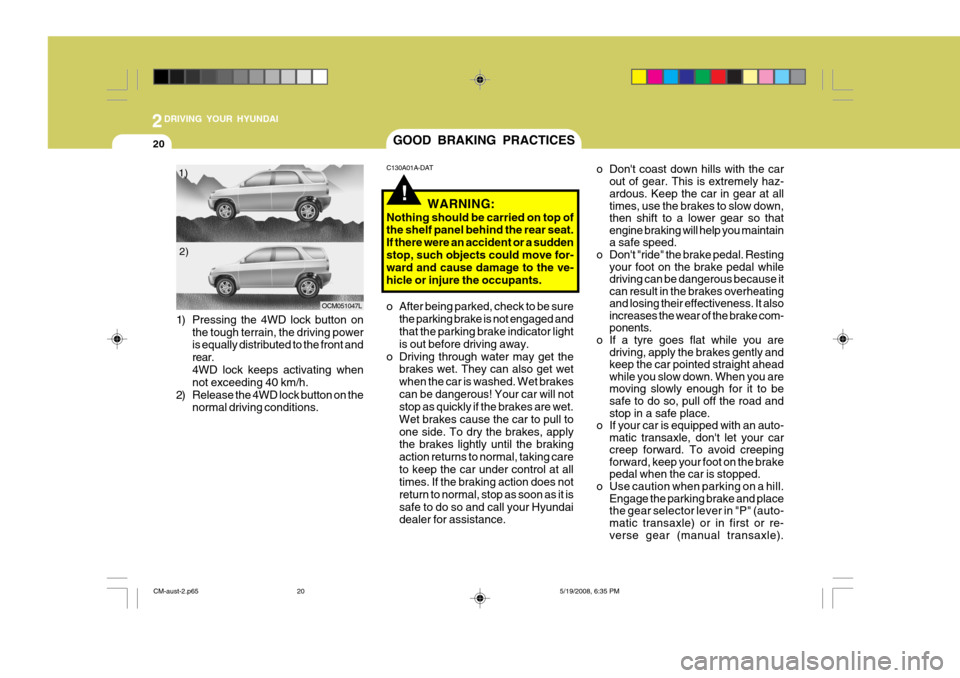
1) Pressing the 4WD lock button on
the tough terrain, the driving power is equally distributed to the front and rear. 4WD lock keeps activating when not exceeding 40 km/h.
2) Release the 4WD lock button on the normal driving conditions.
1)
2)
OCM051047L
CM-aust-2.p65 5/19/2008, 6:35 PM
20
Page 170 of 269
2
DRIVING YOUR HYUNDAI
25
C160J01A-AAT Don't Let Ice and Snow Accumu- late Underneath Under some conditions, snow and ice can build up under the fenders andinterfere with the steering. When driving in severe winter conditions where this may happen, you should periodicallycheck underneath the car to be sure the movement of the front wheels and the steering components are not obstructed. C160K01A-DAT Carry Emergency Equipment Depending on the severity of the weather where you drive your car, you should carry appropriate emergency equip-ment. Some of the items you may want to carry include tyre chains, tow straps or chains, flashlight, emergency flares,sand, a shovel, jumper cables, a win- dow scraper, gloves, ground cloth, cov- eralls, a blanket, etc.HIGHER SPEED MOTORING
C170A01A-DAT Pre-Trip Inspections
1. Tyres: Adjust the tyre inflation pressures tospecification. Low tyre inflation pres- sures will result in overheating and possible failure of the tyres. Avoid us-ing worn or damaged tyres which may result in reduced traction or tyre failure. NOTE: Never exceed the maximum tyre in- flation pressure shown on the tyres.
2. Fuel, engine coolant and engine oil: High speed travel consumes more fuel than urban motoring. Do not forget tocheck both engine coolant and engine oil.
3. Drive belt: A loose or damaged drive belt may result in overheating of the engine.
C160I01A-AAT Don't Let Your Parking Brake Freeze Under some conditions your parking brake can freeze in the engaged posi-tion. This is most likely to happen when there is an accumulation of snow or ice around or near the rear brakes or if thebrakes are wet. If there is a risk the parking brake may freeze, apply it only temporarily while you put the gearselector lever in "P" (automatic) or in first or reverse gear (manual transaxle) and block the rear wheels so the carcannot roll. Then release the parking brake.
CM-aust-2.p65
5/19/2008, 6:35 PM
25
Page 171 of 269
2DRIVING YOUR HYUNDAI
26
!
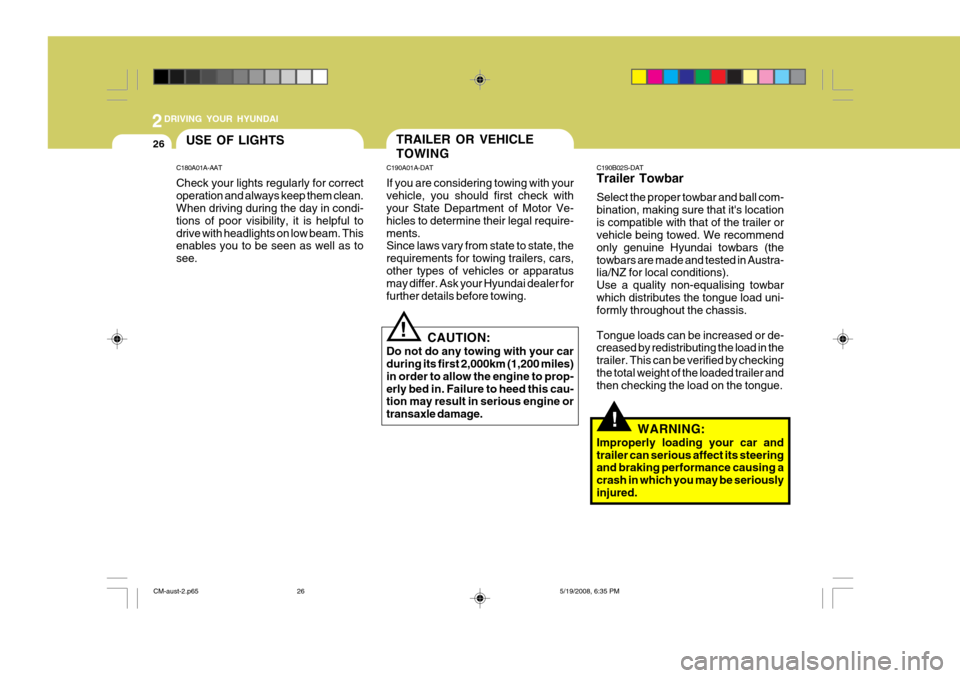
C190B02S-DAT Trailer Towbar Select the proper towbar and ball com- bination, making sure that it's locationis compatible with that of the trailer or vehicle being towed. We recommend only genuine Hyundai towbars (thetowbars are made and tested in Austra- lia/NZ for local conditions). Use a quality non-equalising towbarwhich distributes the tongue load uni- formly throughout the chassis. Tongue loads can be increased or de- creased by redistributing the load in the trailer. This can be verified by checkingthe total weight of the loaded trailer and then checking the load on the tongue.
WARNING:
Improperly loading your car and trailer can serious affect its steering and braking performance causing a crash in which you may be seriouslyinjured.
TRAILER OR VEHICLE TOWING
C190A01A-DAT If you are considering towing with your vehicle, you should first check with your State Department of Motor Ve- hicles to determine their legal require-ments. Since laws vary from state to state, the requirements for towing trailers, cars,other types of vehicles or apparatus may differ. Ask your Hyundai dealer for further details before towing.
CAUTION:
Do not do any towing with your car during its first 2,000km (1,200 miles) in order to allow the engine to prop-erly bed in. Failure to heed this cau- tion may result in serious engine or transaxle damage.
!
USE OF LIGHTS
C180A01A-AAT Check your lights regularly for correct operation and always keep them clean. When driving during the day in condi- tions of poor visibility, it is helpful todrive with headlights on low beam. This enables you to be seen as well as to see.
CM-aust-2.p65 5/19/2008, 6:35 PM
26
Page 174 of 269
2
DRIVING YOUR HYUNDAI
29
!
C190F01A-DAT Trailer and Vehicle Towing Tips
1. Before towing, check towbar and
safety chain connections as well as proper operation of the trailer running lights, brake lights and turn signals.
2. Always drive your vehicle at a mod- erate speed (Less than 100 km/h).
3. Trailer towing requires more fuel than
normal conditions.
4. To maintain engine braking efficiency and electrical charging performance, do not use fifth gear (manualtransaxle) or overdrive (automatic transaxle).
5. Always secure items in the trailer to prevent load shift while driving.
6. Check the condition and air pressure
of all tyres on the trailer and your car. Low tyre pressure can seriously af- fect the handling. Also check the spare tyre.
7. The vehicle/trailer combination is more affected by crosswind and buf-feting. When being passed by alarge vehicle, keep a constant speed and steer straight ahead. If there is too much wind buffeting, slow downto get out of the other vehicle's air turbulence. 8. When parking your car and trailer,
especially on a hill, be sure to follow all the normal precautions. Turn your front wheel into the curb, set the parking brake firmly, and put thetransaxle in 1st or Reverse (manual) or Park (automatic). In addition, place wheel chocks at each of the trailer'styres.
9. If the trailer has electric brakes, drive
your vehicle with the trailer attached,and then apply the trailer brakes by hand. This test confirms the opera- tion of the trailer brakes and alsochecks your electrical connection at the same time.
10. During your trip, check occasionally to be sure that the load is secure,and that the lights and any trailer brakes are still working.
11. Avoid jerky starts, sudden accel- eration or sudden stops.
12. Avoid sharp turns and rapid lane changes.
13. Avoid holding the brake pedal down
too long or too frequently. This couldcause the brakes to overheat, re- sulting in reduced braking efficiency.
CAUTION:
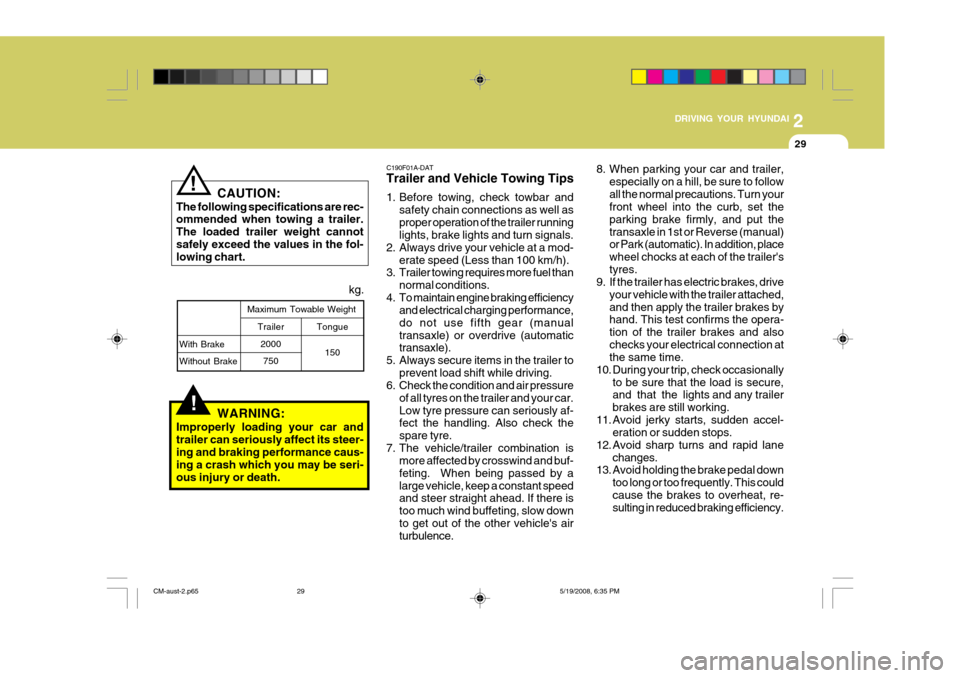
The following specifications are rec-ommended when towing a trailer. The loaded trailer weight cannotsafely exceed the values in the fol- lowing chart.
!
Maximum Towable Weight kg.
With Brake Without Brake
WARNING:
Improperly loading your car and trailer can seriously affect its steer-ing and braking performance caus- ing a crash which you may be seri- ous injury or death.
Tongue
150
Trailer
2000750
CM-aust-2.p65 5/19/2008, 6:35 PM
29