oil Hyundai Santa Fe 2009 Owner's Manual - RHD (UK, Australia)
[x] Cancel search | Manufacturer: HYUNDAI, Model Year: 2009, Model line: Santa Fe, Model: Hyundai Santa Fe 2009Pages: 269, PDF Size: 9.78 MB
Page 10 of 269
YOUR VEHICLE AT A GLANCE
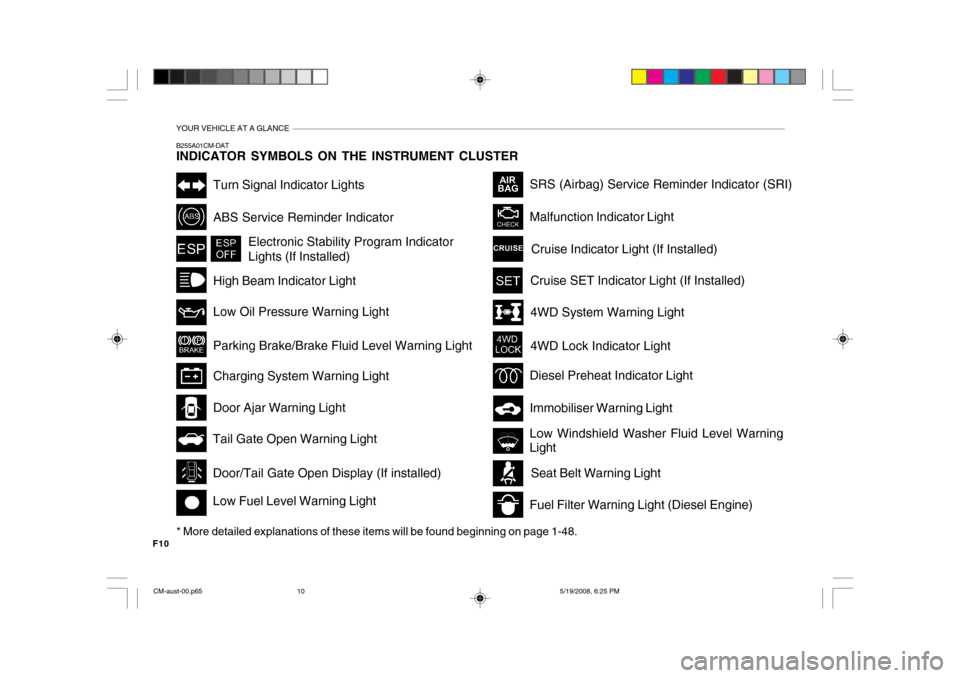
F10B255A01CM-DAT INDICATOR SYMBOLS ON THE INSTRUMENT CLUSTER
* More detailed explanations of these items will be found beginning on page 1-48.
4WD System Warning Light
Malfunction Indicator Light
SRS (Airbag) Service Reminder Indicator (SRI)
Tail Gate Open Warning Light
Low Fuel Level Warning Light Door Ajar Warning Light
ABS Service Reminder Indicator
Turn Signal Indicator Lights
High Beam Indicator Light Low Oil Pressure Warning Light Parking Brake/Brake Fluid Level Warning Light Charging System Warning Light
Immobiliser Warning Light
4WD Lock Indicator Light
Electronic Stability Program Indicator Lights (If Installed)
Cruise SET Indicator Light (If Installed)
Door/Tail Gate Open Display (If installed)
Cruise Indicator Light (If Installed)
Low Windshield Washer Fluid Level Warning LightSeat Belt Warning Light
Diesel Preheat Indicator Light
Fuel Filter Warning Light (Diesel Engine)
CM-aust-00.p65 5/19/2008, 6:25 PM
10
Page 13 of 269
1FEATURES OF YOUR HYUNDAI
2
OCM051001R
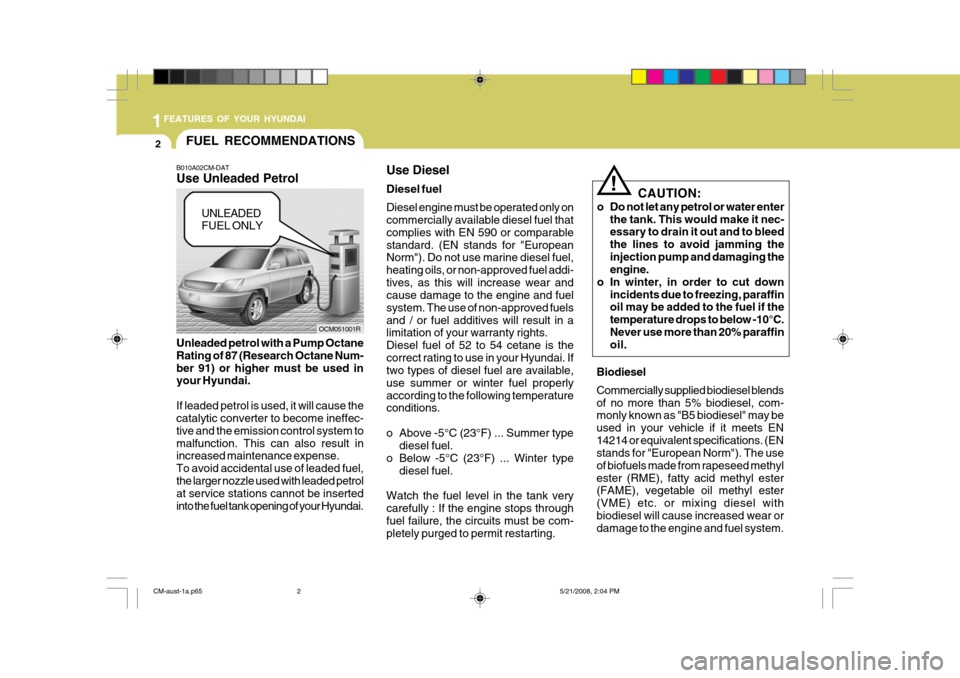
Unleaded petrol with a Pump Octane Rating of 87 (Research Octane Num-ber 91) or higher must be used in your Hyundai. If leaded petrol is used, it will cause the catalytic converter to become ineffec- tive and the emission control system tomalfunction. This can also result in increased maintenance expense. To avoid accidental use of leaded fuel,the larger nozzle used with leaded petrol at service stations cannot be inserted into the fuel tank opening of your Hyundai.
B010A02CM-DAT Use Unleaded Petrol
FUEL RECOMMENDATIONS
UNLEADED FUEL ONLY
!
Use Diesel Diesel fuel Diesel engine must be operated only on commercially available diesel fuel that complies with EN 590 or comparablestandard. (EN stands for "European Norm"). Do not use marine diesel fuel, heating oils, or non-approved fuel addi-tives, as this will increase wear and cause damage to the engine and fuel system. The use of non-approved fuelsand / or fuel additives will result in a limitation of your warranty rights. Diesel fuel of 52 to 54 cetane is thecorrect rating to use in your Hyundai. If two types of diesel fuel are available, use summer or winter fuel properlyaccording to the following temperature conditions.
o Above -5°C (23°F) ... Summer type
diesel fuel.
o Below -5°C (23°F) ... Winter type diesel fuel.
Watch the fuel level in the tank very carefully : If the engine stops through fuel failure, the circuits must be com- pletely purged to permit restarting. CAUTION:
o Do not let any petrol or water enter the tank. This would make it nec- essary to drain it out and to bleed the lines to avoid jamming theinjection pump and damaging the engine.
o In winter, in order to cut down
incidents due to freezing, paraffinoil may be added to the fuel if the temperature drops to below -10°C.Never use more than 20% paraffin oil.
Biodiesel Commercially supplied biodiesel blends of no more than 5% biodiesel, com- monly known as "B5 biodiesel" may be used in your vehicle if it meets EN14214 or equivalent specifications. (EN stands for "European Norm"). The use of biofuels made from rapeseed methylester (RME), fatty acid methyl ester (FAME), vegetable oil methyl ester (VME) etc. or mixing diesel withbiodiesel will cause increased wear or damage to the engine and fuel system.
CM-aust-1a.p65 5/21/2008, 2:04 PM
2
Page 36 of 269
1
FEATURES OF YOUR HYUNDAI
25
!
A slack belt will greatly reduce the protection afforded to the wearer. Care should be taken to avoid con-tamination of the webbing with pol- ishes, oils and chemicals, and par- ticularly battery acid. Cleaning maysafely be carried out using mild soap and water. The belt should be re- placed if webbing becomes frayed,contaminated or damaged. It is es- sential to replace the entire assem- bly after it has been worn in a severeimpact even if damage to the assem- bly is not obvious. Belts should not be worn with straps twisted. Eachbelt assembly must only be used by one occupant; it is dangerous to put a belt around a child being carriedon the occupant's lap.
WARNING:
No modifications or additions should be made by the user which will either prevent the seat belt adjusting de-vices from operating to remove slack, or prevent the seat belt assembly from being adjusted to remove slack. B150B01A-DAT Maintenance of Seat Belts When cleaning the seat belts, as rec- ommended, avoid getting solutions intothe buckle where they may attack the lubricant or cause corrosion. Do not attempt to bleach or re-dye belts, asthis may affect the webbing strength. NOTE: Do not attempt any form of modifica- tions or repairs to seat belt compo- nents. If the retractor or other com- ponents do not operate correctly,call an authorised Hyundai Dealer, who will take the necessary correc- tive action. Your authorised dealerwill inspect all seat belt components at regular intervals and advise if re- placement is required. Between theseinspections you should make regu- lar checks to ensure that foreign objects are not preventing completebuckle engagement.
B160B01A-AAT Periodic Inspection It is recommended that all seat belts be inspected periodically for wear or dam-age of any kind. Parts of the system that are damaged should be replaced as soon as possible. B160C01A-AAT Keep Belts Clean and Dry Seat belts should be kept clean and dry. If belts become dirty, they can becleaned by using a mild soap solution and warm water. Bleach, dye, strong detergents or abrasives should not beused because they may damage and weaken the fabric. B160D01A-AAT When To Replace Seat Belts The entire seat belt assembly or as- semblies should be replaced if the ve- hicle has been involved in an accident. This should be done even if no damageis visible. Additional questions con- cerning seat belt operation should be directed to your Hyundai Dealer.
CM-aust-1a.p65
5/21/2008, 2:05 PM
25
Page 56 of 269
1
FEATURES OF YOUR HYUNDAI
45
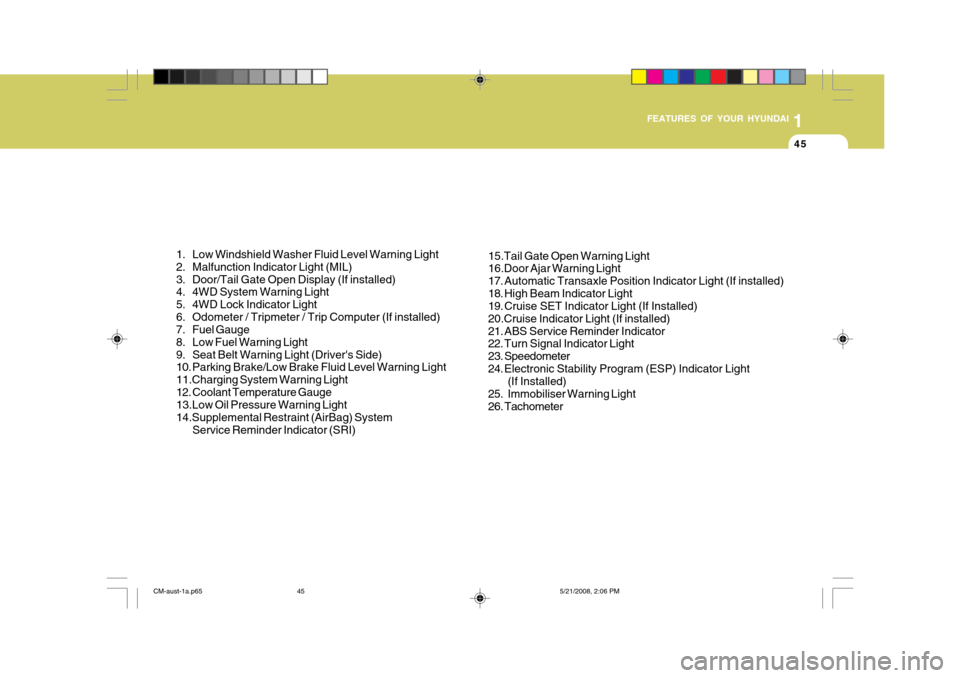
1. Low Windshield Washer Fluid Level Warning Light
2. Malfunction Indicator Light (MIL)
3. Door/Tail Gate Open Display (If installed)
4. 4WD System Warning Light
5. 4WD Lock Indicator Light
6. Odometer / Tripmeter / Trip Computer (If installed)
7. Fuel Gauge
8. Low Fuel Warning Light
9. Seat Belt Warning Light (Driver's Side)
10. Parking Brake/Low Brake Fluid Level Warning Light 11.Charging System Warning Light
12. Coolant Temperature Gauge 13.Low Oil Pressure Warning Light 14.Supplemental Restraint (AirBag) System Service Reminder Indicator (SRI) 15.Tail Gate Open Warning Light 16.Door Ajar Warning Light
17. Automatic Transaxle Position Indicator Light (If installed)
18. High Beam Indicator Light
19. Cruise SET Indicator Light (If Installed) 20.Cruise Indicator Light (If installed)
21. ABS Service Reminder Indicator
22. Turn Signal Indicator Light
23. Speedometer
24. Electronic Stability Program (ESP) Indicator Light
(If Installed)
25. Immobiliser Warning Light
26. Tachometer
CM-aust-1a.p65 5/21/2008, 2:06 PM
45
Page 58 of 269
1
FEATURES OF YOUR HYUNDAI
47
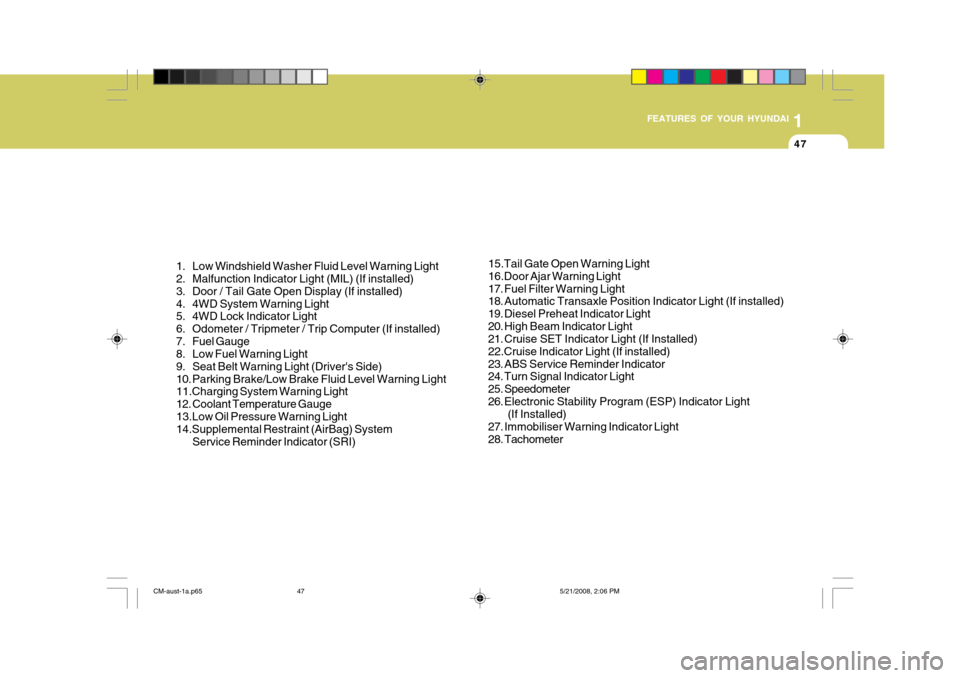
1. Low Windshield Washer Fluid Level Warning Light
2. Malfunction Indicator Light (MIL) (If installed)
3. Door / Tail Gate Open Display (If installed)
4. 4WD System Warning Light
5. 4WD Lock Indicator Light
6. Odometer / Tripmeter / Trip Computer (If installed)
7. Fuel Gauge
8. Low Fuel Warning Light
9. Seat Belt Warning Light (Driver's Side)
10. Parking Brake/Low Brake Fluid Level Warning Light 11.Charging System Warning Light
12. Coolant Temperature Gauge13.Low Oil Pressure Warning Light 14.Supplemental Restraint (AirBag) System Service Reminder Indicator (SRI) 15.Tail Gate Open Warning Light 16.Door Ajar Warning Light
17. Fuel Filter Warning Light
18. Automatic Transaxle Position Indicator Light (If installed)
19. Diesel Preheat Indicator Light
20. High Beam Indicator Light
21. Cruise SET Indicator Light (If Installed) 22.Cruise Indicator Light (If installed)
23. ABS Service Reminder Indicator
24. Turn Signal Indicator Light
25. Speedometer
26. Electronic Stability Program (ESP) Indicator Light
(If Installed)
27. Immobiliser Warning Indicator Light
28. Tachometer
CM-aust-1a.p65 5/21/2008, 2:06 PM
47
Page 60 of 269
1
FEATURES OF YOUR HYUNDAI
49
!
B260G01A-AAT
Low Oil Pressure Warn- ing Light
CAUTION:
If the low oil pressure warning light stays on while the engine is running,serious engine damage may result. The oil pressure warning light comes on whenever there is insufficient oilpressure. In normal operation, it should come on when the ignition switch is turned on, then go outwhen the engine is started. If the oil pressure warning light stays on while the engine is running, there is aserious malfunction. If this happens, stop the car as soon as it is safe to do so, turn off theengine and check the oil level. If the oil level is low, fill the engine oil to the proper level and start the engineagain. If the light stays on with the engine running, turn the engine off immediately. In any instance wherethe oil light stays on when the engine is running, the engine should be checked by a Hyundai dealer beforethe car is driven again.
!
B260H02A-GAT Parking Brake/Low Brake Fluid Level Warning Light
WARNING:
If you suspect brake trouble, have your brakes checked by a Hyundai dealer as soon as possible. Driving your car with a problem in either thebrake electrical system or brake hy- draulic system is dangerous, and could result in a serious injury or death.
Warning Light Operation The parking brake/low brake fluid level warning light should come on when theparking brake is applied and the ignition switch is turned to "ON" or "START". After the engine is started, the lightshould go out when the parking brake is released. If the parking brake is not applied, the warning light should comeon when the ignition switch is turned to "ON" or "START", then go out when the engine starts. If the light comes on atany other time, you should slow the vehicle and bring it to a complete stop in a safe location off the roadway. The brake fluid level warning light indi-cates that the brake fluid level in thebrake master cylinder is low and hy- draulic brake fluid conforming to DOT 3 or DOT 4 specifications should be added.After adding fluid, if no other trouble is found, the car should be immediately and carefully driven to a Hyundai dealerfor inspection. If further trouble is expe- rienced, the vehicle should not be driven at all but taken to a dealer by aprofessional towing service or some other safe method. Your Hyundai is equipped with dual-diagonal braking systems. This means you still have braking on two wheels even if one of the dual systems shouldfail. With only one of the dual systems working, more than normal pedal travel and greater pedal pressure are requiredto stop the car. Also, the car will not stop in as short a distance with only half of the brake system working. If thebrakes fail while you are driving, shift to a lower gear for additional engine brak- ing and stop the car as soon as it is safeto do so.
CM-aust-1a.p65
5/21/2008, 2:06 PM
49
Page 96 of 269
1
FEATURES OF YOUR HYUNDAI
85
B650A01S-AAT Stowage Precautions
1. Do not place objects on the cargo security screen. Such objects may be thrown about inside the vehicle and possibly injure vehicle occu-pants during an accident or when braking.
2. For better fuel economy, do not carry
unnecessary weight.
3. Never allow anyone to ride in the
luggage compartment. It is designed for luggage only.
4. Try to maintain the balance of the
vehicle and locate the weight as far forward as possible.
!
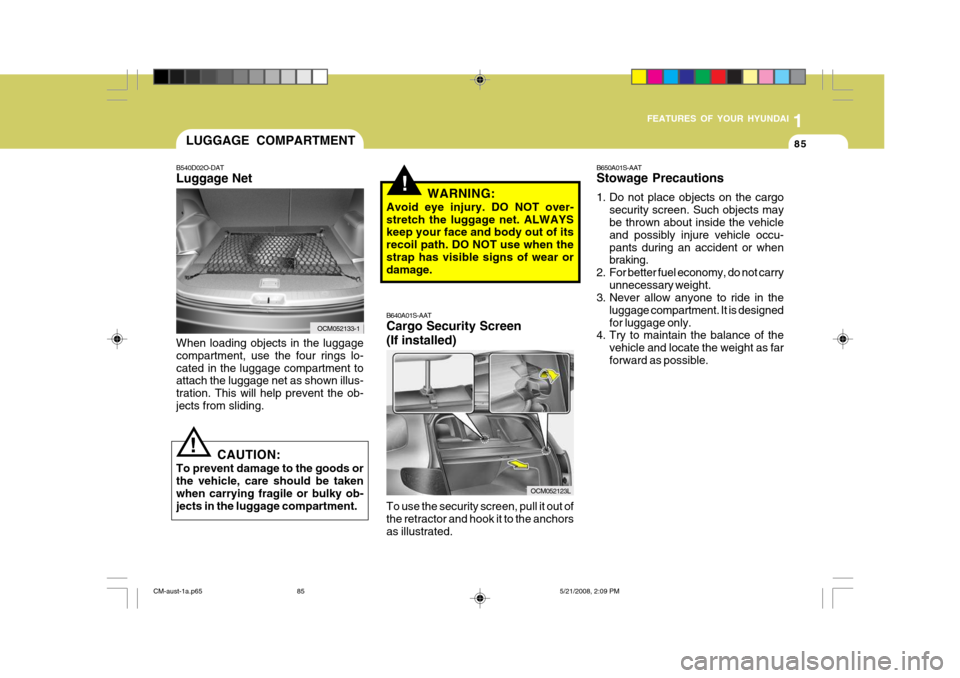
B640A01S-AAT Cargo Security Screen (If installed) To use the security screen, pull it out of the retractor and hook it to the anchors as illustrated.
! CAUTION:
To prevent damage to the goods or the vehicle, care should be taken when carrying fragile or bulky ob- jects in the luggage compartment. WARNING:
Avoid eye injury. DO NOT over-
stretch the luggage net. ALWAYS keep your face and body out of its recoil path. DO NOT use when thestrap has visible signs of wear or damage.
OCM052123L
When loading objects in the luggage compartment, use the four rings lo-cated in the luggage compartment to attach the luggage net as shown illus- tration. This will help prevent the ob-jects from sliding.
LUGGAGE COMPARTMENT
B540D02O-DAT Luggage Net
OCM052133-1
CM-aust-1a.p65 5/21/2008, 2:09 PM
85
Page 132 of 269
1
FEATURES OF YOUR HYUNDAI
121CARE OF DISCS
Damaged Disc Do not attempt to play damaged, warped or cracked discs. These could severelydamage the playback mechanism. Storage When not in use, place your discs in their individual cases and store them in a cool place away from the sun, heat,and dust. Do not grip or pull out the disc with your hand while the disc is being pulled intothe unit by the self loading mechanism.
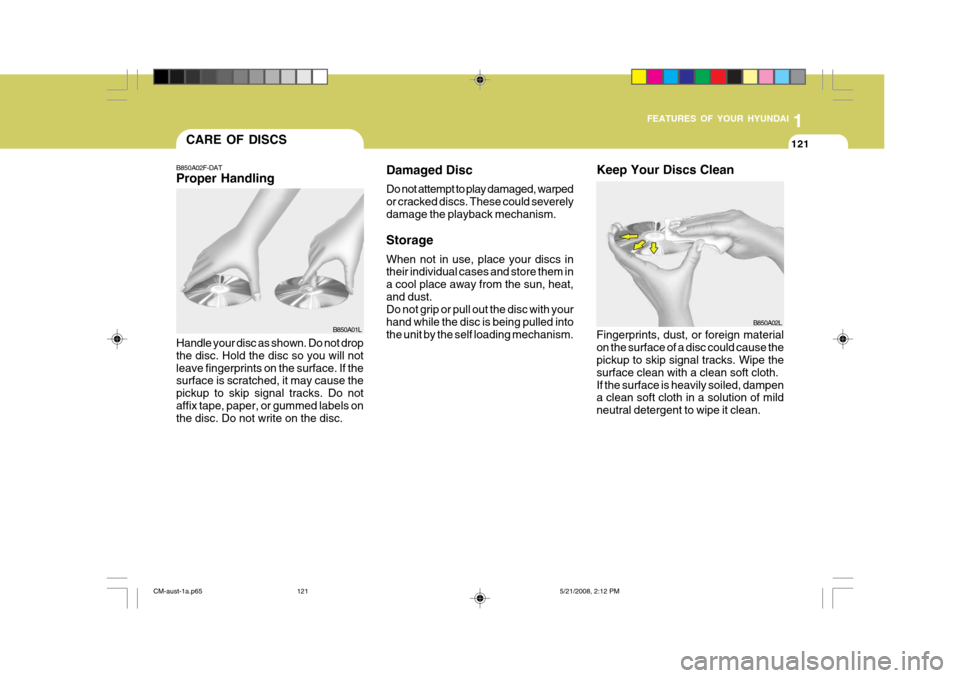
B850A02F-DAT Proper Handling Handle your disc as shown. Do not drop the disc. Hold the disc so you will notleave fingerprints on the surface. If the surface is scratched, it may cause the pickup to skip signal tracks. Do notaffix tape, paper, or gummed labels on the disc. Do not write on the disc.
B850A02LB850A01L
Fingerprints, dust, or foreign material on the surface of a disc could cause the pickup to skip signal tracks. Wipe the surface clean with a clean soft cloth.If the surface is heavily soiled, dampen a clean soft cloth in a solution of mild neutral detergent to wipe it clean.
Keep Your Discs Clean
CM-aust-1a.p65
5/21/2008, 2:12 PM
121
Page 147 of 269
2DRIVING YOUR HYUNDAI
2
C010A01O-DAT
WARNING: ENGINE EXHAUST CAN BE DANGEROUS!
Engine exhaust fumes can be extremely dangerous. If, at any time, you smell exhaust fumes inside the vehicle, open the windows immediately. o Do not inhale exhaust fumes. Exhaust fumes contain carbon monoxide, a colorless, odorless gas that can cause unconsciousness and death by asphyxiation. o Be sure the exhaust system does not leak. The exhaust system should be checked whenever the vehicle is raised to change the oil or for any other purpose.If you hear a change in the sound of the exhaust or if you drive over something that strikes the underneath sideof the car, have the exhaust system checked as soon as possible by your Hyundai dealer. o Do not run the engine in an enclosed area. Letting the engine idle in your garage, even with the garage door open, is a hazardous practice. Never run theengine in your garage any longer than it takes to start the engine and back the car out. o Avoid idling the engine for prolonged periods with people inside the car. If it is necessary to idle the engine for a prolonged period with people inside the car, be sure to do so only in anopen area with the air intake set at "Fresh" and the fan operating at one of the higher speeds so fresh air is drawn into the interior. If you must drive with the tail gate open because you are carrying objects that make this necessary:
1. Close all windows.
2. Open side vents.
3. Set the air intake control at "Fresh", the air flow control at "Floor" or "Face" and the fan at one of the higher speeds.
To assure proper operation of the ventilation system, be sure the ventilation air intakes located just in front of the windshield are kept clear of snow, ice, leaves or other obstructions.
!
CM-aust-2.p65 5/19/2008, 6:34 PM
2
Page 148 of 269
2
DRIVING YOUR HYUNDAI
3
!
BEFORE STARTING THE ENGINE
C020A01CM-DAT Before you start the engine, you should always:
1. Look around the vehicle to be sure
there are no flat tyres, puddles of oil, water or other indications of possible trouble.
2. After entering the car, check to be sure the hand brake is engaged.
3. Check that all windows, and lights are clean.
4. Check that the interior and exterior
mirrors are clean and in position.
5. Check your seat, seatback and head- rest to be sure they are in their properpositions.
6. Lock all the doors.
7. Fasten your seat belt and be sure
that all other occupants have fas- tened theirs.
8. Turn off all lights and accessories
that are not needed.
9. When you turn the ignition switch to "ON", check that all appropriate warn-ing lights are operating and that youhave sufficient fuel.
10. Check the operation of warning lights
and all bulbs when key is in the "ON"position.
C020A01HP-DAT
o In a collision crash, an unbelted
person is significantly more likelyto die than a person wearing aseatbelt.
RISK OF ROLLOVER
WARNING:
o Utility vehicle has a significantly higher collision rate than othertype of vehicles.
o Utility vehicle have higher ground clearance and a narrower trackto make them capable of perform-ing in a wide variety of off-road applications. Specific design characteristics give them a highercentre of gravity than ordinary cars. An advantage of the higher ground clearance is a better viewof the road allowing you to antici- pate problem. They are not de- signed for cornering at the samespeeds as conventional 2-wheel drive vehicles any more than low- slung sports cars are designed toperform satisfactorily under off- road conditions. If at all possible, avoid sharp turns or abrupt ma-neuvers. As with other vehicles of this type, failure to operate this vehicle correctly may result inloss of control or vehicle rollover.
CM-aust-2.p65 5/19/2008, 6:34 PM
3