lock Hyundai Santa Fe 2009 Owner's Guide
[x] Cancel search | Manufacturer: HYUNDAI, Model Year: 2009, Model line: Santa Fe, Model: Hyundai Santa Fe 2009Pages: 353, PDF Size: 10.86 MB
Page 37 of 353
1FEATURES OF YOUR HYUNDAI26
!
WARNING:
B080D02TG-1
o For maximum effectiveness in case of
an accident the headrest should be
adjusted so the middle of the headrest
is at the same height as the top of the
occupant's eyes. For this reason, the
use of a cushion that holds the body
away from the seatback is not recom-
mended.
o Do not operate vehicle with the head-
rests removed as injury to the occu-
pants may occur in the event of an
accident. Headrests may provide pro-
tection against neck injuries when
properly adjusted.
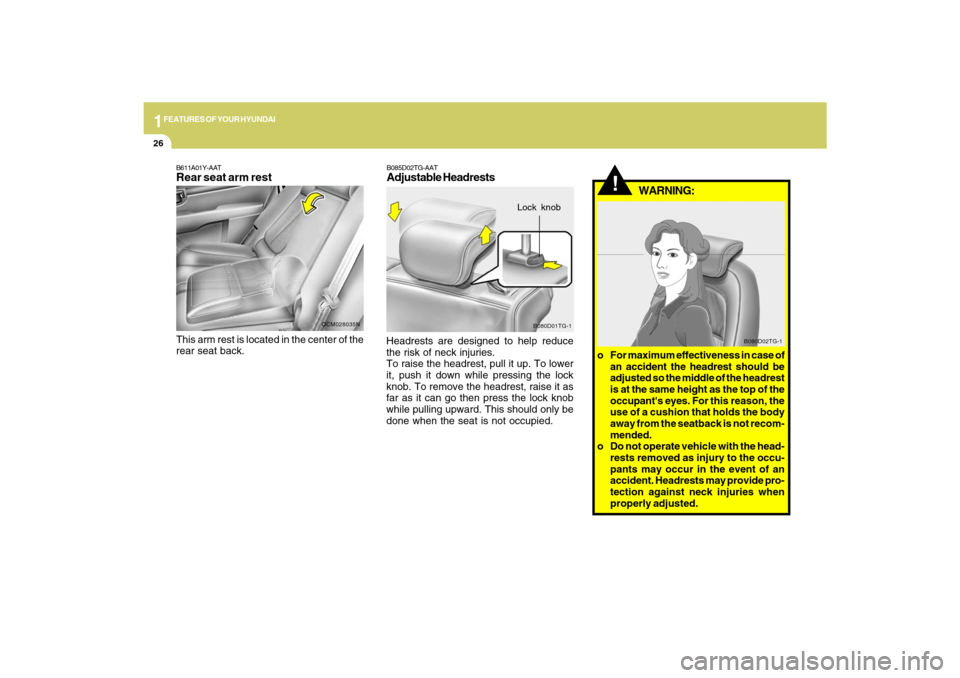
B085D02TG-AATAdjustable HeadrestsHeadrests are designed to help reduce
the risk of neck injuries.
To raise the headrest, pull it up. To lower
it, push it down while pressing the lock
knob. To remove the headrest, raise it as
far as it can go then press the lock knob
while pulling upward. This should only be
done when the seat is not occupied.
B080D01TG-1
Lock knob
OCM028035N
B611A01Y-AATRear seat arm restThis arm rest is located in the center of the
rear seat back.
Page 41 of 353
1FEATURES OF YOUR HYUNDAI30
!
OCM052307
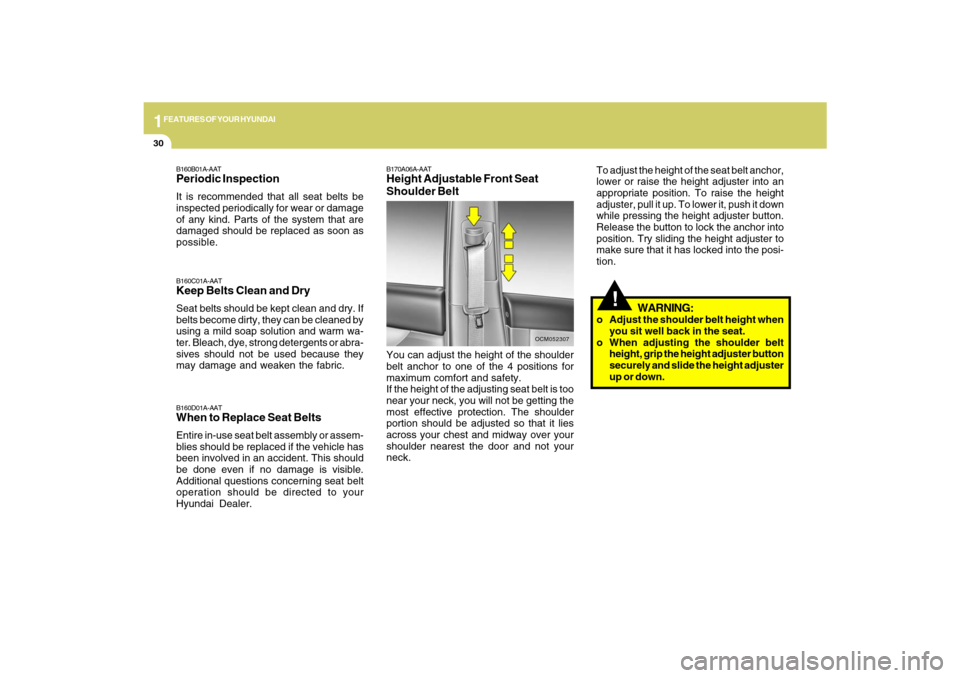
B170A06A-AATHeight Adjustable Front Seat
Shoulder BeltYou can adjust the height of the shoulder
belt anchor to one of the 4 positions for
maximum comfort and safety.
If the height of the adjusting seat belt is too
near your neck, you will not be getting the
most effective protection. The shoulder
portion should be adjusted so that it lies
across your chest and midway over your
shoulder nearest the door and not your
neck.To adjust the height of the seat belt anchor,
lower or raise the height adjuster into an
appropriate position. To raise the height
adjuster, pull it up. To lower it, push it down
while pressing the height adjuster button.
Release the button to lock the anchor into
position. Try sliding the height adjuster to
make sure that it has locked into the posi-
tion.
B160C01A-AATKeep Belts Clean and DrySeat belts should be kept clean and dry. If
belts become dirty, they can be cleaned by
using a mild soap solution and warm wa-
ter. Bleach, dye, strong detergents or abra-
sives should not be used because they
may damage and weaken the fabric.B160D01A-AATWhen to Replace Seat BeltsEntire in-use seat belt assembly or assem-
blies should be replaced if the vehicle has
been involved in an accident. This should
be done even if no damage is visible.
Additional questions concerning seat belt
operation should be directed to your
Hyundai Dealer.B160B01A-AATPeriodic InspectionIt is recommended that all seat belts be
inspected periodically for wear or damage
of any kind. Parts of the system that are
damaged should be replaced as soon as
possible.
WARNING:
o Adjust the shoulder belt height when
you sit well back in the seat.
o When adjusting the shoulder belt
height, grip the height adjuster button
securely and slide the height adjuster
up or down.
Page 42 of 353
1
FEATURES OF YOUR HYUNDAI
31
!
WARNING:
o Verify the shoulder belt anchor is
locked into position at the appropriate
height. Never position the shoulder
belt across your neck or face. Im-
properly positioned seat belts can
cause serious injuries in an accident.
o Failure to replace seat belts after an
accident could leave you with dam-
aged seat belts that will not provide
protection in the event of another
collision leading to personal injury or
death. Replace your seat belts after
being in an accident as soon as pos-
sible.
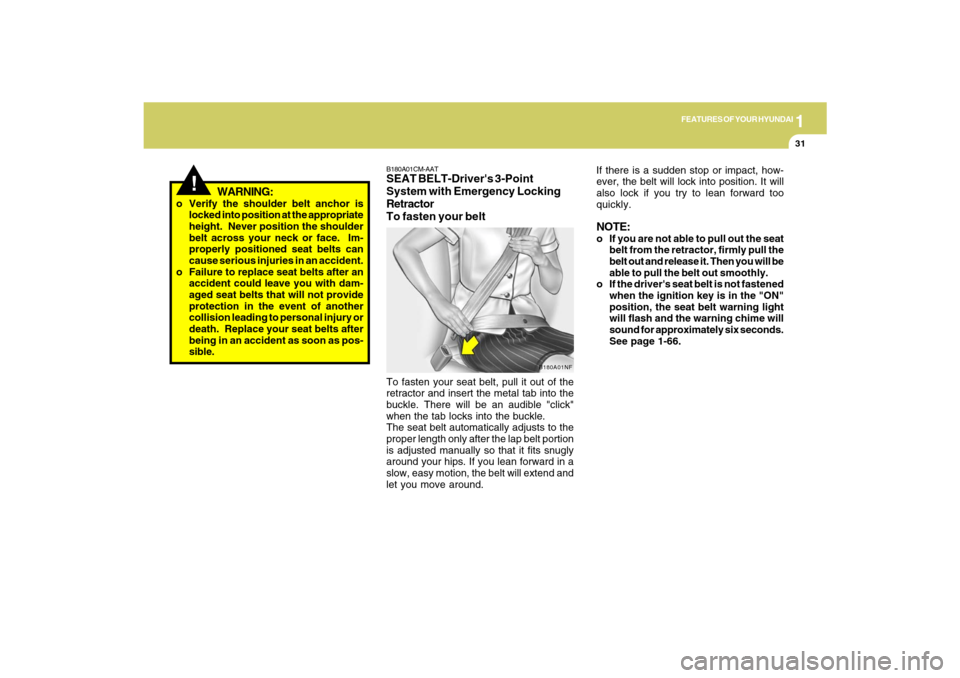
To fasten your seat belt, pull it out of the
retractor and insert the metal tab into the
buckle. There will be an audible "click"
when the tab locks into the buckle.
The seat belt automatically adjusts to the
proper length only after the lap belt portion
is adjusted manually so that it fits snugly
around your hips. If you lean forward in a
slow, easy motion, the belt will extend and
let you move around.
B180A01CM-AATSEAT BELT-Driver's 3-Point
System with Emergency Locking
Retractor
To fasten your belt
B180A01NF
If there is a sudden stop or impact, how-
ever, the belt will lock into position. It will
also lock if you try to lean forward too
quickly.NOTE:o If you are not able to pull out the seat
belt from the retractor, firmly pull the
belt out and release it. Then you will be
able to pull the belt out smoothly.
o If the driver's seat belt is not fastened
when the ignition key is in the "ON"
position, the seat belt warning light
will flash and the warning chime will
sound for approximately six seconds.
See page 1-66.
Page 43 of 353
1FEATURES OF YOUR HYUNDAI32
!
WARNING:
o For maximum restraint system pro-
tection, the seat belts must always be
used whenever the car is moving.
o Children age 12 and younger must
always be properly restrained in the
rear seat. Never allow children to ride
in the front passenger seat. If a child
over 13 must be seated in the front
seat, he/she must be properly belted
and the seat should be moved as far
back as possible.
o Never wear the shoulder belt under
your arm or behind your back. An
improperly positioned shoulder belt
can cause serious injuries in a crash.
The shoulder belt should be positioned
midway over your shoulder across
your collarbone.
o Avoid wearing twisted seat belts. A
twisted belt can't do its job as well. In
a collision, it could even cut into you.
Be sure the belt webbing is straight
and not twisted.
o Be careful not to damage the belt
webbing or hardware. If the belt web-
bing or hardware is damaged, replace
it. When the seat belt is fully extended from
the retractor to allow the installation of a
child restraint system, the seat belt opera-
tion changes to allow the belt to retract, but
not to extend (Automatic Locking Retrac-
tor Type). See page 1-39.
NOTE:Although the convertible retractor pro-
vides the same level of protection for
seated passengers in either emergency
or automatic locking modes, it is recom-
mended that seated passengers use the
emergency locking feature for improved
convenience. The automatic locking
function is intended to facilitate child
restraint installation. To convert from
the automatic locking feature to the
emergency locking operation mode, al-
low the unbuckled seat belt to fully re-
tract.
B190A01CM-AATSEAT BELTS-Front Passenger and
Rear Seat 3-Point System with
Convertible Locking RetractorConvertible retractor type seat belts are
installed in the rear seat positions to help
accommodate the installation of child re-
straint systems. Although a convertible re-
tractor is also installed in the front passen-
ger seat position, Hyundai strongly recom-
mends that children always be seated in the
rear seat. NEVER place any infant restraint
system in the front seat of the vehicle.
This type of seat belt combines the fea-
tures of both an emergency locking retrac-
tor seat belt and an automatic locking
retractor seat belt. To fasten your seat belt,
pull it out of the retractor and insert the
metal tab into the buckle. There will be an
audible "click" when the tab locks into the
buckle. When not securing a child restraint,
the seat belt operates in the same way as
the driver's seat belt (Emergency Locking
Retractor Type). It automatically adjusts to
the proper length only after the lap belt
portion of the seat belt is adjusted manu-
ally so that it fits snugly around your hips.
Page 44 of 353
1
FEATURES OF YOUR HYUNDAI
33
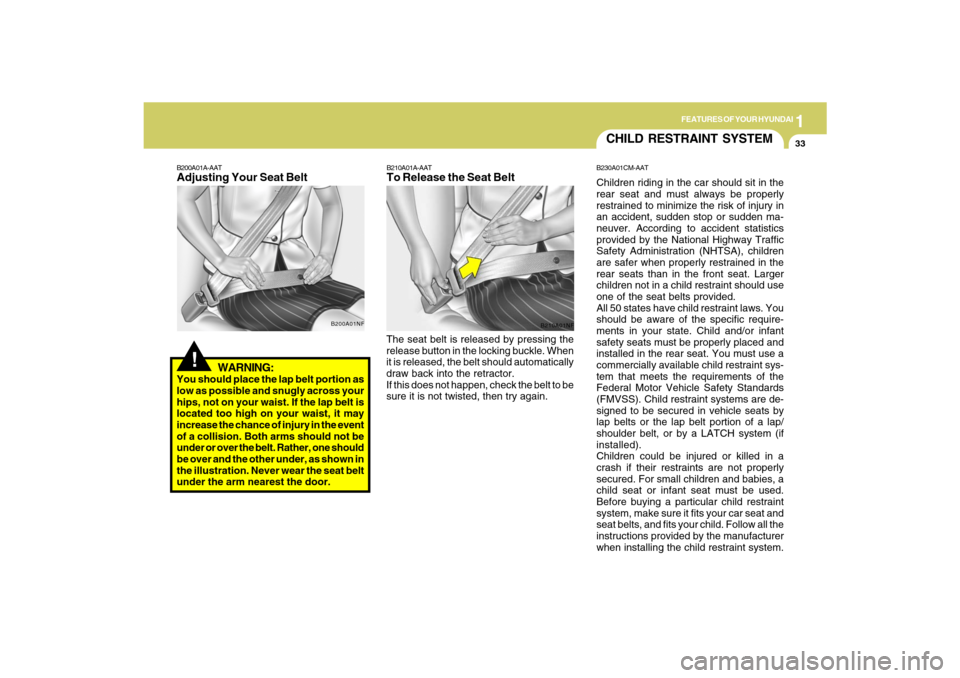
WARNING:
You should place the lap belt portion as
low as possible and snugly across your
hips, not on your waist. If the lap belt is
located too high on your waist, it may
increase the chance of injury in the event
of a collision. Both arms should not be
under or over the belt. Rather, one should
be over and the other under, as shown in
the illustration. Never wear the seat belt
under the arm nearest the door.
!
B200A01A-AATAdjusting Your Seat Belt
B200A01NF
The seat belt is released by pressing the
release button in the locking buckle. When
it is released, the belt should automatically
draw back into the retractor.
If this does not happen, check the belt to be
sure it is not twisted, then try again.B210A01A-AATTo Release the Seat Belt
B210A01NF
CHILD RESTRAINT SYSTEMB230A01CM-AATChildren riding in the car should sit in the
rear seat and must always be properly
restrained to minimize the risk of injury in
an accident, sudden stop or sudden ma-
neuver. According to accident statistics
provided by the National Highway Traffic
Safety Administration (NHTSA), children
are safer when properly restrained in the
rear seats than in the front seat. Larger
children not in a child restraint should use
one of the seat belts provided.
All 50 states have child restraint laws. You
should be aware of the specific require-
ments in your state. Child and/or infant
safety seats must be properly placed and
installed in the rear seat. You must use a
commercially available child restraint sys-
tem that meets the requirements of the
Federal Motor Vehicle Safety Standards
(FMVSS). Child restraint systems are de-
signed to be secured in vehicle seats by
lap belts or the lap belt portion of a lap/
shoulder belt, or by a LATCH system (if
installed).
Children could be injured or killed in a
crash if their restraints are not properly
secured. For small children and babies, a
child seat or infant seat must be used.
Before buying a particular child restraint
system, make sure it fits your car seat and
seat belts, and fits your child. Follow all the
instructions provided by the manufacturer
when installing the child restraint system.
Page 45 of 353
1FEATURES OF YOUR HYUNDAI34
!
o Never hold a child in your arms or lap
when riding in a vehicle. The violent
forces created during a crash will tear
the child from your arms and throw
the child against the car’s interior.
o Never put a seat belt over yourself
and a child. During a crash, the belt
could press deep into the child caus-
ing serious internal injuries.
o Never leave children unattended in a
vehicle – not even for a short time.
The car can heat up very quickly,
resulting in serious injuries to chil-
dren inside. Even very young chil-
dren may inadvertently cause the
vehicle to move, entangle themselves
in the windows, or lock themselves or
others inside the vehicle.
o Never allow two children, or any two
persons, to use the same seat belt.
o Children often squirm and reposition
themselves improperly. Never let a
child ride with the shoulder belt under
their arm or behind their back. Al-
ways properly position and secure
children in rear seat.
WARNING:
!
WARNING:
To reduce the chance or serious or fatal
injuries:
o Children of all ages are safer when
restrained in the rear seat. A child
riding in the front passenger seat can
be forcefully struck by an inflating air
bag resulting in serious or fatal inju-
ries.
o Always follow the instructions for in-
stallation and use of the child restraint
maker.
o Always make sure the child seat is
secured properly in the car and your
child is securely restrained in the child
seat.
!
WARNING:
o A child restraint system must be
placed in the rear seat. Never install
a child or infant seat on the front
passenger's seat. Should an accident
occur and cause the passenger side
air bag to deploy, it could severely
injure or kill an infant or child seated
in an infant or child seat. Thus only use
a child restraint in the rear seat of
your vehicle.
o A safety belt or child restraint system
can become very hot if it is left in a
closed vehicle on a sunny day, even
if the outside temperature does not
feel hot. Be sure to check the seat
cover and buckles before placing a
child there.
o When the child restraint system is not
in use, store it in the luggage compart-
ment or fasten it with a safety belt so
that it will not be thrown forward in the
case of a sudden stop or an accident.
o Children may be seriously injured or
killed by an inflating air bag. All chil-
dren, even those too large for child
restraints, must ride in the rear seat.
Page 50 of 353
1
FEATURES OF YOUR HYUNDAI
39
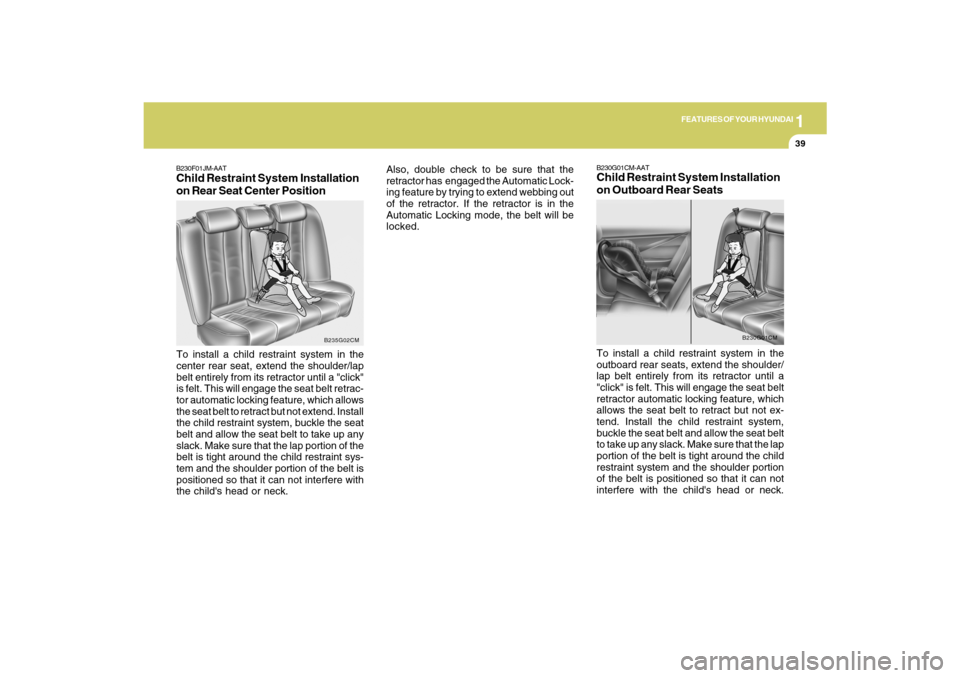
B230F01JM-AATChild Restraint System Installation
on Rear Seat Center PositionTo install a child restraint system in the
center rear seat, extend the shoulder/lap
belt entirely from its retractor until a "click"
is felt. This will engage the seat belt retrac-
tor automatic locking feature, which allows
the seat belt to retract but not extend. Install
the child restraint system, buckle the seat
belt and allow the seat belt to take up any
slack. Make sure that the lap portion of the
belt is tight around the child restraint sys-
tem and the shoulder portion of the belt is
positioned so that it can not interfere with
the child's head or neck.
B235G02CM
Also, double check to be sure that the
retractor has engaged the Automatic Lock-
ing feature by trying to extend webbing out
of the retractor. If the retractor is in the
Automatic Locking mode, the belt will be
locked.
B230G01CM-AATChild Restraint System Installation
on Outboard Rear SeatsTo install a child restraint system in the
outboard rear seats, extend the shoulder/
lap belt entirely from its retractor until a
"click" is felt. This will engage the seat belt
retractor automatic locking feature, which
allows the seat belt to retract but not ex-
tend. Install the child restraint system,
buckle the seat belt and allow the seat belt
to take up any slack. Make sure that the lap
portion of the belt is tight around the child
restraint system and the shoulder portion
of the belt is positioned so that it can not
interfere with the child's head or neck.
B230G01CM
Page 51 of 353
1FEATURES OF YOUR HYUNDAI40
OMG035300
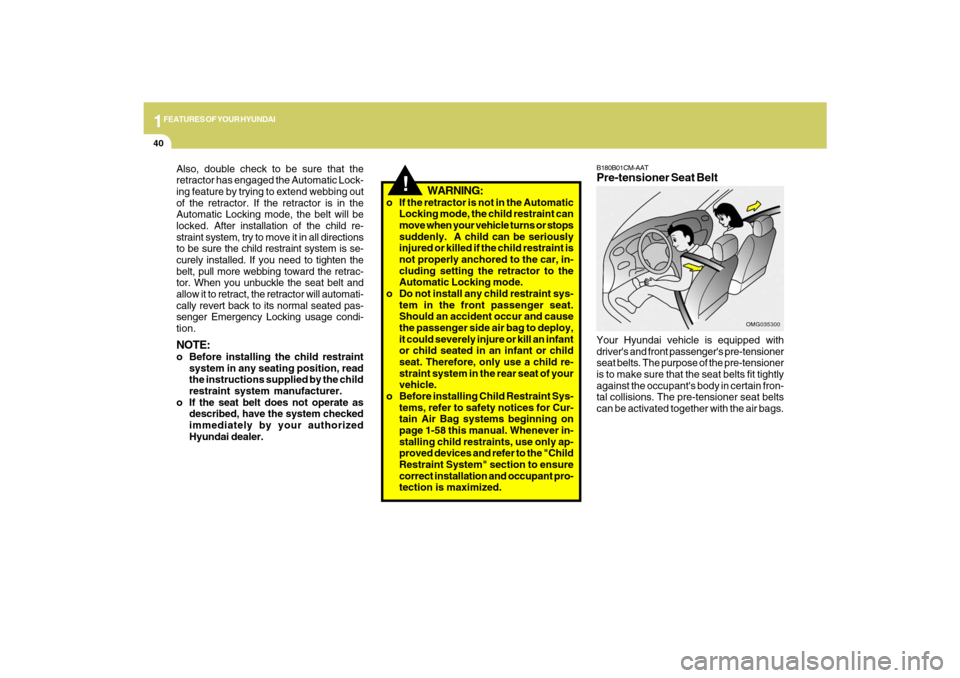
Your Hyundai vehicle is equipped with
driver's and front passenger's pre-tensioner
seat belts. The purpose of the pre-tensioner
is to make sure that the seat belts fit tightly
against the occupant's body in certain fron-
tal collisions. The pre-tensioner seat belts
can be activated together with the air bags.B180B01CM-AATPre-tensioner Seat Belt
!
WARNING:
o If the retractor is not in the Automatic
Locking mode, the child restraint can
move when your vehicle turns or stops
suddenly. A child can be seriously
injured or killed if the child restraint is
not properly anchored to the car, in-
cluding setting the retractor to the
Automatic Locking mode.
o Do not install any child restraint sys-
tem in the front passenger seat.
Should an accident occur and cause
the passenger side air bag to deploy,
it could severely injure or kill an infant
or child seated in an infant or child
seat. Therefore, only use a child re-
straint system in the rear seat of your
vehicle.
o Before installing Child Restraint Sys-
tems, refer to safety notices for Cur-
tain Air Bag systems beginning on
page 1-58 this manual. Whenever in-
stalling child restraints, use only ap-
proved devices and refer to the "Child
Restraint System" section to ensure
correct installation and occupant pro-
tection is maximized. Also, double check to be sure that the
retractor has engaged the Automatic Lock-
ing feature by trying to extend webbing out
of the retractor. If the retractor is in the
Automatic Locking mode, the belt will be
locked. After installation of the child re-
straint system, try to move it in all directions
to be sure the child restraint system is se-
curely installed. If you need to tighten the
belt, pull more webbing toward the retrac-
tor. When you unbuckle the seat belt and
allow it to retract, the retractor will automati-
cally revert back to its normal seated pas-
senger Emergency Locking usage condi-
tion.
NOTE:o Before installing the child restraint
system in any seating position, read
the instructions supplied by the child
restraint system manufacturer.
o If the seat belt does not operate as
described, have the system checked
immediately by your authorized
Hyundai dealer.
Page 52 of 353
1
FEATURES OF YOUR HYUNDAI
41
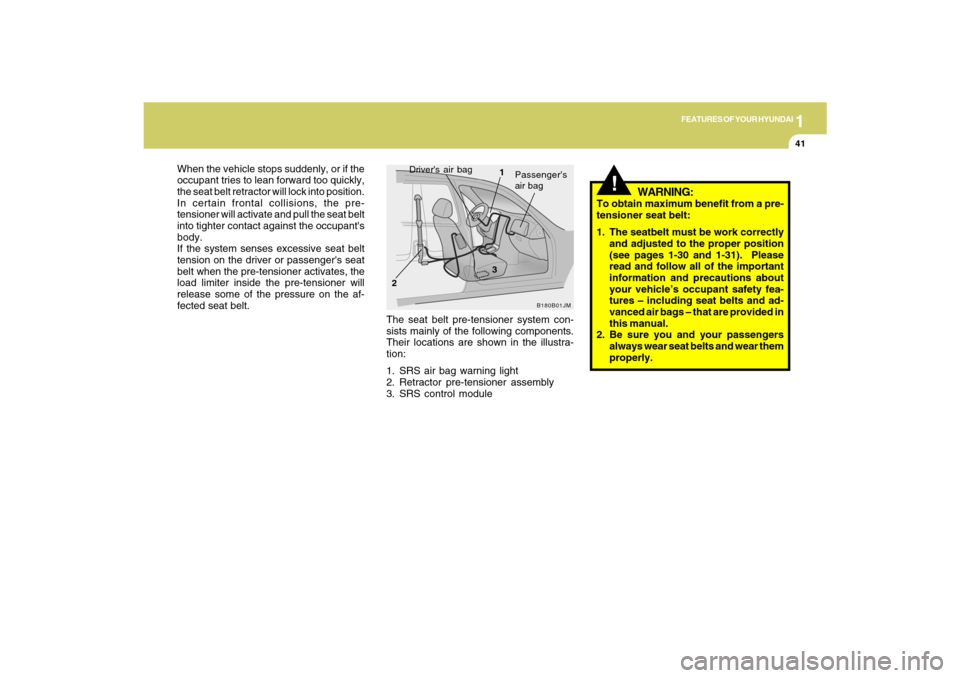
The seat belt pre-tensioner system con-
sists mainly of the following components.
Their locations are shown in the illustra-
tion:
1. SRS air bag warning light
2. Retractor pre-tensioner assembly
3. SRS control module
B180B01JM
Driver's air bag
1
2
Passenger's
air bag
3
When the vehicle stops suddenly, or if the
occupant tries to lean forward too quickly,
the seat belt retractor will lock into position.
In certain frontal collisions, the pre-
tensioner will activate and pull the seat belt
into tighter contact against the occupant's
body.
If the system senses excessive seat belt
tension on the driver or passenger's seat
belt when the pre-tensioner activates, the
load limiter inside the pre-tensioner will
release some of the pressure on the af-
fected seat belt.
!
WARNING:
To obtain maximum benefit from a pre-
tensioner seat belt:
1. The seatbelt must be work correctly
and adjusted to the proper position
(see pages 1-30 and 1-31). Please
read and follow all of the important
information and precautions about
your vehicle’s occupant safety fea-
tures – including seat belts and ad-
vanced air bags – that are provided in
this manual.
2. Be sure you and your passengers
always wear seat belts and wear them
properly.
Page 61 of 353
1FEATURES OF YOUR HYUNDAI50
CAUTION:
When installing a container of liquid air
freshener inside the vehicle, do not place
it near the instrument cluster nor on the
instrument panel surface. If there is any
leakage from the air freshener onto these
areas (instrument cluster, instrument
panel or air ventilator), it may damage
these parts. If the liquid from the air
freshener does leak onto these areas,
wash them with water immediately.
!Passenger's Air bag
OCM051009L
!
WARNING:
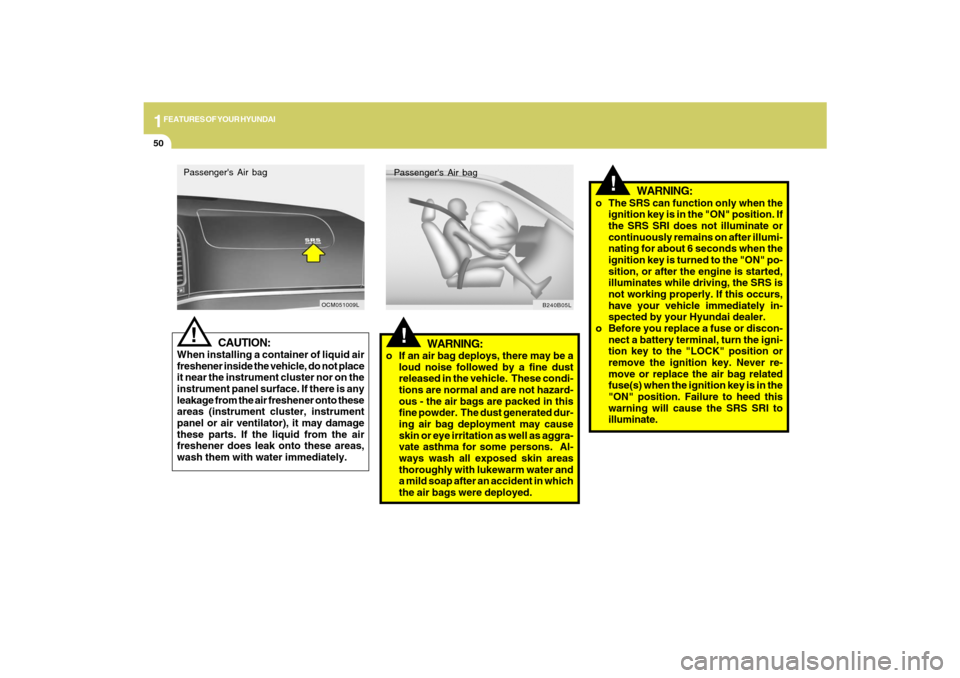
o If an air bag deploys, there may be a
loud noise followed by a fine dust
released in the vehicle. These condi-
tions are normal and are not hazard-
ous - the air bags are packed in this
fine powder. The dust generated dur-
ing air bag deployment may cause
skin or eye irritation as well as aggra-
vate asthma for some persons. Al-
ways wash all exposed skin areas
thoroughly with lukewarm water and
a mild soap after an accident in which
the air bags were deployed.Passenger's Air bag
B240B05L
!
o The SRS can function only when the
ignition key is in the "ON" position. If
the SRS SRI does not illuminate or
continuously remains on after illumi-
nating for about 6 seconds when the
ignition key is turned to the "ON" po-
sition, or after the engine is started,
illuminates while driving, the SRS is
not working properly. If this occurs,
have your vehicle immediately in-
spected by your Hyundai dealer.
o Before you replace a fuse or discon-
nect a battery terminal, turn the igni-
tion key to the "LOCK" position or
remove the ignition key. Never re-
move or replace the air bag related
fuse(s) when the ignition key is in the
"ON" position. Failure to heed this
warning will cause the SRS SRI to
illuminate.
WARNING: