light Hyundai Santa Fe Sport 2015 Owner's Manual
[x] Cancel search | Manufacturer: HYUNDAI, Model Year: 2015, Model line: Santa Fe Sport, Model: Hyundai Santa Fe Sport 2015Pages: 785, PDF Size: 13.38 MB
Page 15 of 785
Your vehicle at a glance
2 2
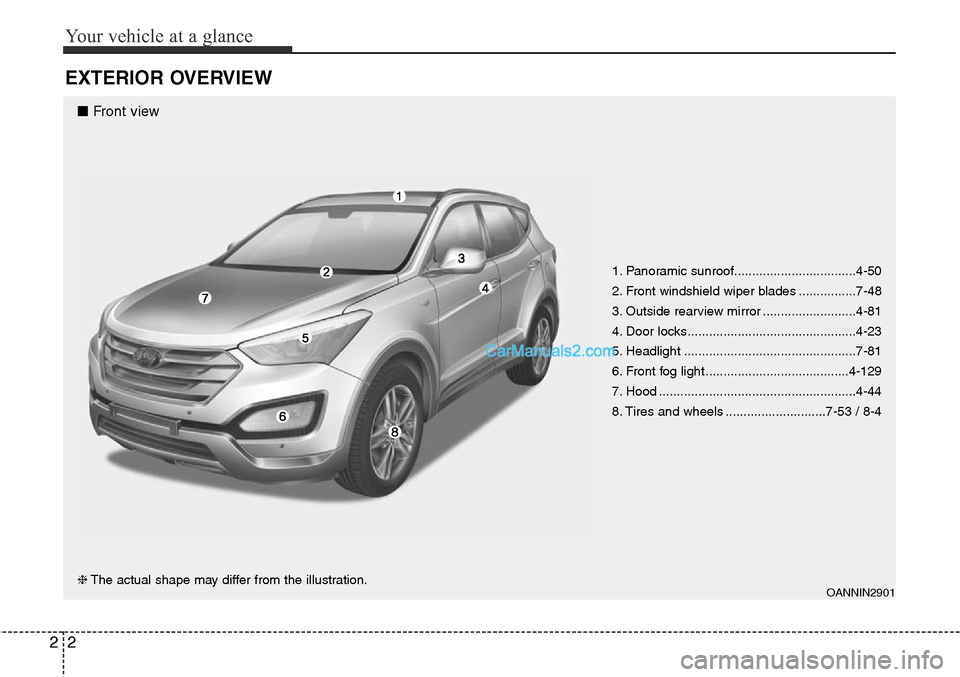
EXTERIOR OVERVIEW
1. Panoramic sunroof..................................4-50
2. Front windshield wiper blades ................7-48
3. Outside rearview mirror ..........................4-81
4. Door locks...............................................4-23
5. Headlight ................................................7-81
6. Front fog light ........................................4-129
7. Hood .......................................................4-44
8. Tires and wheels ............................7-53 / 8-4
OANNIN2901❈The actual shape may differ from the illustration.
■ Front view
Page 19 of 785
Your vehicle at a glance
6 2
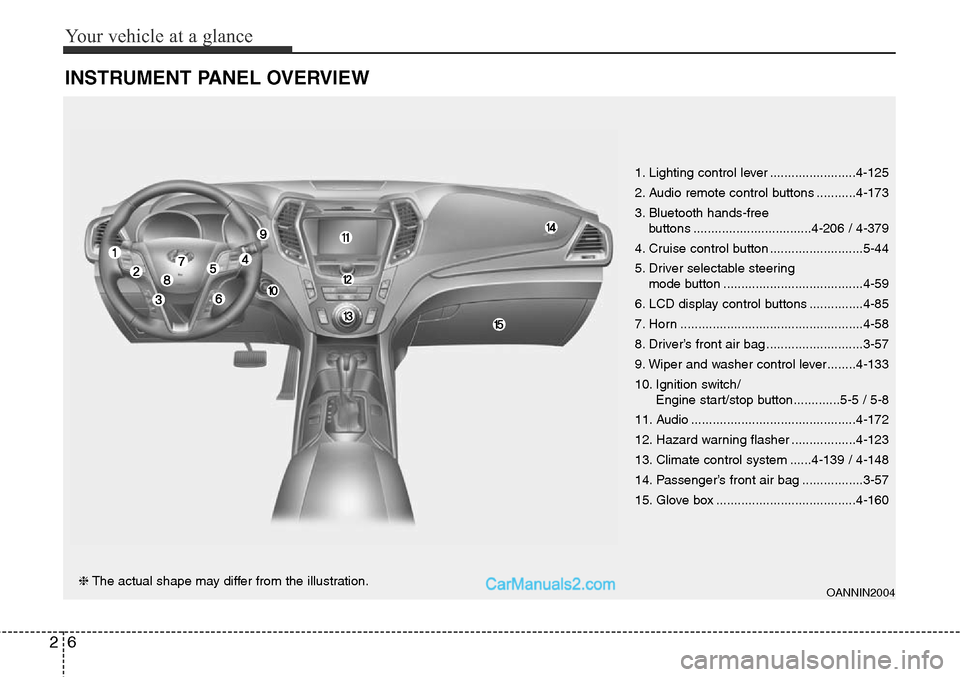
INSTRUMENT PANEL OVERVIEW
OANNIN2004❈The actual shape may differ from the illustration.1. Lighting control lever ........................4-125
2. Audio remote control buttons ...........4-173
3. Bluetooth hands-free
buttons .................................4-206 / 4-379
4. Cruise control button ..........................5-44
5. Driver selectable steering
mode button .......................................4-59
6. LCD display control buttons ...............4-85
7. Horn ...................................................4-58
8. Driver’s front air bag ...........................3-57
9. Wiper and washer control lever........4-133
10. Ignition switch/
Engine start/stop button.............5-5 / 5-8
11. Audio ..............................................4-172
12. Hazard warning flasher ..................4-123
13. Climate control system ......4-139 / 4-148
14. Passenger’s front air bag .................3-57
15. Glove box .......................................4-160
Page 22 of 785
Safety features of your vehicle
Seats . . . . . . . . . . . . . . . . . . . . . . . . . . . . . . . . . . . . . . 3-2
• Front seat adjustment - Manual . . . . . . . . . . . . . . . . . 3-5
• Front seat adjustment - Power. . . . . . . . . . . . . . . . . . . 3-6
• Driver position memory system . . . . . . . . . . . . . . . . . . 3-8
• Rear seat adjustment . . . . . . . . . . . . . . . . . . . . . . . . . 3-14
Seat belts . . . . . . . . . . . . . . . . . . . . . . . . . . . . . . . . . 3-23
• Seat belt restraint system . . . . . . . . . . . . . . . . . . . . . . 3-23
• Pre-tensioner seat belt. . . . . . . . . . . . . . . . . . . . . . . . . 3-28
• Seat belt precautions . . . . . . . . . . . . . . . . . . . . . . . . . . 3-31
• Care of seat belts . . . . . . . . . . . . . . . . . . . . . . . . . . . . . 3-34
Child restraint system . . . . . . . . . . . . . . . . . . . . . . 3-35
• Using a child restraint system . . . . . . . . . . . . . . . . . . 3-37
• Tether Anchor system . . . . . . . . . . . . . . . . . . . . . . . . . 3-40
• Securing a child restraint seat with child seat lower
anchor system . . . . . . . . . . . . . . . . . . . . . . . . . . . . . . . 3-42
Air bag - supplemental restraint system . . . . . . . 3-44
• How does the air bag system operate . . . . . . . . . . . . 3-45
• Do not Install a child restraint on a front
passenger's seat . . . . . . . . . . . . . . . . . . . . . . . . . . . . . 3-46
• Air bag warning light . . . . . . . . . . . . . . . . . . . . . . . . . 3-47
• SRS components and functions . . . . . . . . . . . . . . . . . 3-47
• Occupant classification system. . . . . . . . . . . . . . . . . . 3-51
• Main components of occupant classification system 3-52
• Driver's and passenger's front air bag . . . . . . . . . . . 3-57
• Side impact air bag . . . . . . . . . . . . . . . . . . . . . . . . . . . 3-62• Curtain air bag . . . . . . . . . . . . . . . . . . . . . . . . . . . . . . 3-63
• Inflation and non-inflation conditions of the air bag . 3-65
• SRS Care . . . . . . . . . . . . . . . . . . . . . . . . . . . . . . . . . . . 3-70
• Additional safety precautions . . . . . . . . . . . . . . . . . . . 3-71
• Air bag warning label . . . . . . . . . . . . . . . . . . . . . . . . . 3-72
33
Page 25 of 785
Safety features of your vehicle
4 3
WARNING - Rear
seatbacks
• The rear seatback must be
securely latched. If not, pas-
sengers and objects could be
thrown forward resulting in
serious injury or death in the
event of a sudden stop or col-
lision.
• No passenger should ride in
the cargo area or sit or lie on
folded seatbacks while the
vehicle is moving. All passen-
gers must be properly seated
in seats and restrained prop-
erly while riding.
• When resetting the seatback
to the upright position, make
sure it is securely latched by
pushing it forward and rear-
wards.
• To avoid the possibility of
burns, do not remove the car-
pet in the cargo area. Emission
control devices beneath this
floor generate high tempera-
tures.
(Continued)(Continued)
• Luggage and other cargo
should be laid flat in the cargo
area or on the folded rear
seatback. If objects are large,
heavy, or must be piled, they
must be secured. Under no
circumstances should cargo
be piled higher than the seat-
backs. Failure to follow these
warnings could result in seri-
ous injury or death in the
event of a sudden stop, colli-
sion or rollover.
WARNING
After adjusting the seat, always
check that it is securely locked
into place by attempting to
move the seat forward or
reverse without using the lock
release lever. Sudden or unex-
pected movement of the dri-
ver's seat could cause you to
lose control of the vehicle
resulting in an accident.
WARNING
• Do not adjust the seat while
wearing seat belts. Moving the
seat cushion forward may
cause strong pressure on the
abdomen.
• Use extreme caution so that
hands or other objects are not
caught in the seat mechanisms
while the seat is moving.
• Do not place a cigarette
lighter on the floor or seat.
When you operate the seat,
gas may exit out of the lighter
and cause a fire.
• Use extreme caution when
picking small objects trapped
under the seats or between
the seat and the center con-
sole. Your hands might be cut
or injured by the sharp edges
of the seats mechanism.
Page 26 of 785
35
Safety features of your vehicle
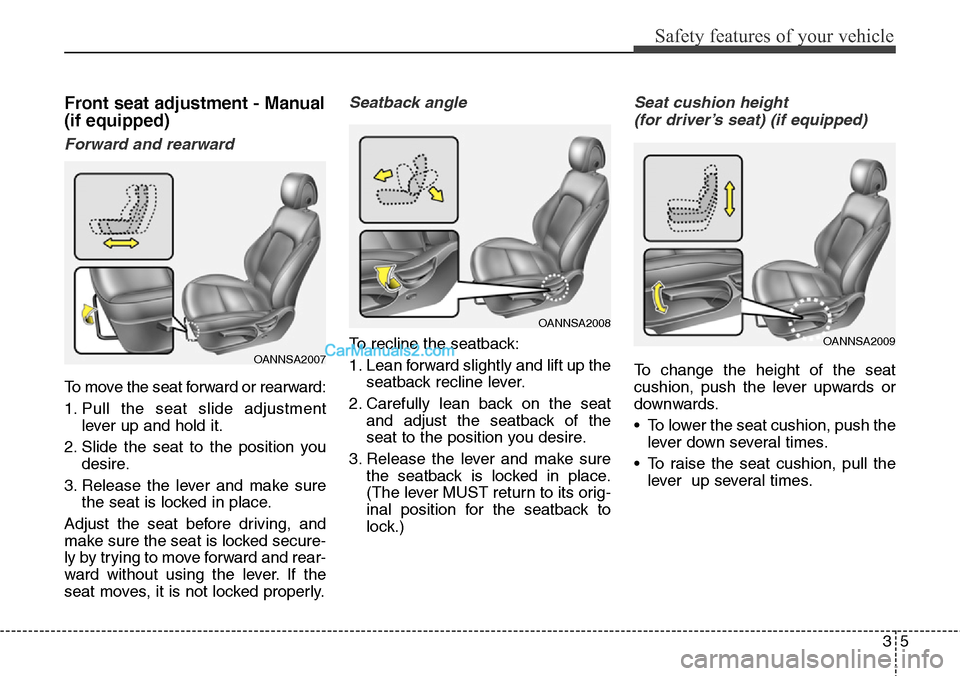
Front seat adjustment - Manual
(if equipped)
Forward and rearward
To move the seat forward or rearward:
1. Pull the seat slide adjustment
lever up and hold it.
2. Slide the seat to the position you
desire.
3. Release the lever and make sure
the seat is locked in place.
Adjust the seat before driving, and
make sure the seat is locked secure-
ly by trying to move forward and rear-
ward without using the lever. If the
seat moves, it is not locked properly.
Seatback angle
To recline the seatback:
1. Lean forward slightly and lift up the
seatback recline lever.
2. Carefully lean back on the seat
and adjust the seatback of the
seat to the position you desire.
3. Release the lever and make sure
the seatback is locked in place.
(The lever MUST return to its orig-
inal position for the seatback to
lock.)
Seat cushion height
(for driver’s seat) (if equipped)
To change the height of the seat
cushion, push the lever upwards or
downwards.
• To lower the seat cushion, push the
lever down several times.
• To raise the seat cushion, pull the
lever up several times.OANNSA2007
OANNSA2008
OANNSA2009
Page 45 of 785
Safety features of your vehicle
24 3
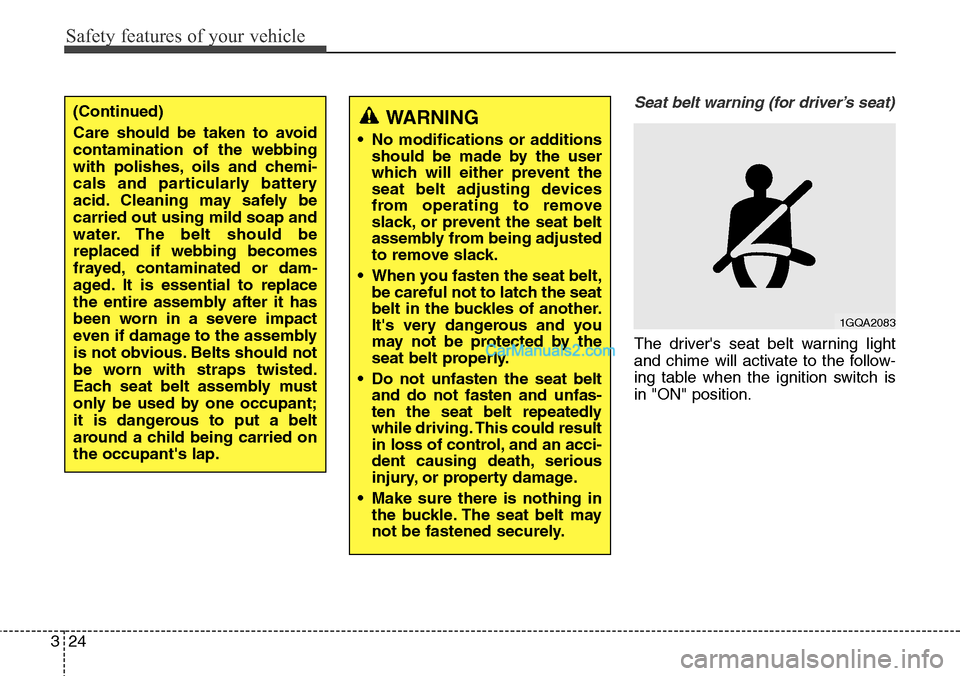
Seat belt warning (for driver’s seat)
The driver's seat belt warning light
and chime will activate to the follow-
ing table when the ignition switch is
in "ON" position.
WARNING
• No modifications or additions
should be made by the user
which will either prevent the
seat belt adjusting devices
from operating to remove
slack, or prevent the seat belt
assembly from being adjusted
to remove slack.
• When you fasten the seat belt,
be careful not to latch the seat
belt in the buckles of another.
It's very dangerous and you
may not be protected by the
seat belt properly.
• Do not unfasten the seat belt
and do not fasten and unfas-
ten the seat belt repeatedly
while driving. This could result
in loss of control, and an acci-
dent causing death, serious
injury, or property damage.
• Make sure there is nothing in
the buckle. The seat belt may
not be fastened securely.
1GQA2083
(Continued)
Care should be taken to avoid
contamination of the webbing
with polishes, oils and chemi-
cals and particularly battery
acid. Cleaning may safely be
carried out using mild soap and
water. The belt should be
replaced if webbing becomes
frayed, contaminated or dam-
aged. It is essential to replace
the entire assembly after it has
been worn in a severe impact
even if damage to the assembly
is not obvious. Belts should not
be worn with straps twisted.
Each seat belt assembly must
only be used by one occupant;
it is dangerous to put a belt
around a child being carried on
the occupant's lap.
Page 46 of 785
325
Safety features of your vehicle
*1Warning pattern repeats 11 times
with an interval of 24 seconds. If
the driver's seat belt is buckled, the
light will stop within 6 seconds and
chime will stop immediately.
*
2The light will stop within 6 seconds
and chime will stop immediately.
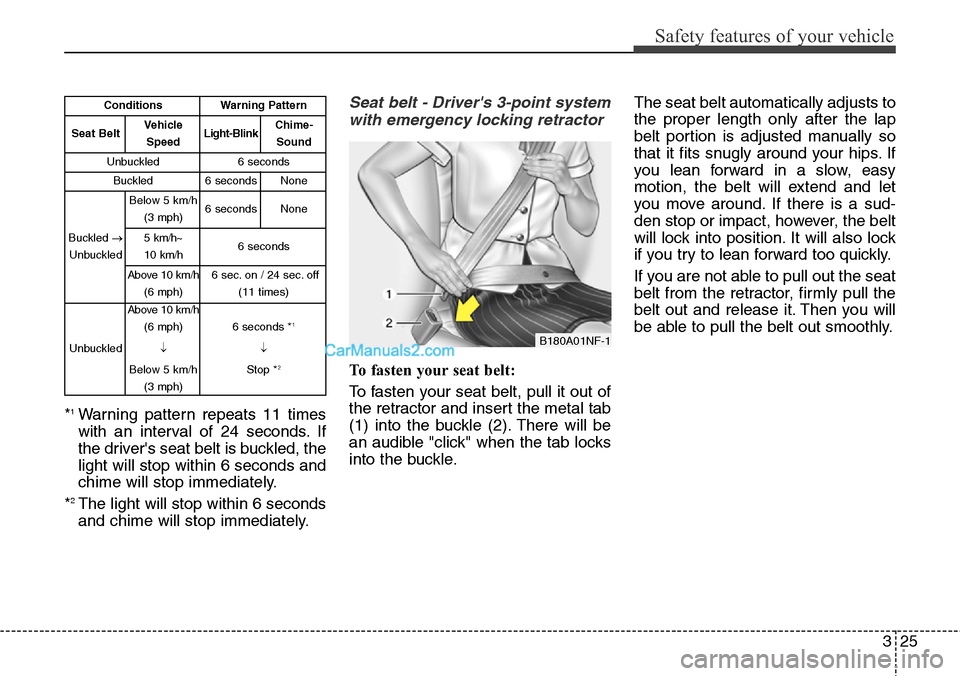
Seat belt - Driver's 3-point system
with emergency locking retractor
To fasten your seat belt:
To fasten your seat belt, pull it out of
the retractor and insert the metal tab
(1) into the buckle (2). There will be
an audible "click" when the tab locks
into the buckle.The seat belt automatically adjusts to
the proper length only after the lap
belt portion is adjusted manually so
that it fits snugly around your hips. If
you lean forward in a slow, easy
motion, the belt will extend and let
you move around. If there is a sud-
den stop or impact, however, the belt
will lock into position. It will also lock
if you try to lean forward too quickly.
If you are not able to pull out the seat
belt from the retractor, firmly pull the
belt out and release it. Then you will
be able to pull the belt out smoothly.
B180A01NF-1
ConditionsWarning Pattern
Seat BeltVehicle
SpeedLight-BlinkChime-
Sound
Unbuckled6 seconds
Buckled6 secondsNone
Buckled →
Unbuckled
Below 5 km/h
(3 mph)6 secondsNone
5 km/h~
10 km/h6 seconds
Above 10 km/h
(6 mph)6 sec. on / 24 sec. off
(11 times)
Unbuckled
Above 10 km/h
(6 mph)
↓
Below 5 km/h
(3 mph)
6 seconds *1
↓
Stop *
2
Page 50 of 785
329
Safety features of your vehicle
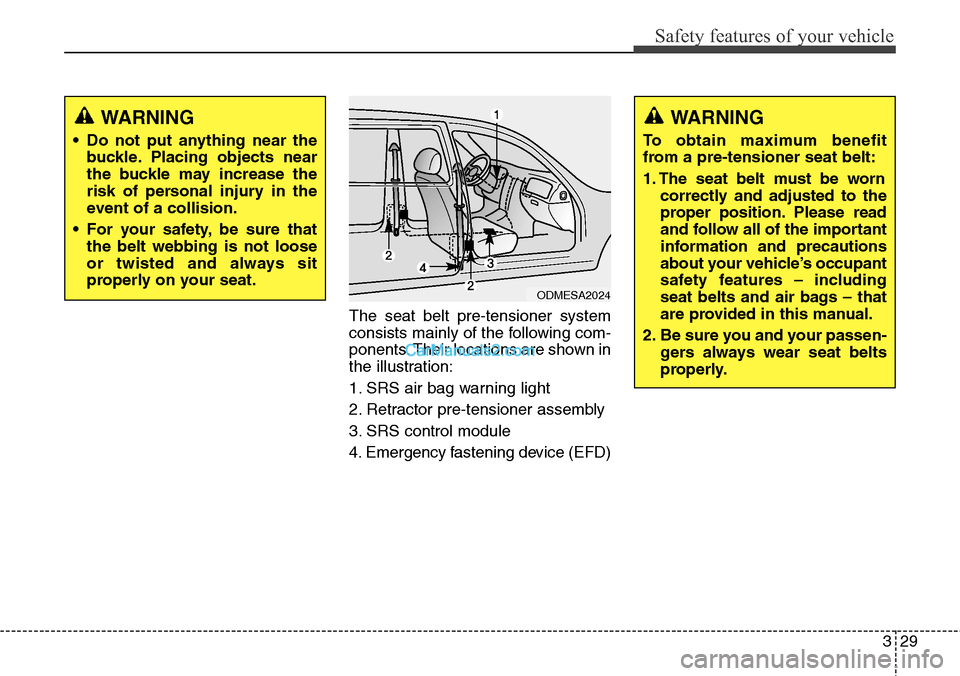
The seat belt pre-tensioner system
consists mainly of the following com-
ponents. Their locations are shown in
the illustration:
1. SRS air bag warning light
2. Retractor pre-tensioner assembly
3. SRS control module
4. Emergency fastening device (EFD)
WARNING
• Do not put anything near the
buckle. Placing objects near
the buckle may increase the
risk of personal injury in the
event of a collision.
• For your safety, be sure that
the belt webbing is not loose
or twisted and always sit
properly on your seat.
ODMESA2024
WARNING
To obtain maximum benefit
from a pre-tensioner seat belt:
1. The seat belt must be worn
correctly and adjusted to the
proper position. Please read
and follow all of the important
information and precautions
about your vehicle’s occupant
safety features – including
seat belts and air bags – that
are provided in this manual.
2. Be sure you and your passen-
gers always wear seat belts
properly.
Page 51 of 785
Safety features of your vehicle
30 3
✽NOTICE
• Both the driver's and front pas-
senger's seat belt pre-tensioner
system may be activated not only
in certain frontal collision but also
in certain side collision or rollover,
if the vehicle is equipped with a
side or curtain air bag.
• When the pre-tensioner seat belts
are activated, a loud noise may be
heard and fine dust, which may
appear to be smoke, may be visible
in the passenger compartment.
These are normal operating condi-
tions and are not hazardous.
• Although it is harmless, the fine
dust may cause skin irritation and
should not be breathed for pro-
longed periods. Wash all exposed
skin areas thoroughly after an
accident in which the pre-tension-
er seat belts were activated.
• Because the sensor that activates
the SRS air bag is connected with
the pre-tensioner seat belt, the
SRS air bag warning light on
the instrument panel will illumi-
nate for approximately 6 seconds
after the ignition switch has been
turned to the ON position, and
then it should turn off.WARNING
• Pre-tensioners are designed
to operate only one time. After
activation, pre-tensioner seat
belts must be replaced. All
seat belts, of any type, should
always be replaced after they
have been worn during a colli-
sion.
• The pre-tensioner seat belt
assembly mechanisms
become hot during activation.
Do not touch the pre-tension-
er seat belt assemblies for
several minutes after they
have been activated.
• Do not attempt to inspect or
replace the pre-tensioner seat
belts yourself. This must be
done by an authorized
HYUNDAI dealer.
• Do not strike the pre-tension-
er seat belt assemblies.
• Do not attempt to service or
repair the pre-tensioner seat
belt system in any manner.
(Continued)
CAUTION
If the pre-tensioner seat belt
system are not working proper-
ly, this warning light will illumi-
nate even if there is no malfunc-
tion of the SRS air bag. If the
SRS air bag warning light does
not illuminate when the ignition
switch is turned ON, or if it
remains illuminated after illumi-
nating for approximately 6 sec-
onds, or if it illuminates while
the vehicle is being driven, have
an authorized HYUNDAI dealer
inspect the pre-tensioner seat
belt and SRS air bag system as
soon as possible.
Page 53 of 785
Safety features of your vehicle
32 3
✽NOTICE
Small children are best protected
from injury in an accident when
properly restrained in the rear seat
by a child restraint system that
meets the requirements of the safety
standards of your country. Before
buying any child restraint system,
make sure that it has a label certify-
ing that it meets safety standards of
your country. The restraint must be
appropriate for your child's height
and weight. Check the label on the
child restraint for this information.
Refer to “Child restraint system” in
this section.
Larger children
Children who are too large for child
restraint systems should always
occupy the rear seat and use the
available lap/shoulder belts. The lap
portion should be fastened snug on
the hips and as low as possible.
Check belt fit periodically. A child's
squirming could put the belt out of
position. Children are afforded the
most safety in the event of an acci-
dent when they are restrained by a
proper restraint system in the rear
seat. If a larger child (over age 12)
must be seated in the front seat, the
child should be securely restrained
by the available lap/shoulder belt and
the seat should be placed in the rear-
most position. Children age 12 and
under should be restrained securely
in the rear seat. NEVER place a child
age 12 and under in the front seat.
NEVER place a rear facing child seat
in the front seat of a vehicle.If the shoulder belt portion slightly
touches the child’s neck or face, try
placing the child closer to the center
of the vehicle. If the shoulder belt still
touches their face or neck they need
to be returned to a child restraint sys-
tem.
WARNING - Shoulder
belts on small children
• Never allow a shoulder belt to
be in contact with a child’s
neck or face while the vehicle
is in motion.
• If seat belts are not properly
worn and adjusted on chil-
dren, there is a risk of death or
serious injury.