sensor Hyundai Santa Fe Sport 2016 Owner's Manual
[x] Cancel search | Manufacturer: HYUNDAI, Model Year: 2016, Model line: Santa Fe Sport, Model: Hyundai Santa Fe Sport 2016Pages: 763, PDF Size: 37.75 MB
Page 50 of 763
329
Safety features of your vehicle
✽
✽NOTICE
• Both the driver's and front pas-
senger's seat belt pre-tensioner
system may be activated not only
in certain frontal collision but also
in certain side collision or rollover,
if the vehicle is equipped with a
side or curtain air bag.
• When the pre-tensioner seat belts are activated, a loud noise may be
heard and fine dust, which may
appear to be smoke, may be visible
in the passenger compartment.
These are normal operating condi-
tions and are not hazardous.
• Although it is harmless, the fine dust may cause skin irritation and
should not be breathed for pro-
longed periods. Wash all exposed
skin areas thoroughly after an
accident in which the pre-tension-
er seat belts were activated.
• Because the sensor that activates the SRS air bag is connected with
the pre-tensioner seat belt, the
SRS air bag warning light on
the instrument panel will illumi-
nate for approximately 6 seconds
after the ignition switch has been
turned to the ON position, and
then it should turn off.WARNING
Pre-tensioners are designed
to operate only one time. After
activation, pre-tensioner seat
belts must be replaced. All
seat belts, of any type, should
always be replaced after they
have been worn during a colli-
sion.
The pre-tensioner seat belt assembly mechanisms
become hot during activation.
Do not touch the pre-tension-
er seat belt assemblies for
several minutes after they
have been activated.
Do not attempt to inspect or replace the pre-tensioner seat
belts yourself. This must be
done by an authorized
HYUNDAI dealer.
Do not strike the pre-tension- er seat belt assemblies.
Do not attempt to service or repair the pre-tensioner seat
belt system in any manner.
(Continued)
CAUTION
If the pre-tensioner seat beltsystem are not working proper-ly, this warning light will illumi-nate even if there is no malfunc-tion of the SRS air bag. If theSRS air bag warning light doesnot illuminate when the ignitionswitch is turned ON, or if itremains illuminated after illumi-nating for approximately 6 sec-onds, or if it illuminates whilethe vehicle is being driven, havean authorized HYUNDAI dealerinspect the pre-tensioner seatbelt and SRS air bag system assoon as possible.
AN HMA 3.QXP 3/5/2015 3:09 PM Page 29
Page 65 of 763
Safety features of your vehicle
44
3
How does the air bag system
operate
Air bags are activated (able to
inflate if necessary) only when the
ignition switch is turned to the ON or
START position.
The appropriate air bags inflate instantly in the event of serious
frontal or side collision in order to
help protect the occupants from
serious physical injury.
There is no single speed at which the air bags will inflate.
Generally, air bags are designed to
inflate by the severity of a collision
and its direction. These two factors
determine whether the sensors
send out an electronic deployment/
inflation signal.
Air bag deployment depends on a number of factors including vehicle
speed, angles of impact and the
density and stiffness of the vehicles
or objects which your vehicle hits in
the collision. Though, factors are not
limited to those mentioned above. The front air bags will completely
inflate and deflate in an instant.
It is virtually impossible for you to
see the air bags inflate during an
accident.
It is much more likely that you will
simply see the deflated air bags
hanging out of their storage com-
partments after the collision.
In addition to inflating in serious side collisions, side and/or curtain
air bags will inflate if the sensing
system detects a rollover.
When a rollover is detected, side and/or curtain airbags will remain
inflated longer to help provide pro-
tection from ejection, especially
when used in conjunction with the
seat belts.
In order to help provide protection, the air bags must inflate rapidly. The
speed of air bag inflation is a con-
sequence of the extremely short
time in which to inflate the air bag
between the occupant and the vehi-
cle structures before the occupant
impacts those structures. This speed of inflation reduces the
risk of serious or life-threatening
injuries and is thus a necessary part
of air bag design.
However, air bag inflation can also
cause injuries which normally can
include facial abrasions, bruises and
broken bones because the inflation
speed also causes the air bags to
expand with a great deal of force.
There are even circumstances under which contact with the air
bag can cause fatal injuries, espe-
cially if the occupant is positioned
excessively close to the air bag.
WARNING
To avoid severe personal injuryor death caused by deploying
air bags in a collision, the driv-
er should sit as far back from
the steering wheel air bag as
possible (at least 10 inches
(250 mm) away). The front pas-
sengers should always move
their seats as far back as pos-
sible and sit back in their seat.
(Continued)
AN HMA 3.QXP 3/5/2015 3:09 PM Page 44
Page 67 of 763
Safety features of your vehicle
46
3
Air bag warning light
The purpose of the air bag warning
light in your instrument panel is to
alert you of a potential problem with
your airbag system, which includes
side and/or curtain airbags used for
rollover protection.
When the ignition switch is turned
ON, the indicator light should illumi-
nate for approximately 6 seconds,
then go off.
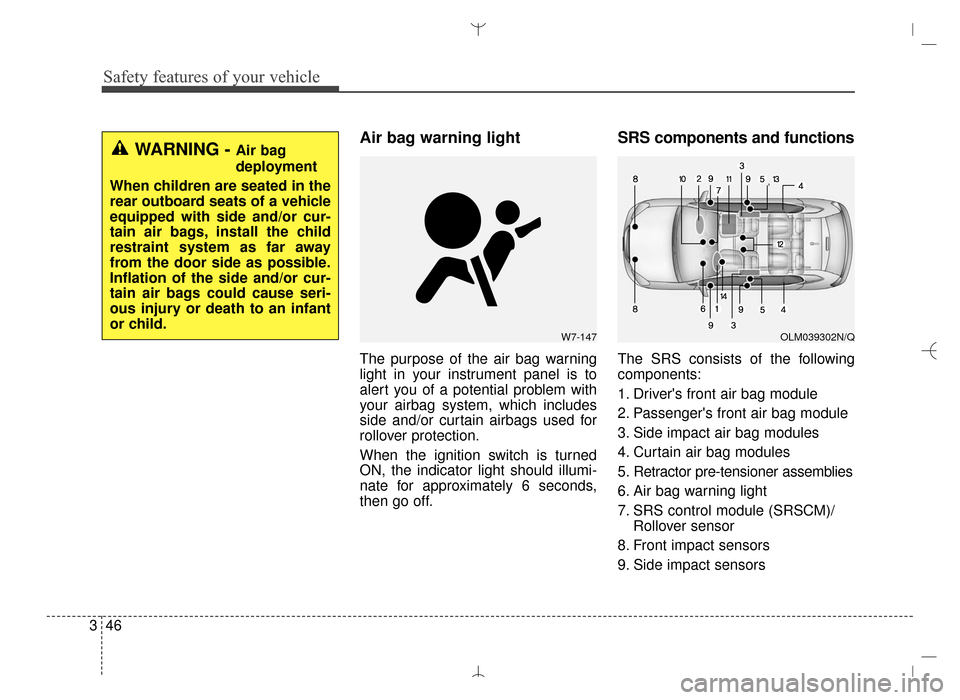
SRS components and functions
The SRS consists of the following
components:
1. Driver's front air bag module
2. Passenger's front air bag module
3. Side impact air bag modules
4. Curtain air bag modules
5. Retractor pre-tensioner assemblies
6. Air bag warning light
7. SRS control module (SRSCM)/
Rollover sensor
8. Front impact sensors
9. Side impact sensors
W7-147
WARNING - Air bag
deployment
When children are seated in the
rear outboard seats of a vehicle
equipped with side and/or cur-
tain air bags, install the child
restraint system as far away
from the door side as possible.
Inflation of the side and/or cur-
tain air bags could cause seri-
ous injury or death to an infant
or child.
OLM039302N/Q
,
AN HMA 3.QXP 3/5/2015 3:09 PM Page 46
Page 68 of 763
347
Safety features of your vehicle
10. PASS AIR BAG “OFF” indicator(Front passenger’s seat only)
11. Occupant classification system (Front passenger’s seat only)
12. Driver’s and front passenger’s seat belt buckle sensors
13. Emergency fastening device (EFD)
14. Driver’s knee air bag module
The SRSCM continually monitors all
SRS components while the ignition
switch is ON to determine if a crash
impact is severe enough to require
air bag deployment or pre-tensioner
seat belt deployment. The SRS air bag warning light " "
on the instrument panel will illumi-
nate for about 6 seconds after the
ignition switch is turned to the ON
position, after which the SRS air bag
warning light " " should go out.
W7-147
WARNING
If any of the following condi-
tions occurs, this indicates a
malfunction of the SRS. Have an
authorized HYUNDAI dealer
inspect the air bag system as
soon as possible.
The light does not turn on
briefly when you turn the igni-
tion ON.
The light stays on after illumi- nating for approximately 6
seconds.
The light comes on while the vehicle is in motion.
The light blinks when the igni- tion switch is in ON position.
AN HMA 3.QXP 3/5/2015 3:09 PM Page 47
Page 75 of 763
Safety features of your vehicle
54
3
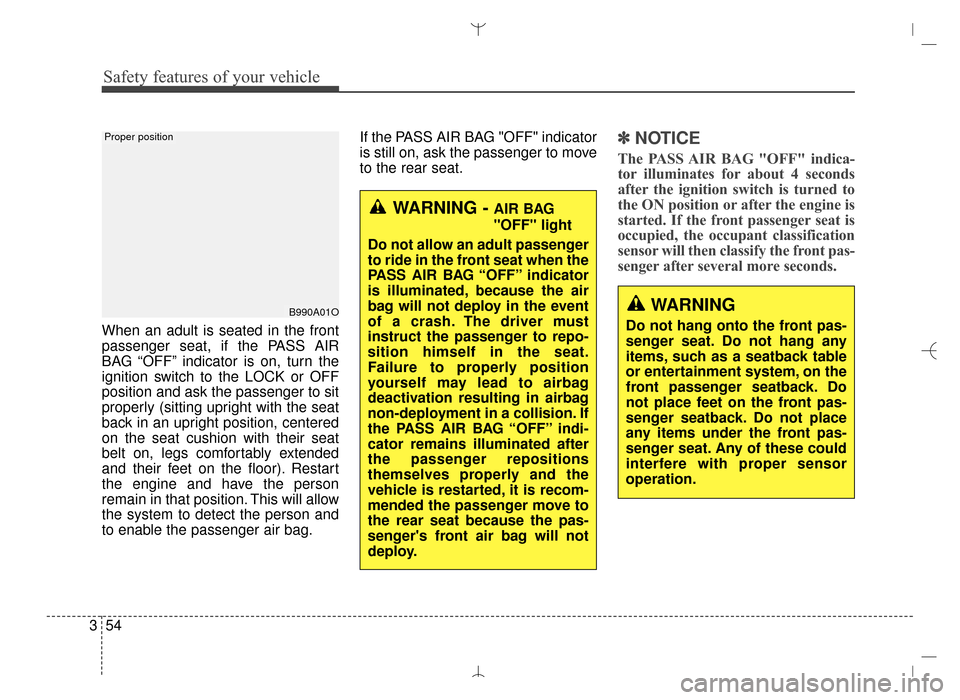
When an adult is seated in the front
passenger seat, if the PASS AIR
BAG “OFF” indicator is on, turn the
ignition switch to the LOCK or OFF
position and ask the passenger to sit
properly (sitting upright with the seat
back in an upright position, centered
on the seat cushion with their seat
belt on, legs comfortably extended
and their feet on the floor). Restart
the engine and have the person
remain in that position. This will allow
the system to detect the person and
to enable the passenger air bag. If the PASS AIR BAG "OFF" indicator
is still on, ask the passenger to move
to the rear seat.
✽ ✽
NOTICE
The PASS AIR BAG "OFF" indica-
tor illuminates for about 4 seconds
after the ignition switch is turned to
the ON position or after the engine is
started. If the front passenger seat is
occupied, the occupant classification
sensor will then classify the front pas-
senger after several more seconds.
B990A01O
Proper position
WARNING
Do not hang onto the front pas-
senger seat. Do not hang any
items, such as a seatback table
or entertainment system, on the
front passenger seatback. Do
not place feet on the front pas-
senger seatback. Do not place
any items under the front pas-
senger seat. Any of these could
interfere with proper sensor
operation.
WARNING - AIR BAG
"OFF" light
Do not allow an adult passenger
to ride in the front seat when the
PASS AIR BAG “OFF” indicator
is illuminated, because the air
bag will not deploy in the event
of a crash. The driver must
instruct the passenger to repo-
sition himself in the seat.
Failure to properly position
yourself may lead to airbag
deactivation resulting in airbag
non-deployment in a collision. If
the PASS AIR BAG “OFF” indi-
cator remains illuminated after
the passenger repositions
themselves properly and the
vehicle is restarted, it is recom-
mended the passenger move to
the rear seat because the pas-
senger's front air bag will not
deploy.
AN HMA 3.QXP 3/5/2015 3:09 PM Page 54
Page 78 of 763
357
Safety features of your vehicle
Your vehicle is equipped with a
Supplemental Restraint (Air Bag)
System and the lap/shoulder belts at
both the driver and passenger seat-
ing positions.
The indications of the system's pres-
ence are the letters "SRS AIR BAG"
embossed on the air bag pad cover
in the steering wheel, on the knee
bolster below the steering wheel col-
umn and the passenger's side front
panel pad above the glove box.
The SRS consists of air bags
installed under the pad covers in the
center of the steering wheel , in the
knee bolster below the steering
wheel column and the passenger's
side front panel above the glove box.
The purpose of the SRS is to provide
the vehicle's driver and/or the front
passenger with additional protection
than that offered by the seat belt sys-
tem alone in case of a frontal impact
of sufficient severity.The seat belt buckle sensors deter-
mine if the driver and front passen-
ger's seat belts are fastened. These
sensors provide the ability to control
the SRS deployment based on
whether or not the seat belts are fas-
tened, and how severe the impact is.
The advanced SRS offers the ability
to control the air bag inflation within
two levels. A first stage level is pro-
vided for moderate-severity impacts.
A second stage level is provided for
more severe impacts.
According to the impact severity and
seat belt usage, the SRSCM (SRS
Control Module) controls the air bag
inflation. Failure to properly wear
seat belts can increase the risk or
severity of injury in an accident.
Additionally, your vehicle is equipped
with an occupant classification sys-
tem in the front passenger's seat.
The occupant classification system
detects the presence of a passenger
in the front passenger's seat and will
turn off the front passenger's air bag
under certain conditions. For more
detail, see "Occupant classification
system" in this section.
AN HMA 3.QXP 3/5/2015 3:09 PM Page 57
Page 83 of 763
Safety features of your vehicle
62
3
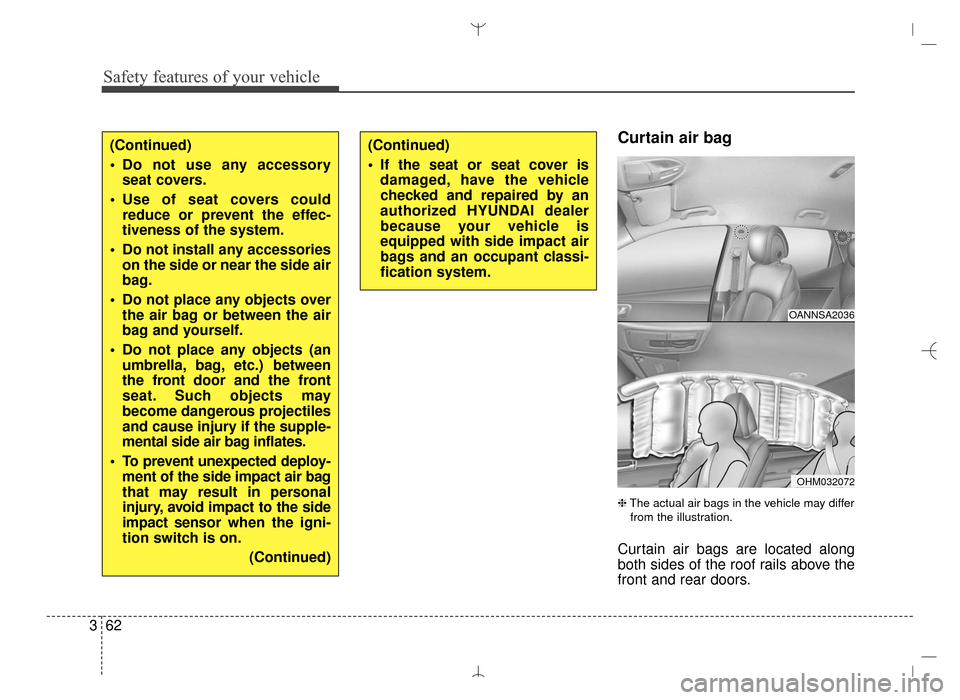
Curtain air bag
❈ The actual air bags in the vehicle may differ
from the illustration.
Curtain air bags are located along
both sides of the roof rails above the
front and rear doors.
(Continued)
Do not use any accessory seat covers.
Use of seat covers could reduce or prevent the effec-
tiveness of the system.
Do not install any accessories on the side or near the side air
bag.
Do not place any objects over the air bag or between the air
bag and yourself.
Do not place any objects (an umbrella, bag, etc.) between
the front door and the front
seat. Such objects may
become dangerous projectiles
and cause injury if the supple-
mental side air bag inflates.
To prevent unexpected deploy- ment of the side impact air bag
that may result in personal
injury, avoid impact to the side
impact sensor when the igni-
tion switch is on.
(Continued)(Continued)
If the seat or seat cover isdamaged, have the vehicle
checked and repaired by an
authorized HYUNDAI dealer
because your vehicle is
equipped with side impact air
bags and an occupant classi-
fication system.
OANNSA2036
OHM032072
AN HMA 3.QXP 3/5/2015 3:09 PM Page 62
Page 85 of 763
Safety features of your vehicle
64
3
Why didn’t my air bag go off in a
collision? (Inflation and non-infla-
tion conditions of the air bag)
There are many types of accidents
in which the air bag would not be
expected to provide additional
protection.
These include rear impacts, sec-
ond or third collisions in multiple
impact accidents, as well as low
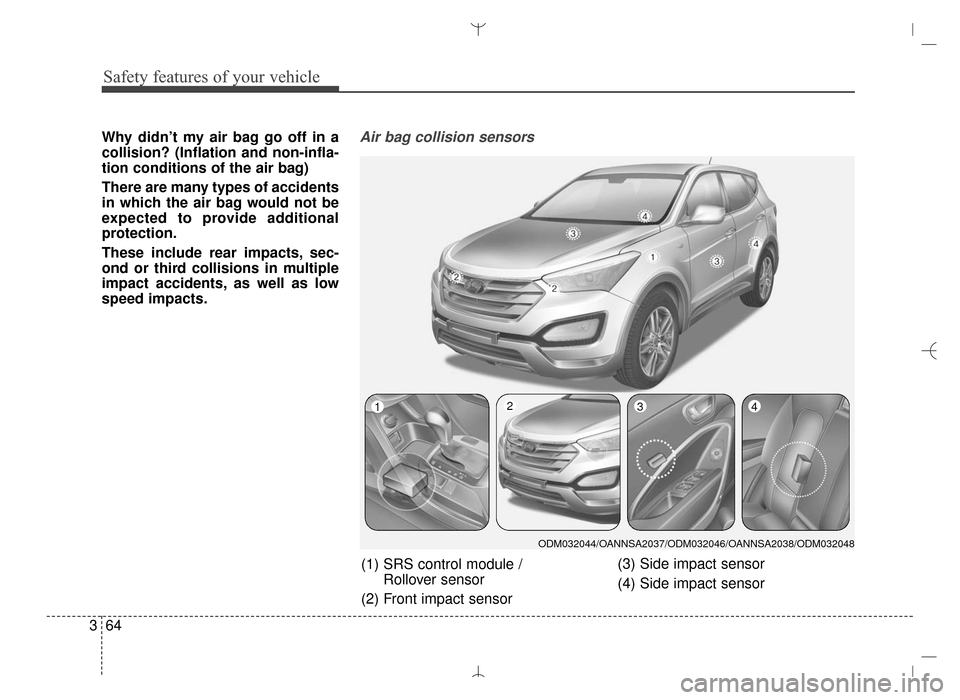
speed impacts.Air bag collision sensors
(1) SRS control module /
Rollover sensor
(2) Front impact sensor (3) Side impact sensor
(4) Side impact sensor
ODM032044/OANNSA2037/ODM032046/OANNSA2038/ODM032048
1234
AN HMA 3.QXP 3/5/2015 3:10 PM Page 64
Page 86 of 763
365
Safety features of your vehicle
Problems may arise if the sensorinstallation angles are changed
due to the deformation of the front
bumper, body or C pillars or front
door where side collision sensors
are installed. Have the vehicle
checked and repaired by an
authorized HYUNDAI dealer.
Your vehicle has been designed to absorb impact and deploy the air
bag(s) in certain collisions.
Installing bumper guards or side
steppers or replacing a bumper
with non-genuine parts may
adversely affect your vehicle’s col-
lision and air bag deployment per-
formance.Air bag inflation conditions
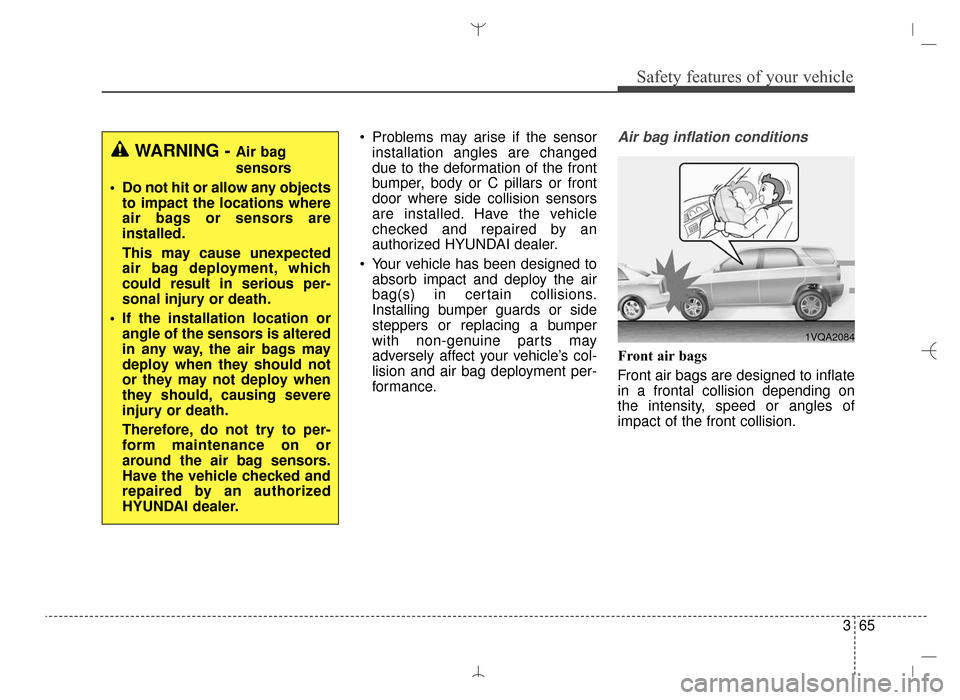
Front air bags
Front air bags are designed to inflate
in a frontal collision depending on
the intensity, speed or angles of
impact of the front collision.
WARNING - Air bag
sensors
Do not hit or allow any objects to impact the locations where
air bags or sensors are
installed.
This may cause unexpected
air bag deployment, which
could result in serious per-
sonal injury or death.
If the installation location or angle of the sensors is altered
in any way, the air bags may
deploy when they should not
or they may not deploy when
they should, causing severe
injury or death.
Therefore, do not try to per-
form maintenance on or
around the air bag sensors.
Have the vehicle checked and
repaired by an authorized
HYUNDAI dealer.
1VQA2084
AN HMA 3.QXP 3/5/2015 3:10 PM Page 65
Page 87 of 763
Safety features of your vehicle
66
3
❈ The actual air bags in the vehicle may dif-
fer from the illustration.
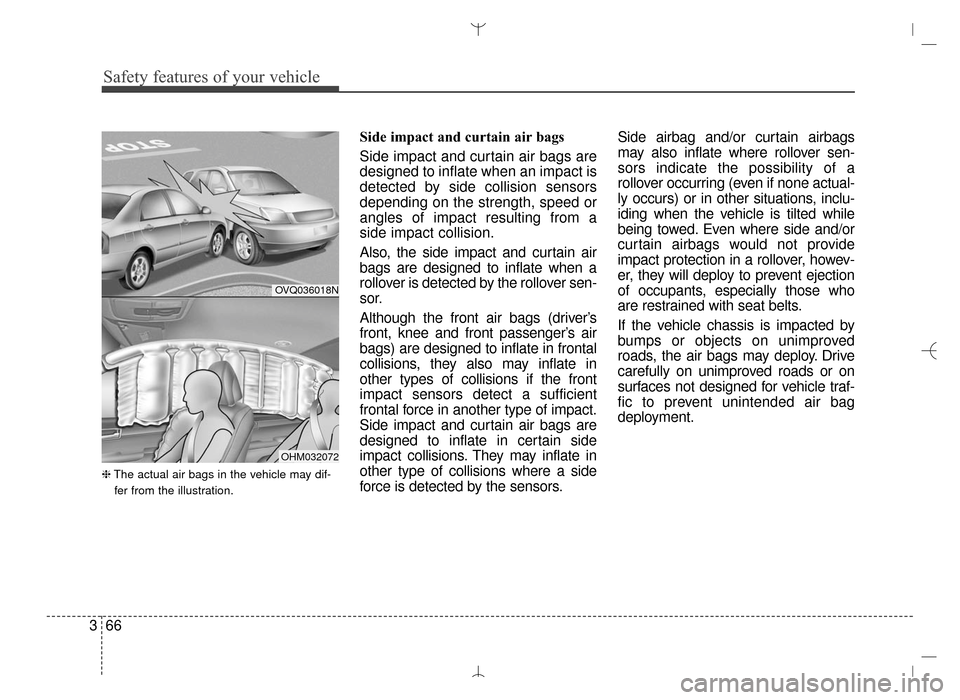
Side impact and curtain air bags
Side impact and curtain air bags are
designed to inflate when an impact is
detected by side collision sensors
depending on the strength, speed or
angles of impact resulting from a
side impact collision.
Also, the side impact and curtain air
bags are designed to inflate when a
rollover is detected by the rollover sen-
sor.
Although the front air bags (driver’s
front, knee and front passenger’s air
bags) are designed to inflate in frontal
collisions, they also may inflate in
other types of collisions if the front
impact sensors detect a sufficient
frontal force in another type of impact.
Side impact and curtain air bags are
designed to inflate in certain side
impact collisions. They may inflate in
other type of collisions where a side
force is detected by the sensors. Side airbag and/or curtain airbags
may also inflate where rollover sen-
sors indicate the possibility of a
rollover occurring (even if none actual-
ly occurs) or in other situations, inclu-
iding when the vehicle is tilted while
being towed. Even where side and/or
curtain airbags would not provide
impact protection in a rollover, howev-
er, they will deploy to prevent ejection
of occupants, especially those who
are restrained with seat belts.
If the vehicle chassis is impacted by
bumps or objects on unimproved
roads, the air bags may deploy. Drive
carefully on unimproved roads or on
surfaces not designed for vehicle traf-
fic to prevent unintended air bag
deployment.
OVQ036018N
OHM032072
AN HMA 3.QXP 3/5/2015 3:10 PM Page 66