fuel Hyundai Sonata
[x] Cancel search | Manufacturer: HYUNDAI, Model Year: , Model line: , Model:Pages: 340, PDF Size: 18.45 MB
Page 210 of 340
533
Driving your vehicle
Use your air conditioning sparingly.The air conditioning system is operat-
ed by engine power so your fuel econ-
omy is reduced when you use it.
Open windows at high speeds can reduce fuel economy.
Fuel economy is less in crosswinds and headwinds. To help offset some of
this loss, slow down when driving in
these conditions.
Keeping a vehicle in good operating con-
dition is important both for economy and
safety. Therefore, have an authorised
HYUNDAI dealer perform scheduled
inspections and maintenance.
WARNING - Engine off dur-
ing motion
Never turn the engine off to coast
down hills or anytime the vehicle is
in motion. The power steering and
power brakes will not function
properly without the engine run-
ning. Instead, keep the engine on
and downshift to an appropriate
gear for engine braking effect. In
addition, turning off the ignition
while driving could engage the
steering wheel lock resulting in
loss of vehicle steering which
could cause serious injury ordeath.
Page 214 of 340
537
Driving your vehicle
Fuel, engine coolant and engine oil:
High speed travel consumes more fuel
than urban motoring. Do not forget to
check both engine coolant and engineoil.
Drive belt:
A loose or damaged drive belt may result
in overheating of the engine.
WARNING
Underinflated or overinflated tyres can cause poor handling,
loss of vehicle control, and sud-den tyre failure leading to acci-
dents, injuries, and even death.
Always check the tyres for proper
inflation before driving. For prop-
er tyre pressures, refer to section
9, “Tyres and wheels”.
Driving on tyres with no or insuf- ficient tread is dangerous. Worn-out tyres can result in loss of
vehicle control, collisions, injury,
and even death. Worn-out tyresshould be replaced as soon as
possible and should never be
used for driving. Always check
the tyre tread before driving your
car. For further information and
tread limits, refer to section 7,
“Tyres and wheels”.
Page 219 of 340
Driving your vehicle
42
5
E140000AFD-EA
If you are considering towing with your
car, you should first check with your
country's Department of Motor Vehicles
to determine their legal requirements.
Since laws vary the requirements for tow-
ing trailers, cars, or other types of vehi-
cles or apparatus may differ. Ask an
authorised HYUNDAI dealer for further
details before towing.
Your vehicle can tow a trailer. To identify
what the vehicle trailering capacity is for
your vehicle, you should read the infor-
mation in “Weight of the trailer” thatappears later in this section.
Remember that trailering is different than
just driving your vehicle by itself.
Trailering means changes in handling,
durability, and fuel economy. Successful,
safe trailering requires correct equip-
ment, and it has to be used properly.This section contains many time-tested,
important trailering tips and safety rules.
Many of these are important for your
safety and that of your passengers.
Please read this section carefully before
you pull a trailer. Load-pulling components such as the
engine, transaxle, wheel assemblies, and
tyres are forced to work harder against
the load of the added weight. The engine
is required to operate at relatively higher
speeds and under greater loads. This
additional burden generates extra heat.
The trailer also adds considerably to
wind resistance, increasing the pulling
requirements.
TRAILER TOWING
CAUTION
Pulling a trailer improperly can
damage your vehicle and result in costly repairs not covered by yourwarranty. To pull a trailer correctly,
follow the advice in this section.
WARNING - Towing a trail-
er
If you don't use the correct equip-
ment and drive improperly, you can
lose control when you pull a trailer.
For example, if the trailer is too
heavy, the brakes may not work
well - or even at all. You and your
passengers could be seriously or
fatally injured. Pull a trailer only if
you have followed all the steps inthis section.
WARNING - Weight limits
Before towing, make sure the total
trailer weight, gross combination
weight, gross vehicle weight, grossaxle weight and trailer tongue loadare all within the limits.
Page 227 of 340
Driving your vehicle
50
5
E160000AUN-EA
This section will guide you in the proper
loading of your vehicle and/or trailer, to
keep your loaded vehicle weight within its
design rating capability, with or without a
trailer. Properly loading your vehicle will
provide maximum return of the vehicle
design performance. Before loading your
vehicle, familiarize yourself with the fol-
lowing terms for determining your vehi-
cle's weight ratings, with or without a
trailer, from the vehicle's specifications
and the certification label:
E160100AUN-EA Base kerb weight
This is the weight of the vehicle including a full tank of fuel and all standard equip-
ment. It does not include passengers,
cargo, or optional equipment.
E160200AUN-EA
Vehicle kerb weight
This is the weight of your new vehicle
when you picked it up from your dealer
plus any aftermarket equipment.
E160300AUN-EA
Cargo weight
This figure includes all weight added to
the Base Kerb Weight, including cargoand optional equipment. E160400AUN-EA
GAW (Gross axle weight)
This is the total weight placed on each
axle (front and rear) - including vehicle
kerb weight and all payload.
E160500AUN-EA
GAWR (Gross axle weight rating)
This is the maximum allowable weight
that can be carried by a single axle (front
or rear). These numbers are shown on
the certification label.
The total load on each axle must never
exceed its GAWR.
E160600AUN-EA
GVW (Gross vehicle weight)
This is the Base Kerb Weight plus actual
Cargo Weight plus passengers.
E160700AUN-EA
GVWR (Gross vehicle weight rating)
This is the maximum allowable weight of
the fully loaded vehicle (including all
options, equipment, passengers and
cargo). The GVWR is shown on the cer-tification label.
E160800AUN-EA Overloading
VEHICLE WEIGHT
WARNING -
Vehicle weight
The gross axle weight rating
(GAWR) and the gross vehicle
weight rating (GVWR) for your vehi-
cle are on the certification label.Exceeding these ratings can cause
an accident or vehicle damage. You
can calculate the weight of your
load by weighing the items (and
people) before putting them in the
vehicle. Be careful not to overload
your vehicle.
Page 230 of 340
63
What to do in an emergency
2. When the car is stopped, turn on youremergency hazard flashers, set the
parking brake and put the transaxle in
P (automatic transaxle) or reverse
(manual transaxle).
3. Have all passengers get out of the car. Be sure they all get out on the side of
the car that is away from traffic.
4. When changing a flat tyre, follow the instruction provided later in this sec-tion.
F020300AFD-EA If engine stalls while driving
1. Reduce your speed gradually, keeping a straight line. Move cautiously off the
road to a safe place.
2. Turn on your emergency flashers.
3. Try to start the engine again. If your vehicle will not start, contact an autho-
rised HYUNDAI dealer or seek other
qualified assistance. F030100AUN
If engine doesn't turn over or
turns over slowly
1. If your car has an automatic transaxle,
be sure the gear selector lever is in N
(Neutral) or P (Park) and the emer-
gency brake is set.
2. Check the battery connections to be sure they are clean and tight.
3. Turn on the interior light. If the light dims or goes out when you operate the
starter, the battery is discharged.
4. Check the starter connections to be sure they are securely tightened.
5. Do not push or pull the vehicle to start it. See instructions for "Jump starting". F030200AFD-EA
If engine turns over normally but
does not start
1. Check fuel level.
2. With the ignition switch in the OFF
position, check all connectors at igni-
tion, coil and spark plugs. Reconnect
any connectors that may be discon-
nected or loose.
3. Check the fuel line in the engine com- partment.
4. If the engine still does not start, call an authorised HYUNDAI dealer or seek
other qualified assistance.
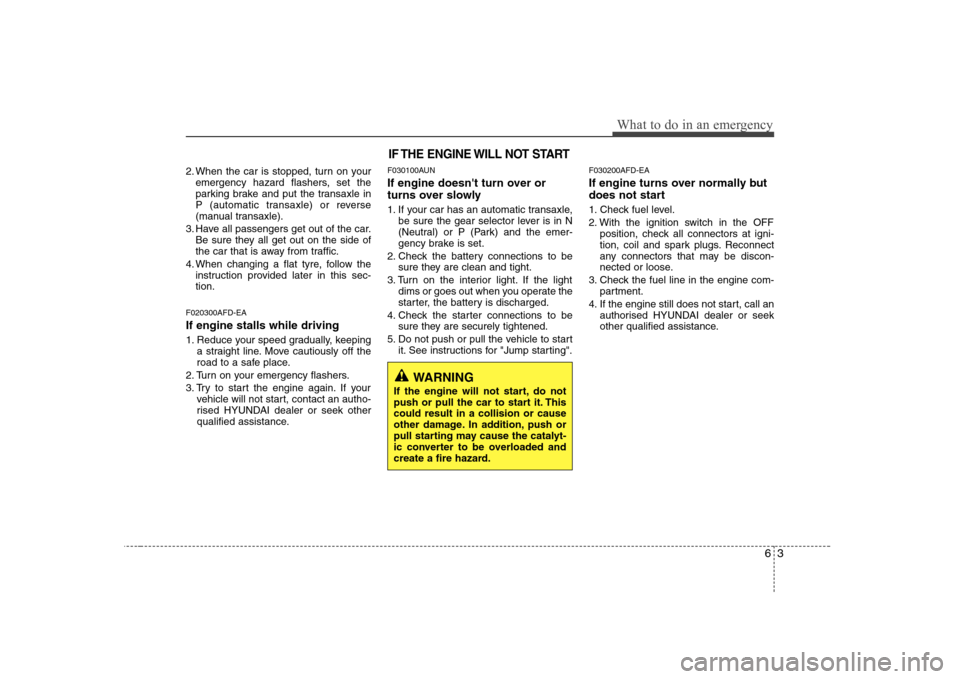
IF THE ENGINE WILL NOT START
WARNING
If the engine will not start, do not
push or pull the car to start it. Thiscould result in a collision or cause
other damage. In addition, push or
pull starting may cause the catalyt-
ic converter to be overloaded and
create a fire hazard.
Page 244 of 340
7
Engine compartment / 7-2 Maintenance services / 7-4
Owner maintenance / 7-6Scheduled maintenance service / 7-8Explanation of scheduled maintenance items / 7-21Engine oil / 7-24Engine coolant / 7-25Brake and clutch fluid / 7-28
Power steering fluid / 7-29Automatic transaxle fluid / 7-30
Washer fluid / 7-32Parking brake / 7-32
Fuel filter / 7-33
Air cleaner / 7-34
Climate control air filter / 7-36
Wiper blades / 7-38 Battery / 7-40
Tyres and wheels / 7-43Fuses / 7-53Light bulbs / 7-62
Appearance care / 7-70
Emission control system / 7-76
Maintenance
Page 246 of 340
73
Maintenance
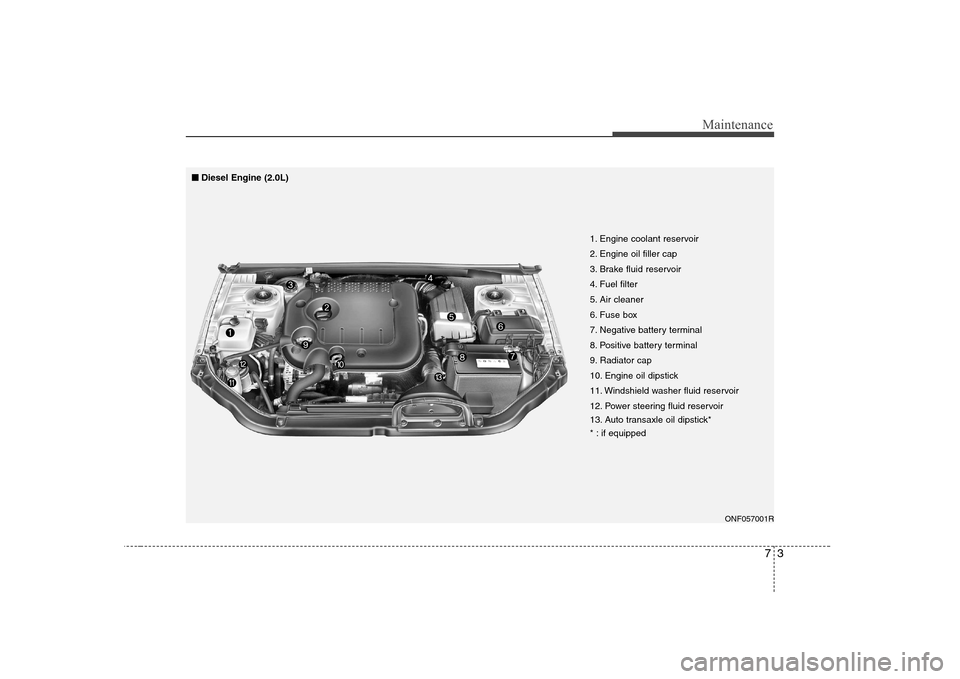
ONF057001R
1. Engine coolant reservoir
2. Engine oil filler cap
3. Brake fluid reservoir
4. Fuel filter
5. Air cleaner
6. Fuse box
7. Negative battery terminal
8. Positive battery terminal
9. Radiator cap
10. Engine oil dipstick
11. Windshield washer fluid reservoir
12. Power steering fluid reservoir
13. Auto transaxle oil dipstick*
* : if equipped
■
■
Diesel Engine (2.0L)
Page 248 of 340
75
Maintenance
G020200AFD-EA Owner maintenance precautions
Improper or incomplete service may
result in problems. This section gives
instructions only for the maintenance
items that are easy to perform.
As explained earlier in this section, sev-
eral procedures can be done only by an
authorised HYUNDAI dealer with special
tools.
✽✽NOTICE
Improper owner maintenance during the warranty period may affect warran-
ty coverage. For details, read the sepa-
rate Service Passport provided with the
vehicle. If you're unsure about any serv-
icing or maintenance procedure, have itdone by an authorised HYUNDAI deal-
er.
WARNING - Maintenance
work
Performing maintenance work on a vehicle can be dangerous. You
can be seriously injured while
performing some maintenance
procedures. If you lack sufficient
knowledge and experience or the
proper tools and equipment to do
the work, have it done by an
authorised HYUNDAI dealer.
Working under the bonnet with the engine running is dangerous.
It becomes even more dangerous
when you wear jewelry or loose
clothing. These can become
entangled in moving parts and
result in injury. Therefore, if you
must run the engine while work-
ing under the bonnet, make cer-
tain that you remove all jewelry
(especially rings, bracelets,
watches, and necklaces) and all
neckties, scarves, and similar
loose clothing before gettingnear the engine or cooling fans.WARNING - Diesel Engine
Never work on injection system with engine running or within 30
seconds after shutting off engine.
High-pressure pump, rail, injectorsand high-pressure pipes are sub-
ject to high pressure even after the
engine stopped. The fuel jet pro-
duced by fuel leaks may cause seri-
ous injury, if it touches the body.
People using pacemakers shouldnot be within 30cm of the ECU orwiring harness within the engine
room while engine is running, since
the high currents in the electronic
engine control system produce
considerable magnetic fields.
Page 249 of 340
Maintenance
6
7
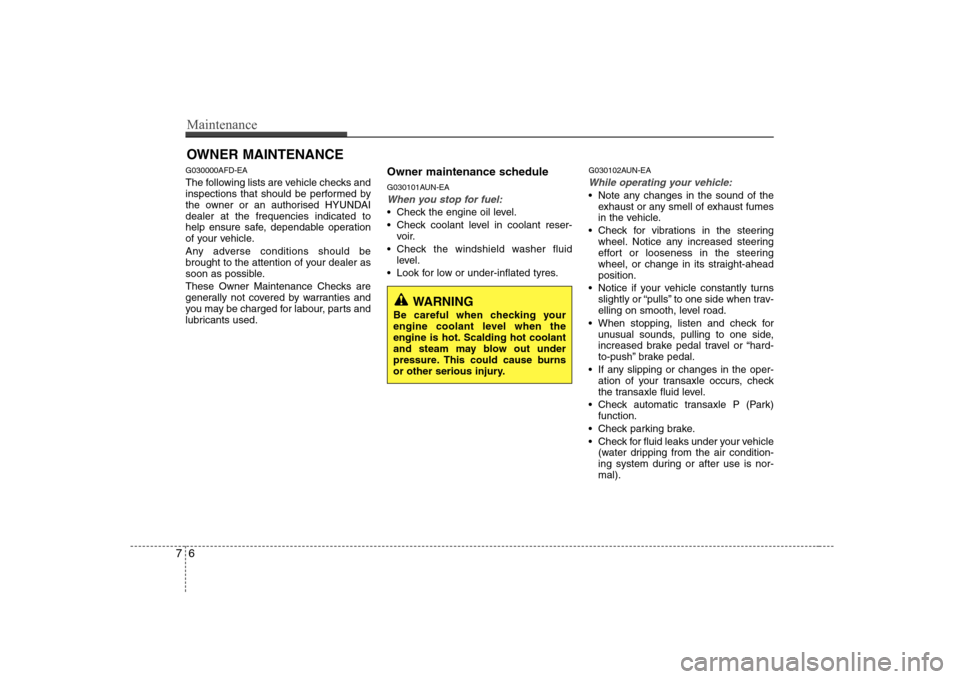
OWNER MAINTENANCE
G030000AFD-EA
The following lists are vehicle checks and
inspections that should be performed by
the owner or an authorised HYUNDAIdealer at the frequencies indicated to
help ensure safe, dependable operation
of your vehicle.
Any adverse conditions should be
brought to the attention of your dealer as
soon as possible.
These Owner Maintenance Checks are
generally not covered by warranties and
you may be charged for labour, parts and
lubricants used. Owner maintenance schedule
G030101AUN-EA
When you stop for fuel:
Check the engine oil level.
Check coolant level in coolant reser-
voir.
Check the windshield washer fluid level.
Look for low or under-inflated tyres. G030102AUN-EA
While operating your vehicle:
Note any changes in the sound of the
exhaust or any smell of exhaust fumes
in the vehicle.
Check for vibrations in the steering wheel. Notice any increased steering
effort or looseness in the steering
wheel, or change in its straight-aheadposition.
Notice if your vehicle constantly turns slightly or “pulls” to one side when trav-
elling on smooth, level road.
When stopping, listen and check for unusual sounds, pulling to one side,
increased brake pedal travel or “hard-
to-push” brake pedal.
If any slipping or changes in the oper- ation of your transaxle occurs, check
the transaxle fluid level.
Check automatic transaxle P (Park) function.
Check parking brake.
Check for fluid leaks under your vehicle (water dripping from the air condition-
ing system during or after use is nor-mal).
WARNING
Be careful when checking your
engine coolant level when the
engine is hot. Scalding hot coolant
and steam may blow out under
pressure. This could cause burns
or other serious injury.
Page 253 of 340
Maintenance
10
7
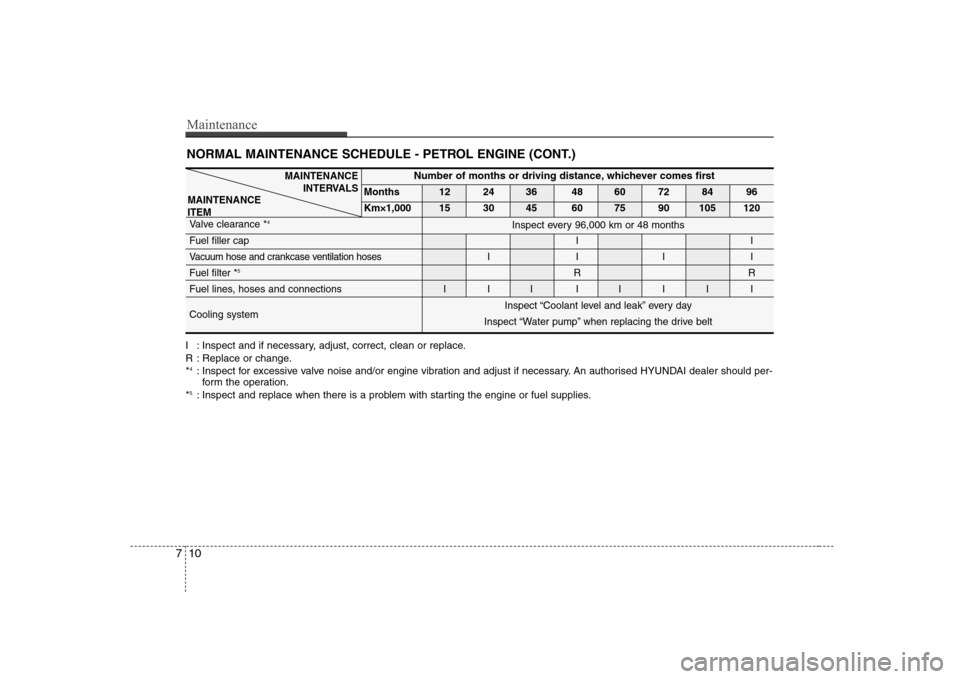
NORMAL MAINTENANCE SCHEDULE - PETROL ENGINE (CONT.)
MAINTENANCE
INTERVALSNumber of months or driving distance, whichever comes first
Months 12 24 36 48 60 72 84 96
Km×1,000 15 30 45 60 75 90 105 120
Valve clearance * 4
Fuel filler cap
II
Vacuum hose and crankcase ventilation hosesIIII
Fuel filter *
5RR
Fuel lines, hoses and connections I I I I I I I I Cooling system
Inspect “Coolant level and leak” every day Inspect every 96,000 km or 48 months
Inspect “Water pump” when replacing the drive belt
I : Inspect and if necessary, adjust, correct, clean or replace.
R : Replace or change.* 4
: Inspect for excessive valve noise and/or engine vibration and adjust if necessary. An authorised HYUNDAI dealer should per-
form the operation.
* 5
: Inspect and replace when there is a problem with starting the engine or fuel supplies.
MAINTENANCE ITEM