seat belt replace Hyundai Sonata 2017 Owner's Manual
[x] Cancel search | Manufacturer: HYUNDAI, Model Year: 2017, Model line: Sonata, Model: Hyundai Sonata 2017Pages: 563, PDF Size: 17.7 MB
Page 19 of 563
2-2
You will find many safety precautions
and recommendations throughout
this section, and throughout this man-
ual. The safety precautions in this sec-
tion are among the most important.
Always Wear Your Seat Belt
A seat belt is your best protection in
all types of accidents. Air bags are
designed to supplement seat belts,
not replace them. So even though
your vehicle is equipped with air bags,
ALWAYS make sure you and your
passengers wear your seat belts, and
wear them properly.
Restrain All Children
All children under age 13 should ride
in your vehicle properly restrained in
a rear seat, not the front seat. Infants
and small children should be
restrained in an appropriate child
restraint. Larger children should use
a booster seat with the lap/shoulder
belt until they can use the seat belt
properly without a booster seat.
Air Bag Hazards
While air bags can save lives, they
can also cause serious or fatal
injuries to occupants who sit too
close to them, or who are not prop-
erly restrained. Infants, young chil-
dren, and shorter adults are at the
greatest risk of being injured by an
inflating air bag. Follow all instruc-
tions and warnings in this manual.
Driver Distraction
Driver distraction presents a serious
and potentially deadly danger, espe-
cially for inexperienced drivers. Safety
should be the first concern when
behind the wheel and drivers need to
be aware of the wide array of potential
distractions, such as drowsiness,
reaching for objects, eating, personal
grooming, other passengers, and
using cellular phones.
Drivers can become distracted when
they take their eyes and attention off
the road or their hands off the wheel
to focus on activities other than driv-
ing. To reduce your risk of distraction
or getting into an accident:
I IM
M P
PO
O R
RT
TA
A N
N T
T
S
S A
A F
FE
E T
T Y
Y
P
P R
R E
EC
CA
A U
U T
TI
IO
O N
NS
S
Safety system of your vehicle
Page 40 of 563
2-23
Safety system of your vehicle
2
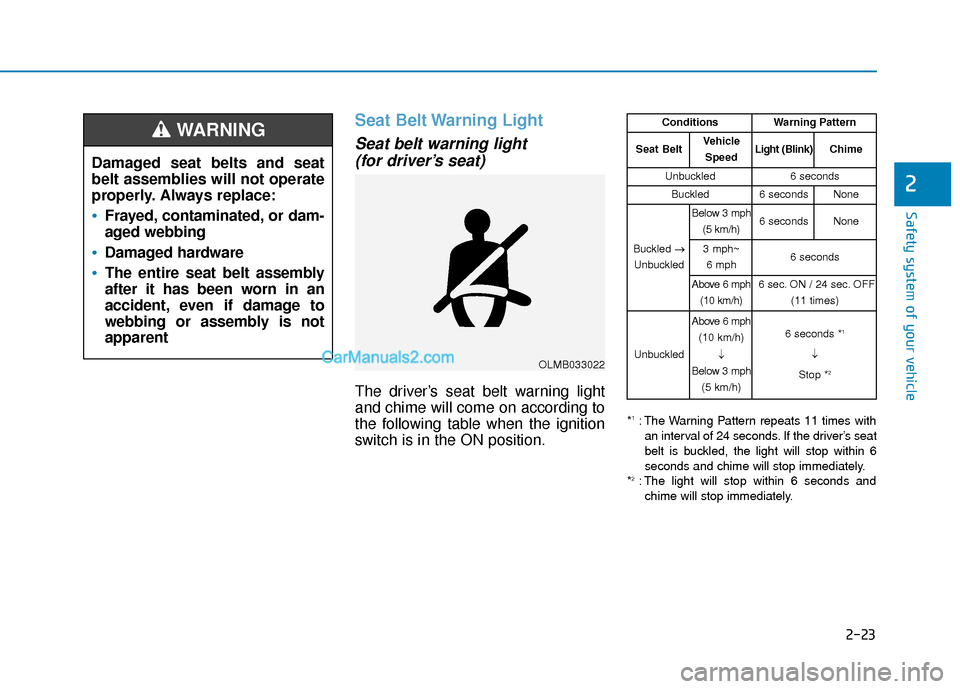
Seat Belt Warning Light
Seat belt warning light (for driver’s seat)
The driver’s seat belt warning light
and chime will come on according to
the following table when the ignition
switch is in the ON position.
*1: The Warning Pattern repeats 11 times with
an interval of 24 seconds. If the driver’s seat
belt is buckled, the light will stop within 6
seconds and chime will stop immediately.
*
2: The light will stop within 6 seconds and chime will stop immediately.
Damaged seat belts and seat
belt assemblies will not operate
properly. Always replace:
Frayed, contaminated, or dam-
aged webbing
Damaged hardware
The entire seat belt assembly
after it has been worn in an
accident, even if damage to
webbing or assembly is not
apparent
WARNING
OLMB033022
ConditionsWarning Pattern
Seat BeltVehicle
SpeedLight (Blink)Chime
Unbuckled6 seconds
Buckled6 secondsNone
Buckled →
Unbuckled
Below 3 mph (5 km/h)6 secondsNone
3 mph~6 mph6 seconds
Above 6 mph (10 km/h)6 sec. ON / 24 sec. OFF (11 times)
Unbuckled
Above 6 mph(10 km/h)
↓
Below 3 mph
(5 km/h)6 seconds *1
↓
Stop *
2
Page 45 of 563
2-28
Safety system of your vehicle
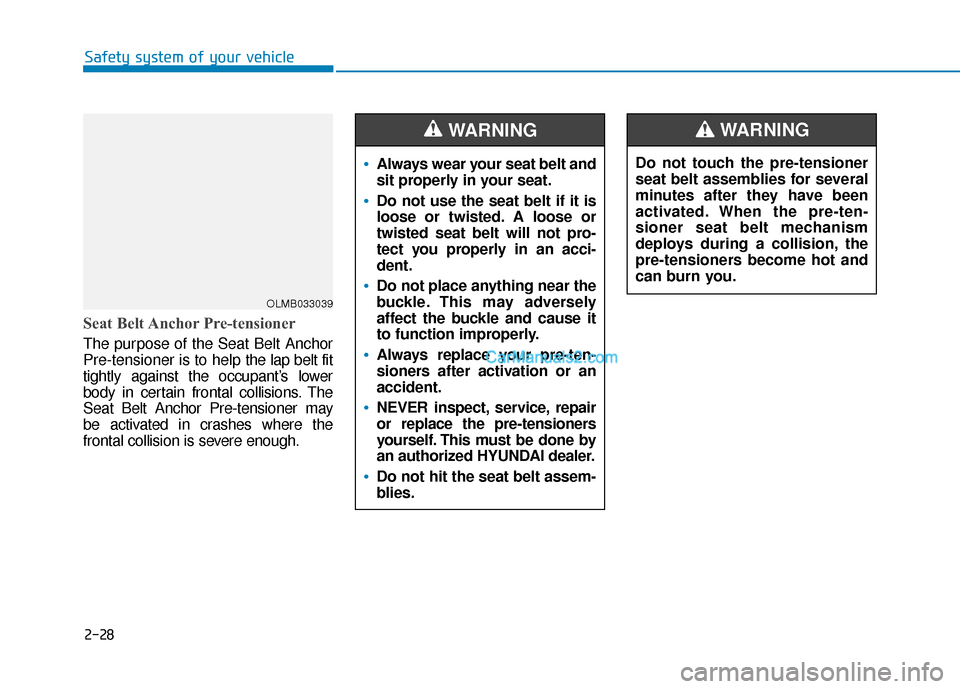
Seat Belt Anchor Pre-tensioner
The purpose of the Seat Belt Anchor
Pre-tensioner is to help the lap belt fit
tightly against the occupant’s lower
body in certain frontal collisions. The
Seat Belt Anchor Pre-tensioner may
be activated in crashes where the
frontal collision is severe enough. Do not touch the pre-tensioner
seat belt assemblies for several
minutes after they have been
activated. When the pre-ten-
sioner seat belt mechanism
deploys during a collision, the
pre-tensioners become hot and
can burn you.
WARNING
Always wear your seat belt and
sit properly in your seat.
Do not use the seat belt if it is
loose or twisted. A loose or
twisted seat belt will not pro-
tect you properly in an acci-
dent.
Do not place anything near the
buckle. This may adversely
affect the buckle and cause it
to function improperly.
Always replace your pre-ten-
sioners after activation or an
accident.
NEVER inspect, service, repair
or replace the pre-tensioners
yourself. This must be done by
an authorized HYUNDAI dealer.
Do not hit the seat belt assem-
blies.
WARNING
OLMB033039
Page 50 of 563
2-33
Safety system of your vehicle
2
Care of Seat Belts
Seat belt systems should never be
disassembled or modified. In addi-
tion, care should be taken to assure
that seat belts and belt hardware are
not damaged by seat hinges, doors
or other abuse.
Periodic inspection
All seat belts should be inspected
periodically for wear or damage of
any kind. Any damaged parts should
be replaced as soon as possible by
an authorized HYUNDAI dealer.
Keep belts clean and dry
Seat belts should be kept clean and
dry. If belts become dirty, they can be
cleaned by using a mild soap solu-
tion and warm water. Bleach, dye,
strong detergents or abrasives
should not be used because they
may damage and weaken the fabric.
When to replace seat belts
The entire seat belt assembly or
assemblies should be replaced if the
vehicle has been involved in an acci-
dent. This should be done even if no
damage is visible. Additional ques-
tions concerning seat belt operation
should be directed to an authorized
HYUNDAI dealer.
Page 63 of 563
2-46
Safety system of your vehicle
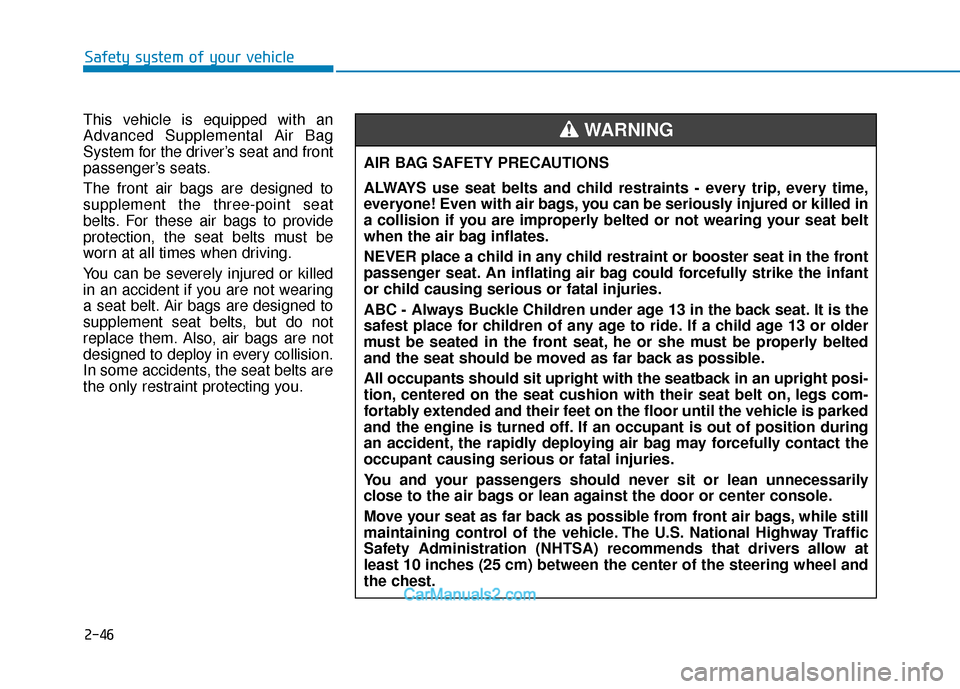
This vehicle is equipped with an
Advanced Supplemental Air Bag
System for the driver’s seat and front
passenger’s seats.
The front air bags are designed to
supplement the three-point seat
belts. For these air bags to provide
protection, the seat belts must be
worn at all times when driving.
You can be severely injured or killed
in an accident if you are not wearing
a seat belt. Air bags are designed to
supplement seat belts, but do not
replace them. Also, air bags are not
designed to deploy in every collision.
In some accidents, the seat belts are
the only restraint protecting you. AIR BAG SAFETY PRECAUTIONS
ALWAYS use seat belts and child restraints - every trip, every time,
everyone! Even with air bags, you can be seriously injured or killed in
a collision if you are improperly belted or not wearing your seat belt
when the air bag inflates.
NEVER place a child in any child restraint or booster seat in the front
passenger seat. An inflating air bag could forcefully strike the infant
or child causing serious or fatal injuries.
ABC - Always Buckle Children under age 13 in the back seat. It is the
safest place for children of any age to ride. If a child age 13 or older
must be seated in the front seat, he or she must be properly belted
and the seat should be moved as far back as possible.
All occupants should sit upright with the seatback in an upright posi-
tion, centered on the seat cushion with their seat belt on, legs com-
fortably extended and their feet on the floor until the vehicle is parked
and the engine is turned off. If an occupant is out of position during
an accident, the rapidly deploying air bag may forcefully contact the
occupant causing serious or fatal injuries.
You and your passengers should never sit or lean unnecessarily
close to the air bags or lean against the door or center console.
Move your seat as far back as possible from front air bags, while still
maintaining control of the vehicle. The U.S. National Highway Traffic
Safety Administration (NHTSA) recommends that drivers allow at
least 10 inches (25 cm) between the center of the steering wheel and
the chest.
WARNING
Page 72 of 563
2-55
Safety system of your vehicle
2
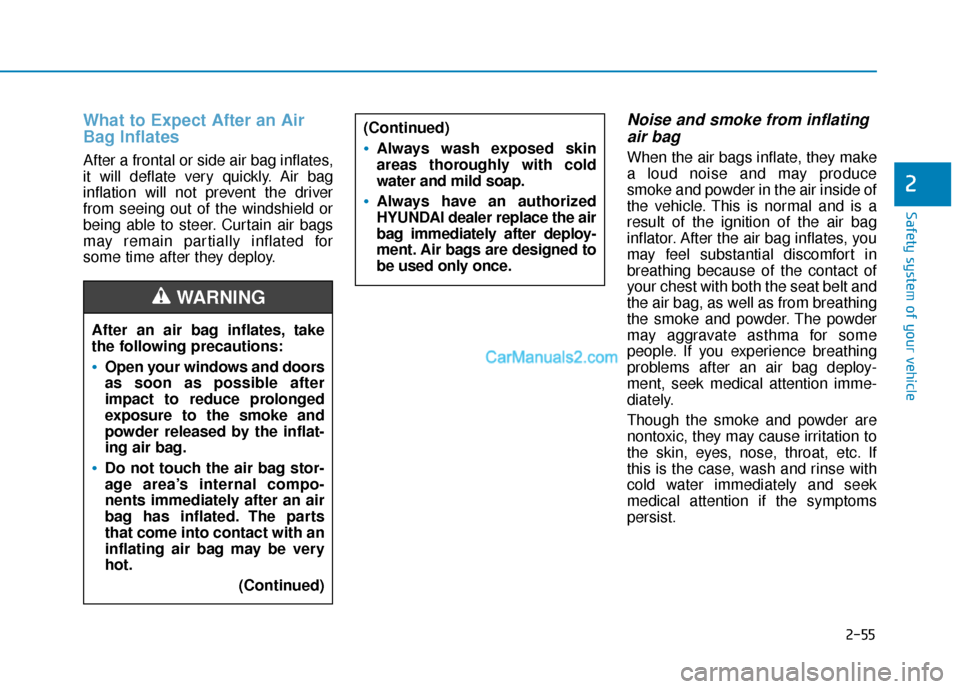
After an air bag inflates, take
the following precautions:
Open your windows and doors
as soon as possible after
impact to reduce prolonged
exposure to the smoke and
powder released by the inflat-
ing air bag.
Do not touch the air bag stor-
age area’s internal compo-
nents immediately after an air
bag has inflated. The parts
that come into contact with an
inflating air bag may be very
hot.(Continued)
WARNING
What to Expect After an Air
Bag Inflates
After a frontal or side air bag inflates,
it will deflate very quickly. Air bag
inflation will not prevent the driver
from seeing out of the windshield or
being able to steer. Curtain air bags
may remain partially inflated for
some time after they deploy.
Noise and smoke from inflatingair bag
When the air bags inflate, they make
a loud noise and may produce
smoke and powder in the air inside of
the vehicle. This is normal and is a
result of the ignition of the air bag
inflator. After the air bag inflates, you
may feel substantial discomfort in
breathing because of the contact of
your chest with both the seat belt and
the air bag, as well as from breathing
the smoke and powder. The powder
may aggravate asthma for some
people. If you experience breathing
problems after an air bag deploy-
ment, seek medical attention imme-
diately.
Though the smoke and powder are
nontoxic, they may cause irritation to
the skin, eyes, nose, throat, etc. If
this is the case, wash and rinse with
cold water immediately and seek
medical attention if the symptoms
persist.
(Continued)Always wash exposed skin
areas thoroughly with cold
water and mild soap.
Always have an authorized
HYUNDAI dealer replace the air
bag immediately after deploy-
ment. Air bags are designed to
be used only once.
Page 554 of 563

I-3
Battery ........................................................................\
.....7-38
Battery saver function ...................................................3-115
Before driving ...................................................................5-4
Blind spot detection system (BSD) ................................5-73
Blind spot mirror.............................................................3-41
Brake fluid ......................................................................7-\
30
Brake system ...................................................................5-28Anti-lock brake system (ABS) ...................................5-40
Auto hold ....................................................................5-37\
Disc brakes wear indicator ........................................5-29
Electronic parking brake (EPB) .................................5-31
Electronic stability control (ESC) ..............................5-43
Hill-start assist control (HAC) ...................................5-46
Parking brake (Manual)..............................................5-29
Power brakes ..............................................................5-28
Bulb replacement ............................................................7-70
Bulb wattage .....................................................................8-3\
Button start/stop, see engine start/stop button ..................5-9 California perchlorate notice ..........................................7-94
Capacities (Lubricants) .....................................................8-6
Care
Exterior care ...............................................................7-82
Interior care ................................................................7-87
Tire care ......................................................................7-\
41
Center console storage ..................................................3-155
Central door lock switch .................................................3-16
Certification label .............................................................8-9
Chains Tire chains ..................................................................5-96
Checking tire inflation pressure ......................................7-43
Child restraint system (CRS) ..........................................2-34 Booster seats...............................................................2-37
Children always in the rear ........................................2-34
Forward-facing child seats ........................................2-37
Installing a Child Restraint System (CRS) ................2-37
Lower anchors and tether for children (LATCH) system .......................................................................2\
-38
Rear-facing child seats ..............................................2-36
Securing with lap/shoulder belt..................................2-42
Securing with LATCH anchors ..................................2-40
Securing with Tether anchors .....................................2-41
Selecting a Child Restraint System (CRS).................2-35
Child-protector rear door lock ........................................3-18
I
Index
BC
Page 557 of 563

I-6
Gauges........................................................................\
.....3-70
Glove box......................................................................3-\
155
Glove box lamp.............................................................3-121
Guide to Hyundai Genuine Parts ......................................F-5
Hazard warning flasher .....................................................6-2
Hazardous driving conditions .........................................5-93
Head restraints ................................................................2-15
Headlamp bulb replacement ...........................................7-70
Headlamp delay function ..............................................3-115
Headlamp position ........................................................3-110
Heated steering wheel .....................................................3-23
HeaterAutomatic climate control system............................3-139
Manual climate control system ................................3-129
High - beam operation ..................................................3-111
Hill-start assist control (HAC)........................................5-46
Hood........................................................................\
........3-56
Horn ........................................................................\
........3-24
How to use this manual ....................................................F-6 If the engine overheats ......................................................6-7
If the engine stalls at a crossroad or crossing...................6-2
If the engine stalls while driving ......................................6-2
If the engine will not start.................................................6-3
If you have a flat tire ......................................................6-15
If you have a flat tire while driving ..................................6-3
Ignition switch ..................................................................5-6
Engine start/stop button................................................5-9
Key ignition swtich ......................................................5-6
Immobilzer system..........................................................3-12
Improtant safety precautions.............................................2-2 Air bag hazards ............................................................2-2
Always wear your seat belt ..........................................2-2
Control your speed .......................................................2-3
Driver distraction..........................................................2-2
Keep your vehicle in safe condition.............................2-3
Restrain all children .....................................................2-2
In case of emergency while driving..................................6-2
Indicator lights (Instrument cluster) .............................3-104
Information mode ...........................................................3-78
Inside rearview mirror ....................................................3-25
Index
H
IG