check HYUNDAI SONATA 2021 Owners Manual
[x] Cancel search | Manufacturer: HYUNDAI, Model Year: 2021, Model line: SONATA, Model: HYUNDAI SONATA 2021Pages: 546, PDF Size: 51.21 MB
Page 10 of 546
01
1-5
Your new vehicle is designed to obtain
maximum performance with UNLEADED
FUEL, as well as minimize exhaust
emissions and spark plug fouling.
Your new vehicle is designed to use only
unleaded fuel having an octane number
((R+M)/2) of 87 (Research Octane
Number 91) or higher. (Do not use
methanol blended fuels)
NOTICE
To prevent damage to the engine and
engine components, never add any fuel
system cleaning agents to the fuel tank
other than what has been specified.
Consult an authorized HYUNDAI dealer
for additional information.
WARNING
• Do not “top off” after the nozzle
automatically shuts off when
refueling.
• Always check that the fuel cap is
installed securely to prevent fuel
spillage in the event of an accident.
fuel requIreMents
Throughout this manual DANGER,
WARNING, CAUTION, NOTICE and the
SAFETY ALERT SYMBOL will be used.
This is the safety alert symbol. It
is used to alert you to potential
physical injury hazards. Obey
all safety messages that follow
this symbol to avoid possible
injury or death. The safety alert
symbol precedes the signal
words DANGER, WARNING and
CAUTION.
DANGER
DANGER indicates a hazardous
situation which, if not avoided, will
result in death or serious injury.
WARNING
WARNING indicates a hazardous
situation which, if not avoided, could
result in death or serious injury.
CAUTION
CAUTION indicates a hazardous
situation which, if not avoided, could
result in minor or moderate injury.
NOTICE
NOTICE indicates a situation which,
if not avoided, could result in vehicle
damage.
Page 22 of 546
02
2-9
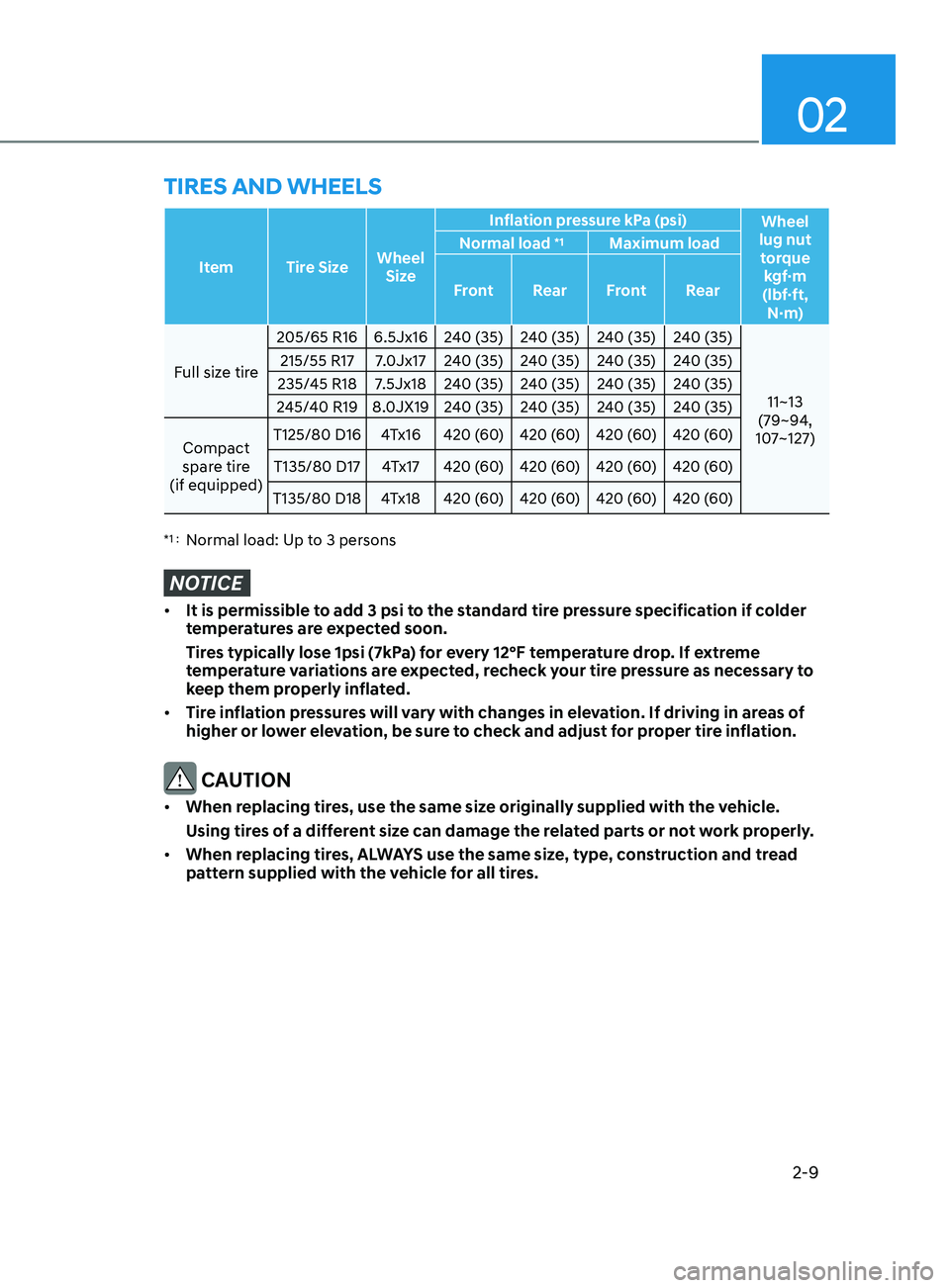
tirEs anD whEEls
Item Tire SizeWheel
Size Inflation pressure kPa (psi)
Wheel
lug nut torque kgf·m
(lbf·ft, N·m)
Normal load
*1Maximum load
Front RearFront Rear
Full size tire 205/65 R16 6.5Jx16 240 (35) 240 (35) 240 (35) 240 (35)
11~13
(79~94,
107~127)
215/55 R17 7.0Jx17 240 (35) 240 (35) 240 (35) 240 (35)
235/45 R18 7.5Jx18 240 (35) 240 (35) 240 (35) 240 (35)
245/40 R19 8.0JX19 240 (35) 240 (35) 240 (35) 240 (35)
Compact
spare tire
(if equipped) T125/80 D16 4Tx16 420 (60) 420 (60) 420 (60) 420 (60)
T135/80 D17 4Tx17 420 (60) 420 (60) 420 (60) 420 (60)
T135/80 D18 4Tx18 420 (60) 420 (60) 420 (60) 420 (60)
*1 : Normal load: Up to 3 persons
NOTICE
• It is permissible to add 3 psi to the standard tire pressure specification if colder
temperatures are expected soon.
Tires typically lose 1psi (7kPa) for every 12°F temperature drop. If extreme
temperature variations are expected, recheck your tire pressure as necessary to
keep them properly inflated.
• Tire inflation pressures will vary with changes in elevation. If driving in areas of
higher or lower elevation, be sure to check and adjust for proper tire inflation.
CAUTION
• When replacing tires, use the same size originally supplied with the vehicle.
Using tires of a different size can damage the related parts or not work properly.
• When replacing tires, ALWAYS use the same size, type, construction and tread
pattern supplied with the vehicle for all tires.
Page 25 of 546
Vehicle Information
2-12
Recommended SAE Viscosity
Number
CAUTION
Always be sure to clean the area around
any filler plug, drain plug, or dipstick
before checking or draining any
lubricant. This is especially important
in dusty or sandy areas and when the
vehicle is used on unpaved roads.
Cleaning the plug and dipstick areas
will prevent dirt and grit from entering
the engine and other mechanisms that
could be damaged.Engine oil viscosity (thickness) has an
effect on fuel economy and cold weather
operating (engine start and engine oil
flowability). Lower viscosity engine oils
can provide better fuel economy and
cold weather performance, however,
higher viscosity engine oils are required
for satisfactory lubrication in hot
weather.
Using oils of any viscosity other than
those recommended could result in
engine damage.
When choosing an oil, consider the
range of temperature your vehicle will be
operated in before the next oil change.
Proceed to select the recommended oil
viscosity from the chart.
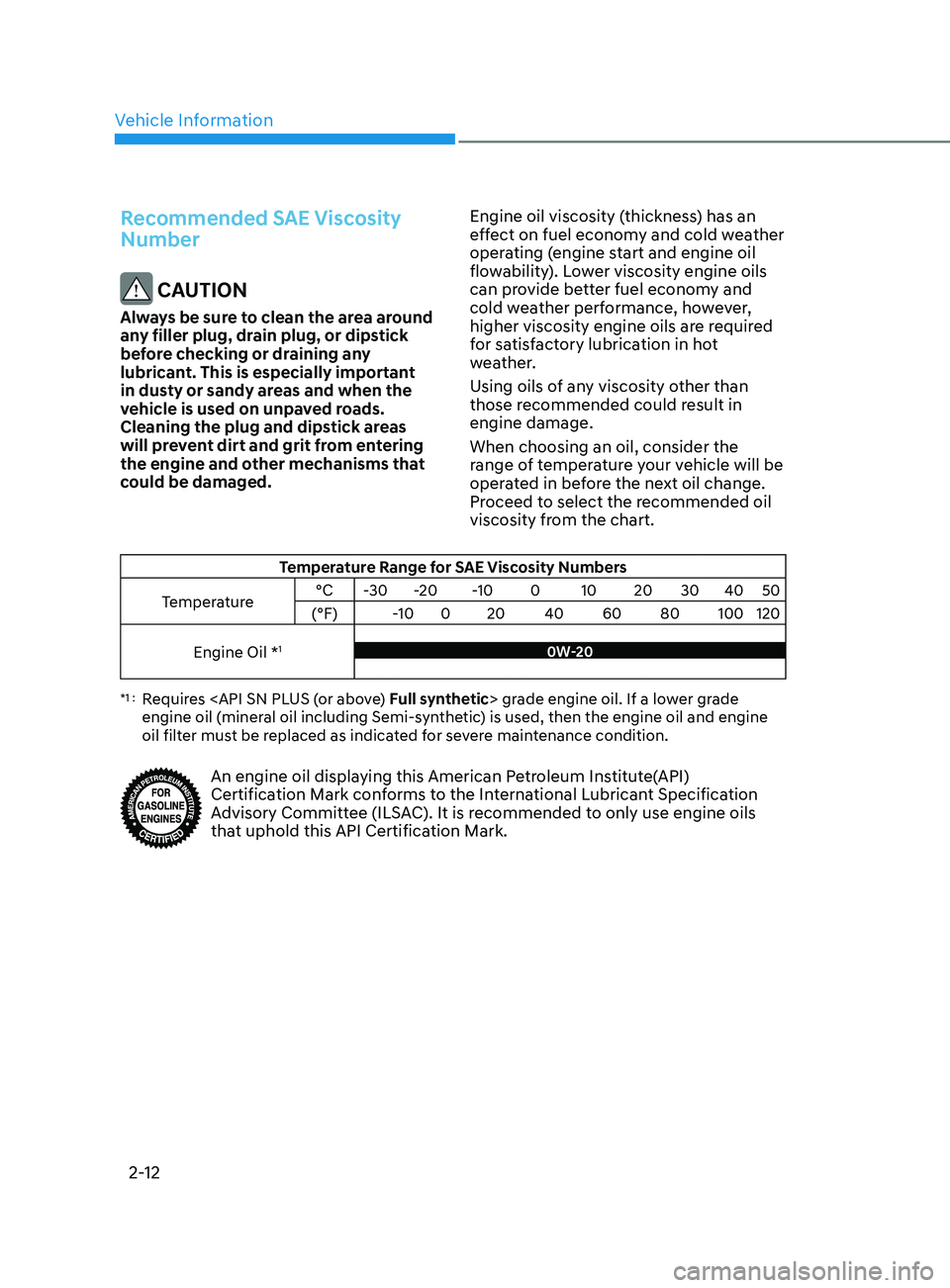
Temperature Range for SAE Viscosity Numbers
Temperature °C
-30 -20 -10 0 10 20 30 40 50
(°F) -100 20 40 60 80 100 120
Engine Oil *
10W-20
*1 : Requires
engine oil (mineral oil including Semi-synthetic) is used, then the engine oil and engine
oil filter must be replaced as indicated for severe maintenance condition.
An engine oil displaying this American Petroleum Institute(API)
Certification Mark conforms to the International Lubricant Specification
Advisory Committee (ILSAC). It is recommended to only use engine oils
that uphold this API Certification Mark.
Page 30 of 546
3-2
You will find many safety precautions
and recommendations throughout this
section, and throughout this manual.
The safety precautions in this section are
among the most important.
Always Wear Your Seat Belt
A seat belt is your best protection in all
types of accidents. Air bags are designed
to supplement seat belts, not replace
them. So even though your vehicle is
equipped with air bags, ALWAYS make
sure you and your passengers wear your
seat belts, and wear them properly.
Restrain All Children
All children under age 13 should ride
in your vehicle properly restrained in a
rear seat, not the front seat. Infants and
small children should be restrained in
an appropriate child restraint. Larger
children should use a booster seat with
the lap/shoulder belt until they can use
the seat belt properly without a booster
seat.
Air Bag Hazards
While air bags can save lives, they can
also cause serious or fatal injuries to
occupants who sit too close to them, or
who are not properly restrained. Infants,
young children, and shorter adults are at
the greatest risk of being injured by an
inflating air bag. Follow all instructions
and warnings in this manual.
Driver Distraction
Driver distraction presents a serious and
potentially deadly danger, especially for
inexperienced drivers. Safety should be
the first concern when behind the wheel,
and drivers need to be aware of the wide
array of potential distractions, such as
drowsiness, reaching for objects, eating,
personal grooming, other passengers,
and using cellular phones.Drivers can become distracted when
they take their eyes and attention off
the road or their hands off the wheel to
focus on activities other than driving. To
reduce your risk of distraction or getting
into an accident:
•
ALWAYS set up your mobile devices
(i.e., MP3 players, phones, navigation
units, etc.) when your vehicle is
parked or safely stopped.
• ONLY use your mobile device when
allowed by laws and when conditions
permit safe use. NEVER text or email
while driving. Most states have laws
prohibiting drivers from texting. Some
states and cities also prohibit drivers
from using handheld phones.
• NEVER let the use of a mobile device
distract you from driving. You have a
responsibility to your passengers and
others on the road to always drive
safely, with your hands on the wheel
as well as your eyes and attention on
the road.
Control Your Speed
Excessive speed is a major factor in crash
injuries and deaths. Generally, the higher
the speed, the greater the risk, but
serious injuries can also occur at lower
speeds. Never drive faster than is safe
for current conditions, regardless of the
maximum speed posted.
Keep Your Vehicle in Safe
Condition
Having a tire blowout or a mechanical
failure can be extremely hazardous. To
reduce the possibility of such problems,
check your tire pressures and condition
frequently, and perform all regularly
scheduled maintenance.
Important Safety precautIonS
Seats & Safety System
Page 50 of 546
3-22
NOTICE
If you are not able to smoothly pull
enough of the seat belt out from the
retractor, firmly pull the seat belt out
and release it. After release, you will be
able to pull the belt out smoothly.
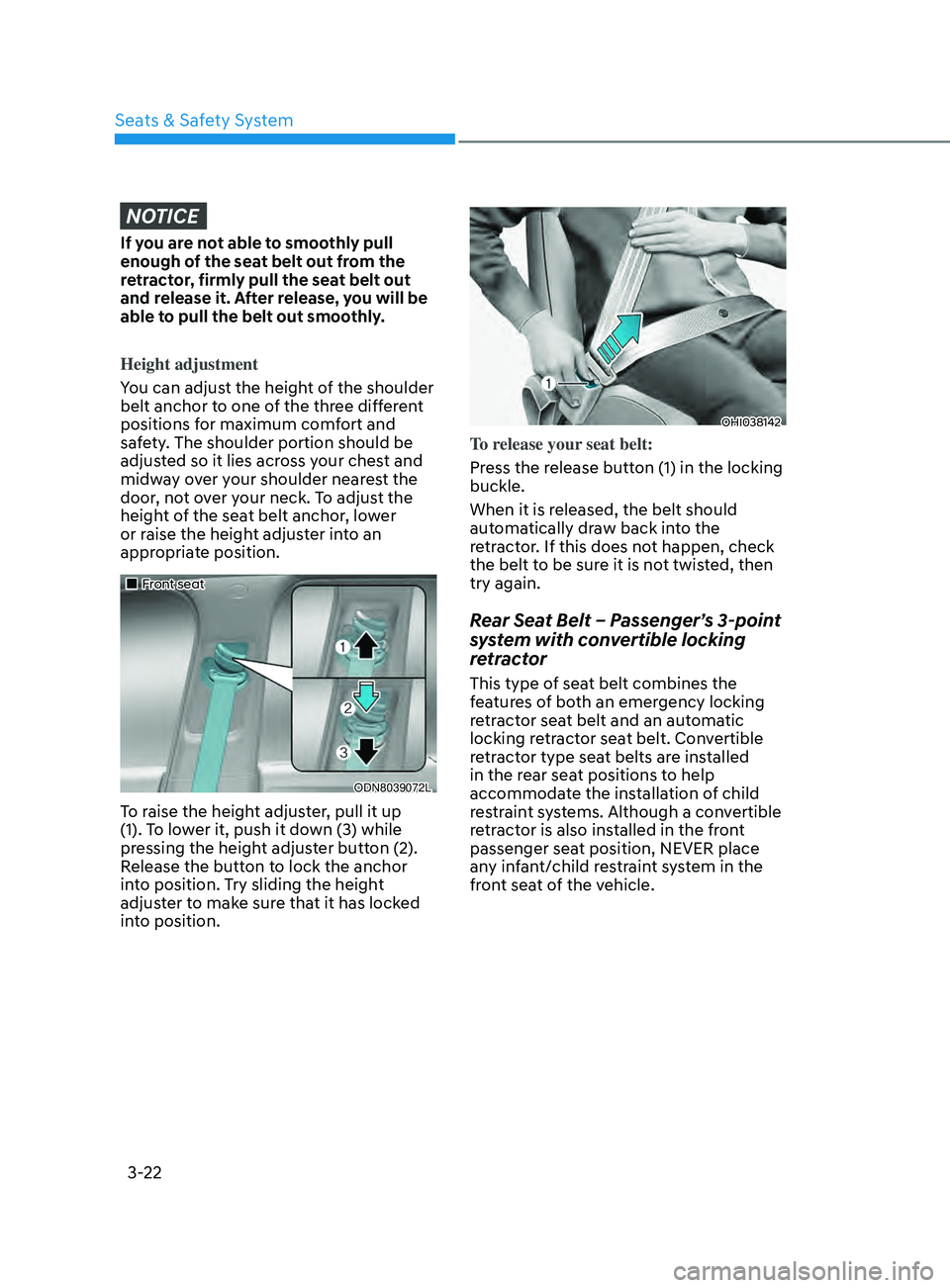
Height adjustment
You can adjust the height of the shoulder
belt anchor to one of the three different
positions for maximum comfort and
safety. The shoulder portion should be
adjusted so it lies across your chest and
midway over your shoulder nearest the
door, not over your neck. To adjust the
height of the seat belt anchor, lower
or raise the height adjuster into an
appropriate position.
„„Front seat
ODN8039072L
To raise the height adjuster, pull it up
(1). To lower it, push it down (3) while
pressing the height adjuster button (2).
Release the button to lock the anchor
into position. Try sliding the height
adjuster to make sure that it has locked
into position.
OHI038142
To release your seat belt:
Press the release button (1) in the locking
buckle.
When it is released, the belt should
automatically draw back into the
retractor. If this does not happen, check
the belt to be sure it is not twisted, then
try again.
Rear Seat Belt – Passenger’s 3-point
system with convertible locking
retractor
This type of seat belt combines the
features of both an emergency locking
retractor seat belt and an automatic
locking retractor seat belt. Convertible
retractor type seat belts are installed
in the rear seat positions to help
accommodate the installation of child
restraint systems. Although a convertible
retractor is also installed in the front
passenger seat position, NEVER place
any infant/child restraint system in the
front seat of the vehicle.
Seats & Safety System
Page 54 of 546
3-26
Additional Seat Belt Safety
Precautions
Seat belt use during pregnancy
The seat belt should always be used
during pregnancy. The best way to
protect your unborn child is to protect
yourself by always wearing the seat belt.
Pregnant women should always wear
a lap-shoulder seat belt. Place the
shoulder belt across your chest, routed
between your breasts and away from
your neck. Place the lap belt line so
that it fits snugly and as low as possible
across the hips, not across the abdomen.
WARNING
• A pregnant woman or a patient is
more vulnerable to any imapcts on
the abdomen during an abrupt stop
or accident. If you are in an accident
while pregnant, we recommend you
consult your doctor.
• To reduce the risk of serious injury or
death to an unborn child during an
accident, pregnant women should
NEVER place the lap portion of the
seat belt above or over the area of
the abdomen where the unborn child
is located.
Seat belt use and children
Infant and small children
All 50 states have child restraint laws
which require children to travel in
approved child restraint devices,
including booster seats. The age at
which seat belts can be used instead
of child restraints differs among states,
so you should be aware of the specific
requirements in your state, and where
you are travelling. Infant and child
restraints must be properly placed
and installed in a rear seat. For more
information refer to the “Child Restraint
Systems” section in this chapter.
WARNING
ALWAYS properly restrain infants
and small children in a child restraint
appropriate for the child’s height and
weight.
To reduce the risk of serious injury or
death to a child and other passengers,
NEVER hold a child in your lap or arms
when the vehicle is moving. The violent
forces created during an accident will
tear the child from your arms and throw
the child against the interior of the
vehicle.
Small children are best protected
from injury in an accident when
properly restrained in the rear seat
by a child restraint system that meets
the requirements of the Federal Motor
Vehicle Safety Standards. Before buying
any child restraint system, make sure
that it has a label certifying that it meets
Federal Motor Vehicle Safety Standard
FMVSS 213. The restraint must be
appropriate for your child’s height and
weight. Check the label on the child
restraint for this information. Refer to the
“Child Restraint Systems” section in this
chapter.
Seats & Safety System
Page 55 of 546
03
3-27
Larger children
Children under age 13 and who are too
large for a booster seat must always
occupy the rear seat and use the
available lap/shoulder belts. A seat belt
should lie across the upper thighs and
be snug across the shoulder and chest
to restrain the child safely. Check belt fit
periodically. Children are afforded the
most safety in the event of an accident
when they are restrained by a proper
restraint system and/or seat belts in the
rear seat. Always have the LATCH system
inspected by your authorized HYUNDAI
dealer after an accident. An accident can
damage the LATCH system and may not
properly secure the child restraint.
If a larger child over age 13 must be
seated in the front seat, the child must
be securely restrained by the available
lap/shoulder belt and the seat should be
placed in the rearmost position.
If the shoulder belt portion slightly
touches the child’s neck or face, try
placing the child closer to the center
of the vehicle. If the shoulder belt still
touches their face or neck, they need to
be returned to an appropriate booster
seat in the rear seat.
WARNING
• Always make sure children are
wearing their seat belts and that they
are properly adjusted before driving.
• NEVER allow the shoulder belt to
contact the child’s neck or face.
• Do not allow more than one child to
use a single seat belt.
Transporting an injured person
A seat belt should be used when an
injured person is being transported.
Consult a physician for specific
recommendations.
One person per belt
Two people (including children) should
never attempt to use a single seat belt.
This could increase the severity of
injuries in case of an accident.
Do not lie down
Sitting in a reclined position when the
vehicle is in motion can be dangerous.
Even when buckled up, the protections
of your restraint system (seat belts and
air bags) is greatly reduced by reclining
your seatback.
To reduce the chance of injuries in the
event of an accident and to achieve the
maximum effectiveness of the restraint
system, all passengers should be sitting
up and the front and rear seats should
be in an upright position when the car is
moving.
A seat belt cannot provide proper
protection if the person is lying down in
the rear seat or if the front or rear seats
are in a reclined position.
WARNING
• NEVER ride with a reclined seatback
when the vehicle is moving.
• Riding with a reclined seatback
increases your chance of serious
or fatal injuries in the event of a
collision or sudden stop.
• Drivers and passengers should
always sit well back in their seats,
properly belted, and with the
seatbacks upright.
Page 57 of 546
03
3-29
Children Always in the Rear
WARNING
Always properly restrain children in the
rear seats of the vehicle.
Children of all ages are safer when
restrained in the rear seat. A child riding
in the front passenger seat can be
forcefully struck by an inflating air bag
resulting in SERIOUS INJURY or DEATH.
Children under age 13 must always
ride in the rear seats and must always
be properly restrained to minimize the
risk of injury in an accident, sudden
stop or sudden maneuver. According
to accident statistics, children are safer
when properly restrained in the rear
seats than in the front seat. Even with
air bags, children can be seriously
injured or killed. Children too large for
a child restraint must use the seat belts
provided.
All 50 states have child restraint laws
which require children to travel in
approved child restraint devices. The
laws governing the age or height/weight
restrictions at which seat belts can be
used instead of child restraints differs
among states, so you should be aware of
the specific requirements in your state,
and where you are travelling.
Child restraint systems must be properly
placed and installed in the rear seat.
You must use a commercially available
child restraint system that meets the
requirements of the Federal Motor
Vehicle Safety Standards (FMVSS 213).
Child restraint systems are generally
designed to be secured in a vehicle seat
by lap belt portion of a lap/shoulder belt,
or by a LATCH system in the rear seats of
the vehicle.
Child restraint system (CRS)
Infants and younger children must be
restrained in an appropriate rear-facing
or forward-facing CRS that has first
been properly secured to the rear seat
of the vehicle. Read and comply with
the instructions for installation and use
provided by the manufacturer of the
child restraint.
WARNING
An improperly secured child restraint
can increase the risk of SERIOUS
INJURY or DEATH in an accident. Always
take the following precautions when
using a child restraint system:
• NEVER install a child or infant
restraint in the front passenger’s
seat.
• Always properly secure the child
restraint to a rear seat of the vehicle.
• Always follow the child restraint
system manufacturer’s instructions
for installation and use.
• Always properly restrain your child in
the child restraint.
• If the vehicle head restraint prevents
proper installation of a child seat
(as described in the child restraint
system manual), the head restraint of
the respective seating position shall
be readjusted or entirely removed.
• Do not use an infant carrier or a
child safety seat that “hooks” over
a seatback, it may not provide
adequate protection in an accident.
• After an accident, have a HYUNDAI
dealer check the child restraint
system, seat belts, tether anchors
and lower anchors.
Child RestRaint sy stem (CRs )
Page 60 of 546
3-32
After selecting a proper child seat
for your child, check to make sure it
fits properly in your vehicle. Follow
the instructions provided by the
manufacturer when installing the child
seat. Note these general steps when
installing the seat to your vehicle:
• Properly secure the child restraint to
the vehicle. All child restraints must
be secured to the vehicle with the lap
part of a lap/shoulder belt or with the
LATCH system.
• Make sure the child restraint is
firmly secured. After installing a
child restraint to the vehicle, push
and pull the seat forward-and-back
and side-to-side to verify that it
is securely attached to the seat. A
child restraint secured with a seat
belt should be installed as firmly as
possible. However, some side-to-side
movement can be expected.
• Secure the child in the child
restraint. Make sure the child is
properly strapped in the child restraint
according to the manufacturer
instructions.
CAUTION
A child restraint in a closed vehicle can
become very hot. To prevent burns,
check the seating surface and buckles
before placing your child in the child
restraint.
Lower Anchors and Tether for
Children (LATCH System)
The LATCH system holds a child restraint
during driving and in an accident. This
system is designed to make installation
of the child restraint easier and reduce
the possibility of improperly installing
your child restraint. The LATCH system
uses anchors in the vehicle and
attachments on the child restraint. The
LATCH system eliminates the need to use
seat belts to secure the child restraint to
the rear seats.
Lower anchors are metal bars built into
the vehicle. There are two lower anchors
for each LATCH seating position that
will accommodate a child restraint with
lower attachments.
To use the LATCH system in your vehicle,
you must have a child restraint with
LATCH attachments.
The child seat manufacturer will provide
you with instructions on how to use the
child seat with its attachments for the
LATCH lower anchors.
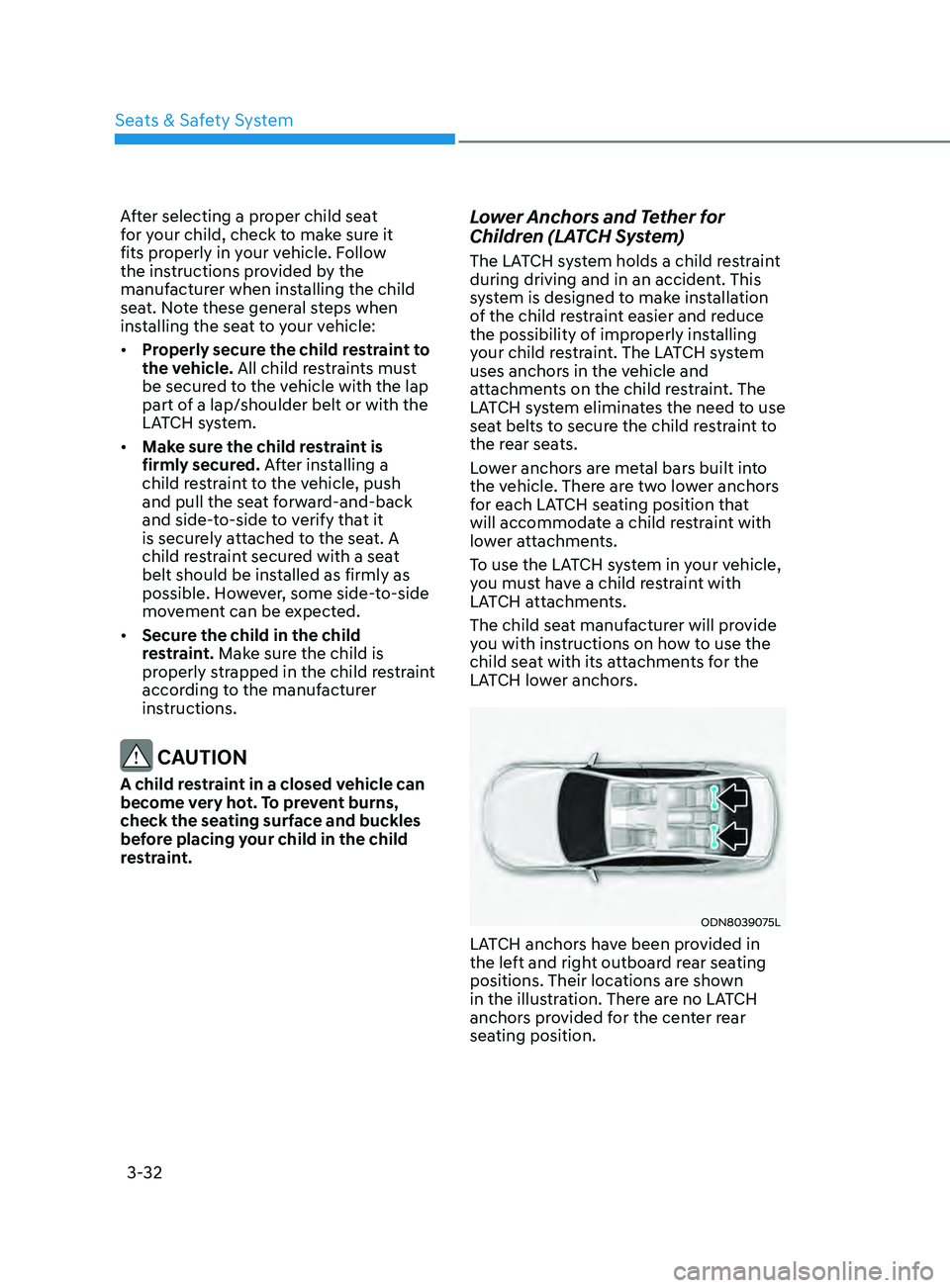
ODN8039075L
LATCH anchors have been provided in
the left and right outboard rear seating
positions. Their locations are shown
in the illustration. There are no LATCH
anchors provided for the center rear
seating position.
Seats & Safety System
Page 63 of 546
03
3-35
3. Check that the child restraint is
securely attached to the seat by
pushing and pulling the seat forward-
and-back and side-to-side.
Securing a child restraint with lap/
shoulder belt
When not using the LATCH system, all
child restraints must be secured to a
vehicle rear seat with the lap part of a
lap/shoulder belt.
WARNING
ALWAYS place a rear-facing child
restraint in the rear seat of the vehicle.
Placing a rear-facing child restraint in
the front seat can result in serious injury
or death if the child restraint is struck
by an inflating air bag.
OHI038145
Automatic locking mode
Since all passenger seat belts move
freely under normal conditions and
only lock under extreme or emergency
conditions (emergency locking mode),
you must manually pull the seat belt all
the way out to shift the retractor to the
“Automatic Locking” mode to secure a
child restraint.
The “Automatic Locking” mode will
help prevent the normal movement of
the child in the vehicle from causing
the seat belt to loosen and compromise
the child restraint system. To secure a
child restraint system, use the following
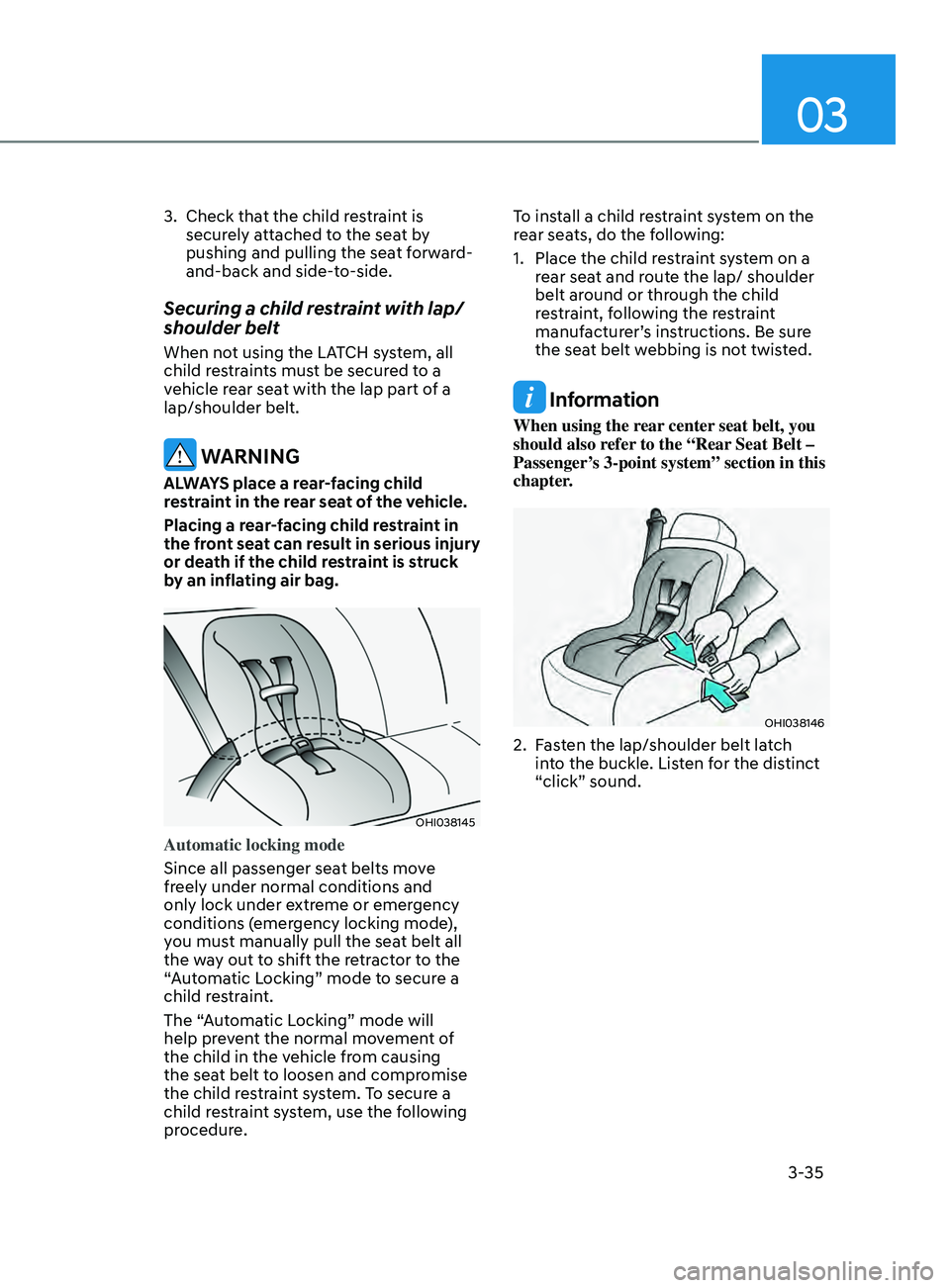
procedure. To install a child restraint system on the
rear seats, do the following:
1.
Place the child r
estraint system on a
rear seat and route the lap/ shoulder
belt around or through the child
restraint, following the restraint
manufacturer’s instructions. Be sure
the seat belt webbing is not twisted.
Information
When using the rear center seat belt, you
should also refer to the “Rear Seat Belt –
Passenger’s 3-point system” section in this
chapter.
OHI038146
2. Fasten the lap/shoulder belt latch into the buckle. Listen for the distinct
“click” sound.