fuel system Hyundai Terracan 2003 Service Manual
[x] Cancel search | Manufacturer: HYUNDAI, Model Year: 2003, Model line: Terracan, Model: Hyundai Terracan 2003Pages: 349, PDF Size: 4.56 MB
Page 324 of 349
OWNER MAINTENANCE
6-12
3. If the transmission fluid level is low, use a
funnel to add transmission fluid through the dipstick tube until the level reaches the "HOT"range. Do not overfill.
WARNING: The electric engine cooling fan automatical-
ly switches on and off according to engine temperature. Be careful to keep away fromthe fan during this check as it may switch onat any time.
WARNING (Diesel only): Never work on injection system with engine
running or within 30 seconds after shutting off engine. High pressure pump, rail, injec-tors and high pressure pipes are subject tohigh pressure even after the engine stopped.The fuel jet produced by fuel leaks maycause serious injury, if it touch the body.People using pacemakers should not move
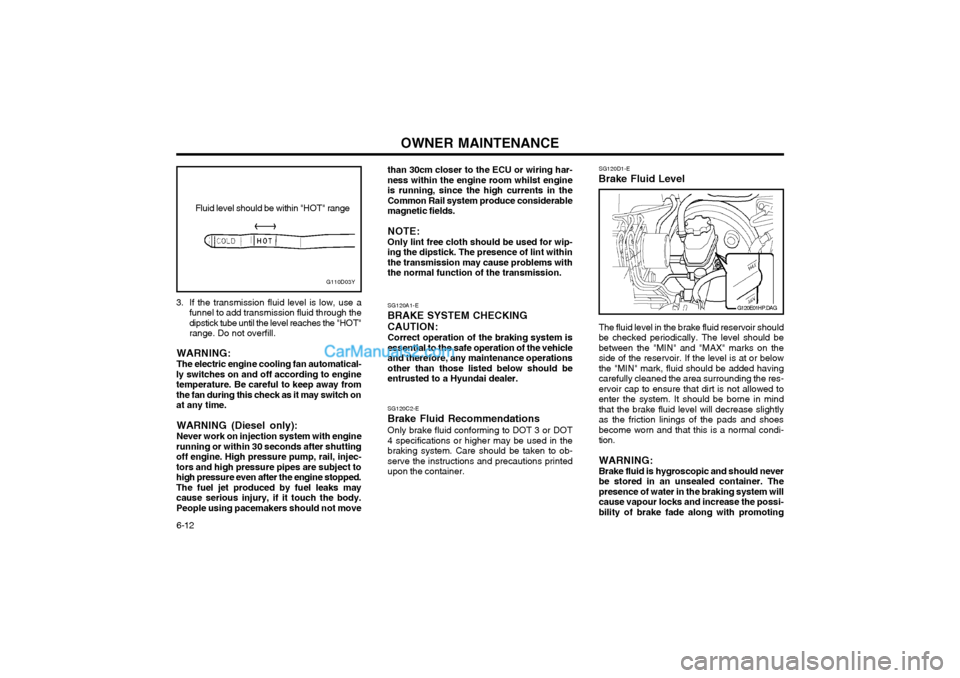
G110D03Y
Fluid level should be within "HOT" range
than 30cm closer to the ECU or wiring har- ness within the engine room whilst engineis running, since the high currents in theCommon Rail system produce considerablemagnetic fields.
NOTE: Only lint free cloth should be used for wip-
ing the dipstick. The presence of lint within the transmission may cause problems withthe normal function of the transmission.
G120E01HP.DAG
SG120A1-E
BRAKE SYSTEM CHECKING CAUTION: Correct operation of the braking system is essential to the safe operation of the vehicleand therefore, any maintenance operationsother than those listed below should beentrusted to a Hyundai dealer. SG120C2-E
Brake Fluid Recommendations Only brake fluid conforming to DOT 3 or DOT 4 specifications or higher may be used in thebraking system. Care should be taken to ob-serve the instructions and precautions printedupon the container. SG120D1-E
Brake Fluid Level
The fluid level in the brake fluid reservoir shouldbe checked periodically. The level should bebetween the "MIN" and "MAX" marks on theside of the reservoir. If the level is at or belowthe "MIN" mark, fluid should be added havingcarefully cleaned the area surrounding the res-ervoir cap to ensure that dirt is not allowed toenter the system. It should be borne in mindthat the brake fluid level will decrease slightlyas the friction linings of the pads and shoesbecome worn and that this is a normal condi-tion. WARNING: Brake fluid is hygroscopic and should never be stored in an unsealed container. Thepresence of water in the braking system willcause vapour locks and increase the possi-bility of brake fade along with promoting
Page 331 of 349
OWNER MAINTENANCE 6-19
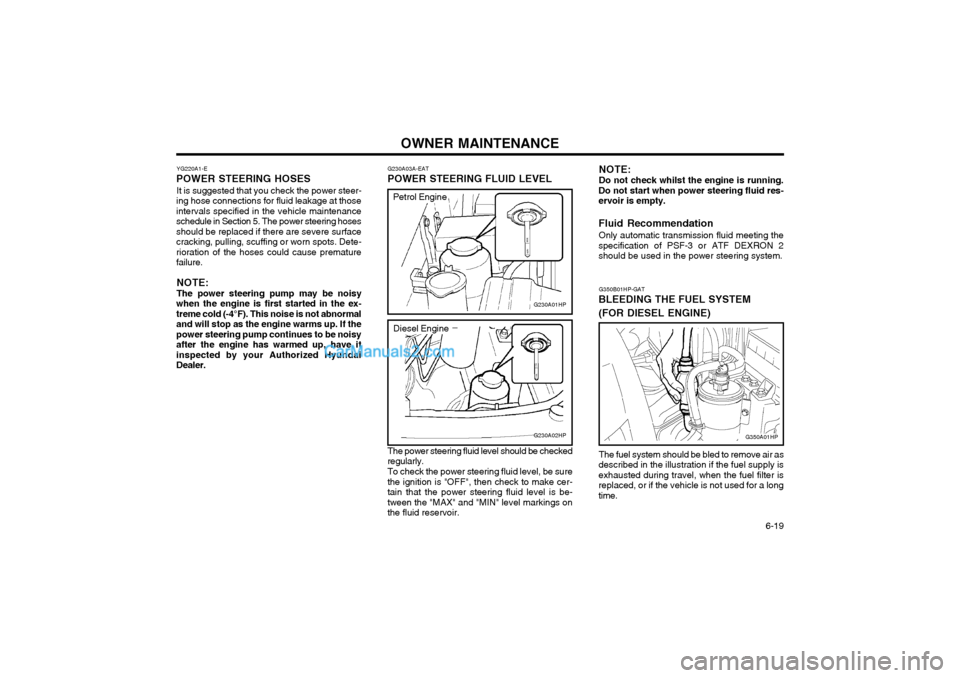
The power steering fluid level should be checked
regularly.
To check the power steering fluid level, be sure
the ignition is "OFF", then check to make cer- tain that the power steering fluid level is be-tween the "MAX" and "MIN" level markings onthe fluid reservoir.
YG220A1-E
POWER STEERING HOSES
It is suggested that you check the power steer-
ing hose connections for fluid leakage at thoseintervals specified in the vehicle maintenanceschedule in Section 5. The power steering hosesshould be replaced if there are severe surfacecracking, pulling, scuffing or worn spots. Dete-rioration of the hoses could cause prematurefailure.
NOTE: The power steering pump may be noisy
when the engine is first started in the ex- treme cold (-4°F). This noise is not abnormaland will stop as the engine warms up. If thepower steering pump continues to be noisyafter the engine has warmed up, have itinspected by your Authorized HyundaiDealer. G230A03A-EAT POWER STEERING FLUID LEVEL
G230A01HP
G230A02HP
Petrol Engine
Diesel Engine
G350B01HP-GAT
BLEEDING THE FUEL SYSTEM (FOR DIESEL ENGINE)
The fuel system should be bled to remove air as
described in the illustration if the fuel supply is exhausted during travel, when the fuel filter isreplaced, or if the vehicle is not used for a longtime.
G350A01HP
NOTE: Do not check whilst the engine is running.
Do not start when power steering fluid res- ervoir is empty. Fluid Recommendation
Only automatic transmission fluid meeting the
specification of PSF-3 or ATF DEXRON 2 should be used in the power steering system.
Page 336 of 349
EMISSION CONTROL SYSTEMS 7-1
vehicle may be damaged. You should inspect the exhaust system each time the car is raisedfor lubrication or oil change. To check condition
1. Holes and gas leaks due to corrosion, dam-
age, etc., should be rectified.
2. The joints should be checked for loose con- nections and gas leakage.
3. The hanger rubber and brackets should be checked for damage. DH010B1-E
1. CRANKCASE EMISSION CONTROL
SYSTEM ; For a Petrol Engine
The positive crankcase ventilation system is
employed to prevent air pollution caused by blow-by gases being emitted from the crank-case.
This system supplies fresh air to the crankcase
through the air cleaner. Inside the crankcase,the fresh air mixes with blow-by gases, thenpasses through the PCV valve into the intakesystem.
ZH010C1-E
2. EVAPORATIVE EMISSION CON-
TROL SYSTEM ; For a Petrol Engine
The Evaporative Emission Control System is designed to prevent fuel vapors from escapinginto the atmosphere.
Canister While the engine is inoperative, fuel vaporsgenerated inside the fuel tank are absorbed andstored in the canister. When the engine isrunning, the fuel vapors absorbed in the canis-ter are drawn into the induction system throughthe purge control solenoid valve.
YH000A1-A
7. EMISSION CON-
TROL SYSTEMS
YH020A1-E
EXHAUST GAS WARNING
Exhaust gases contain carbon monoxide, a
potentially toxic gas that is colorless and odor-less. Avoid breathing exhaust gases.
o Do not run the engine in confined areas, such as garages, any longer than neces- sary to move the car in or out.
o Do not drive with the trunk open. An open trunk may draw exhaust gases into the pas-senger compartment. If you must drive withthe trunk open, drive only with all the win-dows wide open and the blower motor onhigh speed.
o If it is necessary to sit in a parked car with the engine running for more than a shortperiod, adjust your heating system to forceoutside air into the car by placing the airselector button of the heater in the FRESHAIR position and mode control in the VENTposition. Set the fan at high speed and thecontrols in any position desired.
Inspect the exhaust system Whenever a change is noticed in the sound of
the exhaust system, the underside or rear of the ZH010A1-E EMISSION CONTROL SYSTEMS (Not all models) Your Hyundai is equipped with an emission control systems. There are three emission control systems which are as follows. (1) Crankcase emission control system (2) Evaporative emission control system(3) Exhaust emission control system In order to assure the proper function of the emission control system, it is recommendedthat you have your car inspected and main-tained by an authorized Hyundai dealer in ac-cordance with the schedule in this manual.
7
Page 337 of 349
EMISSION CONTROL SYSTEMS
7-2
Purge Control Solenoid Valve
The purge control solenoid valve is controlled
by the ECU; when the engine coolant tempera- ture is low, and during idling, it closes, so thatevaporated fuel is not taken into the surge tank.After engine warm-up, during ordinary driving, itopens to introduce evaporated fuel to the surgetank. misfire and result in excessive loading of thecatalytic converter.
o Avoid idling the engine for periods longer than 10 minutes.
o Your Hyundai should not be either pushed or pulled to get it started. This can cause thecatalytic converter to overload.
o Take care not to stop your Hyundai over any combustible material such as grass, paper,leaves or rags.
o Do not touch the catalytic converter or any other part of the exhaust system while theengine is running.
o Remember that your Hyundai dealer is your best source of assistance.
JH010D1-E
3. EXHAUST EMISSION CONTROL
SYSTEM
EGR system ; For a Petrol Engine This system helps control oxides of nitrogen byrecirculating a portion of the exhaust gases intothe intake manifold, thereby reducing cylindercombustion temperatures. YH040A2-E
CATALYTIC CONVERTER
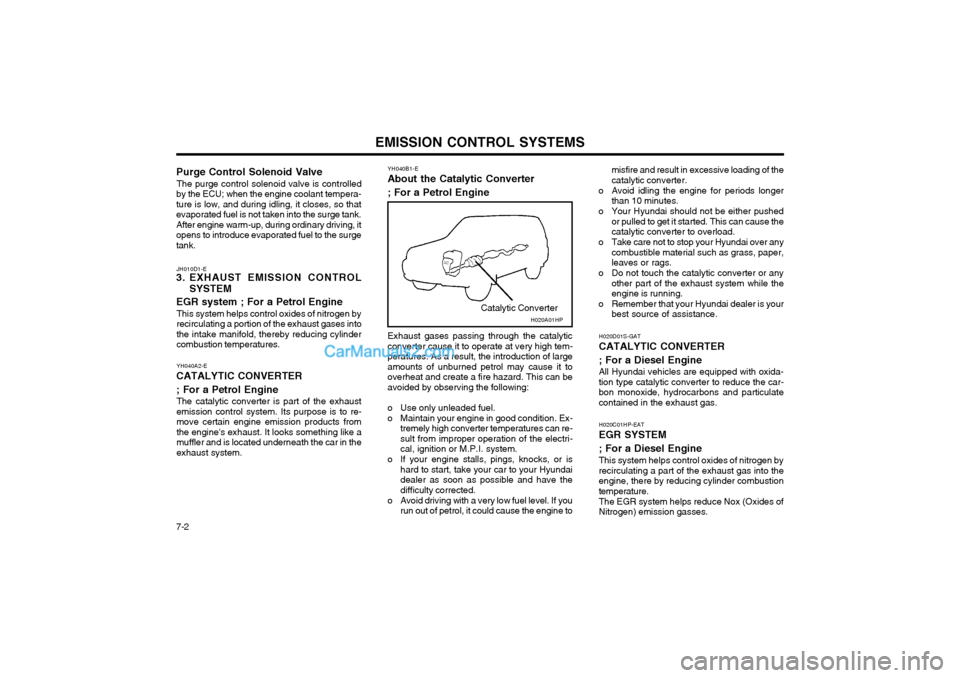
; For a Petrol Engine The catalytic converter is part of the exhaust emission control system. Its purpose is to re-move certain engine emission products fromthe engine's exhaust. It looks something like amuffler and is located underneath the car in theexhaust system. YH040B1-E
About the Catalytic Converter ; For a Petrol Engine
Exhaust gases passing through the catalytic converter cause it to operate at very high tem-peratures. As a result, the introduction of largeamounts of unburned petrol may cause it tooverheat and create a fire hazard. This can beavoided by observing the following:
o Use only unleaded fuel.
o Maintain your engine in good condition. Ex- tremely high converter temperatures can re- sult from improper operation of the electri-cal, ignition or M.P.I. system.
o If your engine stalls, pings, knocks, or is hard to start, take your car to your Hyundaidealer as soon as possible and have thedifficulty corrected.
o Avoid driving with a very low fuel level. If you run out of petrol, it could cause the engine to H020D01S-GAT CATALYTIC CONVERTER ; For a Diesel Engine All Hyundai vehicles are equipped with oxida- tion type catalytic converter to reduce the car-bon monoxide, hydrocarbons and particulatecontained in the exhaust gas. H020C01HP-EAT EGR SYSTEM ; For a Diesel Engine This system helps control oxides of nitrogen by recirculating a part of the exhaust gas into theengine, there by reducing cylinder combustiontemperature. The EGR system helps reduce Nox (Oxides of Nitrogen) emission gasses.
Catalytic ConverterH020A01HP
Page 341 of 349
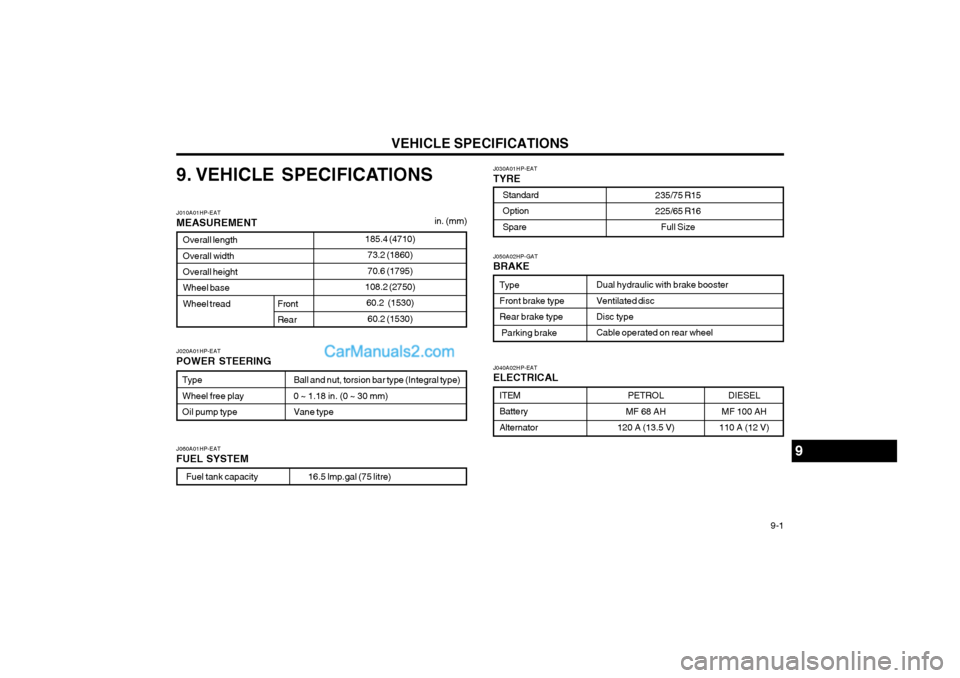
VEHICLE SPECIFICATIONS 9-1
J050A02HP-GAT BRAKE
Dual hydraulic with brake booster Ventilated discDisc type Cable operated on rear wheel
TypeFront brake type Rear brake type
Parking brake
J030A01HP-EAT TYRE
16.5 lmp.gal (75 litre)
9. VEHICLE SPECIFICATIONS
Overall length Overall widthOverall height Wheel base Wheel tread
Front Rear
Type Wheel free playOil pump typeBall and nut, torsion bar type (Integral type) 0 ~ 1.18 in. (0 ~ 30 mm)Vane type
J010A01HP-EAT MEASUREMENT J020A01HP-EAT POWER STEERING J060A01HP-EAT FUEL SYSTEM
185.4 (4710)
73.2 (1860) 70.6 (1795)
108.2 (2750)
60.2 (1530)60.2 (1530) Standard Option Spare
ITEM Battery Alternator
J040A02HP-EAT ELECTRICAL
PETROL
MF 68 AH
120 A (13.5 V) DIESEL
MF 100 AH
110 A (12 V)
Fuel tank capacity
9
in. (mm) 235/75 R15 225/65 R16
Full Size
Page 346 of 349
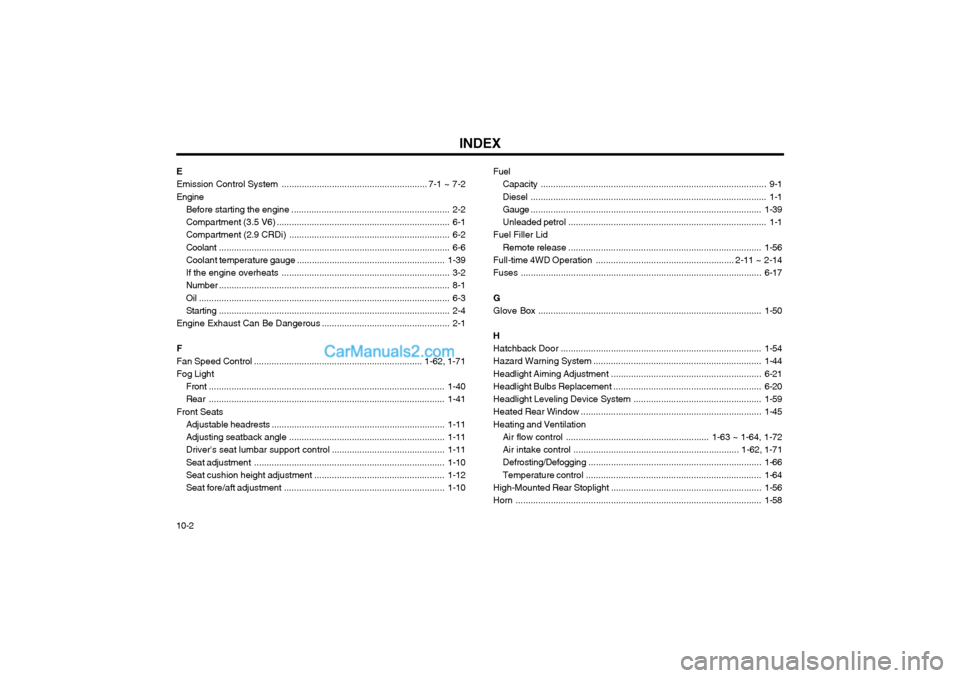
INDEX
10-2 E Emission Control System
.......................................................... 7-1 ~ 7-2
Engine Before starting the engine ............................................................... 2-2 Compartment (3.5 V6) ..................................................................... 6-1
Compartment (2.9 CRDi) ................................................................ 6-2
Coolant ............................................................................................ 6-6
Coolant temperature gauge ........................................................... 1-39
If the engine overheats ................................................................... 3-2
Number ............................................................................................ 8-1
Oil .................................................................................................... 6-3 Starting ............................................................................................ 2-4
Engine Exhaust Can Be Dangerous ................................................... 2-1
F Fan Speed Con trol ................................................................... 1-62, 1-71
Fog Light
Front .............................................................................................. 1-40
Rear .............................................................................................. 1-41
Front Seats Adjustable headrests ..................................................................... 1-11
Adjusting seatback angle .............................................................. 1-11
Driver's seat lumbar support control .............................................1-11
Seat adjustment ............................................................................ 1-10
Seat cushion height adjustment .................................................... 1-12
Seat fore/aft adjustment ................................................................ 1-10Fuel
Capacity .......................................................................................... 9-1
Diesel .............................................................................................. 1-1
Gauge ............................................................................................ 1-39
Unleaded petrol ............................................................................... 1-1
Fuel Filler Lid
Remote release ............................................................................. 1-56
Full-time 4WD Operation .................... ................................... 2-11 ~ 2-14
Fuses ................................................................................................ 6-17
G Glove Box ......................................................................................... 1-50
H Hatchback Door ................................................................................ 1-54
Hazard Warning System ................................................................... 1-44
Headlight Aiming Adjustment ............................................................ 6-21
Headlight Bulbs Replacement ........................................................... 6-20
Headlight Leveling Device System ................................................... 1-59
Heated Rear Window ........................................................................ 1-45
Heating and Ventilation Air flow control ......................................................... 1-63 ~ 1-64, 1-72
Air intake control .................................................................. 1-62, 1-71
Defrosting/Defogging ..................................................................... 1-66
Temperature control ...................................................................... 1-64
High-Mounted Rear Stoplight ............................................................ 1-56
Horn .................................................................................................. 1-58