warning Hyundai Terracan 2003 User Guide
[x] Cancel search | Manufacturer: HYUNDAI, Model Year: 2003, Model line: Terracan, Model: Hyundai Terracan 2003Pages: 349, PDF Size: 4.56 MB
Page 26 of 349
FEATURES OF YOUR HYUNDAI
1- 18
B150A02A-GAT SEAT BELT PRECAUTIONSAll occupants of the vehicle should wear their seat belts at all times. Indeed, your province's laws may require that some or all occupants of the vehicle use seat belts. The possibility of injury or the severity of injury in
an accident will be decreased if this elementary safety precaution is observed. In addition, the following recommendations are made:
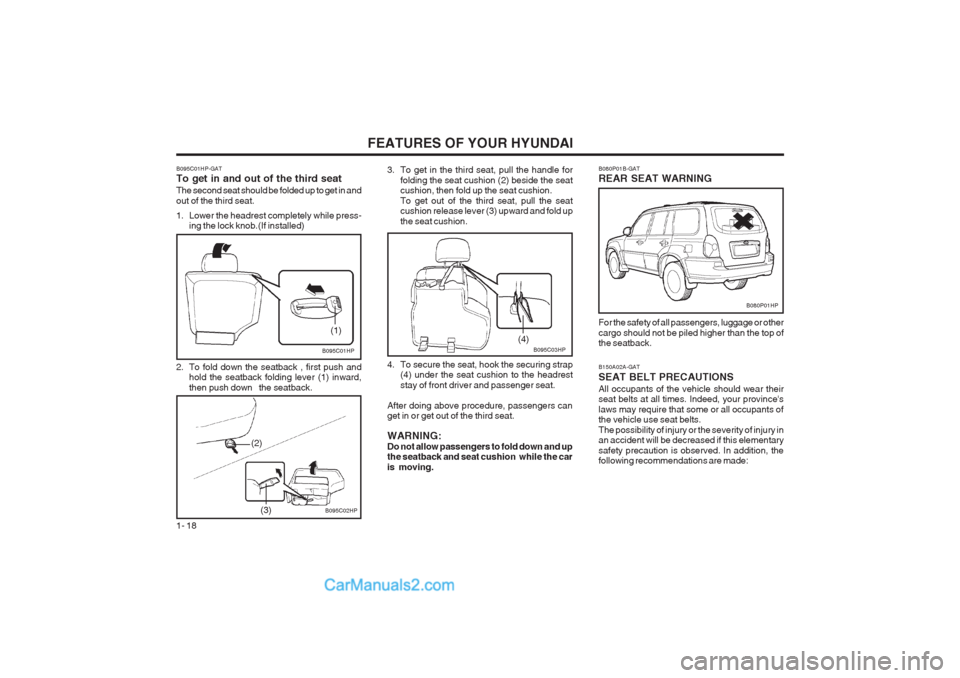
3. To get in the third seat, pull the handle for
folding the seat cushion (2) beside the seatcushion, then fold up the seat cushion. To get out of the third seat, pull the seat cushion release lever (3) upward and fold up the seat cushion.
4. To secure the seat, hook the securing strap (4) under the seat cushion to the headreststay of front driver and passenger seat.
After doing above procedure, passengers can get in or get out of the third seat. WARNING: Do not allow passengers to fold down and up the seatback and seat cushion while the car is moving.
B095C03HP
(4)
B080P01B-GAT REAR SEAT WARNING
B080P01HP
For the safety of all passengers, luggage or other cargo should not be piled higher than the top of the seatback.
B095C01HP-GAT To get in and out of the third seat The second seat should be folded up to get in and out of the third seat.
1. Lower the headrest completely while press- ing the lock knob.(If installed)
2. To fold down the seatback , first push and hold the seatback folding lever (1) inward, then push down the seatback.
B095C01HP
B095C02HP
(1)
(3)
(2)
Page 27 of 349
FEATURES OF YOUR HYUNDAI 1- 19
B150B01Y-GAT Infant or Small Child Some countries require the use of child restraint systems for infants and small children. Whether this is required by law or not, it is strongly recommended that a child restraint seat or infant
restraint system be used for infants or small children weighing less than 18 kilograms (40 pounds). NOTE: Small children are best protected in an acci- dent when properly restrained by a child restraint system. B150C02A-AAT Larger ChildrenChildren who are too large for child restraint systems should always occupy the rear seat and use the available lap/shoulder belts. The lap portion should be fastened snug on the hips and as low as possible. Check belt fit periodically. A child's squirming could put the belt out of posi- tion. Children are afforded the most safety in the event of an accident when they are restrained by a proper restraint system in the rear seat. If a larger child (over age 13) must be seated in the front seat, the child should be securely restrained by the available lap/shoulder belt and the seat should be placed in the rearmost position. Chil- dren under the age of 13 should be restrained securely in the rear seat. NEVER place a child under the age of 13 in the front seat. NEVER place a rear facing child seat in the front seat of a vehicle.
B150E01A-AAT Injured Person A seat belt should be used when an injured person is being transported. When this is neces- sary, you should consult a physician for recom- mendations. B150F01A-AAT One Person Per BeltTwo people (including children) should never attempt to use a single seat belt. This could increase the severity of injuries in case of an accident. B150G01A-AAT Do Not Lie Down To reduce the chance of injuries in the event of an accident and to achieve maximum effectiveness of the restraint system, all passengers should be sitting up and the front seats should be in an upright position when the car is moving. A seat belt cannot operate properly if the person is lying down in the rear seat or if the front seat is in a reclined position.
B150D01A-AAT Pregnant Women The use of a seat belt is recommended for pregnant women to lessen the chance of injury in an accident. When a seat belt is used, the lap belt portion should be placed as low and snugly as possible on the hips, not across the abdomen. For specific recommendations, consult a physi- cian.
WARNING: Sitting in a reclined position or lying down when your vehicle is in motion can be dan- gerous. Even if you buckle up, your seat belts can't do their job when you're reclined. The shoulder belt can't do its job because it won't be against your body. Instead, it will be in front of you. In a crash you could go into it with great force, receiving serious neck or other injuries. The lap belt can't do its job either. In a crash the belt could go up over your abdomen. The belt forces would be applied there, not at your strong pelvic bones. This could cause serious internal injuries. For proper protection when the vehicle is in motion, have the seatback upright. Then sit well back in the seat and wear your seat belt properly. See page 1-21. B160A01A-AAT CARE OF SEAT BELTS Seat belt systems should never be disassem- bled or modified. In addition, care should be taken to assure that seat belts and belt hardware are not damaged by seat hinges, doors or other abuse. WARNING: When you return the rear seatback to its upright position after the rear seatback was folded down, be careful not to damage the seat belt webbing or buckle. Be sure that the webbing or buckle does not get caught or pinched in the rear seat.
Page 28 of 349
FEATURES OF YOUR HYUNDAI
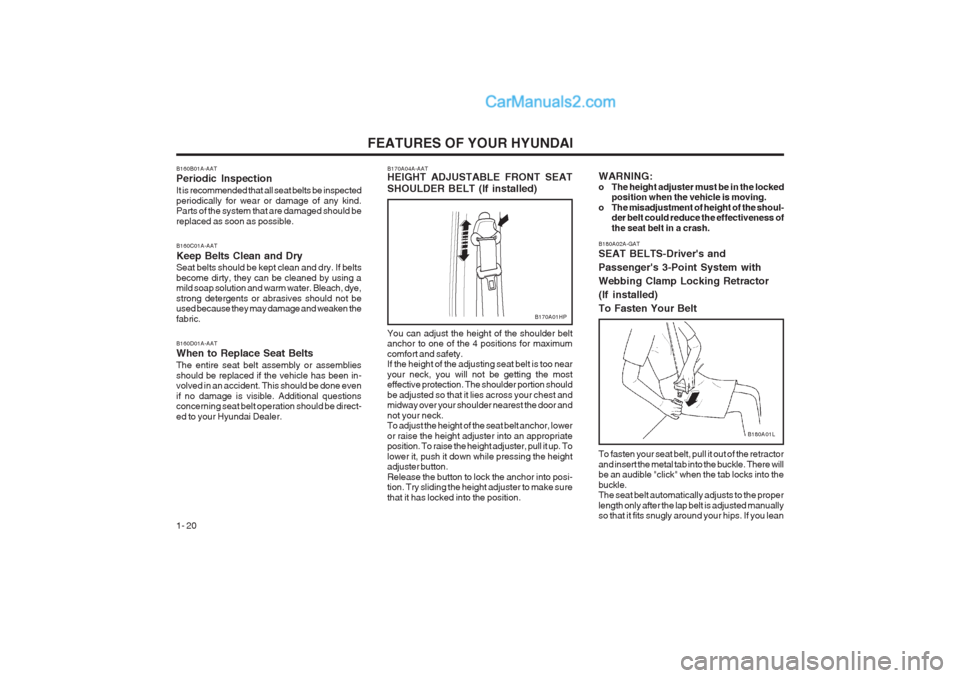
1- 20 To fasten your seat belt, pull it out of the retractor and insert the metal tab into the buckle. There will be an audible "click" when the tab locks into the buckle. The seat belt automatically adjusts to the proper length only after the lap belt is adjusted manually so that it fits snugly around your hips. If you lean
B180A02A-GAT SEAT BELTS-Driver's and Passenger's 3-Point System withWebbing Clamp Locking Retractor(If installed)To Fasten Your Belt
B180A01L
B170A04A-AAT HEIGHT ADJUSTABLE FRONT SEAT SHOULDER BELT (If installed)
B170A01HP
You can adjust the height of the shoulder belt anchor to one of the 4 positions for maximum comfort and safety. If the height of the adjusting seat belt is too near your neck, you will not be getting the most effective protection. The shoulder portion should be adjusted so that it lies across your chest and midway over your shoulder nearest the door and not your neck. To adjust the height of the seat belt anchor, lower or raise the height adjuster into an appropriate position. To raise the height adjuster, pull it up. To lower it, push it down while pressing the height adjuster button. Release the button to lock the anchor into posi- tion. Try sliding the height adjuster to make sure that it has locked into the position. WARNING:
o The height adjuster must be in the locked
position when the vehicle is moving.
o The misadjustment of height of the shoul- der belt could reduce the effectiveness ofthe seat belt in a crash.
B160B01A-AAT Periodic Inspection It is recommended that all seat belts be inspected periodically for wear or damage of any kind. Parts of the system that are damaged should be replaced as soon as possible. B160C01A-AAT Keep Belts Clean and Dry Seat belts should be kept clean and dry. If belts become dirty, they can be cleaned by using a mild soap solution and warm water. Bleach, dye, strong detergents or abrasives should not be used because they may damage and weaken the fabric. B160D01A-AAT When to Replace Seat Belts The entire seat belt assembly or assemblies should be replaced if the vehicle has been in- volved in an accident. This should be done even if no damage is visible. Additional questions concerning seat belt operation should be direct- ed to your Hyundai Dealer.
Page 30 of 349
FEATURES OF YOUR HYUNDAI
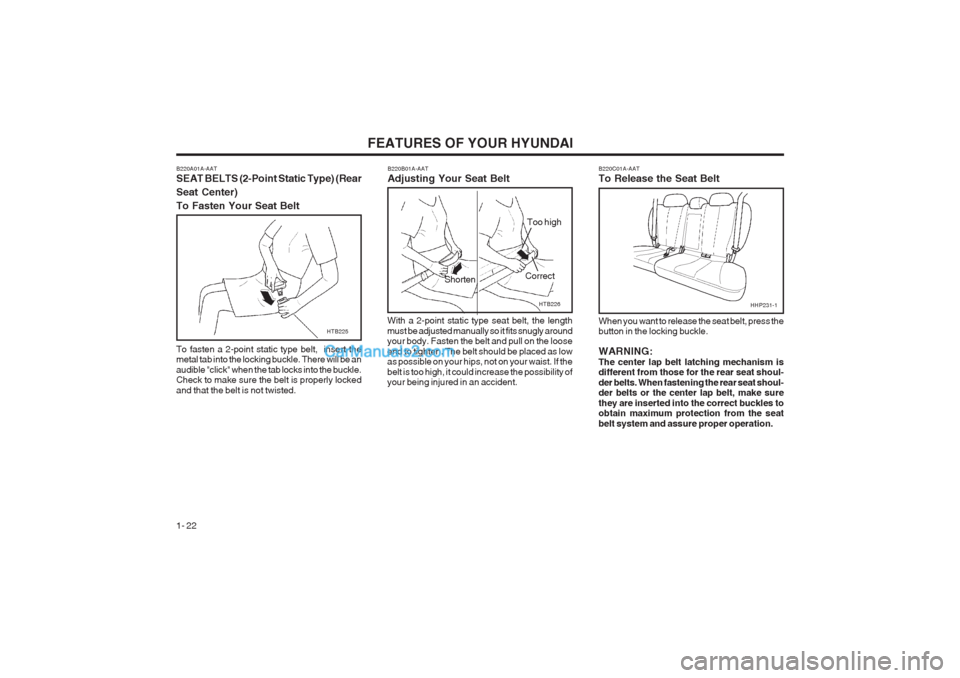
1- 22 B220C01A-AAT To Release the Seat Belt When you want to release the seat belt, press the button in the locking buckle. WARNING: The center lap belt latching mechanism is different from those for the rear seat shoul- der belts. When fastening the rear seat shoul- der belts or the center lap belt, make sure they are inserted into the correct buckles to obtain maximum protection from the seat belt system and assure proper operation.
B220B01A-AAT Adjusting Your Seat Belt
HTB226
With a 2-point static type seat belt, the length must be adjusted manually so it fits snugly around your body. Fasten the belt and pull on the loose end to tighten. The belt should be placed as low as possible on your hips, not on your waist. If the belt is too high, it could increase the possibility of your being injured in an accident. Correct
Shorten Too high
HTB225
B220A01A-AAT SEAT BELTS (2-Point Static Type) (Rear Seat Center)To Fasten Your Seat Belt To fasten a 2-point static type belt, insert the metal tab into the locking buckle. There will be an audible "click" when the tab locks into the buckle. Check to make sure the belt is properly locked and that the belt is not twisted.
HHP231-1
Page 31 of 349
FEATURES OF YOUR HYUNDAI 1- 23
B230A03P-GAT CHILD RESTRAINT SYSTEM (If Installed) Children riding in the car should sit in the rear seat and must always be properly restrained to minimize the risk of injury in an accident, sudden stop or sudden maneuver. According to accident statistics, children are safer when properly re- strained in the rear seats than in the front seat. Larger children not in a child restraint should use one of the seat belts provided. You are required by law to use safety restraints for children. If small children ride in your vehicle you must put them in a child restraint system (safety seat). Children could be injured or killed in a crash if their restraints are not properly secured. For small children and babies, a child seat or infant seat must be used. Before buying a particular child restraint system, make sure it fits your car and seat belts, and fits your child. Follow all the instructions provided by the manufacturer when installing the child restraint system.
WARNING:
o A child restraint system must be placed in
the rear seat. Never install a child or infantseat on the front passenger's seat. Should an accident occur and cause the
passenger's side airbag to deploy, it could severely injure or kill an infant or child seated in an infant or child seat. Thus, only use a child restraint in the rear seat of your vehicle.
o Since a safety belt or child restraint sys-
tem can become very hot if it is left in a closed vehicle, be sure to check the seat cover and buckles before placing a child there.
o When the child restraint system is not in use, fasten it with a safety belt so that it will not be thrown forward in the case of a sudden stop or an accident.
o Children who are too large to be in a child restraint should sit in the rear seat and be restrained with the available lap/shoulder belts. Never allow children to ride in the front passenger seat.
o Always make sure that the shoulder belt
portion of the outboard lap/shoulder belt is positioned midway over the shoulder, never across the neck or behind the back. Moving the child closer to the center of the vehicle may help provide a good shoulder belt fit. The lap belt portion of the lap/ shoulder belt or the center seat lap belt must always be positioned as low as pos- sible on the child's hips and as snug as possible. o If the seat belt will not properly fit the
child, Hyundai recommends the use of anapproved booster seat in the rear seat in order to raise the child's seating height so that the seat belt will properly fit the child.
o Never allow a child to stand up or kneel on the seat.
o Never use an infant carrier or child safety seat that "hooks" over a seatback; it may not provide adequate security in an acci- dent.
o Never allow a child to be held in a person's arms while they are in a moving vehicle, as this could result in serious injury to the child in the event of an accident or a sudden stop. Holding a child in a moving vehicle does not provide the child with any means of protection during an acci- dent, even if the person holding the child is wearing a seat belt.
o If the child restraint seat is not anchored
properly, the risk of a child being seri- ously injured or killed in a collision greatly increases.
Page 32 of 349
FEATURES OF YOUR HYUNDAI
1- 24
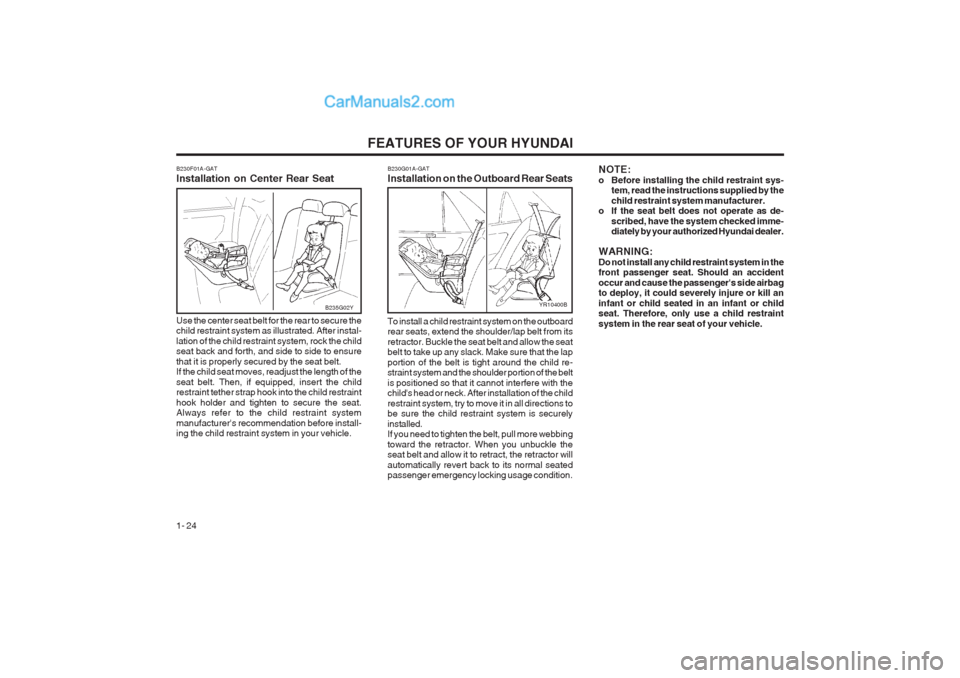
B230F01A-GAT Installation on Center Rear Seat Use the center seat belt for the rear to secure the child restraint system as illustrated. After instal- lation of the child restraint system, rock the child seat back and forth, and side to side to ensure that it is properly secured by the seat belt. If the child seat moves, readjust the length of the seat belt. Then, if equipped, insert the child restraint tether strap hook into the child restraint hook holder and tighten to secure the seat. Always refer to the child restraint system manufacturer's recommendation before install- ing the child restraint system in your vehicle.
B230G01A-GAT Installation on the Outboard Rear Seats To install a child restraint system on the outboard rear seats, extend the shoulder/lap belt from its retractor. Buckle the seat belt and allow the seat belt to take up any slack. Make sure that the lap portion of the belt is tight around the child re- straint system and the shoulder portion of the belt is positioned so that it cannot interfere with the child's head or neck. After installation of the child restraint system, try to move it in all directions to be sure the child restraint system is securely installed. If you need to tighten the belt, pull more webbing toward the retractor. When you unbuckle the seat belt and allow it to retract, the retractor will automatically revert back to its normal seated passenger emergency locking usage condition.
B235G02YYR10400B
NOTE:
o Before installing the child restraint sys-
tem, read the instructions supplied by thechild restraint system manufacturer.
o If the seat belt does not operate as de-
scribed, have the system checked imme- diately by your authorized Hyundai dealer.
WARNING: Do not install any child restraint system in the front passenger seat. Should an accident occur and cause the passenger's side airbag to deploy, it could severely injure or kill an infant or child seated in an infant or child seat. Therefore, only use a child restraint system in the rear seat of your vehicle.
Page 35 of 349
FEATURES OF YOUR HYUNDAI 1- 27
WARNING:
o Do not install a child restraint seat at the
center of the rear seat using the vehicle'sISOFIX anchors. The ISOFIX anchors are only provided for the left and right out- board rear seating positions. Do not mis- use the ISOFIX anchors by attempting to attach a child restraint seat in the middle of the rear seat to the ISOFIX anchors. In a crash, the child restraint seat ISOFIX attachments may not be strong enough to secure the child restraint seat properly in the center of the rear seat and may break, causing serious injury or death.
o Do not mount more than one child re-
straint to a child restraint lower anchor- age point. The improper increased load may cause the anchorage points or tether anchor to break, causing serious injury or death.
o Attach the ISOFIX or ISOFIX-compatible
child restraint seat only to the appropriate locations shown in the illustration.
o Always follow the installation and use instructions provided by the manufacturer of the child restraint.
Age Group Seating PositionFront
Passenger Rear
Outboard Rear
Center
0 : Up to 10 kg (0 ~ 9 months) 0+ : Up to 13 kg (0 ~ 2 years) I : 9kg to 18kg (9 months ~ 4 years) II & III : 15kg to 36kg (4 ~ 12 years)XUU
XUU
X U, L1 U XU FUF
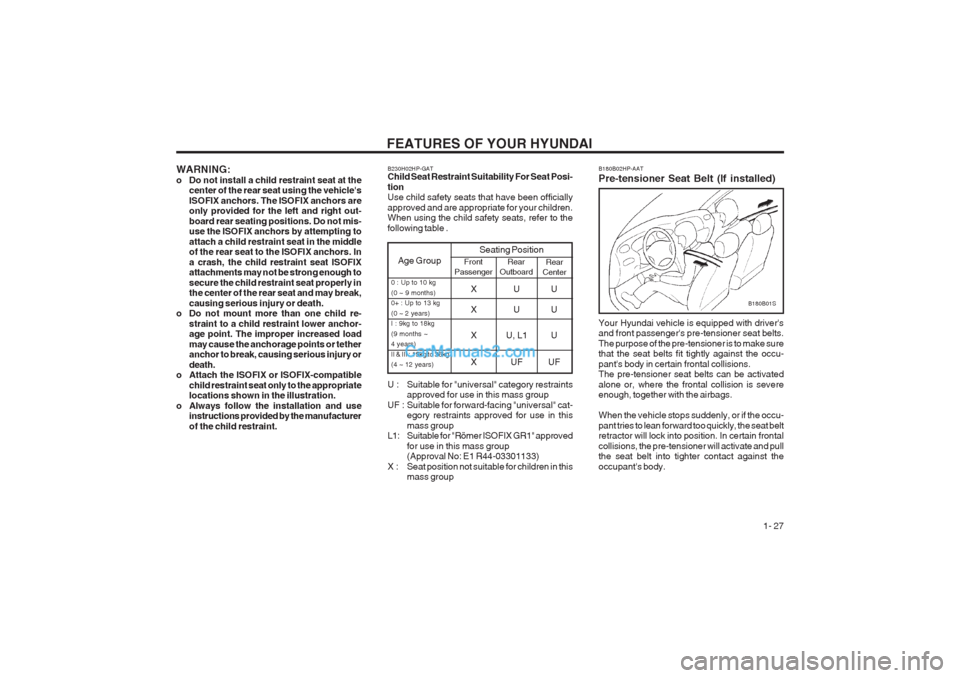
B230H02HP-GAT Child Seat Restraint Suitability For Seat Posi- tion Use child safety seats that have been officially approved and are appropriate for your children. When using the child safety seats, refer to the following table .
U : Suitable for "universal" category restraints
approved for use in this mass group
UF : Suitable for forward-facing "universal" cat- egory restraints approved for use in this mass group
L1: Suitable for "Römer ISOFIX GR1" approved
for use in this mass group (Approval No: E1 R44-03301133)
X : Seat position not suitable for children in this mass group Your Hyundai vehicle is equipped with driver'sand front passenger's pre-tensioner seat belts. The purpose of the pre-tensioner is to make sure that the seat belts fit tightly against the occu- pant's body in certain frontal collisions. The pre-tensioner seat belts can be activated alone or, where the frontal collision is severe enough, together with the airbags. When the vehicle stops suddenly, or if the occu- pant tries to lean forward too quickly, the seat belt retractor will lock into position. In certain frontal collisions, the pre-tensioner will activate and pull the seat belt into tighter contact against the occupant's body.
B180B02HP-AAT Pre-tensioner Seat Belt (If installed)
B180B01S
Page 36 of 349
FEATURES OF YOUR HYUNDAI
1- 28 nated after blinking for approximately 6 seconds, or if it illuminates while the ve- hicle is being driven, please have an au- thorized Hyundai dealer inspect the pre- tensioner seat belts and SRS airbag sys- tem as soon as possible.
WARNING:
o Pre-tensioners are designed to operate only one time. After activation, pre-tensioner seat belts must be replaced. All seat belts, of any type, should always be replaced after they have been worn during a collision.
o The pre-tensioner seat belt assembly
mechanisms become hot during activa- tion. Do not touch the pre-tensioner seat belt assemblies for several minutes after they have been activated.
o Do not attempt to inspect or replace the pre-tensioner seat belts yourself. This must be done by an authorized Hyundai dealer.
o Do not strike the pre-tensioner seat belt assemblies.
o Do not attempt to service or repair the pre- tensioner seat belt system in any manner.
o Improper handling of the pre-tensioner seat belt assemblies, and failure to heed the warnings to not strike, modify, insp- ect, replace, service or repair the pre- tensioner seat belt assemblies may lead to improper operation or inadvertent acti- vation and serious injury.
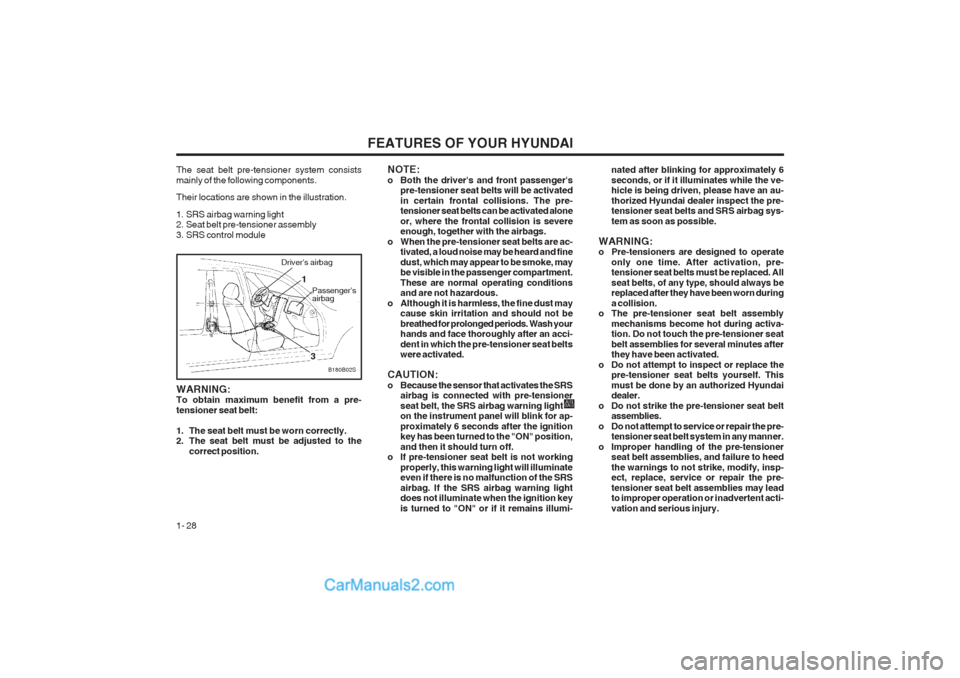
The seat belt pre-tensioner system consistsmainly of the following components. Their locations are shown in the illustration.
1. SRS airbag warning light
2. Seat belt pre-tensioner assembly
3. SRS control module
B180B02S
Driver's airbag
1
3
Passenger's airbag
WARNING: To obtain maximum benefit from a pre- tensioner seat belt:
1. The seat belt must be worn correctly.
2. The seat belt must be adjusted to the correct position. NOTE:
o Both the driver's and front passenger's
pre-tensioner seat belts will be activatedin certain frontal collisions. The pre- tensioner seat belts can be activated alone or, where the frontal collision is severe enough, together with the airbags.
o When the pre-tensioner seat belts are ac- tivated, a loud noise may be heard and fine dust, which may appear to be smoke, may be visible in the passenger compartment. These are normal operating conditions and are not hazardous.
o Although it is harmless, the fine dust may cause skin irritation and should not be breathed for prolonged periods. Wash your hands and face thoroughly after an acci- dent in which the pre-tensioner seat belts were activated.
CAUTION:
o Because the sensor that activates the SRS airbag is connected with pre-tensionerseat belt, the SRS airbag warning light on the instrument panel will blink for ap- proximately 6 seconds after the ignition key has been turned to the "ON" position, and then it should turn off.
o If pre-tensioner seat belt is not working
properly, this warning light will illuminate even if there is no malfunction of the SRS airbag. If the SRS airbag warning light does not illuminate when the ignition key is turned to "ON" or if it remains illumi-
AIR
BAG
Page 37 of 349
FEATURES OF YOUR HYUNDAI 1- 29
NOTE: Be sure to read information about the SRS on the labels provided on the backside of the sun visor and in the glove box. WARNING:
o As its name implies, the SRS is designed
to work with, and be supplemental to, thedriver's and the passenger's three point seat belt systems and is not a substitute for them. Therefore, your seat belts must be worn at all times while the vehicle is in motion. The airbags deploy only in certain frontal impact conditions severe enough to likely cause significant injury to the vehicle occupants.
o The SRS is designed to deploy the airbags
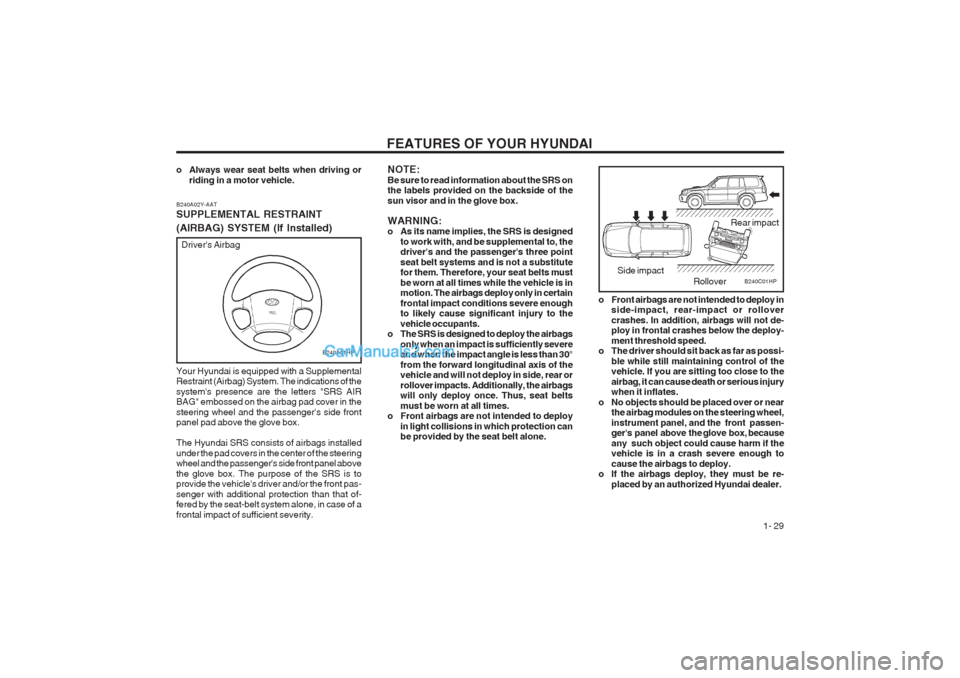
only when an impact is sufficiently severe and when the impact angle is less than 30° from the forward longitudinal axis of the vehicle and will not deploy in side, rear or rollover impacts. Additionally, the airbags will only deploy once. Thus, seat belts must be worn at all times.
o Front airbags are not intended to deploy
in light collisions in which protection can be provided by the seat belt alone.
o Always wear seat belts when driving or
riding in a motor vehicle.
B240A02Y-AAT SUPPLEMENTAL RESTRAINT (AIRBAG) SYSTEM (If Installed) Your Hyundai is equipped with a Supplemental
Restraint (Airbag) System. The indications of the
system's presence are the letters "SRS AIR BAG" embossed on the airbag pad cover in the steering wheel and the passenger's side front panel pad above the glove box. The Hyundai SRS consists of airbags installed
under the pad covers in the center of the steering wheel and the passenger's side front panel above the glove box. The purpose of the SRS is to provide the vehicle's driver and/or the front pas- senger with additional protection than that of- fered by the seat-belt system alone, in case of a frontal impact of sufficient severity. Driver's Airbag
B240A01HP
B240C01HP
Rear impact
Side impact Rollover
o Front airbags are not intended to deploy in side-impact, rear-impact or rollover crashes. In addition, airbags will not de- ploy in frontal crashes below the deploy- ment threshold speed.
o The driver should sit back as far as possi-
ble while still maintaining control of the vehicle. If you are sitting too close to the airbag, it can cause death or serious injury when it inflates.
o No objects should be placed over or near the airbag modules on the steering wheel, instrument panel, and the front passen- ger's panel above the glove box, because any such object could cause harm if the vehicle is in a crash severe enough to cause the airbags to deploy.
o If the airbags deploy, they must be re-
placed by an authorized Hyundai dealer.
Page 39 of 349
FEATURES OF YOUR HYUNDAI 1- 31
B240B05L
may damage these parts. If the liquid from the air freshener does leak onto these areas, wash them with water immediately. WARNING:
o When the SRS is activated, there may be a
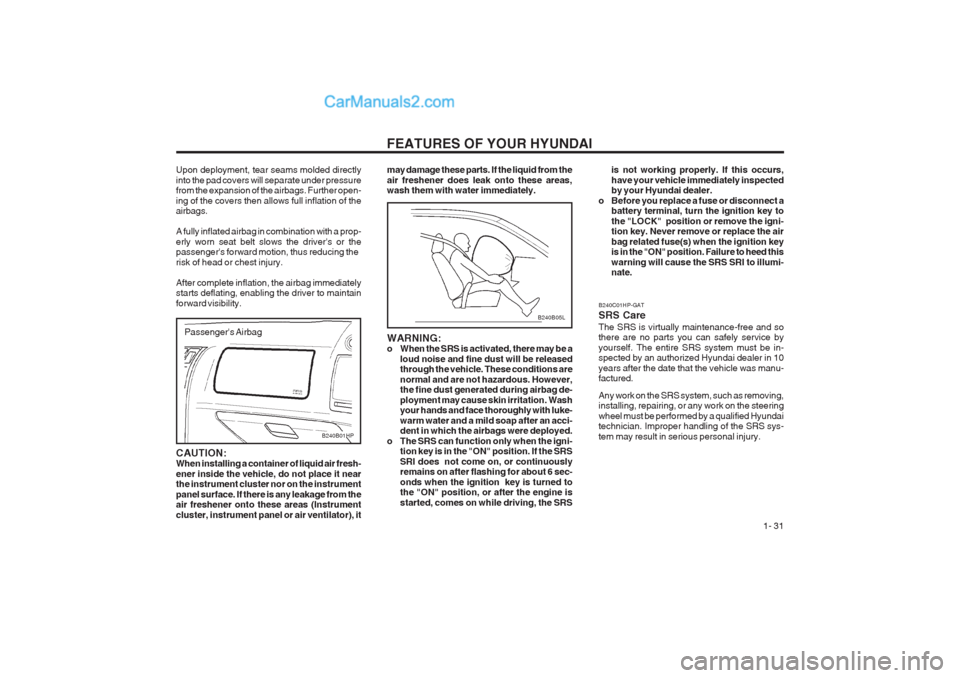
loud noise and fine dust will be releasedthrough the vehicle. These conditions are normal and are not hazardous. However, the fine dust generated during airbag de- ployment may cause skin irritation. Wash your hands and face thoroughly with luke- warm water and a mild soap after an acci- dent in which the airbags were deployed.
o The SRS can function only when the igni- tion key is in the "ON" position. If the SRS SRI does not come on, or continuously remains on after flashing for about 6 sec- onds when the ignition key is turned to the "ON" position, or after the engine is started, comes on while driving, the SRS
Passenger's Airbag
Upon deployment, tear seams molded directly into the pad covers will separate under pressure from the expansion of the airbags. Further open- ing of the covers then allows full inflation of the airbags. A fully inflated airbag in combination with a prop- erly worn seat belt slows the driver's or the passenger's forward motion, thus reducing the risk of head or chest injury. After complete inflation, the airbag immediately starts deflating, enabling the driver to maintain forward visibility.
B240B01HP
CAUTION: When installing a container of liquid air fresh- ener inside the vehicle, do not place it near the instrument cluster nor on the instrument panel surface. If there is any leakage from the air freshener onto these areas (Instrument cluster, instrument panel or air ventilator), it B240C01HP-GAT SRS CareThe SRS is virtually maintenance-free and so there are no parts you can safely service by yourself. The entire SRS system must be in- spected by an authorized Hyundai dealer in 10 years after the date that the vehicle was manu- factured. Any work on the SRS system, such as removing, installing, repairing, or any work on the steering wheel must be performed by a qualified Hyundai technician. Improper handling of the SRS sys- tem may result in serious personal injury.is not working properly. If this occurs,have your vehicle immediately inspected by your Hyundai dealer.
o Before you replace a fuse or disconnect a battery terminal, turn the ignition key to the "LOCK" position or remove the igni- tion key. Never remove or replace the air bag related fuse(s) when the ignition key is in the "ON" position. Failure to heed this warning will cause the SRS SRI to illumi- nate.