lock Hyundai Terracan 2004 Owners Manual
[x] Cancel search | Manufacturer: HYUNDAI, Model Year: 2004, Model line: Terracan, Model: Hyundai Terracan 2004Pages: 361, PDF Size: 4.69 MB
Page 283 of 361
CONTROLS AND EQUIPMENT1- 83
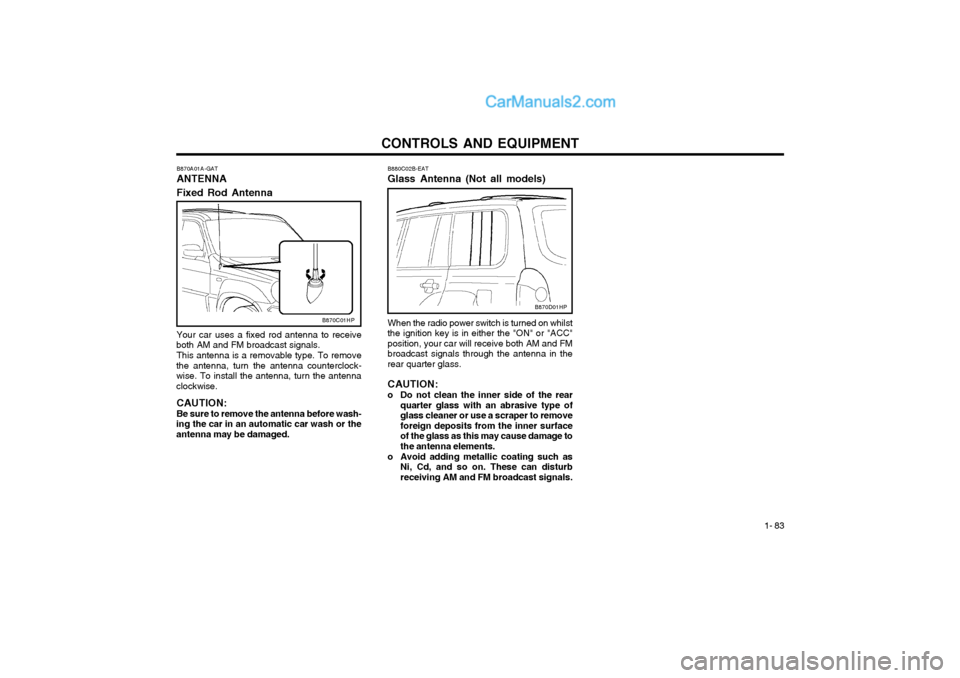
B880C02B-EAT Glass Antenna (Not all models) When the radio power switch is turned on whilst the ignition key is in either the "ON" or "ACC"position, your car will receive both AM and FMbroadcast signals through the antenna in therear quarter glass. CAUTION:
o Do not clean the inner side of the rear quarter glass with an abrasive type of glass cleaner or use a scraper to removeforeign deposits from the inner surfaceof the glass as this may cause damage tothe antenna elements.
o Avoid adding metallic coating such as Ni, Cd, and so on. These can disturbreceiving AM and FM broadcast signals.
B870C01HP
B870A01A-GAT ANTENNA Fixed Rod Antenna Your car uses a fixed rod antenna to receive
both AM and FM broadcast signals.
This antenna is a removable type. To remove
the antenna, turn the antenna counterclock- wise. To install the antenna, turn the antennaclockwise.
CAUTION: Be sure to remove the antenna before wash-
ing the car in an automatic car wash or the antenna may be damaged.
B870D01HP
Page 285 of 361
DRIVING YOUR HYUNDAI
2- 2 C020A01A-EAT
BEFORE STARTING THE ENGINE
Before you start the engine, you should always:
1. Look around the vehicle to be sure there are no flat tyres, puddles of oil or water or other indications of possible trouble.
2. After entering the car, check to be sure the parking brake is engaged.
3. Check that all windows, and lights are clean.
4. Check that the interior and exterior mirrors are clean and in position.
5. Check your seat, seatback and headrest to be sure they are in their proper positions.
6. Close all the doors.
7. Fasten your seat belt and be sure that all other occupants have fastened theirs.
8. Turn off all lights and accessories that are not needed.
9. When you turn the ignition switch to "ON" check that all appropriate warning lights are operating and that you have sufficient fuel.
10.Check the operation of warning lights and all bulbs when key is in the "ON" position. C030A01HP-EAT COMBINATION IGNITION SWITCH AND STEERING LOCK To Start the Engine
o If your Hyundai is equipped with a manual
transmission, place the shift lever in neutral and depress the clutch pedal fully.
o If your Hyundai has an automatic transmis- sion, place the shift lever in "P" (park).
o To start the engine, insert the ignition key and turn it to the "START" position. Releaseit as soon as the engine starts. Do not holdthe key in the "START" position for morethat 15 seconds.
NOTE: For safety, the engine will not start if the shift lever is not in "P" or "N" position(Automatic Transmission). SC050A1-E
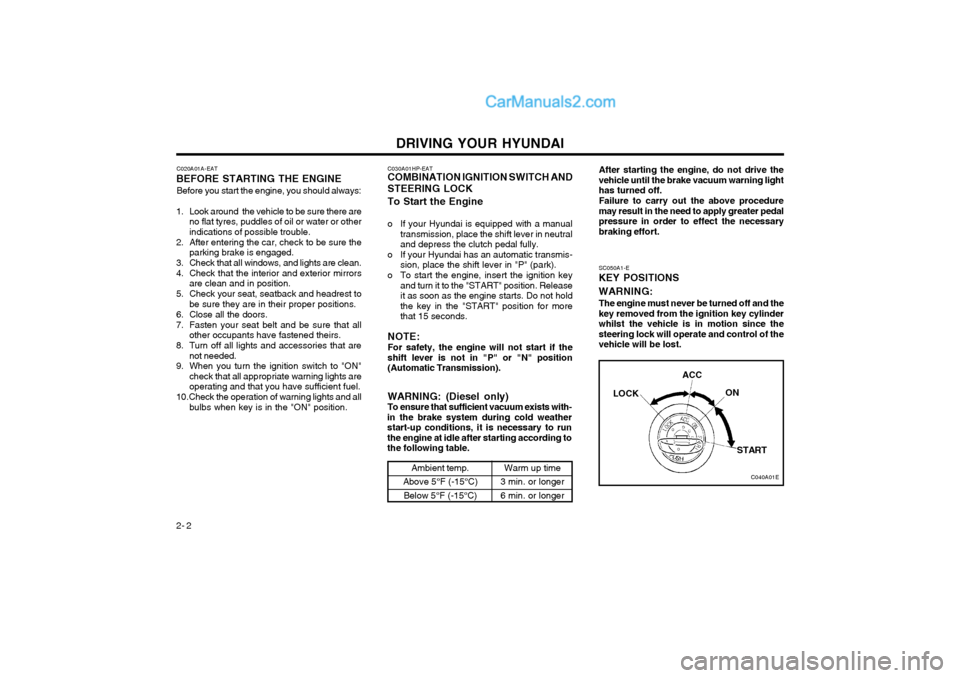
KEY POSITIONS WARNING:
The engine must never be turned off and the key removed from the ignition key cylinderwhilst the vehicle is in motion since thesteering lock will operate and control of thevehicle will be lost.
C040A01E
LOCK
ACC
ON
START
WARNING: (Diesel only) To ensure that sufficient vacuum exists with-
in the brake system during cold weatherstart-up conditions, it is necessary to runthe engine at idle after starting according tothe following table.
Ambient temp.
Above 5°F (-15°C) Below 5°F (-15°C)Warm up time
3 min. or longer 6 min. or longer After starting the engine, do not drive the vehicle until the brake vacuum warning lighthas turned off. Failure to carry out the above procedure may result in the need to apply greater pedalpressure in order to effect the necessarybraking effort.
Page 286 of 361
DRIVING YOUR HYUNDAI 2- 3
YC030A1-E
STEERING WHEEL LOCK
When the ignition key is removed, the steering
wheel lock will be activated. The lock only engages at one position of the steering wheeland therefore it will be possible to turn the wheeluntil this position is reached. It is not, however,necessary for the lock to be engaged beforeleaving the vehicle since in the event of at-tempted unauthorized removal, the lock willengage when attempts are made to steer thevehicle.
Should it be difficult to turn the key from the
"LOCK" position, it may be found that rockingthe steering wheel to and fro whilst turning thekey will assist.
CAUTION: Never remove the key from the ignition lock
whilst the vehicle is in motion since the steering mechanism lock will be activated.
"START"
The engine is started in this position. It will
crank until you release the key.
NOTE: Do not hold the key in the "START" position
for more than 15 seconds. "ON"
When the key is at the "ON" position, the
ignition and all accessories are available for use. If the engine is not running, the key shouldnot be left at this position since the battery willbecome discharged and damage to the ignitionsystem may also result. For information regard-ing engine starting, refer to "STARTING THEENGINE". "ACC"
When the ignition key is at the "ACC" position,
the radio and other accessories may be used."LOCK"
The ignition key may only be inserted or re-
moved at this position.
NOTE: The ignition key can only be removed if the
transmission selector is at the "P" position (automatic transmission only). C070C01A-AAT
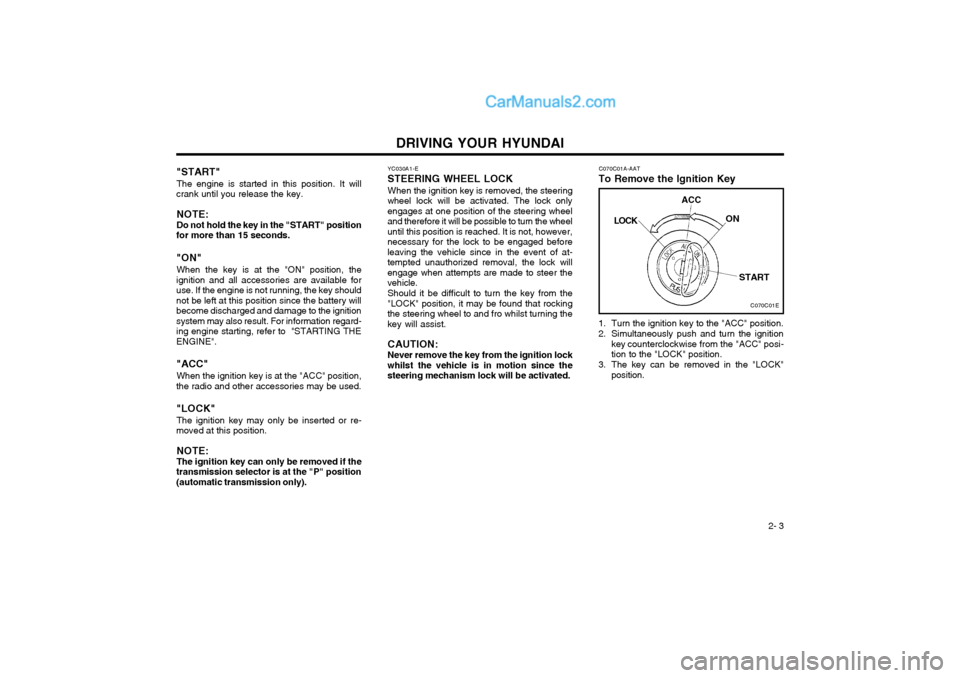
To Remove the Ignition Key
1. Turn the ignition key to the "ACC" position.
2. Simultaneously push and turn the ignition key counterclockwise from the "ACC" posi- tion to the "LOCK" position.
3. The key can be removed in the "LOCK" position.
C070C01E
LOCK
ACC
ON
START
Page 287 of 361
DRIVING YOUR HYUNDAI
2- 4 low the engine to idle for 20 seconds or so before driving the vehicle. CAUTION: Do not leave the vehicle unattended whilst idling. Never allow the vehicle to idle orwarm up in a confined space (ie garage)longer than is necessary to move the vehi-cle into an open area.
HPC060A1-E
STARTING THE ENGINE
1. Ensure that the transmission is in neutral and that the clutch pedal is held depressed (manual transmission) or the transmissionselector is at the "P" position (automatictransmission vehicle).
2. Turn the ignition key to and hold at the "Start" position until the engine starts. Whenthe engine has started, release the key.
NOTE: Do not operate the starter for more than 15
seconds continuously or continue to oper- ate the starter after the engine has started toavoid damaging the starter motor. If theengine makes a false start, allow it and thestarter motor to come to rest before at-tempting to start the engine again. Neverattempt to start the engine with the trans-mission in gear. Do not depress the accel-erator pedal whilst starting the engine. Al-
C050A01E
C050B01HP-EAT
Starting Procedure
1. Insert key, and fasten the seat belt.
2. Apply the parking brake.
3. If your Hyundai is equipped with a manual transmission, place the shift lever in neutral and depress the clutch pedal fully. If yourHyundai has an automatic transmission,place the shift lever in "P" (park).
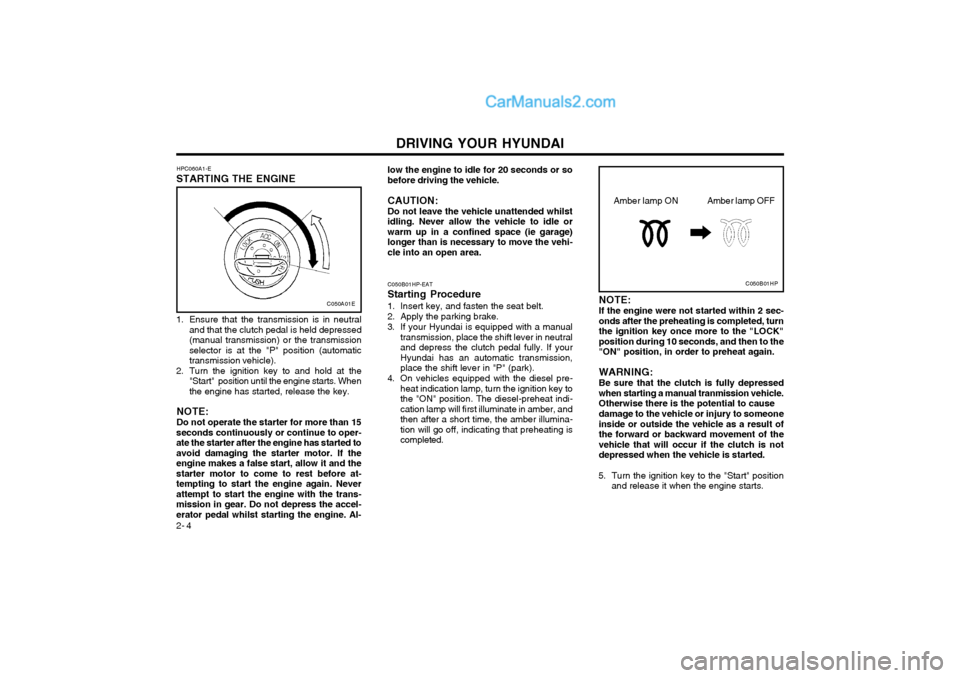
4. On vehicles equipped with the diesel pre- heat indication lamp, turn the ignition key tothe "ON" position. The diesel-preheat indi-cation lamp will first illuminate in amber, andthen after a short time, the amber illumina-tion will go off, indicating that preheating iscompleted.C050B01HP
Amber lamp OFF
Amber lamp ON
NOTE: If the engine were not started within 2 sec- onds after the preheating is completed, turnthe ignition key once more to the "LOCK"position during 10 seconds, and then to the"ON" position, in order to preheat again. WARNING: Be sure that the clutch is fully depressed when starting a manual tranmission vehicle.Otherwise there is the potential to cause damage to the vehicle or injury to someone inside or outside the vehicle as a result ofthe forward or backward movement of thevehicle that will occur if the clutch is notdepressed when the vehicle is started.
5. Turn the ignition key to the "Start" position and release it when the engine starts.
Page 290 of 361
DRIVING YOUR HYUNDAI 2- 7
DC110D1-E
o N (Neutral):
With the selector in this position, no gear is
selected and no drive is transmitted from the engine. The engine may be started with theselector in this position.
CAUTION: Do not coast with the selector at the "N"
position.
DC110C1-E
o R (Reverse):
With the selector in this position, reverse gear
will be engaged. The engine may not be started with the selector in this position.
CAUTION:The selector must NEVER be shifted to the
"R" position whilst the vehicle is in motion. HPC090A1-E
SELECTOR POSITIONS o P (Park): With the selector in this position, no drive is
transmitted from the engine and the transmis- sion output and therefore the front wheels locked.The engine may be started with the selector inthis position.
CAUTION:The selector must NEVER be shifted to the
"P" position whilst the vehicle is in motion,otherwise serious transmission damage willresult. C090E01O-AAT
o D(Drive): Use for normal driving. The transmission will
automatically shift through a four gear sequence.
For optimum fuel economy, accelerate gradu-ally. The transmission will automatically shift tothe second, third and overdrive gears.
C090H01A-EAT
NOTE:
o The brake pedal should be depressed when shifting from NEUTRAL to a for- ward or reverse gear.
o The brake pedal fully depressed in order to move the shift lever from the "P"(Park) position to any of the other posi-tions.
o It is always possible to shift from "R", "N", "D", "2", "L" positions to "P" posi-tion.
DC110F1-E
o 2 (Second Gear):
With the selector in this position, first gear will
be engaged from rest. The transmission willupshift to second gear depending upon thevehicle speed and throttle position. No upshiftto third or fourth will occur. The engine may notbe started with the selector in this position.
CAUTION: Do not move the selector to the 2 position
when the vehicle speed is in excess of 60 m.p.h. DC110G2-E
o L (Low Gear):
With the selector in this position, first gear will
be engaged from rest. No upshift will occurregardless of vehicle speed and throttle open-ing. The engine may not be started with theselector in this position.
CAUTION: Do not move the selector to the L position
when the vehicle speed is in excess of 50 m.p.h.
Page 292 of 361
DRIVING YOUR HYUNDAI 2- 9
o Ensure that the overdrive switch is at the
"ON" position for maximum economy.
o If rapid acceleration is required, fully de- press the accelerator pedal. In this condi- tion, the kickdown mechanism will be oper-ated and the transmission will automaticallydownshift according to the vehicle speed.
C120A02A-EAT
ANTI-LOCK BRAKE SYSTEM (Not all models)
The Anti-Lock Brake System (ABS) is designed
to prevent wheel lock-up during sudden braking or on hazardous road surfaces. The ABS con-trol module monitors the wheel speed and con-trols the pressure applied to each brake. Thus,in emergency situations or on slick roads, ABSwill increase vehicle control during braking.
NOTE: During ABS operation, a slight pulsation
may be felt in the brake pedal when the brakes are applied. Also, a noise may beheard in the engine compartment whilst brak-ing. These conditions are normal and indi-cate that the anti-lock brake system is func-tioning properly. WARNING: ABS will not prevent accidents due to im-
proper or dangerous driving manoeuvres. Even though vehicle control is improvedduring emergency braking, always maintaina safe distance between you and objectsahead. Vehicle speeds should always bereduced during extreme road conditions.
The braking distance for cars equipped with
an anti-lock braking system may be longerthan for those without it in the followingroad conditions.
o Driving on rough, gravel or snow-cov- ered roads.
o Driving with tire chains installed.
o Driving on roads where the road surface is pitted or has different surface height.
These roads should be driven at reduced
speeds. The safety features of an ABS equipped vehicle should not be tested byhigh speed driving or cornering. This couldendanger the safety of yourself or others.
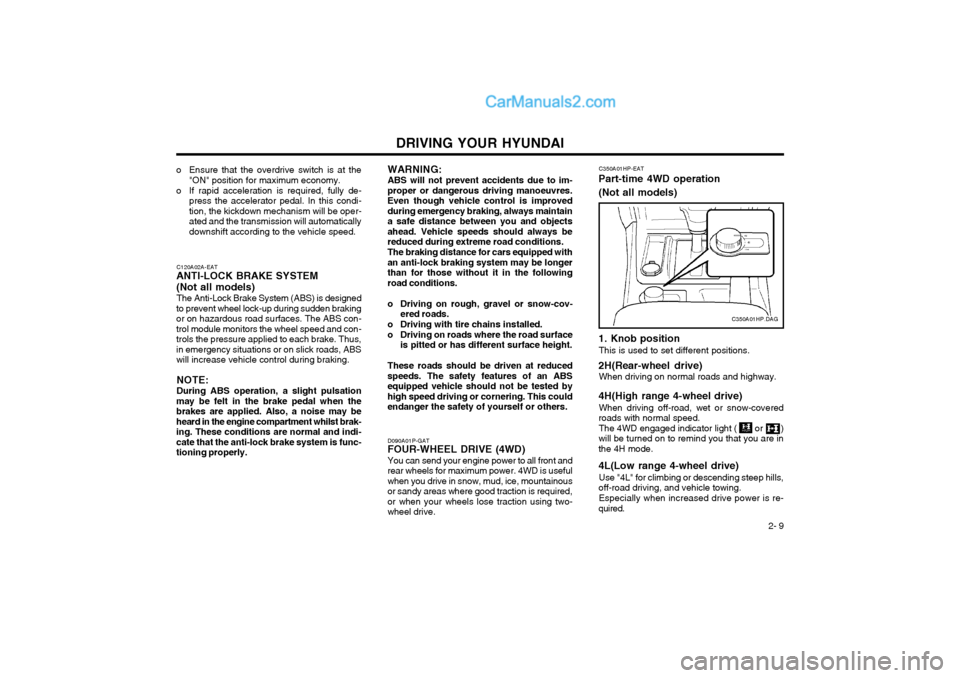
C350A01HP-EAT
Part-time 4WD operation (Not all models)
1. Knob position
This is used to set different positions.
2H(Rear-wheel drive) When driving on normal roads and highway.
4H(High range 4-wheel drive) When driving off-road, wet or snow-covered
roads with normal speed. The 4WD engaged indicator light ( or )
will be turned on to remind you that you are in the 4H mode. 4L(Low range 4-wheel drive)
Use "4L" for climbing or descending steep hills,
off-road driving, and vehicle towing.
Especially when increased drive power is re-
quired.
C350A01HP.DAG
D090A01P-GAT
FOUR-WHEEL DRIVE (4WD)
You can send your engine power to all front and
rear wheels for maximum power. 4WD is useful when you drive in snow, mud, ice, mountainousor sandy areas where good traction is required,or when your wheels lose traction using two-wheel drive.
Page 299 of 361
DRIVING YOUR HYUNDAI
2- 16 ZC170E1-E
Windscreen Washers & Wipers
The windscreen washer bottle should be filled with a solution of water and a proprietary winterscreen wash additive. The windscreen wipersshould not be used if the blades are frozen tothe windscreen or if they are covered withsnow, before this is removed. NOTE: Never allow undiluted screen washer fluid additive to spill upon the paintwork or useengine coolant anti-freeze since damage tothe paintwork may result.
o When driving in extreme conditions, the windscreen wiper blades may fail to clearthe screen properly due to the formation ofice upon the blade edge. It will therefore benecessary to periodically remove such iceto restore their efficiency.
o If the power operated door mirrors become frozen, attempts to adjust these may dam-age the mechanism.
o The formation of snow or ice build up inside the wheel arches may interfere with theroadwheels or steering mechanism. In suchinstances, unusual noises or an increase insteering effort may result. Therefore, ensurethat the wheelarches are checked periodi-cally and any accumulated snow or ice re-moved.
ZC170B1-E
Electrical System
Winter conditions impose severe demands upon
vehicle electrical systems, particularly the charg-ing circuit. The battery condition and perfor-mance along with the alternator performanceand drive belt condition should be checked priorto the onset of winter.
YC170C1-E
Anti-freeze/Corrosion inhibitor The cooling system must always contain anEthylene-Glycol based anti-freeze solution. Thesystem is filled during manufacture with solu-tion of the correct strength which should bechecked before the onset of winter and adjust-ed or changed as required. NOTE: The anti-freeze solution contains a corro- sion inhibitor to prevent degradation of thealuminium castings contained within theengine. Therefore, never, drain the systemand refill with water only. In addition, anti-freeze solution must ALWAYS be used in vehicles fitted with air conditioning,to prevent the heater matrix from freezing andsubsequently bursting with the refrigeration sys-tem in use. ZC170D1-E
Door Locks
Should the door lock mechanism become fro-zen, a proprietary lock de-icer should be used.Alternatively, warming the door key may thawthe door lock. However, the key should behandled carefully to avoid burning the fingers. Never attempt to thaw a frozen door lock using hot water, since the water will eventually freezeand compound the problem. NOTE: The proper temperature for using the immo-bilizer key is from -40°F to 176°F (-40°C to80°C). If you heat the immobilizer key over176°F to open the frozen lock, it may causedamage to the transponder in its head.
Page 306 of 361
IN CASE OF EMERGENCY
3-4 SD060A1-E
IN THE EVENT OF A PUNCTURE
If a puncture occurs whilst driving the vehicle:
1. Bring the car to rest as soon as it is safe to do so and with the minimum amount of braking required which will assist in main-taining the maximum amount of control. Thevehicle should be parked wherever possibleupon firm level ground to facilitate wheelchanging.
2. If the vehicle is creating a hazard and the road conditions do not permit the wheel tobe changed safely, assistance should besought.
3. Passengers must not be allowed to remain inside the vehicle during wheel changing. Ifa puncture occurs whilst the vehicle is on amotorway, the passengers should take ref-uge on the motorway embankment to avoidthe possibility of injury occurring should thevehicle be struck by other motorway traffic.
4. Wheel changing should be performed ac- cording to the following instructions. HPD070A1-E
CHANGING A FLAT TYRE
It is of the utmost importance that care isexercised when changing road wheels. Ensurethat the parking brake is set and that the gearshift lever is in reverse (P, if the vehicle hasautomatic transmission).
D060A01HP
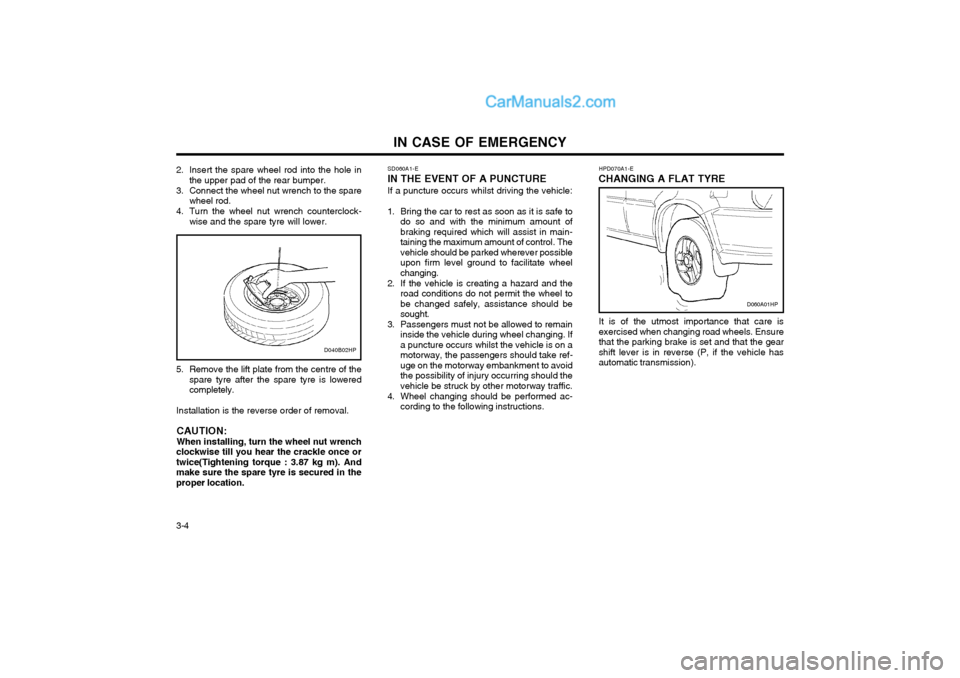
5. Remove the lift plate from the centre of the spare tyre after the spare tyre is lowered completely.
Installation is the reverse order of removal.
CAUTION: When installing, turn the wheel nut wrench
clockwise till you hear the crackle once or
twice(Tightening torque : 3.87 kg m). Andmake sure the spare tyre is secured in theproper location.
2. Insert the spare wheel rod into the hole in the upper pad of the rear bumper.
3. Connect the wheel nut wrench to the spare wheel rod.
4. Turn the wheel nut wrench counterclock- wise and the spare tyre will lower.
D040B02HP
Page 307 of 361
IN CASE OF EMERGENCY 3-5
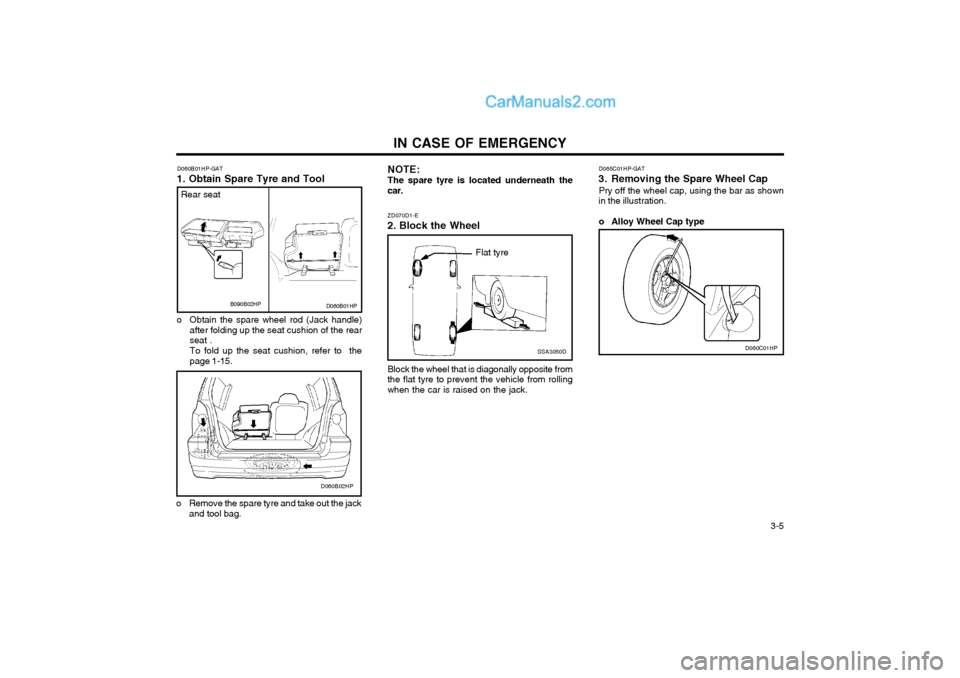
Block the wheel that is diagonally opposite from the flat tyre to prevent the vehicle from rollingwhen the car is raised on the jack.
ZD070D1-E
2. Block the Wheel
SSA3050D
Flat tyre
D060B01HP NOTE: The spare tyre is located underneath the
car.
o Obtain the spare wheel rod (Jack handle) after folding up the seat cushion of the rear seat . To fold up the seat cushion, refer to the page 1-15.
D060B01HP-GAT
1. Obtain Spare Tyre and Tool
o Remove the spare tyre and take out the jack and tool bag.
D060B02HP
B090B02HP
Rear seat D065C01HP-GAT
3. Removing the Spare Wheel Cap
Pry off the wheel cap, using the bar as shown
in the illustration.
o Alloy Wheel Cap type
D060C01HP
Page 308 of 361
IN CASE OF EMERGENCY
3-6 ZD070F1-E
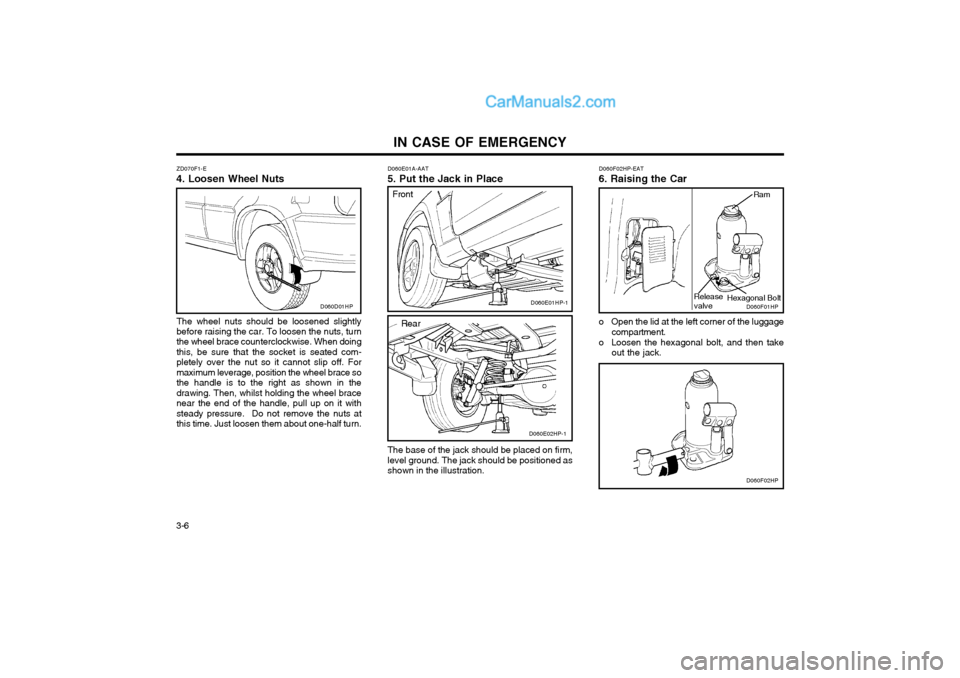
4. Loosen Wheel Nuts
The wheel nuts should be loosened slightly before raising the car. To loosen the nuts, turn the wheel brace counterclockwise. When doing this, be sure that the socket is seated com-pletely over the nut so it cannot slip off. Formaximum leverage, position the wheel brace sothe handle is to the right as shown in thedrawing. Then, whilst holding the wheel bracenear the end of the handle, pull up on it withsteady pressure. Do not remove the nuts atthis time. Just loosen them about one-half turn.
D060D01HP
D060F02HP
D060F02HP-EAT
6. Raising the Car
D060F01HP
o Open the lid at the left corner of the luggage compartment.
o Loosen the hexagonal bolt, and then take out the jack.
Ram
Hexagonal BoltRelease valve
D060E01A-AAT
5. Put the Jack in Place
The base of the jack should be placed on firm, level ground. The jack should be positioned asshown in the illustration.D060E01HP-1
D060E02HP-1
Rear
Front