lock Hyundai Terracan 2004 Owner's Manual
[x] Cancel search | Manufacturer: HYUNDAI, Model Year: 2004, Model line: Terracan, Model: Hyundai Terracan 2004Pages: 361, PDF Size: 4.69 MB
Page 309 of 361
IN CASE OF EMERGENCY 3-7
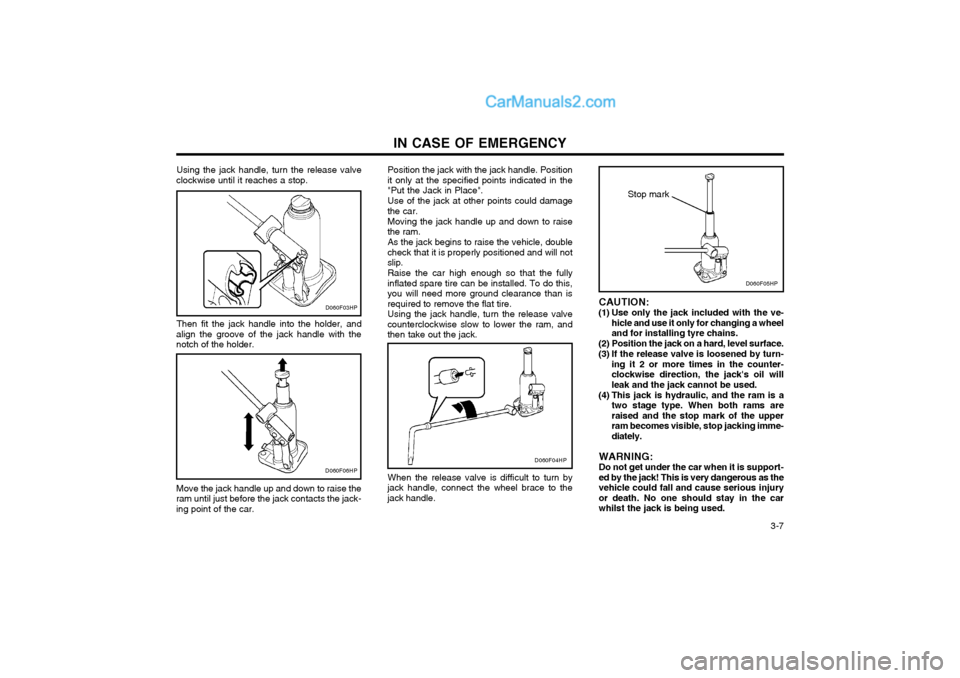
Using the jack handle, turn the release valve
clockwise until it reaches a stop.
Then fit the jack handle into the holder, and
align the groove of the jack handle with the notch of the holder.
D060F03HP
Move the jack handle up and down to raise the
ram until just before the jack contacts the jack- ing point of the car.
D060F04HP
When the release valve is difficult to turn by
jack handle, connect the wheel brace to the jack handle. CAUTION:
(1) Use only the jack included with the ve- hicle and use it only for changing a wheeland for installing tyre chains.
(2) Position the jack on a hard, level surface.
(3) If the release valve is loosened by turn- ing it 2 or more times in the counter- clockwise direction, the jack's oil willleak and the jack cannot be used.
(4) This jack is hydraulic, and the ram is a two stage type. When both rams areraised and the stop mark of the upperram becomes visible, stop jacking imme-diately.
WARNING:Do not get under the car when it is support-ed by the jack! This is very dangerous as thevehicle could fall and cause serious injuryor death. No one should stay in the carwhilst the jack is being used.
D060F05HP
D060F06HP Position the jack with the jack handle. Position
it only at the specified points indicated in the "Put the Jack in Place".
Use of the jack at other points could damage
the car.
Moving the jack handle up and down to raise
the ram.
As the jack begins to raise the vehicle, double
check that it is properly positioned and will notslip.
Raise the car high enough so that the fully
inflated spare tire can be installed. To do this,you will need more ground clearance than isrequired to remove the flat tire. Using the jack handle, turn the release valve
counterclockwise slow to lower the ram, andthen take out the jack.
Stop mark
Page 312 of 361
IN CASE OF EMERGENCY
3-10 D080B01HP-EAT
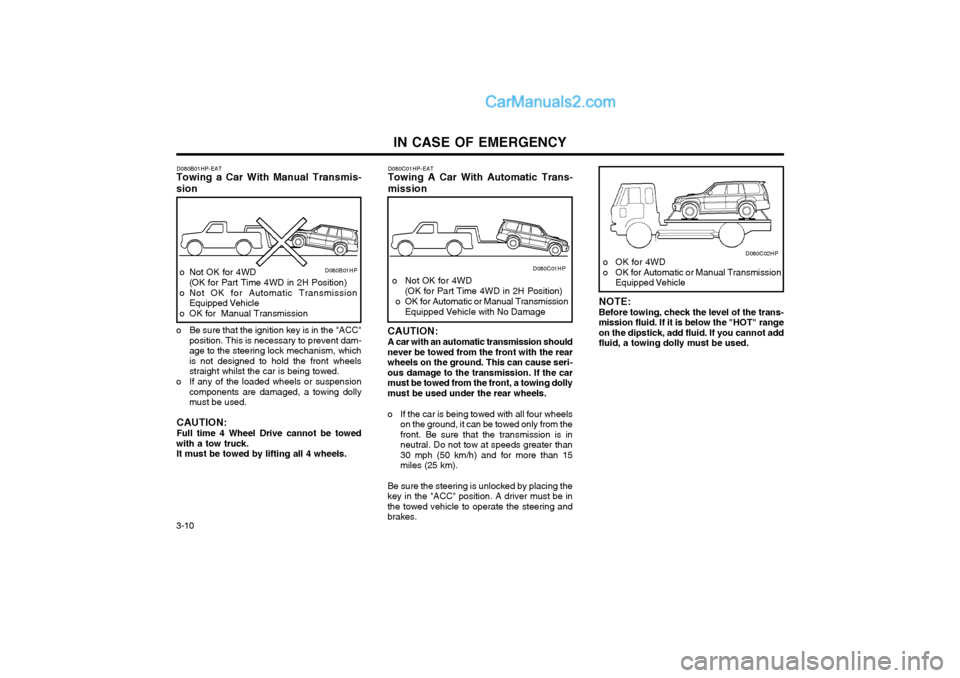
Towing a Car With Manual Transmis- sion
o Not OK for 4WD
(OK for Part Time 4WD in 2H Position)
o Not OK for Automatic Transmission Equipped Vehicle
o OK for Manual Transmission D080B01HP
o Be sure that the ignition key is in the "ACC" position. This is necessary to prevent dam- age to the steering lock mechanism, whichis not designed to hold the front wheelsstraight whilst the car is being towed.
o If any of the loaded wheels or suspension components are damaged, a towing dollymust be used.
CAUTION: Full time 4 Wheel Drive cannot be towed
with a tow truck. It must be towed by lifting all 4 wheels.o OK for 4WD
o OK for Automatic or Manual Transmission Equipped VehicleD080C02HP
NOTE: Before towing, check the level of the trans- mission fluid. If it is below the "HOT" rangeon the dipstick, add fluid. If you cannot addfluid, a towing dolly must be used.
D080C01HP-EAT
Towing A Car With Automatic Trans- mission
CAUTION: A car with an automatic transmission should never be towed from the front with the rearwheels on the ground. This can cause seri-ous damage to the transmission. If the carmust be towed from the front, a towing dollymust be used under the rear wheels.
o If the car is being towed with all four wheels on the ground, it can be towed only from thefront. Be sure that the transmission is inneutral. Do not tow at speeds greater than30 mph (50 km/h) and for more than 15miles (25 km).
Be sure the steering is unlocked by placing thekey in the "ACC" position. A driver must be inthe towed vehicle to operate the steering andbrakes.
o Not OK for 4WD (OK for Part Time 4WD in 2H Position)
o OK for Automatic or Manual Transmission Equipped Vehicle with No Damage
D080C01HP
Page 320 of 361
VEHICLE MAINTENANCE REQUIREMENTS
5- 4
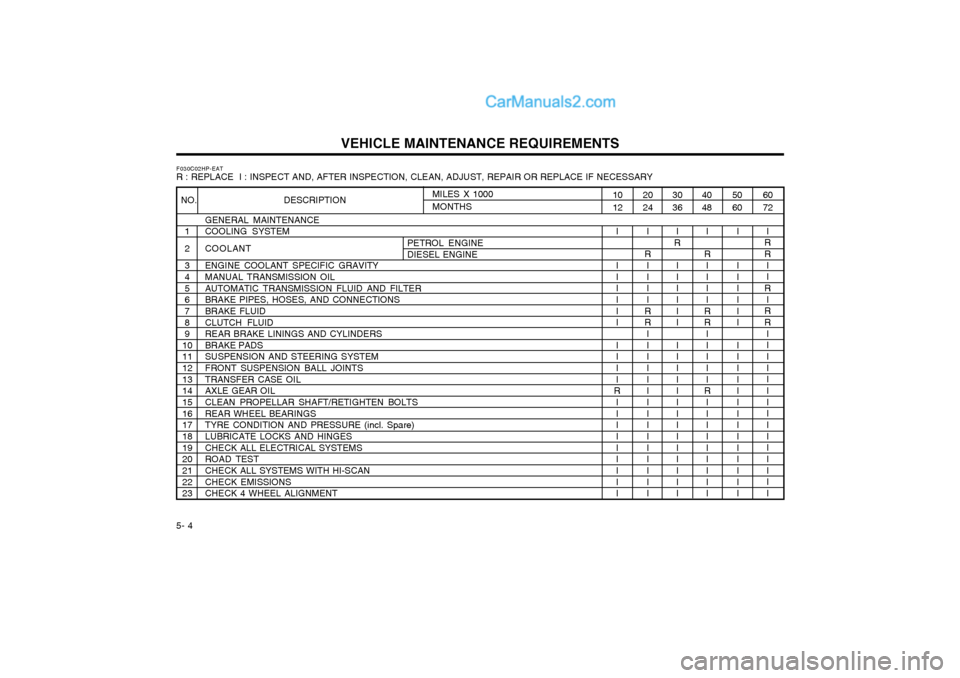
F030C02HP-EAT R : REPLACE I : INSPECT AND, AFTER INSPECTION, CLEAN, ADJUST, REPAIR OR REPLACE IF NECESSARY
GENERAL MAINTENANCE COOLING SYSTEM COOLANTENGINE COOLANT SPECIFIC GRAVITY MANUAL TRANSMISSION OIL AUTOMATIC TRANSMISSION FLUID AND FILTER BRAKE PIPES, HOSES, AND CONNECTIONSBRAKE FLUID CLUTCH FLUID REAR BRAKE LININGS AND CYLINDERSBRAKE PADSSUSPENSION AND STEERING SYSTEM FRONT SUSPENSION BALL JOINTS TRANSFER CASE OILAXLE GEAR OIL CLEAN PROPELLAR SHAFT/RETIGHTEN BOLTS REAR WHEEL BEARINGSTYRE CONDITION AND PRESSURE (incl. Spare) LUBRICATE LOCKS AND HINGES CHECK ALL ELECTRICAL SYSTEMSROAD TEST CHECK ALL SYSTEMS WITH HI-SCAN CHECK EMISSIONSCHECK 4 WHEEL ALIGNMENT
60 72
50 60
4048
I
R R
II
R
I
RR
III I II I II I II I II
I I I II I I I II I II I II I II I I
I
R I I II
RR I I II I
R II II I II I I
30 36
2024
I
R
I I II I I I II I II I II I II I I
I
R I I II
RR I I II I II I II I II I I
10 12
I I I II I I I II I
R
II II I II I I
MILES X 1000 MONTHS
NO. DESCRIPTION
1 23 4 5 67 8 9
1011 12 1314 15 1617 18 1920 21
22 23
PETROL ENGINE DIESEL ENGINE
Page 329 of 361
OWNER MAINTENANCE 6-5
If the indicated oil level is at or below the lower
mark of the dipstick, oil should be added until the level is at or below the upper mark.
To add oil to the engine, remove the filler cap by
rotating in an counterclockwise direction andpour engine oil into the engine. Before checkingthe level again, allow several minutes for the oilto drain into the sump. Replace the oil filler caprotating it in a clockwise direction until tight.
The quantity of oil required to raise the level
from the minimum to maximum level is approx-imately 1 litre (Petrol Engine)/1.4 litres (DieselEngine). G350A01A-EAT
ENGINE OIL CONSUMPTION
Function of engine oil Engine oil has the primary function of lubricat-
ing and cooling the inside of the engine.
Engine oil consumption It is normal that an engine should consume
some engine oil whilst normal driving.
The causes of oil consumption in a normal
engine are as follows;
o Engine oil is used to lubricate pistons, piston rings and cylinders. A thin film of oil is left on the cylinder wall when a piston moves downwards in thecylinder.High negative pressure generated duringengine operation sucks some of this oil intothe combustion chamber. This oil with some oil of the cylinder wall is burned by the high temperature combustiongases during the combustion process.
o The engine oil consumption is strongly ef- fected by the viscosity and quality of oil,engine rpm and driving condition etc. More engine oil may be consumed under severe driving conditions such as highspeeds, frequent acceleration and decelera-tion, compared to normal driving.
G030D03HP-E G040A04A-EAT
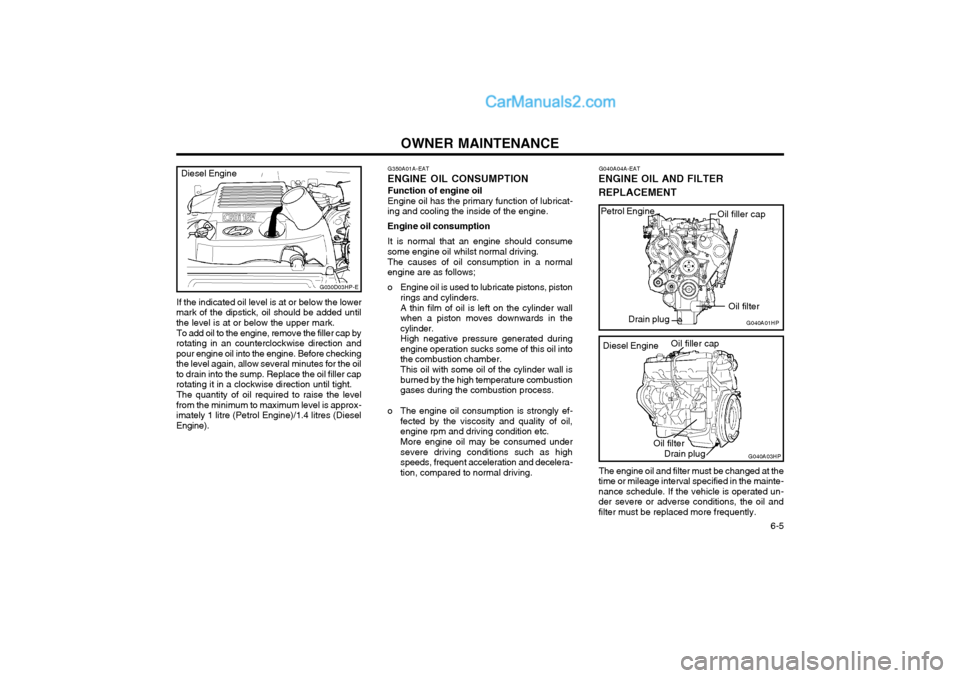
ENGINE OIL AND FILTER REPLACEMENT
G040A03HP
Oil filler cap
Oil filter Drain plug
G040A01HP
Petrol Engine
Oil filter
Drain plug Oil filler cap
The engine oil and filter must be changed at the
time or mileage interval specified in the mainte- nance schedule. If the vehicle is operated un-der severe or adverse conditions, the oil andfilter must be replaced more frequently. Diesel Engine
Diesel Engine
Page 330 of 361
OWNER MAINTENANCE
6-6
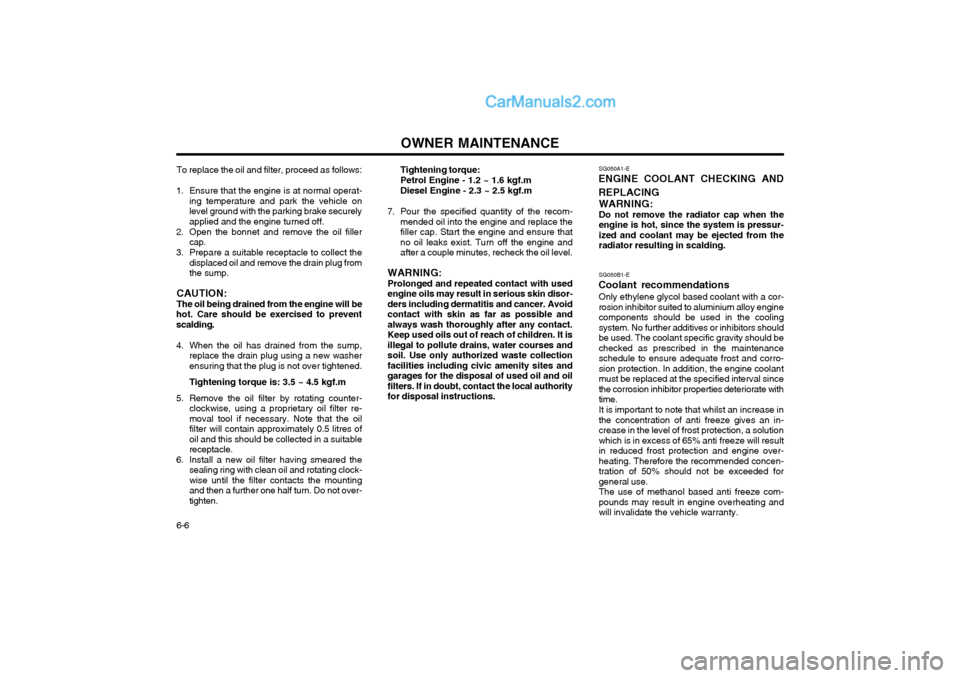
To replace the oil and filter, proceed as follows:
1. Ensure that the engine is at normal operat- ing temperature and park the vehicle on level ground with the parking brake securelyapplied and the engine turned off.
2. Open the bonnet and remove the oil filler cap.
3. Prepare a suitable receptacle to collect the displaced oil and remove the drain plug fromthe sump.
CAUTION: The oil being drained from the engine will be
hot. Care should be exercised to prevent scalding.
4. When the oil has drained from the sump, replace the drain plug using a new washer ensuring that the plug is not over tightened. Tightening torque is: 3.5 ~ 4.5 kgf.m
5. Remove the oil filter by rotating counter- clockwise, using a proprietary oil filter re- moval tool if necessary. Note that the oilfilter will contain approximately 0.5 litres ofoil and this should be collected in a suitablereceptacle.
6. Install a new oil filter having smeared the sealing ring with clean oil and rotating clock-wise until the filter contacts the mountingand then a further one half turn. Do not over-tighten. Tightening torque: Petrol Engine - 1.2 ~ 1.6 kgf.mDiesel Engine - 2.3 ~ 2.5 kgf.m
7. Pour the specified quantity of the recom- mended oil into the engine and replace the filler cap. Start the engine and ensure thatno oil leaks exist. Turn off the engine andafter a couple minutes, recheck the oil level.
WARNING: Prolonged and repeated contact with used engine oils may result in serious skin disor-ders including dermatitis and cancer. Avoidcontact with skin as far as possible andalways wash thoroughly after any contact.Keep used oils out of reach of children. It isillegal to pollute drains, water courses andsoil. Use only authorized waste collectionfacilities including civic amenity sites andgarages for the disposal of used oil and oilfilters. If in doubt, contact the local authorityfor disposal instructions. SG050A1-E
ENGINE COOLANT CHECKING AND REPLACING
WARNING: Do not remove the radiator cap when the engine is hot, since the system is pressur-ized and coolant may be ejected from theradiator resulting in scalding. SG050B1-E
Coolant recommendations Only ethylene glycol based coolant with a cor- rosion inhibitor suited to aluminium alloy enginecomponents should be used in the coolingsystem. No further additives or inhibitors shouldbe used. The coolant specific gravity should bechecked as prescribed in the maintenanceschedule to ensure adequate frost and corro-sion protection. In addition, the engine coolantmust be replaced at the specified interval sincethe corrosion inhibitor properties deteriorate withtime. It is important to note that whilst an increase in the concentration of anti freeze gives an in-crease in the level of frost protection, a solutionwhich is in excess of 65% anti freeze will resultin reduced frost protection and engine over-heating. Therefore the recommended concen-tration of 50% should not be exceeded forgeneral use.The use of methanol based anti freeze com-pounds may result in engine overheating andwill invalidate the vehicle warranty.
Page 334 of 361
OWNER MAINTENANCE
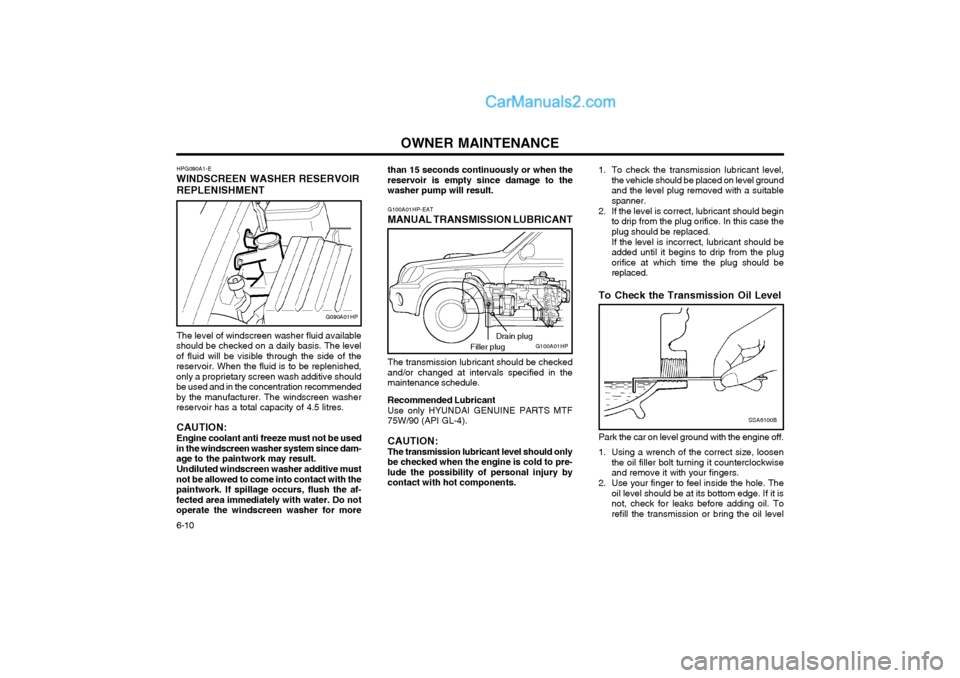
6-10 1. To check the transmission lubricant level,
the vehicle should be placed on level ground and the level plug removed with a suitablespanner.
2. If the level is correct, lubricant should begin to drip from the plug orifice. In this case theplug should be replaced. If the level is incorrect, lubricant should be added until it begins to drip from the plugorifice at which time the plug should bereplaced.
To Check the Transmission Oil Level
SSA6100B
Park the car on level ground with the engine off.
1. Using a wrench of the correct size, loosen the oil filler bolt turning it counterclockwise and remove it with your fingers.
2. Use your finger to feel inside the hole. The oil level should be at its bottom edge. If it isnot, check for leaks before adding oil. Torefill the transmission or bring the oil level
G100A01HP-EAT
MANUAL TRANSMISSION LUBRICANT
The transmission lubricant should be checkedand/or changed at intervals specified in themaintenance schedule. Recommended Lubricant Use only HYUNDAI GENUINE PARTS MTF 75W/90 (API GL-4). CAUTION: The transmission lubricant level should onlybe checked when the engine is cold to pre-lude the possibility of personal injury bycontact with hot components.
G090A01HP
HPG090A1-E
WINDSCREEN WASHER RESERVOIR
REPLENISHMENT The level of windscreen washer fluid available
should be checked on a daily basis. The level of fluid will be visible through the side of thereservoir. When the fluid is to be replenished,only a proprietary screen wash additive shouldbe used and in the concentration recommendedby the manufacturer. The windscreen washerreservoir has a total capacity of 4.5 litres.
CAUTION: Engine coolant anti freeze must not be used
in the windscreen washer system since dam- age to the paintwork may result.
Undiluted windscreen washer additive must
not be allowed to come into contact with thepaintwork. If spillage occurs, flush the af-fected area immediately with water. Do notoperate the windscreen washer for more than 15 seconds continuously or when thereservoir is empty since damage to thewasher pump will result.
G100A01HP
Drain plug
Filler plug
Page 336 of 361
OWNER MAINTENANCE
6-12
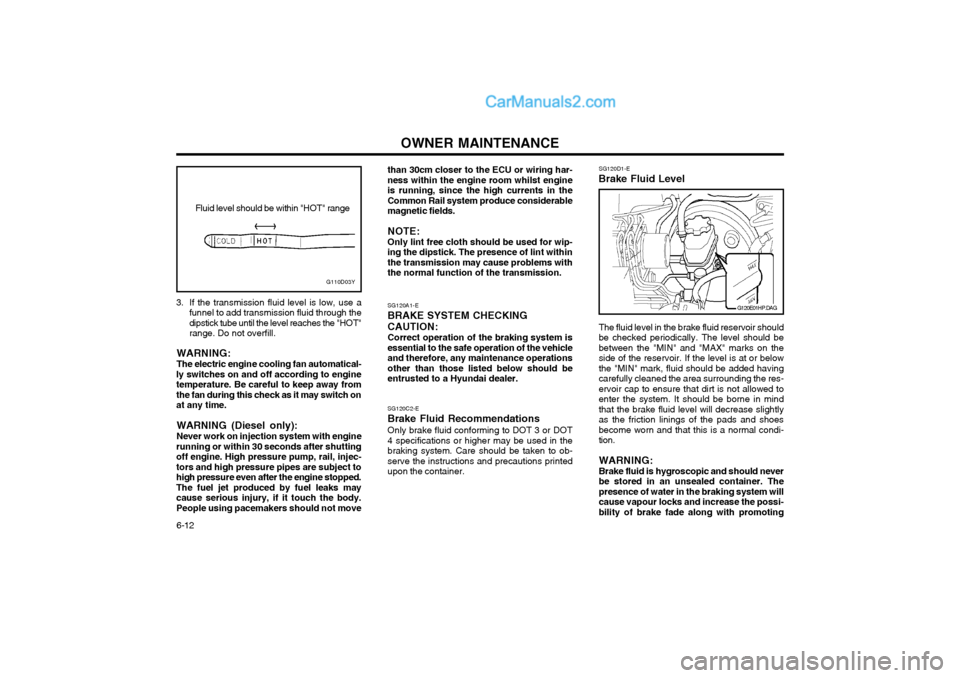
3. If the transmission fluid level is low, use a
funnel to add transmission fluid through the dipstick tube until the level reaches the "HOT"range. Do not overfill.
WARNING: The electric engine cooling fan automatical-
ly switches on and off according to engine temperature. Be careful to keep away fromthe fan during this check as it may switch onat any time.
WARNING (Diesel only): Never work on injection system with engine
running or within 30 seconds after shutting off engine. High pressure pump, rail, injec-tors and high pressure pipes are subject tohigh pressure even after the engine stopped.The fuel jet produced by fuel leaks maycause serious injury, if it touch the body.People using pacemakers should not move
G110D03Y
Fluid level should be within "HOT" range
than 30cm closer to the ECU or wiring har- ness within the engine room whilst engineis running, since the high currents in theCommon Rail system produce considerablemagnetic fields.
NOTE: Only lint free cloth should be used for wip-
ing the dipstick. The presence of lint within the transmission may cause problems withthe normal function of the transmission.
G120E01HP.DAG
SG120A1-E
BRAKE SYSTEM CHECKING CAUTION: Correct operation of the braking system is essential to the safe operation of the vehicleand therefore, any maintenance operationsother than those listed below should beentrusted to a Hyundai dealer. SG120C2-E
Brake Fluid Recommendations Only brake fluid conforming to DOT 3 or DOT 4 specifications or higher may be used in thebraking system. Care should be taken to ob-serve the instructions and precautions printedupon the container. SG120D1-E
Brake Fluid Level
The fluid level in the brake fluid reservoir shouldbe checked periodically. The level should bebetween the "MIN" and "MAX" marks on theside of the reservoir. If the level is at or belowthe "MIN" mark, fluid should be added havingcarefully cleaned the area surrounding the res-ervoir cap to ensure that dirt is not allowed toenter the system. It should be borne in mindthat the brake fluid level will decrease slightlyas the friction linings of the pads and shoesbecome worn and that this is a normal condi-tion. WARNING: Brake fluid is hygroscopic and should never be stored in an unsealed container. Thepresence of water in the braking system willcause vapour locks and increase the possi-bility of brake fade along with promoting
Page 350 of 361
CONSUMER INFORMATION 8-1
YI000A1-E
8. CONSUMERINFORMATION
8
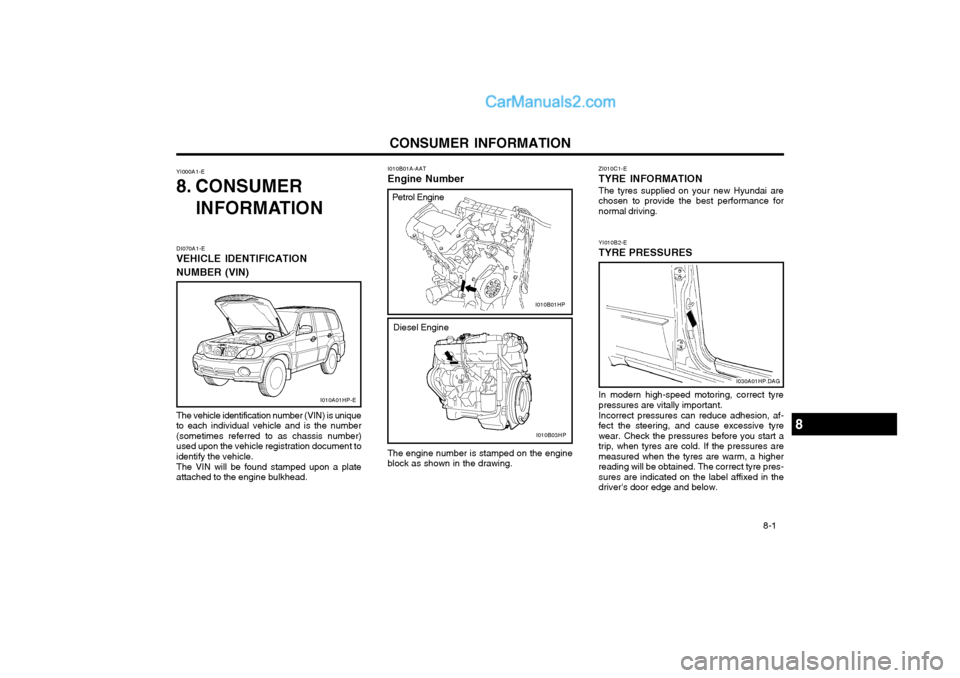
DI070A1-E VEHICLE IDENTIFICATION NUMBER (VIN)
I010A01HP-E
I030A01HP.DAG
I010B03HP
I010B01HP
Petrol Engine
The vehicle identification number (VIN) is unique to each individual vehicle and is the number(sometimes referred to as chassis number)used upon the vehicle registration document toidentify the vehicle. The VIN will be found stamped upon a plate attached to the engine bulkhead. I010B01A-AAT Engine Number The engine number is stamped on the engine block as shown in the drawing.
ZI010C1-E TYRE INFORMATION The tyres supplied on your new Hyundai are chosen to provide the best performance fornormal driving. YI010B2-E TYRE PRESSURES In modern high-speed motoring, correct tyre pressures are vitally important. Incorrect pressures can reduce adhesion, af- fect the steering, and cause excessive tyrewear. Check the pressures before you start atrip, when tyres are cold. If the pressures aremeasured when the tyres are warm, a higherreading will be obtained. The correct tyre pres-sures are indicated on the label affixed in thedriver's door edge and below.
Diesel Engine
Page 357 of 361
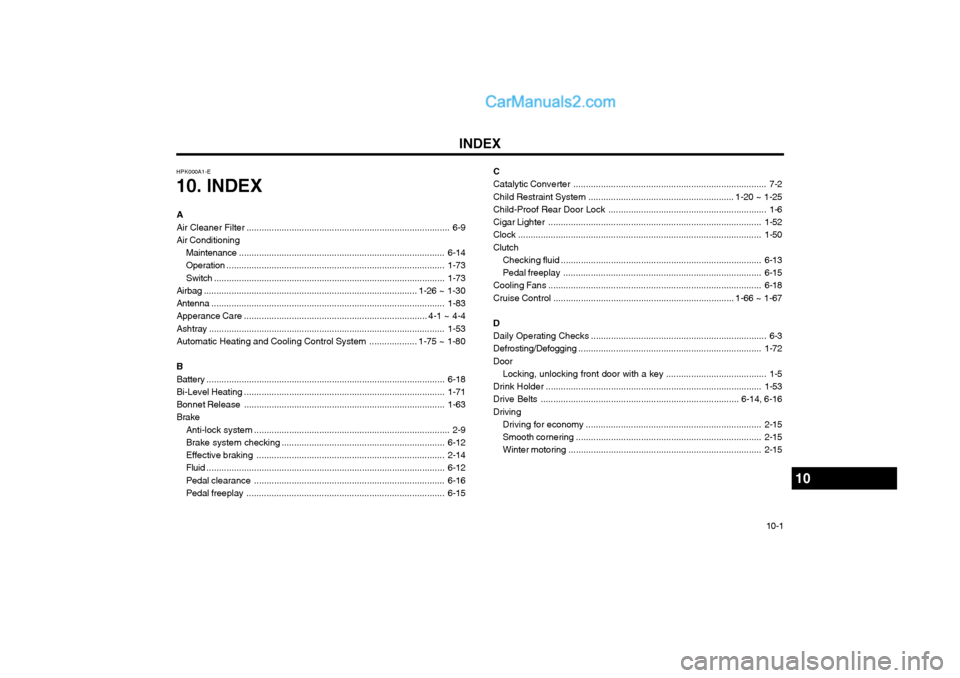
INDEX10-1
C Catalytic Converter
............................................................................. 7-2
Child Restraint System .......................................................... 1-20 ~ 1-25
Child-Proof Rear Door Lock ......... ...................................................... 1-6
Cigar Lighter ..................................................................................... 1-52
Clock ................................................................................................. 1-50
Clutch Checking fluid ................................................................................ 6-13
Pedal freeplay ............................................................................... 6-15
Cooling Fans ..................................................................................... 6-18
Cruise Control ........................................................................ 1-66 ~ 1-67
DDaily Operating Checks ...................................................................... 6-3
Defrosting/Defogging ......................................................................... 1-72
Door Locking, unlocking front door with a key ........................................ 1-5
Drink Holder ...................................................................................... 1-53
Drive Belts ............................................................................... 6-14, 6-16
Driving Driving for economy ...................................................................... 2-15
Smooth cornering .......................................................................... 2-15
Winter motoring ............................................................................. 2-15
HPK000A1-E 10. INDEX
A Air Cleaner Filter ................................................................................. 6-9
Air Conditioning
Maintenance .................................................................................. 6-14
Operation ....................................................................................... 1-73
Switch ............................................................................................ 1-73
Airbag ..................................................................................... 1-26 ~ 1-30
Antenna ............................................................................................. 1-83
Apperance Care ......................................................................... 4-1 ~ 4-4
Ashtray .............................................................................................. 1-53
Automatic Heating and Cooling Control System ...................1-75 ~ 1-80
BBattery ............................................................................................... 6-18
Bi-Level Heating ................................................................................ 1-71
Bonnet Release ................................................................................ 1-63
Brake
Anti-lock system .............................................................................. 2-9
Brake system checking ................................................................. 6-12
Effective braking ........................................................................... 2-14
Fluid ............................................................................................... 6-12
Pedal clearance ............................................................................ 6-16
Pedal freeplay ............................................................................... 6-15
10