Cooling system Hyundai Terracan 2004 User Guide
[x] Cancel search | Manufacturer: HYUNDAI, Model Year: 2004, Model line: Terracan, Model: Hyundai Terracan 2004Pages: 361, PDF Size: 4.69 MB
Page 160 of 361
DO-IT-YOURSELF MAINTENANCE
6-8
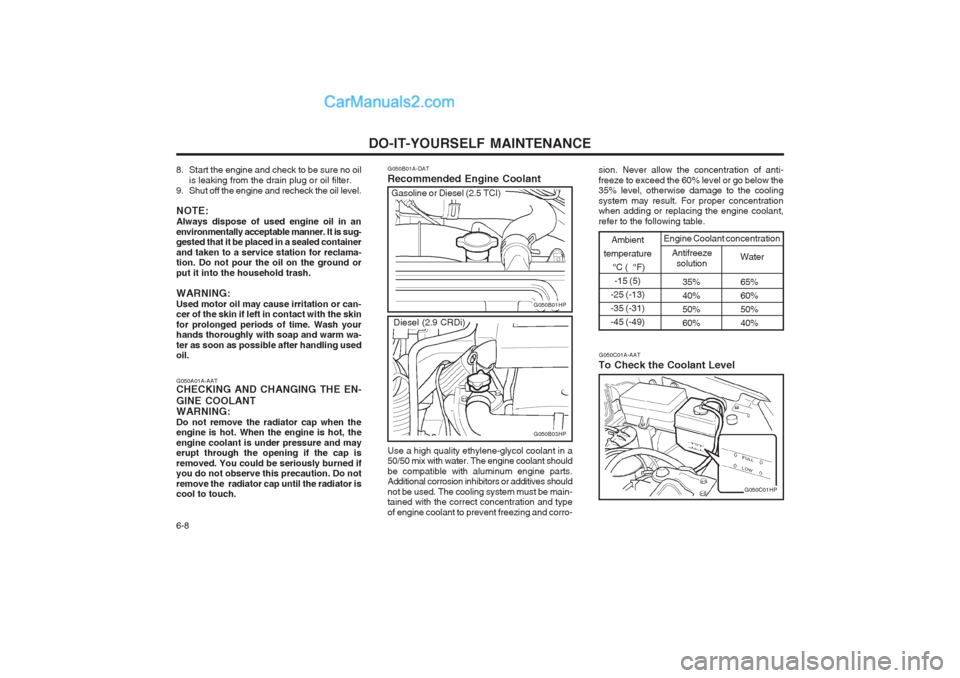
G050B01A-DAT Recommended Engine Coolant
35% 65%
40% 60%
50% 50%
60% 40%
Ambient
temperature °C ( °F)-15 (5)
-25 (-13) -35 (-31)-45 (-49)
Antifreeze solution Water
Engine Coolant concentration
G050B01HP
G050C01A-AAT
To Check the Coolant Level
G050C01HP
Use a high quality ethylene-glycol coolant in a 50/50 mix with water. The engine coolant should be compatible with aluminum engine parts. Additional corrosion inhibitors or additives should not be used. The cooling system must be main- tained with the correct concentration and type of engine coolant to prevent freezing and corro-
Gasoline or Diesel (2.5 TCI)
G050B03HP
Diesel (2.9 CRDi) sion. Never allow the concentration of anti- freeze to exceed the 60% level or go below the 35% level, otherwise damage to the cooling system may result. For proper concentration when adding or replacing the engine coolant, refer to the following table.
8. Start the engine and check to be sure no oil
is leaking from the drain plug or oil filter.
9. Shut off the engine and recheck the oil level. NOTE: Always dispose of used engine oil in anenvironmentally acceptable manner. It is sug- gested that it be placed in a sealed container and taken to a service station for reclama- tion. Do not pour the oil on the ground or put it into the household trash. WARNING: Used motor oil may cause irritation or can- cer of the skin if left in contact with the skin for prolonged periods of time. Wash your hands thoroughly with soap and warm wa- ter as soon as possible after handling used oil. G050A01A-AAT CHECKING AND CHANGING THE EN- GINE COOLANT WARNING: Do not remove the radiator cap when the engine is hot. When the engine is hot, the engine coolant is under pressure and may erupt through the opening if the cap is removed. You could be seriously burned if you do not observe this precaution. Do not remove the radiator cap until the radiator is cool to touch.
Page 161 of 361
DO-IT-YOURSELF MAINTENANCE 6-9
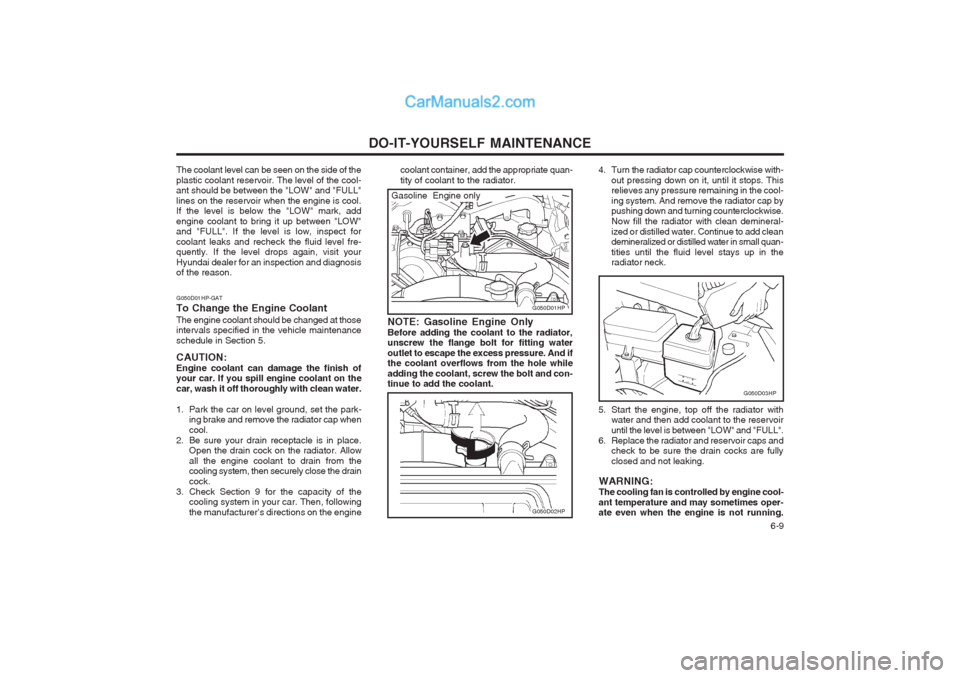
coolant container, add the appropriate quan- tity of coolant to the radiator.
G050D03HP
G050D01HP
G050D02HP
NOTE: Gasoline Engine Only Before adding the coolant to the radiator, unscrew the flange bolt for fitting water outlet to escape the excess pressure. And if the coolant overflows from the hole while adding the coolant, screw the bolt and con- tinue to add the coolant. 4. Turn the radiator cap counterclockwise with-
out pressing down on it, until it stops. Thisrelieves any pressure remaining in the cool- ing system. And remove the radiator cap by pushing down and turning counterclockwise. Now fill the radiator with clean demineral-ized or distilled water. Continue to add clean demineralized or distilled water in small quan- tities until the fluid level stays up in the radiator neck.
5. Start the engine, top off the radiator with water and then add coolant to the reservoir until the level is between "LOW" and "FULL".
6. Replace the radiator and reservoir caps and check to be sure the drain cocks are fullyclosed and not leaking.
WARNING:The cooling fan is controlled by engine cool-
ant temperature and may sometimes oper- ate even when the engine is not running.
Gasoline Engine only
The coolant level can be seen on the side of the plastic coolant reservoir. The level of the cool- ant should be between the "LOW" and "FULL" lines on the reservoir when the engine is cool. If the level is below the "LOW" mark, add engine coolant to bring it up between "LOW" and "FULL". If the level is low, inspect for coolant leaks and recheck the fluid level fre- quently. If the level drops again, visit your Hyundai dealer for an inspection and diagnosis of the reason.
G050D01HP-GAT To Change the Engine CoolantThe engine coolant should be changed at those intervals specified in the vehicle maintenance schedule in Section 5. CAUTION: Engine coolant can damage the finish of your car. If you spill engine coolant on the car, wash it off thoroughly with clean water.
1. Park the car on level ground, set the park-
ing brake and remove the radiator cap when cool.
2. Be sure your drain receptacle is in place. Open the drain cock on the radiator. Allowall the engine coolant to drain from the cooling system, then securely close the drain cock.
3. Check Section 9 for the capacity of the cooling system in your car. Then, followingthe manufacturer’s directions on the engine
Page 165 of 361
DO-IT-YOURSELF MAINTENANCE 6-13
G110D03Y
Fluid level should be within "HOT" range
WARNING: The cooling fan is controlled by engine cool-ant temperature and may sometimes oper- ate even when the engine is not running. Use extreme caution when working near the blades of the cooling fan, so that you are not injured by a rotating fan blade. As the en- gine coolant temperature decreases, the fan will automatically shut off. This is a normal condition. WARNING (Diesel only): Never work on injection system with enginerunning or within 30 seconds after shutting off engine. High pressure pump, rail, injec- tors and high pressure pipes are subjected to high pressure even after the engine has been switched off. The fuel jet produced by fuel leaks may cause serious injury, if it contacts with the body. People using pace- makers should not move closer than 30cm to the ECU or wiring harness within the
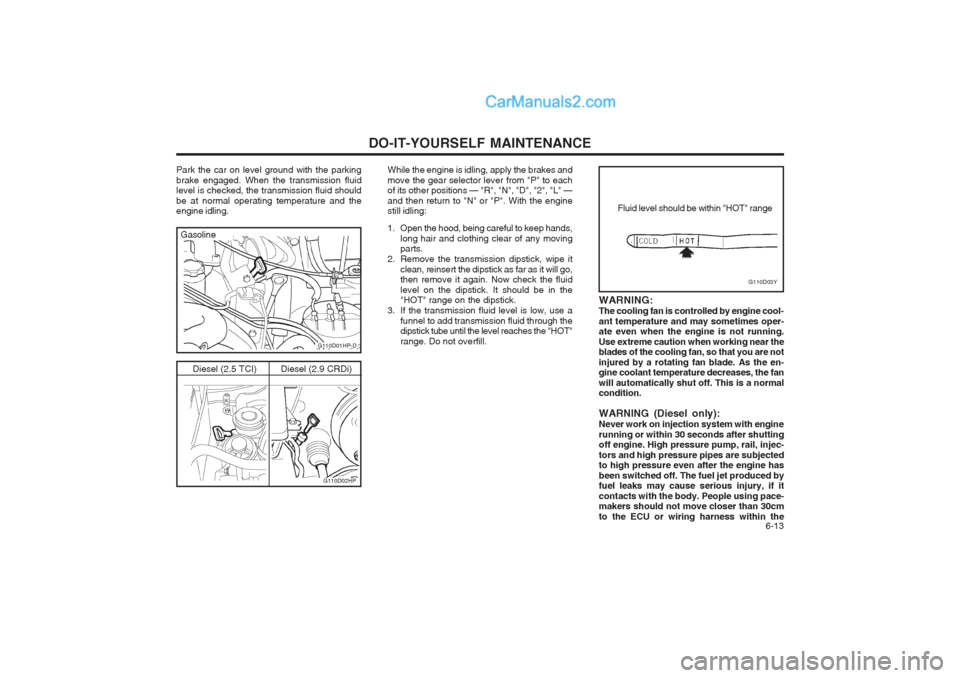
Park the car on level ground with the parking brake engaged. When the transmission fluid level is checked, the transmission fluid should be at normal operating temperature and the engine idling.
While the engine is idling, apply the brakes and move the gear selector lever from "P" to each of its other positions — "R", "N", "D", "2", "L" — and then return to "N" or "P". With the engine still idling:
1. Open the hood, being careful to keep hands,
long hair and clothing clear of any moving parts.
2. Remove the transmission dipstick, wipe it clean, reinsert the dipstick as far as it will go,then remove it again. Now check the fluid level on the dipstick. It should be in the "HOT" range on the dipstick.
3. If the transmission fluid level is low, use a funnel to add transmission fluid through thedipstick tube until the level reaches the "HOT" range. Do not overfill.
G110D01HP-D
Gasoline
Diesel (2.9 CRDi)
Diesel (2.5 TCI)
G110D02HP
Page 167 of 361
DO-IT-YOURSELF MAINTENANCE 6-15
Diesel (2.5 TCI)
G140D01HP-GAT
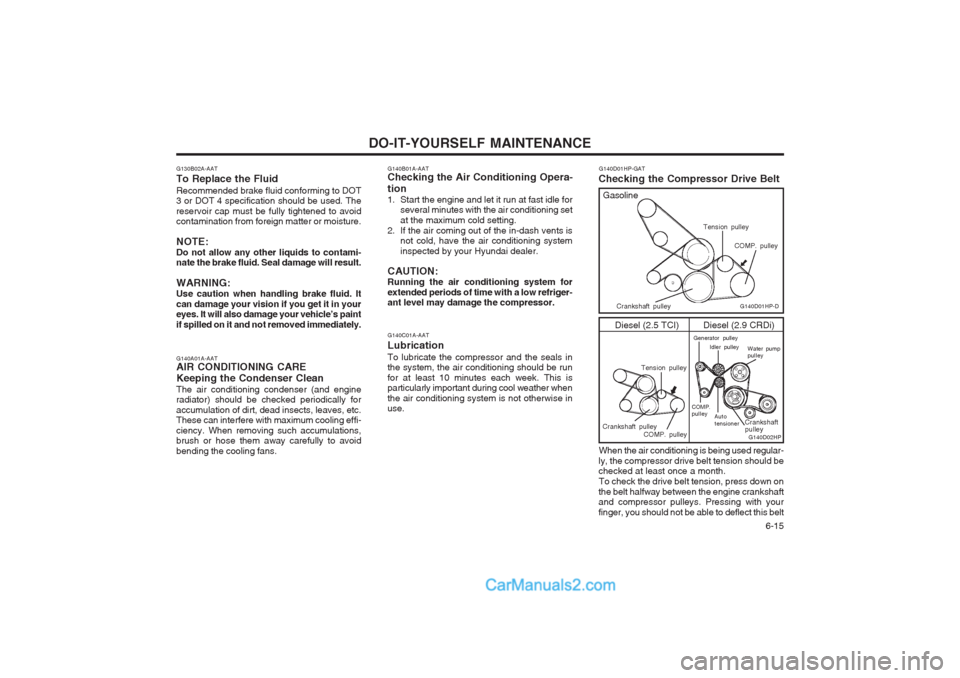
Checking the Compressor Drive Belt
G140A01A-AAT AIR CONDITIONING CARE Keeping the Condenser Clean The air conditioning condenser (and engine radiator) should be checked periodically for accumulation of dirt, dead insects, leaves, etc. These can interfere with maximum cooling effi- ciency. When removing such accumulations, brush or hose them away carefully to avoid bending the cooling fans.
G130B02A-AAT To Replace the FluidRecommended brake fluid conforming to DOT 3 or DOT 4 specification should be used. The reservoir cap must be fully tightened to avoid contamination from foreign matter or moisture. NOTE: Do not allow any other liquids to contami- nate the brake fluid. Seal damage will result. WARNING: Use caution when handling brake fluid. Itcan damage your vision if you get it in your eyes. It will also damage your vehicle’s paint if spilled on it and not removed immediately.
When the air conditioning is being used regular-
ly, the compressor drive belt tension should be checked at least once a month. To check the drive belt tension, press down on
the belt halfway between the engine crankshaftand compressor pulleys. Pressing with your finger, you should not be able to deflect this belt
G140D01HP-D
G140D02HP
Gasoline
Generator pulley Idler pulley Water pump pulley
COMP.pulley Auto tensionerCOMP. pulley
Crankshaft pulley Diesel (2.9 CRDi)
Crankshaft pulleyCOMP. pulleyCrankshaft pulley
Tension pulley
Tension pulley
G140B01A-AAT Checking the Air Conditioning Opera- tion
1. Start the engine and let it run at fast idle for
several minutes with the air conditioning set at the maximum cold setting.
2. If the air coming out of the in-dash vents is not cold, have the air conditioning systeminspected by your Hyundai dealer.
CAUTION:Running the air conditioning system forextended periods of time with a low refriger- ant level may damage the compressor. G140C01A-AAT LubricationTo lubricate the compressor and the seals in the system, the air conditioning should be run for at least 10 minutes each week. This is particularly important during cool weather when the air conditioning system is not otherwise in use.
Page 188 of 361
INDEX 10-1
A
Air bag ...................................................................................
1-30 ~ 1-33
Air Cleaner Filter ............................................................................... 6-10
Air Conditioning Care .............................................................................................. 6-15
Filter ..................................................................................... 1-79, 6-16
Operation .............................................................................. 1-72, 6-15
Switch ............................................................................................ 1-72
Antenna ........................................................................................... 1-101
Ashtray .............................................................................................. 1-53
Audio Fault Code .............................................................................. 1-98
Automatic Heating and Cooling Control System ...................1-74 ~ 1-78
BBattery ...................................................................................... 2-14, 6-20
Bi-Level Heating ................................................................................ 1-70
Brake Anti-lock system .............................................................................. 2-8
Checking the brakes ..................................................................... 6-14
Fluid ............................................................................................... 6-14
Pedal clearance ............................................................................ 6-18
Pedal free-play .............................................................................. 6-17
Practices ....................................................................................... 2-13
Breaking-In your New Hyundai ........................................................... 1-2 C Care of Cassette
Tapes ................................................................... 1-99
Care of Disc ...................................................................................... 1-99
Cassette Tape Player Operation (H240) ............................... 1-85 ~ 1-86
Cassette Tape Player Operation (H280) ............................... 1-90 ~ 1-91
Catalytic Converter ............................................................................. 7-1
CD Auto changer (H280) ............................................. 1-60, 1-95 ~ 1-97
Child Restraint System .......................................................... 1-24 ~ 1-28
Child-Protector Rear Door Lock ......................................................... 1-7
Cigarette Lighter ................................................................................ 1-52
Clock ................................................................................................. 1-51
Clutch
Checking fluid ................................................................................ 6-14
Pedal free-play .............................................................................. 6-17
Combination Light
Headlight flasher ........................................................................... 1-49
Headlight switch ............................................................................ 1-49
High-beam switch .......................................................................... 1-49
Lane change signal ....................................................................... 1-48
Parking light auto cut .................................................................... 1-49
Turn signal operation .................................................................... 1-48
Compact Disc Player Operation (H280) ................................ 1-92 ~ 1-94
Cooling Fans ..................................................................................... 6-20
Corrosion protection Cleaning the interior ........................................................................ 4-3
Protecting your Hyundai from corrosion ................ ......................... 4-1
Washing and waxing ....................................................................... 4-2
Cruise Control ........................................................................ 1-65 ~ 1-67
10. INDEX
10
Page 244 of 361
CONTROLS AND EQUIPMENT
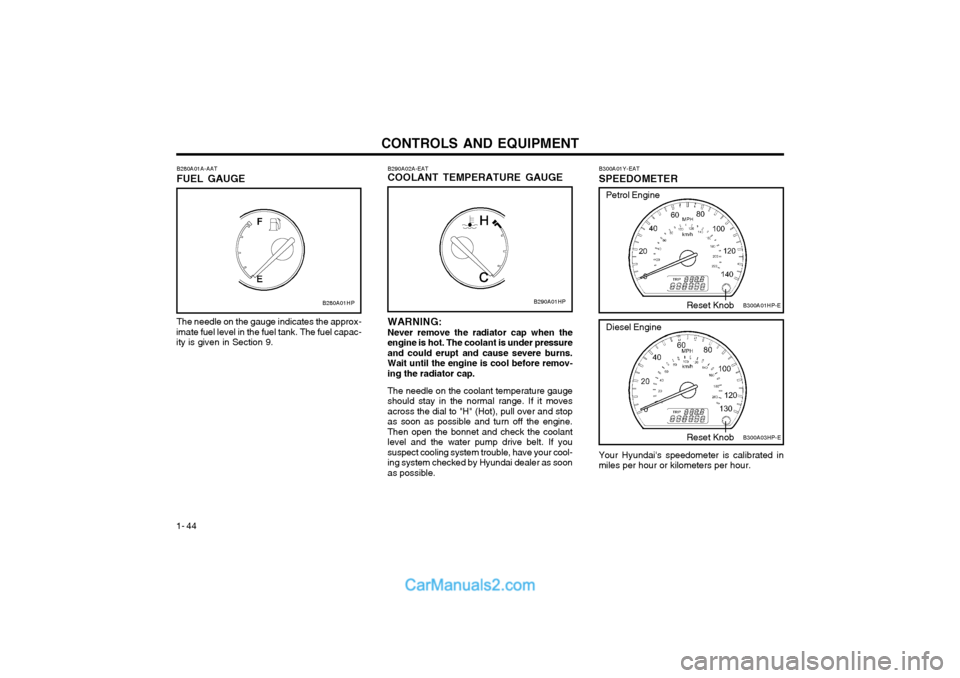
1- 44
B300A01Y-EAT SPEEDOMETER Your Hyundai's speedometer is calibrated in miles per hour or kilometers per hour. B300A03HP-EB290A02A-EAT COOLANT TEMPERATURE GAUGE WARNING: Never remove the radiator cap when the engine is hot. The coolant is under pressureand could erupt and cause severe burns.Wait until the engine is cool before remov-ing the radiator cap. The needle on the coolant temperature gauge should stay in the normal range. If it movesacross the dial to "H" (Hot), pull over and stopas soon as possible and turn off the engine.Then open the bonnet and check the coolantlevel and the water pump drive belt. If yoususpect cooling system trouble, have your cool-ing system checked by Hyundai dealer as soonas possible.
B280A01A-AAT FUEL GAUGE The needle on the gauge indicates the approx-
imate fuel level in the fuel tank. The fuel capac- ity is given in Section 9.
B280A01HPB290A01HP
Petrol Engine
Reset Knob
B300A01HP-E
Diesel EngineReset Knob
Page 268 of 361
CONTROLS AND EQUIPMENT
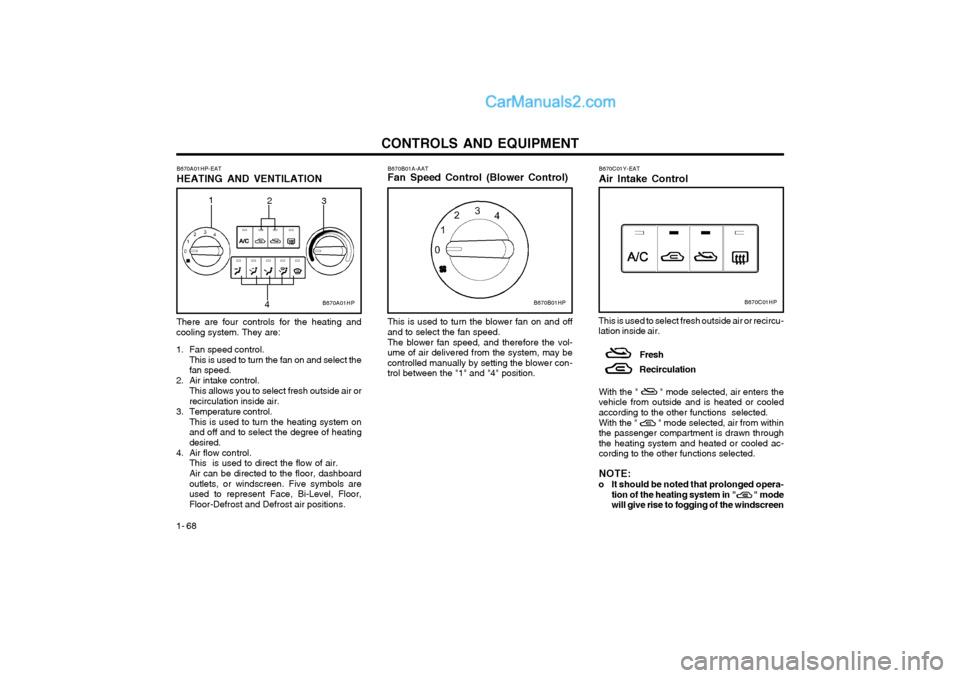
1- 68 B670B01A-AAT Fan Speed Control (Blower Control) This is used to turn the blower fan on and off
and to select the fan speed.
The blower fan speed, and therefore the vol-
ume of air delivered from the system, may be controlled manually by setting the blower con-trol between the "1" and "4" position.
B670A01HP-EAT HEATING AND VENTILATION There are four controls for the heating and
cooling system. They are:
1. Fan speed control. This is used to turn the fan on and select the fan speed.
2. Air intake control. This allows you to select fresh outside air orrecirculation inside air.
3. Temperature control. This is used to turn the heating system onand off and to select the degree of heatingdesired.
4. Air flow control. This is used to direct the flow of air. Air can be directed to the floor, dashboard outlets, or windscreen. Five symbols areused to represent Face, Bi-Level, Floor,Floor-Defrost and Defrost air positions. B670C01Y-EAT Air Intake Control
This is used to select fresh outside air or recircu- lation inside air. Fresh Recirculation
With the " " mode selected, air enters the vehicle from outside and is heated or cooledaccording to the other functions selected. With the " " mode selected, air from within the passenger compartment is drawn throughthe heating system and heated or cooled ac-cording to the other functions selected. NOTE:
o It should be noted that prolonged opera- tion of the heating system in " " mode will give rise to fogging of the windscreen
B670B01HPB670C01HPB670A01HP
2
3
1
4
Page 273 of 361
CONTROLS AND EQUIPMENT1- 73
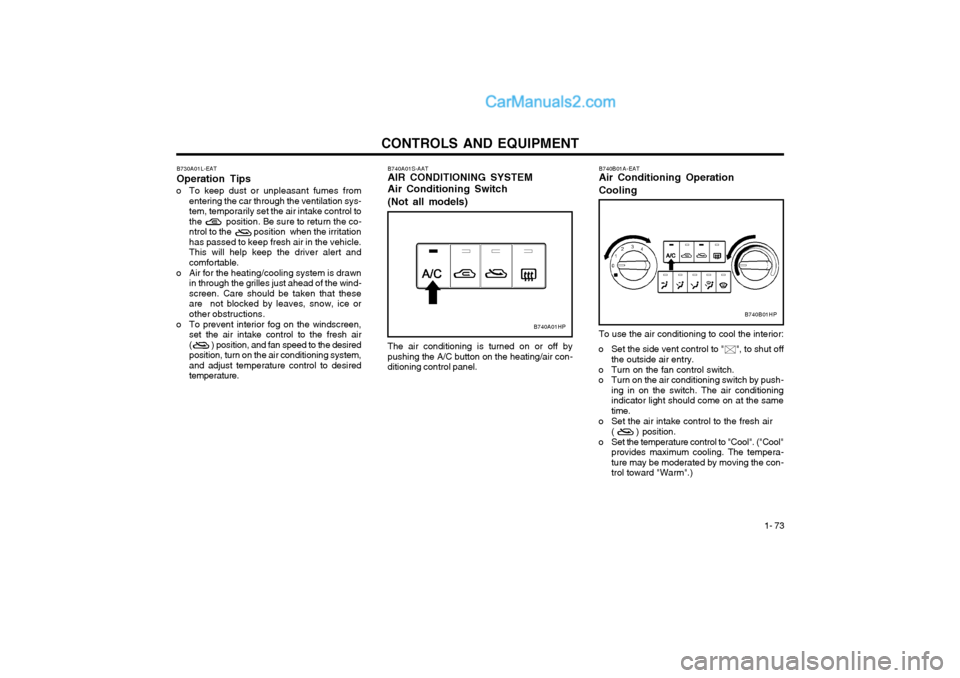
The air conditioning is turned on or off by pushing the A/C button on the heating/air con-ditioning control panel.
B740A01S-AAT AIR CONDITIONING SYSTEM Air Conditioning Switch (Not all models)
B730A01L-EAT Operation Tips
o To keep dust or unpleasant fumes from entering the car through the ventilation sys-
tem, temporarily set the air intake control to
the position. Be sure to return the co-
ntrol to the position when the irritationhas passed to keep fresh air in the vehicle.This will help keep the driver alert andcomfortable.
o Air for the heating/cooling system is drawn in through the grilles just ahead of the wind-screen. Care should be taken that these
are not blocked by leaves, snow, ice or
other obstructions.
o To prevent interior fog on the windscreen, set the air intake control to the fresh air( ) position, and fan speed to the desiredposition, turn on the air conditioning system,and adjust temperature control to desiredtemperature.
B740A01HP
B740B01A-EAT Air Conditioning Operation Cooling To use the air conditioning to cool the interior:
o Set the side vent control to " ", to shut off
the outside air entry.
o Turn on the fan control switch.
o Turn on the air conditioning switch by push- ing in on the switch. The air conditioningindicator light should come on at the sametime.
o Set the air intake control to the fresh air ( ) position.
o Set the temperature control to "Cool". ("Cool" provides maximum cooling. The tempera-ture may be moderated by moving the con-trol toward "Warm".)
B740B01HP
Page 275 of 361
CONTROLS AND EQUIPMENT1- 75
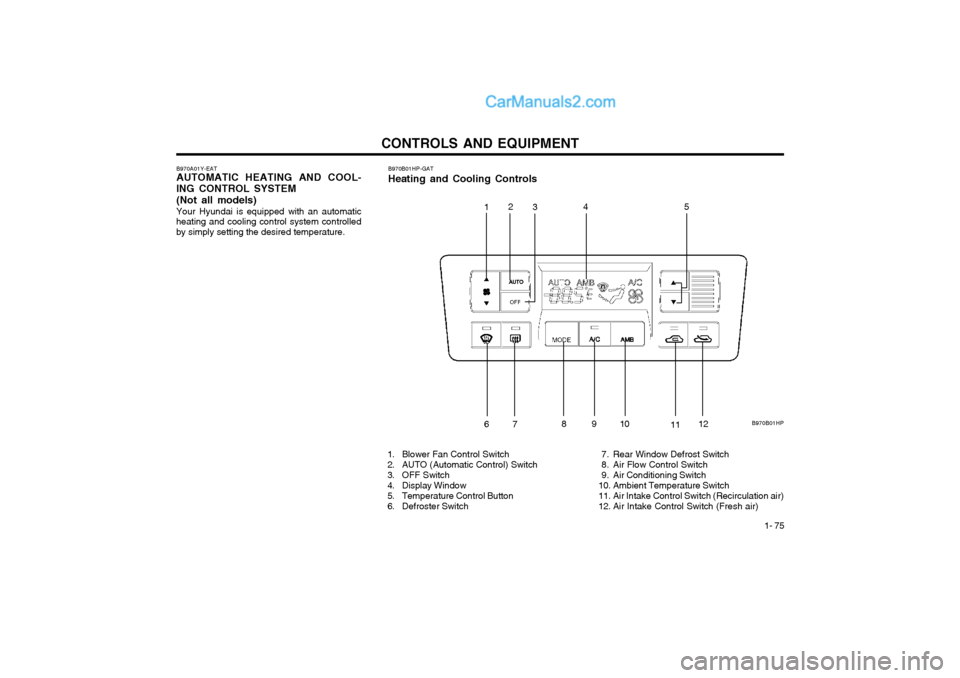
B970A01Y-EAT AUTOMATIC HEATING AND COOL-
ING CONTROL SYSTEM
(Not aII models) Your Hyundai is equipped with an automatic
heating and cooling control system controlled by simply setting the desired temperature. B970B01HP-GAT Heating and Cooling Controls
1. Blower Fan Control Switch
2. AUTO (Automatic Control) Switch
3. OFF Switch
4. Display Window
5. Temperature Control Button
6. Defroster Switch 7. Rear Window Defrost Switch
8. Air Flow Control Switch
9. Air Conditioning Switch
10. Ambient Temperature Switch
11. Air Intake Control Switch (Recirculation air)
12. Air Intake Control Switch (Fresh air)
B970B01HP
1
2
3 45
67 891
0
1112
Page 276 of 361
CONTROLS AND EQUIPMENT
1- 76
B970C02L-EAT Automatic Operation
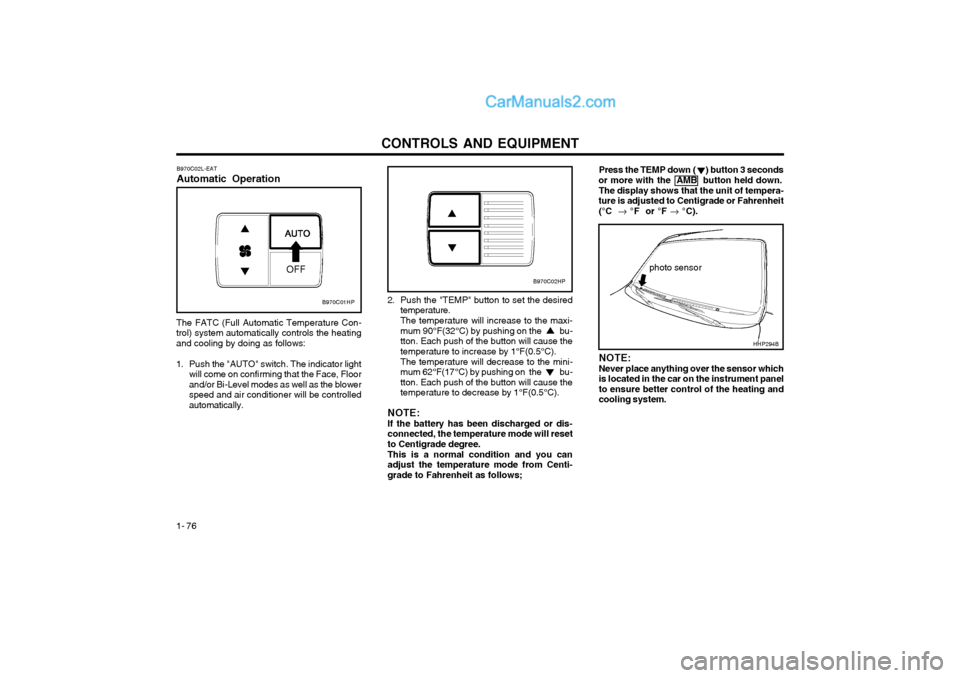
The FATC (Full Automatic Temperature Con- trol) system automatically controls the heatingand cooling by doing as follows:
1. Push the "AUTO" switch. The indicator light will come on confirming that the Face, Floorand/or Bi-Level modes as well as the blowerspeed and air conditioner will be controlledautomatically. Press the TEMP down ( ) button 3 seconds
or more with the AMB button held down.
The display shows that the unit of tempera-
ture is adjusted to Centigrade or Fahrenheit
(°C °F or °F °C).
photo sensor
HHP294B
2. Push the "TEMP" button to set the desired
temperature. The temperature will increase to the maxi- mum 90°F(32°C) by pushing on the bu-tton. Each push of the button will cause thetemperature to increase by 1°F(0.5°C). The temperature will decrease to the mini- mum 62°F(17°C) by pushing on the bu-tton. Each push of the button will cause thetemperature to decrease by 1°F(0.5°C).
NOTE: If the battery has been discharged or dis- connected, the temperature mode will resetto Centigrade degree. This is a normal condition and you can adjust the temperature mode from Centi-grade to Fahrenheit as follows; NOTE: Never place anything over the sensor which is located in the car on the instrument panelto ensure better control of the heating andcooling system.
B970C01HP
B970C02HP