automatic transmission Hyundai Terracan 2004 User Guide
[x] Cancel search | Manufacturer: HYUNDAI, Model Year: 2004, Model line: Terracan, Model: Hyundai Terracan 2004Pages: 361, PDF Size: 4.69 MB
Page 120 of 361
DRIVING YOUR HYUNDAI 2- 11
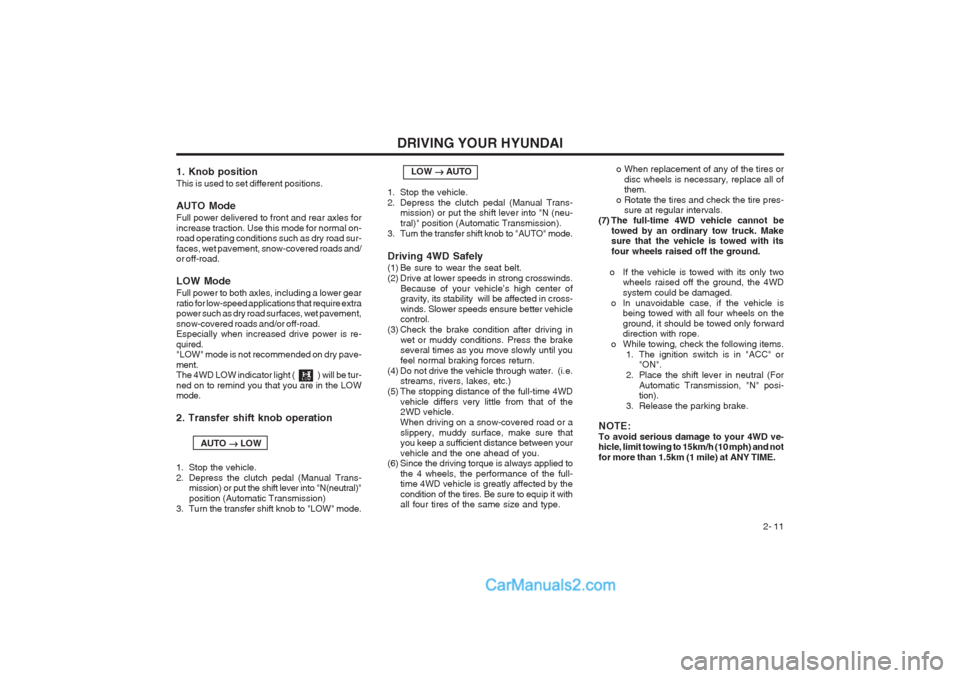
1. Knob position This is used to set different positions. AUTO Mode Full power delivered to front and rear axles for increase traction. Use this mode for normal on- road operating conditions such as dry road sur- faces, wet pavement, snow-covered roads and/ or off-road. LOW Mode Full power to both axles, including a lower gear ratio for low-speed applications that require extra power such as dry road surfaces, wet pavement, snow-covered roads and/or off-road. Especially when increased drive power is re- quired. "LOW" mode is not recommended on dry pave- ment. The 4WD LOW indicator light ( ) will be tur- ned on to remind you that you are in the LOW mode. 2. Transfer shift knob operation AUTO
LOW
1. Stop the vehicle.
2. Depress the clutch pedal (Manual Trans- mission) or put the shift lever into "N(neutral)"position (Automatic Transmission)
3. Turn the transfer shift knob to "LOW" mode. LOW
AUTO
1. Stop the vehicle.
2. Depress the clutch pedal (Manual Trans- mission) or put the shift lever into "N (neu-tral)" position (Automatic Transmission).
3. Turn the transfer shift knob to "AUTO" mode. Driving 4WD Safely
(1) Be sure to wear the seat belt.
(2) Drive at lower speeds in strong crosswinds. Because of your vehicle’s high center of gravity, its stability will be affected in cross- winds. Slower speeds ensure better vehicle control.
(3) Check the brake condition after driving in wet or muddy conditions. Press the brakeseveral times as you move slowly until you feel normal braking forces return.
(4) Do not drive the vehicle through water. (i.e. streams, rivers, lakes, etc.)
(5) The stopping distance of the full-time 4WD vehicle differs very little from that of the 2WD vehicle.
When driving on a snow-covered road or a slippery, muddy surface, make sure thatyou keep a sufficient distance between your vehicle and the one ahead of you.
(6) Since the driving torque is always applied to
the 4 wheels, the performance of the full- time 4WD vehicle is greatly affected by the condition of the tires. Be sure to equip it with all four tires of the same size and type.o When replacement of any of the tires ordisc wheels is necessary, replace all of them.
o Rotate the tires and check the tire pres- sure at regular intervals.
(7) The full-time 4WD vehicle cannot be towed by an ordinary tow truck. Makesure that the vehicle is towed with its four wheels raised off the ground.
o If the vehicle is towed with its only two wheels raised off the ground, the 4WDsystem could be damaged.
o In unavoidable case, if the vehicle is being towed with all four wheels on theground, it should be towed only forward direction with rope.
o While towing, check the following items. 1. The ignition switch is in "ACC" or"ON".
2. Place the shift lever in neutral (For Automatic Transmission, "N" posi-tion).
3. Release the parking brake.
NOTE: To avoid serious damage to your 4WD ve- hicle, limit towing to 15km/h (10 mph) and not for more than 1.5km (1 mile) at ANY TIME.
Page 123 of 361
DRIVING YOUR HYUNDAI
2- 14
o Don’t "ride" the brake pedal. Resting your foot
on the brake pedal while driving can be dan- gerous because it can result in the brakes overheating and losing their effectiveness. It also increases the wear of the brake com- ponents.
o If a tire goes flat while you are driving, apply
the brakes gently and keep the car pointed straight ahead while you slow down. When you are moving slowly enough for it to be safe to do so, pull off the road and stop in a safe place.
o If your car is equipped with an automatic
transmission, don’t let your car creep for- ward. To avoid creeping forward, keep your foot firmly on the brake pedal when the car is stopped.
o Use caution when parking on a hill. Engage the parking brake and place the gear selector lever in "P" (automatic transmission) or in first or reverse gear (manual transmission). If your car is facing downhill, turn the front wheels into the curb to help keep the car from rolling. If your car is facing uphill, turn the front wheels away from the curb to help keep the car from rolling. If there is no curb or if it is required by other conditions to keep the car from rolling, block the wheels.
o Under some conditions your parking brake
can freeze in the engaged position. This is most likely to happen when there is an ac- cumulation of snow or ice around or near the rear brakes or if the brakes are wet. If there is a risk that the parking brake may freeze, apply it only temporarily while you put thegear selector lever in "P" (automatic) or in first or reverse gear (manual transmission) and block the rear wheels so the car cannot roll. Then release the parking brake.
o Do not hold the vehicle on the upgrade with the accelerator pedal. This can cause the transmission to overheat. Always use the brake pedal or parking brake.
C140A01A-AAT DRIVING FOR ECONOMY You can save fuel and get more miles from your car if you follow these suggestions:
o Drive smoothly. Accelerate at a moderate rate. Don't make "jack-rabbit" starts or full- throttle shifts and maintain a steady cruising speed. Don't race between stoplights. Try to adjust your speed to that of the other traffic so you don't have to change speeds unneces- sarily. Avoid heavy traffic whenever possible. Always maintain a safe distance from other vehicles so you can avoid unnecessary brak- ing. This also reduces brake wear.
o Drive at a moderate speed. The faster you drive, the more fuel your car uses. Driving at a moderate speed, especially on the high- way, is one of the most effective ways to reduce fuel consumption.
o Don't "ride" the brake or clutch pedal. This
can increase fuel consumption and also in- crease wear on these components. In addi- tion, driving with your foot resting on the brake pedal may cause the brakes to overheat,which reduces their effectiveness and may lead to more serious consequences.
o Take care of your tires. Keep them inflated to the recommended pressure. Incorrect infla- tion, either too much or too little, results in unnecessary tire wear. Check the tire pres- sures at least once a month.
o Be sure that the wheels are aligned correctly.
Improper alignment can result from hitting curbs or driving too fast over irregular surfac- es. Poor alignment causes faster tire wear and may also result in other problems as well as greater fuel consumption.
o Keep your car in good condition. For better
fuel economy and reduced maintenance costs, maintain your car in accordance with the maintenance schedule in Section 5. If you drive your car in severe conditions, more frequent maintenance is required (see Sec- tion 5 for details).
o Keep your car clean. For maximum service, your Hyundai should be kept clean and free of corrosive materials. It is especially important that mud, dirt, ice, etc. not be allowed to accumulate on the underside of the car. This extra weight can result in increased fuel con- sumption and also contribute to corrosion.
o Travel lightly. Don't carry unnecessary weight
in your car. Weight reduces fuel economy.
o Don't let the engine idle longer than neces-
sary. If you are waiting (and not in traffic), turn off your engine and restart only when you're ready to go.
Page 125 of 361
DRIVING YOUR HYUNDAI
2- 16
C160H01A-AAT Use Approved Anti-Freeze in Window Washer System To keep the water in the window washer system from freezing, add an approved anti-freeze solu- tion in accordance with instructions on the con- tainer. Window washer anti-freeze is available from Hyundai dealers and most auto parts out- lets. Do not use engine coolant or other types of anti-freeze as these may damage the finish.
C160F01A-AAT Check Spark Plugs and Ignition System Inspect your spark plugs as described in Section 6 and replace them if necessary. Also check all ignition wiring and components to be sure they are not cracked, worn or damaged in any way.
C160G02A-GAT To Keep Locks from Freezing To keep the locks from freezing, squirt an ap- proved de-icer fluid or glycerine into the key opening. If a lock is covered with ice, squirt it with an approved de-icing fluid to remove the ice. If the lock is frozen internally, you may be able to thaw it out by using a heated key. Handle the heated key with care to avoid
injury.
NOTE: The proper temperature for using the immo- bilizer key is from -40°C (-40°F) to 80°C (176°F). If you heat the immobilizer key over 80°C (176°F) to open the frozen lock, it may cause damage to the transponder in its head. C160I01HP-GAT Don’t Let Your Parking Brake Freeze Under some conditions your parking brake can freeze in the engaged position. This is most likely to happen when there is an accumulation of snow or ice around or near the rear brakes or if the brakes are wet. If there is a risk the parking brake may freeze, apply it only temporarily while you put the gear selector lever in "P" (automatic) or in first or reverse gear (manual transmission) and block the rear wheels so the car cannot roll. Then release the parking brake. C160K01A-AAT Carry Emergency Equipment Depending on the severity of the weather where you drive your car, you should carry appropriate emergency equipment. Some of the items you may want to carry include tire chains, tow straps or chains, flashlight, emergency flares, sand, a shovel, jumper cables, a window scraper, gloves, ground cloth, coveralls, a blanket, etc.
C160J01A-AAT Don’t Let Ice and Snow Accumulate Underneath Under some conditions, snow and ice can build up under the fenders and interfere with the steer- ing. When driving in severe winter conditions where this may happen, you should periodically check underneath the car to be sure the move- ment of the front wheels and the steering compo- nents is not obstructed.
C180A01A-AAT USE OF LIGHTS Check your lights regularly for correct operation and always keep them clean. When driving dur- ing the day in conditions of poor visibility, it is helpful to drive with headlights on low beam. This enables you to be seen as well as to see.
C170A01A-AAT HIGHER SPEED MOTORING Pre-Trip Inspections 1. Tires: Adjust the tire inflation pressures to specifica- tion. Low tire inflation pressures will result in overheating and possible failure of the tires. Avoid using worn or damaged tires which may result in reduced traction or tire failure. NOTE: Never exceed the maximum tire inflation pres- sure shown on the tires. 2. Fuel, engine coolant and engine oil: High speed travel consumes more fuel than urban motoring. Do not forget to check both engine coolant and engine oil. 3. Drive belt: A loose or damaged drive belt may result in overheating of the engine.
Page 127 of 361
DRIVING YOUR HYUNDAI
2- 18
NOTE:
1. Never load the trailer with more weight in
the back than in the front. About 60% ofthe trailer load should be in the front half on the trailer and the remaining 40% in the rear.
2. The total gross vehicle weight with trailer
must not exceed the Gross Vehicle Weight Rating (GVWR) shown on the vehicle iden- tification plate (see page 8-1). The total gross vehicle weight is the combined weight of the vehicle, driver, all passen- gers and their luggage, cargo, hitch, trailer tongue load and other optional equip- ment.
3. The front or rear axle weight must not exceed the Gross Axle Weight Rating (GAWR) shown on the vehicle identifica- tion plate (see page 8-1). It is possible that your towing package does not exceed the GVWR but exceeds the GAWR. Improper trailer loading and/or too much luggage in the cargo area can overload the rear axle. Redistribute the load and check the axle weight again.
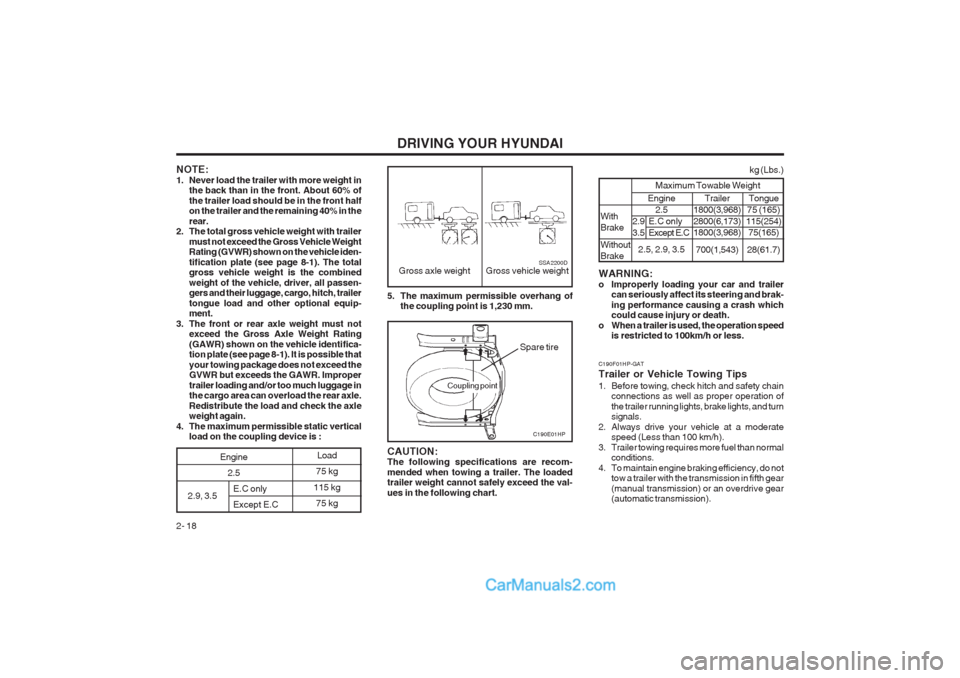
4. The maximum permissible static vertical load on the coupling device is : 5. The maximum permissible overhang of
the coupling point is 1,230 mm.
Gross axle weight Gross vehicle weightSSA2200D
C190E01HP
CAUTION: The following specifications are recom- mended when towing a trailer. The loaded trailer weight cannot safely exceed the val- ues in the following chart.
Spare tire
2.9, 3.5 E.C only Except E.C Load
75 kg
115 kg 75 kg
Engine 2.5
Coupling point
C190F01HP-GAT Trailer or Vehicle Towing Tips
1. Before towing, check hitch and safety chain connections as well as proper operation of the trailer running lights, brake lights, and turn
signals.
2. Always drive your vehicle at a moderate speed (Less than 100 km/h).
3. Trailer towing requires more fuel than normal conditions.
4. To maintain engine braking efficiency, do not tow a trailer with the transmission in fifth gear(manual transmission) or an overdrive gear (automatic transmission).
WARNING:
o Improperly loading your car and trailer
can seriously affect its steering and brak-ing performance causing a crash which could cause injury or death.
o When a trailer is used, the operation speed is restricted to 100km/h or less. Engine
2.5
2.5, 2.9, 3.5
2.9 E.C only
3.5 Except E.C
kg (Lbs.)
Maximum Towable Weight
With Brake Without Brake Trailer
1800(3,968) 2800(6,173) 1800(3,968)
700(1,543) Tongue
75 (165)
115(254) 75(165)
28(61.7)
Page 128 of 361
DRIVING YOUR HYUNDAI 2- 19
5. Always secure items in the trailer to prevent
load shift while driving.
6. Check the condition and air pressure of all
tires on the trailer and your car. Low tire pressure can seriously affect the handling.
Also check the spare tire.
7. The vehicle/trailer combination is more af-
fected by crosswind and buffeting. When being passed by a large vehicle, keep a constant speed and steer straight ahead. If there is too much wind buffeting slow down to get out of the other vehicle's air turbulence.
8. When parking your car and trailer, especially
on a hill, be sure to follow all the normal precautions. Turn your front wheel into the curb, set the parking brake firmly, and put the transmission in 1st or Reverse (manual) or Park (automatic). In addition, place wheel
chocks at each of the trailer's tires.
9. If the trailer has electric brakes, start your vehicle and trailer moving, and then apply the trailer brake controller by hand to be sure the brakes are working. This lets you check your
electrical connection at the same time.
10. During your trip, check occasionally to be
sure that the load is secure, and that the lights and any trailer brakes are still working.
11. Avoid jerky starts, sudden acceleration or sudden stops.
12. Avoid sharp turns and rapid lane changes.
13. Avoid holding the brake pedal down too long or too frequently. This could cause the brakes to overheat, resulting in reduced braking effi- ciency.
14. When going down a hill, shift into a lower gear
and use the engine braking effect. When ascending a long grade, downshift the trans- mission to a lower gear and reduce speed to reduce chances of engine overloading and/or overheating.
15. If you have to stop while going uphill, do not
hold the vehicle in place by pressing on the accelerator. This can cause the automatic transmission to overheat. Use the parking brake or footbrake.
NOTE: When towing, check transmission fluid more frequently. CAUTION: If overheating should occur when towing, (temperature gauge reads near red zone), taking the following action may reduce or
eliminate the problem.
1. Turn off the air conditioner.
2. Reduce highway speed.
3. Select a lower gear when going uphill.
4. While in stop and go traffic, place the gear selector in park or neutral and idle theengine at a higher speed.
Page 129 of 361
WHAT TO DO IN AN EMERGENCY 3-1
3. WHAT TO DO IN ANEMERGENCY
D010A01A-AAT IF THE ENGINE WILL NOT START WARNING: If the engine will not start, do not push or pull the car to start it. This could result in a collision or cause other damage. In addition, push or pull starting may cause the catalytic converter to be overloaded and create a fire hazard. D010B01HP-GAT If Engine Doesn’t Turn Over or Turns Over Slowly
1. If your car has an automatic transmission, be sure the gear selector lever is in "N" or "P" and the emergency brake is set. 2. Check the battery connections to be sure
they are clean and tight.
3. Turn on the interior light. If the light dims or
goes out when you operate the starter, the battery is discharged.
4. Check the starter connections to be sure they are securely tightened.
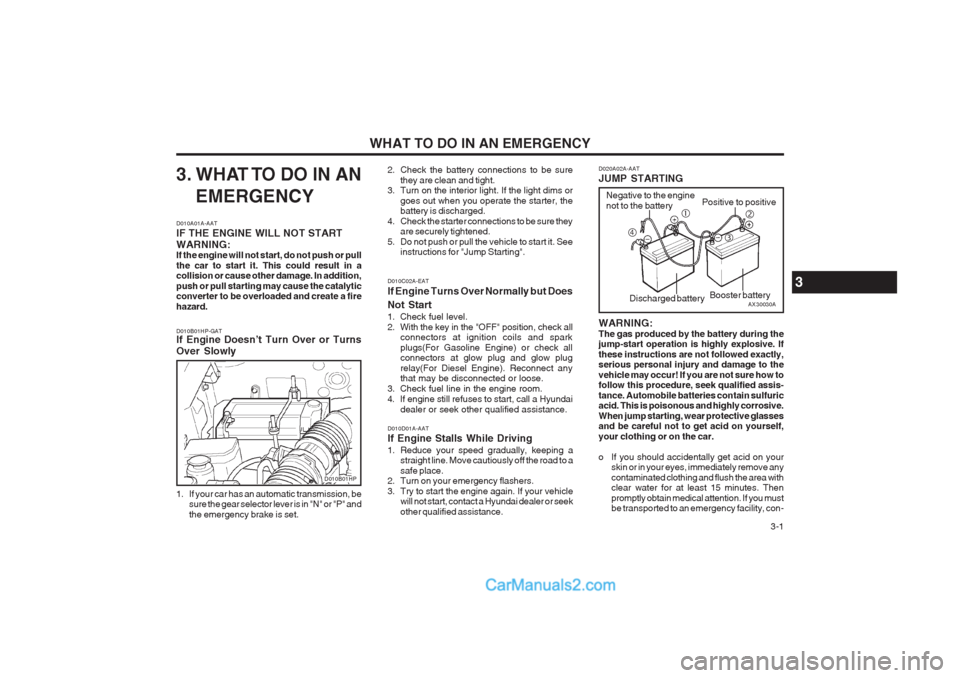
5. Do not push or pull the vehicle to start it. See instructions for "Jump Starting". D020A02A-AAT JUMP STARTING WARNING: The gas produced by the battery during the jump-start operation is highly explosive. If these instructions are not followed exactly, serious personal injury and damage to the vehicle may occur! If you are not sure how to follow this procedure, seek qualified assis- tance. Automobile batteries contain sulfuric acid. This is poisonous and highly corrosive. When jump starting, wear protective glasses and be careful not to get acid on yourself, your clothing or on the car.
o If you should accidentally get acid on your
skin or in your eyes, immediately remove any contaminated clothing and flush the area with clear water for at least 15 minutes. Then promptly obtain medical attention. If you must be transported to an emergency facility, con-
D010C02A-EAT If Engine Turns Over Normally but Does Not Start
1. Check fuel level.
2. With the key in the "OFF" position, check allconnectors at ignition coils and sparkplugs(For Gasoline Engine) or check all connectors at glow plug and glow plug relay(For Diesel Engine). Reconnect any that may be disconnected or loose.
3. Check fuel line in the engine room.
4. If engine still refuses to start, call a Hyundai
dealer or seek other qualified assistance.
D010D01A-AAT If Engine Stalls While Driving
1. Reduce your speed gradually, keeping a straight line. Move cautiously off the road to a safe place.
2. Turn on your emergency flashers.
3. Try to start the engine again. If your vehicle will not start, contact a Hyundai dealer or seekother qualified assistance.
AX30030A
Negative to the engine not to the battery
Positive to positive
Booster battery
c
e
f d
Discharged battery
D010B01HP
3
Page 132 of 361
WHAT TO DO IN AN EMERGENCY
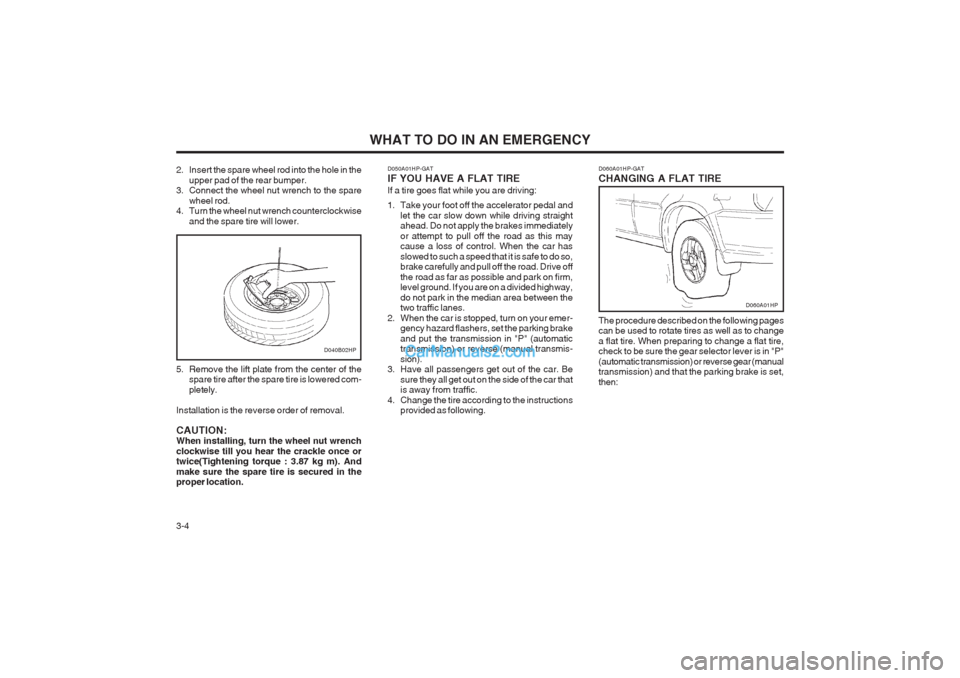
3-4 D060A01HP-GAT CHANGING A FLAT TIRE The procedure described on the following pages can be used to rotate tires as well as to change a flat tire. When preparing to change a flat tire, check to be sure the gear selector lever is in "P" (automatic transmission) or reverse gear (manual transmission) and that the parking brake is set, then:
D060A01HP
D050A01HP-GAT IF YOU HAVE A FLAT TIRE If a tire goes flat while you are driving:
1. Take your foot off the accelerator pedal and
let the car slow down while driving straight ahead. Do not apply the brakes immediately or attempt to pull off the road as this may cause a loss of control. When the car has slowed to such a speed that it is safe to do so, brake carefully and pull off the road. Drive off the road as far as possible and park on firm, level ground. If you are on a divided highway, do not park in the median area between the two traffic lanes.
2. When the car is stopped, turn on your emer- gency hazard flashers, set the parking brake and put the transmission in "P" (automatic transmission) or reverse (manual transmis- sion).
3. Have all passengers get out of the car. Be
sure they all get out on the side of the car that is away from traffic.
4. Change the tire according to the instructions provided as following.
5. Remove the lift plate from the center of the
spare tire after the spare tire is lowered com- pletely.
Installation is the reverse order of removal. CAUTION: When installing, turn the wheel nut wrench clockwise till you hear the crackle once or
twice(Tightening torque : 3.87 kg m). And make sure the spare tire is secured in the proper location.
D040B02HP
2. Insert the spare wheel rod into the hole in the upper pad of the rear bumper.
3. Connect the wheel nut wrench to the spare
wheel rod.
4. Turn the wheel nut wrench counterclockwise
and the spare tire will lower.
Page 137 of 361
WHAT TO DO IN AN EMERGENCY 3-9
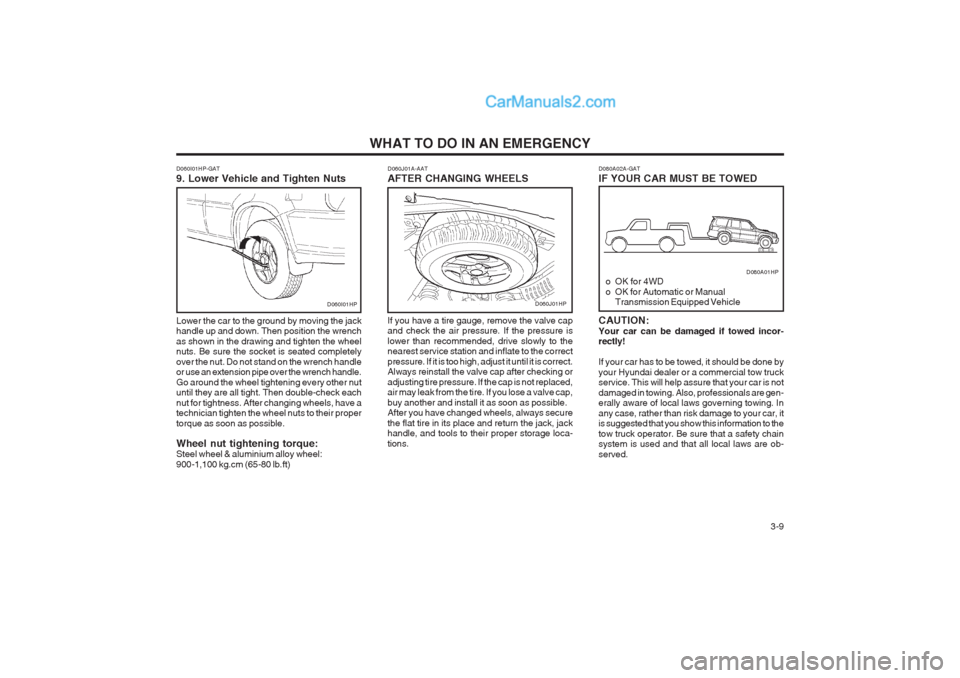
Lower the car to the ground by moving the jack handle up and down. Then position the wrench as shown in the drawing and tighten the wheel nuts. Be sure the socket is seated completely over the nut. Do not stand on the wrench handle or use an extension pipe over the wrench handle. Go around the wheel tightening every other nut until they are all tight. Then double-check each nut for tightness. After changing wheels, have a technician tighten the wheel nuts to their proper torque as soon as possible. Wheel nut tightening torque: Steel wheel & aluminium alloy wheel: 900-1,100 kg.cm (65-80 lb.ft)
D060I01HP-GAT 9. Lower Vehicle and Tighten Nuts
D060I01HP
D060J01A-AAT AFTER CHANGING WHEELS If you have a tire gauge, remove the valve cap and check the air pressure. If the pressure is lower than recommended, drive slowly to the nearest service station and inflate to the correct pressure. If it is too high, adjust it until it is correct. Always reinstall the valve cap after checking or adjusting tire pressure. If the cap is not replaced, air may leak from the tire. If you lose a valve cap, buy another and install it as soon as possible. After you have changed wheels, always secure the flat tire in its place and return the jack, jack handle, and tools to their proper storage loca- tions.D060J01HP
D080A02A-GAT IF YOUR CAR MUST BE TOWED
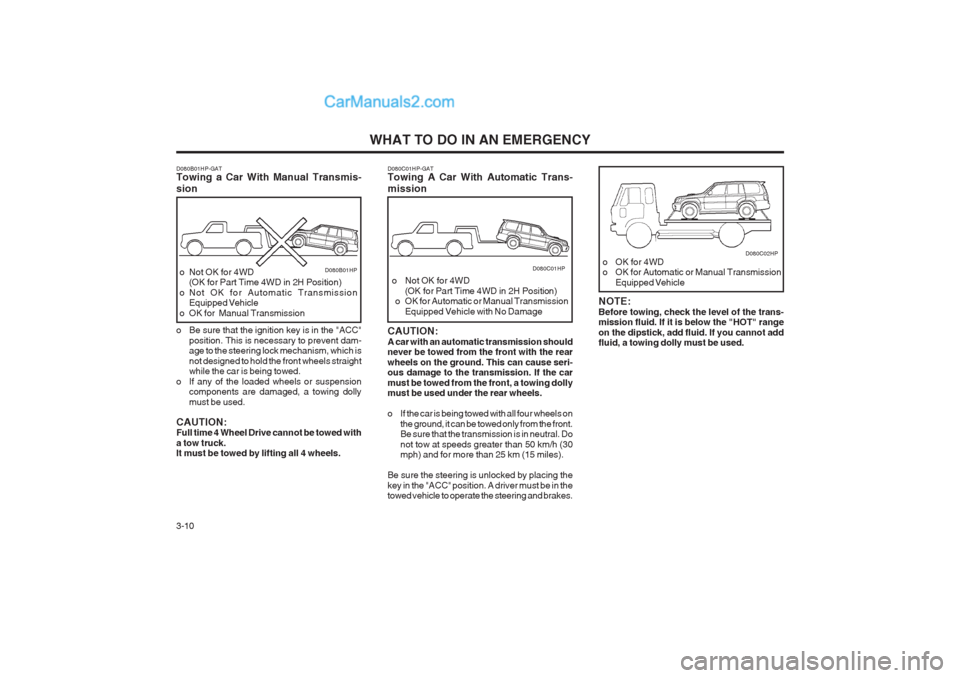
o OK for 4WD
o OK for Automatic or Manual
Transmission Equipped Vehicle D080A01HP
CAUTION:Your car can be damaged if towed incor- rectly! If your car has to be towed, it should be done by your Hyundai dealer or a commercial tow truck service. This will help assure that your car is not damaged in towing. Also, professionals are gen- erally aware of local laws governing towing. In any case, rather than risk damage to your car, it is suggested that you show this information to the tow truck operator. Be sure that a safety chain system is used and that all local laws are ob- served.
Page 138 of 361
WHAT TO DO IN AN EMERGENCY
3-10
o OK for 4WD
o OK for Automatic or Manual Transmission Equipped VehicleD080C02HP
NOTE: Before towing, check the level of the trans- mission fluid. If it is below the "HOT" range on the dipstick, add fluid. If you cannot add fluid, a towing dolly must be used.
D080C01HP-GAT Towing A Car With Automatic Trans- mission CAUTION: A car with an automatic transmission should never be towed from the front with the rear wheels on the ground. This can cause seri- ous damage to the transmission. If the car must be towed from the front, a towing dolly must be used under the rear wheels.
o If the car is being towed with all four wheels on
the ground, it can be towed only from the front. Be sure that the transmission is in neutral. Do not tow at speeds greater than 50 km/h (30 mph) and for more than 25 km (15 miles).
Be sure the steering is unlocked by placing the key in the "ACC" position. A driver must be in the towed vehicle to operate the steering and brakes.
o Not OK for 4WD (OK for Part Time 4WD in 2H Position)
o OK for Automatic or Manual Transmission
Equipped Vehicle with No Damage
D080C01HP
D080B01HP-GAT Towing a Car With Manual Transmis- sion
o Not OK for 4WD(OK for Part Time 4WD in 2H Position)
o Not OK for Automatic Transmission Equipped Vehicle
o OK for Manual Transmission D080B01HP
o Be sure that the ignition key is in the "ACC" position. This is necessary to prevent dam- age to the steering lock mechanism, which is not designed to hold the front wheels straight while the car is being towed.
o If any of the loaded wheels or suspension components are damaged, a towing dolly must be used.
CAUTION: Full time 4 Wheel Drive cannot be towed with a tow truck. It must be towed by lifting all 4 wheels.
Page 148 of 361
VEHICLE MAINTENANCE REQUIREMENTS 5-5
I
R I I I I I I I I I II I I I
R
I
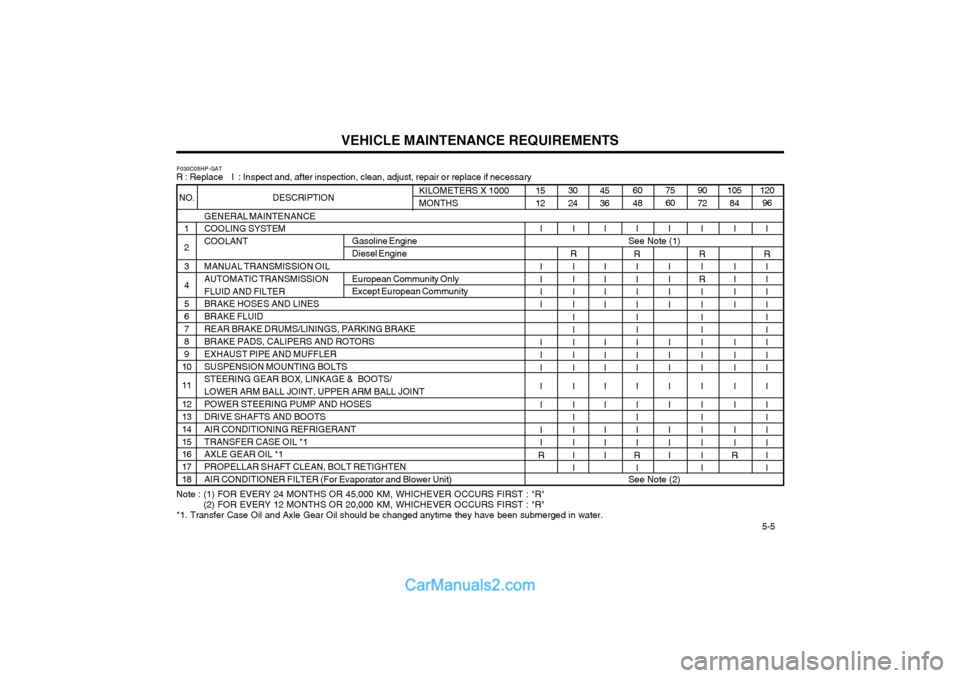
GENERAL MAINTENANCE COOLING SYSTEM COOLANT MANUAL TRANSMISSION OIL AUTOMATIC TRANSMISSIONFLUID AND FILTER BRAKE HOSES AND LINES BRAKE FLUIDREAR BRAKE DRUMS/LININGS, PARKING BRAKE BRAKE PADS, CALIPERS AND ROTORS EXHAUST PIPE AND MUFFLERSUSPENSION MOUNTING BOLTS STEERING GEAR BOX, LINKAGE & BOOTS/ LOWER ARM BALL JOINT, UPPER ARM BALL JOINTPOWER STEERING PUMP AND HOSES DRIVE SHAFTS AND BOOTS AIR CONDITIONING REFRIGERANTTRANSFER CASE OIL *1 AXLE GEAR OIL *1 PROPELLAR SHAFT CLEAN, BOLT RETIGHTENAIR CONDITIONER FILTER (For Evaporator and Blower Unit)
1 2 3 4 5 67 8 9
10 11 12 13 1415 16 1718
F030C05HP-GAT
R : Replace I : Inspect and, after inspection, clean, adjust, repair or replace if necessary
Note : (1) FOR EVERY 24 MONTHS OR 45,000 KM, WHICHEVER OCCURS FIRST : "R"
(2) FOR EVERY 12 MONTHS OR 20,000 KM, WHICHEVER OCCURS FIRST : "R"
*1. Transfer Case Oil and Axle Gear Oil should be changed anytime they have been submerged in water.
NO. DESCRIPTION
I
R I I I I I I I I I II I I I I I15 12 30 24
45 36 60 4875 60
90 72105
84 120
96KILOMETERS X 1000 MONTHS
I
R I I I I I I I I I II I I I I I I I I I I I I I II I I I
I I I I I I I I II I I
R I I I I I I I I II I I II
R I
R I I I I I I I II I I I I I I I I I I I I I II I I
R
European Community Only Except European Community
See Note (1)Gasoline Engine Diesel Engine
See Note (2)