ESP Hyundai Terracan 2004 Owner's Guide
[x] Cancel search | Manufacturer: HYUNDAI, Model Year: 2004, Model line: Terracan, Model: Hyundai Terracan 2004Pages: 361, PDF Size: 4.69 MB
Page 296 of 361
DRIVING YOUR HYUNDAI 2- 13
Driving on dry paved road and high- way
Select the AUTO to drive on dry paved roads.
Especially on dry highway, never select the LOW. Driving on snowy or icy roads
Select the AUTO or LOW in accordance with
the road conditions, and then gradually depress the accelerator pedal for a smooth start. Driving on sandy or muddy roads
Select the LOW and then gradually depress the
accelerator pedal for a smooth start. Keep the pressure on the accelerator pedal constant aspossible, and drive at low speed. Climbing sharp grades
Select the LOW to maximize use the engine
torque.Descending sharp grades
Select the LOW, use the engine brake and
descend slowly.
(8) For speedometer test or inspection/mainte-
nance (I/M) program of full-time 4WD ve- hicle, use a four-wheel chassis dynamom-eter.
CAUTION: Never engage the parking brake whilst per-
forming these tests.
o In rare cases when it's unavoidable that a 4WD vehicle is to be inspected for speed- ometer test on 2WD roll tester, strictly followthe procedures next.
1. Check the tyre pressures recommended for your vehicle.
2. Place the rear wheels on the roll tester for speedometer test as shown in theillustration.
3. Release the parking brake.
4. Place the front wheels on the temporary free roller as shown in the illustration.
WARNING:Keep away from the front of the vehicle
whilst inspecting. This is very dangerous as the vehicle can jump forward and causeserious injury or death.
(9) When using tyre chains, always attach them to the rear wheels.
(10) I f the front or rear wheels get stuck in the
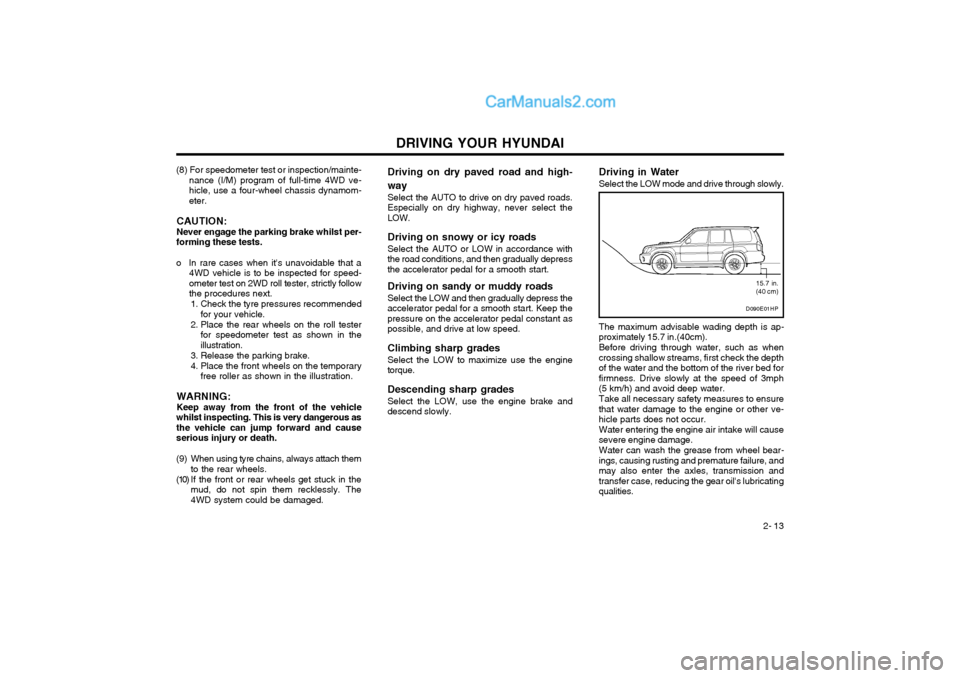
mud, do not spin them recklessly. The 4WD system could be damaged. Driving in Water
Select the LOW mode and drive through slowly.
D090E01HP
The maximum advisable wading depth is ap-
proximately 15.7 in.(40cm).
Before driving through water, such as when
crossing shallow streams, first check the depth of the water and the bottom of the river bed forfirmness. Drive slowly at the speed of 3mph(5 km/h) and avoid deep water.
Take all necessary safety measures to ensure
that water damage to the engine or other ve-hicle parts does not occur. Water entering the engine air intake will cause
severe engine damage.
Water can wash the grease from wheel bear-
ings, causing rusting and premature failure, andmay also enter the axles, transmission andtransfer case, reducing the gear oil's lubricatingqualities.
15.7 in. (40 cm)
Page 298 of 361
DRIVING YOUR HYUNDAI 2- 15
DC170A1-E
WINTER MOTORING The onset of winter conditions subject motor
vehicles to greater operating demands. There- fore, the following suggestions will assist inmaintaining peak performance and reliabilityduring these periods:
C140A01A-EAT
DRIVING FOR ECONOMY
You can save fuel and get more miles from your
car if you follow these suggestions:
o Drive smoothly. Accelerate at a moderate rate. Don't make "jack-rabbit" starts or full- throttle shifts and maintain a steady cruisingspeed. Don't race between stoplights. Try toadjust your speed to that of the other trafficso you don't have to change speeds unnec-essarily. Avoid heavy traffic whenever pos-sible. Always maintain a safe distance fromother vehicles so you can avoid unneces-sary braking. This also reduces brake wear.
o Drive at a moderate speed. The faster you drive, the more fuel your car uses. Driving ata moderate speed, especially on the high-way, is one of the most effective ways toreduce fuel consumption.
o Don't "ride" the brake or clutch pedal. This can increase fuel consumption and alsoincrease wear on these components. In ad-dition, driving with your foot resting on thebrake pedal may cause the brakes to over-heat, which reduces their effectiveness andmay lead to more serious consequences.
o Take care of your tyres. Keep them inflated to the recommended pressure. Incorrect in-flation, either too much or too little, results inunnecessary tyre wear. Check the tyre pres-sures at least once a month. o Be sure that the wheels are aligned correct-
ly. Improper alignment can result from hittingcurbs or driving too fast over irregular sur-faces. Poor alignment causes faster tyrewear and may also result in other problemsas well as greater fuel consumption.
o Keep your car in good condition. For better fuel economy and reduced maintenancecosts, maintain your car in accordance withthe maintenance schedule in Section 5. Ifyou drive your car in severe conditions,more frequent maintenance is required (seeSection 5 for details).
o Keep your car clean. For maximum service, your Hyundai should be kept clean and freeof corrosive materials. It is especially impor-tant that mud, dirt, ice, etc. not be allowed toaccumulate on the underside of the car. Thisextra weight can result in increased fuelconsumption and also contribute to corro-sion.
o Travel lightly. Don't carry unnecessary weight in your car. Weight reduces fuel economy.
o Don't let the engine idle longer than neces- sary. If you are waiting (and not in traffic),turn off your engine and restart only whenyou're ready to go.
o Remember, your Hyundai does not require extended warm-up. As soon as the engineis running smoothly, you can drive away. Invery cold weather, however, give your en-gine a slightly longer warm-up period. o Don't "labour" or "over-rev" the engine.
Labouring is driving too slowly in too high agear resulting in the vehicle kangarooing. Ifthis happens, shift to a lower gear. Over-revving is racing the engine beyond its safelimit. This can be avoided by shifting at therecommended speeds.
o Use your air conditioning sparingly. The air conditioning system is operated by enginepower so your fuel economy is reducedwhen you use it.
C150A01A-EAT SMOOTH CORNERINGAvoid braking or gear changing in corners, especially when roads are wet. Ideally, cornersshould always be taken under gentle accelera-tion. If you follow these suggestions, tyre wearwill be held to a minimum.
Page 302 of 361
DRIVING YOUR HYUNDAI 2- 19
CAUTION: If overheating should occur when towing,
(temperature gauge reads near red zone), taking the following action may reduce oreliminate the problem.
1. Turn off the air conditioner.
2. Reduce highway speed.
3. Select a lower gear when going uphill.
4. Whilst in stop and go traffic, place the gear selector in park or neutral and idle the engine at a higher speed.
HPC200E1-E
Trailer or Vehicle Towing Tips
1. Before towing, check towbar and safety cable connections as well as proper operation of the trailer running lights, brake lights, andturn signals.
2. Always drive your vehicle at a moderate speed (Less than 60 mph)
3. Trailer towing requires more fuel than nor- mal conditions.
4. To maintain engine braking efficiency and electrical charging performance, do not usefifth gear (manual transmission).
5. Always secure items in the trailer to prevent load shift whilst driving.
6. Check the condition and air pressure of all tyres on the trailer and your car. Low tyrepressure can seriously affect the handling.Also check the spare tyre.
7. The vehicle/trailer combination is more af- fected by crosswind and buffeting. When being passed by a large vehicle, keep a constant speed and steer straight ahead.If there is too much wind buffeting slowdown to get out of the other vehicle's airturbulence.
8. When parking your car and trailer, especial- ly on a hill, be sure to follow all the normalprecautions. Turn your front wheel into thecurb, set the parking brake firmly, and putthe transmission in 1st or Reverse (manual)or Park (automatic). In addition, place wheelchocks at each of the trailer's tyres. 9. If the trailer has electric brakes, start your
vehicle and trailer moving, and then applythe trailer brake controller by hand to besure the brakes are working. This lets youcheck your electrical connection at the sametime.
10. During your trip, check occasionally to be sure that the load is secure, and that thelights and any trailer brakes are still working.
11. Avoid jerky starts, sudden acceleration or sudden stops.
12. Avoid sharp turns and rapid lane changes.
13. Avoid holding the brake pedal down too long or too frequently. This could cause the brakes to overheat, resulting in reduced brakingefficiency.
14. When going down a hill, shift into a lower gear and use the engine braking effect. When ascending a long grade, downshift the transmission to a lower gear and reducespeed to reduce chances of engine over-loading and/or overheating.
15. If you have to stop whilst going uphill, do not hold the vehicle in place by pressing on theaccelerator. This can cause the automatictransmission to overheat. Use the parkingbrake or footbrake.
NOTE: When towing, check transmission fluid more
frequently.
Page 305 of 361
IN CASE OF EMERGENCY 3-3
WARNING: Whilst the engine is running, keep hands
and clothing away from moving parts such as the fan and drive belts to prevent injury.
WARNING (Diesel only): Never work on injection system with engine
running or within 30 seconds after shutting off engine. High pressure pump, rail, injec-tors and high pressure pipes are subject tohigh pressure even after the engine stopped.The fuel jet produced by fuel leaks maycause serious injury, if it touch the body.People using pacemakers should not movethan 30cm closer to the ECU or wiring har-ness within the engine room while engine isrunning, since the high currents in the Com-mon Rail system produce considerable mag-netic fields.
5. If the water pump drive belt is broken or coolant is leaking out, stop the engine imme- diately and call the nearest Hyundai dealerfor assistance.
WARNING: Do not remove the radiator cap when the
engine is hot since steam and boiling water may be ejected from the radiator resulting inburns or scalding. YD050A1-E
SPARE TYRE For Full Size
The following instructions for the FULL SIZE
spare tyre should be observed:
Check inflation pressure as soon as possible
after installing the spare tyre, and adjust to the specified pressure. The tyre pressure shouldbe periodically checked and maintained at thespecified pressure whilst the tyre is stored.
Spare Tyre Pressure
Inflation Pressure
Tyre Size
FULL SIZE 29 psi (200 kPa)
6. If the cause of the overheating cannot be
found, wait until the engine temperature has returned to normal. Then, if coolant hasbeen lost, carefully remove the radiator capand add water to bring the fluid level in thereservoir up to the base of the radiator fillopening. Fill the coolant expansion tank tothe halfway mark.
7. Proceed with caution until it is established that the engine is operating normally. If theengine overheats repeatedly, the advice of aHyundai dealer should be sought.
CAUTION: Serious loss of coolant indicates there is a
leak in the cooling system and this should be checked as soon as possible by a Hyundaidealer.
D040B01HP
D040B03HP-EAT
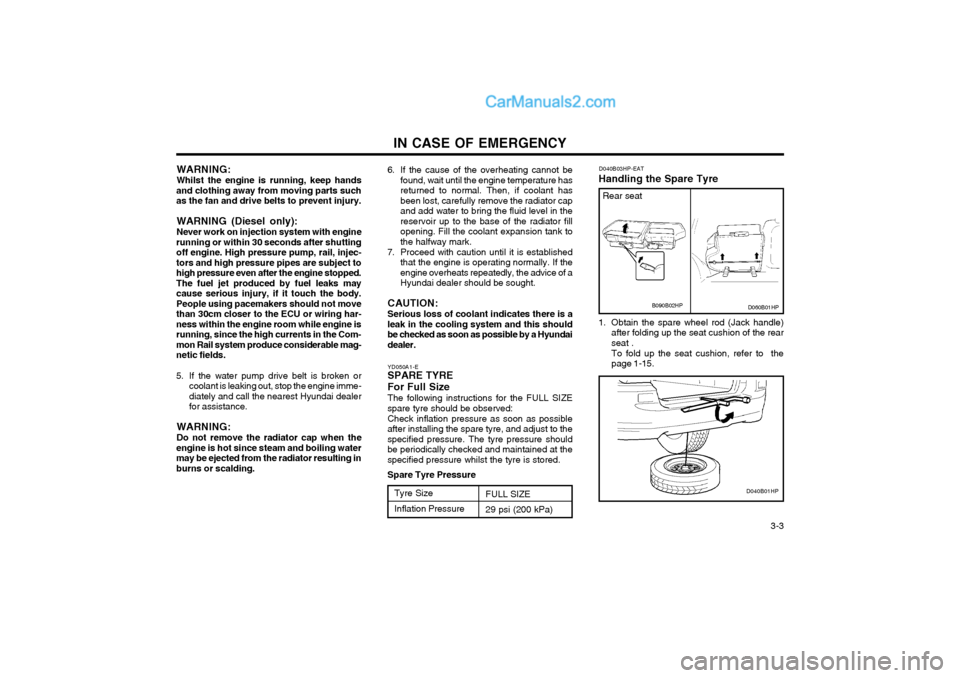
Handling the Spare Tyre
1. Obtain the spare wheel rod (Jack handle) after folding up the seat cushion of the rear seat . To fold up the seat cushion, refer to the page 1-15.
D060B01HPB090B02HP
Rear seat
Page 317 of 361
VEHICLE MAINTENANCE REQUIREMENTS 5-1
NOTE:
The inspection and testing of certain elec-
tronic fuel injection/engine management and automatic transmission control sys-tems require specialised electronic equip-ment specifically designed for Hyundai ve-hicles. The use of general purpose electri-cal test equipment may result in damage tothe control unit microprocessors.
YF010A1-A
5. VEHICLE MAINTE-
NANCE REQUIRE- MENTS
DF020A1-E
MAINTENANCE AND SERVICING REQUIREMENTS To ensure the continued reliability and safety
of the vehicle, certain routine maintenance operations are required at specific mileage ortime intervals.
It is the responsibility of the vehicle owner to
ensure that the maintenance schedules shownin both this Owner's Manual and the Warrantyand Service Passport are adhered to.
The new vehicle warranty may be invalidated
if the routine maintenance operations are notperformed in line with the recommendationsoutlined and the safety and durability of thevehicle adversely affected.
It is recommended that all maintenance op-
erations with the exception of the daily oper-ating checks are entrusted to a Hyundai dealerto ensure that the latest repair and mainte-nance procedures and specialized servicingtools are employed. In addition, the use ofgenuine Hyundai replacement parts will en-sure that the vehicle safety and performancewill not be compromised. DF020C1-E
Specified Scheduled Procedures The specified scheduled procedures are listed
in the maintenance charts beginning at page5-2. The operations specified must be per-formed at the time or mileage intervals shownirrespective of whether the mileage interval has been reached before the specified time interval.
Certain lubricants and components degrade
with both time and mileage (eg, engine oil andbrake fluid) and therefore it is not permissableto base the maintenance schedule upon mile-age alone. It is strongly recommended thatthe maintenance operations are performed bya Hyundai dealer because of the need forspecialized knowledge and tooling and to en-sure that no possibility of invalidating themanufacturers warranty exists.
The maintenance schedules relate to vehicles
operated under normal conditions, vehicleswhich are operated under adverse conditionswill require more frequent maintenance whichis described at page 5-5. DF020F1-E
SERVICE HISTORY
It is important that all scheduled maintenance
services are recorded in the warranty andservice passport to ensure that proof of main-tenance is available when warranty service isrequired.
5
Page 331 of 361
OWNER MAINTENANCE 6-7
NOTE: It is imperative that vehicles fitted with an
air conditioning system have a coolant con- centration of the recommended strength atall times. The use of the air conditioningsystem when the cooling system is filledwith water only will result in the heatermatrix freezing and subsequently bursting.
SG050C1-E
Coolant Level
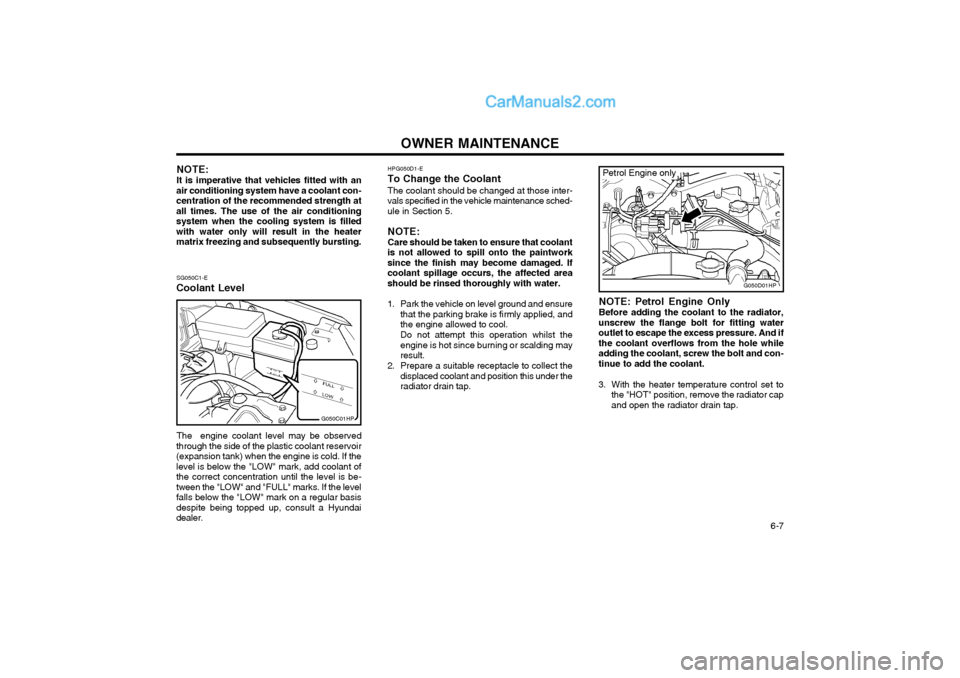
The engine coolant level may be observed
through the side of the plastic coolant reservoir(expansion tank) when the engine is cold. If thelevel is below the "LOW" mark, add coolant ofthe correct concentration until the level is be-tween the "LOW" and "FULL" marks. If the levelfalls below the "LOW" mark on a regular basisdespite being topped up, consult a Hyundaidealer. HPG050D1-E
To Change the Coolant
The coolant should be changed at those inter-
vals specified in the vehicle maintenance sched-ule in Section 5.
NOTE: Care should be taken to ensure that coolant
is not allowed to spill onto the paintwork since the finish may become damaged. Ifcoolant spillage occurs, the affected areashould be rinsed thoroughly with water.
1. Park the vehicle on level ground and ensure that the parking brake is firmly applied, and the engine allowed to cool. Do not attempt this operation whilst the engine is hot since burning or scalding mayresult.
2. Prepare a suitable receptacle to collect the displaced coolant and position this under theradiator drain tap. NOTE: Petrol Engine Only Before adding the coolant to the radiator,
unscrew the flange bolt for fitting water outlet to escape the excess pressure. And ifthe coolant overflows from the hole whileadding the coolant, screw the bolt and con-tinue to add the coolant.
3. With the heater temperature control set to the "HOT" position, remove the radiator cap and open the radiator drain tap.
G050D01HP
Petrol Engine only
G050C01HP
Page 334 of 361
OWNER MAINTENANCE
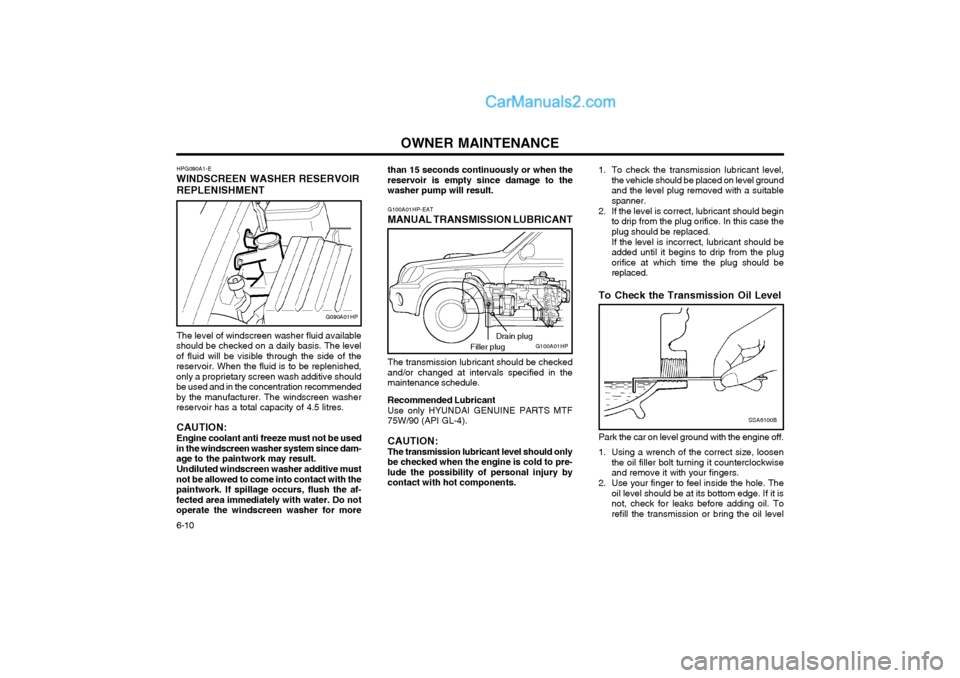
6-10 1. To check the transmission lubricant level,
the vehicle should be placed on level ground and the level plug removed with a suitablespanner.
2. If the level is correct, lubricant should begin to drip from the plug orifice. In this case theplug should be replaced. If the level is incorrect, lubricant should be added until it begins to drip from the plugorifice at which time the plug should bereplaced.
To Check the Transmission Oil Level
SSA6100B
Park the car on level ground with the engine off.
1. Using a wrench of the correct size, loosen the oil filler bolt turning it counterclockwise and remove it with your fingers.
2. Use your finger to feel inside the hole. The oil level should be at its bottom edge. If it isnot, check for leaks before adding oil. Torefill the transmission or bring the oil level
G100A01HP-EAT
MANUAL TRANSMISSION LUBRICANT
The transmission lubricant should be checkedand/or changed at intervals specified in themaintenance schedule. Recommended Lubricant Use only HYUNDAI GENUINE PARTS MTF 75W/90 (API GL-4). CAUTION: The transmission lubricant level should onlybe checked when the engine is cold to pre-lude the possibility of personal injury bycontact with hot components.
G090A01HP
HPG090A1-E
WINDSCREEN WASHER RESERVOIR
REPLENISHMENT The level of windscreen washer fluid available
should be checked on a daily basis. The level of fluid will be visible through the side of thereservoir. When the fluid is to be replenished,only a proprietary screen wash additive shouldbe used and in the concentration recommendedby the manufacturer. The windscreen washerreservoir has a total capacity of 4.5 litres.
CAUTION: Engine coolant anti freeze must not be used
in the windscreen washer system since dam- age to the paintwork may result.
Undiluted windscreen washer additive must
not be allowed to come into contact with thepaintwork. If spillage occurs, flush the af-fected area immediately with water. Do notoperate the windscreen washer for more than 15 seconds continuously or when thereservoir is empty since damage to thewasher pump will result.
G100A01HP
Drain plug
Filler plug