ESP Hyundai Terracan 2004 Owner's Guide
[x] Cancel search | Manufacturer: HYUNDAI, Model Year: 2004, Model line: Terracan, Model: Hyundai Terracan 2004Pages: 361, PDF Size: 4.69 MB
Page 194 of 361
YA020A1-E
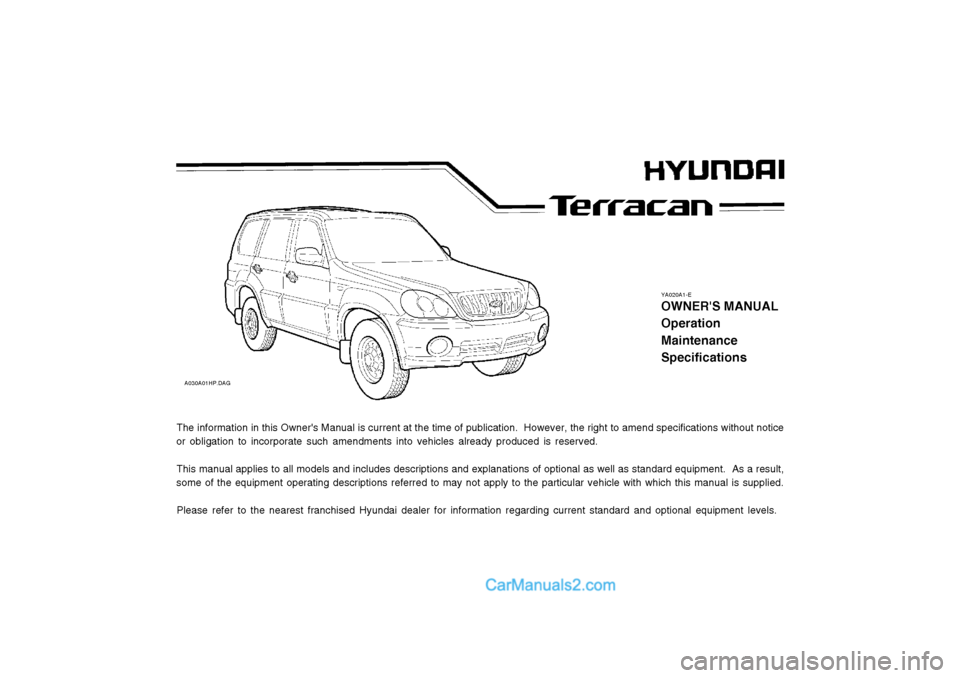
OWNER'S MANUAL OperationMaintenanceSpecifications
A030A01HP.DAG
The information in this Owner's Manual is current at the time of publication. However, the right to amend specifications without notice
or obligation to incorporate such amendments into vehicles already produced is reserved.
This manual applies to all models and includes descriptions and explanations of optional as well as standard equipment. As a r esult,
some of the equipment operating descriptions referred to may not apply to the particular vehicle with which this manual is supp lied.
Please refer to the nearest franchised Hyundai dealer for information regarding current standard and optional equipment levels.
Page 195 of 361
DA030A1-EResponsibilty For Maintenance
It is the responsibility of the vehicle owner/driver to ensure that all routine maintenance services are undertaken in line with the recommendations specified in Section 5 of thismanual. In addition, in order to ensure continued validity of the new vehicle warrantyand safe operation of the vehicle, non scheduled maintenance/running repairs shouldbe undertaken at the earliest available opportunity. Under severe operating conditions, more frequent maintenance is required. Details of the maintenance schedule for such conditions are also given in section 5. It is recommended that all maintenance operations and repairs are entrusted to a franchised Hyundai dealer to ensure that the latest repair methods, specialized toolingand genuine Hyundai parts are used to ensure the continued reliability and safety ofthe vehicle.
Page 201 of 361
CONTROLS AND EQUIPMENT1- 1
ZB000A1-A
1. CONTROLS AND
EQUIPMENT neck. However, care must be exercised when refuelling the vehicle tank from jerry cans or bymeans of a funnel that the fuel being used isunleaded.
The use of leaded fuel in this vehicle will result
in irreversible pollution of the catalyst element.Such pollution will prevent correct operation ofthe catalyst and give rise to increased operat-ing temperatures leading to the catalyst ele-ment melting and restricting the exhaust flowalong with an increase in exhaust emissionlevels.
CAUTION: The vehicle warranty will not extend to dam-
age arising from the use of incorrect fuels.
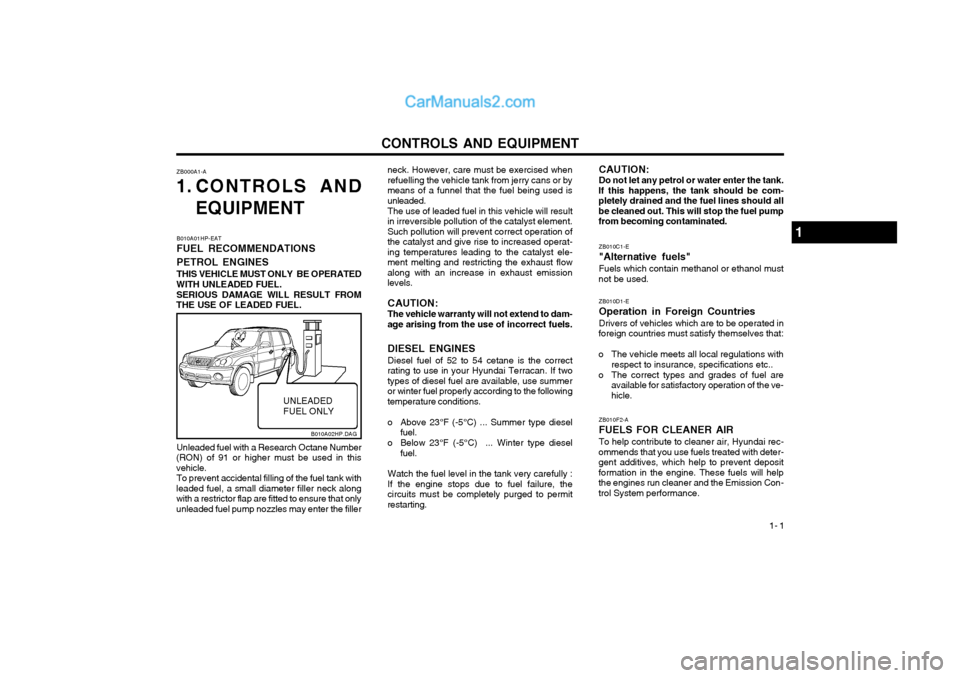
Unleaded fuel with a Research Octane Number
(RON) of 91 or higher must be used in this vehicle. To prevent accidental filling of the fuel tank with
leaded fuel, a small diameter filler neck alongwith a restrictor flap are fitted to ensure that onlyunleaded fuel pump nozzles may enter the filler
B010A02HP.DAG
UNLEADED FUEL ONLY
B010A01HP-EAT FUEL RECOMMENDATIONS PETROL ENGINES THIS VEHICLE MUST ONLY BE OPERATED
WITH UNLEADED FUEL.
SERIOUS DAMAGE WILL RESULT FROM
THE USE OF LEADED FUEL.
DIESEL ENGINESDiesel fuel of 52 to 54 cetane is the correct
rating to use in your Hyundai Terracan. If two types of diesel fuel are available, use summeror winter fuel properly according to the followingtemperature conditions.
o Above 23°F (-5°C) ... Summer type diesel fuel.
o Below 23°F (-5°C) ... Winter type diesel fuel.
Watch the fuel level in the tank very carefully :
If the engine stops due to fuel failure, the circuits must be completely purged to permitrestarting. CAUTION: Do not let any petrol or water enter the tank.
If this happens, the tank should be com- pletely drained and the fuel lines should allbe cleaned out. This will stop the fuel pumpfrom becoming contaminated.
ZB010D1-E Operation in Foreign CountriesDrivers of vehicles which are to be operated in
foreign countries must satisfy themselves that:
o The vehicle meets all local regulations with respect to insurance, specifications etc..
o The correct types and grades of fuel are available for satisfactory operation of the ve- hicle.
ZB010C1-E "Alternative fuels"Fuels which contain methanol or ethanol must
not be used.
ZB010F2-AFUELS FOR CLEANER AIRTo help contribute to cleaner air, Hyundai rec-
ommends that you use fuels treated with deter- gent additives, which help to prevent depositformation in the engine. These fuels will helpthe engines run cleaner and the Emission Con-trol System performance.
1
Page 224 of 361
CONTROLS AND EQUIPMENT
1- 24
NOTE: At present, this seat is the only one comply-
ing with that provision. In case that other manufacturers will furnish proof of a re-spective certification, Hyundai is going toevaluate this seat carefully and will give arecommendation provided that seat com-plies to the law. Please ask your Hyundaidealer in this respect.
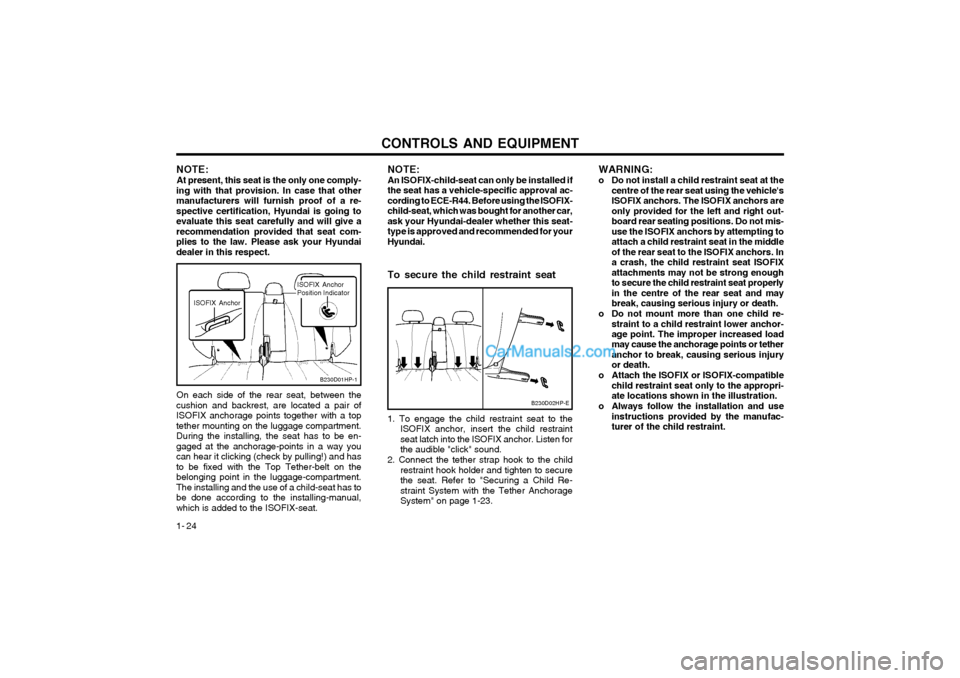
On each side of the rear seat, between the
cushion and backrest, are located a pair ofISOFIX anchorage points together with a toptether mounting on the luggage compartment.During the installing, the seat has to be en-gaged at the anchorage-points in a way youcan hear it clicking (check by pulling!) and hasto be fixed with the Top Tether-belt on thebelonging point in the luggage-compartment.The installing and the use of a child-seat has tobe done according to the installing-manual,which is added to the ISOFIX-seat.
B230D02HP-E
NOTE: An ISOFIX-child-seat can only be installed ifthe seat has a vehicle-specific approval ac-cording to ECE-R44. Before using the ISOFIX-child-seat, which was bought for another car,ask your Hyundai-dealer whether this seat-type is approved and recommended for yourHyundai.
To secure the child restraint seat
1. To engage the child restraint seat to the ISOFIX anchor, insert the child restraintseat latch into the ISOFIX anchor. Listen forthe audible "click" sound.
2. Connect the tether strap hook to the child restraint hook holder and tighten to securethe seat. Refer to "Securing a Child Re-straint System with the Tether AnchorageSystem" on page 1-23. WARNING:
o Do not install a child restraint seat at the
centre of the rear seat using the vehicle's ISOFIX anchors. The ISOFIX anchors areonly provided for the left and right out-board rear seating positions. Do not mis-use the ISOFIX anchors by attempting toattach a child restraint seat in the middleof the rear seat to the ISOFIX anchors. Ina crash, the child restraint seat ISOFIXattachments may not be strong enoughto secure the child restraint seat properlyin the centre of the rear seat and maybreak, causing serious injury or death.
o Do not mount more than one child re- straint to a child restraint lower anchor-age point. The improper increased load may cause the anchorage points or tether anchor to break, causing serious injuryor death.
o Attach the ISOFIX or ISOFIX-compatible child restraint seat only to the appropri-ate locations shown in the illustration.
o Always follow the installation and use instructions provided by the manufac-turer of the child restraint.
B230D01HP-1
ISOFIX Anchor ISOFIX Anchor Position Indicator
Page 257 of 361
CONTROLS AND EQUIPMENT1- 57
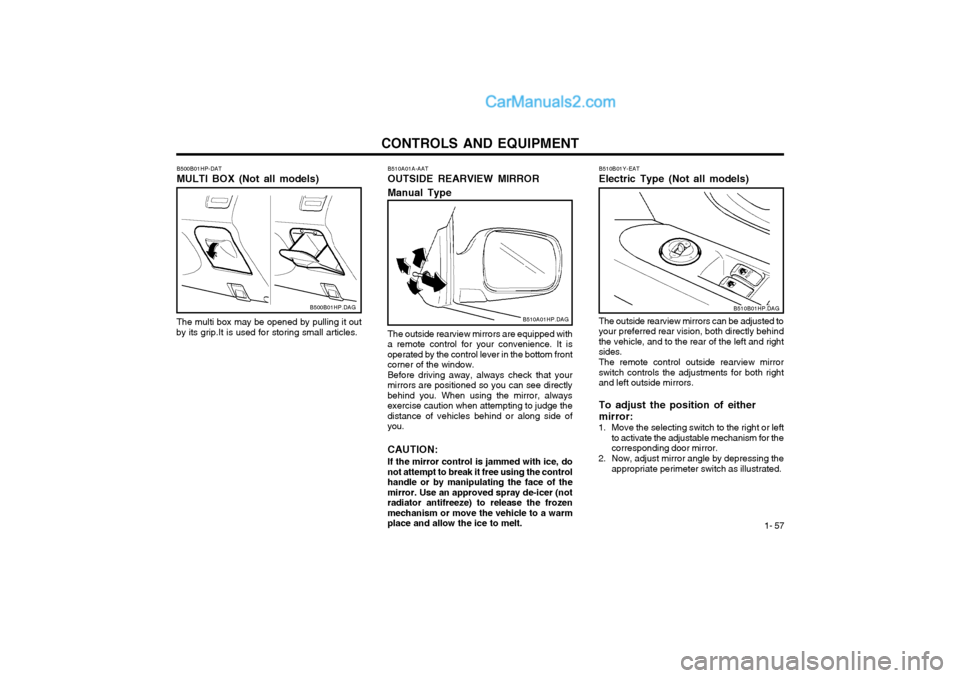
The outside rearview mirrors are equipped with
a remote control for your convenience. It is operated by the control lever in the bottom frontcorner of the window. Before driving away, always check that your
mirrors are positioned so you can see directlybehind you. When using the mirror, alwaysexercise caution when attempting to judge thedistance of vehicles behind or along side ofyou. CAUTION:
If the mirror control is jammed with ice, do
not attempt to break it free using the control handle or by manipulating the face of themirror. Use an approved spray de-icer (notradiator antifreeze) to release the frozenmechanism or move the vehicle to a warmplace and allow the ice to melt. B510A01A-AAT OUTSIDE REARVIEW MIRROR Manual Type
B510A01HP.DAG
B510B01Y-EAT Electric Type (Not all models)B510B01HP.DAG
The outside rearview mirrors can be adjusted to your preferred rear vision, both directly behindthe vehicle, and to the rear of the left and rightsides. The remote control outside rearview mirror switch controls the adjustments for both rightand left outside mirrors. To adjust the position of either mirror:
1. Move the selecting switch to the right or left to activate the adjustable mechanism for the corresponding door mirror.
2. Now, adjust mirror angle by depressing the appropriate perimeter switch as illustrated.B500B01HP.DAG
The multi box may be opened by pulling it out
by its grip.It is used for storing small articles. B500B01HP-DAT MULTI BOX (Not all models)
Page 280 of 361
CONTROLS AND EQUIPMENT
1- 80 B740D01Y-AAT Operation Tips
o If the interior of the car is hot when you first get in, open the windows for a few minutes to expel the hot air.
o When you are using the air conditioning system, keep all windows closed to keephot air out.
o When moving slowly, as in heavy traffic, shift to a lower gear. This increases enginespeed, which in turn increases the speed ofthe air conditioning compressor.
o On steep grades, turn the air conditioning off to avoid the possibility of the engine over-heating.
o During winter months or in periods when the air conditioning is not used regularly, run theair conditioning once every month for a fewminutes. This will help circulate the lubri-cants and keep your system in peak operat-ing condition.
Page 292 of 361
DRIVING YOUR HYUNDAI 2- 9
o Ensure that the overdrive switch is at the
"ON" position for maximum economy.
o If rapid acceleration is required, fully de- press the accelerator pedal. In this condi- tion, the kickdown mechanism will be oper-ated and the transmission will automaticallydownshift according to the vehicle speed.
C120A02A-EAT
ANTI-LOCK BRAKE SYSTEM (Not all models)
The Anti-Lock Brake System (ABS) is designed
to prevent wheel lock-up during sudden braking or on hazardous road surfaces. The ABS con-trol module monitors the wheel speed and con-trols the pressure applied to each brake. Thus,in emergency situations or on slick roads, ABSwill increase vehicle control during braking.
NOTE: During ABS operation, a slight pulsation
may be felt in the brake pedal when the brakes are applied. Also, a noise may beheard in the engine compartment whilst brak-ing. These conditions are normal and indi-cate that the anti-lock brake system is func-tioning properly. WARNING: ABS will not prevent accidents due to im-
proper or dangerous driving manoeuvres. Even though vehicle control is improvedduring emergency braking, always maintaina safe distance between you and objectsahead. Vehicle speeds should always bereduced during extreme road conditions.
The braking distance for cars equipped with
an anti-lock braking system may be longerthan for those without it in the followingroad conditions.
o Driving on rough, gravel or snow-cov- ered roads.
o Driving with tire chains installed.
o Driving on roads where the road surface is pitted or has different surface height.
These roads should be driven at reduced
speeds. The safety features of an ABS equipped vehicle should not be tested byhigh speed driving or cornering. This couldendanger the safety of yourself or others.
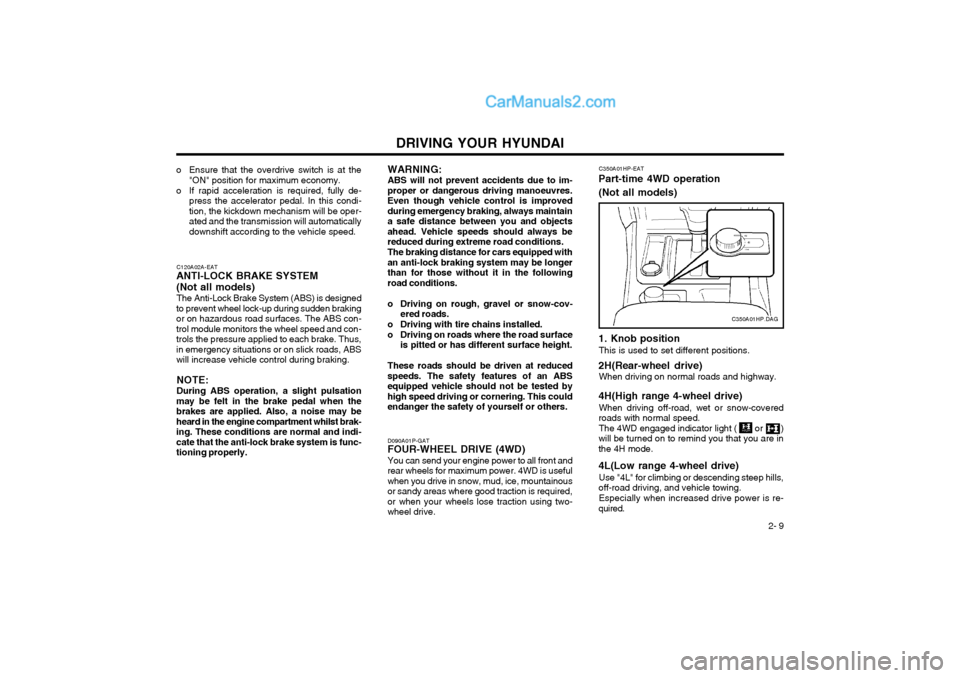
C350A01HP-EAT
Part-time 4WD operation (Not all models)
1. Knob position
This is used to set different positions.
2H(Rear-wheel drive) When driving on normal roads and highway.
4H(High range 4-wheel drive) When driving off-road, wet or snow-covered
roads with normal speed. The 4WD engaged indicator light ( or )
will be turned on to remind you that you are in the 4H mode. 4L(Low range 4-wheel drive)
Use "4L" for climbing or descending steep hills,
off-road driving, and vehicle towing.
Especially when increased drive power is re-
quired.
C350A01HP.DAG
D090A01P-GAT
FOUR-WHEEL DRIVE (4WD)
You can send your engine power to all front and
rear wheels for maximum power. 4WD is useful when you drive in snow, mud, ice, mountainousor sandy areas where good traction is required,or when your wheels lose traction using two-wheel drive.
Page 293 of 361
DRIVING YOUR HYUNDAI
2- 10
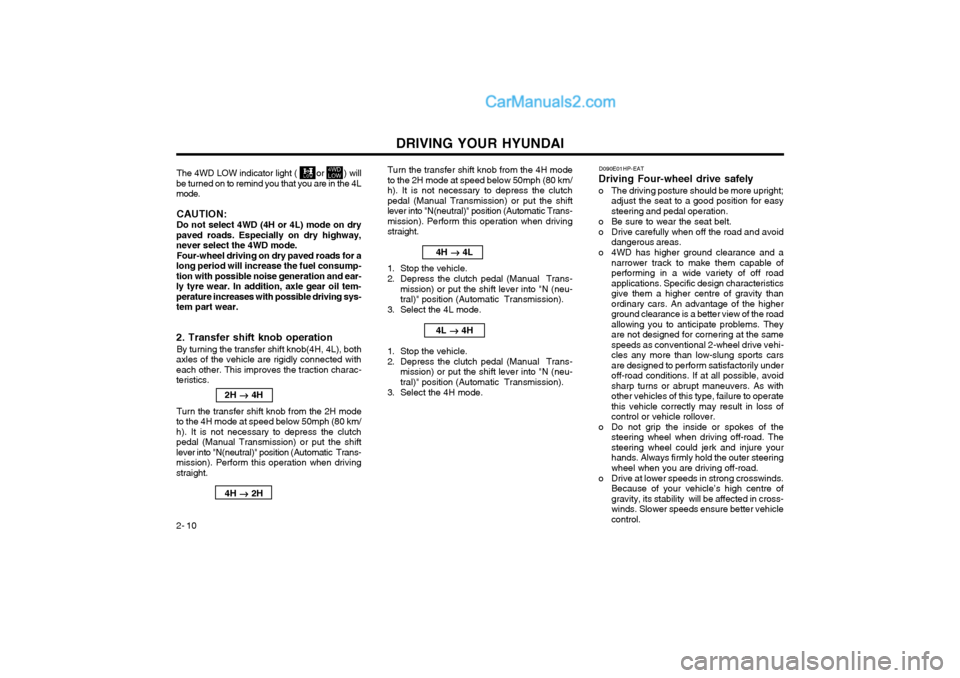
2. Transfer shift knob operation By turning the transfer shift knob(4H, 4L), both
axles of the vehicle are rigidly connected with each other. This improves the traction charac-teristics.
2H
4H
Turn the transfer shift knob from the 2H mode
to the 4H mode at speed below 50mph (80 km/h). It is not necessary to depress the clutchpedal (Manual Transmission) or put the shiftlever into "N(neutral)" position (Automatic Trans-mission). Perform this operation when drivingstraight.
4H
2H
Turn the transfer shift knob from the 4H mode
to the 2H mode at speed below 50mph (80 km/ h). It is not necessary to depress the clutchpedal (Manual Transmission) or put the shiftlever into "N(neutral)" position (Automatic Trans-mission). Perform this operation when drivingstraight.
4H
4L
1. Stop the vehicle.
2. Depress the clutch pedal (Manual Trans- mission) or put the shift lever into "N (neu- tral)" position (Automatic Transmission).
3. Select the 4L mode.
4L
4H
1. Stop the vehicle.
2. Depress the clutch pedal (Manual Trans- mission) or put the shift lever into "N (neu- tral)" position (Automatic Transmission).
3. Select the 4H mode.The 4WD LOW indicator light ( or ) will
be turned on to remind you that you are in the 4L mode.
CAUTION: Do not select 4WD (4H or 4L) mode on dry
paved roads. Especially on dry highway, never select the 4WD mode. Four-wheel driving on dry paved roads for a
long period will increase the fuel consump-tion with possible noise generation and ear-ly tyre wear. In addition, axle gear oil tem-perature increases with possible driving sys-tem part wear. D090E01HP-EAT
Driving Four-wheel drive safely
o The driving posture should be more upright; adjust the seat to a good position for easy steering and pedal operation.
o Be sure to wear the seat belt.
o Drive carefully when off the road and avoid dangerous areas.
o 4WD has higher ground clearance and a narrower track to make them capable of performing in a wide variety of off roadapplications. Specific design characteristicsgive them a higher centre of gravity thanordinary cars. An advantage of the higherground clearance is a better view of the roadallowing you to anticipate problems. Theyare not designed for cornering at the samespeeds as conventional 2-wheel drive vehi-cles any more than low-slung sports carsare designed to perform satisfactorily underoff-road conditions. If at all possible, avoidsharp turns or abrupt maneuvers. As withother vehicles of this type, failure to operatethis vehicle correctly may result in loss ofcontrol or vehicle rollover.
o Do not grip the inside or spokes of the steering wheel when driving off-road. Thesteering wheel could jerk and injure yourhands. Always firmly hold the outer steeringwheel when you are driving off-road.
o Drive at lower speeds in strong crosswinds. Because of your vehicle’s high centre ofgravity, its stability will be affected in cross-winds. Slower speeds ensure better vehiclecontrol.
Page 294 of 361
DRIVING YOUR HYUNDAI 2- 11
o Check your brake condition once you are
out of mud or water. Press the brake several times as you move slowly until your feelnormal braking forces return.
o Four-wheel driving on flat and normal roads can result in a severe binding conditionwhen turning the steering wheel.
Driving on dry paved road and high- way Select the 2H(2WD) to drive on dry paved roads. Especially on dry highway, never selectthe 4H or 4L(4WD).
Driving on snowy or icy roads Select the 4H or 4L in accordance with the roadconditions, and then gradually depress the ac-celerator pedal for a smooth start.
Driving on sandy or muddy roads Select the 4H or 4L and then gradually depressthe accelerator pedal for a smooth start. Keepthe pressure on the accelerator pedal constantas possible, and drive at low speed.
Climbing sharp grades Select the 4L to maximize use the engine torque.
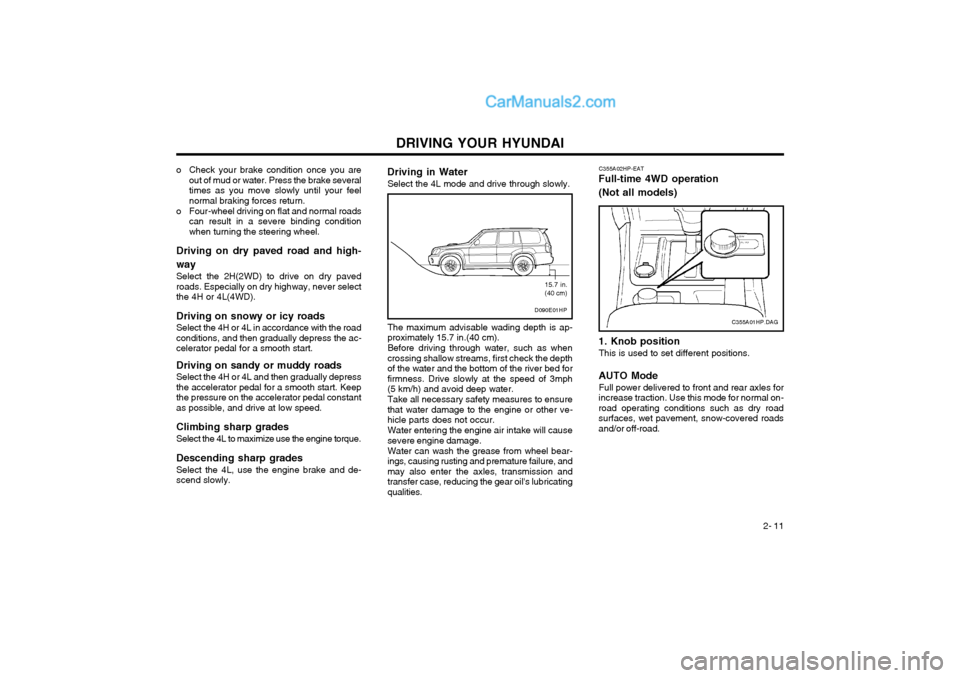
Descending sharp grades Select the 4L, use the engine brake and de-scend slowly. Driving in Water
Select the 4L mode and drive through slowly. The maximum advisable wading depth is ap- proximately 15.7 in.(40 cm). Before driving through water, such as when crossing shallow streams, first check the depthof the water and the bottom of the river bed forfirmness. Drive slowly at the speed of 3mph(5 km/h) and avoid deep water. Take all necessary safety measures to ensure that water damage to the engine or other ve-hicle parts does not occur. Water entering the engine air intake will cause severe engine damage. Water can wash the grease from wheel bear- ings, causing rusting and premature failure, andmay also enter the axles, transmission andtransfer case, reducing the gear oil's lubricatingqualities.
C355A02HP-EAT
Full-time 4WD operation (Not all models) 1. Knob position
This is used to set different positions.
AUTO Mode Full power delivered to front and rear axles for
increase traction. Use this mode for normal on- road operating conditions such as dry roadsurfaces, wet pavement, snow-covered roadsand/or off-road.
C355A01HP.DAG
D090E01HP
15.7 in. (40 cm)
Page 295 of 361
DRIVING YOUR HYUNDAI
2- 12 Driving 4WD Safely
(1) Be sure to wear the seat belt.
(2) Drive at lower speeds in strong crosswinds.
Because of your vehicle's high centre of gravity, its stability will be affected in cross-winds. Slower speeds ensure better vehiclecontrol.
(3) Check the brake condition after driving in wet or muddy conditions. Press the brakeseveral times as you move slowly until youfeel normal braking forces return.
(4) Do not drive the vehicle through water. (i.e. streams, rivers, lakes, etc.)
(5) The stopping distance of the full-time 4WD vehicle differs very little from that of the2WD vehicle.
When driving on a snow-covered road or a slippery, muddy surface, make sure thatyou keep a sufficient distance between yourvehicle and the one ahead of you.
(6) Since the driving torque is always applied to the 4 wheels, the performance of the full-time 4WD vehicle is greatly affected by thecondition of the tyres. Be sure to equip itwith all four tyres of the same size and type.o When replacement of any of the tyres or disc wheels is necessary, replace all ofthem.
o Rotate the tyres and check the tyre pres- sure at regular intervals.
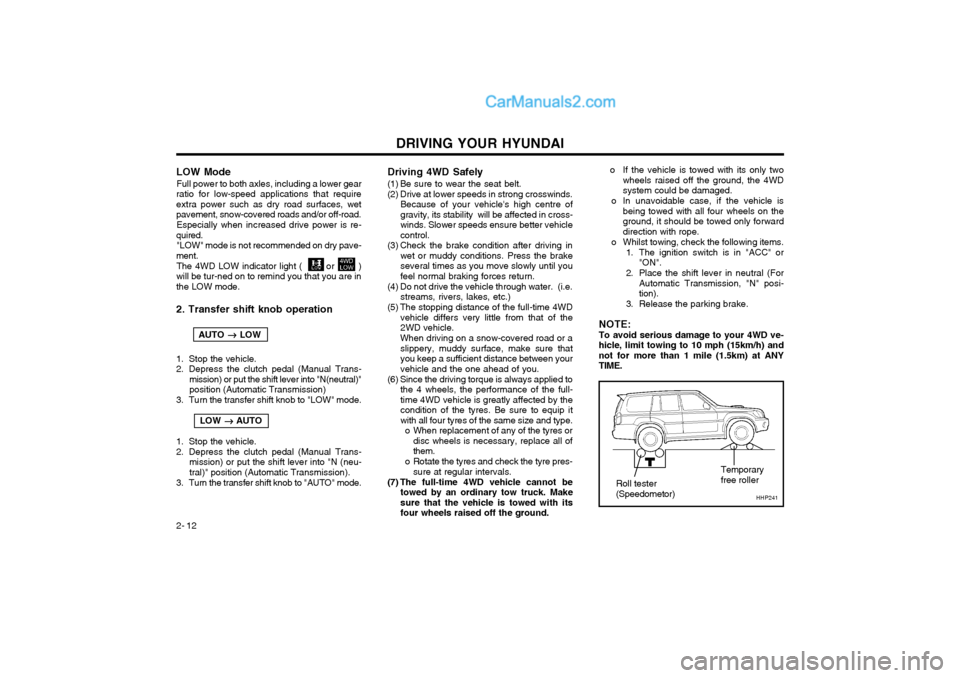
(7) The full-time 4WD vehicle cannot be towed by an ordinary tow truck. Makesure that the vehicle is towed with itsfour wheels raised off the ground. o If the vehicle is towed with its only two
wheels raised off the ground, the 4WDsystem could be damaged.
o In unavoidable case, if the vehicle is being towed with all four wheels on theground, it should be towed only forwarddirection with rope.
o Whilst towing, check the following items.
1. The ignition switch is in "ACC" or"ON".
2. Place the shift lever in neutral (For Automatic Transmission, "N" posi-tion).
3. Release the parking brake.
NOTE: To avoid serious damage to your 4WD ve- hicle, limit towing to 10 mph (15km/h) andnot for more than 1 mile (1.5km) at ANYTIME.
HHP241
Roll tester (Speedometor) Temporaryfree roller
LOW Mode
Full power to both axles, including a lower gear
ratio for low-speed applications that require extra power such as dry road surfaces, wetpavement, snow-covered roads and/or off-road.
Especially when increased drive power is re-
quired. "LOW" mode is not recommended on dry pave-
ment.
The 4WD LOW indicator light ( or )
will be tur-ned on to remind you that you are inthe LOW mode. 2. Transfer shift knob operation
AUTO
LOW
1. Stop the vehicle.
2. Depress the clutch pedal (Manual Trans- mission) or put the shift lever into "N(neutral)"position (Automatic Transmission)
3. Turn the transfer shift knob to "LOW" mode.
LOW
AUTO
1. Stop the vehicle.
2. Depress the clutch pedal (Manual Trans- mission) or put the shift lever into "N (neu-tral)" position (Automatic Transmission).
3. Turn the transfer shift knob to "AUTO" mode.