radiator Hyundai Terracan 2004 Owner's Manual
[x] Cancel search | Manufacturer: HYUNDAI, Model Year: 2004, Model line: Terracan, Model: Hyundai Terracan 2004Pages: 361, PDF Size: 4.69 MB
Page 51 of 361
FEATURES OF YOUR HYUNDAI 1- 43
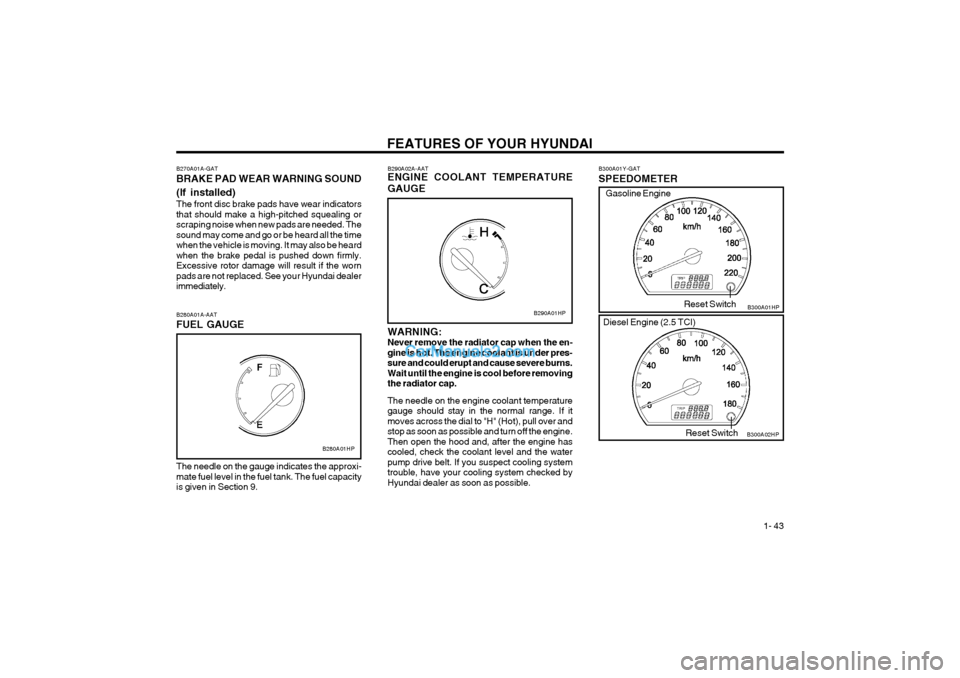
B300A01Y-GAT SPEEDOMETERB300A01HP
B300A02HP
Reset Switch
Reset Switch
Gasoline Engine
Diesel Engine (2.5 TCI)
B280A01A-AAT FUEL GAUGE
B280A01HP
The needle on the gauge indicates the approxi- mate fuel level in the fuel tank. The fuel capacityis given in Section 9. B290A02A-AAT ENGINE COOLANT TEMPERATURE GAUGE WARNING: Never remove the radiator cap when the en-gine is hot. The engine coolant is under pres-sure and could erupt and cause severe burns.Wait until the engine is cool before removingthe radiator cap. The needle on the engine coolant temperature gauge should stay in the normal range. If itmoves across the dial to "H" (Hot), pull over andstop as soon as possible and turn off the engine.Then open the hood and, after the engine hascooled, check the coolant level and the waterpump drive belt. If you suspect cooling systemtrouble, have your cooling system checked byHyundai dealer as soon as possible.
B290A01HP
B270A01A-GAT BRAKE PAD WEAR WARNING SOUND (If installed) The front disc brake pads have wear indicators that should make a high-pitched squealing orscraping noise when new pads are needed. Thesound may come and go or be heard all the timewhen the vehicle is moving. It may also be heardwhen the brake pedal is pushed down firmly.Excessive rotor damage will result if the wornpads are not replaced. See your Hyundai dealerimmediately.
Page 64 of 361
FEATURES OF YOUR HYUNDAI
1- 56
B510A01HP
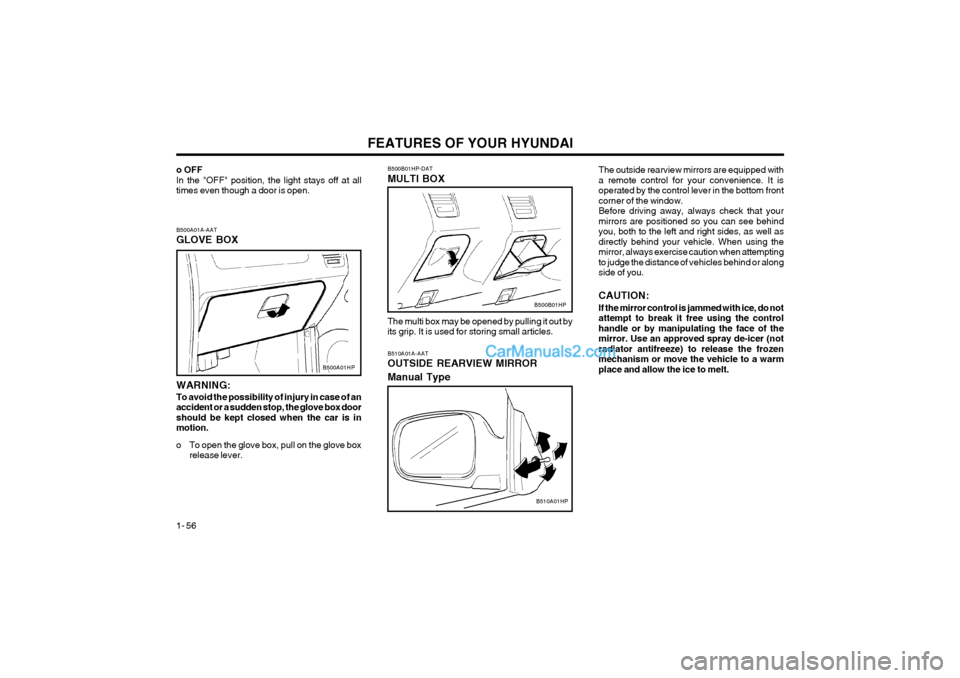
B500A01A-AAT GLOVE BOX
B500A01HP
WARNING: To avoid the possibility of injury in case of an accident or a sudden stop, the glove box doorshould be kept closed when the car is inmotion.
o To open the glove box, pull on the glove box release lever.
B500B01HP
The multi box may be opened by pulling it out by its grip. It is used for storing small articles.
B500B01HP-DAT MULTI BOX
o OFF In the "OFF" position, the light stays off at alltimes even though a door is open.
B510A01A-AAT OUTSIDE REARVIEW MIRROR Manual TypeThe outside rearview mirrors are equipped with a remote control for your convenience. It isoperated by the control lever in the bottom frontcorner of the window.Before driving away, always check that yourmirrors are positioned so you can see behindyou, both to the left and right sides, as well asdirectly behind your vehicle. When using themirror, always exercise caution when attemptingto judge the distance of vehicles behind or alongside of you. CAUTION: If the mirror control is jammed with ice, do not attempt to break it free using the controlhandle or by manipulating the face of themirror. Use an approved spray de-icer (notradiator antifreeze) to release the frozenmechanism or move the vehicle to a warmplace and allow the ice to melt.
Page 70 of 361
FEATURES OF YOUR HYUNDAI
1- 62
WARNING: Fuel vapors are dangerous. Before refueling,always stop the engine and never allow sparksor open flames near the filler area. If you needto replace the filler cap, use a genuine Hyundaireplacement part.If you open the fuel filler cap during highambient temperatures, a slight "pressuresound" may be heard. This is normal and nota cause for concern.Whenever you open the fuel filler cap, turn itslowly.
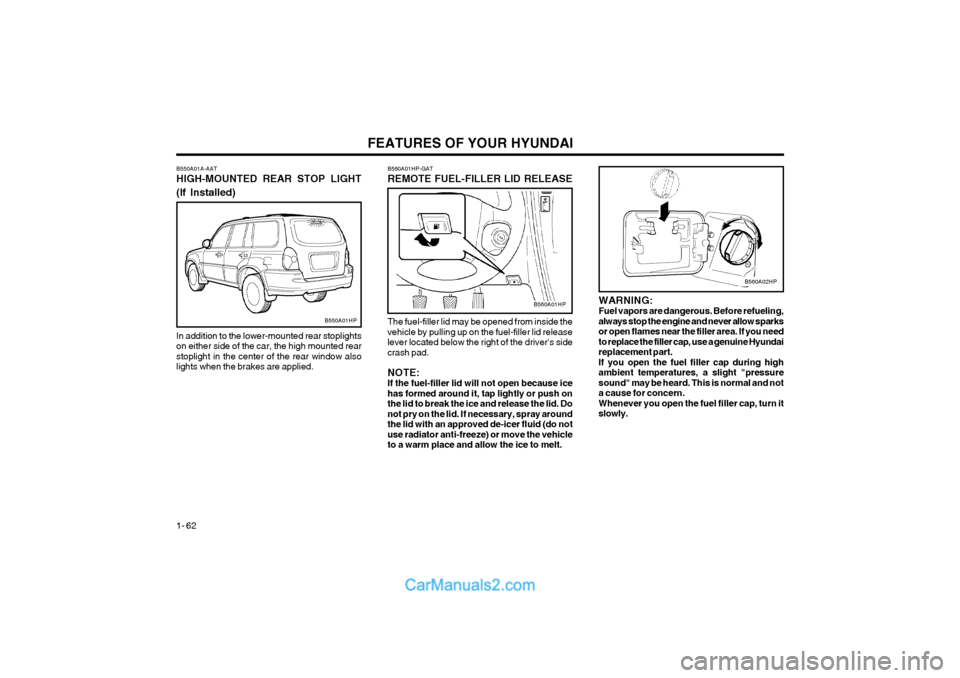
B550A01A-AAT HIGH-MOUNTED REAR STOP LIGHT (If Installed)
In addition to the lower-mounted rear stoplights on either side of the car, the high mounted rearstoplight in the center of the rear window alsolights when the brakes are applied.
B550A01HP
B560A01HP-GAT REMOTE FUEL-FILLER LID RELEASE
The fuel-filler lid may be opened from inside the vehicle by pulling up on the fuel-filler lid releaselever located below the right of the driver's sidecrash pad. NOTE: If the fuel-filler lid will not open because icehas formed around it, tap lightly or push onthe lid to break the ice and release the lid. Donot pry on the lid. If necessary, spray aroundthe lid with an approved de-icer fluid (do notuse radiator anti-freeze) or move the vehicleto a warm place and allow the ice to melt.
B560A01HP
B560A02HP
Page 130 of 361
WHAT TO DO IN AN EMERGENCY
3-2 tinue to apply water to the affected area with a sponge or cloth.
o The gas produced by the battery during the
jump-start operation is highly explosive. Do not smoke or allow a spark or an open flame in the vicinity.
o The battery being used to provide the jump
start must be 12-volt. If you cannot determine that it is a 12-volt battery, do not attempt to use it for the jump start.
o To jump start a car with a discharged battery,
follow this procedure exactly:
1. If the booster battery is installed in another vehicle, be sure the two vehicles are nottouching.
2. Turn off all unnecessary lights and acces-
sories in both vehicles.
3. Attach the clamps of the jumper cable in the
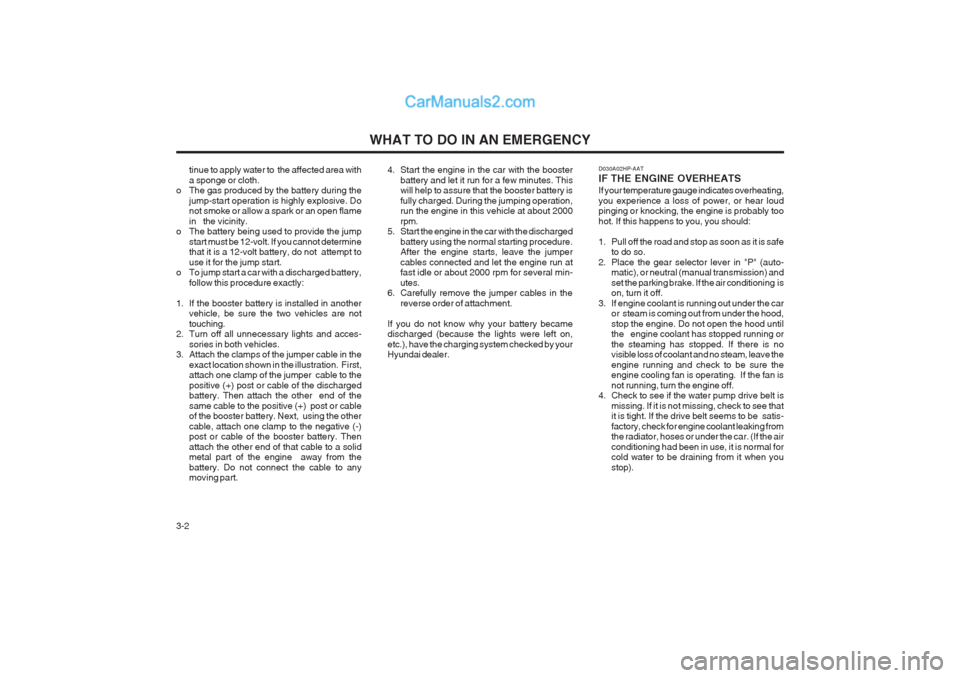
exact location shown in the illustration. First, attach one clamp of the jumper cable to the positive (+) post or cable of the discharged battery. Then attach the other end of the same cable to the positive (+) post or cable of the booster battery. Next, using the other cable, attach one clamp to the negative (-) post or cable of the booster battery. Then attach the other end of that cable to a solid metal part of the engine away from the battery. Do not connect the cable to any moving part. 4. Start the engine in the car with the booster
battery and let it run for a few minutes. Thiswill help to assure that the booster battery is fully charged. During the jumping operation, run the engine in this vehicle at about 2000 rpm.
5. Start the engine in the car with the discharged
battery using the normal starting procedure. After the engine starts, leave the jumper cables connected and let the engine run at fast idle or about 2000 rpm for several min- utes.
6. Carefully remove the jumper cables in the
reverse order of attachment.
If you do not know why your battery became discharged (because the lights were left on, etc.), have the charging system checked by your Hyundai dealer. D030A02HP-AAT IF THE ENGINE OVERHEATS If your temperature gauge indicates overheating, you experience a loss of power, or hear loud pinging or knocking, the engine is probably too hot. If this happens to you, you should:
1. Pull off the road and stop as soon as it is safe
to do so.
2. Place the gear selector lever in "P" (auto- matic), or neutral (manual transmission) and set the parking brake. If the air conditioning is on, turn it off.
3. If engine coolant is running out under the car or steam is coming out from under the hood, stop the engine. Do not open the hood until the engine coolant has stopped running or the steaming has stopped. If there is no visible loss of coolant and no steam, leave the engine running and check to be sure the engine cooling fan is operating. If the fan is not running, turn the engine off.
4. Check to see if the water pump drive belt is
missing. If it is not missing, check to see that it is tight. If the drive belt seems to be satis- factory, check for engine coolant leaking from the radiator, hoses or under the car. (If the air conditioning had been in use, it is normal for cold water to be draining from it when you stop).
Page 131 of 361
WHAT TO DO IN AN EMERGENCY 3-3
WARNING: While the engine is running, keep hands and clothing away from moving parts such as the fan and drive belts to prevent injury. WARNING (Diesel only): Never work on injection system with engine running or within 30 seconds after shutting off engine. High pressure pump, rail, injec- tors and high pressure pipes are subject to high pressure even after the engine stopped. The fuel jet produced by fuel leaks may cause serious injury, if it touch the body. People using pacemakers should not move than 30cm closer to the ECU or wiring harness within the engine room while engine is running, since the high currents in the Common Rail system produce considerable magnetic fields.
5. If the water pump drive belt is broken or
coolant is leaking out, stop the engine im- mediately and call the nearest Hyundai deal- er for assistance.
WARNING: Do not remove the radiator cap when the engine is hot. This can allow coolant to be blown out of the opening and cause serious burns. D040A01HP-GAT SPARE TIREThe following instructions for the FULL SIZE spare tire should be observed: Check inflation pressure as soon as possible after installing the spare tire, and adjust to the specified pressure. The tire pressure should be periodically checked and maintained at the spec- ified pressure while the tire is stored.
Inflation Pressure
Tire Size
Full Size 200 kPa (29 psi)
Spare Tire Pressure
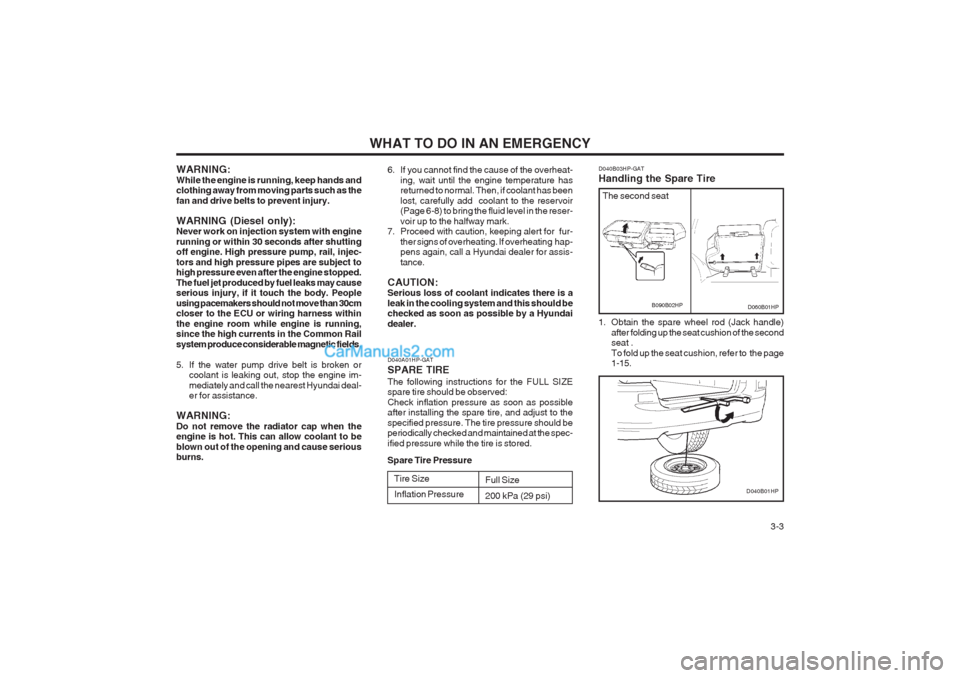
D040B03HP-GAT Handling the Spare Tire
1. Obtain the spare wheel rod (Jack handle)
after folding up the seat cushion of the second seat . To fold up the seat cushion, refer to the page 1-15.
The second seat
6. If you cannot find the cause of the overheat-
ing, wait until the engine temperature has returned to normal. Then, if coolant has been lost, carefully add coolant to the reservoir (Page 6-8) to bring the fluid level in the reser- voir up to the halfway mark.
7. Proceed with caution, keeping alert for fur-
ther signs of overheating. If overheating hap- pens again, call a Hyundai dealer for assis- tance.
CAUTION: Serious loss of coolant indicates there is a leak in the cooling system and this should be checked as soon as possible by a Hyundai dealer.
D040B01HP
D060B01HPB090B02HP
Page 153 of 361
DO-IT-YOURSELF MAINTENANCE 6-1
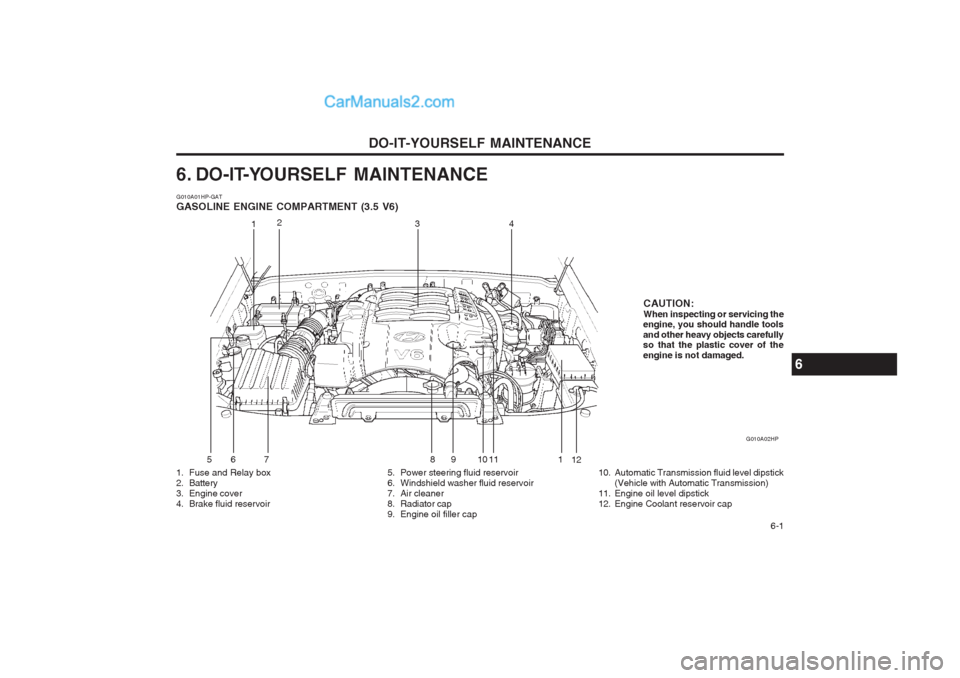
6. DO-IT-YOURSELF MAINTENANCE G010A01HP-GAT GASOLINE ENGINE COMPARTMENT (3.5 V6)
1. Fuse and Relay box
2. Battery
3. Engine cover
4. Brake fluid reservoir5. Power steering fluid reservoir
6. Windshield washer fluid reservoir
7. Air cleaner
8. Radiator cap
9. Engine oil filler cap10. Automatic Transmission fluid level dipstick
(Vehicle with Automatic Transmission)
11. Engine oil level dipstick
12. Engine Coolant reservoir cap G010A02HP
1
2
4
56 7 89 1 011
6
1 CAUTION: When inspecting or servicing the
engine, you should handle toolsand other heavy objects carefully so that the plastic cover of the engine is not damaged.
312
Page 154 of 361
DO-IT-YOURSELF MAINTENANCE
6-2
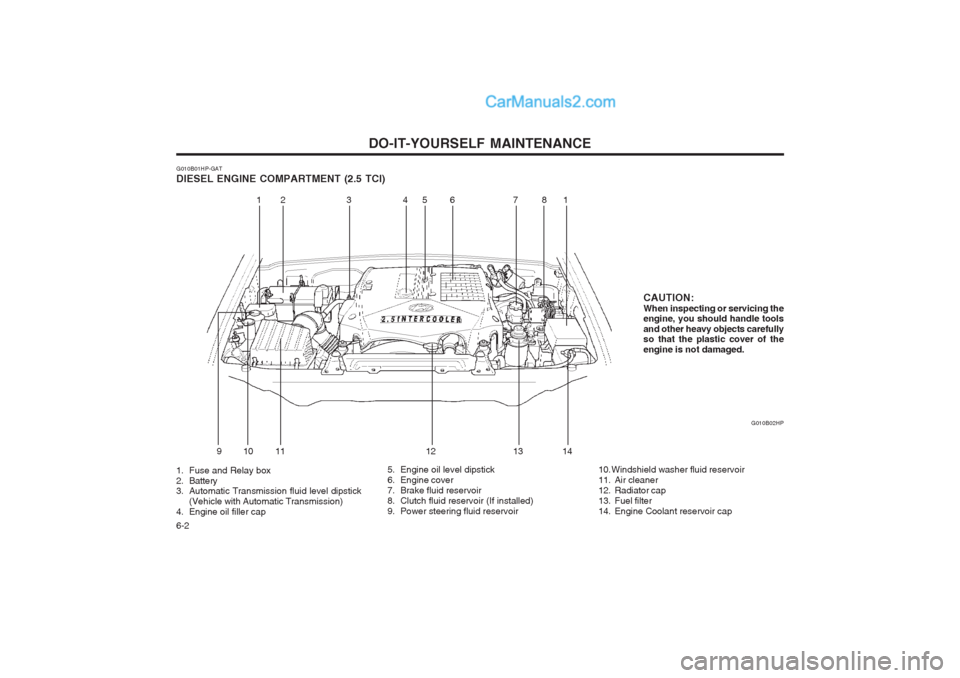
G010B01HP-GAT DIESEL ENGINE COMPARTMENT (2.5 TCI) G010B02HP
1. Fuse and Relay box
2. Battery
3. Automatic Transmission fluid level dipstick (Vehicle with Automatic Transmission)
4. Engine oil filler cap 5. Engine oil level dipstick
6. Engine cover
7. Brake fluid reservoir
8. Clutch fluid reservoir (If installed)
9. Power steering fluid reservoir
10. Windshield washer fluid reservoir
11. Air cleaner
12. Radiator cap
13. Fuel filter
14. Engine Coolant reservoir cap
121
CAUTION: When inspecting or servicing the engine, you should handle tools and other heavy objects carefully so that the plastic cover of the engine is not damaged.345 7 86
91 0 1 1 1 2 13 14
Page 155 of 361
DO-IT-YOURSELF MAINTENANCE 6-3
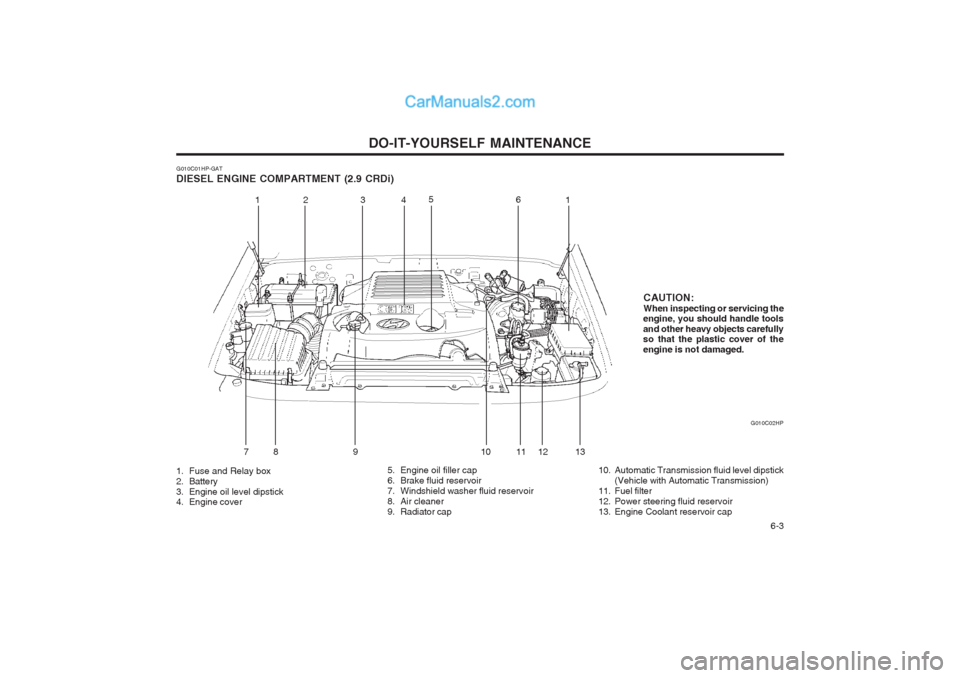
G010C01HP-GAT DIESEL ENGINE COMPARTMENT (2.9 CRDi) G010C02HP
1. Fuse and Relay box
2. Battery
3. Engine oil level dipstick
4. Engine cover 5. Engine oil filler cap
6. Brake fluid reservoir
7. Windshield washer fluid reservoir
8. Air cleaner
9. Radiator cap10. Automatic Transmission fluid level dipstick
(Vehicle with Automatic Transmission)
11. Fuel filter
12. Power steering fluid reservoir
13. Engine Coolant reservoir cap
12 3 5
6
78 9 1 0 121
CAUTION: When inspecting or servicing the
engine, you should handle toolsand other heavy objects carefully so that the plastic cover of the engine is not damaged.
4
13
11
Page 160 of 361
DO-IT-YOURSELF MAINTENANCE
6-8
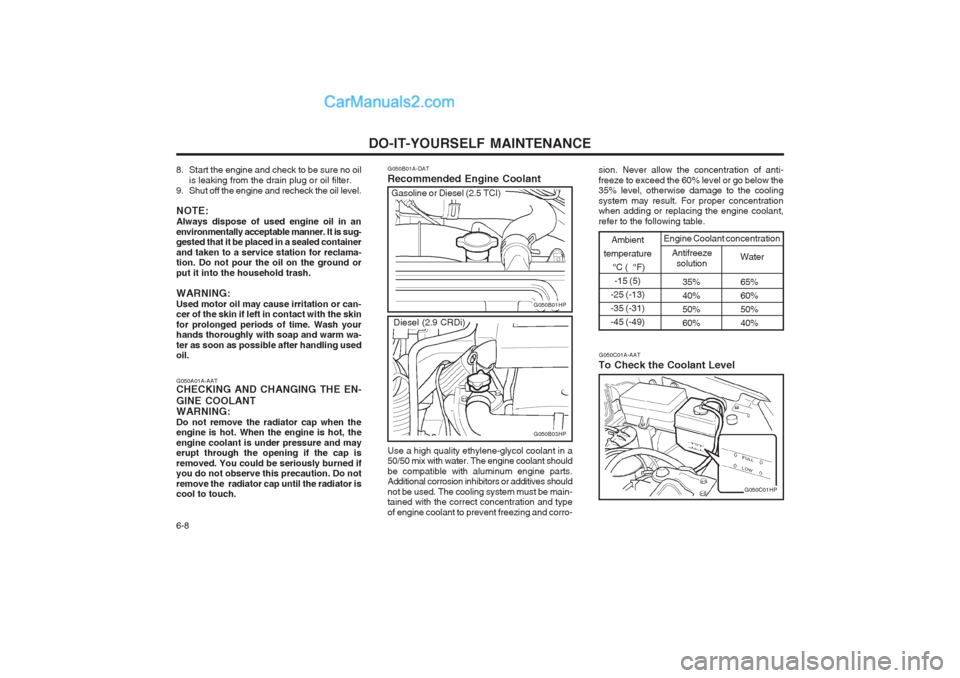
G050B01A-DAT Recommended Engine Coolant
35% 65%
40% 60%
50% 50%
60% 40%
Ambient
temperature °C ( °F)-15 (5)
-25 (-13) -35 (-31)-45 (-49)
Antifreeze solution Water
Engine Coolant concentration
G050B01HP
G050C01A-AAT
To Check the Coolant Level
G050C01HP
Use a high quality ethylene-glycol coolant in a 50/50 mix with water. The engine coolant should be compatible with aluminum engine parts. Additional corrosion inhibitors or additives should not be used. The cooling system must be main- tained with the correct concentration and type of engine coolant to prevent freezing and corro-
Gasoline or Diesel (2.5 TCI)
G050B03HP
Diesel (2.9 CRDi) sion. Never allow the concentration of anti- freeze to exceed the 60% level or go below the 35% level, otherwise damage to the cooling system may result. For proper concentration when adding or replacing the engine coolant, refer to the following table.
8. Start the engine and check to be sure no oil
is leaking from the drain plug or oil filter.
9. Shut off the engine and recheck the oil level. NOTE: Always dispose of used engine oil in anenvironmentally acceptable manner. It is sug- gested that it be placed in a sealed container and taken to a service station for reclama- tion. Do not pour the oil on the ground or put it into the household trash. WARNING: Used motor oil may cause irritation or can- cer of the skin if left in contact with the skin for prolonged periods of time. Wash your hands thoroughly with soap and warm wa- ter as soon as possible after handling used oil. G050A01A-AAT CHECKING AND CHANGING THE EN- GINE COOLANT WARNING: Do not remove the radiator cap when the engine is hot. When the engine is hot, the engine coolant is under pressure and may erupt through the opening if the cap is removed. You could be seriously burned if you do not observe this precaution. Do not remove the radiator cap until the radiator is cool to touch.
Page 161 of 361
DO-IT-YOURSELF MAINTENANCE 6-9
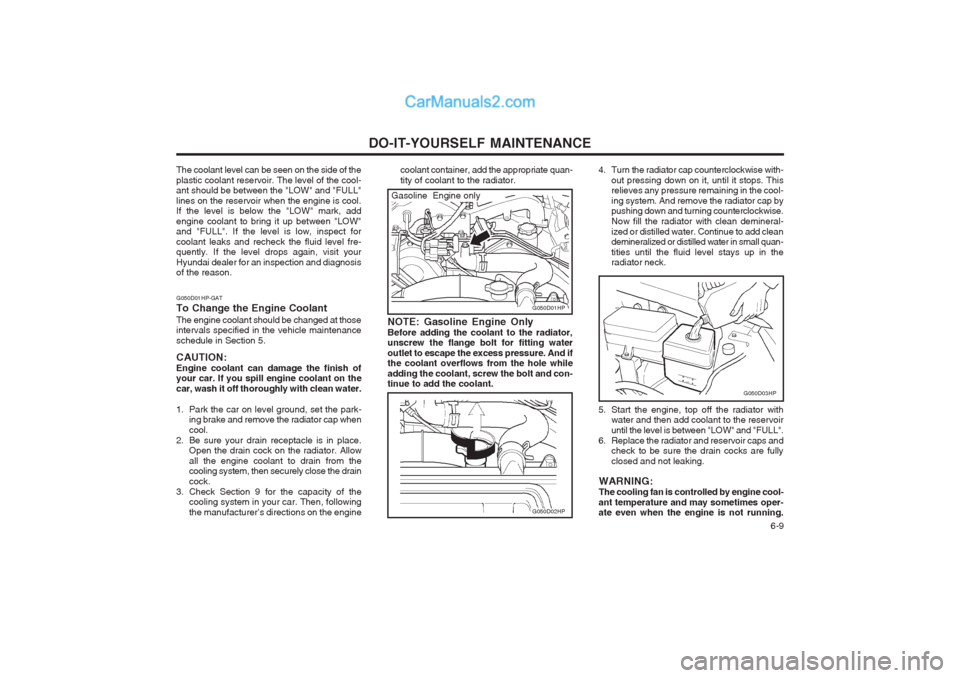
coolant container, add the appropriate quan- tity of coolant to the radiator.
G050D03HP
G050D01HP
G050D02HP
NOTE: Gasoline Engine Only Before adding the coolant to the radiator, unscrew the flange bolt for fitting water outlet to escape the excess pressure. And if the coolant overflows from the hole while adding the coolant, screw the bolt and con- tinue to add the coolant. 4. Turn the radiator cap counterclockwise with-
out pressing down on it, until it stops. Thisrelieves any pressure remaining in the cool- ing system. And remove the radiator cap by pushing down and turning counterclockwise. Now fill the radiator with clean demineral-ized or distilled water. Continue to add clean demineralized or distilled water in small quan- tities until the fluid level stays up in the radiator neck.
5. Start the engine, top off the radiator with water and then add coolant to the reservoir until the level is between "LOW" and "FULL".
6. Replace the radiator and reservoir caps and check to be sure the drain cocks are fullyclosed and not leaking.
WARNING:The cooling fan is controlled by engine cool-
ant temperature and may sometimes oper- ate even when the engine is not running.
Gasoline Engine only
The coolant level can be seen on the side of the plastic coolant reservoir. The level of the cool- ant should be between the "LOW" and "FULL" lines on the reservoir when the engine is cool. If the level is below the "LOW" mark, add engine coolant to bring it up between "LOW" and "FULL". If the level is low, inspect for coolant leaks and recheck the fluid level fre- quently. If the level drops again, visit your Hyundai dealer for an inspection and diagnosis of the reason.
G050D01HP-GAT To Change the Engine CoolantThe engine coolant should be changed at those intervals specified in the vehicle maintenance schedule in Section 5. CAUTION: Engine coolant can damage the finish of your car. If you spill engine coolant on the car, wash it off thoroughly with clean water.
1. Park the car on level ground, set the park-
ing brake and remove the radiator cap when cool.
2. Be sure your drain receptacle is in place. Open the drain cock on the radiator. Allowall the engine coolant to drain from the cooling system, then securely close the drain cock.
3. Check Section 9 for the capacity of the cooling system in your car. Then, followingthe manufacturer’s directions on the engine