wiring Hyundai Terracan 2004 Owner's Manual
[x] Cancel search | Manufacturer: HYUNDAI, Model Year: 2004, Model line: Terracan, Model: Hyundai Terracan 2004Pages: 361, PDF Size: 4.69 MB
Page 39 of 361
FEATURES OF YOUR HYUNDAI 1- 31
B240B02L
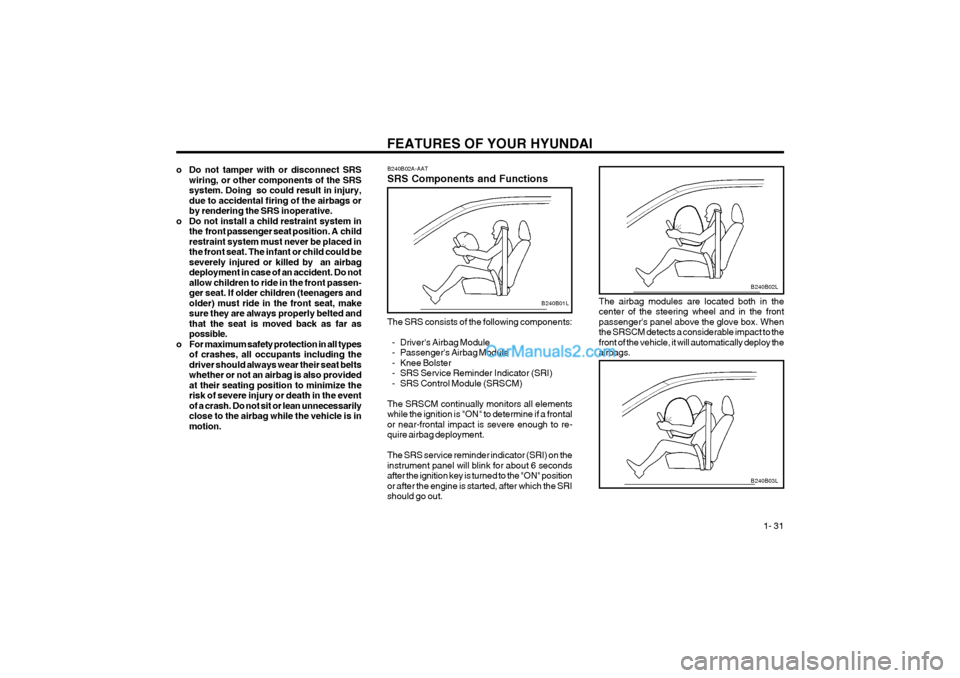
The airbag modules are located both in the center of the steering wheel and in the frontpassenger's panel above the glove box. Whenthe SRSCM detects a considerable impact to thefront of the vehicle, it will automatically deploy theairbags.
B240B03L
o Do not tamper with or disconnect SRS
wiring, or other components of the SRS system. Doing so could result in injury,due to accidental firing of the airbags orby rendering the SRS inoperative.
o Do not install a child restraint system in the front passenger seat position. A childrestraint system must never be placed inthe front seat. The infant or child could beseverely injured or killed by an airbagdeployment in case of an accident. Do notallow children to ride in the front passen-ger seat. If older children (teenagers andolder) must ride in the front seat, makesure they are always properly belted andthat the seat is moved back as far aspossible.
o For maximum safety protection in all types of crashes, all occupants including thedriver should always wear their seat beltswhether or not an airbag is also providedat their seating position to minimize therisk of severe injury or death in the eventof a crash. Do not sit or lean unnecessarilyclose to the airbag while the vehicle is inmotion. B240B02A-AAT SRS Components and Functions
B240B01L
The SRS consists of the following components:
- Driver's Airbag Module
- Passenger's Airbag Module
- Knee Bolster
- SRS Service Reminder Indicator (SRI)
- SRS Control Module (SRSCM)
The SRSCM continually monitors all elementswhile the ignition is "ON" to determine if a frontalor near-frontal impact is severe enough to re-quire airbag deployment. The SRS service reminder indicator (SRI) on the instrument panel will blink for about 6 secondsafter the ignition key is turned to the "ON" positionor after the engine is started, after which the SRIshould go out.
Page 41 of 361
FEATURES OF YOUR HYUNDAI 1- 33
YT10355A
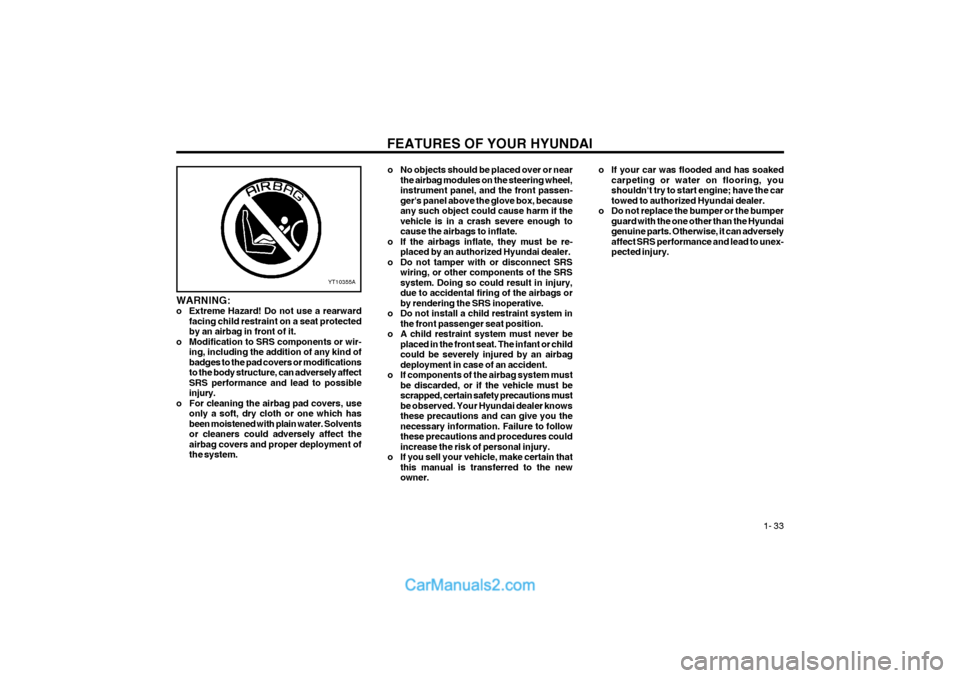
WARNING:
o Extreme Hazard! Do not use a rearwardfacing child restraint on a seat protectedby an airbag in front of it.
o Modification to SRS components or wir- ing, including the addition of any kind ofbadges to the pad covers or modificationsto the body structure, can adversely affectSRS performance and lead to possibleinjury.
o For cleaning the airbag pad covers, use only a soft, dry cloth or one which hasbeen moistened with plain water. Solventsor cleaners could adversely affect theairbag covers and proper deployment ofthe system. o No objects should be placed over or near
the airbag modules on the steering wheel,instrument panel, and the front passen-ger's panel above the glove box, becauseany such object could cause harm if thevehicle is in a crash severe enough tocause the airbags to inflate.
o If the airbags inflate, they must be re- placed by an authorized Hyundai dealer.
o Do not tamper with or disconnect SRS wiring, or other components of the SRSsystem. Doing so could result in injury,due to accidental firing of the airbags orby rendering the SRS inoperative.
o Do not install a child restraint system in the front passenger seat position.
o A child restraint system must never be placed in the front seat. The infant or childcould be severely injured by an airbagdeployment in case of an accident.
o If components of the airbag system must be discarded, or if the vehicle must bescrapped, certain safety precautions mustbe observed. Your Hyundai dealer knowsthese precautions and can give you thenecessary information. Failure to followthese precautions and procedures couldincrease the risk of personal injury.
o If you sell your vehicle, make certain that this manual is transferred to the newowner. o If your car was flooded and has soaked
carpeting or water on flooring, youshouldn't try to start engine; have the cartowed to authorized Hyundai dealer.
o Do not replace the bumper or the bumper guard with the one other than the Hyundaigenuine parts. Otherwise, it can adverselyaffect SRS performance and lead to unex-pected injury.
Page 125 of 361
DRIVING YOUR HYUNDAI
2- 16
C160H01A-AAT Use Approved Anti-Freeze in Window Washer System To keep the water in the window washer system from freezing, add an approved anti-freeze solu- tion in accordance with instructions on the con- tainer. Window washer anti-freeze is available from Hyundai dealers and most auto parts out- lets. Do not use engine coolant or other types of anti-freeze as these may damage the finish.
C160F01A-AAT Check Spark Plugs and Ignition System Inspect your spark plugs as described in Section 6 and replace them if necessary. Also check all ignition wiring and components to be sure they are not cracked, worn or damaged in any way.
C160G02A-GAT To Keep Locks from Freezing To keep the locks from freezing, squirt an ap- proved de-icer fluid or glycerine into the key opening. If a lock is covered with ice, squirt it with an approved de-icing fluid to remove the ice. If the lock is frozen internally, you may be able to thaw it out by using a heated key. Handle the heated key with care to avoid
injury.
NOTE: The proper temperature for using the immo- bilizer key is from -40°C (-40°F) to 80°C (176°F). If you heat the immobilizer key over 80°C (176°F) to open the frozen lock, it may cause damage to the transponder in its head. C160I01HP-GAT Don’t Let Your Parking Brake Freeze Under some conditions your parking brake can freeze in the engaged position. This is most likely to happen when there is an accumulation of snow or ice around or near the rear brakes or if the brakes are wet. If there is a risk the parking brake may freeze, apply it only temporarily while you put the gear selector lever in "P" (automatic) or in first or reverse gear (manual transmission) and block the rear wheels so the car cannot roll. Then release the parking brake. C160K01A-AAT Carry Emergency Equipment Depending on the severity of the weather where you drive your car, you should carry appropriate emergency equipment. Some of the items you may want to carry include tire chains, tow straps or chains, flashlight, emergency flares, sand, a shovel, jumper cables, a window scraper, gloves, ground cloth, coveralls, a blanket, etc.
C160J01A-AAT Don’t Let Ice and Snow Accumulate Underneath Under some conditions, snow and ice can build up under the fenders and interfere with the steer- ing. When driving in severe winter conditions where this may happen, you should periodically check underneath the car to be sure the move- ment of the front wheels and the steering compo- nents is not obstructed.
C180A01A-AAT USE OF LIGHTS Check your lights regularly for correct operation and always keep them clean. When driving dur- ing the day in conditions of poor visibility, it is helpful to drive with headlights on low beam. This enables you to be seen as well as to see.
C170A01A-AAT HIGHER SPEED MOTORING Pre-Trip Inspections 1. Tires: Adjust the tire inflation pressures to specifica- tion. Low tire inflation pressures will result in overheating and possible failure of the tires. Avoid using worn or damaged tires which may result in reduced traction or tire failure. NOTE: Never exceed the maximum tire inflation pres- sure shown on the tires. 2. Fuel, engine coolant and engine oil: High speed travel consumes more fuel than urban motoring. Do not forget to check both engine coolant and engine oil. 3. Drive belt: A loose or damaged drive belt may result in overheating of the engine.
Page 131 of 361
WHAT TO DO IN AN EMERGENCY 3-3
WARNING: While the engine is running, keep hands and clothing away from moving parts such as the fan and drive belts to prevent injury. WARNING (Diesel only): Never work on injection system with engine running or within 30 seconds after shutting off engine. High pressure pump, rail, injec- tors and high pressure pipes are subject to high pressure even after the engine stopped. The fuel jet produced by fuel leaks may cause serious injury, if it touch the body. People using pacemakers should not move than 30cm closer to the ECU or wiring harness within the engine room while engine is running, since the high currents in the Common Rail system produce considerable magnetic fields.
5. If the water pump drive belt is broken or
coolant is leaking out, stop the engine im- mediately and call the nearest Hyundai deal- er for assistance.
WARNING: Do not remove the radiator cap when the engine is hot. This can allow coolant to be blown out of the opening and cause serious burns. D040A01HP-GAT SPARE TIREThe following instructions for the FULL SIZE spare tire should be observed: Check inflation pressure as soon as possible after installing the spare tire, and adjust to the specified pressure. The tire pressure should be periodically checked and maintained at the spec- ified pressure while the tire is stored.
Inflation Pressure
Tire Size
Full Size 200 kPa (29 psi)
Spare Tire Pressure
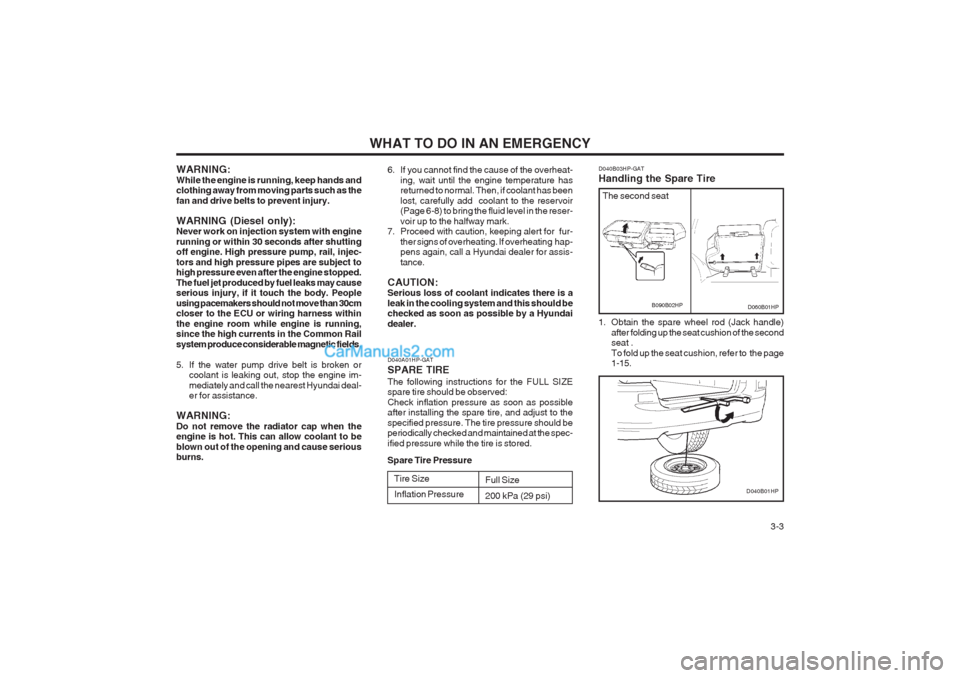
D040B03HP-GAT Handling the Spare Tire
1. Obtain the spare wheel rod (Jack handle)
after folding up the seat cushion of the second seat . To fold up the seat cushion, refer to the page 1-15.
The second seat
6. If you cannot find the cause of the overheat-
ing, wait until the engine temperature has returned to normal. Then, if coolant has been lost, carefully add coolant to the reservoir (Page 6-8) to bring the fluid level in the reser- voir up to the halfway mark.
7. Proceed with caution, keeping alert for fur-
ther signs of overheating. If overheating hap- pens again, call a Hyundai dealer for assis- tance.
CAUTION: Serious loss of coolant indicates there is a leak in the cooling system and this should be checked as soon as possible by a Hyundai dealer.
D040B01HP
D060B01HPB090B02HP
Page 143 of 361
CORROSION PREVENTION AND APPEARANCE CARE
4-4 E040E01A-AAT Cleaning the Windows You may use any household window cleaner on the windows. However, when cleaning the inside of the rear window be careful not to damage the rear window defroster wiring. E050A01A-AAT Any Questions? If you have any questions about the care of your car, consult your Hyundai dealer.
E040D01A-AAT Cleaning the Seat Belts To clean the seat belts, use a cloth or sponge with mild soap or detergent and warm water. Do not use strong detergents, dye, bleach or abra- sive materials on the seat belts as this may weaken the fabric. While cleaning the belts, inspect them for exces- sive wear, cuts, fraying or other signs of damage and replace them if necessary.
E040C01A-AAT Cleaning the Carpets Use a foam-type carpet cleaner. Cleaners of this type are available in aerosol cans in liquid form or powder. Read the instructions and follow them exactly. Using a vacuum cleaner with the appro- priate attachment, remove as much dirt from the carpets as possible. Apply the foam following the manufacturer’s directions, then rub in overlap- ping circles. Do not add water. These cleaners work best when the carpet is kept as dry as possible.
Page 150 of 361
VEHICLE MAINTENANCE REQUIREMENTS 5-7
F060A01A-AAT
EXPLANATION OF SCHEDULED MAIN- TENANCE ITEMS
F060M01A-AAT
o Engine Oil and Filter The engine oil and filter should be changed at
the intervals specified in the maintenance sched- ule. If the car is being driven in severe condi-tions, more frequent oil and filter changes arerequired.
F060B01A-AAT
o Drive Belts Inspect all drive belts for evidence of cuts,
cracks, excessive wear or oil saturation andreplace if necessary. Drive belts should bechecked periodically for proper tension andadjusted as necessary.
F060C01A-AAT
o Fuel Filter
A clogged filter can limit the speed at which the
vehicle may be driven, damage the emissionsystem and cause hard starting. If an exces-sive amount of foreign matter accumulates inthe fuel tank, the filter may require replacementmore frequently.
After installing a new filter, run the engine for
several minutes, and check for leaks at theconnections. Fuel filters should be installed bytrained technicians. F060D01TB-GAT
o Fuel Lines, Fuel Hoses and Connec-
tions
Check the fuel lines, fuel hoses and connec-
tions for leakage and damage. Have a trainedtechnician replace any damaged or leaking partsimmediately. WARNING (Diesel only): Never work on injection system with engine
running or within 30 seconds after shutting off engine. High pressure pump, rail, injec-tors and high pressure pipes are subjectedto high pressure even after the engine hasbeen switched off. The fuel jet produced byfuel leaks may cause serious injury, if itcontacts with the body. People using pace-makers should not move closer than 30cmto the ECU or wiring harness within theengine room with the engine running, sincethe high currents in the Common Rail sys-tem produce considerable magnetic fields.
F060E01A-AAT
o Timing Belt Inspect all parts related to the timing belt for
damage and deformation. Replace any dam-aged parts immediately. F060G01A-AAT
o Vapor Hose and Fuel Filler Cap
The vapor hose and fuel filler cap should be
inspected at those intervals specified in themaintenance schedule. Make sure that a newvapor hose or fuel filler cap is correctly re-placed.
F060F01A-AAT
o Vacuum, Crankcase
Ventilation Hoses
Inspect the surface of hoses for evidence of
heat and/or mechanical damage. Hard and brit-tle rubber, cracking, tears, cuts, abrasions, andexcessive swelling indicate deterioration. Par-ticular attention should be paid to examinethose hose surfaces nearest to high heat sourc-es, such as the exhaust manifold.
Inspect the hose routing to assure that the
hoses do not come in contact with any heatsource, sharp edges or moving componentwhich might cause heat damage or mechanicalwear. Inspect all hose connections, such asclamps and couplings, to make sure they aresecure, and that no leaks are present. Hosesshould be replaced immediately if there is anyevidence of deterioration or damage.
Page 165 of 361
DO-IT-YOURSELF MAINTENANCE 6-13
G110D03Y
Fluid level should be within "HOT" range
WARNING: The cooling fan is controlled by engine cool-ant temperature and may sometimes oper- ate even when the engine is not running. Use extreme caution when working near the blades of the cooling fan, so that you are not injured by a rotating fan blade. As the en- gine coolant temperature decreases, the fan will automatically shut off. This is a normal condition. WARNING (Diesel only): Never work on injection system with enginerunning or within 30 seconds after shutting off engine. High pressure pump, rail, injec- tors and high pressure pipes are subjected to high pressure even after the engine has been switched off. The fuel jet produced by fuel leaks may cause serious injury, if it contacts with the body. People using pace- makers should not move closer than 30cm to the ECU or wiring harness within the
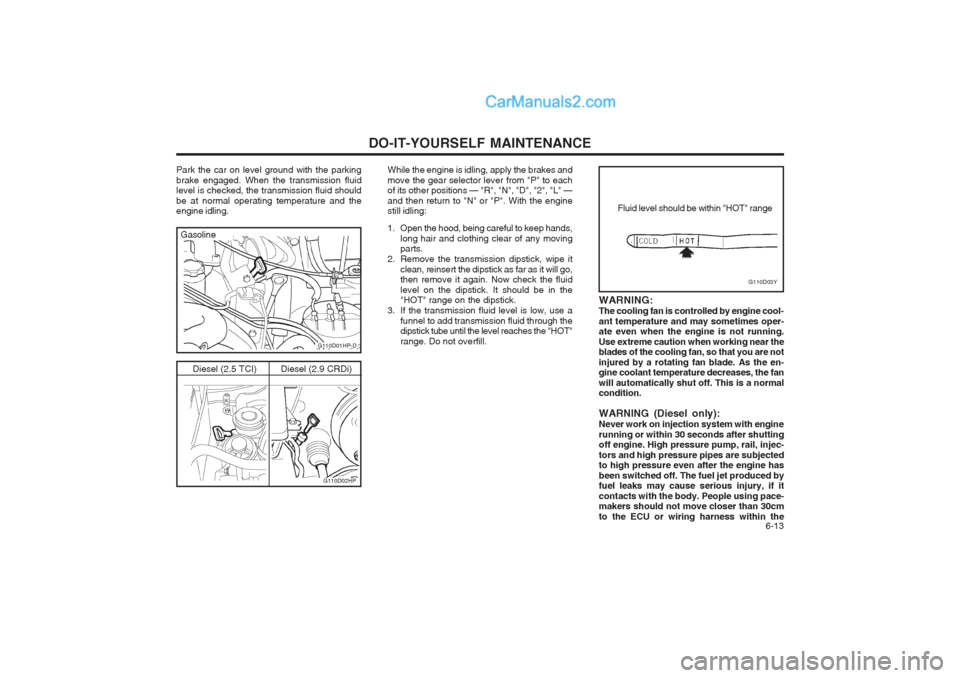
Park the car on level ground with the parking brake engaged. When the transmission fluid level is checked, the transmission fluid should be at normal operating temperature and the engine idling.
While the engine is idling, apply the brakes and move the gear selector lever from "P" to each of its other positions — "R", "N", "D", "2", "L" — and then return to "N" or "P". With the engine still idling:
1. Open the hood, being careful to keep hands,
long hair and clothing clear of any moving parts.
2. Remove the transmission dipstick, wipe it clean, reinsert the dipstick as far as it will go,then remove it again. Now check the fluid level on the dipstick. It should be in the "HOT" range on the dipstick.
3. If the transmission fluid level is low, use a funnel to add transmission fluid through thedipstick tube until the level reaches the "HOT" range. Do not overfill.
G110D01HP-D
Gasoline
Diesel (2.9 CRDi)
Diesel (2.5 TCI)
G110D02HP
Page 170 of 361
DO-IT-YOURSELF MAINTENANCE
6-18
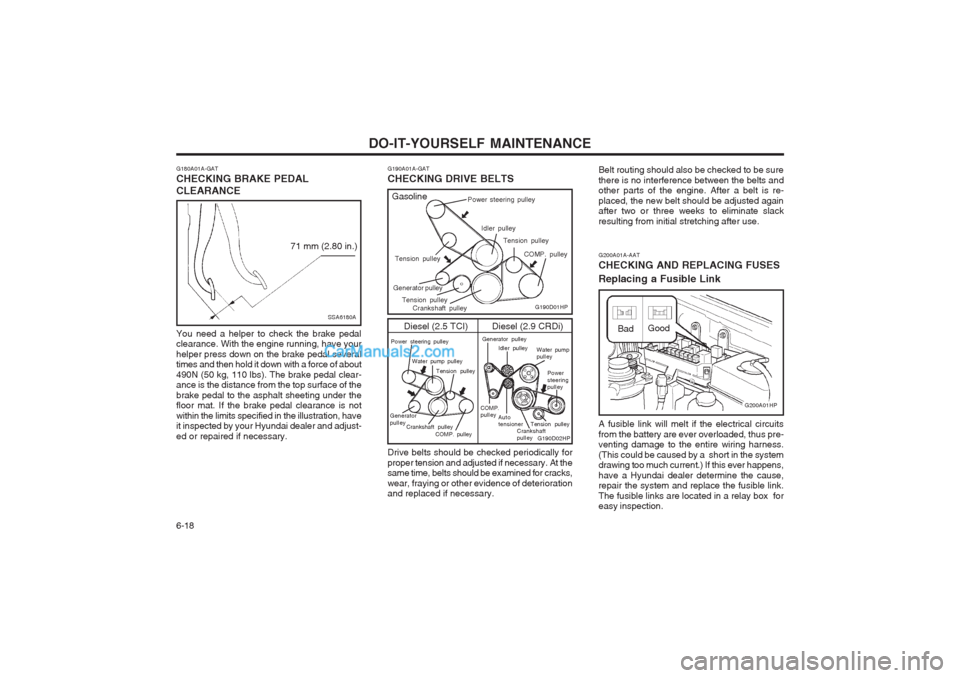
G200A01A-AAT CHECKING AND REPLACING FUSES Replacing a Fusible Link A fusible link will melt if the electrical circuits from the battery are ever overloaded, thus pre- venting damage to the entire wiring harness. (This could be caused by a short in the system drawing too much current.) If this ever happens, have a Hyundai dealer determine the cause, repair the system and replace the fusible link. The fusible links are located in a relay box for easy inspection.
G200A01HP
Bad
Good
Belt routing should also be checked to be sure there is no interference between the belts and other parts of the engine. After a belt is re- placed, the new belt should be adjusted again after two or three weeks to eliminate slack resulting from initial stretching after use.
G190A01A-GAT CHECKING DRIVE BELTS Drive belts should be checked periodically for proper tension and adjusted if necessary. At the same time, belts should be examined for cracks, wear, fraying or other evidence of deterioration and replaced if necessary. Diesel (2.5 TCI)
G190D01HP
G190D02HP
Gasoline
Generator pulley
Idler pulley Water pump pulley
COMP.pulley Autotensioner
Crankshaft pulley
Diesel (2.9 CRDi)
Crankshaft pulleyCOMP. pulley
Generator pulley Power steering pulley
Idler pulley Tension pulley
COMP. pulley
Power steering pulley
Water pump pulley Tension pulley Power steering pulley
Crankshaft pulleyTension pulleyGenerator pulley
Tension pulley
Tension pulley
G180A01A-GAT CHECKING BRAKE PEDAL CLEARANCE You need a helper to check the brake pedal clearance. With the engine running, have your helper press down on the brake pedal several times and then hold it down with a force of about 490N (50 kg, 110 lbs). The brake pedal clear- ance is the distance from the top surface of the brake pedal to the asphalt sheeting under the floor mat. If the brake pedal clearance is not within the limits specified in the illustration, have it inspected by your Hyundai dealer and adjust- ed or repaired if necessary.
SSA6180A
71 mm (2.80 in.)
Page 230 of 361
CONTROLS AND EQUIPMENT
1- 30 vehicle is in a crash severe enough to cause the airbags to inflate.
o If the airbags inflate, they must be re- placed by an authorized Hyundai dealer.
o Do not tamper with or disconnect SRS wiring, or other components of the SRSsystem. Doing so could result in injury,due to accidental firing of the airbags orby rendering the SRS inoperative.
o A child restraint system must never be placed in the front seat. The infant or childcould be severely injured by an airbagdeployment in case of an accident.
o If components of the airbag system must be discarded, or if the vehicle must bescrapped, certain safety precautions must
be observed. Your Hyundai dealer knowsthese precautions and can give you thenecessary information. Failure to followthese precautions and procedures couldincrease the risk of personal injury.
o If you sell your vehicle, be sure to inform the new owner of these important pointsand make certain that this manual istransferred to the new owner.
o If your car was flooded and has soaked carpeting or water on flooring, youshouldn't try to start engine; have the cartowed to authorized Hyundai dealer.
o Do not replace the bumper or the bumper guard with the one other than the Hyundaigenuine parts. Otherwise, it can adverselyaffect SRS performance and lead to un-expected injury.
Page 305 of 361
IN CASE OF EMERGENCY 3-3
WARNING: Whilst the engine is running, keep hands
and clothing away from moving parts such as the fan and drive belts to prevent injury.
WARNING (Diesel only): Never work on injection system with engine
running or within 30 seconds after shutting off engine. High pressure pump, rail, injec-tors and high pressure pipes are subject tohigh pressure even after the engine stopped.The fuel jet produced by fuel leaks maycause serious injury, if it touch the body.People using pacemakers should not movethan 30cm closer to the ECU or wiring har-ness within the engine room while engine isrunning, since the high currents in the Com-mon Rail system produce considerable mag-netic fields.
5. If the water pump drive belt is broken or coolant is leaking out, stop the engine imme- diately and call the nearest Hyundai dealerfor assistance.
WARNING: Do not remove the radiator cap when the
engine is hot since steam and boiling water may be ejected from the radiator resulting inburns or scalding. YD050A1-E
SPARE TYRE For Full Size
The following instructions for the FULL SIZE
spare tyre should be observed:
Check inflation pressure as soon as possible
after installing the spare tyre, and adjust to the specified pressure. The tyre pressure shouldbe periodically checked and maintained at thespecified pressure whilst the tyre is stored.
Spare Tyre Pressure
Inflation Pressure
Tyre Size
FULL SIZE 29 psi (200 kPa)
6. If the cause of the overheating cannot be
found, wait until the engine temperature has returned to normal. Then, if coolant hasbeen lost, carefully remove the radiator capand add water to bring the fluid level in thereservoir up to the base of the radiator fillopening. Fill the coolant expansion tank tothe halfway mark.
7. Proceed with caution until it is established that the engine is operating normally. If theengine overheats repeatedly, the advice of aHyundai dealer should be sought.
CAUTION: Serious loss of coolant indicates there is a
leak in the cooling system and this should be checked as soon as possible by a Hyundaidealer.
D040B01HP
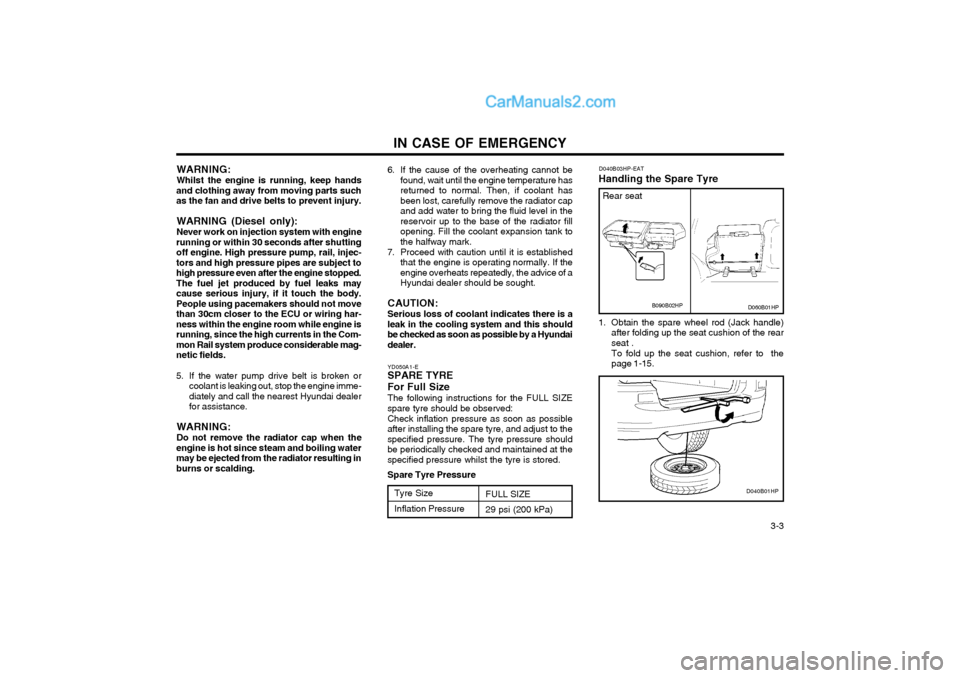
D040B03HP-EAT
Handling the Spare Tyre
1. Obtain the spare wheel rod (Jack handle) after folding up the seat cushion of the rear seat . To fold up the seat cushion, refer to the page 1-15.
D060B01HPB090B02HP
Rear seat