height Hyundai Terracan 2005 User Guide
[x] Cancel search | Manufacturer: HYUNDAI, Model Year: 2005, Model line: Terracan, Model: Hyundai Terracan 2005Pages: 539, PDF Size: 18.03 MB
Page 324 of 539
1
CONTROLS AND EQUIPMENT
19
!
!
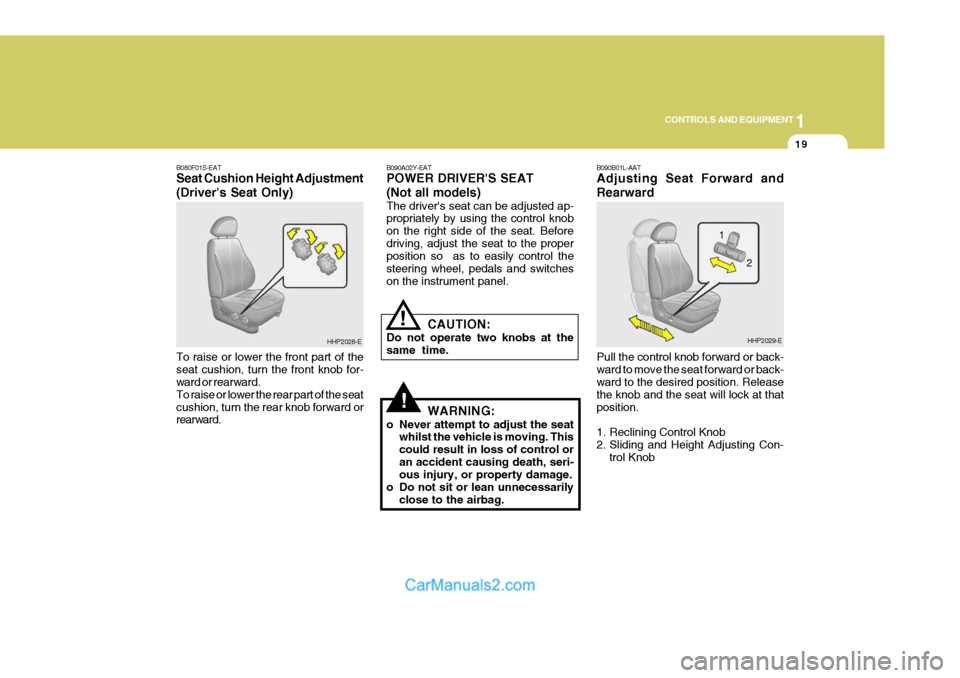
B080F01S-EAT Seat Cushion Height Adjustment (Driver's Seat Only) To raise or lower the front part of the seat cushion, turn the front knob for- ward or rearward. To raise or lower the rear part of the seatcushion, turn the rear knob forward or rearward. B090A02Y-EAT POWER DRIVER'S SEAT (Not all models) The driver's seat can be adjusted ap- propriately by using the control knob on the right side of the seat. Beforedriving, adjust the seat to the proper position so as to easily control the steering wheel, pedals and switcheson the instrument panel.
CAUTION:
Do not operate two knobs at thesame time.
WARNING:
o Never attempt to adjust the seat whilst the vehicle is moving. Thiscould result in loss of control oran accident causing death, seri- ous injury, or property damage.
o Do not sit or lean unnecessarily close to the airbag.
HHP2028-E B090B01L-AAT Adjusting Seat Forward and Rearward Pull the control knob forward or back- ward to move the seat forward or back- ward to the desired position. Release the knob and the seat will lock at thatposition.
1. Reclining Control Knob
2. Sliding and Height Adjusting Con-
trol KnobHHP2029-E
2
1
Page 325 of 539
1CONTROLS AND EQUIPMENT
20
!
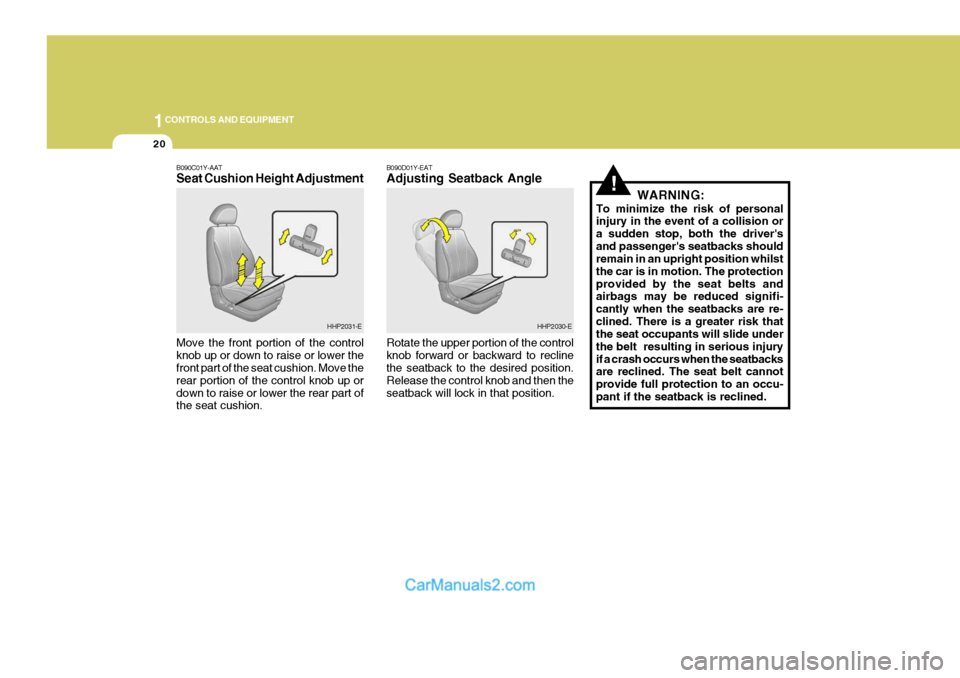
B090C01Y-AAT Seat Cushion Height Adjustment Move the front portion of the control knob up or down to raise or lower the front part of the seat cushion. Move the rear portion of the control knob up ordown to raise or lower the rear part of the seat cushion. B090D01Y-EAT Adjusting Seatback Angle Rotate the upper portion of the control knob forward or backward to recline the seatback to the desired position. Release the control knob and then theseatback will lock in that position.
WARNING:
To minimize the risk of personal injury in the event of a collision or a sudden stop, both the driver'sand passenger's seatbacks should remain in an upright position whilst the car is in motion. The protectionprovided by the seat belts and airbags may be reduced signifi- cantly when the seatbacks are re-clined. There is a greater risk that the seat occupants will slide under the belt resulting in serious injuryif a crash occurs when the seatbacks are reclined. The seat belt cannot provide full protection to an occu-pant if the seatback is reclined.
HHP2031-EHHP2030-E
Page 327 of 539
1CONTROLS AND EQUIPMENT
22
!
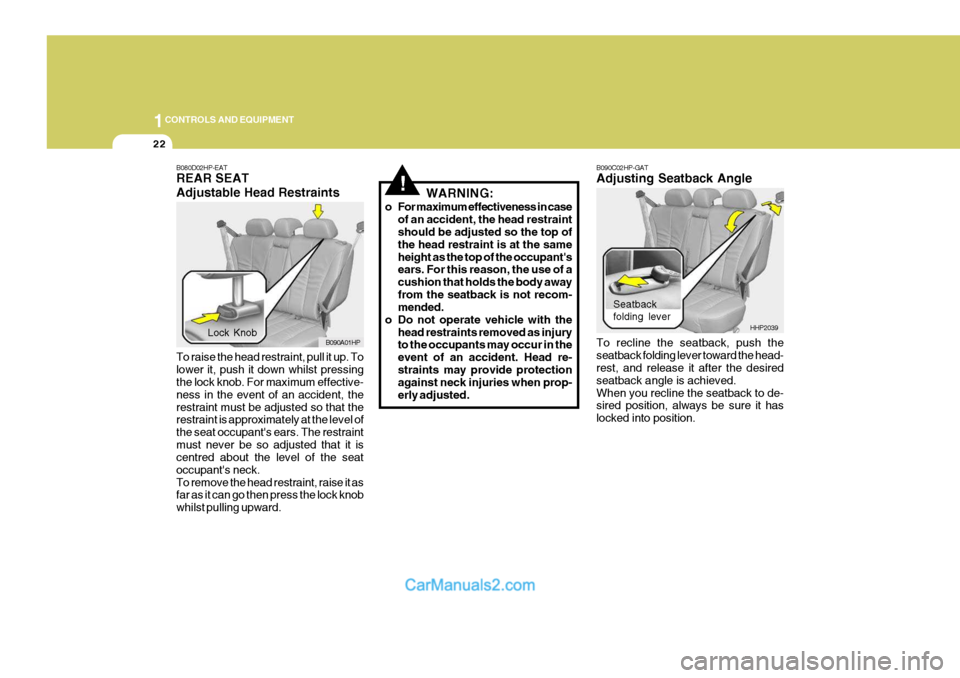
B080D02HP-EAT REAR SEAT Adjustable Head Restraints To raise the head restraint, pull it up. To lower it, push it down whilst pressing the lock knob. For maximum effective- ness in the event of an accident, therestraint must be adjusted so that the restraint is approximately at the level of the seat occupant's ears. The restraintmust never be so adjusted that it is centred about the level of the seat occupant's neck.To remove the head restraint, raise it as far as it can go then press the lock knob whilst pulling upward. WARNING:
o For maximum effectiveness in case of an accident, the head restraint should be adjusted so the top of the head restraint is at the sameheight as the top of the occupant's ears. For this reason, the use of a cushion that holds the body awayfrom the seatback is not recom- mended.
o Do not operate vehicle with the
head restraints removed as injuryto the occupants may occur in the event of an accident. Head re- straints may provide protection against neck injuries when prop-erly adjusted.
Lock Knob B090A01HP B090C02HP-GAT Adjusting Seatback Angle To recline the seatback, push the seatback folding lever toward the head- rest, and release it after the desired seatback angle is achieved.When you recline the seatback to de- sired position, always be sure it has locked into position.
Seatback folding lever
HHP2039
Page 332 of 539
1
CONTROLS AND EQUIPMENT
27
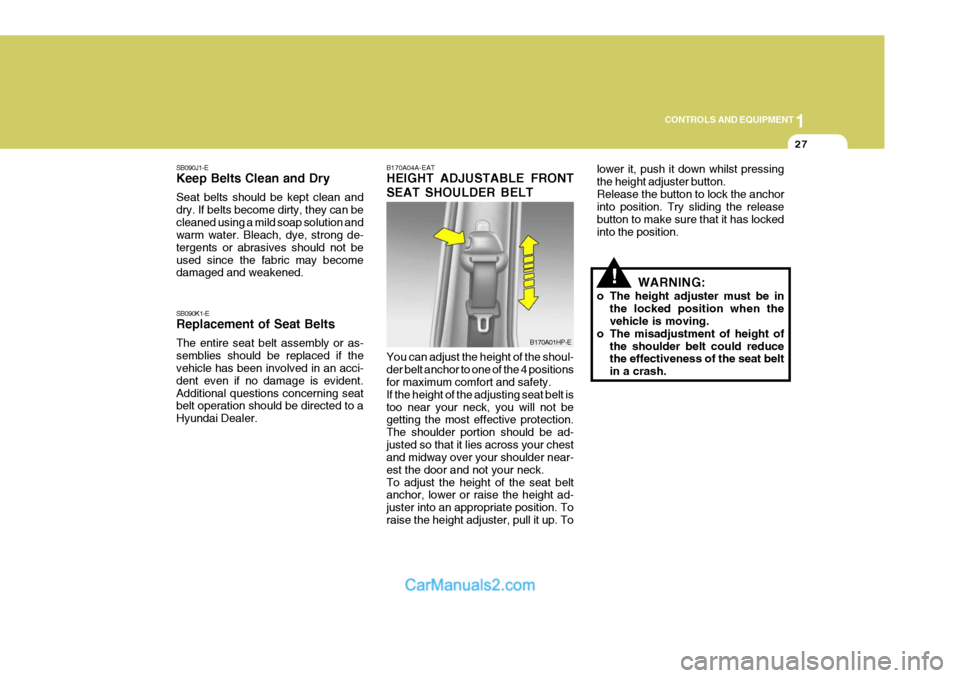
SB090J1-E Keep Belts Clean and Dry Seat belts should be kept clean and dry. If belts become dirty, they can becleaned using a mild soap solution and warm water. Bleach, dye, strong de- tergents or abrasives should not beused since the fabric may become damaged and weakened. SB090K1-E Replacement of Seat Belts The entire seat belt assembly or as- semblies should be replaced if the vehicle has been involved in an acci- dent even if no damage is evident.Additional questions concerning seat belt operation should be directed to a Hyundai Dealer. B170A04A-EAT HEIGHT ADJUSTABLE FRONT SEAT SHOULDER BELT You can adjust the height of the shoul- der belt anchor to one of the 4 positions for maximum comfort and safety. If the height of the adjusting seat belt istoo near your neck, you will not be getting the most effective protection. The shoulder portion should be ad-justed so that it lies across your chest and midway over your shoulder near- est the door and not your neck.To adjust the height of the seat belt anchor, lower or raise the height ad- juster into an appropriate position. Toraise the height adjuster, pull it up. To
B170A01HP-E
!
lower it, push it down whilst pressing the height adjuster button.Release the button to lock the anchor into position. Try sliding the release button to make sure that it has lockedinto the position.
WARNING:
o The height adjuster must be in the locked position when the vehicle is moving.
o The misadjustment of height of the shoulder belt could reducethe effectiveness of the seat belt in a crash.
Page 337 of 539
1CONTROLS AND EQUIPMENT
32
!WARNING:
o A child restraint system must be placed in the rear seat. Never install a child or infant seat on the front passenger's seat. Should an accident occur andcause the passenger side airbag to deploy, it could severely in- jure or kill an infant or child seatedin an infant or child seat. Thus, only use a child restraint in the rear seat of your vehicle.
o Since a safety belt or child re-
straint system can become veryhot if it is left in a closed vehicle, be sure to check the seat cover and buckles before placing achild there.
o When the child restraint system
is not in use, fasten it with asafety belt so that it will not be thrown forward in the case of a sudden stop or an accident. o Children who are too large to be in
a child restraint should sit in the rear seat and be restrained with the available lap/shoulder belts.Never allow children to ride in the front passanger seat.
o Always make sure that the shoul- der belt portion of the outboardlap/shoulder belt is positioned midway over the shoulder, neveracross the neck. Moving the child closer to the centre of the vehicle may help provide a good shoul-der belt fit. The lap belt portion of the lap/shoulder belt or the cen- tre seat lap belt must always bepositioned as low as possible on the child's hips and as snug as possible.
o If the seat belt will not properly fit the child, we recommend the useof an approved booster seat inthe rear seat in order to raise the child's seating height so that the seat belt will properly fit the child.
o Never allow a child to stand up or kneel on the seat. o Never use an infant carrier or child
safety seat that "hooks" over aseatback; it may not provide ad-equate security in an accident.
o Never allow a child to be held in a
person's arms whilst they are in amoving vehicle, as this could re- sult in serious injury to the child in the event of an accident or asudden stop. Holding a child in a moving vehicle does not provide the child with any means of pro-tection during an accident, even if the person holding the child is wearing a seat belt.
o If the child restraint seat is not
anchored properly, the risk of achild being seriously injured or killed in a collision greatly in- creases.
Page 435 of 539
2 DRIVING YOUR HYUNDAI
22EFFECTIVE BRAKING
HPC140A1-E Braking system performance and fric- tion material life are greatly affected by the driving style adopted. The follow- ing suggestions are made to assist inachieving the best results from the braking system.
o Anticipate the road and conditions ahead in order that heavy braking may be avoided.
o When descending long gradients, use the engine to assist in retardingthe vehicle to minimize the possibil-ity of brake fade occurring.
o When trailer towing, ensure that the
trailer brakes function correctly anduse engine braking to assist the vehicle braking system.
o Use only genuine Hyundai replace- ment brake pads and shoes to en-sure consistent friction characteris- tics and wear rates.
o After driving through deep water (e.g. fording), the brakes may becomewet and performance reduced. Al-ways check brake efficiency after emerging from the water and dry the brakes by lightly depressing theLIMITED-SLIP DIFFEREN- TIAL
D190A01HP-EAT (Not all models) A limited-slip differential, if equipped, is for the rear wheel differential only.The features of this limited-slip differ- ential are described below: Just as with a conventional differential,the wheel on one side is allowed to turn at a different speed from the wheel on the other side when the vehicle iscornering. The difference between the limited-slip differential and a conven- tional differential is that if the wheel onone side of the vehicle loses traction, a greater amount of torque is applied to the rear wheel on the other side toimprove traction.
gency braking, always maintain a safe distance between you and ob- jects ahead. Vehicle speeds should always be reduced during extremeroad conditions. The braking distance for cars equipped with an anti-lock brakingsystem may be longer than for those without it in the following road con- ditions.
o Driving on rough, gravel or snow-
covered roads.
o Driving with tire chains installed.
o Driving on roads where the road surface is pitted or has different surface height.
These roads should be driven atreduced speeds. The safety features of an ABS equipped vehicle should not be tested by high speed drivingor cornering. This could endanger the safety of yourself or others.
! CAUTION:
o Never start the engine with the gearshift lever placed in the for- ward or reverse whilst one of therear wheels is jacked up and the other in contact with the ground; doing so may cause the vehicle tojump forward.
o Use only recommended oil for
LSD in the rear axle.See page 9-5 for the recommended oil descriptions.
Page 530 of 539
9 VEHICLE SPECIFICATIONS
2
PETROL
MF 68 AH
120 A (13.5 V)
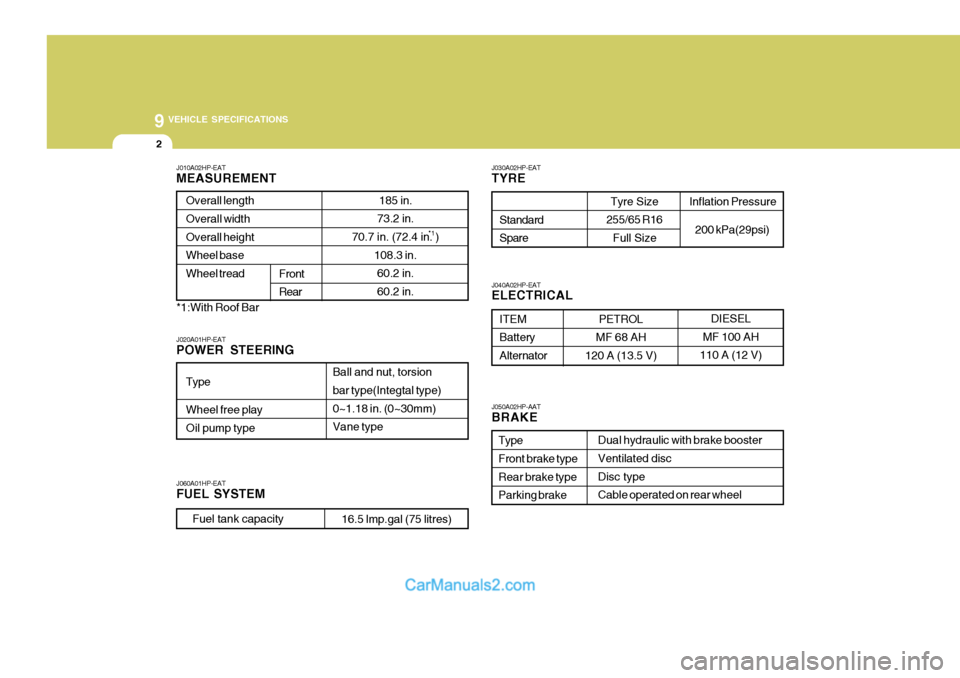
J010A02HP-EAT MEASUREMENT
185 in.
73.2 in.
70.7 in. (72.4 in. )
108.3 in.60.2 in. 60.2 in.
Overall lengthOverall width Overall height Wheel baseWheel tread
Front Rear
J060A01HP-EAT FUEL SYSTEM J030A02HP-EATTYRE
Standard Spare
J050A02HP-AAT BRAKE Dual hydraulic with brake booster Ventilated disc Disc typeCable operated on rear wheel
TypeFront brake type Rear brake type Parking brake
ITEM Battery Alternator
J040A02HP-EAT ELECTRICAL
Fuel tank capacity
DIESEL
MF 100 AH
110 A (12 V)
Tyre Size
255/65 R16
Full Size
16.5 lmp.gal (75 litres)
*1:With Roof Bar
*1
Type
Ball and nut, torsion bar type(Integtal type) 0~1.18 in. (0~30mm) Vane type
J020A01HP-EAT POWER STEERING
Wheel free play Oil pump type
Inflation Pressure
200 kPa(29psi)
Page 536 of 539
10
INDEX
3
Coolant temperature gauge .....................................1-57
If the engine overheats ............................................. 3-4
Number ..................................................................... 8-2
Oil ............................................................................. 6-4 Starting ..................................................................... 2-5
Engine Exhaust Can Be Dangerous! ........................... 2-2
F Fan Speed Control ................. .........................1-90, 1-101
Fog Light Switch Front ....................................................................... 1-62
Rear ........................................................................ 1-62
Four-Wheel Drive(4WD) ............................................. 2-14
Front Door Edge Warning Light ................................. 1-84
Front Seats
Adjustable head restraints ...................................... 1-17
Adjusting seatback angle ....................................... 1-17
Driver's seat lumbar support control .......................1-18
Seat adjust ment ..................................................... 1-16
Seat cushion height adjustment ............................. 1-19
Seat fore/aft adjustment ......................................... 1-16
Fuel Capacity ................................................................... 9-2
Gauge ..................................................................... 1-57
Recommendations .................................................... 1-2
Fuel-Filler Flap Remote release ........................................................ 1-2
Full-time 4WD Operation ............................................ 2-17
Fusible Links ............................................................. 6-25G
Glove Box ................................................................. 1-73
H Hatchback Door ......................................................... 1-78
Hazard Warning System ............................................ 1-65
Headlight Aiming Adjustment..................................... 6-33
Headlight Bulbs Replacement ....................................6-31
Headlight Leveling Device S ystem ............................1-85
Heated Front/Rear Window .. ......................................1-65
Heating and Cooling Control ......................................1-89
Heating and Ventilation
Air flow control ............................................. 1-91, 1-102
Air intake control ......................................... 1-91, 1-101
Defrosting/Defogging ............................................... 1-95
Fan speed control ........................................ 1-90, 1-101
Temperature control ................................................ 1-83
High-Mounted Rear Stop Light ...................................1-82
Horn ........................................................................... 1-84
I Ignition Switch ............................................................. 2-3
Illuminated ignition switch ......................................... 1-8
Immobiliser System ..................................................... 1-5
Indicator and Warning Lights ..................................... 1-50
Instrument Cluster and Indicator Lights ..................... 1-46
Interior Light ............................................................... 1-72
Interior Rearview Mirror .............................................. 1-77
Intermittent Wi pe Facility ........................................... 1-64
Page 538 of 539
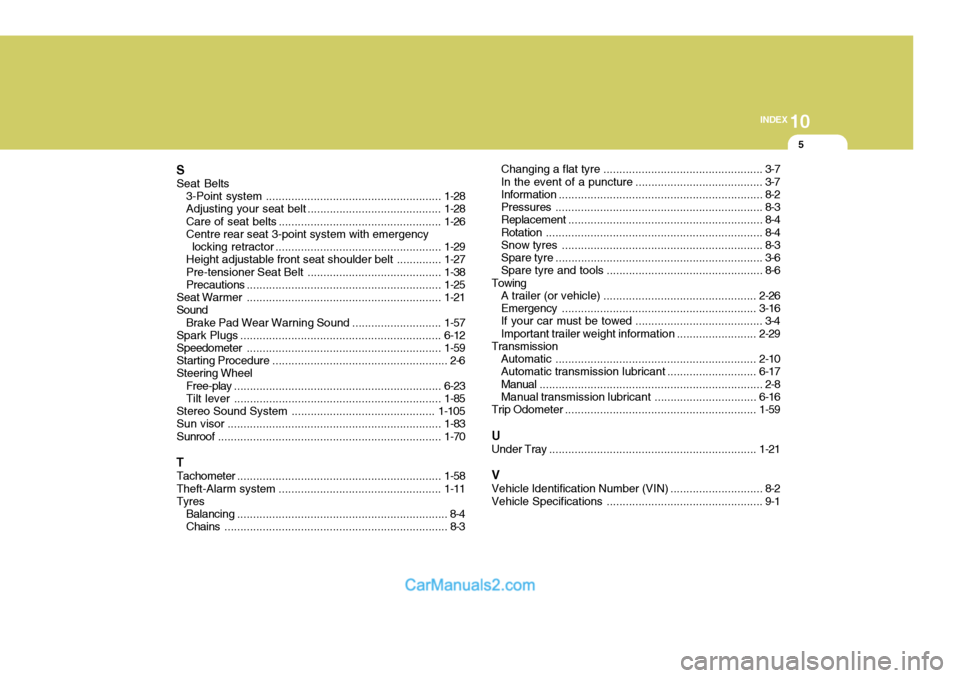
10
INDEX
5
S Seat Belts 3-Point system ....................................................... 1-28
Adjusting your seat belt .......................................... 1-28
Care of seat belts ................................................... 1-26
Centre rear seat 3-point system with emergency
locking retractor .................................................... 1-29
Height adjustable front seat shoulder belt ..............1-27
Pre-tensioner Seat Belt .................. ........................1-38
Precautions ............................................................. 1-25
Seat Warmer ............................................................. 1-21
Sound
Brake Pad Wear Warning Sound ............................ 1-57
Spark Plugs ............................................................... 6-12
Speedometer ............................................................. 1-59
Starting Procedure ....................................................... 2-6
Steering Wheel
Free-play ................................................................. 6-23
Tilt lever ................................................................. 1-85
Stereo Sound System ............................................. 1-105
Sun visor ................................................................... 1-83
Sunroof ...................................................................... 1-70
T Tachometer ................................................................ 1-58
Theft-Alarm system ................................................... 1-11
Tyres
Balancing .................................................................. 8-4
Chains ...................................................................... 8-3 Changing a flat
tyre .................................................. 3-7
In the event of a puncture ........................................ 3-7 Information ................................................................ 8-2
Pressures ................................................................. 8-3
Replacement ............................................................. 8-4
Rotation .................................................................... 8-4
Snow tyres ............................................................... 8-3
Spare tyre ................................................................. 3-6Spare tyre and tools ................................................. 8-6
Towing A trailer (or vehicle) ................................................ 2-26
Emergency ............................................................. 3-16
If your car must be towed ........................................ 3-4 Important trailer weight information ......................... 2-29
Transmission
Automa tic ............................................................... 2-10
Automatic transmission lubricant ............................ 6-17
Manual ...................................................................... 2-8
Manual transmission lubricant ................................ 6-16
Trip Odometer ............................................................ 1-59
U Under Tray ................................................................. 1-21
VVehicle Identification Number (VIN) ............................. 8-2
Vehicle Specifica tions ................................................. 9-1