check engine Hyundai Terracan 2006 Owner's Manual
[x] Cancel search | Manufacturer: HYUNDAI, Model Year: 2006, Model line: Terracan, Model: Hyundai Terracan 2006Pages: 539, PDF Size: 18.11 MB
Page 499 of 539
6
OWNER MAINTENANCE
21
SG140D1-E
Off Season Maintenance
The air conditioning must be run for ten minutes or so weekly during peri- ods when the system would not nor- mally be used to ensure that thecompressor and seals are lubricated. If this precaution is not observed the compressor seals may become stuckto the compressor shaft and dam- aged when the system is next used resulting in a loss of refrigerant anddamage to the compressor. HPG140B1-E
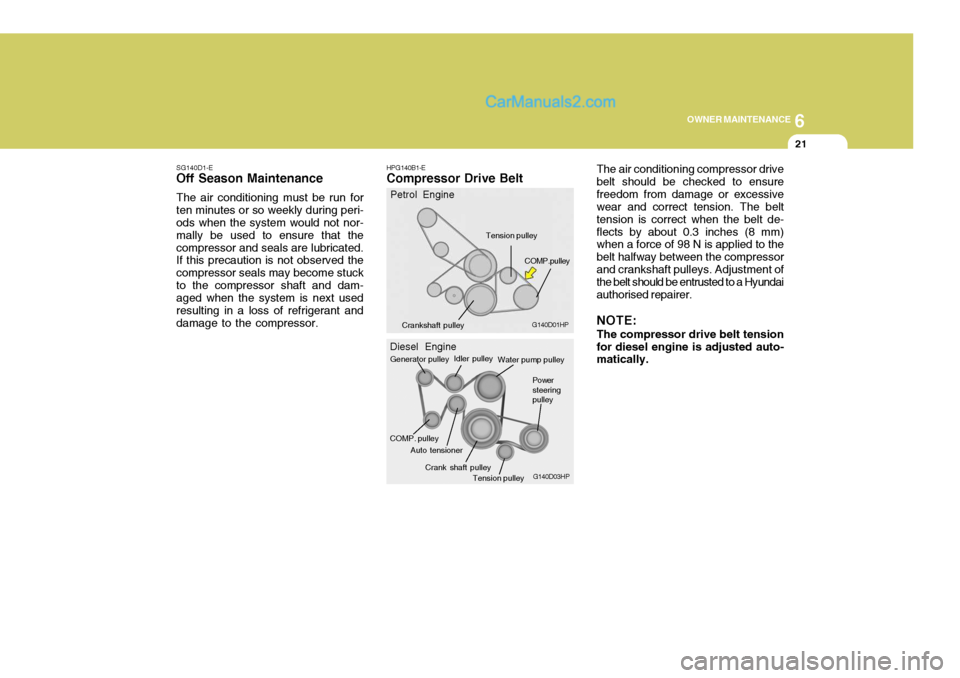
Compressor Drive Belt The air conditioning compressor drivebelt should be checked to ensurefreedom from damage or excessive wear and correct tension. The belt tension is correct when the belt de-flects by about 0.3 inches (8 mm) when a force of 98 N is applied to the belt halfway between the compressorand crankshaft pulleys. Adjustment of the belt should be entrusted to a Hyundai authorised repairer. NOTE: The compressor drive belt tension for diesel engine is adjusted auto- matically.
G140D01HP
Crankshaft pulley
Petrol Engine
COMP.pulley
Tension pulley
G140D03HP
Diesel Engine
Generator pulley
Water pump pulley
Tension pulley
COMP. pulley Power steeringpulley
Idler pulley
Auto tensioner Crank shaft pulley
Page 501 of 539
6
OWNER MAINTENANCE
23
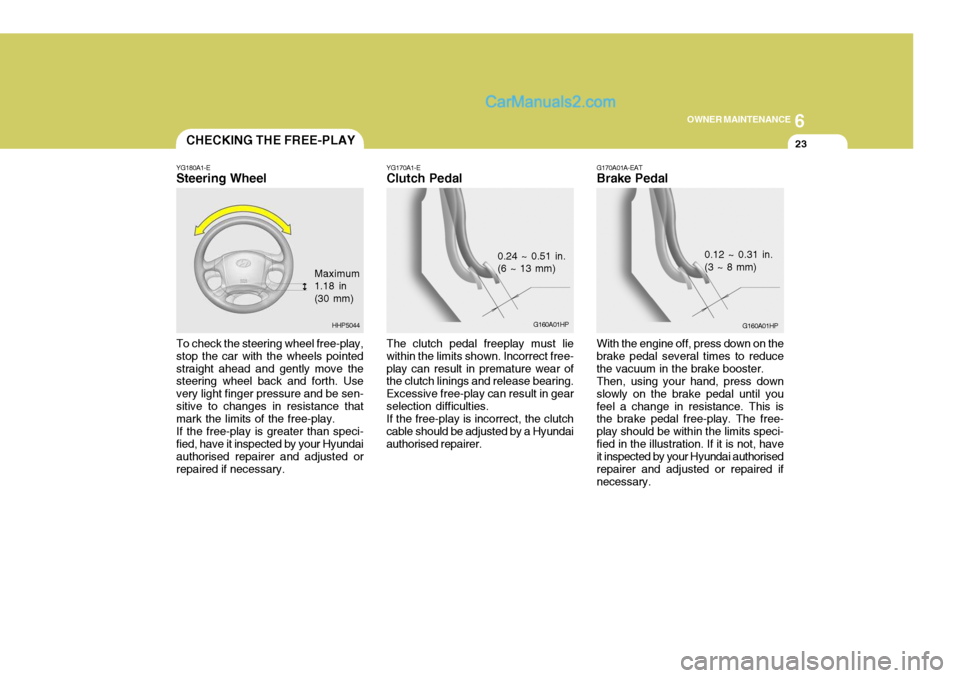
To check the steering wheel free-play, stop the car with the wheels pointedstraight ahead and gently move the steering wheel back and forth. Use very light finger pressure and be sen-sitive to changes in resistance that mark the limits of the free-play. If the free-play is greater than speci- fied, have it inspected by your Hyundai authorised repairer and adjusted or repaired if necessary. YG170A1-E
Clutch Pedal
The clutch pedal freeplay must lie
within the limits shown. Incorrect free-play can result in premature wear of the clutch linings and release bearing. Excessive free-play can result in gearselection difficulties. If the free-play is incorrect, the clutch
cable should be adjusted by a Hyundaiauthorised repairer. G170A01A-EAT Brake Pedal With the engine off, press down on the brake pedal several times to reducethe vacuum in the brake booster.Then, using your hand, press downslowly on the brake pedal until youfeel a change in resistance. This is the brake pedal free-play. The free- play should be within the limits speci-fied in the illustration. If it is not, have it inspected by your Hyundai authorised repairer and adjusted or repaired ifnecessary.CHECKING THE FREE-PLAY
YG180A1-E
Steering Wheel
Maximum 1.18 in(30 mm)
HHP5044
0.24 ~ 0.51 in. (6 ~ 13 mm)
G160A01HP0.12 ~ 0.31 in. (3 ~ 8 mm)
G160A01HP
Page 502 of 539
6 OWNER MAINTENANCE
24
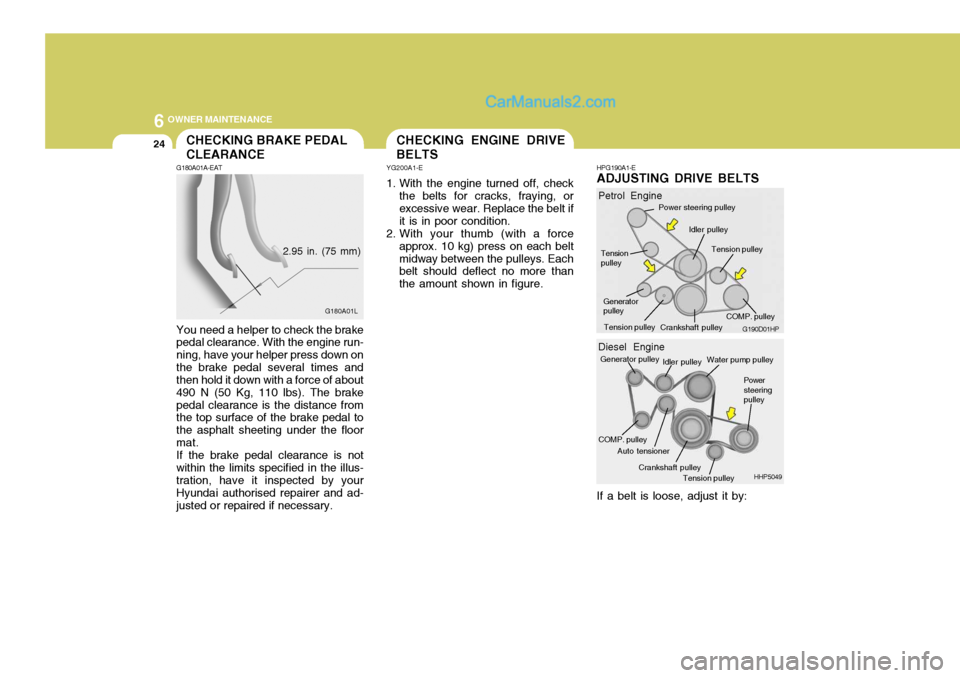
You need a helper to check the brake pedal clearance. With the engine run- ning, have your helper press down onthe brake pedal several times and then hold it down with a force of about 490 N (50 Kg, 110 lbs). The brakepedal clearance is the distance from the top surface of the brake pedal to the asphalt sheeting under the floormat.If the brake pedal clearance is notwithin the limits specified in the illus- tration, have it inspected by your Hyundai authorised repairer and ad-justed or repaired if necessary. HPG190A1-E
ADJUSTING DRIVE BELTS
If a belt is loose, adjust it by:CHECKING BRAKE PEDAL CLEARANCE
2.95 in. (75 mm) G180A01L
G190D01HP
Petrol Engine
Idler pulley
Power steering pulley
Crankshaft pulley
Generator pulley Tension pulley
Tension pulley
Tension pulley
COMP. pulley
HHP5049
Diesel Engine
Generator pulley
Tension pulley
COMP. pulley Power steeringpulley
Idler pulley
Auto tensioner Crankshaft pulley Water pump pulley
G180A01A-EAT
CHECKING ENGINE DRIVE BELTS
YG200A1-E
1. With the engine turned off, check the belts for cracks, fraying, or excessive wear. Replace the belt ifit is in poor condition.
2. With your thumb (with a force
approx. 10 kg) press on each beltmidway between the pulleys. Each belt should deflect no more than the amount shown in figure.
Page 503 of 539
6
OWNER MAINTENANCE
25
!
!
1. Loosen the adusting bolts just
enough so that the components can be moved.
2. Whilst pulling outward on the pry bar
or screwdriver, test the belt deflec-tion with your thumb.
3. After tightening the adjusting bolts, be sure to recheck the belt tension. Overtightening drive belts can cause excessive wear and failurein driven components and belts.
WARNING:
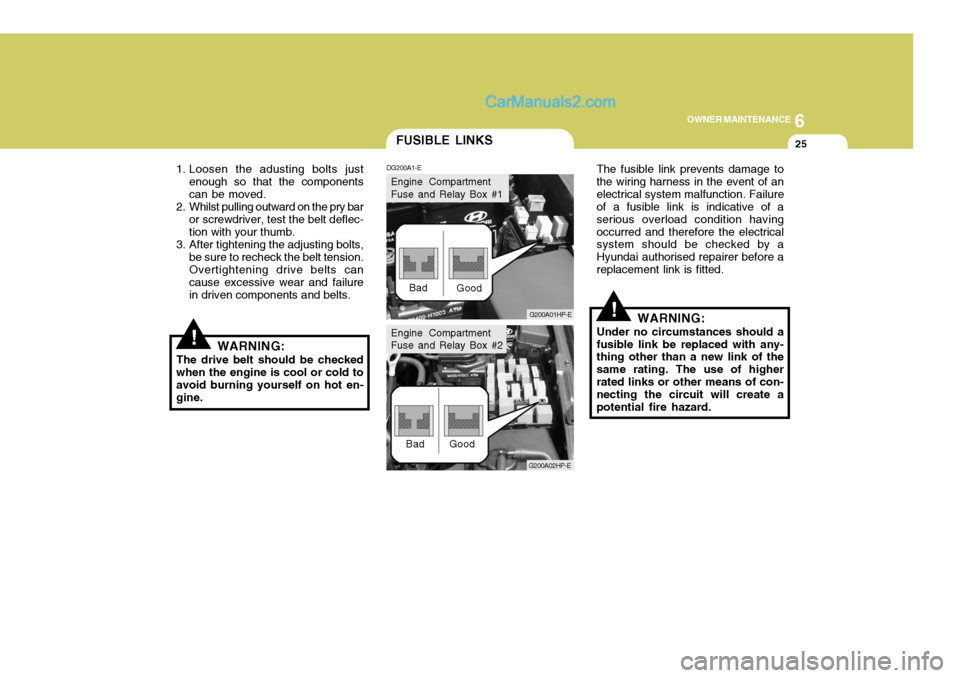
The drive belt should be checked when the engine is cool or cold to avoid burning yourself on hot en-gine. The fusible link prevents damage tothe wiring harness in the event of anelectrical system malfunction. Failure of a fusible link is indicative of a serious overload condition havingoccurred and therefore the electrical system should be checked by a Hyundai authorised repairer before areplacement link is fitted.
WARNING:
Under no circumstances should afusible link be replaced with any- thing other than a new link of the same rating. The use of higherrated links or other means of con- necting the circuit will create a potential fire hazard.
FUSIBLE LINKS
DG200A1-E
G200A01HP-E
Bad
Good
G200A02HP-E
Bad Good
Engine Compartment Fuse and Relay Box #1
Engine Compartment Fuse and Relay Box #2
Page 507 of 539
6
OWNER MAINTENANCE
29
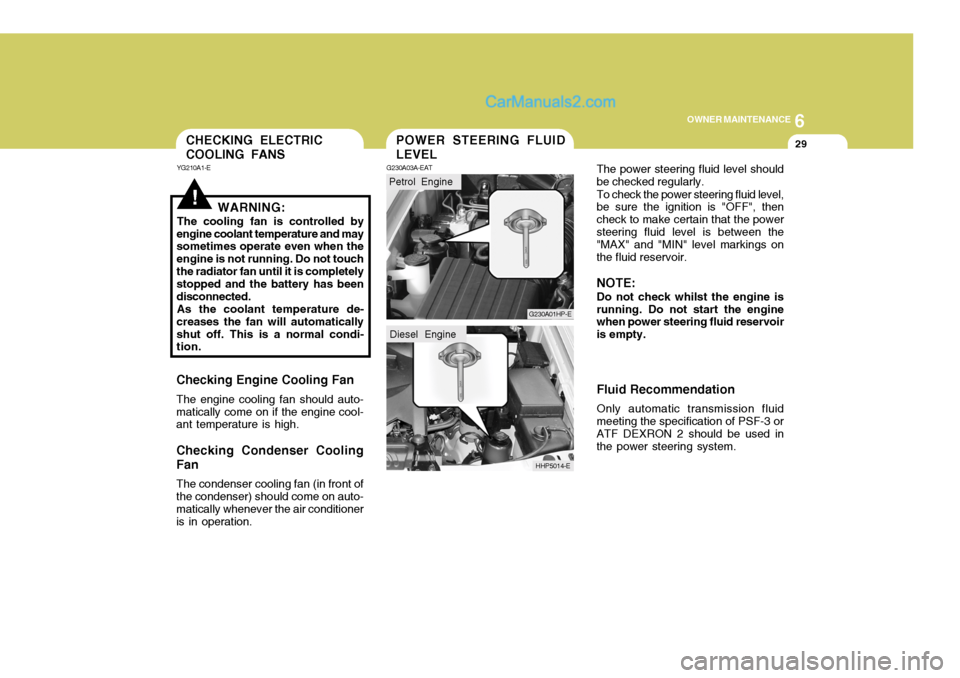
The power steering fluid level should be checked regularly. To check the power steering fluid level, be sure the ignition is "OFF", then check to make certain that the powersteering fluid level is between the "MAX" and "MIN" level markings on the fluid reservoir. NOTE: Do not check whilst the engine is running. Do not start the engine when power steering fluid reservoir is empty. Fluid Recommendation Only automatic transmission fluid meeting the specification of PSF-3 orATF DEXRON 2 should be used in the power steering system.POWER STEERING FLUID LEVEL
G230A03A-EAT
Petrol Engine
G230A01HP-E
HHP5014-E
Diesel Engine
!WARNING:
The cooling fan is controlled by
engine coolant temperature and may sometimes operate even when the engine is not running. Do not touchthe radiator fan until it is completely stopped and the battery has been disconnected. As the coolant temperature de-
creases the fan will automaticallyshut off. This is a normal condi- tion.
Checking Engine Cooling Fan The engine cooling fan should auto- matically come on if the engine cool- ant temperature is high.
Checking Condenser Cooling Fan The condenser cooling fan (in front of the condenser) should come on auto- matically whenever the air conditioner is in operation.
CHECKING ELECTRIC COOLING FANS
YG210A1-E
Page 508 of 539
6 OWNER MAINTENANCE
30
!
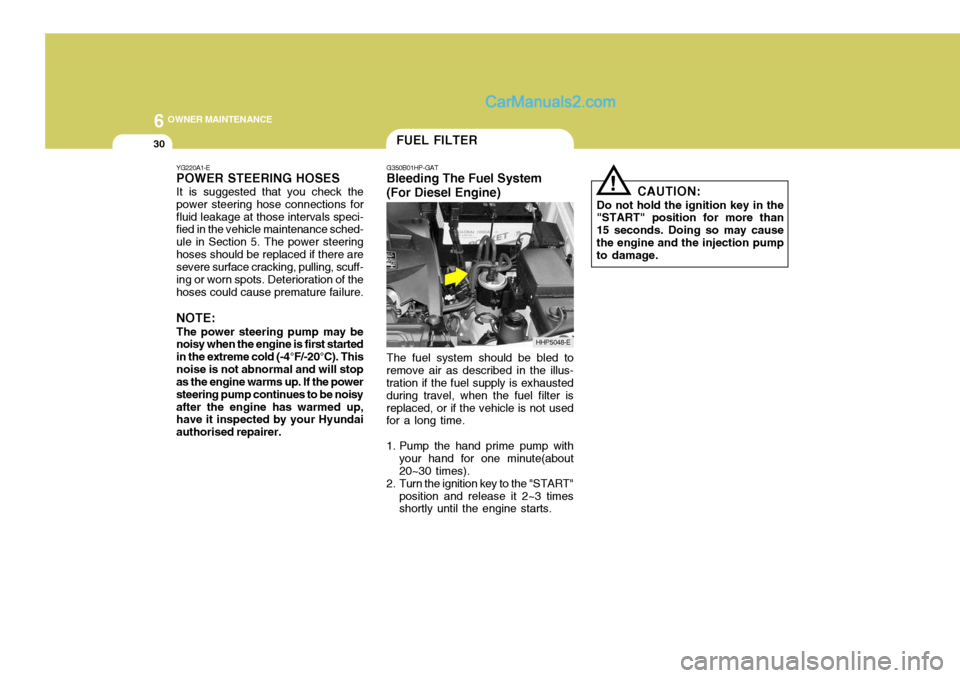
The fuel system should be bled to
remove air as described in the illus- tration if the fuel supply is exhausted during travel, when the fuel filter isreplaced, or if the vehicle is not used for a long time.
1. Pump the hand prime pump with your hand for one minute(about 20~30 times).
2. Turn the ignition key to the "START" position and release it 2~3 times shortly until the engine starts. CAUTION:
Do not hold the ignition key in the"START" position for more than 15 seconds. Doing so may causethe engine and the injection pump to damage.
FUEL FILTER
G350B01HP-GAT
Bleeding The Fuel System (For Diesel Engine)
HHP5048-E
YG220A1-E POWER STEERING HOSES It is suggested that you check the power steering hose connections forfluid leakage at those intervals speci- fied in the vehicle maintenance sched- ule in Section 5. The power steeringhoses should be replaced if there are severe surface cracking, pulling, scuff- ing or worn spots. Deterioration of thehoses could cause premature failure. NOTE: The power steering pump may be noisy when the engine is first started in the extreme cold (-4°F/-20°C). Thisnoise is not abnormal and will stop as the engine warms up. If the power steering pump continues to be noisyafter the engine has warmed up, have it inspected by your Hyundai authorised repairer.
Page 509 of 539
6
OWNER MAINTENANCE
31
!
!
3. Check to be sure that the warning
lamp illuminates when the ignition key is turned to "ON", and that it goes off when the engine is started. If in doubt, consult your nearest Hyundai authorised repairer.
NOTE: It is recommended that water accu- mulated in the fuel filter should be removed by a Hyundai authorised repairer.
WARNING:
Be sure to carefully wipe away anywater drained out in this manner, because the fuel mixed in the water might be ignited and resultin a fire. Before attempting to replace a head-
light bulb, be sure the switch is turned to the "OFF" position.
The next paragraph shows how to
reach the headlight bulbs so they may be changed. Be sure to replacethe burned-out bulb with one of the same number and wattage rating.
Ensure that the replacement bulb has
the same cap configuration and watt-age as the original.
See page 6-35 for the wattage descrip-
tions.
CAUTION:
Keep the lamps out of contact with
petroleum products, such as oil, petrol, etc.
REPLACING HEADLIGHT BULBS
G260A01HP-EAT
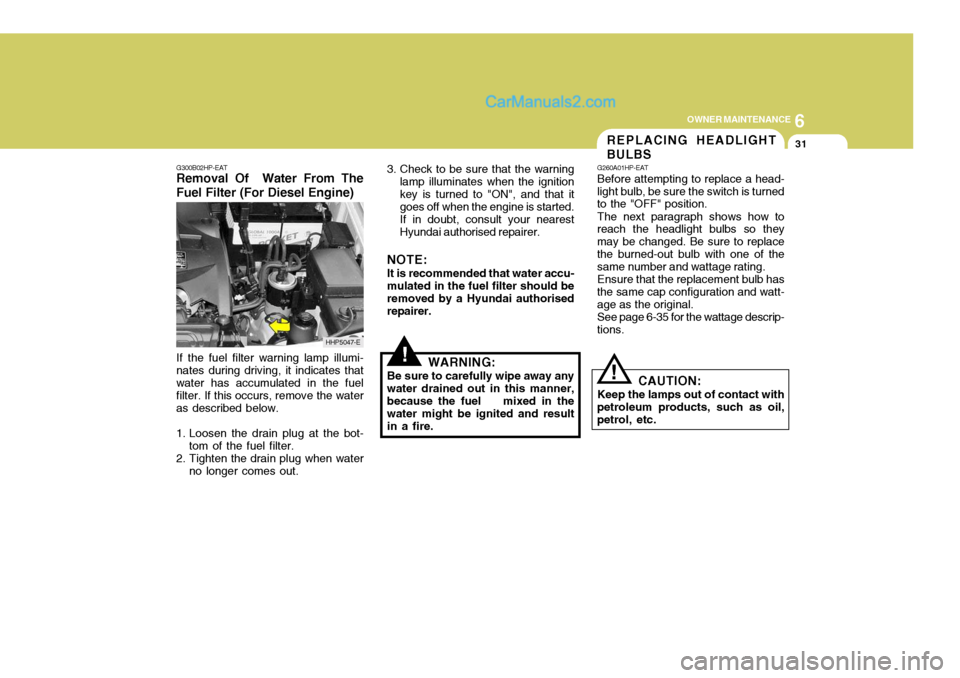
G300B02HP-EAT
Removal Of Water From TheFuel Filter (For Diesel Engine)
If the fuel filter warning lamp illumi- nates during driving, it indicates that water has accumulated in the fuel filter. If this occurs, remove the wateras described below.
1. Loosen the drain plug at the bot- tom of the fuel filter.
2. Tighten the drain plug when water no longer comes out.
HHP5047-E
Page 510 of 539
6 OWNER MAINTENANCE
32
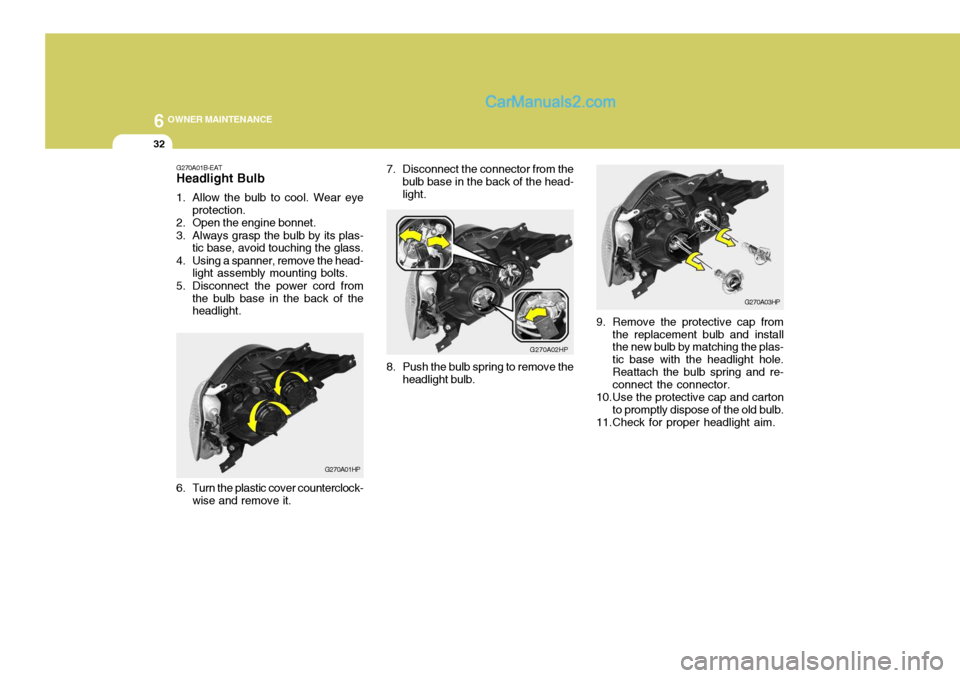
7. Disconnect the connector from the
bulb base in the back of the head- light.
G270A02HP
8. Push the bulb spring to remove the headlight bulb.
G270A03HP
9. Remove the protective cap from the replacement bulb and install the new bulb by matching the plas- tic base with the headlight hole.Reattach the bulb spring and re- connect the connector.
10.Use the protective cap and carton to promptly dispose of the old bulb.
11.Check for proper headlight aim.
G270A01B-EAT
Headlight Bulb
1. Allow the bulb to cool. Wear eye
protection.
2. Open the engine bonnet.
3. Always grasp the bulb by its plas- tic base, avoid touching the glass.
4. Using a spanner, remove the head- light assembly mounting bolts.
5. Disconnect the power cord from the bulb base in the back of the headlight.
G270A01HP
6. Turn the plastic cover counterclock- wise and remove it.
Page 520 of 539
7EMISSION CONTROL SYSTEMS
2
Inspect the exhaust systemWhenever a change is noticed in the
sound of the exhaust system, the underside or rear of the vehicle maybe damaged. You should inspect the exhaust system each time the car is raised for lubrication or oil change. To check condition
1. Holes and gas leaks due to corro- sion, damage, etc., should be recti- fied.
2. The joints should be checked for loose connections and gas leakage.
3. The hanger rubber and brackets
should be checked for damage.EXHAUST GAS WARNING
H030A01HP-EAT Exhaust gases contain carbon monox- ide, a potentially toxic gas that is colorless and odorless. Avoid breath-ing exhaust gases.
o Do not run the engine in confined areas, such as garages, any longer than necessary to move the car inor out.
o Do not drive with the tailgate door
open. An open tailgate door maydraw exhaust gases into the pas- senger compartment. If you must drive with the tailgate door open,drive only with all the windows wide open and the blower motor on high speed.
o If it is necessary to sit in a parked
car with the engine running formore than a short period, adjust your heating system to force out- side air into the car by placing theair selector button of the heater in the FRESH AIR position and mode control in the VENT position. Setthe fan at high speed and the con- trols in any position desired.EMISSION CONTROL SYS- TEMS
ZH010A1-E
(Not all models)
Your Hyundai is equipped with an
emission control systems. There are three emission control sys-
tems which are as follows.
(1) Crankcase emission control sys- tem (For a Petrol Engine)
(2) Evaporative emission control sys- tem (For a Petrol Engine)
(3) Exhaust emission control system
In order to assure the proper function
of the emission control system, it is recommended that you have your car inspected and maintained by a Hyundaiauthorised repairer in accordance with the schedule in this manual.
Page 535 of 539
10INDEX
2
A Air Cleaner Filter ........................................................ 6-12
Air Conditioning
Maintenance ........................................................... 6-20
Operation ................................................................ 1-97
Switch ..................................................................... 1-97
Airbag ........................................................................ 1-40
Antenna ................................................................... 1-108
Apperance Care ........................................................... 4-1
Ashtray ...................................................................... 1-68
Automatic Heating and Cooling Control System ........ 1-99
BBattery ....................................................................... 6-27
Bi-Level Heating ........................................................ 1-95
Bonnet Release ......................................................... 1-83
Brake
Anti-lock system (ABS) .......................................... 2-21
Brake system checking .......................................... 6-18
Effective braking ..................................................... 2-22
Fluid ........................................................................ 6-18
Pedal clearance ...................................................... 6-24
Pedal free-play ........................................................ 6-23
CCatalytic Converter ...................................................... 7-3
Centre Console Compartment ....................................1-74
Child Restraint System .............................................. 1-31
Child-Proof Rear Door Lock ....................................... 1-10Cigar Lighter
.............................................................. 1-67
Climate Control Air Filter ................................ 1-105, 6-22
Clock ......................................................................... 1-66
Clutch Checking fluid ......................................................... 6-19
Pedal free-play ........................................................ 6-23
Cooling Fans ............................................................. 6-28
Cruise Control ............................................................ 1-87
D Daily Operating Checks ............................................... 6-4
Defrosting/Defogging .................................................. 1-96
Door
Central door locks .................................................. 1-11
Locking, unlocking front door with a key .................. 1-9
Drink Holder ............................................................... 1-69
Drive Belts ................................................................. 6-24
Driving Driving for economy ............................................... 2-23
Smooth corneri ng .................................................... 2-24
Winter motoring ...................................................... 2-24
E EGR system ................................................................ 7-5
Emission Control Systems .......................................... 7-2 Engine Before starting the engine ........................................ 2-3Compartment (3.5 V6) .............................................. 6-2
Compartment (2.9 CRDi) ........................................... 6-3
Coolant ..................................................................... 6-9