check engine Hyundai Terracan 2006 Manual PDF
[x] Cancel search | Manufacturer: HYUNDAI, Model Year: 2006, Model line: Terracan, Model: Hyundai Terracan 2006Pages: 539, PDF Size: 18.11 MB
Page 362 of 539
1CONTROLS AND EQUIPMENT
54
!
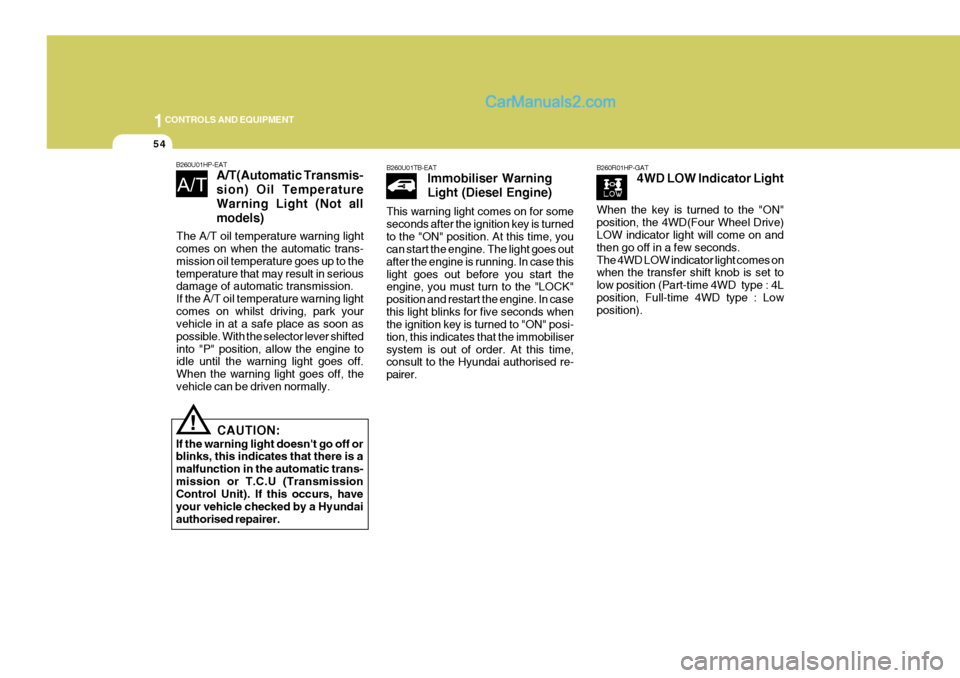
B260U01HP-EAT
A/T(Automatic Transmis- sion) Oil TemperatureWarning Light (Not allmodels)
CAUTION:
If the warning light doesn't go off or blinks, this indicates that there is a malfunction in the automatic trans-mission or T.C.U (Transmission Control Unit). If this occurs, have your vehicle checked by a Hyundaiauthorised repairer.
B260U01TB-EAT Immobiliser Warning Light (Diesel Engine)
This warning light comes on for some seconds after the ignition key is turnedto the "ON" position. At this time, you can start the engine. The light goes out after the engine is running. In case thislight goes out before you start the engine, you must turn to the "LOCK" position and restart the engine. In casethis light blinks for five seconds when the ignition key is turned to "ON" posi- tion, this indicates that the immobilisersystem is out of order. At this time, consult to the Hyundai authorised re- pairer.B260R01HP-GAT 4WD LOW Indicator Light
The A/T oil temperature warning light comes on when the automatic trans- mission oil temperature goes up to thetemperature that may result in serious damage of automatic transmission. If the A/T oil temperature warning lightcomes on whilst driving, park your vehicle in at a safe place as soon as possible. With the selector lever shiftedinto "P" position, allow the engine to idle until the warning light goes off. When the warning light goes off, thevehicle can be driven normally. When the key is turned to the "ON"position, the 4WD(Four Wheel Drive) LOW indicator light will come on and then go off in a few seconds.The 4WD LOW indicator light comes on when the transfer shift knob is set to low position (Part-time 4WD type : 4Lposition, Full-time 4WD type : Low position).
Page 363 of 539
1
CONTROLS AND EQUIPMENT
55
!
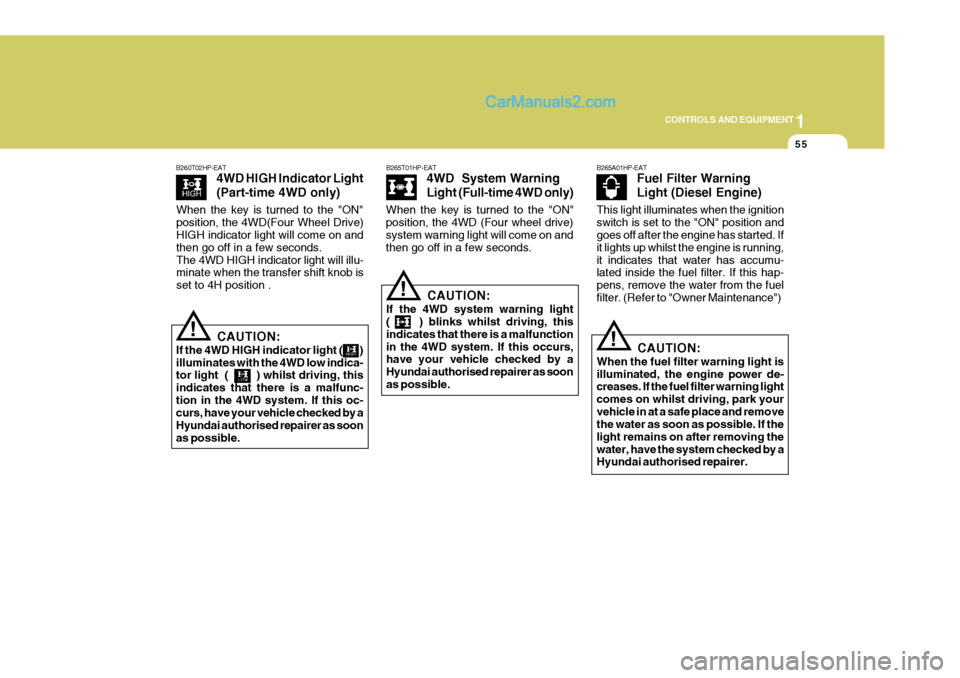
B265T01HP-EAT
4WD System Warning
Light (Full-time 4WD only)
CAUTION:
If the 4WD system warning light ( ) blinks whilst driving, this indicates that there is a malfunctionin the 4WD system. If this occurs, have your vehicle checked by a Hyundai authorised repairer as soonas possible.
!
B260T02HP-EAT
4WD HIGH Indicator Light (Part-time 4WD only)
CAUTION:
If the 4WD HIGH indicator light ( ) illuminates with the 4WD low indica- tor light ( ) whilst driving, this indicates that there is a malfunc-tion in the 4WD system. If this oc- curs, have your vehicle checked by a Hyundai authorised repairer as soonas possible.
B265A01HP-EAT Fuel Filter Warning Light (Diesel Engine)
!CAUTION:
When the fuel filter warning light is illuminated, the engine power de- creases. If the fuel filter warning light comes on whilst driving, park yourvehicle in at a safe place and remove the water as soon as possible. If the light remains on after removing thewater, have the system checked by a Hyundai authorised repairer.
When the key is turned to the "ON" position, the 4WD(Four Wheel Drive) HIGH indicator light will come on and then go off in a few seconds.The 4WD HIGH indicator light will illu- minate when the transfer shift knob is set to 4H position .
When the key is turned to the "ON"position, the 4WD (Four wheel drive) system warning light will come on and then go off in a few seconds.
This light illuminates when the ignitionswitch is set to the "ON" position and goes off after the engine has started. If it lights up whilst the engine is running,it indicates that water has accumu- lated inside the fuel filter. If this hap- pens, remove the water from the fuelfilter. (Refer to "Owner Maintenance")
Page 364 of 539
1CONTROLS AND EQUIPMENT
56
!
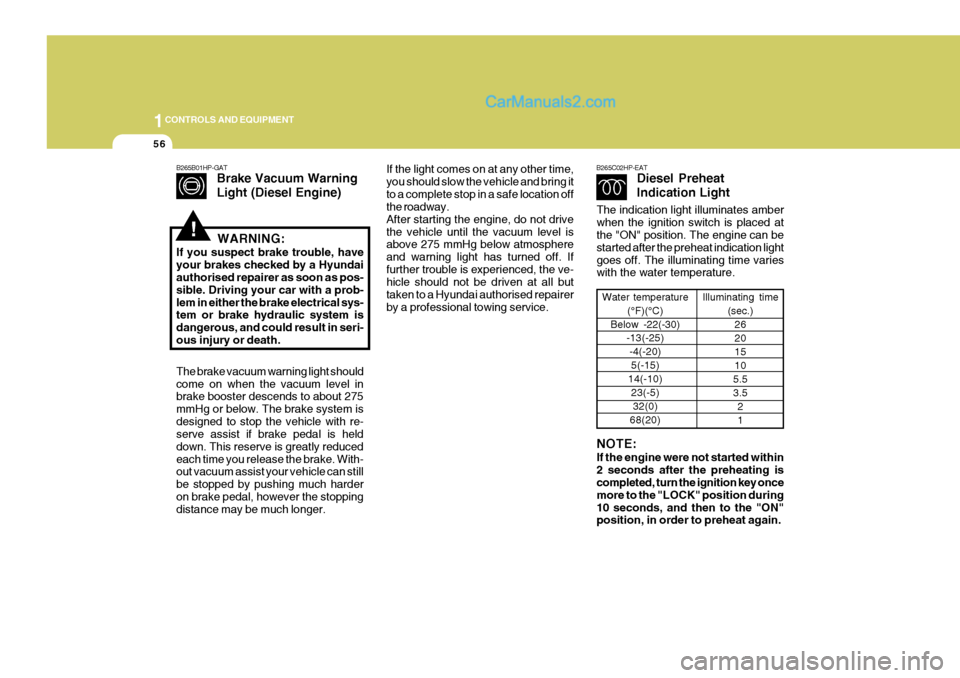
B265B01HP-GAT
Brake Vacuum Warning Light (Diesel Engine)
The brake vacuum warning light should come on when the vacuum level in brake booster descends to about 275 mmHg or below. The brake system isdesigned to stop the vehicle with re- serve assist if brake pedal is held down. This reserve is greatly reducedeach time you release the brake. With- out vacuum assist your vehicle can still be stopped by pushing much harderon brake pedal, however the stopping distance may be much longer. WARNING:
If you suspect brake trouble, have your brakes checked by a Hyundai authorised repairer as soon as pos- sible. Driving your car with a prob-lem in either the brake electrical sys- tem or brake hydraulic system is dangerous, and could result in seri-ous injury or death.If the light comes on at any other time, you should slow the vehicle and bring itto a complete stop in a safe location off the roadway. After starting the engine, do not drivethe vehicle until the vacuum level is above 275 mmHg below atmosphere and warning light has turned off. Iffurther trouble is experienced, the ve- hicle should not be driven at all but taken to a Hyundai authorised repairerby a professional towing service. B265C02HP-EAT
Diesel Preheat Indication Light
Water temperature
(°F)(°C)
Below -22(-30) -13(-25)
-4(-20)5(-15)
14(-10) 23(-5)32(0)
68(20) Illuminating time
(sec.)26 201510
5.53.5 21
NOTE: If the engine were not started within 2 seconds after the preheating is completed, turn the ignition key once more to the "LOCK" position during10 seconds, and then to the "ON" position, in order to preheat again.
The indication light illuminates amber when the ignition switch is placed at the "ON" position. The engine can be started after the preheat indication lightgoes off. The illuminating time varies with the water temperature.
Page 366 of 539
1CONTROLS AND EQUIPMENT
58
The needle on the coolant temperature gauge should stay in the normal range.If it moves across the dial to "H" (Hot), pull over and stop as soon as possible and turn off the engine. Then open thebonnet and check the coolant level and the water pump drive belt. If you sus- pect cooling system trouble, have yourcooling system checked by Hyundai authorised repairer as soon as pos- sible.
! CAUTION:
The engine should not be raced to such a speed that the needle enters the red zone on the tachometer face. This can cause severe engine dam-age and may void your warranty.
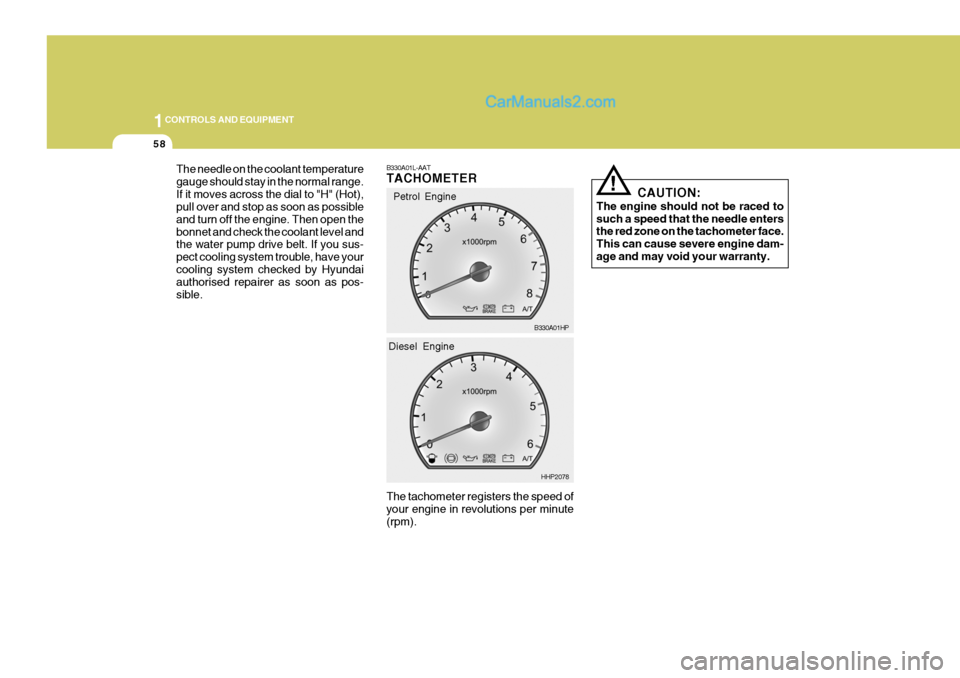
B330A01L-AAT TACHOMETER The tachometer registers the speed of your engine in revolutions per minute (rpm).Petrol Engine
B330A01HP
HHP2078
Diesel Engine
Page 391 of 539
1
CONTROLS AND EQUIPMENT
83
o Automotive fuels are flammable/ explosive materials. When refuel- ing, please note the followingguidelines carefully. Failure to follow these guidelines may re- sult in severe personal injury, se-vere burns or death by fire or explosion.
- Before refueling always note the
location of the Emergency Fuel Shut-Off, if available, at the fuel station facility.
- Before touching the fuel nozzle or fuel filler cap, you shouldeliminate potentially dangerousstatic electricity discharge by touching another metal part of the front of the vehicle, a safedistance away from the fuel filler neck, nozzle, or other fuel source.
- Do not get back into a vehicle once you have begun refueling.Do not touch, rub or slide againstany item or fabric (polyester, satin, nylon, etc.) capable of pro- ducing static electricity. Staticelectricity discharge can ignite fuel vapors resulting in explo sion.If you must re-enter the vehicle, you should once again elimi-nate potentially dangerous static electricity discharge by touch- ing a metal part of the vehicle,away from the fuel filler neck, nozzle or other fuel source.
- When using a portable fuel con- tainer be sure to place the con-tainer on the ground prior to refueling. Static electricity dis-charge from the container can ignite fuel vapors causing a fire. Once refueling has begun, con-tact with the vehicle should be maintained until the filling is complete. Use only portable fuelcontainers designed to carry and store fuel.
- Do not use cellular phones
around a fuel station or whilstrefueling any vehicle. Electric current and/or electronic inter-ference from cellular phones can potentially ignite fuel vapors causing a fire. If you must useyour cellular phone use it in a place away from the fuel station.
- When refueling always shut theengine off. Sparks produced by electrical components related to the engine can ignite fuel va- pors causing a fire. Always in-sure that the engine is OFF be- fore and during refueling. Once refueling is complete, check tomake sure the fuel filler cap and door are securely closed, before starting the engine.
- Do not light any fire around a fuel station. DO NOT use matchesor a lighter and DO NOT SMOKEor leave a lit cigarette in your vehicle whilst at a gas station especially during refueling.Automotive fuel is highly flam- mable and can, when ignited, result in explosion by flames.
- If a fire breaks out during refuel- ing, leave the vicinity of the ve-hicle, and immediately contactthe manager of the fuel station or contact the police and local fire department. Follow anysafety instructions they provide.
Page 419 of 539
2
DRIVING YOUR HYUNDAI
3
!WARNING:
Your vehicle is equipped with tyres designed to provide for safe ride and handling capability.Do not use a size and type of tyre and wheel that is different from the one that was originally installed on yourvehicle. It can affect the safety and performance of your vehicle, which could lead to handling failure orrollover and serious injury. When replacing the tyres, be sure to equip all four tyres with the tyre andwheel of the same size, type, tread, brand and load-carrying capacity. If you nevertheless decide to equipyour vehicle with any tyre/wheel com- bination not recommended by Hyundai for off-road driving, youshould not use these tyres for high- way driving.
BEFORE STARTING THE ENGINE
C020A02A-EAT Before you start the engine, you should always:
1. Look around the vehicle to be sure
there are no flat tyres, puddles of oil or water or other indications of pos- sible trouble.
2. After entering the car, check to be
sure the parking brake is engaged.
3. Check that all windows, and lights
are clean.
4. Check that the interior and exterior mirrors are clean and in position.
5. Check your seat, seatback and headrest to be sure they are in theirproper positions.
6. Close all the doors.
7. Fasten your seat belt and be sure that all other occupants have fas-tened theirs.
8. Turn off all lights and accessories that are not needed.
9. When you turn the ignition switch to "ON" check that all appropriate warning lights are operating and that you have sufficient fuel.
10.Check the operation of warning lights and all bulbs when key is inthe "ON" position. WARNING:
Always wear appropriate shoes when operating your vehicle. Unsuitable shoes (high heels, skiboots, etc.) may interfere with your ability to use the brake and accelera- tor pedal, and the clutch (Not allmodels).
!
Page 423 of 539
2
DRIVING YOUR HYUNDAI
7
!
NOTE: If the engine has not been started within 2 seconds after the preheating is completed, turn the ignition keyonce more to the "LOCK" position during 10 seconds, and then to the "ON" position, in order to preheatagain.
WARNING:
Be sure that the clutch is fully de-pressed when starting a manualtransaxle vehicle. This will prevent sudden movement occuring should the vehicle be started in gear withoutthe clutch depressed. Otherwise there is the potential to cause damage to the vehicle or injury to a personinside or outside of the vehicle as a result of this sudden vehicle move- ment.
5. Turn the ignition key to the "START" position and release it when the en- gine starts.
!
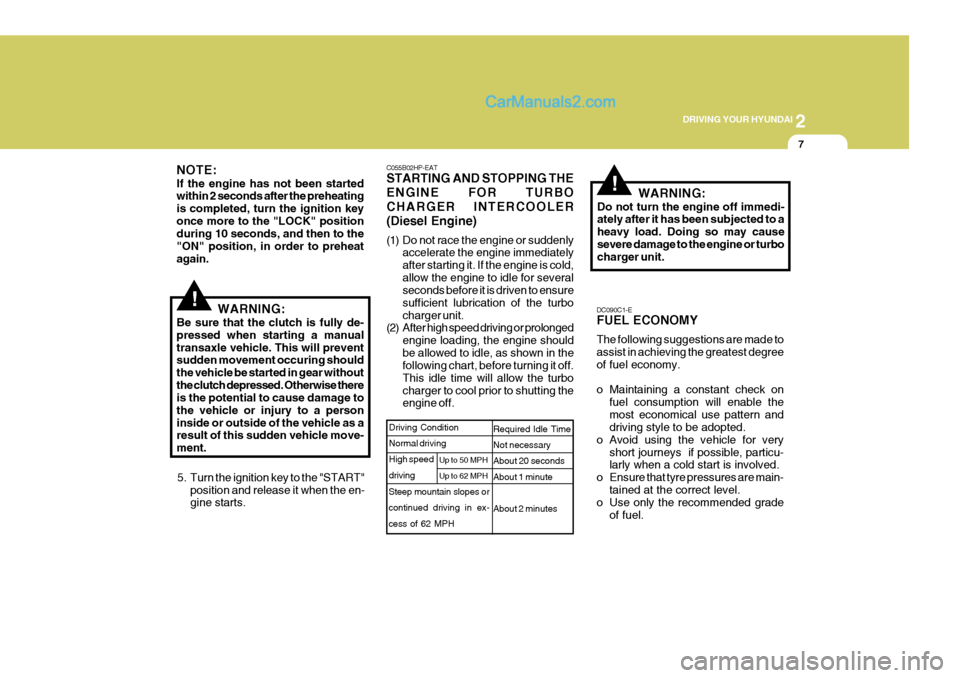
C055B02HP-EAT STARTING AND STOPPING THE ENGINE FOR TURBOCHARGER INTERCOOLER(Diesel Engine)
(1) Do not race the engine or suddenly accelerate the engine immediately after starting it. If the engine is cold,allow the engine to idle for several seconds before it is driven to ensure sufficient lubrication of the turbocharger unit.
(2) After high speed driving or prolonged
engine loading, the engine shouldbe allowed to idle, as shown in the following chart, before turning it off. This idle time will allow the turbocharger to cool prior to shutting the engine off. WARNING:
Do not turn the engine off immedi-ately after it has been subjected to a heavy load. Doing so may causesevere damage to the engine or turbo charger unit.
DC090C1-E FUEL ECONOMY The following suggestions are made to assist in achieving the greatest degree of fuel economy.
o Maintaining a constant check on fuel consumption will enable the most economical use pattern and driving style to be adopted.
o Avoid using the vehicle for very short journeys if possible, particu-larly when a cold start is involved.
o Ensure that tyre pressures are main- tained at the correct level.
o Use only the recommended grade
of fuel.
Steep mountain slopes or continued driving in ex-
cess of 62 MPH Required Idle Time Not necessary About 20 secondsAbout 1 minute About 2 minutes
Driving Condition Normal driving High speed driving
Up to 50 MPH Up to 62 MPH
Page 428 of 539
2 DRIVING YOUR HYUNDAI
12
!
C090I01E-EAT
CAUTION:
o Shift into "R" and "P" only when the vehicle has completely stopped.
o Do not accelerate the engine in reverse or any of the forward posi-tions with the brakes applied.
o Always apply the footbrake when shifting from "P" or "N" to "R","D", "2" or "L" position.
o Do not use the "P" (Park) posi- tion in place of the parking brake.Always set the parking brake,shift the transmission into "P" (Park) and turn off the ignition when you leave the vehicle, evenmomentarily. Never leave the ve- hicle unattended whilst the en- gine is running.
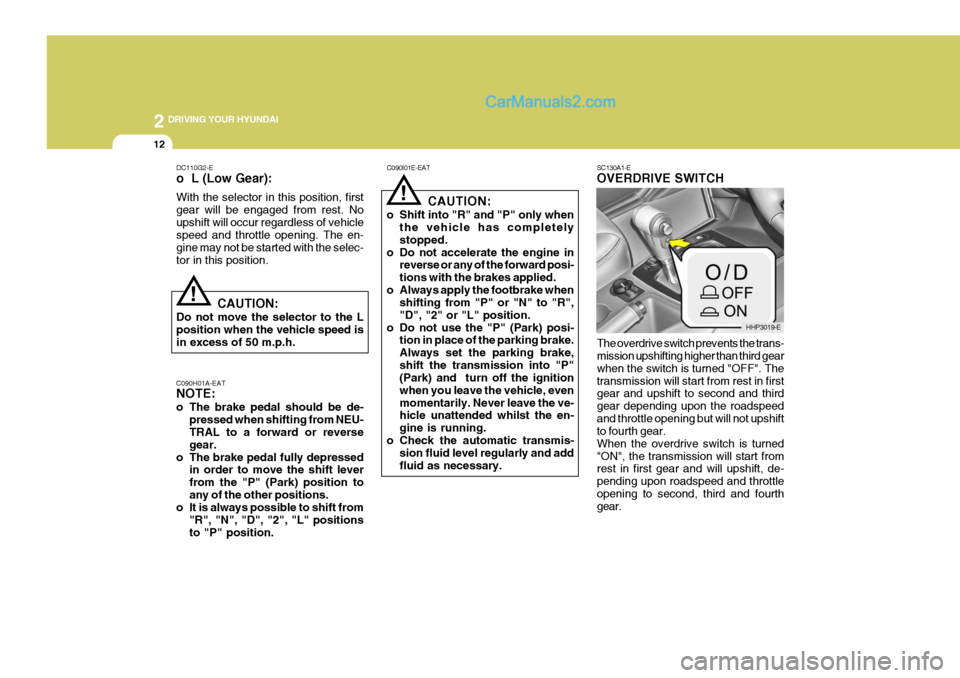
o Check the automatic transmis- sion fluid level regularly and addfluid as necessary. SC130A1-E OVERDRIVE SWITCH The overdrive switch prevents the trans- mission upshifting higher than third gear when the switch is turned "OFF". Thetransmission will start from rest in first gear and upshift to second and third gear depending upon the roadspeedand throttle opening but will not upshift to fourth gear. When the overdrive switch is turned"ON", the transmission will start from rest in first gear and will upshift, de- pending upon roadspeed and throttleopening to second, third and fourth gear.
!
DC110G2-E o L (Low Gear): With the selector in this position, first gear will be engaged from rest. Noupshift will occur regardless of vehicle speed and throttle opening. The en- gine may not be started with the selec-tor in this position.
CAUTION:
Do not move the selector to the Lposition when the vehicle speed isin excess of 50 m.p.h. C090H01A-EAT NOTE:
o The brake pedal should be de- pressed when shifting from NEU- TRAL to a forward or reverse gear.
o The brake pedal fully depressed in order to move the shift leverfrom the "P" (Park) position toany of the other positions.
o It is always possible to shift from
"R", "N", "D", "2", "L" positionsto "P" position.
HHP3019-E
Page 433 of 539
2
DRIVING YOUR HYUNDAI
17
C355A04HP-EAT Full-time 4WD operation (Not all models) 1. Knob position This is used to set different positions.
15.7 in. (40cm) D090E01HP
HHP2114-E
Driving on snowy or icy roads Select the 4H or 4L in accordance with the road conditions, and then graduallydepress the accelerator pedal for a smooth start. Driving on sandy or muddy roads Select the 4H or 4L and then gradually depress the accelerator pedal for asmooth start. Keep the pressure on the accelerator pedal constant as possible, and drive at low speed. Climbing sharp grades Select the 4L to maximize use the engine torque. Descending sharp grades Select the 4L, use the engine brake and descend slowly.
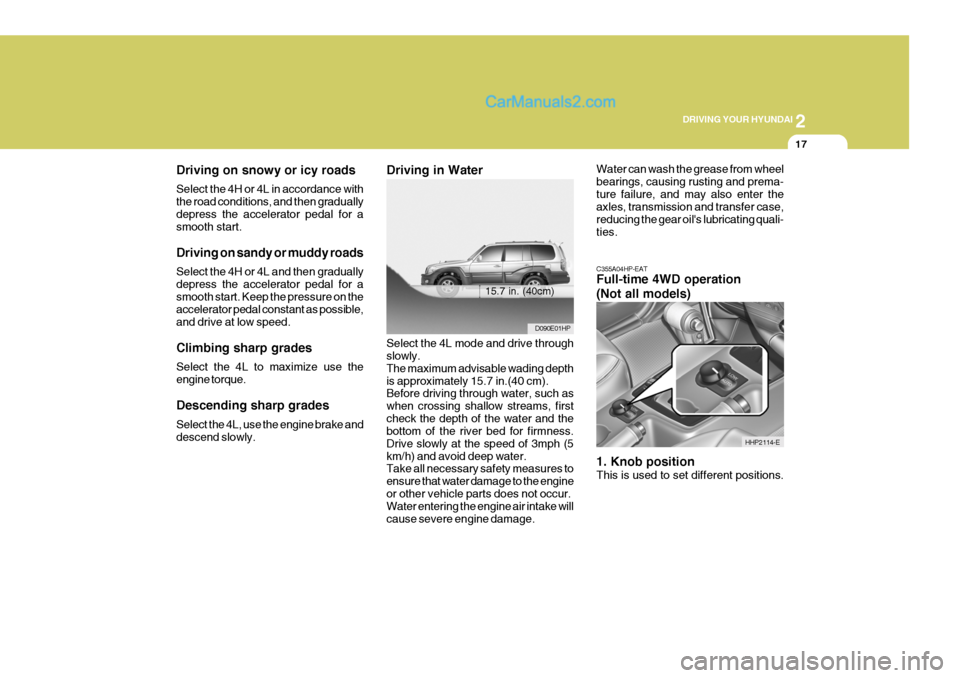
Driving in Water
Water can wash the grease from wheelbearings, causing rusting and prema-ture failure, and may also enter the axles, transmission and transfer case, reducing the gear oil's lubricating quali-ties.
Select the 4L mode and drive through slowly. The maximum advisable wading depthis approximately 15.7 in.(40 cm). Before driving through water, such as when crossing shallow streams, firstcheck the depth of the water and the bottom of the river bed for firmness. Drive slowly at the speed of 3mph (5km/h) and avoid deep water. Take all necessary safety measures to ensure that water damage to the engineor other vehicle parts does not occur. Water entering the engine air intake will cause severe engine damage.
Page 436 of 539
2 DRIVING YOUR HYUNDAI
20
!
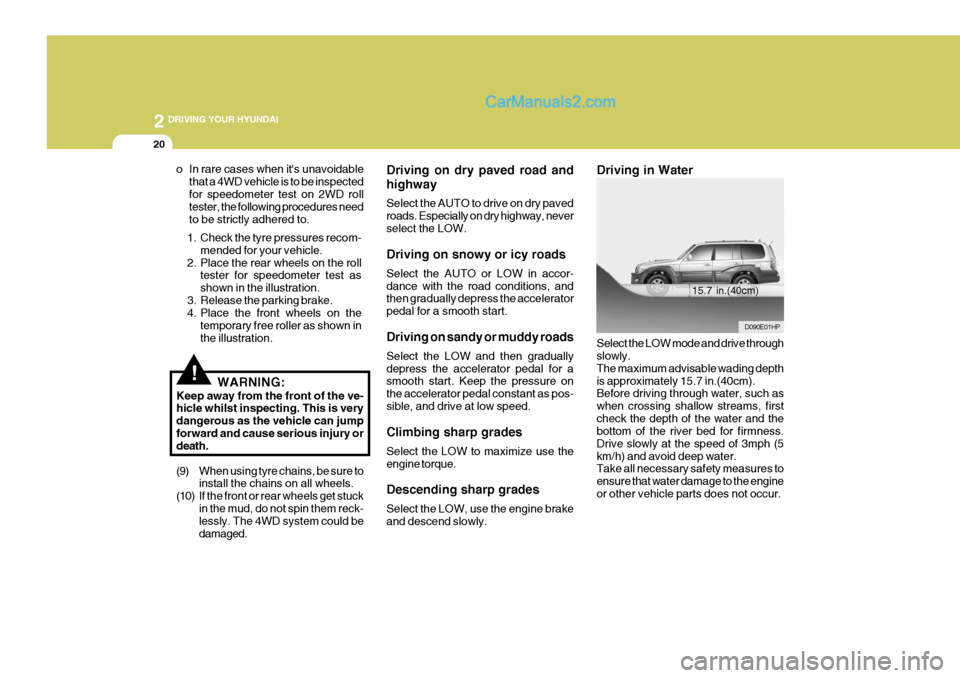
Driving in Water Select the LOW mode and drive through slowly. The maximum advisable wading depthis approximately 15.7 in.(40cm). Before driving through water, such as when crossing shallow streams, firstcheck the depth of the water and the bottom of the river bed for firmness. Drive slowly at the speed of 3mph (5km/h) and avoid deep water. Take all necessary safety measures to ensure that water damage to the engineor other vehicle parts does not occur.
o In rare cases when it's unavoidable
that a 4WD vehicle is to be inspectedfor speedometer test on 2WD roll tester, the following procedures need to be strictly adhered to. Driving on dry paved road and highway Select the AUTO to drive on dry paved roads. Especially on dry highway, neverselect the LOW. Driving on snowy or icy roads Select the AUTO or LOW in accor- dance with the road conditions, and then gradually depress the accelerator pedal for a smooth start. Driving on sandy or muddy roads Select the LOW and then gradually depress the accelerator pedal for a smooth start. Keep the pressure on the accelerator pedal constant as pos-sible, and drive at low speed. Climbing sharp grades Select the LOW to maximize use the engine torque. Descending sharp grades Select the LOW, use the engine brake and descend slowly.
D090E01HP
15.7 in.(40cm)
1. Check the tyre pressures recom-
mended for your vehicle.
2. Place the rear wheels on the roll tester for speedometer test as shown in the illustration.
3. Release the parking brake.
4. Place the front wheels on the
temporary free roller as shown in the illustration.
WARNING:
Keep away from the front of the ve- hicle whilst inspecting. This is very dangerous as the vehicle can jumpforward and cause serious injury or death.
(9) When using tyre chains, be sure to install the chains on all wheels.
(10) If the front or rear wheels get stuck in the mud, do not spin them reck- lessly. The 4WD system could be damaged.