oil Hyundai Terracan 2006 Manual PDF
[x] Cancel search | Manufacturer: HYUNDAI, Model Year: 2006, Model line: Terracan, Model: Hyundai Terracan 2006Pages: 539, PDF Size: 18.11 MB
Page 431 of 539
2
DRIVING YOUR HYUNDAI
15
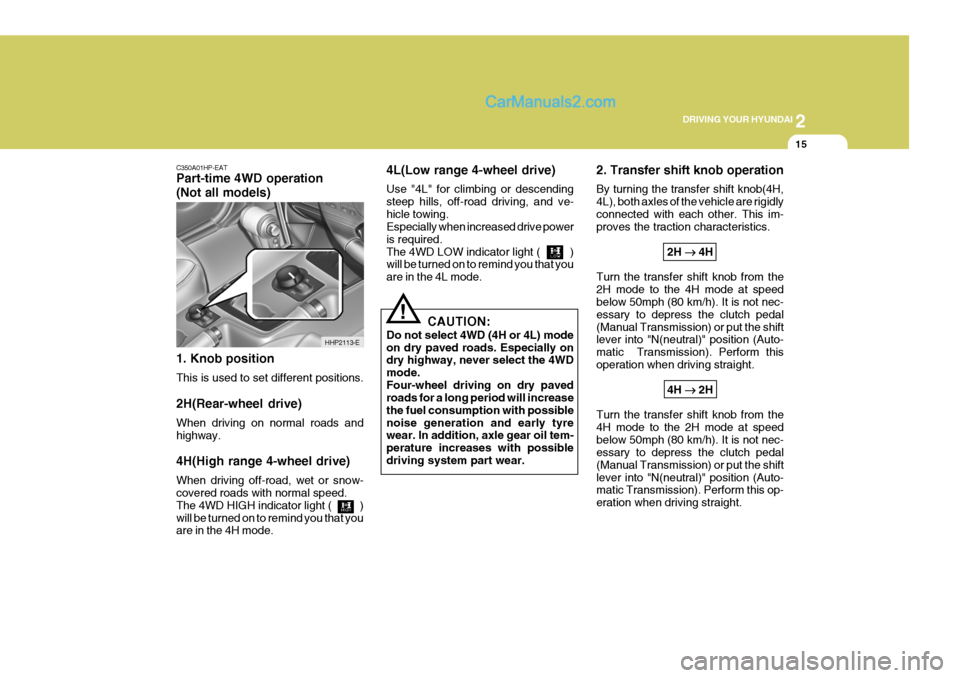
C350A01HP-EAT Part-time 4WD operation (Not all models) 1. Knob position This is used to set different positions. 2H(Rear-wheel drive) When driving on normal roads and highway. 4H(High range 4-wheel drive) When driving off-road, wet or snow- covered roads with normal speed. The 4WD HIGH indicator light ( )will be turned on to remind you that you are in the 4H mode.
!
4L(Low range 4-wheel drive) Use "4L" for climbing or descending steep hills, off-road driving, and ve-hicle towing. Especially when increased drive power is required.The 4WD LOW indicator light ( ) will be turned on to remind you that you are in the 4L mode.
2. Transfer shift knob operation By turning the transfer shift knob(4H, 4L), both axles of the vehicle are rigidlyconnected with each other. This im- proves the traction characteristics.
2H
4H
Turn the transfer shift knob from the 2H mode to the 4H mode at speed below 50mph (80 km/h). It is not nec- essary to depress the clutch pedal(Manual Transmission) or put the shift lever into "N(neutral)" position (Auto- matic Transmission). Perform thisoperation when driving straight. 4H
2H
Turn the transfer shift knob from the4H mode to the 2H mode at speedbelow 50mph (80 km/h). It is not nec- essary to depress the clutch pedal (Manual Transmission) or put the shiftlever into "N(neutral)" position (Auto- matic Transmission). Perform this op- eration when driving straight.
CAUTION:
Do not select 4WD (4H or 4L) modeon dry paved roads. Especially on dry highway, never select the 4WD mode.Four-wheel driving on dry paved roads for a long period will increase the fuel consumption with possiblenoise generation and early tyre wear. In addition, axle gear oil tem- perature increases with possibledriving system part wear.
HHP2113-E
Page 433 of 539
2
DRIVING YOUR HYUNDAI
17
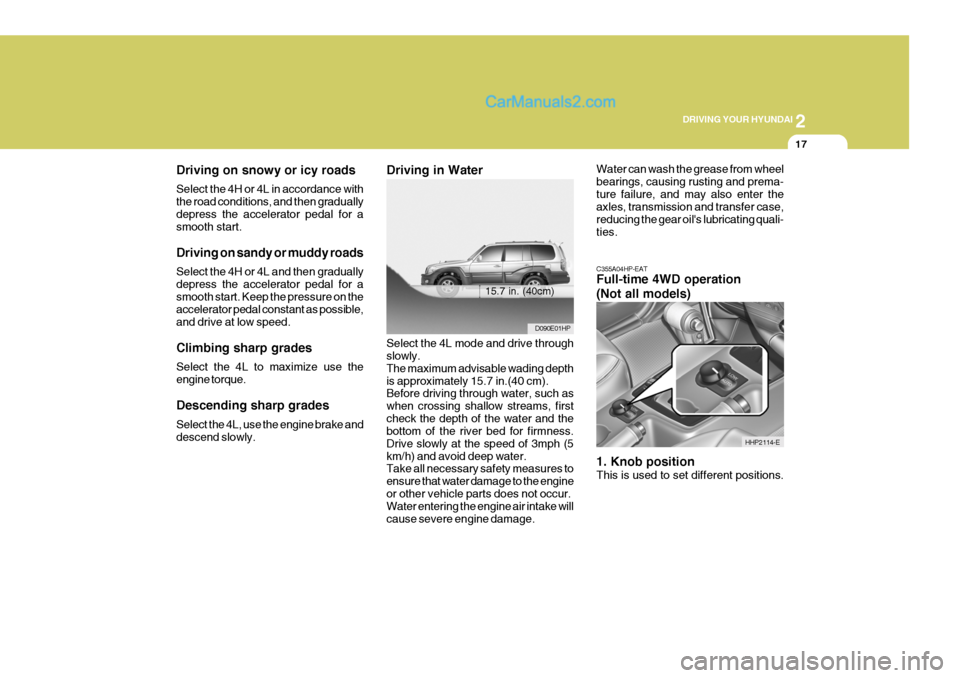
C355A04HP-EAT Full-time 4WD operation (Not all models) 1. Knob position This is used to set different positions.
15.7 in. (40cm) D090E01HP
HHP2114-E
Driving on snowy or icy roads Select the 4H or 4L in accordance with the road conditions, and then graduallydepress the accelerator pedal for a smooth start. Driving on sandy or muddy roads Select the 4H or 4L and then gradually depress the accelerator pedal for asmooth start. Keep the pressure on the accelerator pedal constant as possible, and drive at low speed. Climbing sharp grades Select the 4L to maximize use the engine torque. Descending sharp grades Select the 4L, use the engine brake and descend slowly.
Driving in Water
Water can wash the grease from wheelbearings, causing rusting and prema-ture failure, and may also enter the axles, transmission and transfer case, reducing the gear oil's lubricating quali-ties.
Select the 4L mode and drive through slowly. The maximum advisable wading depthis approximately 15.7 in.(40 cm). Before driving through water, such as when crossing shallow streams, firstcheck the depth of the water and the bottom of the river bed for firmness. Drive slowly at the speed of 3mph (5km/h) and avoid deep water. Take all necessary safety measures to ensure that water damage to the engineor other vehicle parts does not occur. Water entering the engine air intake will cause severe engine damage.
Page 437 of 539
2
DRIVING YOUR HYUNDAI
21
!
Water entering the engine air intake will cause severe engine damage. Water can wash the grease from wheel bearings, causing rusting and prema-ture failure, and may also enter the axles, transmission and transfer case, reducing the gear oil's lubricating quali-ties. CAUTION:
o Whilst the full-time 4WD vehicle is
being raised on a jack, never start the engine or cause the tyres to rotate. There is the danger that rotating tyres touching the ground couldcause the vehicle to move off the jack and jump forward.
o If one of the front or rear wheels begins to spin in mud, snow, etc.,the vehicle can sometimes be driven out by depressing the ac-celerator pedal further; however, avoid running the engine continu- ously at high rpm because doingso could damage the 4WD system.
!WARNING:
o Avoid high cornering speeds.
o Do not make quick steering wheel movements, such as sharp lane charges or fast, sharp turns.
o The risk of rollover is greatly in-
creased if you lose control of yourvehicle at motorway speeds.
o In a collision crash, an unbelted
person is significantly more likelyto die than a person wearing a seatbelt.
o Loss of control often occurs if two or more wheels drop off the road- way and the driver oversteers tore-enter the roadway.
o In the event your vehicle leaves
the roadway, do not steer sharply.Instead, slow down before pulling back into the travel lanes.
ANTI-LOCK BRAKE SYSTEM
C120A02A-EAT The Anti-Lock Brake System (ABS) is designed to prevent wheel lock-up dur- ing sudden braking or on hazardous road surfaces. The ABS control modulemonitors the wheel speed and controls the pressure applied to each brake. Thus, in emergency situations or onslick roads, ABS will increase vehicle control during braking. NOTE: During ABS operation, a slight pul- sation may be felt in the brake pedal when the brakes are applied. Also, a noise may be heard in the enginecompartment while braking. These conditions are normal and indicate that the anti-lock brake system isfunctioning properly.
Page 438 of 539
2 DRIVING YOUR HYUNDAI
22
!
EFFECTIVE BRAKING
HPC141A1-E Braking system performance and fric- tion material life are greatly affected by the driving style adopted. The follow- ing suggestions are made to assist inachieving the best results from the braking system.
o Anticipate the road and conditions ahead in order that heavy braking may be avoided.
o When descending long gradients,
use the engine to assist in retardingthe vehicle to minimise the possibil- ity of brake fade occurring.
o When trailer towing, ensure that the trailer brakes function correctly anduse engine braking to assist the vehicle braking system.
o Use only genuine Hyundai replace- ment brake pads and shoes to en-sure consistent friction characteris-tics and wear rates.
o After driving through deep water (e.g.
fording), the brakes may becomewet and performance reduced. Al- ways check brake efficiency after emerging from the water and dry thebrakes by lightly depressing the brake pedal several times whilst driv- ing slowly.LIMITED-SLIP DIFFEREN- TIAL (LSD)
D190A01HP-EAT (Not all models) A limited-slip differential, if equipped, is for the rear wheel differential only.The features of this limited-slip differ- ential are described below: Just as with a conventional differential,the wheel on one side is allowed to turn at a different speed from the wheel on the other side when the vehicle iscornering. The difference between the limited-slip differential and a conven- tional differential is that if the wheel onone side of the vehicle loses traction, a greater amount of torque is applied to the rear wheel on the other side toimprove traction.
WARNING:
ABS will not prevent accidents dueto improper or dangerous drivingmanoeuvres. Even though vehicle control is improved during emer- gency braking, always maintain asafe distance between you and ob- jects ahead. Vehicle speeds should always be reduced during extremeroad conditions. The braking distance for cars equipped with an anti-lock braking system may be longer than for those without it, in the following road con-ditions. These roads should be driven at reduced speeds.
o Rough, gravel or snow-covered roads.
o With tyre chains installed.
o On roads where the road surface is pitted or has different surfaceheight.
The safety features of an ABSequipped vehicle should not be testedby high speed driving or cornering. This could endanger the safety of yourself or others.
! CAUTION:
o Never start the engine with the gearshift lever placed in the for- ward or reverse whilst one of therear wheels is jacked up and the other in contact with the ground; doing so may cause the vehicle tojump forward.
o Use only recommended oil for
LSD in the rear axle.See page 9-4 for the recommended oil descriptions.
Page 448 of 539
3 IN CASE OF EMERGENCY
2
!WARNING:
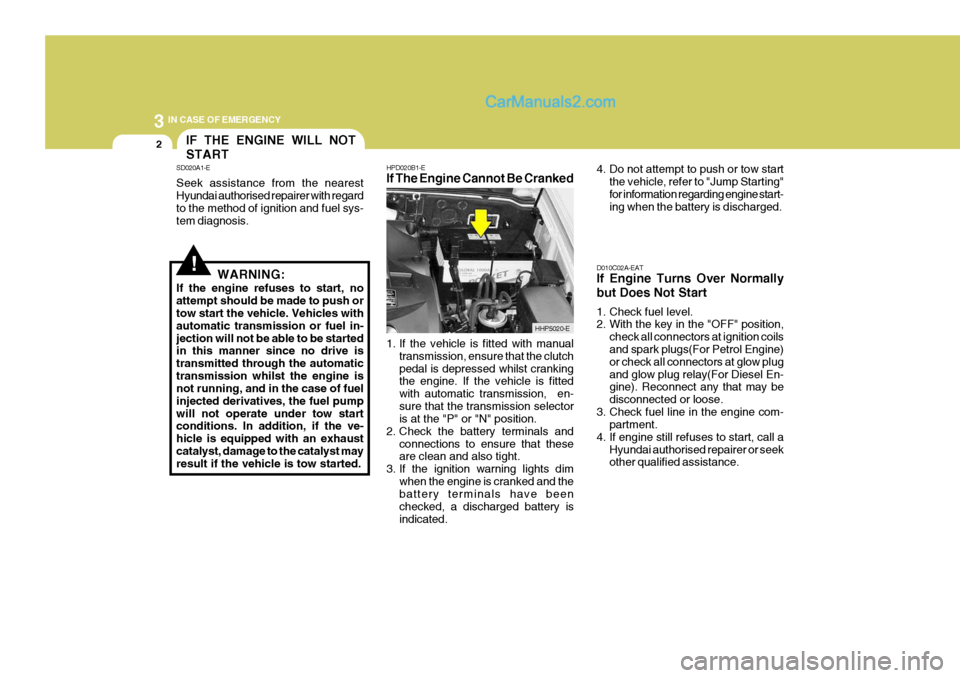
If the engine refuses to start, no attempt should be made to push or tow start the vehicle. Vehicles with automatic transmission or fuel in-jection will not be able to be started in this manner since no drive is transmitted through the automatictransmission whilst the engine is not running, and in the case of fuel injected derivatives, the fuel pumpwill not operate under tow start conditions. In addition, if the ve- hicle is equipped with an exhaustcatalyst, damage to the catalyst may result if the vehicle is tow started. HPD020B1-E If The Engine Cannot Be Cranked
1. If the vehicle is fitted with manual
transmission, ensure that the clutch pedal is depressed whilst cranking the engine. If the vehicle is fitted with automatic transmission, en-sure that the transmission selector is at the "P" or "N" position.
2. Check the battery terminals and
connections to ensure that theseare clean and also tight.
3. If the ignition warning lights dim
when the engine is cranked and thebattery terminals have been checked, a discharged battery isindicated. 4. Do not attempt to push or tow start
the vehicle, refer to "Jump Starting"for information regarding engine start- ing when the battery is discharged.
D010C02A-EAT If Engine Turns Over Normally but Does Not Start
1. Check fuel level.
2. With the key in the "OFF" position, check all connectors at ignition coilsand spark plugs(For Petrol Engine) or check all connectors at glow plugand glow plug relay(For Diesel En- gine). Reconnect any that may be disconnected or loose.
3. Check fuel line in the engine com- partment.
4. If engine still refuses to start, call a Hyundai authorised repairer or seek other qualified assistance.
IF THE ENGINE WILL NOT START
SD020A1-E Seek assistance from the nearest Hyundai authorised repairer with regard to the method of ignition and fuel sys- tem diagnosis.
HHP5020-E
Page 451 of 539
3
IN CASE OF EMERGENCY
5
!
!
!WARNING:
Whilst the engine is running, keep hands and clothing away from mov- ing parts such as the fan and drive belts to prevent injury.
WARNING (Diesel only):
Never work on injection system withengine running or within 30 seconds after shutting off engine. High pres- sure pump, rail, injectors and highpressure pipes are subject to high pressure even after the engine stopped. The fuel jet produced byfuel leaks may cause serious in- jury, if it contacts the body. People using pacemakers should ensure thatthey keep a distance of 30cm from the ECU or wiring harness within the engine room while engine is run-ning, since the high currents in the Common Rail system produce con- siderable magnetic fields. 5. If the water pump drive belt is broken
or coolant is leaking out, stop theengine immediately and call the near- est Hyundai authorised repairer for assistance.
WARNING:
Do not remove the radiator cap when the engine is hot since steam and boiling water may be ejected fromthe radiator resulting in burns or scalding.
6. If the cause of the overheating can- not be found, wait until the engine temperature has returned to normal. Then, if coolant has been lost, care-fully remove the radiator cap and add water to bring the fluid level in the reservoir(page 6-10) up to the baseof the radiator fill opening. Fill the coolant expansion tank to the half- way mark.
7. Proceed with caution until it is estab- lished that the engine is operatingnormally. If the engine overheatsrepeatedly, the advice of a Hyundai authorised repairer should be sought.! CAUTION:
Serious loss of coolant indicates there is a leak in the cooling system and this should be checked as soon as possible by a Hyundai authorisedrepairer.
Page 457 of 539
3
IN CASE OF EMERGENCY
11
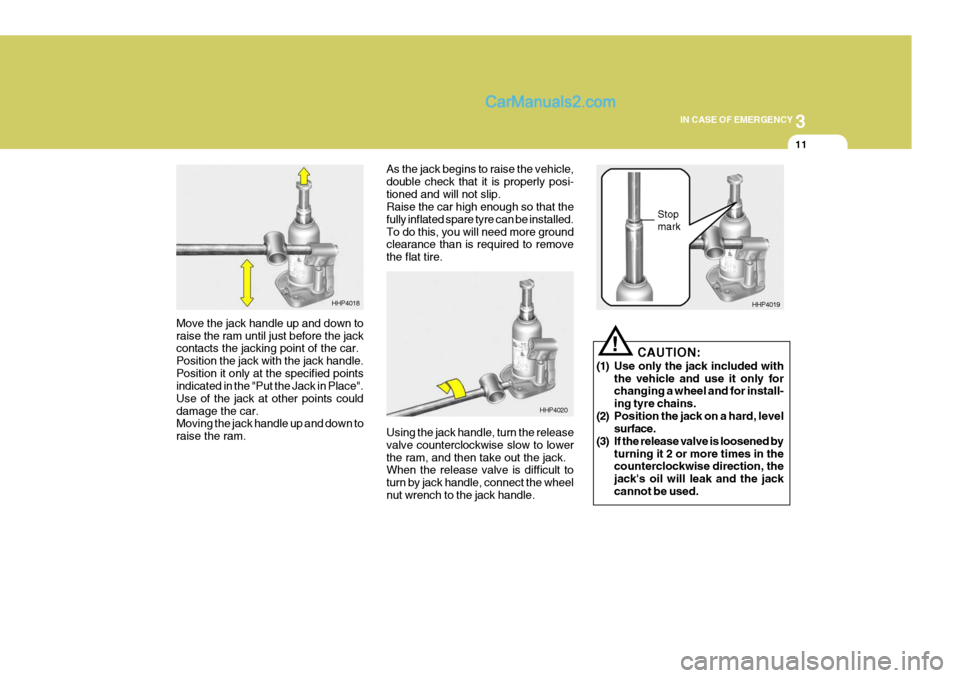
Move the jack handle up and down to raise the ram until just before the jack contacts the jacking point of the car. Position the jack with the jack handle.Position it only at the specified points indicated in the "Put the Jack in Place". Use of the jack at other points coulddamage the car. Moving the jack handle up and down to raise the ram.
HHP4018 As the jack begins to raise the vehicle, double check that it is properly posi-tioned and will not slip. Raise the car high enough so that the fully inflated spare tyre can be installed.To do this, you will need more ground clearance than is required to remove the flat tire. Using the jack handle, turn the release valve counterclockwise slow to lowerthe ram, and then take out the jack. When the release valve is difficult to turn by jack handle, connect the wheelnut wrench to the jack handle.
HHP4020
Stop mark
HHP4019
!CAUTION:
(1) Use only the jack included with the vehicle and use it only for changing a wheel and for install- ing tyre chains.
(2) Position the jack on a hard, level surface.
(3) If the release valve is loosened by turning it 2 or more times in the counterclockwise direction, the jack's oil will leak and the jackcannot be used.
Page 465 of 539
4
CORROSION PREVENTION AND APPEARANCE CARE
3
4
APPEARANCE CARE
3
ZE020C1-E Interior During the winter period, it is possible that the carpet within the passengercompartment may become wet. The carpet should not be allowed to remain in this condition for prolonged periodssince the carpet may begin to create musty smells and promote internal corrosion of the floorpan. Use only a shampoo intended for thepurpose and ensure that the body workis thoroughly wet to soften the dirt film prior to attempting to remove this. After removing the dirt film with a softsponge, the body work should be thor- oughly rinsed and then dried with a good quality chamois leather to pre-vent streaking or spotting of the paint work. Household detergents, solvents andabrasive cleaning materials should not be used in order to avoid damaging the paint film.Plastic wheel covers should be cleaned using a sponge and water. Cast alloy wheels should be cleaned using a mildsoap or neutral detergent. Abrasive compounds must not be used since in the event of these damaging the lac-quer coating, oxidisation of the alu- minium wheel will occur, spoiling the appearance.The use of a toothbrush will facilitate cleaning between the wheel "spokes".VALETING
JE050A1-E Regular cleaning of the exterior paintwork serves two important func- tions. Firstly, the removal of abrasive dirt and contaminants will maintain thelustre of the paintwork and will prevent discolouration and dulling due to pro- longed contact.Secondly, the presence of damage through impact or abrasion will be ap- parent allowing early rectification to bemade thus preventing corrosion from becoming established and spreading beneath the paint film. To avoid "waterspotting" the vehicle should not be washed in direct sunlight particularly in the case of vehicles having dark bodycolours. The heat from the sun rays is absorbed by the paint film increasing the surface temperature. This actioncauses water used for washing to evaporate quickly leaving behind the deposits from the water and the sham-poo used.
Page 467 of 539
4
CORROSION PREVENTION AND APPEARANCE CARE
5
4
APPEARANCE CARE
5
JE100A1-E SEAT BELTS Seat belts should be cleaned only with a mild soap solution. Strong deter-gents, solvents or bleaches may dam- age the belt webbing and therefore re- duce the effectiveness of the belt. Beltswhich display signs of fraying, wear or cuts should be replaced.INTERIOR VALETING
JE110A1-E The soft trim and carpets should be maintained with the regular use of a vacuum cleaner. Heavy soiling should be removed with a dry cleaning agentrecommended for this purpose follow- ing the instructions of the product manufacturer. Paint thinner, solventsor other such cleaning materials should not be used since damage to the up- holstery may result. JE120A1-E WINDOWS A proprietary glass cleaner should be used to clean the inside of the win-dows. However, the rear heated windscreen must only be cleaned us- ing a light horizontal cleaning action.Care should be exercised to avoid the use of abrasive cleaners or contact with items of jewellery which may dam-age the heating elements. YE010A1-E To Clean Leather Upholstery (Not all models) In the normal course of use, leather upholstered surfaces will, like any material, pick-up dust and dirt. Thisdust and dirt MUST be cleaned off or it may work into the surface of the leather, causing damage.Fine leather needs care. This care, as with all fine things, need not be elabo- rate, but should include cleaning whennecessary. Washing leather thoroughly with soap and water will keep your leather lustrous, beautiful and ensureyou have many years of wear. Take a piece of cheese cloth and using any mild soap and lukewarm water,work up a good lather. Thoroughly wash the leather. Wipe clean with a slightly damp cloth and dry with softcloth. Do this as often as the leather becomes soiled.
Page 468 of 539
44APPEARANCE CARE
6
During tanning operations, sufficient oils are incorporated through process-ing that none need be applied during the life of the leather. Oil applied to the finished surface will in no way help theleather and may do more harm than good. Varnished and furniture polishes should NEVER be used under anyconditions.