engine coolant Hyundai Tiburon 2006 Owner's Guide
[x] Cancel search | Manufacturer: HYUNDAI, Model Year: 2006, Model line: Tiburon, Model: Hyundai Tiburon 2006Pages: 266, PDF Size: 10.94 MB
Page 237 of 266
7
EMISSION CONTROL SYSTEMS2
EMISSION CONTROL SYSTEM
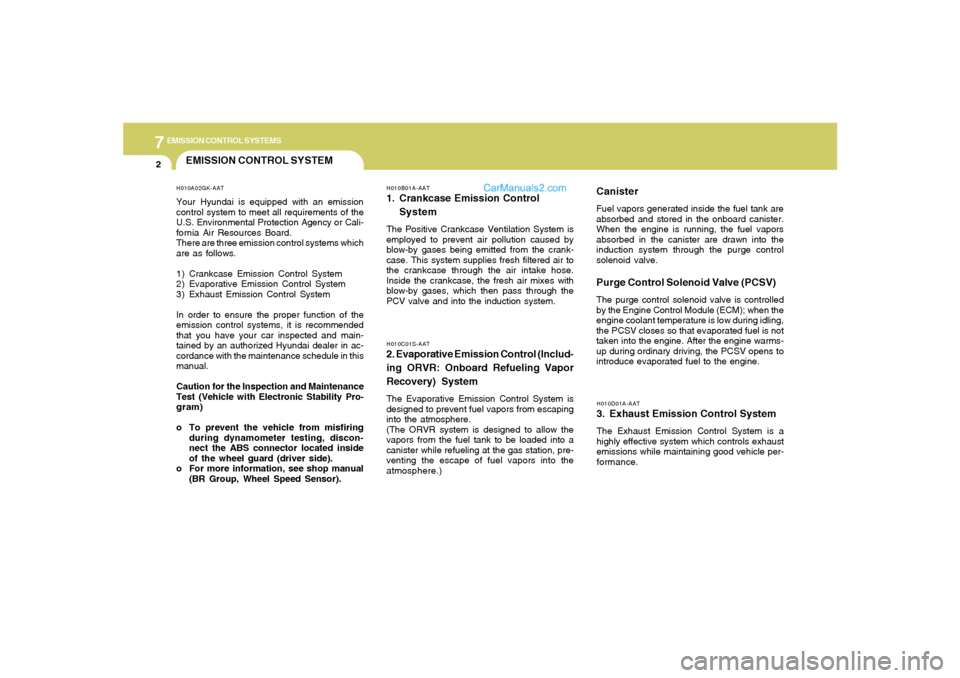
H010D01A-AAT3. Exhaust Emission Control SystemThe Exhaust Emission Control System is a
highly effective system which controls exhaust
emissions while maintaining good vehicle per-
formance.
H010B01A-AAT1. Crankcase Emission Control
SystemThe Positive Crankcase Ventilation System is
employed to prevent air pollution caused by
blow-by gases being emitted from the crank-
case. This system supplies fresh filtered air to
the crankcase through the air intake hose.
Inside the crankcase, the fresh air mixes with
blow-by gases, which then pass through the
PCV valve and into the induction system.
H010A02GK-AATYour Hyundai is equipped with an emission
control system to meet all requirements of the
U.S. Environmental Protection Agency or Cali-
fornia Air Resources Board.
There are three emission control systems which
are as follows.
1) Crankcase Emission Control System
2) Evaporative Emission Control System
3) Exhaust Emission Control System
In order to ensure the proper function of the
emission control systems, it is recommended
that you have your car inspected and main-
tained by an authorized Hyundai dealer in ac-
cordance with the maintenance schedule in this
manual.
Caution for the Inspection and Maintenance
Test (Vehicle with Electronic Stability Pro-
gram)
o To prevent the vehicle from misfiring
during dynamometer testing, discon-
nect the ABS connector located inside
of the wheel guard (driver side).
o For more information, see shop manual
(BR Group, Wheel Speed Sensor).
CanisterFuel vapors generated inside the fuel tank are
absorbed and stored in the onboard canister.
When the engine is running, the fuel vapors
absorbed in the canister are drawn into the
induction system through the purge control
solenoid valve.Purge Control Solenoid Valve (PCSV)The purge control solenoid valve is controlled
by the Engine Control Module (ECM); when the
engine coolant temperature is low during idling,
the PCSV closes so that evaporated fuel is not
taken into the engine. After the engine warms-
up during ordinary driving, the PCSV opens to
introduce evaporated fuel to the engine.
H010C01S-AAT2. Evaporative Emission Control (Includ-
ing ORVR: Onboard Refueling Vapor
Recovery) SystemThe Evaporative Emission Control System is
designed to prevent fuel vapors from escaping
into the atmosphere.
(The ORVR system is designed to allow the
vapors from the fuel tank to be loaded into a
canister while refueling at the gas station, pre-
venting the escape of fuel vapors into the
atmosphere.)
Page 258 of 266
9
VEHICLE SPECIFICATIONS4
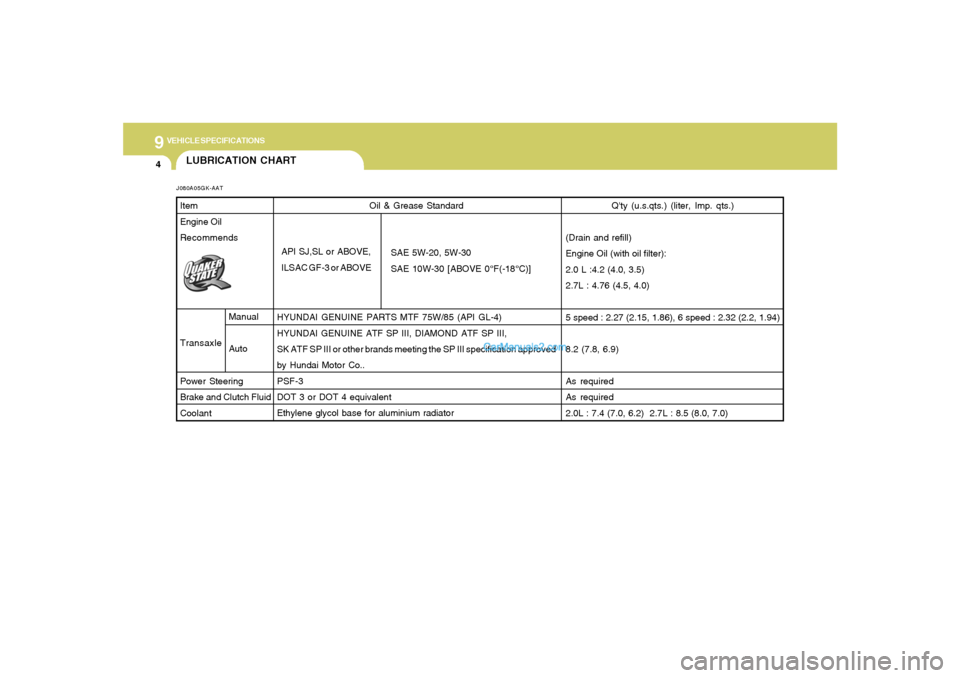
Oil & Grease Standard
HYUNDAI GENUINE PARTS MTF 75W/85 (API GL-4)
HYUNDAI GENUINE ATF SP III, DIAMOND ATF SP III,
SK ATF SP III or other brands meeting the SP III specification approved
by Hundai Motor Co..
PSF-3
DOT 3 or DOT 4 equivalent
Ethylene glycol base for aluminium radiator
LUBRICATION CHARTJ080A05GK-AAT
API SJ,SL or ABOVE,
ILSAC GF-3 or ABOVESAE 5W-20, 5W-30
SAE 10W-30 [ABOVE 0°F(-18°C)]
Item
Engine Oil
Recommends
Transaxle
Power Steering
Brake and Clutch Fluid
Coolant
Manual
Auto
Q'ty (u.s.qts.) (liter, Imp. qts.)
(Drain and refill)
Engine Oil (with oil filter):
2.0 L :4.2 (4.0, 3.5)
2.7L : 4.76 (4.5, 4.0)
5 speed : 2.27 (2.15, 1.86), 6 speed : 2.32 (2.2, 1.94)
8.2 (7.8, 6.9)
As required
As required
2.0L : 7.4 (7.0, 6.2) 2.7L : 8.5 (8.0, 7.0)
Page 261 of 266
10
INDEX
3
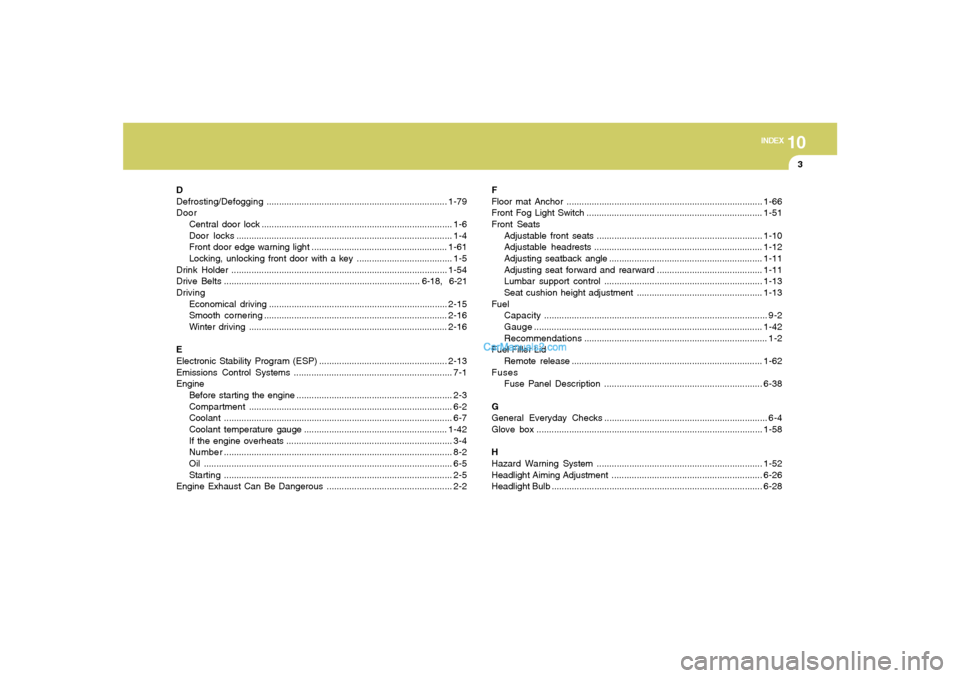
D
Defrosting/Defogging........................................................................1-79
Door
Central door lock............................................................................ 1-6
Door locks...................................................................................... 1-4
Front door edge warning light ......................................................1-61
Locking, unlocking front door with a key ...................................... 1-5
Drink Holder ......................................................................................1-54
Drive Belts.............................................................................. 6-18, 6-21
Driving
Economical driving .......................................................................2-15
Smooth cornering.........................................................................2-16
Winter driving...............................................................................2-16
E
Electronic Stability Program (ESP) ...................................................2-13
Emissions Control Systems ............................................................... 7-1
Engine
Before starting the engine .............................................................. 2-3
Compartment................................................................................. 6-2
Coolant........................................................................................... 6-7
Coolant temperature gauge .........................................................1-42
If the engine overheats .................................................................. 3-4
Number........................................................................................... 8-2
Oil ................................................................................................... 6-5
Starting........................................................................................... 2-5
Engine Exhaust Can Be Dangerous .................................................. 2-2F
Floor mat Anchor ..............................................................................1-66
Front Fog Light Switch ......................................................................1-51
Front Seats
Adjustable front seats ..................................................................1-10
Adjustable headrests...................................................................1-12
Adjusting seatback angle .............................................................1-11
Adjusting seat forward and rearward ..........................................1-11
Lumbar support control ...............................................................1-13
Seat cushion height adjustment ..................................................1-13
Fuel
Capacity......................................................................................... 9-2
Gauge...........................................................................................1-42
Recommendations......................................................................... 1-2
Fuel Filler Lid
Remote release............................................................................1-62
Fuses
Fuse Panel Description ...............................................................6-38
G
General Everyday Checks................................................................. 6-4
Glove box ..........................................................................................1-58
H
Hazard Warning System ..................................................................1-52
Headlight Aiming Adjustment ............................................................6-26
Headlight Bulb....................................................................................6-28