engine control system INFINITI FX35 2008 Owner's Guide
[x] Cancel search | Manufacturer: INFINITI, Model Year: 2008, Model line: FX35, Model: INFINITI FX35 2008Pages: 3924, PDF Size: 81.37 MB
Page 254 of 3924
TROUBLE DIAGNOSIS FOR SYMPTOMSAT-181
< SERVICE INFORMATION >
DE
F
G H
I
J
K L
M A
B
AT
N
O P
Perform self-diagnosis. Refer to AT-91, "Diagnosis Procedure without CONSULT-III"
Is any malfunction detected by self-diagnostic results?
YES >> Check the malfunctioning system. Refer to AT-84, "CONSULT-III Function (TRANSMISSION)",
AT-91, "
Diagnosis Procedure without CONSULT-III".
NO >> GO TO 3.
3.CHECK ACCELERATOR POSITION SENSOR
Check accelerator pedal position sensor. Refer to AT-130
OK or NG
OK >> GO TO 4.
NG >> Repair or replace accelerator pedal position sensor.
4.CHECK A/T FLUID LEVEL
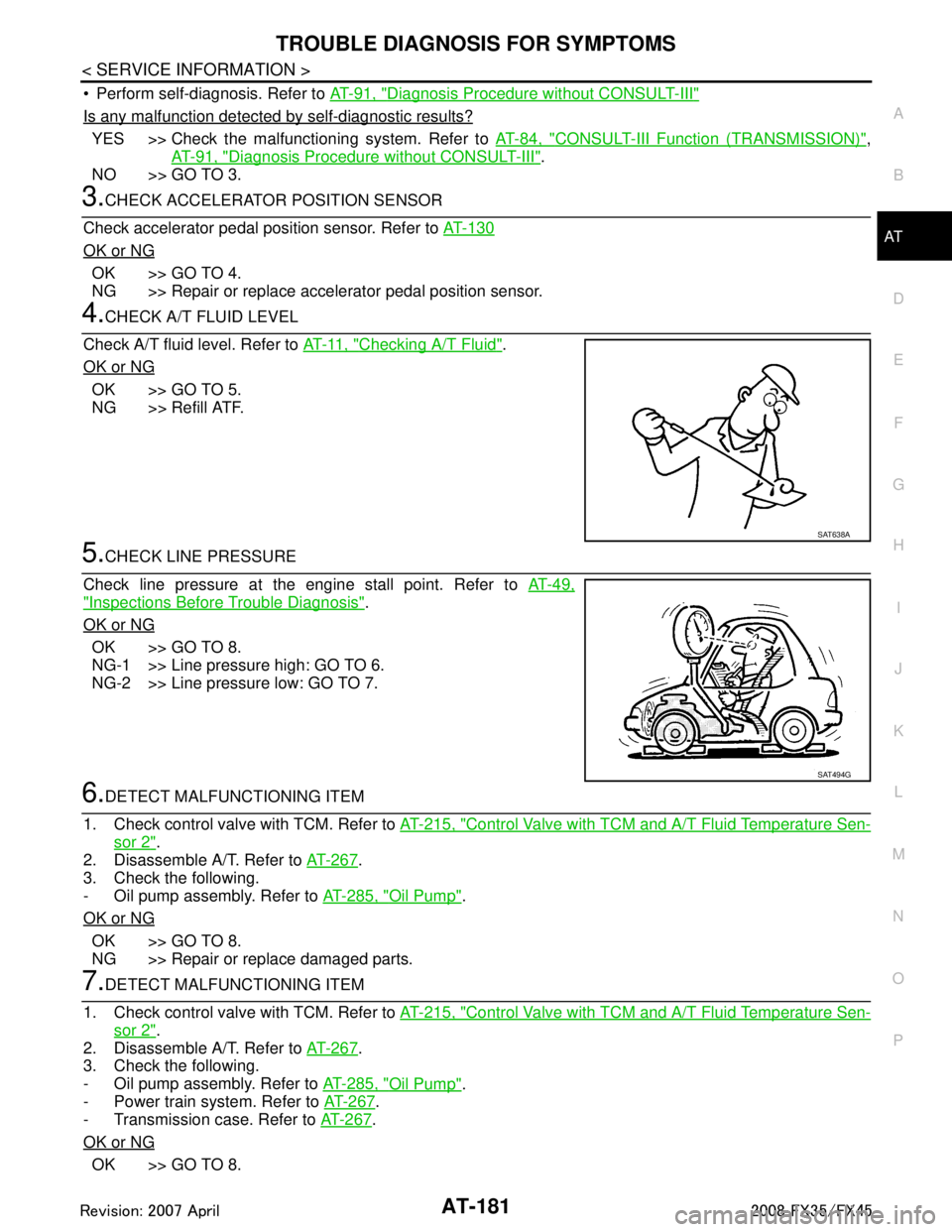
Check A/T fluid level. Refer to AT- 11 , "
Checking A/T Fluid".
OK or NG
OK >> GO TO 5.
NG >> Refill ATF.
5.CHECK LINE PRESSURE
Check line pressure at the engine stall point. Refer to AT-49,
"Inspections Before Trouble Diagnosis".
OK or NG
OK >> GO TO 8.
NG-1 >> Line pressure high: GO TO 6.
NG-2 >> Line pressure low: GO TO 7.
6.DETECT MALFUNCTIONING ITEM
1. Check control valve with TCM. Refer to AT-215, "
Control Valve with TCM and A/T Fluid Temperature Sen-
sor 2".
2. Disassemble A/T. Refer to AT-267
.
3. Check the following.
- Oil pump assembly. Refer to AT-285, "
Oil Pump".
OK or NG
OK >> GO TO 8.
NG >> Repair or replace damaged parts.
7.DETECT MALFUNCTIONING ITEM
1. Check control valve with TCM. Refer to AT-215, "
Control Valve with TCM and A/T Fluid Temperature Sen-
sor 2".
2. Disassemble A/T. Refer to AT-267
.
3. Check the following.
- Oil pump assembly. Refer to AT-285, "
Oil Pump".
- Power train system. Refer to AT-267
.
- Transmission case. Refer to AT-267
.
OK or NG
OK >> GO TO 8.
SAT638A
SAT494G
3AA93ABC3ACD3AC03ACA3AC03AC63AC53A913A773A893A873A873A8E3A773A983AC73AC93AC03AC3
3A893A873A873A8F3A773A9D3AAF3A8A3A8C3A863A9D3AAF3A8B3A8C
Page 256 of 3924

TROUBLE DIAGNOSIS FOR SYMPTOMSAT-183
< SERVICE INFORMATION >
DE
F
G H
I
J
K L
M A
B
AT
N
O P
With CONSULT-III
Perform self-diagnosis.
Without CONSULT-III
Perform self-diagnosis. Refer to AT-91, "
Diagnosis Procedure without CONSULT-III".
Is any malfunction detected by self-diagnostic results?
YES >> Check the malfuncti oning system. Refer to AT-84, "CONSULT-III Function (TRANSMISSION)",
AT-91, "
Diagnosis Procedure without CONSULT-III".
NO >> GO TO 3.
3.CHECK A/T FLUID LEVEL
Check A/T fluid level. Refer to AT- 11 , "
Checking A/T Fluid".
OK or NG
OK >> GO TO 4.
NG >> Refill ATF.
4.CHECK LINE PRESSURE
Check line pressure at the engine stall point. Refer to AT-49,
"Inspections Before Trouble Diagnosis".
OK or NG
OK >> GO TO 7.
NG-1 >> Line pressure high: GO TO 5.
NG-2 >> Line pressure low: GO TO 6.
5.DETECT MALFUNCTIONING ITEM
1. Check control valve with TCM. Refer to AT-215, "
Control Valve with TCM and A/T Fluid Temperature Sen-
sor 2".
2. Disassemble A/T. Refer to AT-267
.
3. Check the following.
- Oil pump assembly. Refer to AT-285, "
Oil Pump".
OK or NG
OK >> GO TO 7.
NG >> Repair or replace damaged parts.
6.DETECT MALFUNCTIONING ITEM
1. Check control valve with TCM. Refer to AT-215, "
Control Valve with TCM and A/T Fluid Temperature Sen-
sor 2".
2. Disassemble A/T. Refer to AT-267
.
3. Check the following.
- Oil pump assembly. Refer to AT-285, "
Oil Pump".
- Power train system. Refer to AT-267
.
- Transmission case. Refer to AT-267
.
OK or NG
OK >> GO TO 7.
NG >> Repair or replace damaged parts.
SAT638A
SAT494G
3AA93ABC3ACD3AC03ACA3AC03AC63AC53A913A773A893A873A873A8E3A773A983AC73AC93AC03AC3
3A893A873A873A8F3A773A9D3AAF3A8A3A8C3A863A9D3AAF3A8B3A8C
Page 258 of 3924

TROUBLE DIAGNOSIS FOR SYMPTOMSAT-185
< SERVICE INFORMATION >
DE
F
G H
I
J
K L
M A
B
AT
N
O P
With CONSULT-III
Perform self-diagnosis.
Without CONSULT-III
Perform self-diagnosis. Refer to AT-91, "
Diagnosis Procedure without CONSULT-III".
Is any malfunction detected by self-diagnostic results?
YES >> Check the malfuncti oning system. Refer to AT-84, "CONSULT-III Function (TRANSMISSION)",
AT-91, "
Diagnosis Procedure without CONSULT-III".
NO >> GO TO 3.
3.CHECK A/T FLUID LEVEL
Check A/T fluid level. Refer to AT- 11 , "
Checking A/T Fluid".
OK or NG
OK >> GO TO 4.
NG >> Refill ATF.
4.CHECK LINE PRESSURE
Check line pressure at the engine stall point. Refer to AT-49,
"Inspections Before Trouble Diagnosis".
OK or NG
OK >> GO TO 7.
NG-1 >> Line pressure high: GO TO 5.
NG-2 >> Line pressure low: GO TO 6.
5.DETECT MALFUNCTIONING ITEM
1. Check control valve with TCM. Refer to AT-215, "
Control Valve with TCM and A/T Fluid Temperature Sen-
sor 2".
2. Disassemble A/T. Refer to AT-267
.
3. Check the following.
- Oil pump assembly. Refer to AT-285, "
Oil Pump".
OK or NG
OK >> GO TO 7.
NG >> Repair or replace damaged parts.
6.DETECT MALFUNCTIONING ITEM
1. Check control valve with TCM. Refer to AT-215, "
Control Valve with TCM and A/T Fluid Temperature Sen-
sor 2".
2. Disassemble A/T. Refer to AT-267
.
3. Check the following.
- Oil pump assembly. Refer to AT-285, "
Oil Pump".
- Power train system. Refer to AT-267
.
- Transmission case. Refer to AT-267
.
OK or NG
OK >> GO TO 7.
NG >> Repair or replace damaged parts.
SAT638A
SAT494G
3AA93ABC3ACD3AC03ACA3AC03AC63AC53A913A773A893A873A873A8E3A773A983AC73AC93AC03AC3
3A893A873A873A8F3A773A9D3AAF3A8A3A8C3A863A9D3AAF3A8B3A8C
Page 260 of 3924

TROUBLE DIAGNOSIS FOR SYMPTOMSAT-187
< SERVICE INFORMATION >
DE
F
G H
I
J
K L
M A
B
AT
N
O P
With CONSULT-III
Perform self-diagnosis.
Without CONSULT-III
Perform self-diagnosis. Refer to AT-91, "
Diagnosis Procedure without CONSULT-III".
Is any malfunction detected by self-diagnostic results?
YES >> Check the malfuncti oning system. Refer to AT-84, "CONSULT-III Function (TRANSMISSION)",
AT-91, "
Diagnosis Procedure without CONSULT-III".
NO >> GO TO 3.
3.CHECK A/T FLUID LEVEL
Check A/T fluid level. Refer to AT- 11 , "
Checking A/T Fluid".
OK or NG
OK >> GO TO 4.
NG >> Refill ATF.
4.CHECK LINE PRESSURE
Check line pressure at the engine stall point. Refer to AT-49,
"Inspections Before Trouble Diagnosis".
OK or NG
OK >> GO TO 7.
NG-1 >> Line pressure high: GO TO 5.
NG-2 >> Line pressure low: GO TO 6.
5.DETECT MALFUNCTIONING ITEM
1. Check control valve with TCM. Refer to AT-215, "
Control Valve with TCM and A/T Fluid Temperature Sen-
sor 2".
2. Disassemble A/T. Refer to AT-267
.
3. Check the following.
- Oil pump assembly. Refer to AT-285, "
Oil Pump".
OK or NG
OK >> GO TO 7.
NG >> Repair or replace damaged parts.
6.DETECT MALFUNCTIONING ITEM
1. Check control valve with TCM. Refer to AT-215, "
Control Valve with TCM and A/T Fluid Temperature Sen-
sor 2".
2. Disassemble A/T. Refer to AT-267
.
3. Check the following.
- Oil pump assembly. Refer to AT-285, "
Oil Pump".
- Power train system. Refer to AT-267
.
- Transmission case. Refer to AT-267
.
OK or NG
OK >> GO TO 7.
NG >> Repair or replace damaged parts.
SAT638A
SAT494G
3AA93ABC3ACD3AC03ACA3AC03AC63AC53A913A773A893A873A873A8E3A773A983AC73AC93AC03AC3
3A893A873A873A8F3A773A9D3AAF3A8A3A8C3A863A9D3AAF3A8B3A8C
Page 262 of 3924

TROUBLE DIAGNOSIS FOR SYMPTOMSAT-189
< SERVICE INFORMATION >
DE
F
G H
I
J
K L
M A
B
AT
N
O P
With CONSULT-III
Perform self-diagnosis.
Without CONSULT-III
Perform self-diagnosis. Refer to AT-91, "
Diagnosis Procedure without CONSULT-III".
Is any malfunction detected by self-diagnostic results?
YES >> Check the malfuncti oning system. Refer to AT-84, "CONSULT-III Function (TRANSMISSION)",
AT-91, "
Diagnosis Procedure without CONSULT-III".
NO >> GO TO 3.
3.CHECK A/T FLUID LEVEL
Check A/T fluid level. Refer to AT- 11 , "
Checking A/T Fluid".
OK or NG
OK >> GO TO 4.
NG >> Refill ATF.
4.CHECK LINE PRESSURE
Check line pressure at the engine stall point. Refer to AT-49,
"Inspections Before Trouble Diagnosis".
OK or NG
OK >> GO TO 7.
NG-1 >> Line pressure high: GO TO 5.
NG-2 >> Line pressure low: GO TO 6.
5.DETECT MALFUNCTIONING ITEM
1. Check control valve with TCM. Refer to AT-215, "
Control Valve with TCM and A/T Fluid Temperature Sen-
sor 2".
2. Disassemble A/T. Refer to AT-267
.
3. Check the following.
- Oil pump assembly. Refer to AT-285, "
Oil Pump".
OK or NG
OK >> GO TO 7.
NG >> Repair or replace damaged parts.
6.DETECT MALFUNCTIONING ITEM
1. Check control valve with TCM. Refer to AT-215, "
Control Valve with TCM and A/T Fluid Temperature Sen-
sor 2".
2. Disassemble A/T. Refer to AT-267
.
3. Check the following.
- Oil pump assembly. Refer to AT-285, "
Oil Pump".
- Power train system. Refer to AT-267
.
- Transmission case. Refer to AT-267
.
OK or NG
OK >> GO TO 7.
NG >> Repair or replace damaged parts.
SAT638A
SAT494G
3AA93ABC3ACD3AC03ACA3AC03AC63AC53A913A773A893A873A873A8E3A773A983AC73AC93AC03AC3
3A893A873A873A8F3A773A9D3AAF3A8A3A8C3A863A9D3AAF3A8B3A8C
Page 264 of 3924

TROUBLE DIAGNOSIS FOR SYMPTOMSAT-191
< SERVICE INFORMATION >
DE
F
G H
I
J
K L
M A
B
AT
N
O P
YES >> Check the malfuncti oning system. Refer to AT-84, "CONSULT-III Function (TRANSMISSION)",
AT-91, "
Diagnosis Procedure without CONSULT-III".
NO >> GO TO 2.
2.CHECK A/T FLUID LEVEL
Check A/T fluid level. Refer to AT- 11 , "
Checking A/T Fluid".
OK or NG
OK >> GO TO 3.
NG >> Refill ATF.
3.CHECK LINE PRESSURE
Check line pressure at the engine stall point. Refer to AT-49,
"Inspections Before Trouble Diagnosis".
OK or NG
OK >> GO TO 6.
NG-1 >> Line pressure high: GO TO 4.
NG-2 >> Line pressure low: GO TO 5.
4.DETECT MALFUNCTIONING ITEM
1. Check control valve with TCM. Refer to AT-215, "
Control Valve with TCM and A/T Fluid Temperature Sen-
sor 2".
2. Disassemble A/T. Refer to AT-267
.
3. Check the following.
- Oil pump assembly. Refer to AT-285, "
Oil Pump".
OK or NG
OK >> GO TO 6.
NG >> Repair or replace damaged parts.
5.DETECT MALFUNCTIONING ITEM
1. Check control valve with TCM. Refer to AT-215, "
Control Valve with TCM and A/T Fluid Temperature Sen-
sor 2".
2. Disassemble A/T. Refer to AT-267
.
3. Check the following.
- Oil pump assembly. Refer to AT-285, "
Oil Pump".
- Power train system. Refer to AT-267
.
- Transmission case. Refer to AT-267
.
OK or NG
OK >> GO TO 6.
NG >> Repair or replace damaged parts.
6.CHECK A/T FLUID CONDITION
1. Remove oil pan. Refer to AT-215, "
Control Valve with TCM and A/T Fluid Temperature Sensor 2".
SAT638A
SAT494G
3AA93ABC3ACD3AC03ACA3AC03AC63AC53A913A773A893A873A873A8E3A773A983AC73AC93AC03AC3
3A893A873A873A8F3A773A9D3AAF3A8A3A8C3A863A9D3AAF3A8B3A8C
Page 280 of 3924

SHIFT CONTROL SYSTEMAT-207
< SERVICE INFORMATION >
DE
F
G H
I
J
K L
M A
B
AT
N
O P
1. Disconnect lower lever of control device and control rod.
2. Remove manual lever from A/T assembly.
3. Remove control rod from vehicle.
INSTALLATION
Install in reverse order of removal. Be careful of the following:
After installation is completed, adjust and check A/T position. Refer to AT-207, "
Adjustment of A/T Position"
and AT-207, "Checking of A/T Position".
Adjustment of A/T PositionINFOID:0000000001327385
1. Loosen nut of control rod.
2. Place PNP switch and selector lever in “P” position.
3. While pressing lower lever toward rear of vehicle (in “P” position
direction), tighten nut to the specified torque. Refer to AT-206,
"Control Rod Removal and Installation".
CAUTION:
Do not push the bracket.
Checking of A/T PositionINFOID:0000000001327386
1. Place selector lever in “P” posit ion, and turn ignition switch ON.
2. Check selector lever can be shifted to other than “P” position when brake pedal is depressed. Also check
selector lever can be shifted from “P” position only when brake pedal is depressed.
3. Move the selector lever and check for excessive effort, sticking, noise or rattle.
4. Check the selector lever stops at each position wit h the feel of engagement when it is moved through all
the positions. Check whether or not t he actual position the selector lever is in matches the position shown
by the shift position indicator and the transmission body.
5. The method of operating the lever to individual positions cor- rectly should be as shown in the figure.
6. When selector button is pressed in “P”, “R”, or “N” position with-
out applying forward/backward force to selector lever, check but-
ton operation for sticking.
7. Check the back-up lamps illuminate only when lever is placed in the “R” position. Check the back-up lamps does not illuminate
when selector lever is pushed against “R” position in the “P” or
“N” position.
8. Check the engine can only be started with the selector lever in the “P” and “N” positions. (With selector lever in the “P” position,
engine can be started even when selector lever is moved for-
ward and backward.)
9. Check transmission is locked completely in “P” position.
10. When selector lever is set to manual shift gate, check manual mode is displayed on combination meter. Shift selector lever to “+” and “-” sides, and check set shift position changes. (Only while a vehicle is oper-
ating.)
SCIA5736E
SCIA2119E
SCIA7465E
3AA93ABC3ACD3AC03ACA3AC03AC63AC53A913A773A893A873A873A8E3A773A983AC73AC93AC03AC3
3A893A873A873A8F3A773A9D3AAF3A8A3A8C3A863A9D3AAF3A8B3A8C
Page 416 of 3924

PRECAUTIONSATC-11
< SERVICE INFORMATION >
C
DE
F
G H
I
K L
M A
B
AT C
N
O P
Never attempt to connect HFC-134a (R-134a) service couplers to a
CFC-12 (R-12) A/C system. T he HFC-134a (R-134a) couplers will
not properly connect to the CFC-12 (R-12) system. However, if an
improper connection is attempted, discharging and contamination
may occur.
REFRIGERANT WEIGHT SCALE
Verify that no refrigerant other than HFC-134a (R-134a) and speci-
fied lubricants have been used with the scale. If the scale controls
refrigerant flow electronically, the hose fitting must be 1/2
″-16 ACME.
CHARGING CYLINDER
Using a charging cylinder is not recommended. Refrigerant may be vented into air from cylinder’s top valve
when filling the cylinder with refrigerant. Also, the accura cy of the cylinder is generally less than that of an
electrical scale or of quality recycle/recharge equipment.
Precaution for Leak Detection DyeINFOID:0000000001328158
The A/C system contains a fluorescent leak detection dy e used for locating refrigerant leaks. An ultraviolet
(UV) lamp is required to illuminate the dye when inspecting for leaks.
Always wear fluorescence enhancing UV safety goggles to protect your eyes and enhance the visibility of
the fluorescent dye.
The fluorescent dye leak detector is not a replacement for an electrical leak detector (SST: J-41995). The flu-
orescent dye leak detector should be used in conjunc tion with an electrical leak detector (SST: J-41995) to
pin-point refrigerant leaks.
For the purpose of safety and customer’s satisfacti on, read and follow all manufacture’s operating instruc-
tions and precautions prior to performing the work.
A compressor shaft seal should not necessarily be re paired because of dye seepage. The compressor shaft
seal should only be repaired after confirming the l eak with an electrical leak detector (SST: J-41995).
Always remove any remaining dye from the leak area after repairs are completed to avoid a misdiagnosis during a future service.
Never allow dye to come into contact with painted body panels or interior components. If dye is spilled, clean
immediately with the approved dye cleaner. Fluorescent dye left on a surface for an extended period of time
cannot be removed.
Never spray the fluorescent dye cleaning agent on hot surfaces (engine exhaust manifold, etc.).
Never use more than one refrigerant dye bot tle (1/4 ounce /7.4 cc) per A/C system.
Leak detection dyes for HFC-134a (R-134a) and CFC-12 (R-12) A/C systems are different. Never use HFC-
134a (R-134a) leak detection dye in CFC-12 (R-12) A/ C system, or CFC-12 (R-12) leak detection dye in
HFC-134a (R-134a) A/C system, or A/C system damage may result.
The fluorescent properties of the dye will remain for thr ee years or a little over unless a compressor malfunc-
tion occurs.
IDENTIFICATION
NOTE:
Vehicles with factory installed fluorescent dye have a green label.
Vehicles without factory installed fluorescent dye have a blue label.
IDENTIFICATION LABEL FOR VEHICLE
Shut-off valve rotati on A/C service valve
Clockwise Open
Counterclockwise Close
RHA273D
RHA274D
3AA93ABC3ACD3AC03ACA3AC03AC63AC53A913A773A893A873A873A8E3A773A983AC73AC93AC03AC3
3A893A873A873A8F3A773A9D3AAF3A8A3A8C3A863A9D3AAF3A8B3A8C
Page 423 of 3924

ATC-18
< SERVICE INFORMATION >
REFRIGERATION SYSTEM
Evaporator intake air temperature is less than 20°C (68 °F).
Engine is running at speeds less than 1,500 rpm.
This is because the V-6 compressor prov ides a means of “capacity” control.
2. The V-6 variable compressor provides refrigerant c ontrol under varying conditions. During cold winters, it
may not produce high refrigerant pressure discharge (compared to previous units) when used with air
conditioning systems.
3. A “clanking” sound may occasionally be heard during re frigerant charge. The sound indicates that the tilt
angle of the wobble (swash) plate has changed and is not a malfunction.
4. For air conditioning systems with the V-6 compresso r, the clutch remains engaged unless: the system
main switch, fan switch or ignition switch is tur ned OFF. When ambient (outside) temperatures are low or
when the amount of refrigerant is insufficient, t he clutch is disengaged to protect the compressor.
DESCRIPTION
General
The variable compressor is a swash plate type that c hanges piston stroke in response to the required cooling
capacity.
The tilt of the wobble (swash) plate allows the piston’ s stroke to change so that refrigerant discharge continu-
ously change from 14.5 to 184 cm
3 (0.885 to 11.228 cu in).
RJIA1260E
3AA93ABC3ACD3AC03ACA3AC03AC63AC53A913A773A893A873A873A8E3A773A983AC73AC93AC03AC3
3A893A873A873A8F3A773A9D3AAF3A8A3A8C3A863A9D3AAF3A8B3A8C
Page 427 of 3924

ATC-22
< SERVICE INFORMATION >
LUBRICANT
LUBRICANT
Maintenance of Lubricant Quantity in CompressorINFOID:0000000001328166
The lubricant in the compressor circulates through the system with the refrigerant. Add lubricant to compres-
sor when replacing any component or after a large refriger ant leakage occurred. It is important to maintain the
specified amount.
If lubricant quantity is not maintained properly, the following malfunctions may result:
Lack of lubricant: May lead to a seized compressor.
Excessive lubricant: Inadequate cooling (thermal exchange interference)
LUBRICANT
LUBRICANT RETURN OPERATION
Adjust the lubricant quantity according to the test group shown below.
1.CHECK LUBRICANT RETURN OPERATION
Can lubricant return operation be performed?
A/C system works properly.
There is no evidence of a lar ge amount of lubricant leakage.
CAUTION:
If excessive lubricant leakage is noted, never perform the lubricant return operation.
OK or NG
OK >> GO TO 2.
NG >> GO TO 3.
2.PERFORM LUBRICANT RETURN OPERATION, PROCEEDING AS FOLLOWS
1. Start the engine, and set to the following conditions:
- Engine speed: Idling to 1,200 rpm
- A/C switch: ON
- Blower speed: Max. position
- Temp. control: Optional [Set so that intake air temperature is 25 to 30 °C (77 to 86 °F).]
- Intake position: Recirculation (REC)
2. Perform lubricant return operation for about 10 minutes.
3. Stop the engine.
>> GO TO 3.
3.CHECK REPLACEMENT PART
Should the compressor be replaced?
YES >> Go to "LUBRICANT ADJUSTING PROCEDURE FOR COMPRESSOR REPLACEMENT".
NO >> Go to "LUBRICANT ADJUSTING PROCEDURE FOR COMPONENTS REPLACEMENT EXCEPT COMPRESSOR".
LUBRICANT ADJUSTING PROCEDURE FOR COMPONENTS REPLACEMENT EXCEPT COM-
PRESSOR
After replacing any of the followi ng major components, add the correct am ount of lubricant to the system.
Amount of lubricant to be added: Name : NISSAN A/C System Oil Type S
Part replaced
Lubricant to be added to system
Remarks
Amount of lubricant
m (US fl oz., Imp fl oz.)
Evaporator 75 (2.5, 2.6) —
Condenser 35 (1.2, 1.2) —
Liquid tank 10 (0.3, 0.4) —
3AA93ABC3ACD3AC03ACA3AC03AC63AC53A913A773A893A873A873A8E3A773A983AC73AC93AC03AC3
3A893A873A873A8F3A773A9D3AAF3A8A3A8C3A863A9D3AAF3A8B3A8C