check engine light INFINITI G35 2006 Owner's Manual
[x] Cancel search | Manufacturer: INFINITI, Model Year: 2006, Model line: G35, Model: INFINITI G35 2006Pages: 344, PDF Size: 6.81 MB
Page 259 of 344
8 Maintenance and do-it-yourself Maintenance requirements ............................... 8-2
General maintenance........................................ 8-2
Explanation of general maintenance
items .......................................................... 8-3
Maintenance precautions .................................. 8-5
Engine compartment check locations................ 8-7
Engine cooling system ..................................... 8-8
Checking engine coolant level..................... 8-8
Changing engine coolant............................. 8-9
Engine oil ....................................................... 8-10
Checking engine oil level........................... 8-10
Changing engine oil and filter ................... 8-11
Automatic transmission fluid........................... 8-13
Power steering fluid ........................................ 8-13
Brake and clutch fluid..................................... 8-14
Brake fluid................................................. 8-14
Clutch fluid ............................................... 8-15
Window washer fluid ....................................... 8-15
Battery ............................................................ 8-16
Jump starting ............................................. 8-18
Drive belts ...................................................... 8-19
Spark plugs .................................................... 8-19
Replacing spark plugs ............................... 8-20 Air cleaner...................................................... 8-20
Windshield wiper blades ................................. 8-21
Cleaning .................................................... 8-21
Replacing .................................................. 8-22
Parking brake and brake pedal....................... 8-23
Checking parking brake............................. 8-23
Checking brake pedal................................ 8-23
Brake booster ........................................... 8-24
Fuses .............................................................. 8-25
Engine compartment.................................. 8-25
Passenger compartment ............................ 8-27
Keyfob battery replacement ............................ 8-28
Keyfob (except Intelligent Key) .................. 8-28
Intelligent Key ........................................... 8-29
Lights.............................................................. 8-31
Headlights................................................. 8-33
Exterior and interior lights......................... 8-33
Wheels and tires ............................................ 8-37
Tire pressure ............................................. 8-37
Tire labeling .............................................. 8-41
Types of tires ............................................ 8-43
Tire chains ................................................ 8-44
Changing wheels and tires ........................ 8-45
w 06.1.4/V35-D/V5.0
X
Page 261 of 344
EXPLANATION OF GENERAL
MAINTENANCE ITEMS Additional information on the following
items with ª*º is found later in this sec-
tion.
Outside the vehicle The maintenance items listed here should
be performed from time to time, unless
otherwise specified.
Doors and engine hood: Check that all
doors and the engine hood operate prop-
erly. Also ensure that all latches lock se-
curely. Lubricate hinges and latches if
necessary. Make sure that the secondary
latch keeps the hood from opening when
the primary latch is released.
When driving in areas using road salt or
other corrosive materials, check lubrica-
tion frequently.
Lights*: Clean the headlights on a regular
basis. Make sure that the headlights,
stop lights, tail lights, turn signal lights,
and other lights are all operating properly
and installed securely. Also check head-
light aim.
Road wheel nuts (lug nuts): When
checking the tires, make sure no wheel nuts are missing, and check for any loose
wheel nuts. Tighten if necessary.
Tires*: Check the pressure with a gauge
often and always prior to long distance
trips. If necessary, adjust the pressure in
all tires, including the spare, to the speci-
fied pressure. Check carefully for damage,
cuts or excessive wear.
Tire rotation*:
Sedan: The tires should be rotated every
7,500 miles (12,000 km) to minimize tire
wear variation.
Coupe: The tires cannot be rotated.
Tire, wheel alignment and balance: If the
vehicle should pull to either side while
driving on a straight and level road, or if
you detect uneven or abnormal tire wear,
there may be a need for wheel alignment.
If the steering wheel or seat vibrates at
normal highway speeds, wheel balancing
may be needed.
O For additional information regarding
tires, refer to ªImportant Tire Safety
Informationº (US) or ªTire Safety Infor-
mationº (Canada) in the Warranty In-
formation Booklet. Windshield: Clean the windshield on a
regular basis. Check the windshield at
least every six months for cracks or other
damage. Have a damaged windshield re-
paired by a qualified repair facility.
Windshield wiper blades*: Check for
cracks or wear if they do not wipe prop-
erly.
Maintenance and do-it-yourself
8-3
w 06.1.4/V35-D/V5.0
X
Page 262 of 344
Inside the vehicle The maintenance items listed here should
be checked on a regular basis, such as
when performing periodic maintenance,
cleaning the vehicle, etc.
Accelerator pedal: Check the pedal for
smooth operation and make sure the
pedal does not catch or require uneven
effort. Keep the floor mat away from the
pedal.
Automatic transmission P (Park) mecha-
nism: On a fairly steep hill check that your
vehicle is held securely with the selector
lever in the P (Park) position without ap-
plying any brakes.
Brake pedal*: Check the pedal for smooth
operation and make sure it has the proper
distance under it when depressed fully.
Check the brake booster function. Be sure
to keep the floor mat away from the
pedal.
Brakes: Check that the brakes do not pull
the vehicle to one side when applied.
Parking brake*: Check that the pedal/
lever has the proper travel and confirm
that your vehicle is held securely on a
fairly steep hill with only the parking
brake applied. Seats: Check seat position controls such
as seat adjusters, seatback recliner, etc.
to ensure they operate smoothly and that
all latches lock securely in every position.
Check that the head restraints move up
and down smoothly and that the locks (if
so equipped) hold securely in all latched
positions.
Seat belts: Check that all parts of the seat
belt system (For example, buckles, an-
chors, adjusters and retractors) operate
properly and smoothly, and are installed
securely. Check the belt webbing for cuts,
fraying, wear or damage.
Steering wheel: Check for changes in the
steering conditions, such as excessive
free play, hard steering or strange noises.
Warning lights and chimes: Make sure
that all warning lights and chimes are op-
erating properly.
Windshield defroster: Check that the air
comes out of the defroster outlets prop-
erly and in sufficient quantity when oper-
ating the heater or air conditioner.
Windshield wiper and washer*: Check that
the wipers and washer operate properly
and that the wipers do not streak. Under the hood and the vehicle The maintenance items listed here should
be checked periodically (For example,
each time you check the engine oil or re-
fuel).
Battery*: Check the fluid level in each
cell. It should be between the MAX and
MIN lines. Vehicles operated in high tem-
peratures or under severe conditions re-
quire frequent checks of the battery fluid
level.
Brake and clutch fluid level*: Make sure
that the brake and clutch fluid levels are
between the MAX and MIN lines on the
reservoir.
Engine coolant level*: Check the coolant
level when the engine is cold.
Engine drive belts*: Make sure that no
belt is frayed, worn, cracked or oily.
Engine oil level*: Check the level after
parking the vehicle on a level location
and turning off the engine. (Wait at least
10 minutes for the oil to drain back into
the oil pan.)
Exhaust system: Make sure there are no
loose supports, cracks or holes. If the
sound of the exhaust seems unusual or
8-4 Maintenance and do-it-yourself
w 06.1.4/V35-D/V5.0
X
Page 270 of 344
O Waste oil must be disposed of prop-
erly.
O Check your local regulations.
4. Loosen the oil filter with an oil filter
wrench
q B
. Remove the oil filter by
turning it by hand.
5. Wipe the engine oil filter mounting
surface with a clean rag.
Be sure to remove any old rubber
gasket remaining on the mounting sur-
face of the engine.
6. Coat the gasket on the new filter with
clean engine oil.
7. Screw in the oil filter clockwise until a
slight resistance is felt, then tighten
additionally more than 2/3 turn.
Oil filter tightening torque:
11 to 15 ft-lb
(14.7 to 20.5 N z m)
8. Clean and re-install the drain plug
with a new washer. Securely tighten
the drain plug with a wrench.
Drain plug tightening torque:
22 to 29 ft-lb
(29 to 39 N z m)
Do not use excessive force. 9. Refill engine with recommended oil
and install the cap securely.
CAUTION The dipstick must be inserted in place to pre-
vent oil spillage from the dipstick hole while
filling the engine with oil.
See ªCapacities and recommended
fuel/lubricantsº in the ª9. Technical
and consumer informationº section for
drain and refill capacity. The drain and
refill capacity depends on the oil tem-
perature and drain time. Use these
specifications for reference only. Al-
ways use the dipstick to determine the
proper amount of oil in the engine.
CAUTION When filling oil, do not pull out the dipstick.
10. Start the engine and check for
leakage around the drain plug and
the oil filter. Correct as required. 11. Turn the engine off and wait more
than 10 minutes. Check the oil level
with the dipstick. Add engine oil if
necessary.
After the operation 1. Install the engine undercover into po-
sition as the following steps.
a. Pull the center of the small plastic
clip out.
b. Hold the engine undercover into
position.
c. Insert the clip through the under-
cover into the hole in the frame,
then push the center of the clip in
to lock the clip in place.
d. Install the other bolts that hold the
undercover in place. Be careful not
to strip the bolts or over-tighten
them.
2. Lower the vehicle carefully to the
ground.
3. Dispose of waste oil and filter prop-
erly.
8-12 Maintenance and do-it-yourself
w 06.1.4/V35-D/V5.0
X
Page 282 of 344
Self-adjusting brakes Your vehicle is equipped with self-
adjusting brakes.
The disc-type brakes self-adjust every
time the brake pedal is applied.
WARNINGSee an INFINITI dealer for a brake system
check if the brake pedal height does not re-
turn to normal.
Brake pad wear indicators The disc brake pads on your vehicle have
audible wear indicators. When a brake pad
requires replacement, it will make a high
pitched scraping or screeching sound when
the vehicle is in motion whether or not the
brake pedal is depressed. Have the brakes
checked as soon as possible if the wear in-
dicator sound is heard.
Under some driving or climate conditions,
occasional brake squeak, squeal or other
noise may be heard. Occasional brake
noise during light to moderate stops is
normal and does not affect the function or
performance of the brake system. Proper brake inspection intervals should
be followed. For additional information,
see the appropriate maintenance log
shown in the INFINITI Service and Mainte-
nance Guide.
High performance sports brake pads oc-
casionally make squeaks, squeals or
other braking noises because of their very
high friction coefficient.
These occasional brake noises are
normal, but if they continue, see an
INFINITI dealer.
BRAKE BOOSTER Check the brake booster function as fol-
lows:
1. With the engine off, press and release
the brake pedal several times. When
brake pedal movement (distance of
travel) remains the same from one
pedal application to the next, continue
on to the next step.
2. While depressing the brake pedal,
start the engine. The pedal height
should drop a little. 3. With the brake pedal depressed, stop
the engine. Keeping the pedal de-
pressed for about 30 seconds, the
pedal height should not change.
4. Run the engine for one minute without
depressing the brake pedal, then turn
it off. Depress the brake pedal several
times. The pedal travel distance will
decrease gradually with each depres-
sion as the vacuum is released from
the booster.
If the brakes do not operate properly, see
an INFINITI dealer.
8-24 Maintenance and do-it-yourself
w 06.1.4/V35-D/V5.0
X
Page 283 of 344
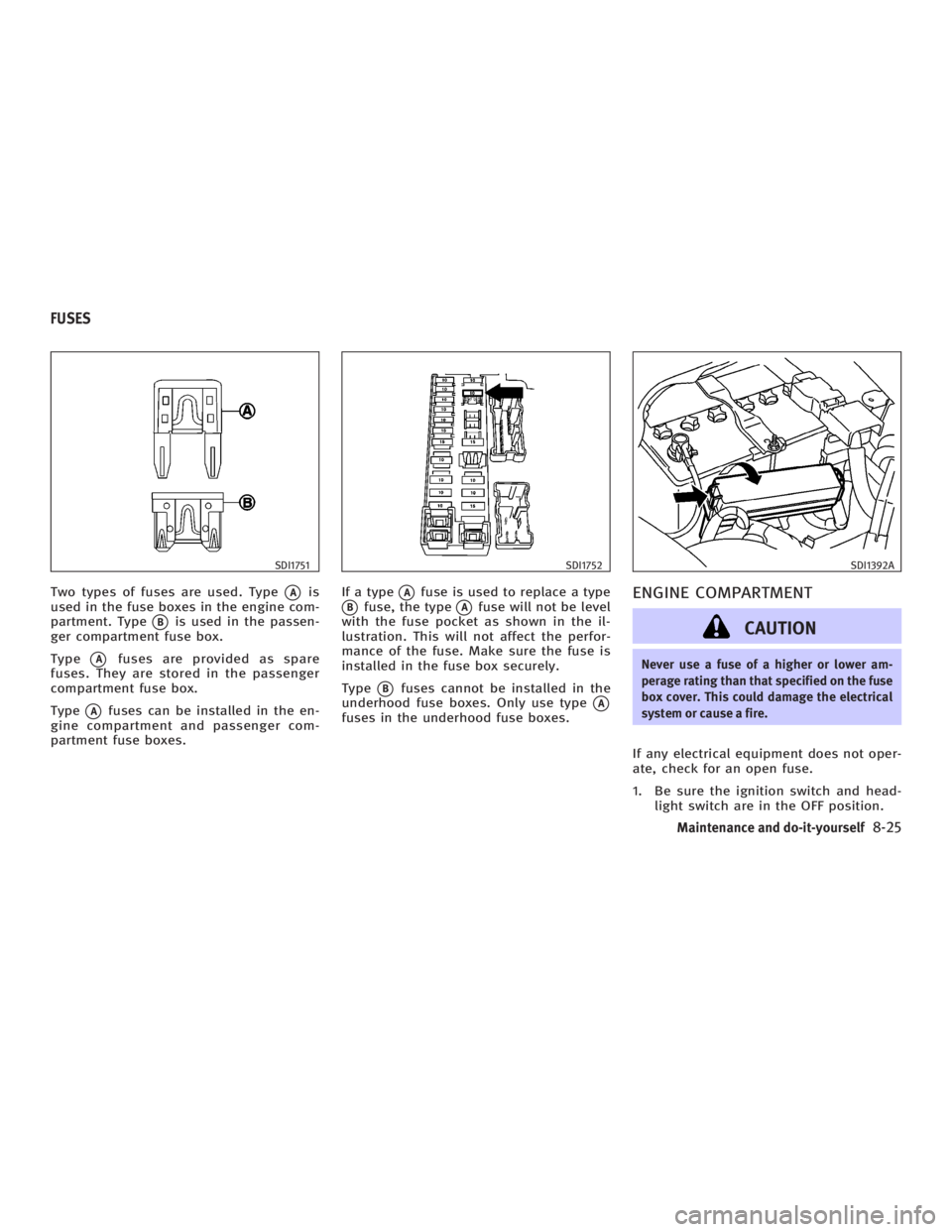
Two types of fuses are used. Type
q A
is
used in the fuse boxes in the engine com-
partment. Type
q B
is used in the passen-
ger compartment fuse box.
Type
q A
fuses are provided as spare
fuses. They are stored in the passenger
compartment fuse box.
Type
q A
fuses can be installed in the en-
gine compartment and passenger com-
partment fuse boxes. If a type
q A
fuse is used to replace a type
q B
fuse, the type
q A
fuse will not be level
with the fuse pocket as shown in the il-
lustration. This will not affect the perfor-
mance of the fuse. Make sure the fuse is
installed in the fuse box securely.
Type
q B
fuses cannot be installed in the
underhood fuse boxes. Only use type
q A
fuses in the underhood fuse boxes. ENGINE COMPARTMENT
CAUTION Never use a fuse of a higher or lower am-
perage rating than that specified on the fuse
box cover. This could damage the electrical
system or cause a fire.
If any electrical equipment does not oper-
ate, check for an open fuse.
1. Be sure the ignition switch and head-
light switch are in the OFF position.SDI1751 SDI1752 SDI1392A
FUSES
Maintenance and do-it-yourself
8-25
w 06.1.4/V35-D/V5.0
X
Page 310 of 344

performance problems and/or fuel system
damage.
O The fuel must be unleaded and have an
octane rating no lower than that recom-
mended for unleaded gasoline.
O If an oxygenate-blend, excepting a
methanol blend, is used, it should con-
tain no more than 10% oxygenate.
(MTBE may, however, be added up to
15%.)
O If a methanol blend is used, it should
contain no more than 5% methanol
(methyl alcohol, wood alcohol). It
should also contain a suitable amount
of appropriate cosolvents and corro-
sion inhibitors. If not properly formu-
lated with appropriate cosolvents and
corrosion inhibitors, such methanol
blends may cause fuel system damage
and/or vehicle performance problems.
At this time, sufficient data is not avail-
able to ensure that all methanol blends
are suitable for use in INFINITI vehicles.
If any driveability problems such as en-
gine stalling and hard hot starting are ex-
perienced after using oxygenate-blend fu-
els, immediately change to a non-
oxygenate fuel or a fuel with a low blend
of MTBE. Take care not to spill gasoline during refu-
eling. Gasoline containing oxygenates can
cause paint damage.
E-85 fuel E-85 fuel is a mixture of approximately
85% fuel ethanol and 15% unleaded gaso-
line. E-85 can only be used in a Flexible
Fuel Vehicle (FFV). Do not use E-85 fuel in
your vehicle. U.S. government regulations
require fuel ethanol dispensing pumps to
be identified by a small, square, orange
and black label with the common abbre-
viation or the appropriate percentage for
that region.
Aftermarket fuel additives INFINITI does not recommend the use of
any aftermarket fuel additives (i.e. fuel in-
jector cleaner, octane booster, intake
valve deposit removers, etc.) which are
sold commercially. Many of these addi-
tives intended for gum, varnish or deposit
removal may contain active solvent or
similar ingredients that can be harmful to
the fuel system and engine.
Octane rating tips Using unleaded gasoline with an octane
rating lower than recommended can cause persistent, heavy spark knock. (Spark
knock is a metallic rapping noise.) If se-
vere, this can lead to engine damage. If
you detect a persistent heavy spark knock
even when using gasoline of the stated oc-
tane rating, or if you hear steady spark
knock while holding a steady speed on
level roads, have your dealer correct the
condition. Failure to correct the condition
is misuse of the vehicle, for which INFINITI
is not responsible.
Incorrect ignition timing will result in
knocking, after-run or overheating. This in
turn may cause excessive fuel consump-
tion or damage to the engine. If any of the
above symptoms are encountered, have
your vehicle checked at an INFINITI dealer
or other competent service facility.
However, now and then you may notice
light spark knock for a short time while ac-
celerating or driving up hills. This is no
cause for concern, because you get the
greatest fuel benefit when there is light
spark knock for a short time under heavy
engine load.
9-4 Technical and consumer information
w 06.1.4/V35-D/V5.0
X
Page 327 of 344
WARNINGNever connect a trailer brake system directly
to the vehicle brake system.
Pre-towing tips O Be certain your vehicle maintains a
level position when a loaded and/or
unloaded trailer is hitched. Do not
drive the vehicle if it has an abnormal
nose-up or nose-down condition;
check for improper tongue load, over-
load, worn suspension or other pos-
sible causes of either condition.
O Always secure items in the trailer to
prevent load shifts while driving.
O Load the trailer so approximately 60%
of the trailer load is in the front half
and 40% is in the back half.
O Check your hitch, trailer tire pressure,
vehicle tire pressure, trailer light op-
eration, and trailer wheel lug nuts
every time you attach a trailer to the
vehicle.
O Be certain your rear view mirrors con-
form to all federal, state or local regula- tions. If not, install any mirrors required
for towing before driving the vehicle.
Trailer towing tips In order to gain skill and an under-
standing of the vehicle's behavior, you
should practice turning, stopping and
backing up in an area which is free from
traffic. Steering stability, and braking per-
formance will be somewhat different than
under normal driving conditions.
O Always secure items in the trailer to
prevent load shift while driving.
O Avoid abrupt starts, acceleration or
stops.
O Avoid sharp turns or lane changes.
O Always drive your vehicle at a mod-
erate speed. Some states or provinces
have specific speed limits for vehicles
that are towing trailers. Obey the local
speed limits.
O When backing up, hold the bottom of
the steering wheel with one hand.
Move your hand in the direction in
which you want the trailer to go. Make
small corrections and back up slowly.
If possible, have someone guide you
when you are backing up. O Always block the wheels on both vehicle
and trailer when parking. Parking on a
slope is not recommended; however, if
you must do so, and if your vehicle is
equipped with automatic transmission,
first apply the parking brake and block
the wheels, and then move the transmis-
sion selector lever into the P (Park) posi-
tion. If you move the selector lever to
the P (Park) position before applying the
parking brake and blocking the wheels,
transmission damage could occur.
O When going down a hill, shift into a
lower gear and use the engine braking
effect. When going up a long grade,
downshift the transmission to a lower
gear and reduce speed to reduce
chances of engine overloading and/or
overheating.
However, for long steep grades, do
not stay in 1st or 2nd gear when
driving above 35 MPH (56 km/h).
O If the engine coolant rises to an ex-
tremely high temperature when the air
conditioning system is on, turn off the
air conditioner. Coolant heat can be
additionally vented by opening the
windows, switching the fan control to
high and setting the temperature con-
trol to the HOT position.
Technical and consumer information
9-21
w 06.1.4/V35-D/V5.0
X
Page 335 of 344
10 Index A
ABS (Anti-lock brake system) ........................... 5-26
Advanced air bag system ................................. 1-42
Air bag system
Front (See INFINITI advanced air bag
system) ..................................................... 1-42
Side and curtain (See supplemental side
air bag and curtain side-impact air bag
systems) ................................................... 1-48
Front passenger air bag and status light ... 1-44
Air bag warning labels ...................................... 1-51
Air bag warning light ................................ 1-51, 2-14
Air cleaner housing filter ................................. 8-20
Air conditioner
Air conditioner operation........................... 4-10
Air conditioner service ...................... 4-10, 4-14
Air conditioner specification label ............. 9-13
Air conditioning system refrigerant
and lubricant recommendations ......... 4-14, 9-7
Ambient temperature ................................. 4-13
Heater and air conditioner (automatic) ...... 4-10
In-cabin microfilter .................................... 4-13
Alcohol, drugs and driving ................................. 5-5
All-wheel drive (AWD)....................................... 5-23
All-wheel drive (AWD) warning light ................... 2-9
Anchor point locations
Top tether strap......................................... 1-27
Antenna ........................................................... 4-29 Anti-lock Brake System (ABS) .......................... 5-26
Anti-lock brake warning light ........................... 2-10
Appearance care
Exterior appearance care............................. 7-2
Interior appearance care ............................. 7-4
Armrest
Rear armrest pocket .................................. 2-37
Ashtray (See cigarette lighter and ashtray) ...... 2-30
Audible reminders ............................................ 2-16
Audio operation precautions ............................ 4-16
Audio system ................................................... 4-14
Steering wheel switch for audio control .... 4-28
Autochanger
Compact Disc (CD) .................................... 4-25
Autolight system.............................................. 2-22
Automatic
Anti-glare inside mirror ............................. 3-32
Automatic adjusting function ..................... 2-41
Automatic sunroof..................................... 2-42
Automatic transmission fluid (ATF)............. 8-13
Drive positioner ........................................ 3-34
Driving with automatic transmission ... 5-6, 5-12
Avoiding collision and rollover ........................... 5-5
B
Battery ............................................................. 8-16
Battery saver system................................. 2-23
Before starting the engine................................ 5-10 Belts (See drive belts) ...................................... 8-19
Bluetooth Hands-Free Phone System ............. 4-30
Booster seats ................................................... 1-31
Brake
Anti-lock brake system (ABS) .................... 5-26
Brake and clutch fluid ............................... 8-14
Brake booster ........................................... 8-24
Brake fluid ................................................ 8-14
Brake pedal .............................................. 8-23
Brake pedal check .................................... 8-23
Brake system ............................................ 5-26
Parking brake check ......................... 5-19, 8-23
Parking brake operation ............................ 5-19
Warning light ............................................ 2-10
Break-in schedule ............................................ 5-22
Brightness control, Instrument panel ............... 2-24
Bulb check/instrument panel............................. 2-9
Bulb replacement ............................................. 8-31
C
Capacities and recommended fuel/lubricants .... 9-2
Car phone or CB radio ..................................... 4-29
Card holder ..................................................... 2-38
CD care and cleaning ....................................... 4-27
Child restraints ................................................. 1-18
Booster seats ............................................. 1-31
Installation on front passenger seat .......... 1-28
w 06.1.5/V35-D/V5.0
X
Page 336 of 344
Installation on rear seat outboard or
center positions ........................................ 1-20
Precautions on child restraints .................. 1-18
Top tether strap anchor point locations ..... 1-27
Child safety ...................................................... 1-12
Child safety rear door lock................................. 3-5
Chimes
Audible reminders ..................................... 2-16
Seat belt warning light and chime ............. 2-13
Cigarette lighter and ashtray ........................... 2-30
Circuit breaker, Fusible link ............................. 8-26
Cleaning exterior and interior ..................... 7-2, 7-4
Clock ............................................................... 2-29
Clutch fluid ...................................................... 8-14
Coat hook ........................................................ 2-38
Cold weather driving........................................ 5-30
Command (See Bluetooth
Hands-Free Phone
System) ........................................................... 4-36
Compact Disc (CD) changer operation .............. 4-25
Compass display ............................................... 2-6
Console box .................................................... 2-36
Control panel buttons (models with navigation
system) ............................................................. 4-2
Controls
Control panel buttons (display with
navigation system)...................................... 4-2
Heater and air conditioner controls
(automatic) ................................................ 4-10
Steering wheel audio controls .................. 4-28
Coolant
Capacities and recommended fuel/
lubricants ................................................... 9-2
Changing engine coolant ............................ 8-9
Checking engine coolant level .................... 8-8 Corrosion protection .......................................... 7-5
Cruise control .................................................. 5-20
Cup holder....................................................... 2-32
Curtain side-impact air bag system (See
supplemental side air bag and curtain
side-impact air bag systems) ........................... 1-48
D
Daytime running light system .......................... 2-24
Defroster switch, Rear window and outside
mirror defroster switch .................................... 2-20
Dimensions and weights ................................... 9-9
Display controls (See control panel buttons),
With navigation system ..................................... 4-2
Door open warning light ................................... 2-11
Door Pockets .................................................... 2-31
Drive belts ....................................................... 8-19
Drive positioner, Automatic.............................. 3-34
Driving
All-wheel drive (AWD) safety precautions .... 5-6
Cold weather driving ................................. 5-30
Driving with automatic transmission ... 5-6, 5-12
Driving with manual transmission ....... 5-7, 5-16
Precautions when starting and driving ........ 5-2
E
Economy, Fuel.................................................. 5-22
Emission control information label ................... 9-12
Emission control system warranty ................... 9-24
Engine
Before starting the engine ......................... 5-10
Break-in schedule ..................................... 5-22 Capacities and recommended fuel/
lubricants ................................................... 9-2
Changing engine coolant ............................ 8-9
Changing engine oil and filter.................... 8-11
Checking engine coolant level .................... 8-8
Checking engine oil level .......................... 8-10
Coolant temperature gauge......................... 2-4
Engine block heater .................................. 5-32
Engine compartment check locations .......... 8-7
Engine cooling system ................................ 8-8
Engine oil .................................................. 8-10
Engine oil and oil filter recommendation..... 9-5
Engine oil viscosity ..................................... 9-5
Engine serial number ................................. 9-11
Engine specifications .................................. 9-8
If your vehicle overheats ............................ 6-11
Starting the engine .................................... 5-11
Entry/exit function, Automatic drive
positioner ........................................................ 3-34
Event data recorders........................................ 9-26
Exhaust gas (Carbon monoxide) ......................... 5-2
F
F.M.V.S.S./C.M.V.S.S. certification label ........... 9-11
Filter
Air cleaner housing filter .......................... 8-20
Changing engine oil and filter.................... 8-11
Flashers (See hazard warning flasher
switch) ............................................................. 2-25
Flat tire.............................................................. 6-2
Flat tire, Tire pressure monitoring system
(TPMS) ............................................................... 5-3
Flat towing....................................................... 9-22
10-2
w 06.1.5/V35-D/V5.0
X