wheel INFINITI G35 2006 Repair Manual
[x] Cancel search | Manufacturer: INFINITI, Model Year: 2006, Model line: G35, Model: INFINITI G35 2006Pages: 344, PDF Size: 6.81 MB
Page 255 of 344
REMOVING SPOTS Remove tar and oil spots, industrial dust,
insects, and tree sap as quickly as pos-
sible from the surface of the paint to
avoid lasting damage or staining. Special
cleaning products are available at an
INFINITI dealer or any automotive acces-
sory store.
UNDERBODY In areas where road salt is used in winter,
the underbody must be cleaned regularly.
This will prevent dirt and salt from
building up and causing underbody and
suspension corrosion. Before the winter
period and again in the spring, the under-
seal must be checked and, if necessary,
re-treated.
GLASS Use glass cleaner to remove smoke and
dust film from the glass surfaces. It is
normal for glass to become coated with a
film after the vehicle is parked in the hot
sun. Glass cleaner and a soft cloth will
easily remove this film. CAUTION When cleaning the inside of the windows, do
not use sharp-edged tools, abrasive
cleaners or chlorine-based disinfectant
cleaners. They could damage the electrical
conductors, radio antenna elements or rear
window defroster elements.
ALUMINUM ALLOY WHEELS Wash regularly, especially during winter
months in areas where road salt is used.
Salt could discolor the wheel if not re-
moved.
CHROME PARTS Clean all chrome parts regularly with a
non-abrasive chrome polish to maintain
the finish.
TIRE DRESSING INFINITI does not recommend the use of
tire dressings. Tire manufacturers apply a
coating to the tires to help reduce discol-
oration of the rubber. If a tire dressing is
applied to the tires, it may react with the
coating and form a compound. This com- pound may come off the tire while driving
and stain the vehicle paint.
If you choose to use a tire dressing, take
the following precautions:
O Use a water-based tire dressing. The
coating on the tire dissolves more
easily with an oil-based tire dressing.
O Apply a light coat of tire dressing to
help prevent it from entering the tire
tread/grooves (where it would be diffi-
cult to remove).
O Wipe off excess tire dressing using a
dry towel. Make sure the tire dressing
is completely removed from the tire
tread/grooves.
O Allow the tire dressing to dry as rec-
ommended by tire dressing manufac-
turer.
Appearance and care
7-3
w 06.1.4/V35-D/V5.0
X
Page 259 of 344
8 Maintenance and do-it-yourself Maintenance requirements ............................... 8-2
General maintenance........................................ 8-2
Explanation of general maintenance
items .......................................................... 8-3
Maintenance precautions .................................. 8-5
Engine compartment check locations................ 8-7
Engine cooling system ..................................... 8-8
Checking engine coolant level..................... 8-8
Changing engine coolant............................. 8-9
Engine oil ....................................................... 8-10
Checking engine oil level........................... 8-10
Changing engine oil and filter ................... 8-11
Automatic transmission fluid........................... 8-13
Power steering fluid ........................................ 8-13
Brake and clutch fluid..................................... 8-14
Brake fluid................................................. 8-14
Clutch fluid ............................................... 8-15
Window washer fluid ....................................... 8-15
Battery ............................................................ 8-16
Jump starting ............................................. 8-18
Drive belts ...................................................... 8-19
Spark plugs .................................................... 8-19
Replacing spark plugs ............................... 8-20 Air cleaner...................................................... 8-20
Windshield wiper blades ................................. 8-21
Cleaning .................................................... 8-21
Replacing .................................................. 8-22
Parking brake and brake pedal....................... 8-23
Checking parking brake............................. 8-23
Checking brake pedal................................ 8-23
Brake booster ........................................... 8-24
Fuses .............................................................. 8-25
Engine compartment.................................. 8-25
Passenger compartment ............................ 8-27
Keyfob battery replacement ............................ 8-28
Keyfob (except Intelligent Key) .................. 8-28
Intelligent Key ........................................... 8-29
Lights.............................................................. 8-31
Headlights................................................. 8-33
Exterior and interior lights......................... 8-33
Wheels and tires ............................................ 8-37
Tire pressure ............................................. 8-37
Tire labeling .............................................. 8-41
Types of tires ............................................ 8-43
Tire chains ................................................ 8-44
Changing wheels and tires ........................ 8-45
w 06.1.4/V35-D/V5.0
X
Page 261 of 344
EXPLANATION OF GENERAL
MAINTENANCE ITEMS Additional information on the following
items with ª*º is found later in this sec-
tion.
Outside the vehicle The maintenance items listed here should
be performed from time to time, unless
otherwise specified.
Doors and engine hood: Check that all
doors and the engine hood operate prop-
erly. Also ensure that all latches lock se-
curely. Lubricate hinges and latches if
necessary. Make sure that the secondary
latch keeps the hood from opening when
the primary latch is released.
When driving in areas using road salt or
other corrosive materials, check lubrica-
tion frequently.
Lights*: Clean the headlights on a regular
basis. Make sure that the headlights,
stop lights, tail lights, turn signal lights,
and other lights are all operating properly
and installed securely. Also check head-
light aim.
Road wheel nuts (lug nuts): When
checking the tires, make sure no wheel nuts are missing, and check for any loose
wheel nuts. Tighten if necessary.
Tires*: Check the pressure with a gauge
often and always prior to long distance
trips. If necessary, adjust the pressure in
all tires, including the spare, to the speci-
fied pressure. Check carefully for damage,
cuts or excessive wear.
Tire rotation*:
Sedan: The tires should be rotated every
7,500 miles (12,000 km) to minimize tire
wear variation.
Coupe: The tires cannot be rotated.
Tire, wheel alignment and balance: If the
vehicle should pull to either side while
driving on a straight and level road, or if
you detect uneven or abnormal tire wear,
there may be a need for wheel alignment.
If the steering wheel or seat vibrates at
normal highway speeds, wheel balancing
may be needed.
O For additional information regarding
tires, refer to ªImportant Tire Safety
Informationº (US) or ªTire Safety Infor-
mationº (Canada) in the Warranty In-
formation Booklet. Windshield: Clean the windshield on a
regular basis. Check the windshield at
least every six months for cracks or other
damage. Have a damaged windshield re-
paired by a qualified repair facility.
Windshield wiper blades*: Check for
cracks or wear if they do not wipe prop-
erly.
Maintenance and do-it-yourself
8-3
w 06.1.4/V35-D/V5.0
X
Page 262 of 344
Inside the vehicle The maintenance items listed here should
be checked on a regular basis, such as
when performing periodic maintenance,
cleaning the vehicle, etc.
Accelerator pedal: Check the pedal for
smooth operation and make sure the
pedal does not catch or require uneven
effort. Keep the floor mat away from the
pedal.
Automatic transmission P (Park) mecha-
nism: On a fairly steep hill check that your
vehicle is held securely with the selector
lever in the P (Park) position without ap-
plying any brakes.
Brake pedal*: Check the pedal for smooth
operation and make sure it has the proper
distance under it when depressed fully.
Check the brake booster function. Be sure
to keep the floor mat away from the
pedal.
Brakes: Check that the brakes do not pull
the vehicle to one side when applied.
Parking brake*: Check that the pedal/
lever has the proper travel and confirm
that your vehicle is held securely on a
fairly steep hill with only the parking
brake applied. Seats: Check seat position controls such
as seat adjusters, seatback recliner, etc.
to ensure they operate smoothly and that
all latches lock securely in every position.
Check that the head restraints move up
and down smoothly and that the locks (if
so equipped) hold securely in all latched
positions.
Seat belts: Check that all parts of the seat
belt system (For example, buckles, an-
chors, adjusters and retractors) operate
properly and smoothly, and are installed
securely. Check the belt webbing for cuts,
fraying, wear or damage.
Steering wheel: Check for changes in the
steering conditions, such as excessive
free play, hard steering or strange noises.
Warning lights and chimes: Make sure
that all warning lights and chimes are op-
erating properly.
Windshield defroster: Check that the air
comes out of the defroster outlets prop-
erly and in sufficient quantity when oper-
ating the heater or air conditioner.
Windshield wiper and washer*: Check that
the wipers and washer operate properly
and that the wipers do not streak. Under the hood and the vehicle The maintenance items listed here should
be checked periodically (For example,
each time you check the engine oil or re-
fuel).
Battery*: Check the fluid level in each
cell. It should be between the MAX and
MIN lines. Vehicles operated in high tem-
peratures or under severe conditions re-
quire frequent checks of the battery fluid
level.
Brake and clutch fluid level*: Make sure
that the brake and clutch fluid levels are
between the MAX and MIN lines on the
reservoir.
Engine coolant level*: Check the coolant
level when the engine is cold.
Engine drive belts*: Make sure that no
belt is frayed, worn, cracked or oily.
Engine oil level*: Check the level after
parking the vehicle on a level location
and turning off the engine. (Wait at least
10 minutes for the oil to drain back into
the oil pan.)
Exhaust system: Make sure there are no
loose supports, cracks or holes. If the
sound of the exhaust seems unusual or
8-4 Maintenance and do-it-yourself
w 06.1.4/V35-D/V5.0
X
Page 263 of 344
there is a smell of exhaust fumes, imme-
diately locate the trouble and correct it.
See ªPrecautions when starting and
drivingº in the ª5. Starting and drivingº
section for exhaust gas (Carbon mon-
oxide).
Fluid leaks: Check under the vehicle for
fuel, oil, water or other fluid leaks after
the vehicle has been parked for a while.
Water dripping from the air conditioner
after use is normal. If you should notice
any leaks or if gasoline fumes are evi-
dent, check for the cause and have it cor-
rected immediately.
Power steering fluid level* and lines:
Check the level when the fluid is cold and
the engine is turned off. Check the lines
for proper attachment, leaks, cracks, etc.
Radiator and hoses: Check the front of the
radiator and clean off any dirt, insects,
leaves, etc., that may have accumulated.
Make sure the hoses have no cracks, de-
formation, deterioration or loose connec-
tions.
Underbody: The underbody is frequently
exposed to corrosive substances such as
those used on icy roads or to control
dust. It is very important to remove these
substances, otherwise rust will form on the floor pan, frame, fuel lines and
around the exhaust system. At the end of
winter, the underbody should be thor-
oughly flushed with plain water, being
careful to clean those areas where mud
and dirt may accumulate. For additional
information, see ªCleaning exteriorº in
the ª7. Appearance and careº section.
Windshield washer fluid*: Check that
there is adequate fluid in the tank. When performing any inspection or main-
tenance work on your vehicle, always take
care to prevent serious accidental injury
to yourself or damage to the vehicle. The
following are general precautions which
should be closely observed.
WARNING O Park the vehicle on a level surface, apply
the parking brake securely and block the
wheels to prevent the vehicle from
moving. For a manual transmission,
move the shift lever to N (Neutral) posi-
tion. For an automatic transmission
models, move the selector lever to P
(Park).
O Be sure the ignition key is in the OFF or
LOCK position when performing any
parts replacement or repairs.
O If you must work with the engine run-
ning, keep your hands, clothing, hair
and tools away from moving fans, belts
and any other moving parts.
O It is advisable to secure or remove any
loose clothing and remove any jewelry,MAINTENANCE PRECAUTIONS
Maintenance and do-it-yourself
8-5
w 06.1.4/V35-D/V5.0
X
Page 295 of 344
TIRE PRESSURE
Tire pressure monitoring system
(TPMS) This vehicle is equipped with the tire
pressure monitoring system (TPMS). It
monitors tire pressure of all tires except
the spare. When the low tire pressure
warning light is lit, one or more of your
tires is significantly under-inflated.
The TPMS will activate only when the ve-
hicle is driven at speeds above 16 MPH
(25 km/h). Also, this system may not de-
tect a sudden drop in tire pressure (for
example a flat tire while driving).
For more details, refer to ªLow tire pres-
sure warning lightº in the ª2. Instruments
and controlsº section, ªTire pressure
monitoring system (TPMS)º in the ª5.
Starting and drivingº section, and ªFlat
tireº in the ª6. In case of emergencyº sec-
tion. Tire inflation pressure Check the tire pressure of the tires (in-
cluding the spare) often and always
prior to long distance trips. The recom-
mended tire pressure specifications are
shown on the F.M.V.S.S./C.M.V.S.S.
label or the Tire and Loading Informa-
tion label under the ªCOLD TIRE PRES-
SUREº heading. The Tire and Loading
Information label is affixed to the driver
side center pillar. Tire pressures should
be checked regularly because:
O Most tires naturally lose air over
time.
O Tires can lose air suddenly when
driven over potholes or other objects
or if the vehicle strikes a curb while
parking.
The tire pressures should be check
when the tires are cold. The tires are
considered COLD after the vehicle has
been parked for 3 or more hours, or
driven less than 1 mile (1.6 km) at mod-
erate speeds.SDI1779A
Vanity mirror light
SDI1401B
License plate light WHEELS AND TIRES
Maintenance and do-it-yourself
8-37
w 06.1.5/V35-D/V5.0
X
Page 298 of 344
Checking the tire pressure 1. Remove the valve stem cap from the
tire.
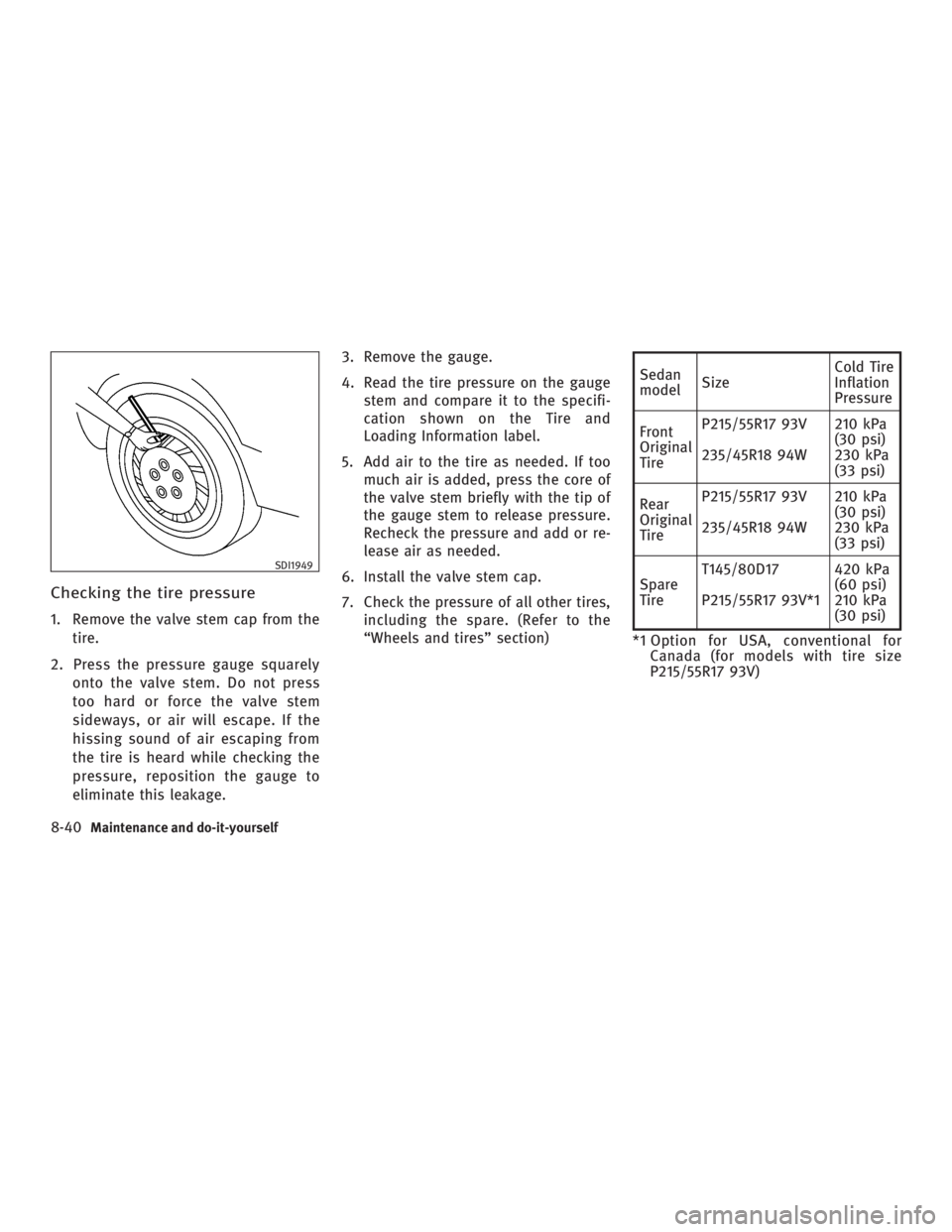
2. Press the pressure gauge squarely
onto the valve stem. Do not press
too hard or force the valve stem
sideways, or air will escape. If the
hissing sound of air escaping from
the tire is heard while checking the
pressure, reposition the gauge to
eliminate this leakage. 3. Remove the gauge.
4. Read the tire pressure on the gauge
stem and compare it to the specifi-
cation shown on the Tire and
Loading Information label.
5. Add air to the tire as needed. If too
much air is added, press the core of
the valve stem briefly with the tip of
the gauge stem to release pressure.
Recheck the pressure and add or re-
lease air as needed.
6. Install the valve stem cap.
7. Check the pressure of all other tires,
including the spare. (Refer to the
ªWheels and tiresº section) Sedan
model Size Cold Tire
Inflation
Pressure
Front
Original
Tire P215/55R17 93V
235/45R18 94W 210 kPa
(30 psi)
230 kPa
(33 psi)
Rear
Original
Tire P215/55R17 93V
235/45R18 94W 210 kPa
(30 psi)
230 kPa
(33 psi)
Spare
Tire T145/80D17
P215/55R17 93V*1 420 kPa
(60 psi)
210 kPa
(30 psi)
*1 Option for USA, conventional for
Canada (for models with tire size
P215/55R17 93V)SDI1949
8-40 Maintenance and do-it-yourself
w 06.1.4/V35-D/V5.0
X
Page 300 of 344
4. R: The ªRº stands for radial.
5. Two-digit number (15): This number
is the wheel or rim diameter in
inches.
6. Two- or three-digit number (95): This
number is the tire's load index. It is
a measurement of how much weight
each tire can support. You may not
find this information on all tires be-
cause it is not required by law.
7. H: Tire speed rating. You should not
drive the vehicle faster than the tire
speed rating.
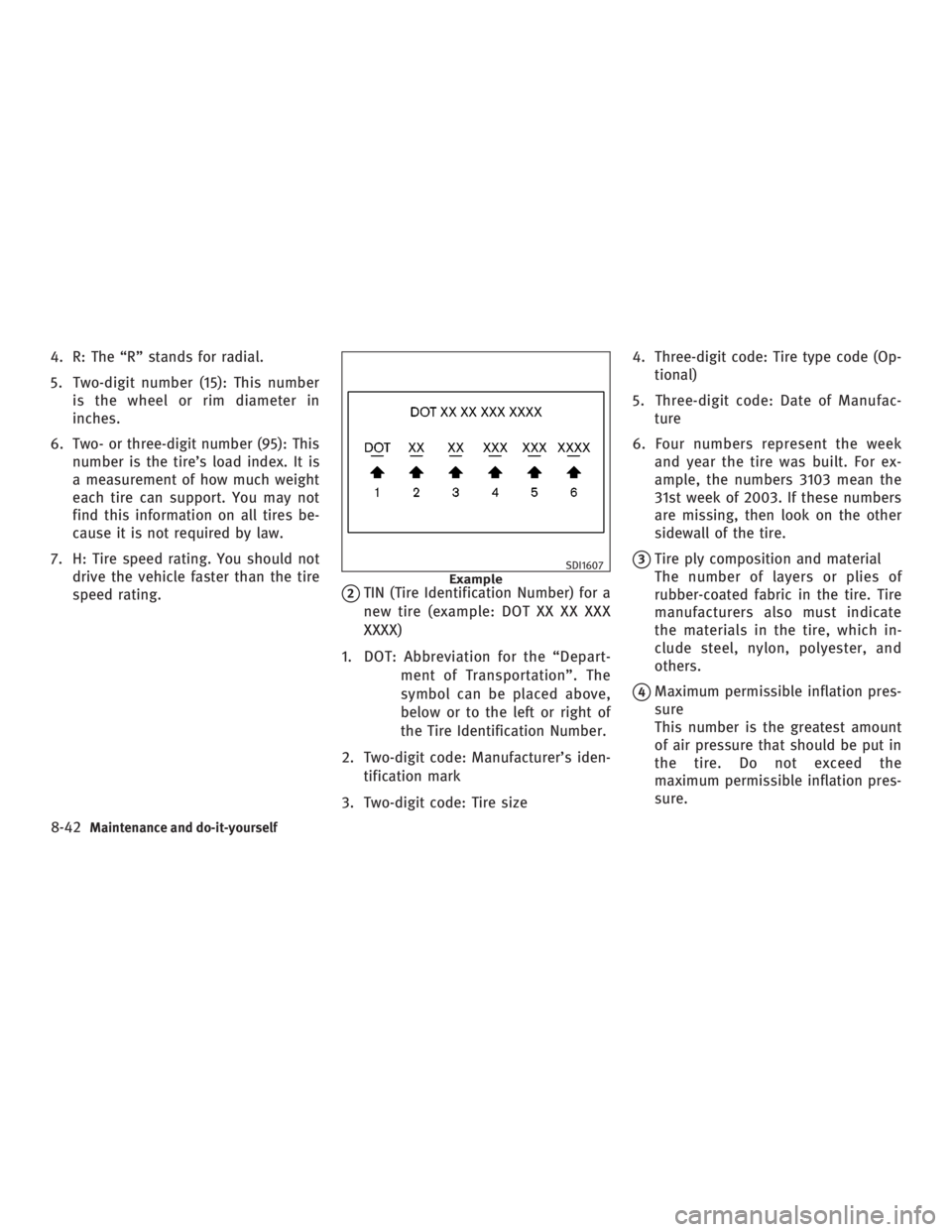
q 2
TIN (Tire Identification Number) for a
new tire (example: DOT XX XX XXX
XXXX)
1. DOT: Abbreviation for the ªDepart-
ment of Transportationº. The
symbol can be placed above,
below or to the left or right of
the Tire Identification Number.
2. Two-digit code: Manufacturer's iden-
tification mark
3. Two-digit code: Tire size 4. Three-digit code: Tire type code (Op-
tional)
5. Three-digit code: Date of Manufac-
ture
6. Four numbers represent the week
and year the tire was built. For ex-
ample, the numbers 3103 mean the
31st week of 2003. If these numbers
are missing, then look on the other
sidewall of the tire.
q 3
Tire ply composition and material
The number of layers or plies of
rubber-coated fabric in the tire. Tire
manufacturers also must indicate
the materials in the tire, which in-
clude steel, nylon, polyester, and
others.
q 4
Maximum permissible inflation pres-
sure
This number is the greatest amount
of air pressure that should be put in
the tire. Do not exceed the
maximum permissible inflation pres-
sure. SDI1607
Example
8-42 Maintenance and do-it-yourself
w 06.1.4/V35-D/V5.0
X
Page 302 of 344
mends the use of SNOW or ALL SEASON
tires on all four wheels.
Snow tires If snow tires are needed, it is necessary
to select tires equivalent in size and load
rating to the original equipment tires. If
you do not, it can adversely affect the
safety and handling of your vehicle.
Generally, snow tires will have lower
speed ratings than factory equipped tires
and may not match the potential
maximum vehicle speed. Never exceed
the maximum speed rating of the tire.
If you operate your vehicle in snowy or icy
conditions, INFINITI recommends the use
of snow or all season tires on all four
wheels.
For additional traction on icy roads, stud-
ded tires may be used. However, some
provinces and states prohibit their use.
Check local, state and provincial laws be-
fore installing studded tires. Skid and
traction capabilities of studded snow
tires, on wet or dry surfaces, may be
poorer than that of non-studded snow
tires. All-wheel drive (AWD) models
CAUTION O Always use tires of the same type, size,
brand, construction (bias, bias-belted or
radial), and tread pattern on all four
wheels. Failure to do so may result in a
circumference difference between tires
on the front and rear axles which will
cause excessive tire wear and may
damage the transmission, transfer case
and differential gears.
O ONLY use spare tires specified for the
AWD model.
If excessive tire wear is found, it is recom-
mended that all four tires be replaced
with tires of the same size, brand, con-
struction and tread pattern. The tire pres-
sure and wheel alignment should also be
checked and corrected as necessary. Con-
tact an INFINITI dealer.
Tire chains must be installed only on the
rear wheels and not on the front wheels.
Do not drive with tire chains on paved
roads which are clear of snow. Driving with chains in such conditions can cause
damage to the various mechanisms of the
vehicle due to some overstress.
TIRE CHAINS Use of tire chains may be prohibited ac-
cording to location. Check the local laws
before installing tire chains. When install-
ing tire chains, make sure they are the
proper size for the tires on your vehicle
and are installed according to the chain
manufacturer's suggestions. Use only SAE
class ªSº chains. Class ªSº chains are
used on vehicles with restricted tire to ve-
hicle clearance. Vehicles that can use
Class ªSº chains are designed to meet
the minimum clearances between the tire
and the closest vehicle suspension or
body component required to accommo-
date the use of a winter traction device
(tire chains or cables). The minimum
clearances are determined using the fac-
tory equipped tires. Other types may
damage your vehicle. Use chain ten-
sioners when recommended by the tire
chain manufacturer to ensure a tight fit.
Loose end links of the tire chain must be
secured or removed to prevent the possi-
bility of whipping action damage to the
fenders or underbody. If possible, avoid
fully loading your vehicle when using tire
chains. In addition, drive at a reduced
8-44 Maintenance and do-it-yourself
w 06.1.4/V35-D/V5.0
X
Page 303 of 344
speed. Otherwise, your vehicle may be
damaged and/or vehicle handling and
performance may be adversely affected.
Tire chains must be installed only on the
rear wheels and not on the front wheels.
Never install tire chains on a TEMPORARY
USE ONLY spare tire.
Do not use the chains on dry roads. Driv-
ing with chains in such conditions can
cause damage to the various mechanisms
of the vehicle due to some overstress.
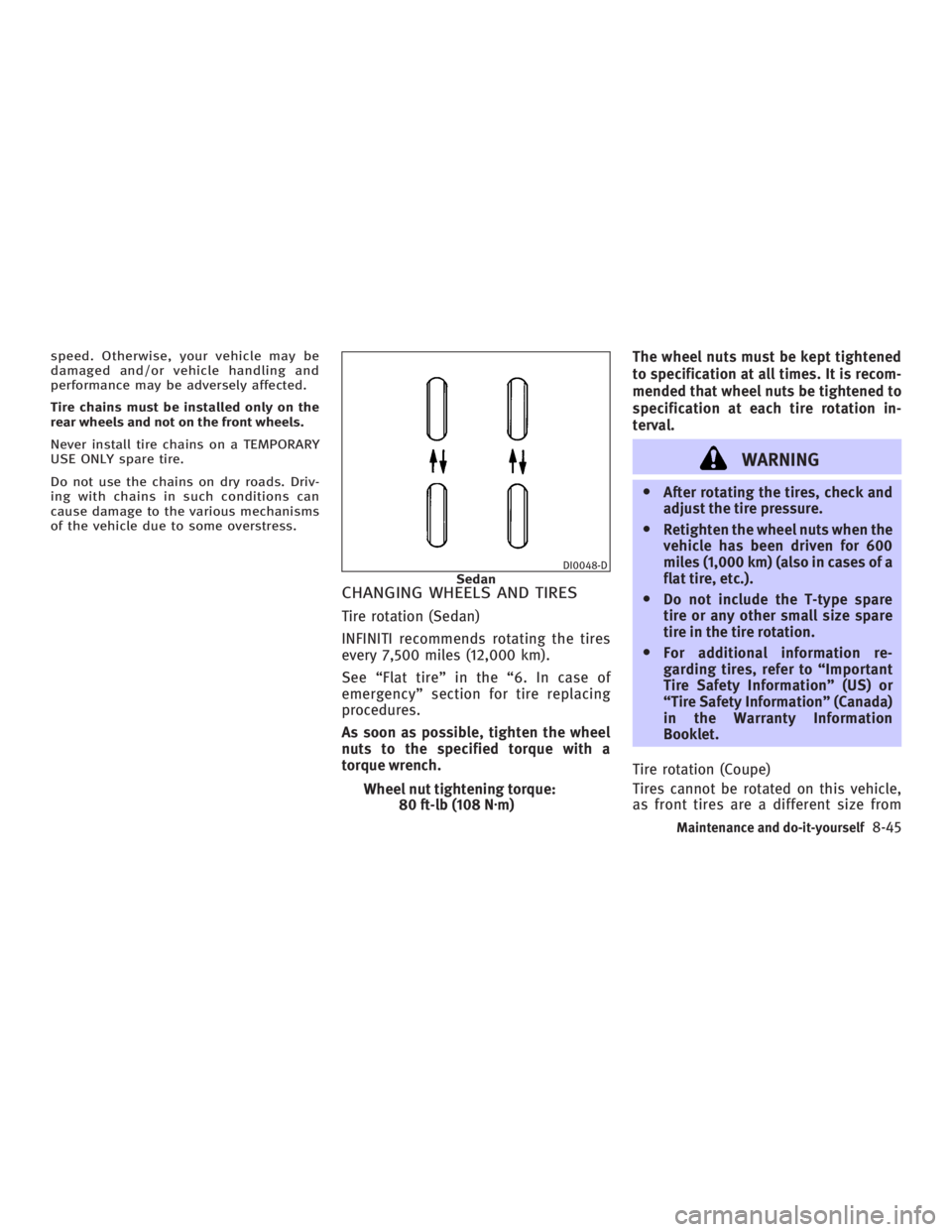
CHANGING WHEELS AND TIRES Tire rotation (Sedan)
INFINITI recommends rotating the tires
every 7,500 miles (12,000 km).
See ªFlat tireº in the ª6. In case of
emergencyº section for tire replacing
procedures.
As soon as possible, tighten the wheel
nuts to the specified torque with a
torque wrench.
Wheel nut tightening torque:
80 ft-lb (108 N z m) The wheel nuts must be kept tightened
to specification at all times. It is recom-
mended that wheel nuts be tightened to
specification at each tire rotation in-
terval.
WARNING O After rotating the tires, check and
adjust the tire pressure.
O Retighten the wheel nuts when the
vehicle has been driven for 600
miles (1,000 km) (also in cases of a
flat tire, etc.).
O Do not include the T-type spare
tire or any other small size spare
tire in the tire rotation.
O For additional information re-
garding tires, refer to ªImportant
Tire Safety Informationº (US) or
ªTire Safety Informationº (Canada)
in the Warranty Information
Booklet.
Tire rotation (Coupe)
Tires cannot be rotated on this vehicle,
as front tires are a different size from DI0048-D
Sedan
Maintenance and do-it-yourself
8-45
w 06.1.5/V35-D/V5.0
X