air condition INFINITI M 2012 Service Manual
[x] Cancel search | Manufacturer: INFINITI, Model Year: 2012, Model line: M, Model: INFINITI M 2012Pages: 522, PDF Size: 3.8 MB
Page 403 of 522
5-90Starting and driving
CAUTION
During the first 1,200 miles (2,000 km),
follow these recommendations to obtain
maximum engine performance and ensure
the future reliability and economy of your
new vehicle.
Failure to follow these recommendations
may result in shortened engine life and
reduced engine performance.
.Avoid driving for long periods at con-
stant speed, either fast or slow. Do not
run the engine over 4,000 rpm.
. Do not accelerate at full throttle in any
gear.
. Avoid quick starts.
. Avoid hard braking as much as possi-
ble. .
Accelerate slowly and smoothly. Main-
tain cruising speeds with a constant
accelerator position.
. Drive at moderate speeds on the high-
way.
. Avoid unnecessary stopping and brak-
ing. Keep a safe distance behind other
vehicles.
. Select a gear range suitable to road
conditions.
. Avoid unnecessary prolonged engine
idling.
. Keep your engine tuned up.
. Follow the recommended periodic main-
tenance schedule.
. Keep the tires inflated at the correct
pressure. Improper tire pressure will
increase wear and waste fuel.
. Make sure the front wheels are properly
aligned. Improper alignment will cause
premature tire wear and lower fuel
economy.
. Climate control operation lowers fuel
economy. Use the air conditioner only
when necessary.
. When cruising at highway speeds, it is
more economical to use the air condi-
tioner and leave the windows closed to
reduce drag.
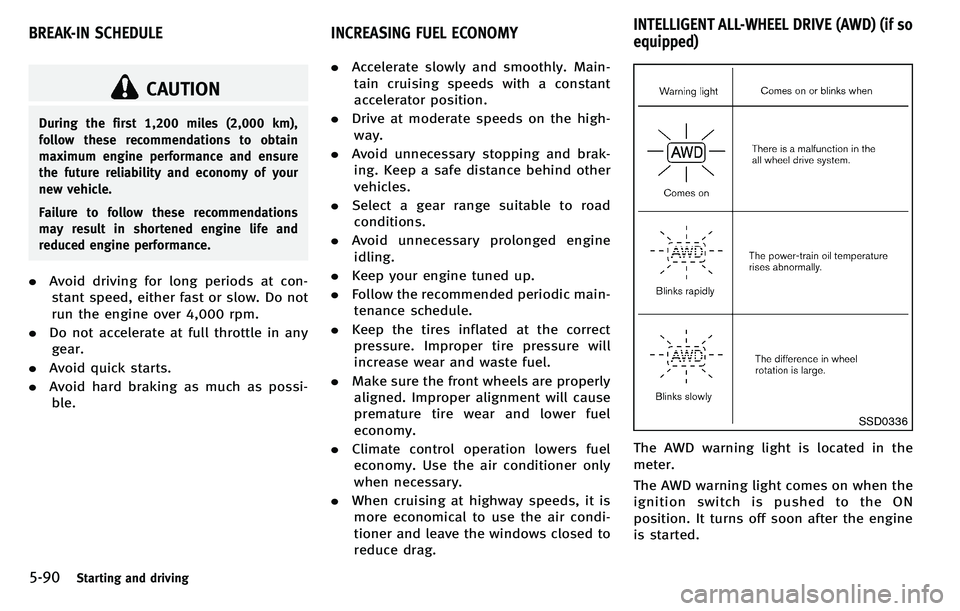
SSD0336
The AWD warning light is located in the
meter.
The AWD warning light comes on when the
ignition switch is pushed to the ON
position. It turns off soon after the engine
is started.
BREAK-IN SCHEDULE INCREASING FUEL ECONOMYINTELLIGENT ALL-WHEEL DRIVE (AWD) (if so
equipped)
Page 413 of 522

5-100Starting and driving
WARNING
.Never rely solely on the hill start assist
system to prevent the vehicle from
moving backward on a hill. Always drive
carefully and attentively. Depress the
brake pedal when the vehicle is stopped
on a steep hill. Be especially careful
when stopped on a hill on frozen or
muddy roads. Failure to prevent the
vehicle from rolling backwards may
result in a loss of control of the vehicle
and possible serious injury or death.
. The hill start assist system is not
designed to hold the vehicle at a
standstill on a hill. Depress the brake
pedal when the vehicle is stopped on a
steep hill. Failure to do so may cause the
vehicle to roll backwards and may result
in a collision or serious personal injury.
. The hill start assist system may not
prevent the vehicle from rolling back-
wards on a hill under all load or road
conditions. Always be prepared to de-
press the brake pedal to prevent the
vehicle from rolling backwards. Failure to
do so may result in a collision or serious
personal injury.
The hill start assist system automatically
keeps the brakes applied to help prevent
the vehicle from rolling backwards in the
time it takes the driver to release the brake
pedal and apply the accelerator when the
vehicle is stopped on a hill.
The hill start assist system will operate
automatically under the following condi-
tions:
.The transmission is shifted to a forward
or reverse gear.
. The vehicle is stopped completely on a
hill by applying the brake.
The maximum holding time is 2 seconds.
After 2 seconds the vehicle will begin to
roll back and the hill start assist system
will stop operating completely.
The hill start assist system will not operate
when the transmission is shifted to the N
(Neutral) or P (Park) position or on a flat
and level road. The 4 Wheel Active Steer (4WAS) system is
an electronically controlled four-wheel
steering system.
Depending on the vehicle speed and
steering angle, the angles of the front
and rear wheels are adjusted by the 4WAS
system to help improve driving perfor-
mance.
If a malfunction occurs in the system, the
4WAS function will stop but the ordinary
two-wheel steering system will operate
normally. The
“4WAS ”warning light will
illuminate. If the light illuminates while you
are driving, contact an INFINITI retailer for
repair.
The steering wheel may be slightly turned
even when driving on a straight road due to
a protection mechanism for the 4WAS
system. This is not a malfunction. The
steering wheel will return to the normal
position after the protection mechanism
deactivates.
The protection mechanism activates under
the following conditions:
. The steering wheel is operated forcibly
when it is hard to operate or the tires
are blocked by obstacles.
. The steering wheel is continuously
operated when the vehicle is parked
HILL START ASSIST SYSTEM 4 WHEEL ACTIVE STEER (4WAS) SYSTEM (if
so equipped)
Page 426 of 522
SCE0886
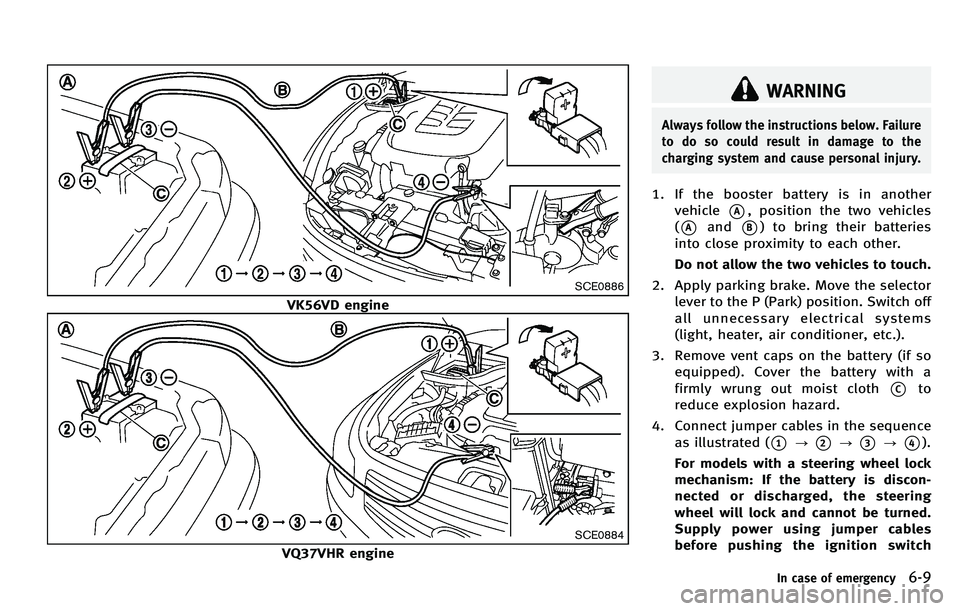
VK56VD engine
SCE0884
VQ37VHR engine
WARNING
Always follow the instructions below. Failure
to do so could result in damage to the
charging system and cause personal injury.
1. If the booster battery is in anothervehicle
*A, position the two vehicles
(
*Aand*B) to bring their batteries
into close proximity to each other.
Do not allow the two vehicles to touch.
2. Apply parking brake. Move the selector lever to the P (Park) position. Switch off
all unnecessary electrical systems
(light, heater, air conditioner, etc.).
3. Remove vent caps on the battery (if so equipped). Cover the battery with a
firmly wrung out moist cloth
*Cto
reduce explosion hazard.
4. Connect jumper cables in the sequence as illustrated (
*1?*2?*3?*4).
For models with a steering wheel lock
mechanism: If the battery is discon-
nected or discharged, the steering
wheel will lock and cannot be turned.
Supply power using jumper cables
before pushing the ignition switch
In case of emergency6-9
Page 428 of 522
CAUTION
.Do not continue to drive if your vehicle
overheats. Doing so could cause engine
damage or a vehicle fire.
. To avoid the danger of being scalded,
never remove the radiator cap while the
engine is still hot. When the radiator cap
is removed, pressurized hot water will
spurt out, possibly causing serious
injury.
. Do not open the hood if steam is coming
out.
If your vehicle is overheating (indicated by
an extremely high temperature gauge
reading), or if you feel a lack of engine
power, detect abnormal noise, etc., take
the following steps:
1. Move the vehicle safely off the road,
apply the parking brake and move the
selector lever to the P (Park) position.
Do not stop the engine.
2. Turn off the climate control. Open all the windows, move the heater or air
conditioner temperature control to
maximum hot and fan control to high speed.
3. If engine overheating is caused by climbing a long hill on a hot day, run
the engine at a fast idle (approximately
1,500 rpm) until the temperature gauge
indication returns to normal.
4. Get out of the vehicle. Look and listen for steam or coolant escaping from the
radiator before opening the hood. (If
steam or coolant is escaping, turn off
the engine.) Do not open the hood
further until no steam or coolant can be
seen.
5. Open the engine hood.WARNING
If steam or water is coming from the engine,
stand clear to prevent getting burned.
6. Visually check drive belts for damage or looseness. Also check if the cooling fan
is running. The radiator hoses and
radiator should not leak water. If cool-
ant is leaking or the cooling fan does
not run, stop the engine.
WARNING
Be careful not to allow your hands, hair,
jewelry or clothing to come into contact
with, or get caught in, engine belts or the
engine cooling fan. The engine cooling fan
can start at any time.
7. After the engine cools down, check thecoolant level in the reservoir tank with
the engine running. Add coolant to the
reservoir tank if necessary. Have your
vehicle repaired at the nearest INFINITI
retailer.
If needed, Roadside Assistance is avail-
able. Please see your Warranty Information
Booklet or Roadside Assistance I.D. Card
for the toll-free number to call (U.S.) or
Warranty & Roadside Assistance Informa-
tion Booklet (Canada).
In case of emergency6-11
IF YOUR VEHICLE OVERHEATS
Page 445 of 522
8-4Maintenance and do-it-yourself
Accelerator pedal:Check the pedal for
smooth operation and make sure the pedal
does not catch or require uneven effort.
Keep the floor mat away from the pedal.
Automatic transmission P (Park) mechan-
ism: On a fairly steep hill, check that your
vehicle is held securely with the selector
leverintheP(Park)positionwithout
applying any brakes.
Brake pedal: Check the pedal for smooth
operation. If the brake pedal suddenly
goes down further than normal, the pedal
feels spongy or the vehicle seems to take
longer to stop, see an INFINITI retailer
immediately. Keep the floor mat away from
the pedal.
Brakes: Check that the brakes do not pull
the vehicle to one side when applied.
Parking brake: Check the parking brake
operation regularly. The vehicle should be
securely held on a fairly steep hill with only
the parking brake applied. If the parking
brake needs adjusted, see an INFINITI
retailer.
Seat belts: Check that all parts of the seat
belt system (for example, buckles, an-
chors, adjuster and retractors) operate
properly and smoothly, and are installed securely. Check the belt webbing for cuts,
fraying, wear or damage.
Seats:
Check seat position controls such as
seat adjusters, seatback recliner, etc. to
ensure they operate smoothly and that all
latches lock securely in every position.
Check that the head restraints move up
and down smoothly and that the locks (if
so equipped) hold securely in all latched
positions.
Steering wheel: Check for changes in the
steering conditions, such as excessive free
play, hard steering or strange noises.
Warning lights and chimes: Make sure that
all warning lights and chimes are operating
properly.
Windshield defroster: Check that the air
comes out of the defroster outlets properly
and in sufficient quantity when operating
the heater or air conditioner.
Windshield wiper and washer*: Check that
the wipers and washer operate properly
and that the wipers do not streak.
Under the hood and vehicle
The maintenance items listed here should
be checked periodically (for example, each
time you check the engine oil or refuel). Battery*:
Check the fluid level in each cell.
It should be between the MAX and MIN
lines. Vehicles operated in high tempera-
tures or under severe condition require
frequent checks of the battery fluid level.
Brake fluid level*: Make sure that the
brake fluid level is between the MAX and
MIN lines on the reservoir.
Engine coolant level*: Check the coolant
level when the engine is cold.
Engine drive belts*: Make sure that no belt
is frayed, worn, cracked or oily.
Engine oil level*: Check the level after
parking the vehicle on a level spot and
turning off the engine. Wait more than 15
minutes for the oil to drain back into the oil
pan.
Exhaust system: Make sure there are no
loose supports, cracks or holes. If the
sound of the exhaust seems unusual or
there is a smell of exhaust fumes, im-
mediately have the exhaust system in-
spected by an INFINITI retailer. (See
“ Precautions when starting and driving ”
in the “5. Starting and driving ”section for
exhaust gas (Carbon monoxide).)
Fluid leaks: Check under the vehicle for
fuel, oil, water or other fluid leaks after the
Page 446 of 522
vehicle has been parked for a while. Water
dripping from the air conditioner after use
is normal. If you should notice any leaks or
if gasoline fumes are evident, check for the
cause and have it corrected immediately.
Power steering fluid level* and lines:
Check the level when the fluid is cold,
with the engine off. Check the lines for
proper attachment, leaks, cracks, etc.
Radiator and hoses:Check the front of the
radiator and clean off any dirt, insects,
leaves, etc., that may have accumulated.
Make sure the hoses have no cracks,
deformation, rot or loose connections.
Underbody: The underbody is frequently
exposed to corrosive substances such as
those used on icy roads or to control dust.
It is very important to remove these
substances, otherwise rust will form on
the floor pan, frame, fuel lines and around
the exhaust system. At the end of winter,
the underbody should be thoroughly
flushed with plain water, being careful to
clean those areas where mud and dirt may
accumulate. For additional information,
see “Cleaning exterior ”in the “7. Appear-
ance and care ”section.
Windshield washer fluid*: Check that there
is adequate fluid in the reservoir. When performing any inspection or main-
tenance work on your vehicle, always take
care to prevent serious accidental injury to
yourself or damage to the vehicle. The
following are general precautions which
should be closely observed.
WARNING
.
Park the vehicle on a level surface, apply
the parking brake securely and block the
wheels to prevent the vehicle from
moving. Move the selector lever to P
(Park).
. Be sure the ignition switch is in the OFF
or LOCK position when performing any
parts replacement or repairs.
. Never connect or disconnect the battery
or any transistorized component while
the ignition switch is in the ON position.
. Never leave the engine or automatic
transmission related component har-
nesses disconnected while the ignition
switch is in the ON position.
. If you must work with the engine
running, keep your hands, clothing, hair
and tools away from moving fans, belts
and any other moving parts. .
It is advisable to secure or remove any
loose clothing and remove any jewelry,
such as rings, watches, etc. before
working on your vehicle.
. Always wear eye protection whenever
you work on your vehicle.
. Ifyoumustruntheengineinan
enclosed space such as a garage, be
sure there is proper ventilation for
exhaust gases to escape.
. Never get under the vehicle while it is
supported only by a jack. If it is
necessary to work under the vehicle,
support it with safety stands.
. Keep smoking materials, flame and
sparks away from fuel tank and the
battery.
. Your vehicle is equipped with an auto-
matic engine cooling fan. It may come on
at any time without warning, even if the
ignition key is in the OFF position and
the engine is not running. To avoid
injury, always disconnect the negative
battery cable before working near the
fan.
. The fuel filter or fuel lines should be
serviced by an INFINITI retailer because
the fuel lines are under high pressure
Maintenance and do-it-yourself8-5
MAINTENANCE PRECAUTIONS
Page 462 of 522
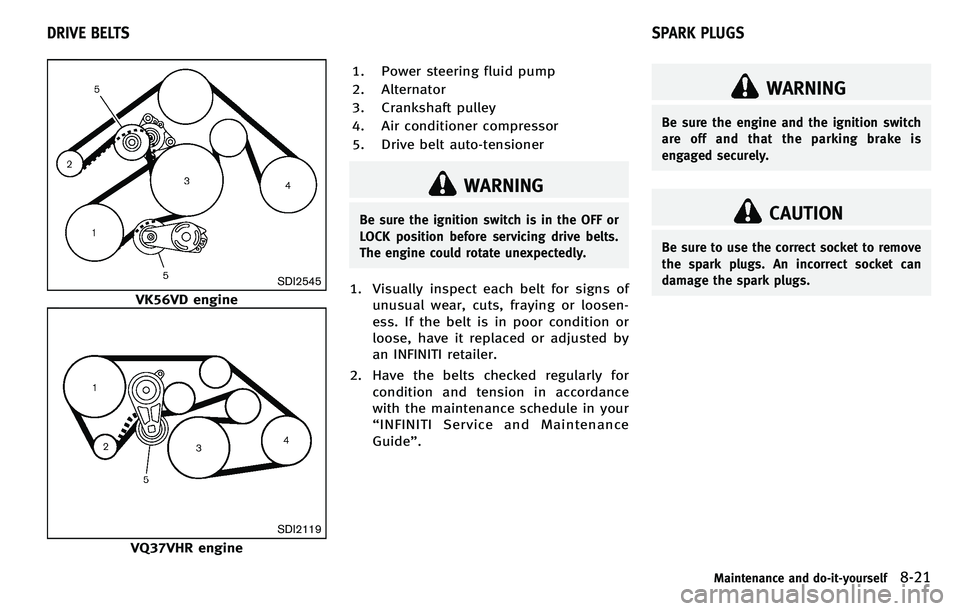
SDI2545
VK56VD engine
SDI2119
VQ37VHR engine1. Power steering fluid pump
2. Alternator
3. Crankshaft pulley
4. Air conditioner compressor
5. Drive belt auto-tensioner
WARNING
Be sure the ignition switch is in the OFF or
LOCK position before servicing drive belts.
The engine could rotate unexpectedly.
1. Visually inspect each belt for signs of
unusual wear, cuts, fraying or loosen-
ess. If the belt is in poor condition or
loose, have it replaced or adjusted by
an INFINITI retailer.
2. Have the belts checked regularly for condition and tension in accordance
with the maintenance schedule in your
“INFINITI Service and Maintenance
Guide ”.
WARNING
Be sure the engine and the ignition switch
are off and that the parking brake is
engaged securely.
CAUTION
Be sure to use the correct socket to remove
the spark plugs. An incorrect socket can
damage the spark plugs.
Maintenance and do-it-yourself8-21
DRIVE BELTS SPARK PLUGS
Page 468 of 522

SDI1754
5. If the fuse is open*A, replace it with a
new fuse
*B. Spare fuses are stored in
the passenger compartment fuse box.
6. If a new fuse also opens, have the electrical system checked and repaired
by an INFINITI retailer.
The holder
*1also contains the fuses. For
checking and/or replacing, see an INFINITI
retailer.
Fusible links
If any electrical equipment does not
operate and fuses are in good condition,
check the fusible links. If any of these
fusible links are melted, replace only with genuine INFINITI parts.
Maintenance and do-it-yourself8-27
Page 488 of 522
9 Technical and consumer information
Capacities and recommended fuel/lubricants....... 9-2Fuel recommendation ...................................... 9-4
Engine oil and oil filter recommendation ......... 9-6
Air conditioning system refrigerant and
lubricant recommendations ............................. 9-7
Specifications ...................................................... 9-8
Engine............................................................. 9-8
Wheels and tires ............................................. 9-9
Dimensions ................................................... 9-10
When traveling or registering your vehicle in
another country ................................................. 9-11
Vehicle identification ......................................... 9-11 Vehicle Identification Number (VIN) plate ....... 9-11
Vehicle identification number
(chassis number) ........................................... 9-11
Engine serial number .................................... 9-12
F.M.V.S.S./C.M.V.S.S. certification label .......... 9-12
Emission control information label ................ 9-13
Tire and loading information label ................. 9-13
Air conditioner specification label.................. 9-13 Installing front license plate .............................. 9-14
Vehicle loading information............................... 9-15
Terms .......................................................... 9-15
Vehicle load capacity ................................... 9-17
Loading tips................................................. 9-18
Measurement of weights.............................. 9-18
Towing a trailer ................................................. 9-19 Flat towing................................................... 9-19
Uniform tire quality grading .............................. 9-19 Treadwear .................................................... 9-19
Traction AA, A, B and C................................ 9-20
Temperature A, B and C ............................... 9-20
Emission control system warranty ..................... 9-20
Reporting safety defects.................................... 9-21
Readiness for Inspection/Maintenance (I/M) test
(US only)........................................................... 9-22
Event Data Recorders (EDR) ............................... 9-23
Owner ’s Manual/Service Manual
order information .............................................. 9-23
In the event of a collision ............................ 9-24
Page 489 of 522

9-2Technical and consumer information
The following are approximate capacities. The actual refill capacities may be a little different. When refilling, follow the procedure
instructed in the“8. Maintenance and do-it-yourself ”section to determine the proper refill capacity.
Capacity (Approximate)
Recommended specifications
US measure Imp measure Liter
Fuel 20-1/8 gal16-3/4 gal 76 See“Fuel recommendation” later in this section.
Engine oil*2
Drain and refill
With oil filter change VQ37VHR
5-1/8 qt4-3/8 qt 4.9
.Engine oil with API Certification Mark*1*10
. Viscosity SAE 5W-30
VK56VD (2WD) 6-3/8 qt
5-1/4 qt6.0
(AWD) 6-1/2 qt 5-3/8 qt6.1
Without oil filter change VQ37VHR
4-7/8 qt4.0 qt 4.6
VK56VD (2WD) 6.0 qt 5.0 qt5.7
(AWD) 6-1/8 qt 5-1/8 qt5.8
Cooling system
With reservoir VQ37VHR
8-7/8 qt7-3/8 qt 8.4
Pre-diluted Genuine NISSAN Long Life Antifreeze/Coolant (blue) or equivalent
VK56VD
11-1/2 qt9-5/8 qt 10.9
Reservoir VQ37VHR
7/8 qt3/4 qt 0.8
VK56VD 7/8 qt3/4 qt 0.8
Automatic transmission fluid ———Genuine NISSAN Matic S ATF*3
Differential gear oil ———Front:
Genuine NISSAN Differential Oil Hypoid Super GL-5 80W-90 or API GL-5 Viscosity SAE
80W-90*4
Rear:
API GL-5 synthetic gear oil, Viscosity SAE 75W-90*5
Transfer fluid ———Genuine NISSAN Matic J ATF*6
Power steering fluid (PSF) Refill to the proper oil level according to the instructions in the “8.
Maintenance and do-it-yourself ”section. Genuine NISSAN PSF or equivalent*7
Brake fluid Genuine NISSAN Super Heavy Duty Brake Fluid*8 or equivalent DOT 3
Multi-purpose grease Without limited slip differential ———
NLGI No. 2 (Lithium soap base)
With limited slip differential ———
Air conditioning system refrigerant ———HFC-134a (R-134a)*9
Air conditioning system lubricants ———NISSAN A/C System Oil
Type S or exact equivalent
Window washer fluid ———Genuine NISSAN Windshield Washer Concentrate Cleaner & Antifreeze or equivalent
CAPACITIES AND RECOMMENDED FUEL/
LUBRICANTS