wheel INFINITI Q60 2018 Manual Online
[x] Cancel search | Manufacturer: INFINITI, Model Year: 2018, Model line: Q60, Model: INFINITI Q60 2018Pages: 466, PDF Size: 2.47 MB
Page 354 of 466
.Do not use a wax containing any abra-
sives, cutting compounds or cleaners
that may damage the vehicle finish.
Machine compound or aggressive polishing
on a base coat/clear coat paint finish may
dull the finish or leave swirl marks.
REMOVING SPOTS
Remove tar and oil spots, industrial dust,
insects, and tree sap as quickly as possible
from the paint surface to avoid lasting
damage or staining. Special cleaning pro-
ducts are available at an INFINITI retailer or
any automotive accessory stores.
UNDERBODY
In areas where road salt is used in winter, the
underbody must be cleaned regularly. This
will prevent dirt and salt from building up
and causing the acceleration of corrosion on
the underbody and suspension. Before the
winter period and again in the spring, the
underseal must be checked and, if necessary,
re-treated.
GLASS
Use glass cleaner to remove smoke and dust
film from the glass surfaces. It is normal for
glass to become coated with a film after the
vehicle is parked in the hot sun. Glass cleaner
and a soft cloth will easily remove this film.
CAUTION
When cleaning the inside of the win-
dows, do not use sharp-edged tools,
abrasive cleaners or chlorine-based dis-
infectant cleaners. They could damage
the electrical conductors, radio antenna
elements or rear window defroster ele-
ments.
WHEELS
Wash the wheels when washing the vehicle
to maintain their appearance.
.Clean the inner side of the wheels when
the wheel is changed or the underside of
the vehicle is washed.
.Inspect wheel rims regularly for dents or
corrosion. Such damage may cause loss
of pressure or poor seal at the tire bead.
.INFINITI recommends that the road
wheels be waxed to protect against road
salt in areas where it is used duringwinter.
CAUTION
Do not use abrasive cleaners when
washing the wheels.
Aluminum alloy wheels
Wash regularly with a sponge dampened in a
mild soap solution, especially during winter
months in areas where road salt is used. Salt
could discolor the wheels if not removed.
CAUTION
Follow the directions below to avoid
staining or discoloring the wheels:
.Do not use a cleaner that uses strong
acid or alkali contents to clean the
wheels.
.Do not apply wheel cleaners to the
wheels when they are hot. The wheel
temperature should be the same as
ambient temperature.
.Rinse the wheel to completely re-
move the cleaner within 15 minutes
after the cleaner is applied.
Appearance and care7-3
Page 355 of 466
7-4Appearance and care
Bright wheels (if so equipped)
The bright wheels use a different coating
process than typical aluminum alloy wheel
and they are not plated wheels. These
wheels are clear-coated and require the
following special cleaning. They should be
regularly washed with a soft sponge soaked
in a lot of water. After washing with water,
wipe clean with a dry, soft cloth and dry
completely. When there is chemical or tire
wax, or dirt such as an antifreeze agent on
the surface, wash them with water as soon
as possible.
CAUTION
.The surfaces of the wheels use a
different coating process than typical
aluminum alloy wheels. Do not use
aluminum alloy wheel cleaners or
abrasive cleaners to clean the wheels.
Using such cleaners could damage the
wheel surfaces.
.Do not use an automatic car wash if
the vehicle is equipped with bright
wheels. The wheel coating may be
damaged.
.Do not use a brush to wash the
wheels if the vehicle is equipped with
bright wheels. The wheel coating maybe damaged.
CHROME PARTS
Clean chrome parts regularly with a non-
abrasive chrome polish to maintain the
finish.
TIRE DRESSING
INFINITI does not recommend the use of tire
dressings. Tire manufacturers apply a coat-
ing to the tires to help reduce discoloration
of the rubber. If a tire dressing is applied to
the tires, it may react with the coating and
form a compound. This compound may come
off the tire while driving and stain the vehicle
paint.
If you choose to use a tire dressing, take the
following precautions:
.Use a water-based tire dressing. The
coating on the tire dissolves more easily
with an oil-based tire dressing.
.Apply a light coat of tire dressing to help
prevent it from entering the tire tread/
grooves (where it would be difficult to
remove).
.Wipe off excess tire dressing using a dry
towel. Make sure the tire dressing is
completely removed from the tire tread/
grooves..Allow the tire dressing to dry as recom-
mended by tire dressing manufacturer.
Page 361 of 466
Wheels and tires............................................................... 8-32
Tire pressure ................................................................ 8-32
Tire labeling.................................................................. 8-36Types of tires............................................................ 8-38
Tire chains.................................................................. 8-40
Changing wheels and tires..................................... 8-41
Page 362 of 466
When performing any inspection or main-
tenance work on your vehicle, always take
care to prevent serious accidental injury to
yourself or damage to the vehicle. The
following are general precautions which
should be closely observed.
WARNING
.Park the vehicle on a level surface,
apply the parking brake securely and
block the wheels to prevent the
vehicle from moving. Move the shift
lever to P (Park).
.Be sure the ignition switch is in the
OFF or LOCK position when per-
forming any parts replacement or
repairs.
.Never connect or disconnect the
battery or any transistorized compo-
nent while the ignition switch is in the
ON position.
.Never leave the engine or automatic
transmission related component har-
nesses disconnected while the igni-
tion switch is in the ON position.
.If you must work with the engine
running, keep your hands, clothing,
hair and tools away from moving
fans, belts and any other movingparts.
.It is advisable to secure or remove
any loose clothing and remove any
jewelry, such as rings, watches, etc.
before working on your vehicle.
.Always wear eye protection when-
ever you work on your vehicle.
.If you must run the engine in an
enclosed space such as a garage, be
sure there is proper ventilation for
exhaust gases to escape.
.Never get under the vehicle while it is
supported only by a jack. If it is
necessary to work under the vehicle,
support it with safety stands.
.Keep smoking materials, flame and
sparks away from fuel tank and the
battery.
.Your vehicle is equipped with an
automatic engine cooling fan. It may
come on at any time without warn-
ing, even if the ignition key is in the
OFF position and the engine is not
running. To avoid injury, always dis-
connect the negative battery cable
before working near the fan.
.Because the fuel lines are under high
pressure even when the engine is off,
it is recommended you visit an
INFINITI retailer for service of thefuel filter or fuel lines.
CAUTION
.Do not work under the hood while the
engine is hot. Turn the engine off and
wait until it cools down.
.Avoid direct contact with used en-
gine oil and coolant. Improperly dis-
posed engine oil, coolant, and/or
other vehicle fluids can damage the
environment. Always conform to lo-
cal regulations for disposal of vehicle
fluid.
This “8. Do-it-yourself” section gives in-
structions regarding only those items which
are relatively easy for an owner to perform.
A genuine INFINITI Service Manual is also
available. (See “Owner’s Manual/Service
Manual order information” (P.10-25).)
You should be aware that incomplete or
improper servicing may result in operating
difficulties or excessive emissions, and could
affect your warranty coverage.If in doubt
about any servicing, it is recommended you
have it done by an INFINITI retailer.
Do-it-yourself8-3
MAINTENANCE PRECAUTIONS
Page 391 of 466
8-32Do-it-yourself
SDI1679
SDI2330
Step light
SDI1258A
Trunk lightIf you have a flat tire, see “Flat tire” (P.6-3).
TIRE PRESSURE
Tire Pressure Monitoring System
(TPMS)
This vehicle is equipped with the Tire
Pressure Monitoring System (TPMS). It
monitors tire pressure of all tires except the
spare. When the low tire pressure warning
light is lit and the “Tire Pressure Low - Add
Air” warning appears in the vehicle informa-
tion display, one or more of your tires is
significantly under-inflated.
The TPMS will activate only when the
vehicle is driven at speeds above 16 MPH
(25 km/h). Also, this system may not detect
a sudden drop in tire pressure (for example a
flat tire while driving).
For more details, see “Low tire pressure
warning light” (P.2-14),“Tire Pressure Mon-
itoring System (TPMS)” (P.5-5) and “Tire
Pressure Monitoring System (TPMS)” (P.6-
3).
Tire inflation pressure
Check the pressure of the tires (in-
cluding the spare) often and always
prior to long distance trips. The
recommended tire pressure specifica-
tions are shown on the Tire and
WHEELS AND TIRES
Page 396 of 466
width.
4. R: The “R” stands for radial.
F: The “F” after “R” indicates Self-
Supporting type run-flat tire.
5. Two-digit number (16): This num-
ber is the wheel or rim diameter in
inches.
6. Two- or three-digit number (94):
This number is the tire’s load index.
It is a measurement of how much
weight each tire can support. You
may not find this information on all
tires because it is not required by
law.
7. H: Tire speed rating. You should
not drive the vehicle faster than
the tire speed rating.
JVM0694X
Example
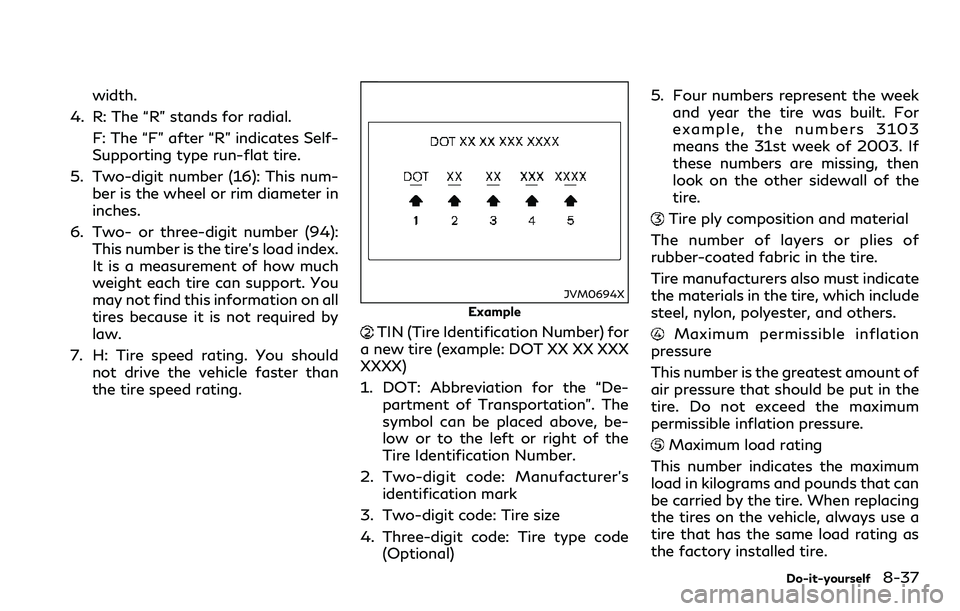
TIN (Tire Identification Number) for
a new tire (example: DOT XX XX XXX
XXXX)
1. DOT: Abbreviation for the “De-
partment of Transportation”. The
symbol can be placed above, be-
low or to the left or right of the
Tire Identification Number.
2. Two-digit code: Manufacturer’s
identification mark
3. Two-digit code: Tire size
4. Three-digit code: Tire type code
(Optional)5. Four numbers represent the week
and year the tire was built. For
example, the numbers 3103
means the 31st week of 2003. If
these numbers are missing, then
look on the other sidewall of the
tire.
Tire ply composition and material
The number of layers or plies of
rubber-coated fabric in the tire.
Tire manufacturers also must indicate
the materials in the tire, which include
steel, nylon, polyester, and others.
Maximum permissible inflation
pressure
This number is the greatest amount of
air pressure that should be put in the
tire. Do not exceed the maximum
permissible inflation pressure.
Maximum load rating
This number indicates the maximum
load in kilograms and pounds that can
be carried by the tire. When replacing
the tires on the vehicle, always use a
tire that has the same load rating as
the factory installed tire.
Do-it-yourself8-37
Page 397 of 466
8-38Do-it-yourself
Term of “tubeless” or “tube type”
Indicates whether the tire requires an
inner tube (“tube type”) or not (“tube-
less”).
The word “radial”
The word “radial” is shown, if the tire
has radial structure.
Manufacturer or brand name
Manufacturer or brand name is
shown.
Other tire-related terminology:
In addition to the many terms that are
defined throughout this section, In-
tended Outboard Sidewall is (1) the
sidewall that contains a whitewall,
bears white lettering or bears manu-
facturer, brand and/or model name
molding that is higher or deeper than
the same molding on the other side-
wall of the tire, or (2) the outward
facing sidewall of an asymmetrical
tire that has a particular side that
must always face outward when
mounted on a vehicle.
TYPES OF TIRES
WARNING
.When changing or replacing tires, be
sure all four tires are of the same type
(Example: Summer, All Season or
Snow) and construction. An INFINITI
retailer may be able to help you with
information about tire type, size,
speed rating and availability.
.Replacement tires may have a lower
speed rating than the factory
equipped tires, and may not match
the potential maximum vehicle speed.
Never exceed the maximum speed
rating of the tire.
.Replacing tires with those not origin-
ally specified by INFINITI could affect
the proper operation of the TPMS.
.For additional information regarding
tires, refer to “Important Tire Safety
Information” (US) or “Tire Safety
Information” (Canada) in the War-
ranty Information Booklet.
All season tires
INFINITI specifies all season tires on some
models to provide good performance allyear, including snowy and icy road condi-
tions. All Season tires are identified by ALL
SEASON and/or M&S (Mud and Snow) on
the tire sidewall. Snow tires have better
snow traction than All Season tires and may
be more appropriate in some areas.
Summer tires
INFINITI specifies summer tires on some
models to provide superior performance on
dry roads. Summer tire performance is
substantially reduced in snow and ice. Sum-
mer tires do not have the tire traction rating
M&S on the tire sidewall.
If you plan to operate your vehicle in snowy
or icy conditions, INFINITI recommends the
use of SNOW tires or ALL SEASON tires on
all four wheels.
Snow tires
If snow tires are needed, it is necessary to
select tires equivalent in size and load rating
to the original equipment tires. If you do not,
it can adversely affect the safety and
handling of your vehicle.
Generally, snow tires will have lower speed
ratings than factory equipped tires and may
not match the potential maximum vehicle
speed. Never exceed the maximum speed
rating of the tire.
If you install snow tires, they must be the
Page 398 of 466
same size, brand, construction and tread
pattern on all four wheels.
For additional traction on icy roads, studded
tires may be used. However, some U.S.
states and Canadian provinces prohibit their
use. Check local, state and provincial laws
before installing studded tires. Skid and
traction capabilities of studded snow tires,
on wet or dry surfaces, may be poorer than
that of non-studded snow tires.
Run-flat tires
Your vehicle is equipped with run-flat tires.
You can continue driving to a safe location
even if they are punctured. Always use run-
flat tires of the specified size on all four
wheels. Mixing tire sizes or construction may
reduce vehicle handling stability. If neces-
sary, contact an INFINITI retailer for assis-
tance.
Frequently check the tire pressure and adjust
pressure of each tire properly. The tire
pressure can be also checked in the vehicle
information display.
It can be difficult to tell if a run-flat tire is
under-inflated or flat. Check the tire pres-
sures as described earlier in this section. If
the tire becomes under-inflated while driv-
ing, the low tire pressure warning light will
illuminate. If the tire becomes flat while
driving, the low tire pressure warning lightand the “Flat Tire - Visit dealer” warning will
appear.
Low tire pressure:
If the vehicle is being driven with low tire
pressure, the low tire pressure warning light
will illuminate.
Flat tire:
If the vehicle is being driven with one or more
flat tires, the low tire pressure warning light
will illuminate continuously and a chime will
sound for 10 seconds. A “Flat Tire - Visit
dealer” warning also appears in the vehicle
information display.
The chime will only sound at the first
indication of a flat tire and the warning light
will illuminate continuously. When the flat
tire warning is activated, have the system
reset and the tire checked, and replaced if
necessary. It is recommended you visit an
INFINITI retailer for these services. Even if
the tire is inflated to the specified COLD tire
pressure, the warning light will continue to
illuminate until the system is reset.
If the low tire pressure warning light illumi-
nates continuously and the “Flat Tire - Visit
dealer” warning appears in the vehicle
information display:
.Do not exceed 50 MPH (80 km/h).
.Increase your following distance to allow
for increased stopping distances..Avoid sudden maneuvers, hard cornering
and hard braking.
WARNING
.Although you can continue driving
with a punctured run-flat tire, re-
member that vehicle handling stabi-
lity is reduced, which could lead to an
accident and personal injury. Also,
driving a long distance at high speeds
may damage the tire.
.Do not drive at speeds above 50
MPH (80 km/h) and do not drive
more than approximately 93 miles
(150 km) with a punctured run-flat
tire. The actual distance the vehicle
can be driven on a flat tire depends on
outside temperature, vehicle load,
road conditions and other factors.
.Drive safely at reduced speeds. Avoid
hard cornering or braking, which may
cause you to lose control of the
vehicle.
.If you detect any unusual sounds or
vibrations while driving with a punc-
tured run-flat tire, pull off the road
to a safe location and stop the vehicle
as soon as possible. The tire may be
seriously damaged and need to be
Do-it-yourself8-39
Page 399 of 466
8-40Do-it-yourself
replaced.
CAUTION
.Never install tire chains on a punctu-
red run-flat tire, as this could damage
your vehicle.
.Avoid driving over any projection or
pothole, as the clearance between
the vehicle and the ground is smaller
than normal.
.Do not enter an automated car wash
with a punctured run-flat tire.
.It is recommended you have the
punctured tire inspected by an
INFINITI retailer or other authorized
repair shop. Replace the tire as soon
as possible if the tire is seriously
damaged.
TIRE CHAINS
CAUTION
Tire chains/cables should not be in-
stalled on 255/40RF19,
P255/40RF19, P255/35R20,
255/35R20 and 275/30R20 tires.
Doing so will cause damage to the
vehicle. If you plan to use tire chains/
cables, you should install 245/40RF19
run-flat tires or 245/40R19 non run-
flat tires on your vehicle.
Use of tire chains may be prohibited accord-
ing to location. Check the local laws before
installing tire chains. When installing tire
chains, make sure they are the proper size
for the tires on your vehicle and are installed
according to the chain manufacturer’s sug-
gestions.Use only SAE Class S chains.Class
“S” chains are used on vehicles with re-
stricted tire to vehicle clearance. Vehicles
that can use Class “S” chains are designed to
meet the SAE standard minimum clearances
between the tire and the closest vehicle
suspension or body component required to
accommodate the use of a winter traction
device (tire chains or cables). The minimum
clearances are determined using the factory
equipped tire size. Other types may damageyour vehicle. Use chain tensioners when
recommended by the tire chain manufac-
turer to ensure a tight fit. Loose end links of
the tire chain must be secured or removed to
prevent the possibility of whipping action
damage to the fenders or underbody. If
possible, avoid fully loading your vehicle
when using tire chains. In addition, drive at
a reduced speed. Otherwise, your vehicle
may be damaged and/or vehicle handling
and performance may be adversely affected.
Tire chains must be installed only on the
rear wheels and not on the front wheels.
Never install tire chains on a TEMPORARY
USE ONLY spare tire (if so equipped). Never
install tire chains on a punctured run-flat tire
(if so equipped), as this could damage your
vehicle.
Do not use tire chains on dry roads. Driving
with tire chains in such conditions can cause
damage to the various mechanisms of the
vehicle due to some overstress.
Page 400 of 466
SDI1662
CHANGING WHEELS AND TIRES
Tire rotation (models equipped with
same size tires on all wheels)
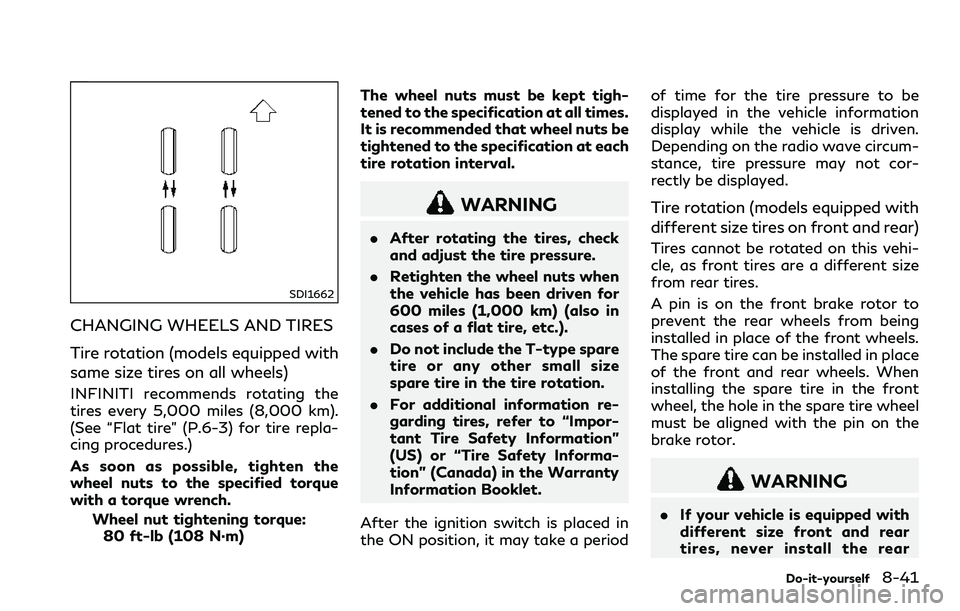
INFINITI recommends rotating the
tires every 5,000 miles (8,000 km).
(See “Flat tire” (P.6-3) for tire repla-
cing procedures.)
As soon as possible, tighten the
wheel nuts to the specified torque
with a torque wrench.
Wheel nut tightening torque:
80 ft-lb (108 N·m)The wheel nuts must be kept tigh-
tened to the specification at all times.
It is recommended that wheel nuts be
tightened to the specification at each
tire rotation interval.
WARNING
.After rotating the tires, check
and adjust the tire pressure.
.Retighten the wheel nuts when
the vehicle has been driven for
600 miles (1,000 km) (also in
cases of a flat tire, etc.).
.Do not include the T-type spare
tire or any other small size
spare tire in the tire rotation.
.For additional information re-
garding tires, refer to “Impor-
tant Tire Safety Information”
(US) or “Tire Safety Informa-
tion” (Canada) in the Warranty
Information Booklet.
After the ignition switch is placed in
the ON position, it may take a periodof time for the tire pressure to be
displayed in the vehicle information
display while the vehicle is driven.
Depending on the radio wave circum-
stance, tire pressure may not cor-
rectly be displayed.
Tire rotation (models equipped with
different size tires on front and rear)
Tires cannot be rotated on this vehi-
cle, as front tires are a different size
from rear tires.
A pin is on the front brake rotor to
prevent the rear wheels from being
installed in place of the front wheels.
The spare tire can be installed in place
of the front and rear wheels. When
installing the spare tire in the front
wheel, the hole in the spare tire wheel
must be aligned with the pin on the
brake rotor.
WARNING
.If your vehicle is equipped with
different size front and rear
tires, never install the rear
Do-it-yourself8-41