transmission oil INFINITI QX56 2011 Factory Service Manual
[x] Cancel search | Manufacturer: INFINITI, Model Year: 2011, Model line: QX56, Model: INFINITI QX56 2011Pages: 5598, PDF Size: 94.53 MB
Page 5 of 5598

QUICK REFERENCE CHART QX56
BRAKE PEDAL
Unit : mm (in)
FRONT DISK BRAKE
Unit : mm (in)
REAR DISK BRAKE
Unit : mm (in)
REFILL CAPACITIESELS00040
Item Standard
Brake pedal height 168.5 (6.63) – 178.5 (7.03)
Depressed brake pedal height
[Depressing 490 N (50 kg, 110 lb) while turning the engine ON] 100 (3.94) or more
Item Limit
Brake pad Wear thickness 1.5 (0.059)
Disc rotor Wear thickness 28.5 (1.122)
Thickness variation (measured at 8 positions) 0.015 (0.0006)
Runout (with it attached to the vehicle) 0.053 (0.0021)
Item Limit
Brake pad Wear thickness 2.0 (0.079)
Disc rotor Wear thickness 18.0 (0.709)
Thickness variation (measured at 8 positions) 0.015 (0.0006)
Runout (with it attached to the vehicle) 0.05 (0.0020)
UNIT
Liter US measure
Fuel tank 98.4 26 gal
Engine Coolant ( With reservoir tank ) at MAX level 14.9 15-6/8 qt
Engine oil Drain and refill
With oil filter change 6.5 6-7/8 qt
Without oil filter change 6.2 6-4/8 qt
Dry engine (Overhaul) 7.6 8 qt
Transmission 10.0 10-5/8 qt
Transfer 1.5 3-1/8 pt
Final drive Front 0.75 1-5/8 pt
Rear 1.75 3-3/4 pt
Power steering system 1.0 7/8 qt
Air conditioning system Compressor oil 0.21 7.1 fl oz
Refrigerant 1.05 kg 2.32 lb
2011
Page 398 of 5598

BCS-10
< SYSTEM DESCRIPTION >
SYSTEM
NOTE:
For details of wiper volume dial position, refer to WW-7, "
FRONT WIPER AND WASHER SYSTEM : System Description".
SIGNAL BUFFER SYSTEM
SIGNAL BUFFER SYSTEM : System DiagramINFOID:0000000006274792
SIGNAL BUFFER SYSTEM : System DescriptionINFOID:0000000006274793
OUTLINE
BCM has the signal transmission function that output s/transmits each input/received signal to each unit.
Signal transmission function list
6 OFF ON ON
7 OFF ON OFF
Wiper volume
dial position Switch status
WIP VOLUME 1 WIP VOLUME 2 WIP VOLUME 3
JMMIA0381GB
Signal name Input Output Description
Ignition switch ON signal
Ignition switch signal Push-button ignition switch
(Push switch) IPDM E/R (CAN)
Driver seat control unit (CAN)
Pre-crash seat
belt control
unit (CAN) Inputs the push-button ignition
switch (push switch) signal and
transmits the ignition switch sta-
tus judged with BCM via CAN
communication.
Door switch signal Any door switch Combination meter (CAN)
IPDM E/R (CAN)
Driver seat control unit (CAN)
Pre-crash seat
belt control
unit (CAN) Inputs the door switch signal
and transmits it via CAN com-
munication.
Oil pressure switch signal IPDM E/R (CAN) Combination meter (CAN) Transmits the received oil pres-
sure switch signal via CAN
communication.
Revision: 2010 May2011 QX56
Page 1924 of 5598
![INFINITI QX56 2011 Factory Service Manual
DLN-122
< UNIT REMOVAL AND INSTALLATION >[TRANSFER: ATX90A]
TRANSFER ASSEMBLY
When installing the transfer to the
transmission, install the mount-
ing bolts following the standard below, tighten b](/img/42/57033/w960_57033-1923.png "INFINITI QX56 2011 Factory Service Manual
DLN-122
< UNIT REMOVAL AND INSTALLATION >[TRANSFER: ATX90A]
TRANSFER ASSEMBLY
When installing the transfer to the
transmission, install the mount-
ing bolts following the standard below, tighten b")
DLN-122
< UNIT REMOVAL AND INSTALLATION >[TRANSFER: ATX90A]
TRANSFER ASSEMBLY
When installing the transfer to the
transmission, install the mount-
ing bolts following the standard below, tighten bolts to the specified
torque.
When installing transfer breather hose, make sure t here are no pinched or restricted areas on the transfer
breather hose caused by bending or winding.
- Install the transfer breather hose (1) of transmission side with the
paint mark (A) facing upward and the mark (B) (: ) facing right
side.
- Install the transfer breather hose (1) of transfer side with the paint mark (A) facing upward, and insert breather hose to breather tube
(2) until dimension (B) shown as follows.
- Be sure to fix breather hose in (A) and (B) positions. Fix with the
paint mark facing upward in the (A) position.
Check oil level and check for oil leakage after installation. Refer to DLN-106, "
Inspection".
If replacing transfer assembly, perform writing unit parameter,
learning of fluid viscosity and initial calibration. Refer to DLN-42,
"Work Procedure".
Bolt symbol A B
Insertion direction Transfer to transmission Transmission to transfer
: Tightening the bolt with bracket
JPDIE0259ZZ
JPDIE0247ZZ
B: 20 mm (0.79 in)
JPDIE0251ZZ
JPDIE0248ZZ
Revision: 2010 May2011 QX56
Page 2034 of 5598
![INFINITI QX56 2011 Factory Service Manual
EC-10
< PRECAUTION >[VK56VD]
PRECAUTIONS
CAUTION:
Comply with the following cautions to
prevent any error and malfunction.
Install the xenon bulb securely. (Ins ufficient bulb socket installation](/img/42/57033/w960_57033-2033.png "INFINITI QX56 2011 Factory Service Manual
EC-10
< PRECAUTION >[VK56VD]
PRECAUTIONS
CAUTION:
Comply with the following cautions to
prevent any error and malfunction.
Install the xenon bulb securely. (Ins ufficient bulb socket installation")
EC-10
< PRECAUTION >[VK56VD]
PRECAUTIONS
CAUTION:
Comply with the following cautions to
prevent any error and malfunction.
Install the xenon bulb securely. (Ins ufficient bulb socket installation may melt the bulb, the connec-
tor, the housing, etc. by high-v oltage leakage or corona discharge.)
Never perform HID circuit in spection with a tester.
Never touch the xenon bulb glass with ha nds. Never put oil and grease on it.
Dispose of the used xenon bulb after packing it in thick vinyl without breaking it.
Never wipe out dirt and cont amination with organic solven t (thinner, gasoline, etc.).
On Board Diagnostic (OBD) System of Engine and A/TINFOID:0000000006217652
The ECM has an on board diagnostic system. It will illuminate the malfunction indicator lamp (MIL) to warn the
driver of a malfunction causing emission deterioration.
CAUTION:
Always turn the ignition switch OFF and disconnect the negative battery cable before any repair or
inspection work. The open/short circuit of related sw itches, sensors, solenoid valves, etc. will cause
the MIL to illuminate.
Always connect and lock the conn ectors securely after work. A loose (unlocked) connector will
cause the MIL to illuminate due to the open circuit. (Be sure the connector is free from water, grease,
dirt, bent terminals, etc.)
Certain systems and components, especially those related to OBD, may use a new style slide-lock-
ing type harness connector. For descripti on and how to disconnect, refer to EC-51, "
Diagnosis
Description".
Always route and secure the harnesses properly afte r work. The interference of the harness with a
bracket, etc. may cause the MIL to illu minate due to the short circuit.
Always connect rubber tubes properly after work. A misconnected or disconnected rubber tube may
cause the MIL to illuminate due to the malfunction of the EVAP system or fuel injection system, etc.
Always erase the unnecessary malfunction information (repairs completed) from the ECM and TCM
(Transmission control module) before re turning the vehicle to the customer.
General PrecautionsINFOID:0000000006217653
Always use a 12 volt battery as power source.
Never attempt to disconnect battery cables while engine is
running.
Before connecting or disconnecting the ECM harness con-
nector, turn ignition switch OFF and disconnect negative bat-
tery cable. Failure to do so may damage the ECM because
battery voltage is applied to ECM even if ignition switch is
turned OFF.
Before removing parts, turn ig nition switch OFF and then dis-
connect battery ground cable.
Never disassemble ECM.
If a battery cable is disconnected, the memory will return to
the ECM value.
The ECM will now start to self-control at its initial value. Thus,
engine operation can vary slight ly in this case. However, this
is not an indication of a ma lfunction. Never replace parts
because of a slight variation.
If the battery is disconnected, the following emission-related
diagnostic information will be lost within 24 hours.
- Diagnostic trouble codes
- 1st trip diagnostic trouble codes
- Freeze frame data
- 1st trip freeze frame data
- System readiness test (SRT) codes
- Test values
SEF289H
JMBIA0057ZZ
Revision: 2010 May2011 QX56
Page 2121 of 5598
![INFINITI QX56 2011 Factory Service Manual
ECM
EC-97
< ECU DIAGNOSIS INFORMATION > [VK56VD]
C
D
E
F
G H
I
J
K L
M A
EC
NP
O
Priority Detected items (DTC)
1 U0101 CAN communication line U0113 U1003 CAN communication line
U1001 CAN commun](/img/42/57033/w960_57033-2120.png "INFINITI QX56 2011 Factory Service Manual
ECM
EC-97
< ECU DIAGNOSIS INFORMATION > [VK56VD]
C
D
E
F
G H
I
J
K L
M A
EC
NP
O
Priority Detected items (DTC)
1 U0101 CAN communication line U0113 U1003 CAN communication line
U1001 CAN commun")
ECM
EC-97
< ECU DIAGNOSIS INFORMATION > [VK56VD]
C
D
E
F
G H
I
J
K L
M A
EC
NP
O
Priority Detected items (DTC)
1 U0101 CAN communication line U0113 U1003 CAN communication line
U1001 CAN communication line
U1024 VVEL CAN communication line
P006A P0101 P0102 P0103 Mass air flow sensor
P010A Manifold absolute pressure sensor
P0112 P0113 P0127 Intake air temperature sensor
P0116 P0117 P0118 P0125 Engine coolant temperature sensor
P0122 P0123 P0222 P0223 P1225 P1226 P2135 Throttle position sensor
P0128 Thermostat function
P0181 P0182 P0183 Fuel tank temperature sensor
P0196 P0197 P0198 Engine oil temperature sensor
P0327 P0328 P0332 P0333 Knock sensor
P0335 Crankshaft position sensor
P0340 P0345 Camshaft position sensor
P0460 P0461 P0462 P0463 Fuel level sensor
P0500 Vehicle speed sensor
P0527 Cooling fan speed sensor
P0605 P0607 P0611 P062B ECM
P0643 Sensor power supply
P0700 TCM
P0705 P0850 Transmission range switch
P1089 P1092 P1608 VVEL control shaft position sensor
P1197 Out of gas*
P1220 Fuel pump control module (FPCM)
P1421 P1423 P1424 Cold start control
P1550 P1551 P1552 P1553 P1554 Battery current sensor
P1556 P1557 Battery temperature sensor
P1606 P1607 VVEL control module
P1610 - P1615 NATS
P2122 P2123 P2127 P2128 P2138 Accelerator pedal position sensor
P2539 P2541 P2542 Low fuel pressure sensor
Revision: 2010 May2011 QX56
Page 2190 of 5598
![INFINITI QX56 2011 Factory Service Manual
EC-166
< DTC/CIRCUIT DIAGNOSIS >[VK56VD]
TROUBLE DIAGNOSIS - SPECIFICATION VALUE
1. Check for the cause of large engine friction. Refer to the following.
- Engine oil level is too high
- Engine oil v](/img/42/57033/w960_57033-2189.png "INFINITI QX56 2011 Factory Service Manual
EC-166
< DTC/CIRCUIT DIAGNOSIS >[VK56VD]
TROUBLE DIAGNOSIS - SPECIFICATION VALUE
1. Check for the cause of large engine friction. Refer to the following.
- Engine oil level is too high
- Engine oil v")
EC-166
< DTC/CIRCUIT DIAGNOSIS >[VK56VD]
TROUBLE DIAGNOSIS - SPECIFICATION VALUE
1. Check for the cause of large engine friction. Refer to the following.
- Engine oil level is too high
- Engine oil viscosity
- Belt tension of power steering, alternat
or, A/C compressor, etc. is excessive
- Noise from engine
- Noise from transmission, etc.
2. Check for the cause of insufficient combustion. Refer to the following.
- Valve clearance malfunction
- Intake valve timing control function malfunction
- Camshaft sprocket installation malfunction, etc.
>> Repair or replace malfunctioning part, and then GO TO 27.
16.CHECK INTAKE SYSTEM
Check for the cause of uneven air flow through mass air flow sensor. Refer to the following.
Crushed air ducts
Malfunctioning seal of air cleaner element
Uneven dirt of air cleaner element
Improper specification of intake air system
Is the inspection result normal?
YES >> GO TO 18.
NO >> Repair or replace malfunctioning part, and then GO TO 17.
17.CHECK “A/F ALPHA-B1”, “A/F ALPHA-B2” AND “B/FUEL SCHDL”
Select “A/F ALPHA-B1”, “A/F ALPHA-B2” and “B/FUE L SCHDL” in “SPEC” of “DATA MONITOR” mode, and
check that each indication is within the SP value.
Is the measurement value within the SP value?
YES >> INSPECTION END
NO >> “B/FUEL SCHDL” is more, “A/F ALPHA-B1” and “A /F ALPHA-B2” are less than the SP value: GO
TO 18.
18.DISCONNECT AND RECONNECT MASS AIR FLOW SENSOR HARNESS CONNECTOR
1. Stop the engine.
2. Disconnect mass air flow sensor harness connector. Check pin terminal and connector for damage and then reconnect it again.
>> GO TO 19.
19.CHECK “A/F ALPHA-B1” AND “A/F ALPHA-B2”
1. Start engine.
2. Select “A/F ALPHA-B1” and “A/F ALPHA-B2” in “ SPEC” of “DATA MONITOR” mode, and check that each
indication is within the SP value.
Is the measurement value within the SP value?
YES >> Detect malfunctioning part of mass air flow sensor circuit and repair it. Refer to EC-201, "Diagno-
sis Procedure". Then GO TO 26.
NO >> GO TO 20.
20.CHECK “MAS A/F SE-B1”
Select “MAS A/F SE-B1” in “SPEC” of “DATA MONITOR” mode, and check that the indication is within the SP
value.
Is the measurement value within the SP value?
YES >> GO TO 21.
NO >> More than the SP value: Replace malfuncti oning mass air flow sensor, and then GO TO 26.
21.REPLACE ECM
1. Replace ECM.
2. Perform EC-143, "
Work Procedure".
Revision: 2010 May2011 QX56
Page 2620 of 5598

EM-58
< REMOVAL AND INSTALLATION >
OIL PAN (UPPER)
Removal and Installation
INFOID:0000000006289563
REMOVAL
WARNING:
To avoid the danger of being scalded, never drain engine oil when engine is hot.
1. Remove oil filter. Refer to LU-9, "
Removal and Installation".
2. Remove oil cooler. Refer to LU-11, "
Exploded View".
3. Move A/C compressor to the position without the hindrance for work. Refer to HA-30, "
Exploded View".
4. Remove oil level gauge and oil level gauge guide.
5. Remove oil pressure switch and oil temperature sensor if necessary.
6. Remove rear plate cover.
7. Remove protector A and protector B. Refer to SCS-32, "
FRONT TUBE ASSEMBLY : Exploded View".
8. Remove front suspension rear cross member. Refer to TM-205, "
2WD : Exploded View" (2WD models) or
TM-208, "
4WD : Exploded View" (4WD models).
9. Remove steering gear assembly. Refer to ST-41, "
Exploded View".
10. Remove front final drive assembly. Refer to DLN-162, "
Exploded View".
11. Remove oil pan (lower). Refer to EM-54, "
Exploded View".
12. Remove oil strainer. Refer to EM-54, "
Exploded View".
13. Remove bolts fixing oil pan (upper) to transmission assembly.
14. Remove oil pan (upper) as per the following:
a. Loosen mounting bolts in the reverse order as shown in the fig- ure with power tool to remove.
NOTE:
Disregard No. 9, 16 when loosening.
b. Insert a suitable tool into the notch at oil pan (upper) (1) as shown.
Pry off case by moving a suitable tool.
CAUTION:
Be careful not to damage the mating surfaces.
15. Remove O-ring from bottom of cylinder block and oil pump.
16. Remove oil pressure switch and oil temperature sensor, if necessary.
INSTALLATION
1. Install oil pan (upper) as per the following:
: Engine front
JPBIA3502ZZ
: Engine front
JPBIA2299ZZ
Revision: 2010 May2011 QX56
Page 2621 of 5598

OIL PAN (UPPER)EM-59
< REMOVAL AND INSTALLATION >
C
DE
F
G H
I
J
K L
M A
EM
NP
O
a. Use a scraper (A) to remove old liquid gasket from mating sur-
faces.
Also remove the old liquid gasket from mating surface of cylin-der block.
Remove old liquid gasket from the bolt holes and threads.
CAUTION:
Never scratch or damage th e mating surfaces when clean-
ing off old liquid gasket.
b. Install new O-rings on the bottom of cylinder block and oil pump.
c. Apply a continuous bead of liquid gasket with tube pre sser (commercial service tool) to the cylinder block
mating surfaces of oil pan (upper) to a limited portion as shown in the figure.
Use Genuine RTV silicone sealant or equivalent. Refer to GI-22, "
Recommended Chemical Prod-
ucts and Sealants".
CAUTION:
Attaching must be done with in 5 minutes after coating.
d. Tighten mounting bolts in numerical order as shown in the fig- ure.
CAUTION:
Install avoiding misal ignment of O-rings.
NOTE:
Tighten mounting bolts No. 1 and 2 in two steps. The numerical
order No. 9 and 16 shown second steps.
There are four types of mounting bolts. Refer to the following for locating bolts.
e. Tighten transmission joint bolts.
f. Install rear plate cover.
2. Install oil strainer.
JPBIA3503ZZ
a. : 5.5 - 7.5 mm (0.217 - 0.295 in) b. : φ4.0 - 5.0 mm (0.157 - 0.197 in)
: Engine front
JPBIA3504ZZ
: Engine front
JPBIA3502ZZ
Order number for tightening 17, 18 2 (16), 3, 5, 6, 7, 8, 10,
11, 14, 15 1(9), 4 12, 13
Bolt size M6 M8
Bolt length 45 mm (1.77 in) 25 mm (0.98 in) 30.0 mm (1.18 in) 120 mm (4.72 in)
Tightening torque 9.0 N· (0.92 kg-m, 80
in-lb) 22.0 N·m (2.2 kg-m, 16 ft-lb)
Revision: 2010 May2011 QX56
Page 2635 of 5598
TIMING CHAINEM-73
< REMOVAL AND INSTALLATION >
C
DE
F
G H
I
J
K L
M A
EM
NP
O
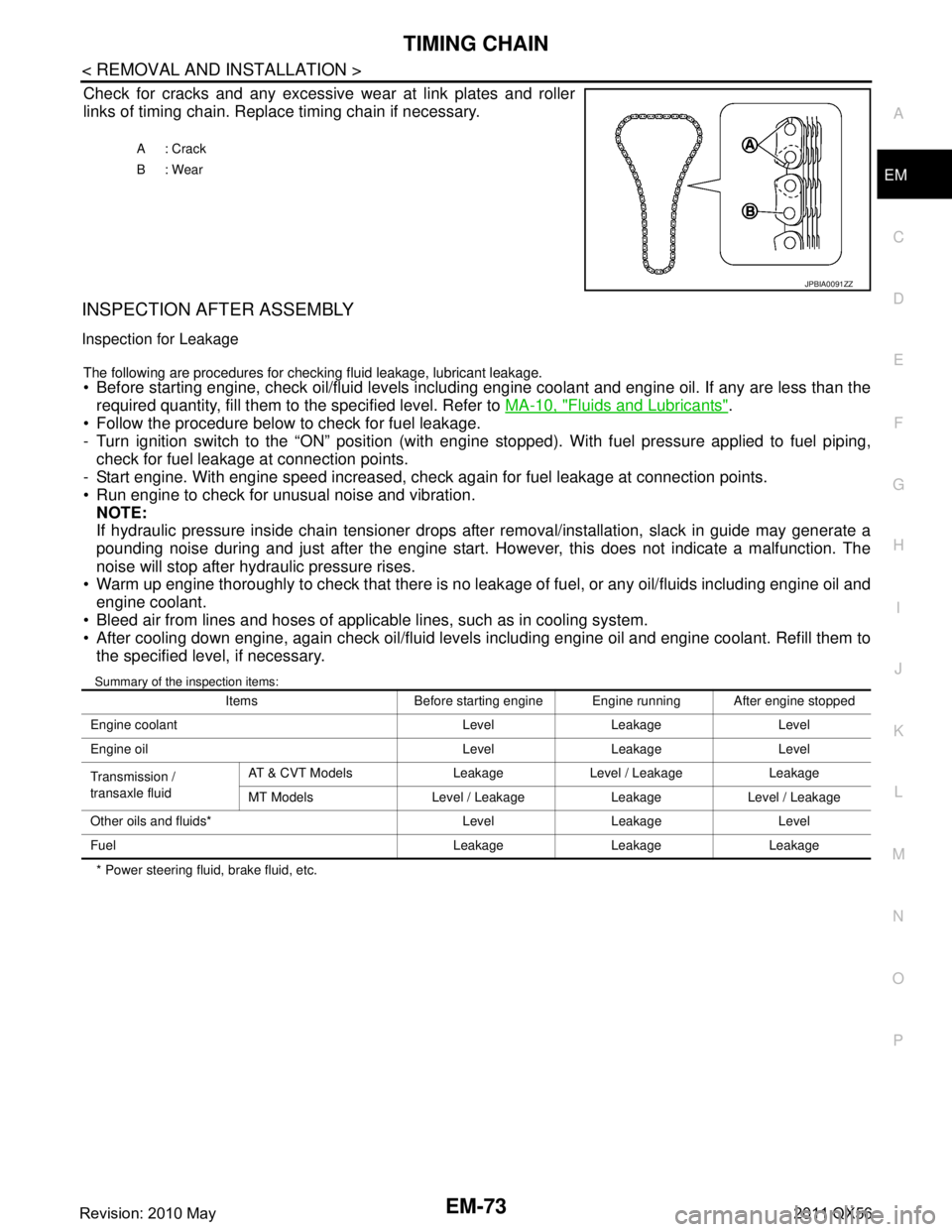
Check for cracks and any excessive
wear at link plates and roller
links of timing chain. Replace timing chain if necessary.
INSPECTION AFTER ASSEMBLY
Inspection for Leakage
The following are procedures for chec king fluid leakage, lubricant leakage. Before starting engine, check oil/fluid levels including engine coolant and engine oil. If any are less than the
required quantity, fill them to the specified level. Refer to MA-10, "
Fluids and Lubricants".
Follow the procedure below to check for fuel leakage.
- Turn ignition switch to the “ON” position (with engi ne stopped). With fuel pressure applied to fuel piping,
check for fuel leakage at connection points.
- Start engine. With engine speed increased, check again for fuel leakage at connection points.
Run engine to check for unusual noise and vibration.
NOTE:
If hydraulic pressure inside chain tensioner drops after removal/installation, slack in guide may generate a
pounding noise during and just after the engine start. However, this does not indicate a malfunction. The
noise will stop after hydraulic pressure rises.
Warm up engine thoroughly to check that there is no leak age of fuel, or any oil/fluids including engine oil and
engine coolant.
Bleed air from lines and hoses of applicable lines, such as in cooling system.
After cooling down engine, again check oil/fluid levels including engine oil and engine coolant. Refill them to the specified level, if necessary.
Summary of the inspection items:
* Power steering fluid, brake fluid, etc. A: Crack
B: Wear
JPBIA0091ZZ
Items Before starting engine Engine running After engine stopped
Engine coolant Level Leakage Level
Engine oil Level Leakage Level
Transmission /
transaxle fluid AT & CVT Models Leakage Level / Leakage Leakage
MT Models Level / Leakage Leakage Level / Leakage
Other oils and fluids* Level Leakage Level
Fuel Leakage Leakage Leakage
Revision: 2010 May2011 QX56
Page 2647 of 5598
CAMSHAFTEM-85
< REMOVAL AND INSTALLATION >
C
DE
F
G H
I
J
K L
M A
EM
NP
O
5. Perform the following inspection if engine oil does not
come out from valve timing control solenoid valve
oil hole of the valve timing control cover.
Remove oil filter, and then clean it. Refer to EM-61, "
Exploded View".
Clean oil groove between oil strainer and valve timing control solenoid valve. Refer to LU-5, "
Engine
Lubrication System" and LU-6, "Engine Lubrication System Schematic".
6. Remove components between valve timing control solenoid valve and camshaft sprocket, and then check each oil groove for clogging.
Clean oil groove if necessary. Refer to LU-5, "
Engine Lubrication System" and LU-6, "Engine Lubrica-
tion System Schematic".
7. After inspection, install removed parts in the reverse order.
Inspection for Leakage
The following are procedures for chec king fluid leakage, lubricant leakage.
Before starting engine, check oil/fluid levels including engine coolant and engine oil. If any are less than the
required quantity, fill them to the specified level. Refer to MA-10, "
Fluids and Lubricants".
Follow the procedure below to check for fuel leakage.
- Turn ignition switch to the “ON” position (with engi ne stopped). With fuel pressure applied to fuel piping,
check for fuel leakage at connection points.
- Start engine. With engine speed increased, check again for fuel leakage at connection points.
Run engine to check for unusual noise and vibration. NOTE:
If hydraulic pressure inside chain tensioner drops after removal/installation, slack in guide may generate a
pounding noise during and just after the engine start. However, this does not indicate a malfunction. The
noise will stop after hydraulic pressure rises.
Warm up engine thoroughly to check that there is no leak age of fuel, or any oil/fluids including engine oil and
engine coolant.
Bleed air from lines and hoses of applicable lines, such as in cooling system.
After cooling down engine, again check oil/fluid levels including engine oil and engine coolant. Refill them to
the specified level, if necessary.
Summary of the inspection items:
* Power steering fluid, brake fluid, etc. Items Before starting engine Engine running After engine stopped
Engine coolant Level Leakage Level
Engine oil Level Leakage Level
Transmission /
transaxle fluid AT & CVT Models Leakage Level / Leakage Leakage
MT Models Level / Leakage Leakage Level / Leakage
Other oils and fluids* Level Leakage Level
Fuel Leakage Leakage Leakage
Revision: 2010 May2011 QX56