cooling INFINITI QX60 2023 User Guide
[x] Cancel search | Manufacturer: INFINITI, Model Year: 2023, Model line: QX60, Model: INFINITI QX60 2023Pages: 636, PDF Size: 7.28 MB
Page 521 of 636

8 Do-it-yourself
Maintenance precautions........................8-2
Engine compartment check locations .............8-3
Engine cooling system .......................... 8-4
Checking engine coolant level .................8-5
Changing engine coolant ......................8-5
Engine oil ........................................8-6
Checking engine oil level .......................8-6
Changing engine oil and oil filter ...............8-6
Automatic Transmission Fluid (ATF) ............8-10
Brake fluid ...................................... 8-11
Windshield-washer fluid ......................... 8-11
Windshield-washer fluid reservoir .............8-11
Battery ........................................ 8-13
Jump starting ............................... 8-14
Variable voltage control system ................8-15
Drive belt ...................................... 8-15
Spark plugs .................................... 8-16
Replacing spark plugs ....................... 8-16
Air cleaner ..................................... 8-17
In-cabin microfilter .......................... 8-17Windshield wiper blades
........................ 8-18
Cleaning .................................... 8-18
Replacing ................................... 8-18
Brakes ......................................... 8-20
Fuses .......................................... 8-20
Engine compartment ........................ 8-21
Passenger compartment ....................8-22
Battery replacement ........................... 8-24
INFINITI Intelligent Key .....................8-24
Lights ......................................... 8-26
Headlights .................................. 8-26
Exterior and interior lights ...................8-26
Wheels and tires ............................... 8-28
Tire pressure ................................ 8-28
Tire labeling ................................ 8-33
Types of tires ............................... 8-37
Tire chains .................................. 8-38
Changing
wheels and tires ................... 8-39
Page 522 of 636

When performing any inspection or maintenance
work on your vehicle, always take care to pre-
vent serious accidental injury to yourself or dam-
age to the vehicle. The following are general
precautions which should be closely observed.
WARNING
• Park the vehicle on a level surface, apply
the parking brake securely and block the
wheels to prevent the vehicle from mov-
ing. Push the park button to engage the
P (Park) position.
• Be sure the ignition switch is in the OFF
or LOCK position when performing any
parts replacement or repairs.
• If you must work with the engine run-
ning, keep your hands, clothing, hair and
tools away from moving fans, belts and
any other moving parts.
• It is advisable to secure or remove any
loose clothing and remove any jewelry,
such as rings, watches, etc. before work-
ing on your vehicle.
• Always wear eye protection whenever
you work on your vehicle.
• Your vehicle is equipped with an auto-
matic engine cooling fan. It may come on
at any time without warning, even if the
ignition switch is in the OFF position and the engine is not running. To avoid injury,
always disconnect the negative battery
cable before working near the fan.
• If you must run the engine in an enclosed
space such as a garage, be sure there is
proper ventilation for exhaust gases to
escape.
• Never get under the vehicle while it is
supported only by a jack. If it is necessary
to work under the vehicle, support it
with safety stands.
•
Keep smoking materials, flame and sparks
away from the fuel tank and battery.
• Because the fuel lines on gasoline engine
models are under high pressure even
when the engine is off, it is recommended
that you visit an INFINITI retailer for ser-
vice of the fuel filter or fuel lines.
CAUTION
• Do not work under the hood while the
engine is hot. Turn the engine off and
wait until it cools down.
• Avoid contact with used engine oil and
coolant. Improperly disposed engine oil,
engine coolant and/or other vehicle flu-
ids can damage the environment. Always
conform to local regulations for disposal
of vehicle fluid. •
Never leave the engine or automatic
transmission related component har-
nesses disconnected while the ignition
switch is in the ON position.
• Never connect or disconnect the battery
or any transistorized component while
the ignition switch is in the ON position.
NOTE:
If the battery is completely drained the
transmission will not manually shift to other
positions.
This “Do-it-yourself” section gives instruc-
tions regarding only those items which are
relatively easy for an owner to perform.
A Genuine INFINITI service manual is also
available. For additional information, see
“Owner’s Manual/Service Manual order in-
formation” (P. 10-36).
You should be aware that incomplete or im-
proper servicing may result in operating diffi-
culties or excessive emissions, and could af-
fect warranty coverage. If in doubt about any
servicing, it is recommended that you have it
done by an INFINITI retailer.
MAINTENANCE PRECAUTIONS
8-2Do-it-yourself
Page 524 of 636

The engine cooling system is filled at the
factory with a pre-diluted mixture of 50%
Genuine NISSAN Long Life Antifreeze/
Coolant (blue) and 50% water to provide
year-round antifreeze and coolant protec-
tion. The antifreeze solution contains rust
and corrosion inhibitors. Additional engine
cooling system additives are not necessary.
WARNING
• Never remove the radiator or coolant
reservoir cap when the engine is hot.
Wait until the engine and radiator cool
down. Serious burns could be caused by
high pressure fluid escaping from the
radiator. For additional information on
precautions, see “If your vehicle over-
heats” (P. 6-14).
• The radiator is equipped with a pressure
type radiator cap. To prevent engine
damage, use only a Genuine NISSAN ra-
diator cap.
CAUTION
• Never use any cooling system additives
such as radiator sealer. Additives may
clog the cooling system and cause dam-
age to the engine, transmission and/or
cooling system.
• When adding or replacing coolant, be
sure to use only Genuine NISSAN Long
Life Antifreeze/Coolant (blue) or
equivalent. Genuine NISSAN Long Life
Antifreeze/Coolant (blue) is pre-diluted
to provide antifreeze protection to -34°
F (-37° C). If additional freeze protection
is needed due to weather where you op-
erate your vehicle, add Genuine NISSAN
Long Life Antifreeze/Coolant (blue)
concentrate following the directions on
the container. If an equivalent coolant
other than Genuine NISSAN Long Life
Antifreeze/Coolant (blue) is used, fol-
low the coolant manufacturer’s instruc-
tions to maintain minimum antifreeze
protection to -34° F (-37° C). The use of
other types of coolant solutions other
than Genuine NISSAN Long Life
Antifreeze/Coolant (blue) or equivalent
may damage the engine cooling system. •
The life expectancy of the factory-fill
coolant is 105,000 miles (168,000 km)
or 7 years. Mixing any other type of cool-
ant other than Genuine NISSAN Long
Life Antifreeze/Coolant (blue) (or
equivalent coolant), including Genuine
NISSAN Long Life Antifreeze/Coolant
(green), or the use of non-distilled water
may reduce the life expectancy of the
factory-fill coolant. For additional infor-
mation, see the “Maintenance and
schedules” section of this manual.
ENGINE COOLING SYSTEM
8-4Do-it-yourself
Page 525 of 636
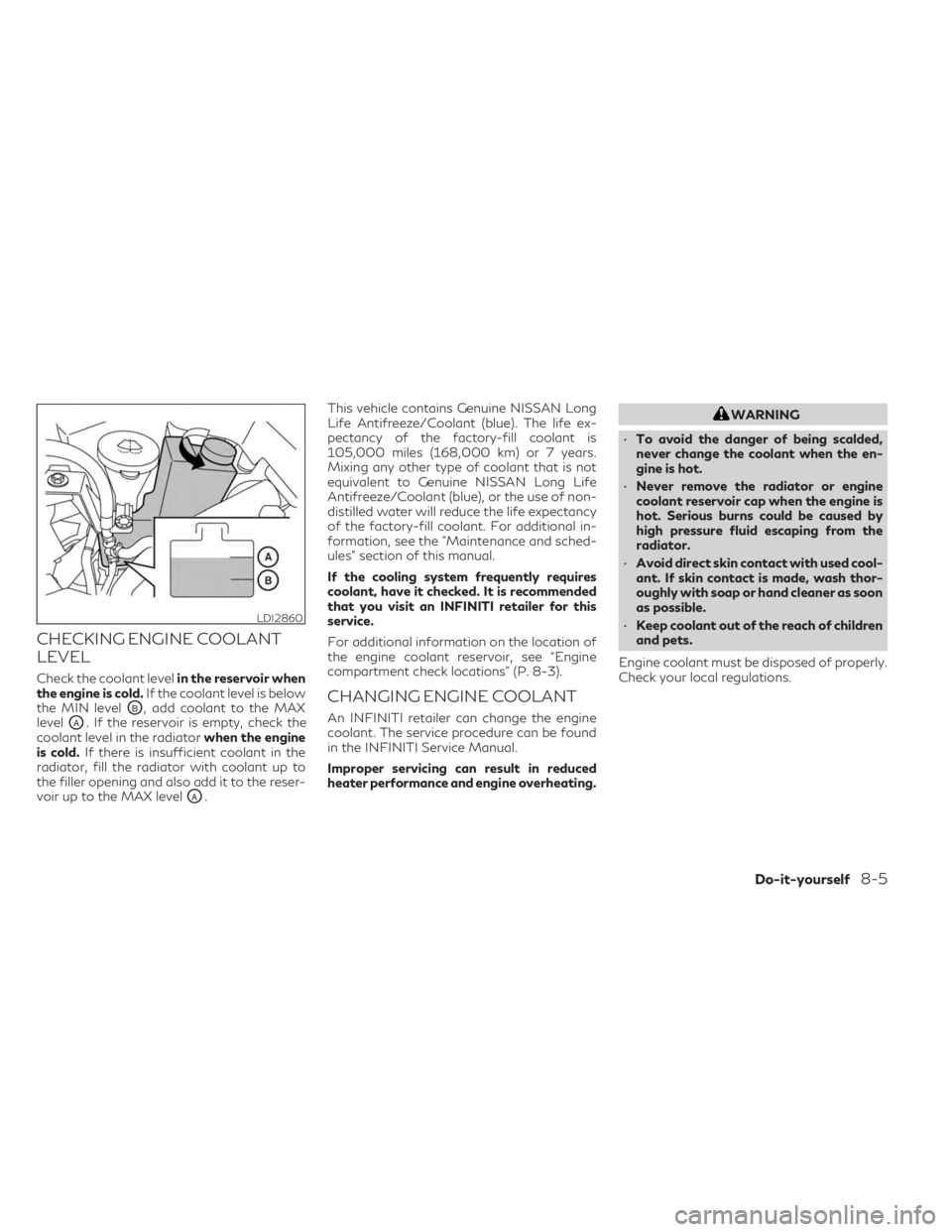
CHECKING ENGINE COOLANT
LEVEL
Check the coolant levelin the reservoir when
the engine is cold. If the coolant level is below
the MIN level
OB, add coolant to the MAX
level
OA. If the reservoir is empty, check the
coolant level in the radiator when the engine
is cold. If there is insufficient coolant in the
radiator, fill the radiator with coolant up to
the filler opening and also add it to the reser-
voir up to the MAX level
OA. This vehicle contains Genuine NISSAN Long
Life Antifreeze/Coolant (blue). The life ex-
pectancy of the factory-fill coolant is
105,000 miles (168,000 km) or 7 years.
Mixing any other type of coolant that is not
equivalent to Genuine NISSAN Long Life
Antifreeze/Coolant (blue), or the use of non-
distilled water will reduce the life expectancy
of the factory-fill coolant. For additional in-
formation, see the "Maintenance and sched-
ules" section of this manual.
If the cooling system frequently requires
coolant, have it checked. It is recommended
that you visit an INFINITI retailer for this
service.
For additional information on the location of
the engine coolant reservoir, see “Engine
compartment check locations” (P. 8-3).
CHANGING ENGINE COOLANT
An INFINITI retailer can change the engine
coolant. The service procedure can be found
in the INFINITI Service Manual.
Improper servicing can result in reduced
heater performance and engine overheating.
WARNING
• To avoid the danger of being scalded,
never change the coolant when the en-
gine is hot.
• Never remove the radiator or engine
coolant reservoir cap when the engine is
hot. Serious burns could be caused by
high pressure fluid escaping from the
radiator.
• Avoid direct skin contact with used cool-
ant. If skin contact is made, wash thor-
oughly with soap or hand cleaner as soon
as possible.
• Keep coolant out of the reach of children
and pets.
Engine coolant must be disposed of properly.
Check your local regulations.
LDI2860
Do-it-yourself8-5
Page 568 of 636
Engine coolant*:Replace coolant at the
specified interval. When adding or replacing
coolant, be sure to use only Genuine NISSAN
Long Life Antifreeze/Coolant (blue) or
equivalent with the proper mixture. (For ad-
ditional information on the proper mixture for
your area, see “Engine cooling system”
(P. 8-4).)
NOTE: Mixing any other type of coolant or
the use of non-distilled water may reduce
the recommended service interval of the
coolant.
Engine oil and oil filter: Replace engine oil
and oil filter at the specified intervals. For
recommended oil grade and viscosity, see
“Recommended fluids/lubricants and capaci-
ties” (P. 10-2).
Engine valve clearance*: Inspect only if valve
noise increases. Adjust valve clearance if
necessary.
Evaporative emissions control vapor lines*:
Check vapor lines for leaks or looseness.
Tighten connections or replace parts as
necessary.
Fuel filter: Periodic maintenance is not re-
quired. (in-tank type filter) Fuel lines*:
Check the fuel hoses, piping and
connections for leaks, looseness, or deterio-
ration. Tighten connections or replace parts
as necessary.
Spark plugs: Replace at specified intervals.
Install new plugs of the same type as origi-
nally equipped.
CHASSIS AND BODY
MAINTENANCE:
Brake lines and cables: Visually inspect for
proper installation. Check for chafing, cracks,
deterioration, and signs of leaking. Replace
any deteriorated or damaged parts
immediately.
Brake pads and rotors: Check for wear, de-
terioration and fluid leaks. Replace any dete-
riorated or damaged parts immediately.
Exhaust system: Visually inspect the exhaust
pipes, muffler and hangers for leaks, cracks,
deterioration, and damage. Tighten connec-
tions or replace parts as necessary.
In-cabin microfilter: Replace at specified in-
tervals. When driving for prolonged periods in
dusty conditions, replace the filter more
frequently. Propeller shaft(s):
Check for damage, loose-
ness, and grease leakage. (AWD)
Steering gear and linkage, axle and suspen-
sion parts, drive shaft boots: Check for dam-
age, looseness, and leakage of oil or grease.
Under severe driving conditions, inspect more
frequently.
Tire rotation: Rotate tires at the specified
interval shown in the maintenance schedule.
When rotating tires, check for damage and
uneven wear. Replace if necessary.
Transmission fluid/oil, differential oil and
transfer case oil: Visually inspect for signs of
leakage at specified intervals.
Replace at specified intervals.
9-6Maintenance and schedules
Page 607 of 636
Remember to keep trailer tongue weight be-
tween 10 - 15% of the trailer weight or within
the trailer tongue load specification recom-
mended by the trailer manufacturer. If the
tongue load becomes excessive, rearrange
the cargo to obtain the proper tongue load.
Do not exceed the maximum tongue weight
specification shown in the “Towing Load/
Specification” chart even if the calculated
available tongue weight is greater than 15%.
If the calculated tongue weight is less than
10%, reduce the total trailer weight to match
the available tongue weight.
Always verify that available capacities are
within the required ratings.TOWING LOAD/SPECIFICATION
WARNING
The towing capacities provided in this
manual are for general reference only. The
safe towing capacity of your vehicle is af-
fected by dealer and factory installed op-
tions and passenger and cargo loads. You
must weigh the vehicle and trailer as de-
scribed in this manual to determine the ac-
tual vehicle towing capacity. Do not exceed
the published maximum towing capacity or
the GCWR or the GVWR shown on the
FMVSS/CMVSS label. Doing so can result
in an accident causing serious personal in-
jury or property damage.
TOWING LOAD/SPECIFICATION CHART
With Tow Package*1 Without Tow Package
Metric measure US measureMetric measure US measure
Maximum Towing Capacity*2 2,722 kg6,000 lbs. 1,588 kg3,500 lbs.
Maximum Tongue Load 272 kg600 lbs. 158 kg350 lbs.
Maximum Gross Combined
Weight Rating 5,035 kg
11,102 lbs. 4,000 kg8,820 lbs.
*1 Vehicles equipped with the towing package include additional powertrain cooling capacity that is specifically designed to handle the higher towing weight.
*2 The towing capacity values are calculated assuming a base vehicle with driver and any options required to achieve the rating. Additional passengers, cargo and/or optional equipment will add weight to the vehicle and reduce your vehicle's maximum towing capacity.
Technical and consumer information10-23
Page 624 of 636

Child restraints.....1-25, 1-26, 1-28, 1-30LATCH (Lower Anchors and Tethers for
CHildren) System.............1-30Precautions on child
restraints...........1-39, 1-45, 1-51Top tether strap anchor point
locations.................. .1-36Child safety rear door lock...........3-6Cleaning exterior and interior......7-2, 7-4Climate-controlled seat switches......2-84Cold weather driving........... .5-184Console box................ .2-102Console light.................2-114Controls
Heater and air conditioner controls. . .4-30CoolantCapacities and recommended
fuel/lubricants
.............. .10-2Changing engine coolant..........8-5Checking engine coolant level.......8-5Engine coolant temperature gauge. . . .2-9Corrosion protection..............7-7Cruise control................ .5-83Cup holders.................2-104
D
Defroster switch
Rear window and outside mirror defroster
switch
................... .2-77Dimensions and weights...........10-9Dimmer switch for instrument panel. . . .2-83Door locks................... .3-4
Drive belt....................8-15Driver Attention Alert............5-156Driving
Cold weather driving..........5-184Driving with automatic transmission. .5-18Precautions when starting and
driving................ .5-4, 5-10Driving the vehicle...............5-18Dual panel moonroof............2-111
E
E-call (SOS) Button............. .2-92Eco Drive Report.............. .5-33Economy - fuel............... .5-161Emergency engine shutoff.......5-14, 6-3Emission control information label. . . .10-12Emission control system warranty. . . .10-32Engine
Before starting the engine........5-16Capacities and recommended
fuel/lubricants.............. .10-2Changing engine coolant..........8-5Changing engine oil.............8-6Changing engine oil filter..........8-6Checking engine coolant level.......8-5Checking engine oil level..........8-6Engine coolant temperature gauge. . . .2-9Engine cooling system...........8-4Engine oil.................. .8-6Engine oil and oil filter
recommendation..............10-6Engine oil pressure warning light. . . .2-15
Engine oil viscosity.............10-7Engine serial number...........10-11Engine specifications...........10-8Starting the engine............ .5-16Engine coolant temperature gauge. . . . .2-9Event Data recorders.......10-34, 10-35Exhaust gas (Carbon monoxide).......5-4Explanation of maintenance items......9-2Explanation of scheduled maintenance
items...................... .9-5Extended storage switch...........2-99
F
F.M.V.S.S. certification label........10-11Flashers (See hazard warning flasher
switch)..................... .6-2Flat tire...................6-3, 6-4Floor mat positioning aid...........7-6Fluid
Brake fluid................. .8-11Capacities and recommended
fuel/lubricants...............10-2Engine coolant............... .8-4Engine oil.................. .8-6Windshield-washer fluid.........8-11Forward Emergency Braking (FEB) with
Pedestrian Detection system. . .2-17, 5-128Front air bag system
(See supplemental restraint system). . . .1-62Front and rear sonar system........5-172Front power seat adjustment.........1-3Front seats................... .1-2
11-2