engine ISUZU KB P190 2007 Workshop Repair Manual
[x] Cancel search | Manufacturer: ISUZU, Model Year: 2007, Model line: KB P190, Model: ISUZU KB P190 2007Pages: 6020, PDF Size: 70.23 MB
Page 4393 of 6020
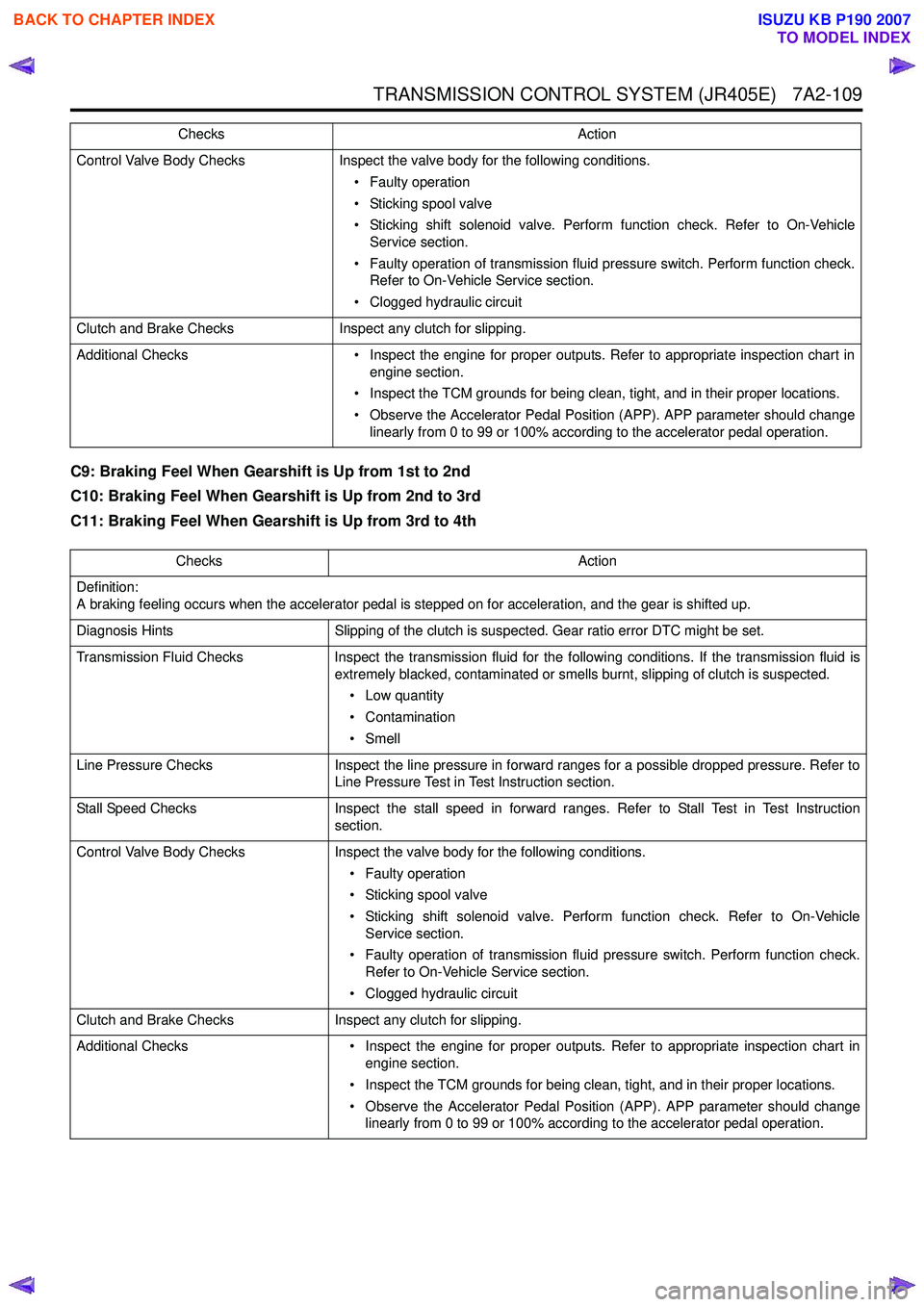
TRANSMISSION CONTROL SYSTEM (JR405E) 7A2-109
C9: Braking Feel When Gearshift is Up from 1st to 2nd
C10: Braking Feel When Gearshift is Up from 2nd to 3rd
C11: Braking Feel When Gearshift is Up from 3rd to 4th
Control Valve Body Checks Inspect the valve body for the following conditions.
• Faulty operation
• Sticking spool valve
• Sticking shift solenoid valve. Perform function check. Refer to On-Vehicle Service section.
• Faulty operation of transmission fluid pressure switch. Perform function check. Refer to On-Vehicle Service section.
• Clogged hydraulic circuit
Clutch and Brake Checks Inspect any clutch for slipping.
Additional Checks • Inspect the engine for proper outputs. Refer to appropriate inspection chart in
engine section.
• Inspect the TCM grounds for being clean, tight, and in their proper locations.
• Observe the Accelerator Pedal Position (APP). APP parameter should change linearly from 0 to 99 or 100% according to the accelerator pedal operation.
Checks Action
Definition:
A braking feeling occurs when the accelerator pedal is stepped on for acceleration, and the gear is shifted up.
Diagnosis Hints Slipping of the clutch is suspected. Gear ratio error DTC might be set.
Transmission Fluid Checks Inspect the transmission fluid for the following conditions. If the transmission fluid is
extremely blacked, contaminated or smells burnt, slipping of clutch is suspected.
• Low quantity
• Contamination
• Smell
Line Pressure Checks Inspect the line pressure in forward ranges for a possible dropped pressure. Refer to
Line Pressure Test in Test Instruction section.
Stall Speed Checks Inspect the stall speed in forward ranges. Refer to Stall Test in Test Instruction
section.
Control Valve Body Checks Inspect the valve body for the following conditions.
• Faulty operation
• Sticking spool valve
• Sticking shift solenoid valve. Perform function check. Refer to On-Vehicle Service section.
• Faulty operation of transmission fluid pressure switch. Perform function check. Refer to On-Vehicle Service section.
• Clogged hydraulic circuit
Clutch and Brake Checks Inspect any clutch for slipping.
Additional Checks • Inspect the engine for proper outputs. Refer to appropriate inspection chart in
engine section.
• Inspect the TCM grounds for being clean, tight, and in their proper locations.
• Observe the Accelerator Pedal Position (APP). APP parameter should change linearly from 0 to 99 or 100% according to the accelerator pedal operation.
Checks
Action
BACK TO CHAPTER INDEX
TO MODEL INDEX
ISUZU KB P190 2007
Page 4394 of 6020

7A2-110 TRANSMISSION CONTROL SYSTEM (JR405E)
C12: Large Shock When Gearshift from 1st to 2nd or 2nd to 1st
C13: Large Shock When Gearshift from 2nd to 3rd or 3rd to 2nd
C14: Large Shock When Gearshift from 3rd to 4th or 4th to 3rd
C15: Large Shock When Kick-down
C16: Large Shock When Accelerator Pedal is Stepped ON or OFF without Gearshift
C17: Large Shock When Gearshift from 2nd to 1st in L Range
C18: Large Shock Others
C19: Large Shock When Vehicle Speed is Reduced by No Accelerator Pedal or Vehicle is Stopped
C20: Large Shock at Lock Up
C21: Shift Down or Engine Overrun When Accelerator Pedal is Stepped ON in 4th Gear
D1: Faulty Gearshift Schedule (Different from Shift Speed Chart)
Checks Action
Definition: • A large shock is felt when the accelerator pedal is stepped on for acceleration and the gear is shifted up or down.
• A large shock is felt when the accelerator pedal is stepped on for kick-down.
• A large shock is felt when the accelerator pedal is not stepped on.
• A large shock is felt when the selector lever is selected in L range.
Diagnosis Hints The same causes as in category No. “C1 - C8: Engine Race Up (Slipping)” are
suspected.
Checks Action
Definition:
A large shock is felt at lock up.
Diagnosis Hints Incorrect input signals or faulty operation of torque converter clutch is suspected.
Refer to category No. “I1: No Lock Up.”
Checks Action
Definition:
Shift down or engine overrun occurs above than kick-down area.
Diagnosis Hints The same causes as in category No. “C1 - C8: Engine Race Up (Slipping)” are
suspected.
Checks Action
Definition:
Faulty gearshift schedule, it is differ from the shift speed chart.
BACK TO CHAPTER INDEX
TO MODEL INDEX
ISUZU KB P190 2007
Page 4395 of 6020

TRANSMISSION CONTROL SYSTEM (JR405E) 7A2-111
D2: Gearshift Frequently
Diagnosis Hints• When inspecting faulty gear shifting, it is important to distinguish between
the fault of the electric system and transmission main unit.
• Fault of electric system. - Monitor the output signal (each solenoid driving signal) using a scan tool. If a trouble signal is sent to the solenoid synchronously with the faulty
gear shifting, the fault is originated in the electric system.
- Monitor the input signal (signal from each sensor) using a scan tool and find an input signal which has an output signal (each solenoid driving
signal) subjected to a fault.
- Fault of the electric system may be derived from temperature or vibration. For instance, although the engine is normal while it is cold, fault may
occur when the engine is warmed up or the vehicle is running.
• Fault of mechanical system. - If the gear is incorrectly shifted, irrespective of the operating signal (On/ Off) of each solenoid, the fault is originated from the transmission main
unit.
- If the clutch slips, or the transmission fluid smells burnt or is contaminated or black, or the stall speed increases. Gear ratio error DTC might be set.
Transmission Range Switch & Selector
Lever Cable Checks Inspect the transmission range switch and selector lever cable for misadjusting
or disordering. Refer to On-Vehicle Service section.
Transmission Fluid Checks Inspect the transmission fluid for the following conditions. If the transmission fluid
is extremely blacked, contaminated or smells burnt, slipping of clutch is
suspected.
• Low quantity
• Contamination
•Smell
Line Pressure Checks Inspect the line pressure in forward ranges for a possible dropped pressure.
Refer to Line Pressure Test in Test Instruction section.
Stall Speed Checks Inspect the stall speed in forward ranges. Refer to Stall Test in Test Instruction
section.
Control Valve Body Checks Inspect the valve body for the following conditions.
• Faulty operation
• Sticking spool valve
• Sticking shift solenoid valve. Perform function check. Refer to On-Vehicle Service section.
• Faulty operation of transmission fluid pressure switch. Perform function check. Refer to On-Vehicle Service section.
• Clogged hydraulic circuit
Checks
Action
Checks Action
Definition:
Shift down or engine overrun occurs above than kick-down area.
Diagnosis Hints The same causes as in category No. “C1 - C8: Engine Race Up (Slipping)” are
suspected.
BACK TO CHAPTER INDEX
TO MODEL INDEX
ISUZU KB P190 2007
Page 4396 of 6020

7A2-112 TRANSMISSION CONTROL SYSTEM (JR405E)
D3: Gearshift Point is Low or High at All Points
D4: Gearshift Point is Low or High at Limited Area
D5: No Kick-down
E1: No Gearshift
Checks Action
Definition: • Gearshift point is deviated from the shift speed chart.
• Gear is not shifted up properly, even though the vehicle is accelerating.
• Gear is not shifted immediately and enough acceleration cannot be obtained, even though the accelerator pedal is being stepped on.
Diagnosis Hints • Inspect the output shaft speed (OSS) sensor for faulty operation.
• Incorrect accelerator pedal position signal is suspected. Observe the Accelerator Pedal Position (APP). APP parameter should change linearly
from 0 to 99 or 100% according to the accelerator pedal operation.
Checks Action
Definition:
The engine speeds up but the vehicle speed does not increase when the accelerator pedal is being stepped on at starting.
Diagnosis Hints Incorrect accelerator pedal position signal is suspected. Observe the
Accelerator Pedal Position (APP). APP parameter should change linearly from
0 to 99 or 100% according to the accelerator pedal operation.
Checks Action
Definition: • Gear is fixed, such as no gearshift from 1st to 2nd, 2nd to 3rd, and 3rd to 4th.
• Sometimes the gear is shifted, and sometimes it is not possible.
Diagnosis Hints • Fixing at same gear speed, a signal error from the accelerator pedal
position (APP) sensor or trouble in the transmission main unit are
suspected.
• Slipping of the clutch is suspected. Gear ratio error DTC might be set.
Transmission Range Switch & Selector Lever
Cable Checks Inspect the transmission range switch and selector lever cable for misadjusting
or disordering. Refer to On-Vehicle Service section.
Transmission Fluid Checks Inspect the transmission fluid for the following conditions. If the transmission
fluid is extremely blacked, contaminated or smells burnt, slipping of clutch is
suspected.
• Low quantity
• Contamination
•Smell
Line Pressure Checks Inspect the line pressure in forward ranges for a possible dropped pressure.
Refer to Line Pressure Test in Test Instruction section.
Stall Speed Checks Inspect the stall speed in forward ranges. Refer to Stall Test in Test Instruction
section.
Control Valve Body Checks Inspect the valve body for the following conditions.
• Faulty operation
• Sticking spool valve
• Sticking shift solenoid valve. Perform function check. Refer to On-Vehicle Service section.
• Clogged hydraulic circuit
Clutch and Brake Checks Inspect the low clutch, high clutch or low & reverse brake for slipping.
BACK TO CHAPTER INDEX
TO MODEL INDEX
ISUZU KB P190 2007
Page 4398 of 6020

7A2-114 TRANSMISSION CONTROL SYSTEM (JR405E)
F1: Low Maximum Speed or Poor Acceleration
F2: Engine Race Up (Slipping) During Acceleration
Control Valve Body ChecksInspect the valve body for the following conditions.
• Faulty operation
• Sticking spool valve
• Sticking shift solenoid valve. Perform function check. Refer to On-Vehicle Service section.
• Clogged hydraulic circuit
Checks
Action
ChecksAction
Definition: • Starting acceleration is poor.
• Acceleration is slow, even though the accelerator pedal is stepped on during the running.
Diagnosis Hints In addition to the low engine output, faulty gearshift of the transmission or
fixing at the 3rd gear in the fail-safe operation may also be possible.
Therefore, if “maximum speed is low, and acceleration is poor”, it should be
cleared up whether the trouble originates from the engine system or
transmission control system by a running test, inspection of stall speed, etc.
Transmission Range Switch & Selector Lever
Cable Checks Inspect the transmission range switch and selector lever cable for
misadjusting or disordering. Refer to On-Vehicle Service section.
Transmission Fluid Checks Inspect the transmission fluid for the following conditions. If the transmission
fluid is extremely blacked, contaminated or smells burnt, slipping of clutch is
suspected.
• Low quantity
• Contamination
• Smell
Line Pressure Checks Inspect the line pressure in forward ranges for a possible dropped pressure.
Refer to Line Pressure Test in Test Instruction section.
Stall Speed Checks Inspect the stall speed in forward ranges. Refer to Stall Test in Test Instruction
section.
Control Valve Body Checks Inspect the valve body for the following conditions.
• Faulty operation
• Sticking spool valve
• Sticking shift solenoid valve. Perform function check. Refer to On-Vehicle Service section.
• Clogged hydraulic circuit
Torque Converter Checks Inspect the torque converter for faulty operation.
Clutch and Brake Checks Inspect the low clutch and high clutch for slipping.
Additional Checks • Inspect the engine for proper outputs. Refer to appropriate inspection
chart in engine section.
• Inspect the TCM grounds for being clean, tight, and in their proper locations.
• Observe the Accelerator Pedal Position (APP). APP parameter should change linearly from 0 to 99 or 100% according to the accelerator pedal
operation.
Checks Action
Definition: • Engine speed increases but the vehicle speed does not increase when the accelerator pedal is being stepped on.
BACK TO CHAPTER INDEX
TO MODEL INDEX
ISUZU KB P190 2007
Page 4399 of 6020

TRANSMISSION CONTROL SYSTEM (JR405E) 7A2-115
F3: Noise or Vibration Occurs During in R, D, 3, 2 or L Range
F4: Engine Brake Does Not Apply in L Range
F5: Engine Stalls Before Vehicle Stops from Running
G1: Vehicle Moves in P Range or Parking is Not Disengaged in Other Than P Range
Diagnosis Hints The same causes as in category No. “C1 - C8: Engine Race Up (Slipping)”
are suspected. When the condition of No. C1 - C8 grows worse, No. F2
results.
Checks Action
Definition:
Noise or vibration occurs in the vicinity of the transmission during running.
Diagnosis Hints Cause other than transmission is suspected. Reproduce the running
condition using a lift up, chassis dynamo, etc. to investigate the origin of the
noise and vibration.
Additional Checks • Inspect the differential gear noise.
• Inspect the propeller shaft noise.
• Inspect the tires for unbalanced or poor uniformity.
Checks
Action
Checks Action
Definition:
The engine brake does not apply, allowing the vehicle to run freely when the accelerator pedal is released at low speed in L
range.
Diagnosis Hints • Slipping of the clutch is suspected. Gear ratio error DTC might be set.
Line Pressure Checks Inspect the line pressure in forward ranges for a possible dropped pressure.
Refer to Line Pressure Test in Test Instruction section.
Control Valve Body Checks Inspect the valve body for the following conditions.
• Faulty operation
• Sticking spool valve
• Sticking shift solenoid valve. Perform function check. Refer to On- Vehicle Service section.
• Clogged hydraulic circuit
Clutch and Brake Checks Inspect the low & reverse brake for slipping.
Sensor Checks Inspect the input shaft speed (ISS) sensor and output shaft speed (OSS)
sensor for faulty operation.
Checks Action
Definition:
The engine stalls simultaneously with the vehicle when the brake pedal is stepped on to stop the vehicle during running.
Diagnosis Hints The same causes as in category No. “B5: Engine Stalls When Selector Lever
is Changed from N to R, D, 3, 2 or L Range” is suspected.
Checks Action
Definition:
Vehicle moves even though it stops on a slope and P range is selected.
Vehicle does not move even though a position other than P range is selected, and the accelerator pedal is being stepped on.
Diagnosis Hints If the vehicle moves in N range, refer to category No. “B1: Vehicle Runs in
N Range”.
BACK TO CHAPTER INDEX
TO MODEL INDEX
ISUZU KB P190 2007
Page 4400 of 6020

7A2-116 TRANSMISSION CONTROL SYSTEM (JR405E)
G2: Large Creeping Force
G3: Small Creeping Force
G4: Large Noise During Idle with Vehicle Stop
Transmission Range Switch & Selector Lever
Cable Checks Inspect the transmission range switch and selector lever cable for
misadjusting or disordering. Refer to On-Vehicle Service section.
Additional Checks Inspect the parking mechanism for faulty operation. Checks Action
Checks
Action
Definition:
Vehicle accelerates in R, D, 3, 2 or L range, even though the accelerator pedal is not being stepped on.
Diagnosis Hints Too high idle speed is suspected. Inspect the engine for proper idle speed.
Checks Action
Definition:
Vehicle does not move, even though a run position is selected on a flat road during idling.
Diagnosis Hints When the creep force is small in all positions, low engine output is suspected.
If the creep is normal only in the R position, operation of the fail-safe function
due to trouble in the electrical system is suspected.
Transmission Fluid Checks Inspect the transmission fluid for the following conditions. If the transmission
fluid is extremely blacked, contaminated or smells burnt, slipping of clutch is
suspected.
• Low quantity
• Contamination
•Smell
Line Pressure Checks Inspect the line pressure in forward ranges for a possible dropped pressure.
Refer to Line Pressure Test in Test Instruction section.
Stall Speed Checks Inspect the stall speed in forward ranges. Refer to Stall Test in Test
Instruction section.
Control Valve Body Checks Inspect the valve body for the following conditions.
• Faulty operation
• Sticking spool valve
• Sticking shift solenoid valve. Perform function check. Refer to On- Vehicle Service section.
• Clogged hydraulic circuit
Torque Converter Checks Inspect the torque converter for faulty operation.
Clutch and Brake Checks Inspect the low clutch for slipping.
Additional Checks • Inspect the engine for proper outputs. Refer to appropriate inspection
chart in engine section.
• Inspect the TCM grounds for being clean, tight, and in their proper locations.
• Inspect the ground return circuit for being clean, tight, and in their proper locations.
Checks Action
Definition:
Transmission is noisy during idle in all range.
BACK TO CHAPTER INDEX
TO MODEL INDEX
ISUZU KB P190 2007
Page 4401 of 6020

TRANSMISSION CONTROL SYSTEM (JR405E) 7A2-117
H1: Judder Occurs at Lock Up
H2: Large Shock at Lock Up
H3: Lock Up Point is High or Low
I1: No Lock Up
Diagnosis Hints • Causes such as the solenoid operating sound or a faulty oil pump are
suspected.
• Distinguishing is possible by stopping the solenoid operation temporarily, checking the correlation for the former case and, changing
the line pressure and confirming the correlation with noise.
• As a matter of course, noise other than the transmission may be generated around the engine, and should be checked carefully.
Notice: When the noise is generated only at the time of a gear shift, it may
be the sound of transmission fluid flowing or gear noise. If the sound varies
depending on the gear speed to be shifted, it may be the gear noise
generated from the planetary gear and its components. If the sound varies
depending on the vehicle speed, it may be the gear noise of the output
system, or the gear noise of the input system or a faulty torque converter.
Checks
Action
Checks Action
Definition:
Judder occurs when lock up area.
Diagnosis Hints Slip due to burning of the torque converter clutch (TCC) facing or insufficient
engagement due to dropped working pressure are suspected. Refer to
category No. “l1: No Lock Up “.
Notice: When the TCC facing has burnt, foreign material mixed in the oil
cooler is suspected. In such a case, inspect the oil cooler circuit for clogging
of the oil cooler.
Checks Action
Definition: • A large shock is felt at lock up.
• Lock up point is excessively high or low.
Diagnosis Hints Incorrect input signals or faulty operation of torque converter clutch (TCC) is
suspected. Refer to category No. “I1: No Lock Up”.
Checks Action
Definition:
Lock up is not performed even though lock up control conditions being satisfied.
Diagnosis Hints • Monitor the signal to the torque converter clutch (TCC) solenoid valve
while carrying out a running test.
• When the transmission fluid temperature is lower than 20 °C (68 °F),
lock up control is inhibited.
• When the output signal to the TCC solenoid valve is sent correctly, causing no lock up, clogged hydraulic circuits or malfunction of the TCC
piston may be suspected.
• Even with the lock up area, the output signal to the TCC solenoid valve is not sent, a fault of the transmission fluid temperature (TFT) sensor
controlling the lock up may be suspected.
Notice: When the TCC facing has burnt, foreign material mixed in the oil
cooler is suspected. In such a case, inspect the oil cooler circuit for clogging
of the oil cooler.
BACK TO CHAPTER INDEX
TO MODEL INDEX
ISUZU KB P190 2007
Page 4402 of 6020

7A2-118 TRANSMISSION CONTROL SYSTEM (JR405E)
J1: Transmission Fluid Leaks from Breather
J2: Transmission Fluid Leaks Between Engine and Converter Housing
J3: Transmission Fluid Leaks Between Converter Housing and Transmission Case
J4: Transmission Fluid Leaks Between Transmission Case and Extension Housing
J3: Transmission Fluid Leaks from Oil Pan
J3: Transmission Fluid Leaks from Manual Shaft Oil Seal
J3: Transmission Fluid Leaks from Oil Cooler Pipe Joint
Z1: Transmission Overheat
Transmission Fluid Checks Inspect the transmission fluid for the following conditions. If the transmission
fluid is extremely blacked, contaminated or smells burnt, slipping of clutch is
suspected.
• Low quantity
• Contamination
• Smell
Control Valve Body Checks Inspect the valve body for the following conditions.
• Faulty operation
• Sticking spool valve
• Sticking TCC solenoid valve. Perform function check. Refer to On- Vehicle Service section.
• Clogged hydraulic circuit
Sensor Checks Inspect the TFT sensor. Use the Temperature vs. Resistance table to test
the TFT sensor at various temperature levels to evaluate the possibility of a
skewed sensor.
Checks
Action
Checks Action
Definition:
Transmission fluid leaks from breather.
Diagnosis Hints Transmission fluid quantity is excessively high.
Checks Action
Definition:
Transmission fluid leaks between engine and converter housing.
Transmission fluid leaks between converter housing and transmission case.
Transmission fluid leaks between transmission case and extension housing.
Transmission fluid leaks from oil pan.
Transmission fluid leaks from manual shaft oil seal.
Transmission fluid leaks from oil cooler pipe joint.
Diagnosis Hints Faulty oil seal or contact surface is suspected.
Checks Action
Definition:
Smells burnt or smoke from transmission.
Diagnosis Hints • Transmission fluid quantity is excessively high.
• Slipping of the clutch is suspected. Gear ratio error DTC might be set.
• Clogged oil cooler.
• Faulty operation of oil pump.
• Faulty torque converter clutch (TCC) piston.
BACK TO CHAPTER INDEX
TO MODEL INDEX
ISUZU KB P190 2007
Page 4403 of 6020

TRANSMISSION CONTROL SYSTEM (JR405E) 7A2-119
Z2: Mode Lamp (Power Drive or 3rd Start) Does Not Turn On
Z3: Mode Lamp (Power Drive or 3rd Start) Does Not Turn Off
Z4: A/T Oil Temperature Lamp Turns On
Z5: Selector Lever Feeling is Faulty
Z6: Poor Fuel Consumption
Checks Action
Definition:
Mode lamp on the instrument panel (IP) cluster does not turn ON even though the switch is ON.
Diagnosis Hints • Faulty mode switch circuit.
• Faulty mode switch.
• Faulty lamp control circuit.
• Faulty IP cluster.
Checks Action
Definition:
Mode lamp on the instrument panel cluster does not turn OFF even though the switch is OFF.
Diagnosis Hints • Faulty mode switch circuit.
• Faulty mode switch.
• Faulty lamp control circuit.
• Faulty IP cluster.
Checks Action
Definition:
A/T oil temperature lamp turns On sometimes.
Diagnosis Hints • If the fluid temperature increases to 135°C (275 °F), the TCM illuminates
A/T Oil Temp lamp on the instrument panel cluster. When the fluid
temperature deceases below 125 °C (257 °F), the lamp goes off.
• When the vehicle is stuck in the mud or continues to accelerate under overload, transmission fluid temperature increases and lamp may be
turned On.
• If the lamp is On under usual conditions, following causes are suspected. - Transmission fluid level has increased for some fault. Refer to category No. “Z1: Transmission Overheat”.
- Skewed transmission fluid temperature (TFT) sensor.
Checks Action
Definition:
Selector lever feeling is faulty.
Diagnosis Hints • Inspect the selector lever cable for misadjusting or disordering.
• Faulty manual plate.
Checks Action
Definition:
Poor fuel consumption.
Diagnosis Hints The same causes as in category No. “C1 - C8: Engine Race Up (Slipping)” are
suspected.
BACK TO CHAPTER INDEX
TO MODEL INDEX
ISUZU KB P190 2007