start ISUZU KB P190 2007 Workshop Repair Manual
[x] Cancel search | Manufacturer: ISUZU, Model Year: 2007, Model line: KB P190, Model: ISUZU KB P190 2007Pages: 6020, PDF Size: 70.23 MB
Page 2256 of 6020

6E–86 ENGINE DRIVEABILITY AND EMISSIONS
5. After choosing the data, click the “Next” button.
6. When all the necessary information is entered, the “details” of software within the database that match
the entered data will appear for confirmation. Click
the “Program” switch and then download the new
software onto Tech-2.
7. “Data Transfer” comes on display. The progress of downloading will be displayed on the screen in the
form of bar graph.
8. Upon finishing the data transfer, turn off the power of Tech-2, removing from P/C. 4. Programming of ECM
1. Check to see if batteries are fully charged, while ABS connectors shall be removed from the vehicle.
2. Connect Tech-2 to Vehicle Diagnostic Connectors.
3. Turn on the power of Tech-2 and the title screen comes on display.
4. Turn on the ignition (without allowing the engine to start)
5. On the title screen of Tech-2, push the “Enter” button.
6. Choose “F1: Service Programming System” on the main screen and then choose “Fl: Program ECU”.
7. While data is being transferred, “Programming in Progress” will be displayed on the Tech-2 screen.
8. Upon finishing the data transfer, Tech-2 will display “Reprogramming Was Successful”. Push the “Exit”
button to bring program to completion
9. Following “Procedure 2: Demand of Data”, try over again “Information Obtaining” and check to confirm
if the data has been correctly re-loaded.
10. Upon finishing confirmation, turn off the ignition of the vehicle and then turn off the power of Tech-2,
removing from the vehicle.
BACK TO CHAPTER INDEX
TO MODEL INDEX
ISUZU KB P190 2007
Page 2260 of 6020

6E–90 ENGINE DRIVEABILITY AND EMISSIONS
ON-BOARD DIAGNOSTIC (OBD) SYSTEM CHECK
Circuit Description
The on-board diagnostic system check is the starting
point for any driveability complaint diagnosis. Before
using this procedure, perform a careful visual/physical
check of the ECM and engine grounds for cleanliness
and tightness.
The on-board diagnostic system check is an organized
approach to identifying a problem created by an
electronic engine control system malfunction.
Diagnostic Aids
An intermittent may be caused by a poor connection,
rubbed-through wire insulation or a wire broken inside
the insulation. Check for poor connections or a
damaged harness. Inspect the ECM harness and
connector for improper mating, broken locks, improperly
formed or damaged terminals, poor terminal-to-wire
connection, and damaged harness.
Te s t D e s c r i p t i o n
Number(s) below refer the step number(s) on the
Diagnostic Chart:
1. The Check Engine Lamp (MIL) should be ON steady
with the ignition “On”, engine “Off”. If not, “No Check
Engine Lamp (MIL)” chart should be used to isolate the
malfunction.
2. Checks the Class 2 data circuit and ensures that the
ECM is able to transmit serial data.
3. This test ensures that the ECM is capable of
controlling the Check Engine Lamp (MIL) and the Check
Engine Lamp (MIL) driver circuit is not shorted to
ground circuit.
4. If the engine will not start, “Engine Cranks But Will
Not Run” chart should be used to diagnose the fault.
6. The Tech2 parameters which is not within the typical
range may help to isolate the area which is causing the
problem.
12. This vehicle is equipped with ECM which utilizes an
electrically erasable programmable read only memory
(EEPROM).
BACK TO CHAPTER INDEX
TO MODEL INDEX
ISUZU KB P190 2007
Page 2261 of 6020
ENGINE DRIVEABILITY AND EMISSIONS 6E–91
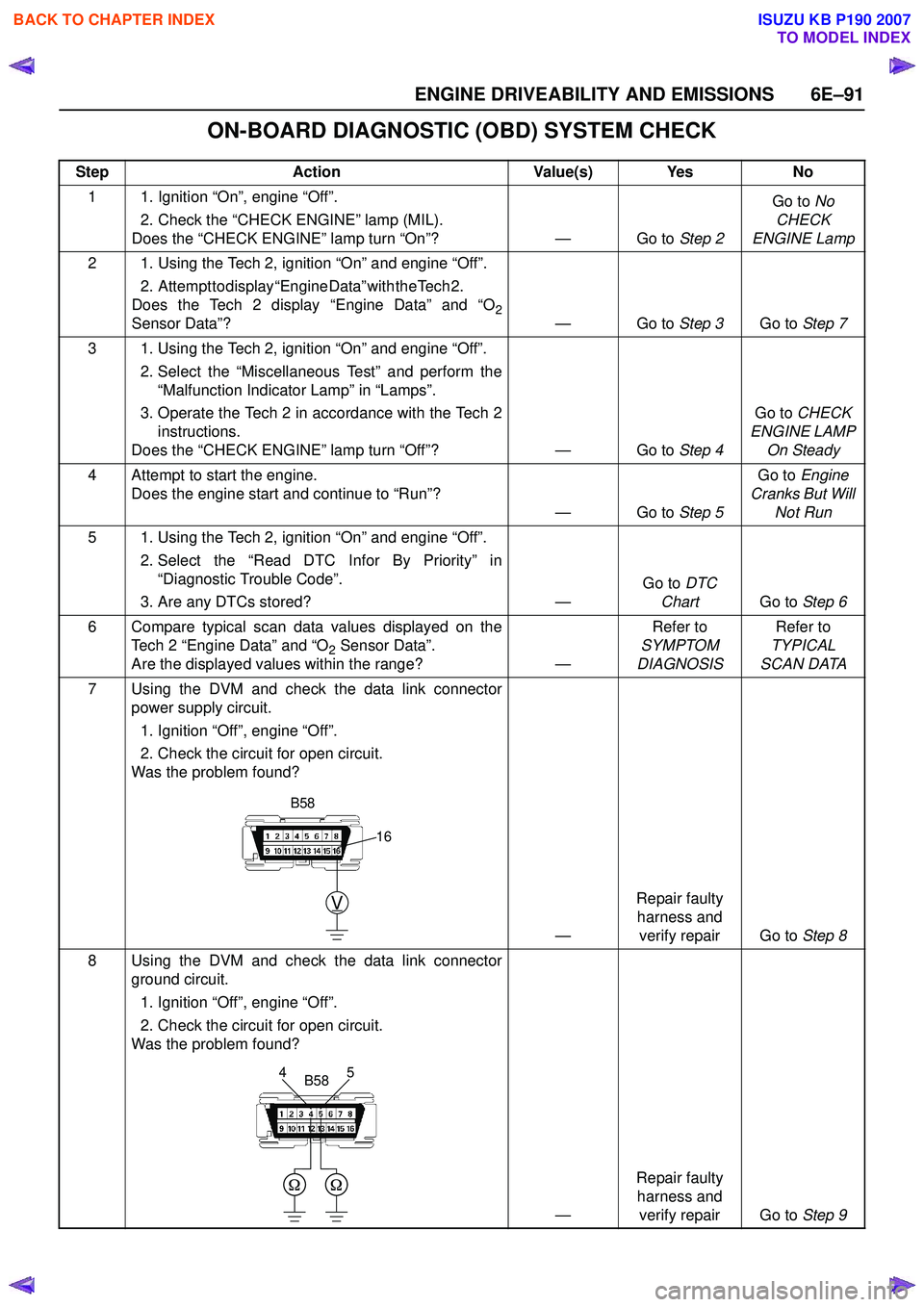
ON-BOARD DIAGNOSTIC (OBD) SYSTEM CHECK
StepAction Value(s) Yes No
1 1. Ignition “On”, engine “Off”. 2. Check the “CHECK ENGINE” lamp (MIL).
Does the “CHECK ENGINE” lamp turn “On”? — Go to Step 2Go to
No
CHECK
ENGINE Lamp
2 1. Using the Tech 2, ignition “On” and engine “Off”. 2 . A t t e m p t t o d i s p l a y “ E n g i n e D a t a ” w i t h t h e T e c h 2 .
Does the Tech 2 display “Engine Data” and “O
2Sensor Data”? — Go to Step 3Go to Step 7
3 1. Using the Tech 2, ignition “On” and engine “Off”. 2. Select the “Miscellaneous Test” and perform the“Malfunction Indicator Lamp” in “Lamps”.
3. Operate the Tech 2 in accordance with the Tech 2 instructions.
Does the “CHECK ENGINE” lamp turn “Off”? — Go to Step 4Go to
CHECK
ENGINE LAMP On Steady
4 Attempt to start the engine. Does the engine start and continue to “Run”? —Go to Step 5Go to
Engine
Cranks But Will Not Run
5 1. Using the Tech 2, ignition “On” and engine “Off”. 2. Select the “Read DTC Infor By Priority” in“Diagnostic Trouble Code”.
3. Are any DTCs stored? —Go to
DTC
Chart Go to Step 6
6 Compare typical scan data values displayed on the Tech 2 “Engine Data” and “O
2 Sensor Data”.
Are the displayed values within the range? —Refer to
SYMPTOM
DIAGNOSIS Refer to
TYPICAL
SCAN DATA
7 Using the DVM and check the data link connector power supply circuit.
1. Ignition “Off”, engine “Off”.
2. Check the circuit for open circuit.
Was the problem found?
—Repair faulty
harness and verify repair Go to Step 8
8 Using the DVM and check the data link connector ground circuit.
1. Ignition “Off”, engine “Off”.
2. Check the circuit for open circuit.
Was the problem found?
—Repair faulty
harness and verify repair Go to Step 9
V
16
B58
5
4B58
BACK TO CHAPTER INDEX
TO MODEL INDEX
ISUZU KB P190 2007
Page 2270 of 6020

6E–100 ENGINE DRIVEABILITY AND EMISSIONS
Injector Coil Test Procedure (Steps 1-6) and Injector Balance Test Procedure (Steps 7-11)
StepAction Value(s) Yes No
1 Was the “On-Board Diagnostic (OBD) System Check” performed? — Go to Step 2Go to
OBD
System Check
2 1. Turn the engine OFF. NOTE: In order to prevent flooding of a single cylinder
and possible engine damage, relieve the fuel pressure
before performing the fuel injector coil test procedure.
2. Relieve the fuel pressure. Refer to Test Description Number 2.
3. Connect the 5-8840-2618-0 Fuel Injector Tester to B+ and ground, and to the 5-8840-2589-0 Injector
Adapter Cable.
4. Remove the harness connector of the Fuel Injector and connect the 5-8840-2589-0 Injector
Adapter Cable for F/I check.
5. Set the amperage supply selector switch on the fuel injector tester to the “Coil Test” 0.5 amp
position.
6. Connect the leads from the 5-8840-2392-0 Digital Voltmeter (DVM) to the fuel injector tester. Refer
to the illustrations associated with the test
description.
7. Set the DVM to the tenths scale (0.0).
8. Observe the engine coolant temperature.
Is the engine coolant temperature within the specified
values? 10°C (50°F)
to
35°C (95°F) Go to Step 3Go to Step 5
3 1. Set the injector adapter cable to injector #1. 2. Press the “Push to Start Test” button on the fuelinjector tester.
3. Observe the voltage reading on the DVM.
Important: The voltage reading may rise during the
test.
4. Record the lowest voltage observed after the first second of the test.
5. Set the injector adapter cable to the next injector and repeat steps 2, 3, and 4.
Did any fuel injector have an erratic voltage reading
(large fluctuations in voltage that did not stabilize) or a
voltage reading outside of the specified values? 5.7-6.6V Go to Step 4Go to Step 7
4 Replace the faulty fuel injector(S). Refer to Fuel
Injector .
Is the action complete? — Go to Step 7—
BACK TO CHAPTER INDEX
TO MODEL INDEX
ISUZU KB P190 2007
Page 2271 of 6020
ENGINE DRIVEABILITY AND EMISSIONS 6E–101
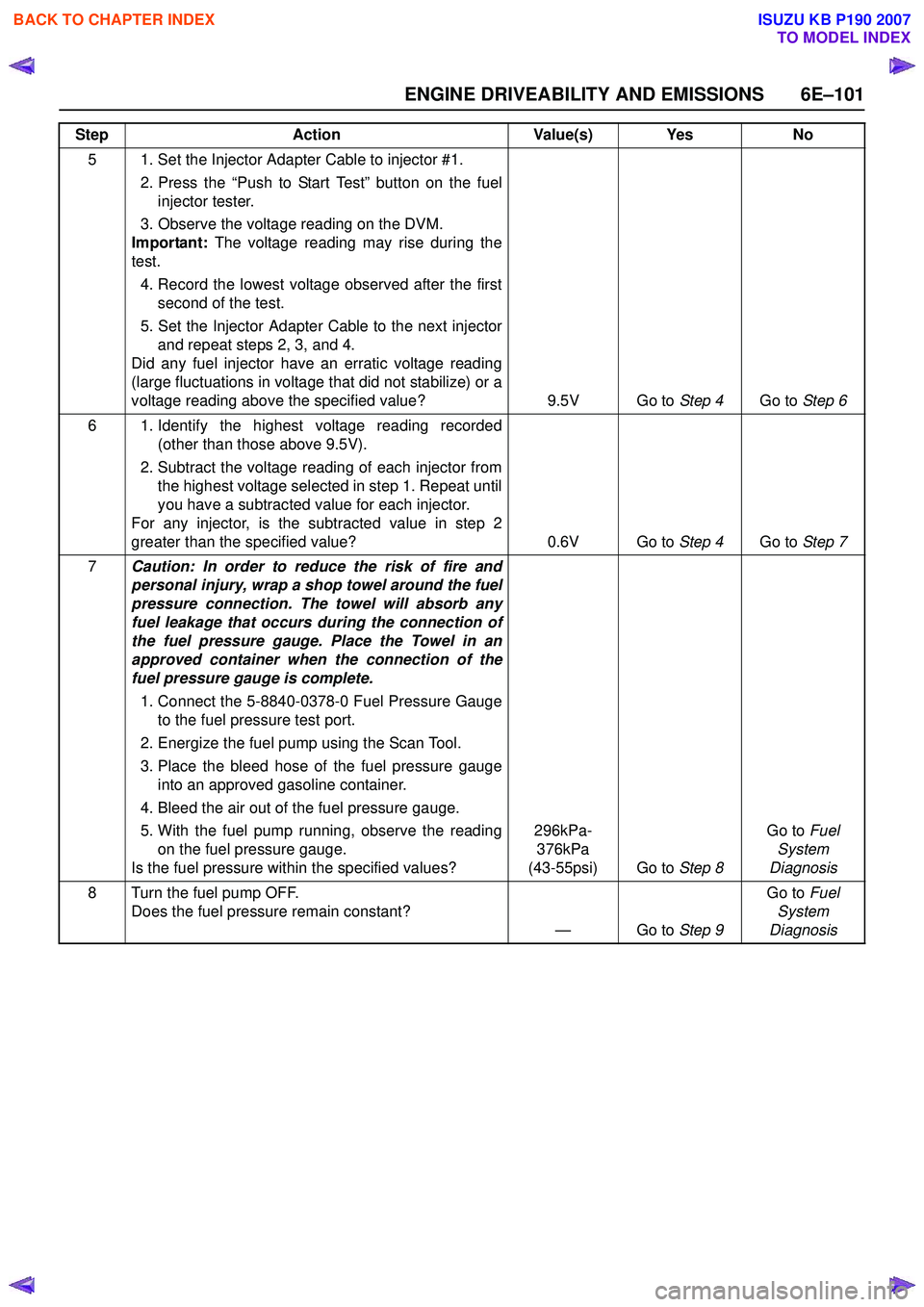
5 1. Set the Injector Adapter Cable to injector #1.2. Press the “Push to Start Test” button on the fuelinjector tester.
3. Observe the voltage reading on the DVM.
Important: The voltage reading may rise during the
test.
4. Record the lowest voltage observed after the first second of the test.
5. Set the Injector Adapter Cable to the next injector and repeat steps 2, 3, and 4.
Did any fuel injector have an erratic voltage reading
(large fluctuations in voltage that did not stabilize) or a
voltage reading above the specified value? 9.5V Go to Step 4Go to Step 6
6 1. Identify the highest voltage reading recorded (other than those above 9.5V).
2. Subtract the voltage reading of each injector from the highest voltage selected in step 1. Repeat until
you have a subtracted value for each injector.
For any injector, is the subtracted value in step 2
greater than the specified value? 0.6V Go to Step 4Go to Step 7
7 Caution: In order to reduce the risk of fire and
personal injury, wrap a shop towel around the fuel
pressure connection. The towel will absorb any
fuel leakage that occurs during the connection of
the fuel pressure gauge. Place the Towel in an
approved container when the connection of the
fuel pressure gauge is complete.
1. Connect the 5-8840-0378-0 Fuel Pressure Gauge to the fuel pressure test port.
2. Energize the fuel pump using the Scan Tool.
3. Place the bleed hose of the fuel pressure gauge into an approved gasoline container.
4. Bleed the air out of the fuel pressure gauge.
5. With the fuel pump running, observe the reading on the fuel pressure gauge.
Is the fuel pressure within the specified values? 296kPa-
376kPa
(43-55psi) Go to Step 8Go to
Fuel
System
Diagnosis
8 Turn the fuel pump OFF. Does the fuel pressure remain constant? —Go to Step 9Go to
Fuel
System
Diagnosis
Step
Action Value(s) Yes No
BACK TO CHAPTER INDEX
TO MODEL INDEX
ISUZU KB P190 2007
Page 2272 of 6020

6E–102 ENGINE DRIVEABILITY AND EMISSIONS
9 1. Connect the 5-8840-0378-0 Fuel Injector Testerand 5-8840-2589-0 Injector Adapter Cable to the
fuel injector harness connector.
2. Set the amperage supply selector switch on the fuel injector tester to the “Balance Test” 0.5-2.5
amp position.
3. Using the Scan Tool turn the fuel pump ON then OFF in order to pressurize the fuel system.
4. Record the fuel pressure indicated by the fuel pressure gauge after the fuel pressure stabilizes.
This is the first pressure reading.
5. Energize the fuel injector by depressing the “Push to Start Test” button on the fuel injector tester.
6. Record the fuel pressure indicated by the fuel pressure gauge after the fuel pressure gauge
needle has stopped moving. This is the second
pressure reading.
7. Repeat steps 1 through 6 for each fuel injector.
8. Subtract the second pressure reading from the first pressure reading for one fuel injector. The
result is the pressure drop value.
9. Obtain a pressure drop value for each fuel injector.
10. Add all of the individual pressure drop values. This is the total pressure drop.
11. Divide the total pressure drop by the number of fuel injectors. This is the average pressure drop.
Does any fuel injector have a pressure drop value that
is either higher than the average pressure drop or
lower than the average pressure drop by the specified
value? 10kPa
(1.5psi) Go to Step 10Go to
OBD
System Check
10 Re-test any fuel injector that does not meet the specification. Refer to the procedure in Step 11.
NOTE: Do not repeat any portion of this test before
running the engine in order to prevent the engine from
flooding.
Does any fuel injector still have a pressure drop value
that is either higher than the average pressure drop or
lower than the average pressure drop by the specified
value? 10kPa
(1.5psi) Go to Step 11Go to
Symptoms
11 1. Replace the faulty fuel injector(s). Refer to Fuel
Injector .
2. Disconnect the 5-8840-2589-0 Injector Adapter Cable for F/I check and re-connect the original F/I
check connector.
Is the action complete? — Verify repair —
Step
Action Value(s) Yes No
BACK TO CHAPTER INDEX
TO MODEL INDEX
ISUZU KB P190 2007
Page 2274 of 6020
6E–104 ENGINE DRIVEABILITY AND EMISSIONS
Fuel Pressure Relief Procedure
1. Remove the fuel cap.
2. Remove the fuel pump relay from the underhood relay center.
3. Start the engine and alow it to stall.
4. Crank the engine for an additional 3 seconds.
Fuel Pressure Gauge Installation
1. Remove the fuel pressure fitting cap.
2. Install fuel pressure gauge 5-8840-0378-0 to the fuel feed line located in front of and above the right
side valve cover.
3. Reinstall the fuel pump relay.
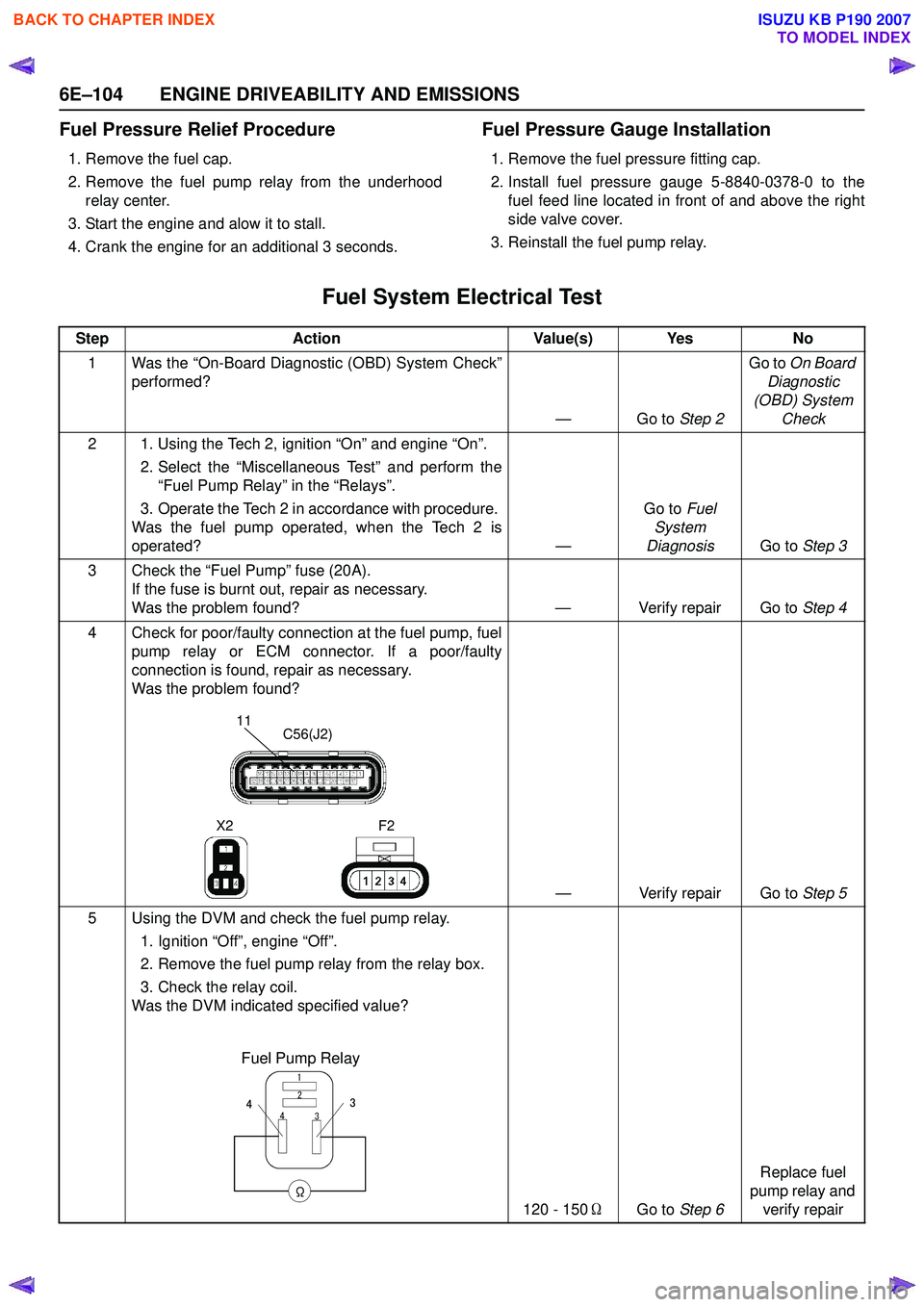
Fuel System Electrical Test
Step Action Value(s) Yes No
1 Was the “On-Board Diagnostic (OBD) System Check” performed?
—Go to Step 2Go to
On Board
Diagnostic
(OBD) System Check
2 1. Using the Tech 2, ignition “On” and engine “On”. 2. Select the “Miscellaneous Test” and perform the“Fuel Pump Relay” in the “Relays”.
3. Operate the Tech 2 in accordance with procedure.
Was the fuel pump operated, when the Tech 2 is
operated? —Go to
Fuel
System
Diagnosis Go to Step 3
3 Check the “Fuel Pump” fuse (20A). If the fuse is burnt out, repair as necessary.
Was the problem found? — Verify repair Go to Step 4
4 Check for poor/faulty connection at the fuel pump, fuel pump relay or ECM connector. If a poor/faulty
connection is found, repair as necessary.
Was the problem found?
— Verify repair Go to Step 5
5 Using the DVM and check the fuel pump relay. 1. Ignition “Off”, engine “Off”.
2. Remove the fuel pump relay from the relay box.
3. Check the relay coil.
Was the DVM indicated specified value?
120 - 150ΩGo to Step 6 Replace fuel
pump relay and verify repair
11C56(J2)
F2
X2
Fuel Pump Relay
3
4 2
1
Ω
34
BACK TO CHAPTER INDEX
TO MODEL INDEX
ISUZU KB P190 2007
Page 2279 of 6020
ENGINE DRIVEABILITY AND EMISSIONS 6E–109
• The fuel injector(s).
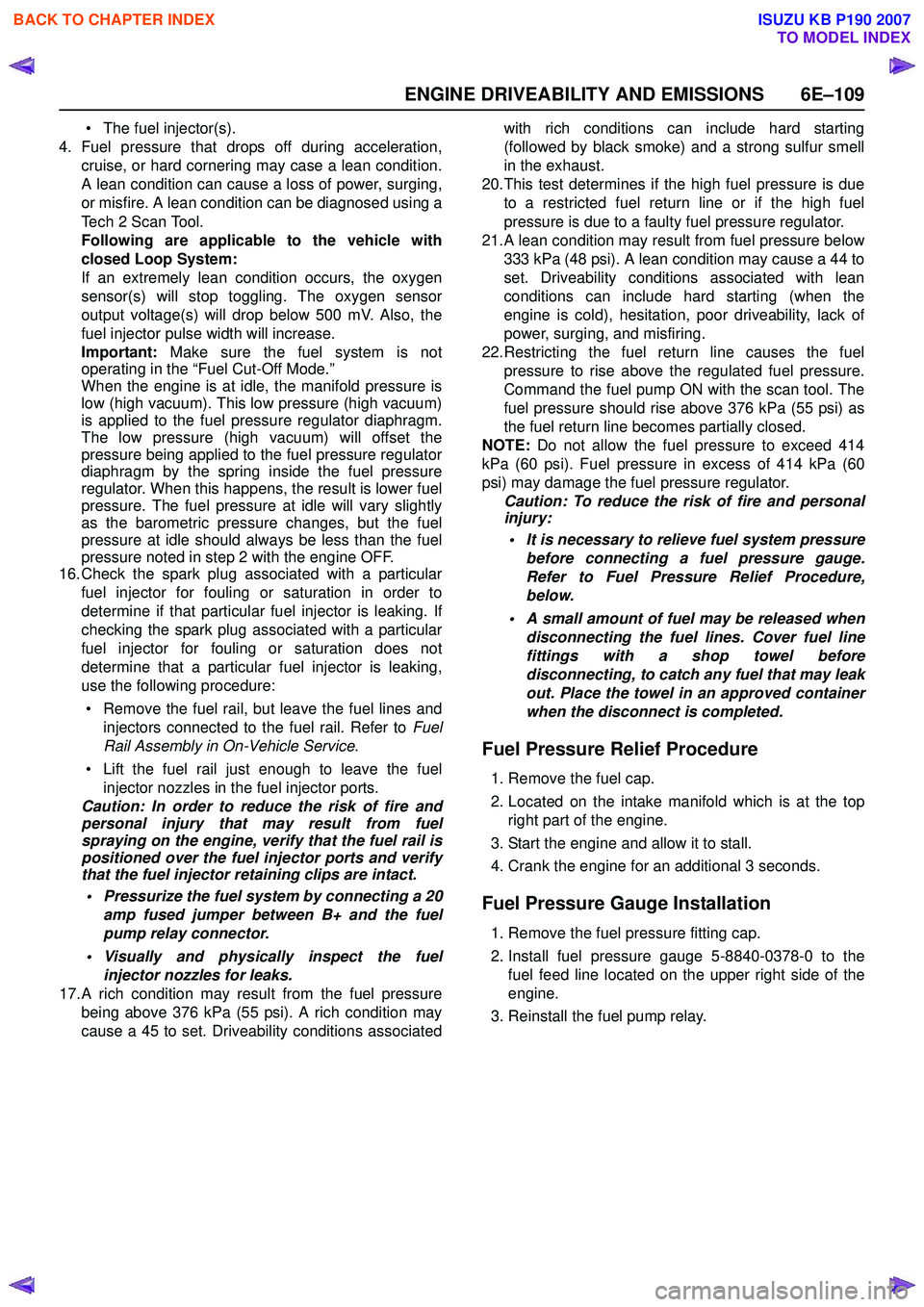
4. Fuel pressure that drops off during acceleration, cruise, or hard cornering may case a lean condition.
A lean condition can cause a loss of power, surging,
or misfire. A lean condition can be diagnosed using a
Tech 2 Scan Tool.
Following are applicable to the vehicle with
closed Loop System:
If an extremely lean condition occurs, the oxygen
sensor(s) will stop toggling. The oxygen sensor
output voltage(s) will drop below 500 mV. Also, the
fuel injector pulse width will increase.
Important: Make sure the fuel system is not
operating in the “Fuel Cut-Off Mode.”
When the engine is at idle, the manifold pressure is
low (high vacuum). This low pressure (high vacuum)
is applied to the fuel pressure regulator diaphragm.
The low pressure (high vacuum) will offset the
pressure being applied to the fuel pressure regulator
diaphragm by the spring inside the fuel pressure
regulator. When this happens, the result is lower fuel
pressure. The fuel pressure at idle will vary slightly
as the barometric pressure changes, but the fuel
pressure at idle should always be less than the fuel
pressure noted in step 2 with the engine OFF.
16.Check the spark plug associated with a particular
fuel injector for fouling or saturation in order to
determine if that particular fuel injector is leaking. If
checking the spark plug associated with a particular
fuel injector for fouling or saturation does not
determine that a particular fuel injector is leaking,
use the following procedure:
• Remove the fuel rail, but leave the fuel lines and injectors connected to the fuel rail. Refer to Fuel
Rail Assembly in On-Vehicle Service .
• Lift the fuel rail just enough to leave the fuel injector nozzles in the fuel injector ports.
Caution: In order to reduce the risk of fire and
personal injury that may result from fuel
spraying on the engine, verify that the fuel rail is
positioned over the fuel injector ports and verify
that the fuel injector retaining clips are intact.
• Pressurize the fuel system by connecting a 20 amp fused jumper between B+ and the fuel
pump relay connector.
• Visually and physically inspect the fuel injector nozzles for leaks.
17.A rich condition may result from the fuel pressure being above 376 kPa (55 psi). A rich condition may
cause a 45 to set. Driveability conditions associated with rich conditions can include hard starting
(followed by black smoke) and a strong sulfur smell
in the exhaust.
20.This test determines if the high fuel pressure is due to a restricted fuel return line or if the high fuel
pressure is due to a faulty fuel pressure regulator.
21.A lean condition may result from fuel pressure below 333 kPa (48 psi). A lean condition may cause a 44 to
set. Driveability conditions associated with lean
conditions can include hard starting (when the
engine is cold), hesitation, poor driveability, lack of
power, surging, and misfiring.
22.Restricting the fuel return line causes the fuel pressure to rise above the regulated fuel pressure.
Command the fuel pump ON with the scan tool. The
fuel pressure should rise above 376 kPa (55 psi) as
the fuel return line becomes partially closed.
NOTE: Do not allow the fuel pressure to exceed 414
kPa (60 psi). Fuel pressure in excess of 414 kPa (60
psi) may damage the fuel pressure regulator. Caution: To reduce the risk of fire and personal
injury:
• It is necessary to relieve fuel system pressure before connecting a fuel pressure gauge.
Refer to Fuel Pressure Relief Procedure,
below.
• A small amount of fuel may be released when disconnecting the fuel lines. Cover fuel line
fittings with a shop towel before
disconnecting, to catch any fuel that may leak
out. Place the towel in an approved container
when the disconnect is completed.
Fuel Pressure Relief Procedure
1. Remove the fuel cap.
2. Located on the intake manifold which is at the top right part of the engine.
3. Start the engine and allow it to stall.
4. Crank the engine for an additional 3 seconds.
Fuel Pressure Gauge Installation
1. Remove the fuel pressure fitting cap.
2. Install fuel pressure gauge 5-8840-0378-0 to the fuel feed line located on the upper right side of the
engine.
3. Reinstall the fuel pump relay.
BACK TO CHAPTER INDEX
TO MODEL INDEX
ISUZU KB P190 2007
Page 2280 of 6020

6E–110 ENGINE DRIVEABILITY AND EMISSIONS
Fuel System Diagnosis
StepAction Value(s) Yes No
1 Was the “On-Board Diagnostic (OBD) System Check” performed? — Go to Step 2Go to
OBD
System Check
2 1. Turn the ignition OFF. 2. Turn the air conditioning system OFF.
3. Relieve fuel system pressure and install the fuel pressure gauge.
4. Turn the ignition ON.
NOTE: The fuel pump will run for approximately 2
seconds. Use the Scan Tool to command the fuel
pump ON.
5. Observe the fuel pressure indicated by the fuel pressure gauge with the fuel pump running.
Is the fuel pressure within the specified limits? 283-376 kPa
(41-55 psi) Go to Step 3Go to Step 17
3 Does the fuel pressure indicated by the fuel pressure gauge remain constant?
NOTE: The fuel pressure will drop when the fuel
pump stops running, then it should stabilize and
remain constant. — Go to Step 4Go to Step 12
4 1. When the vehicle is at normal operating temperature, turn the ignition ON to build fuel
pressure and observe the measurement on the
gauge.
2. Start the engine and observe the fuel pressure gauge.
Did the reading drop by the amount specified after the
engine was started? 21-105 kPa
(3-15 psi) Go to Step 5Go to Step 9
5 Is fuel pressure dropping off during acceleration, cruise, or hard cornering? — Go to Step 6Check for
improper fuel
6 Visually and physically inspect the following items for a restriction:
• The in-line fuel filter.
• The fuel feed line.
Was a restriction found? — Verify repair Go to Step 7
7 Remove the fuel tank and visually and physically inspect the following items:
• The fuel pump strainer for a restriction.
• The fuel line for a leak.
• Verify that the correct fuel pump is in the vehicle.
Was a problem found in any of these areas? — Verify repair Go to Step 8
8 Replace the fuel pump. Is the action complete? — Verify repair —
9 1. Disconnect the vacuum hose from the fuel pressure regulator.
2. With the engine idling, apply 12-14 inches of vacuum to the fuel pressure regulator.
Does the fuel pressure indicated by the fuel pressure
gauge drop by the amount specified? 21-105 kPa
(3-15 psi) Go to Step 10Go to Step 11
BACK TO CHAPTER INDEX
TO MODEL INDEX
ISUZU KB P190 2007
Page 2287 of 6020

ENGINE DRIVEABILITY AND EMISSIONS 6E–11 7
P0351 A Ignition 1 Control Circuit #1 or #4cylinder ignition signals are not
detected consecutively. No fail-safe function.
Consecutive ignition signals are detected. 1. Ignition coil module 1 harness open
circuit, short to ground or short to voltage
circuit.
2. Ignition coil module malfunction.
3. ECM malfunction. J1-19
P0352 A Ignition 2 Control Circuit #2 or #3 cylinder ignition signals are not
detected consecutively. 1. Ignition coil module 2 harness open circuit,
short to ground or short to voltage circuit.
2. Ignition coil module malfunction.
3. ECM malfunction. J1-18
P0443 B EVAP Emission Control System Purge Control Circuit EVAP purge solenoid circuit open, short to
ground or short to voltage circuit. No fail-safe function.
EVAP purge solenoid circuit is correct
condition. 1. Solenoid harness open circuit, short to
ground or short to voltage circuit.
2. Solenoid malfunction.
3. ECM malfunction. J1-5
P0502 B Vehicle Speed Sensor Circuit Low Input 1. No DTC relating to MAP sensor, TPS, ECT sensor, injector control circuit and
ignition control circuit.
2. Engine is running.
3. Vehicle speed is below 3km/h in power condition or 2km/h in deceleration
condition. ECM uses 0km/h condition as
substitute. VSS circuit correct condition.
1. Sensor harness open circuit, short to
ground circuit or short to voltage circuit.
2. Poor connector connection.
3. VSS malfunction.
4. ECM malfunction. J2-23
P0562 D System Voltage Low Battery voltage is below 11V.No fail-safe function.Battery voltage is between 11V and 16V. 1. Battery power feed harness open circuit
or short to ground circuit.
2. ECM ground harness open or poor connection.
3. Poor connector connection.
4. Battery malfunction.
5. Charge system malfunction.
6. ECM malfunction. -
P0563 A System Voltage High Battery voltage is above 16V. 1. Charge system malfunction.
2. Battery jump start cable misconnect.
3. ECM malfunction. -
P0601 A ECM Memory Checksum ECM memory area error.Engine control disabled.Memory are is OK. ECM malfunction. -
P0602 - ECU Programming Error ECM memory area error.Engine control disabled.Memory are is OK. ECM is not programmed. -
P0650 A Malfunction Indicator Lamp (MIL) Control Circuit Malfunction Check engine lamp circuit open, short to
ground or short to voltage circuit. No fail-safe function.
Check engine lamp circuit is correct
condition. 1. Solenoid harness open circuit, short to
ground or short to voltage circuit.
2. Solenoid malfunction.
3. ECM malfunction. J2-32
Code Type
DTC Name DTC Setting Condition Fail-Safe (Back Up)Recovery Condition Related Failure PartsRelated
ECM
Pin No.
BACK TO CHAPTER INDEX
TO MODEL INDEX
ISUZU KB P190 2007