transmission fluid ISUZU KB P190 2007 Workshop Manual Online
[x] Cancel search | Manufacturer: ISUZU, Model Year: 2007, Model line: KB P190, Model: ISUZU KB P190 2007Pages: 6020, PDF Size: 70.23 MB
Page 3917 of 6020

Automatic Transmission – 4L60E – On-vehicle Servicing Page 7C4–4
WARNING Defined
A W ARNING statement immediately precedes an operating procedure or maintenance practice which, if not correctly
followed, could result in death or injury. A WARNING statement alerts you to take necessary action or not to take a
prohibited action. If a W ARNING statement is ignored, the following consequences may occur:
• Death or injury to the technician or other personnel working on the vehicle,
• Death or injury to other people in or near the workplace area, and / or
• Death or injury to the driver / or passenger(s) of the vehicle or other people, if the vehicle has been improperly
repaired.
CAUTION Defined
A CAUTION statement immediately precedes an operating procedure or maintenance practice which, if not correctly
followed, could result in damage to or destruction of equipment, or corruption of data. If a CAUTION statement is ignored,
the following consequences may occur:
• Damage to the vehicle,
• Unnecessary vehicle repairs or component replacement,
• Faulty operation or performance of any system or component being repaired,
• Damage to any system or components which depend on the proper operation of the system or component being
repaired,
• Faulty operation or performance of any systems or components which depend on the proper operation or
performance of the system or component under repair,
• Damage to fasteners, basic tools or special tools and / or
• Leakage of coolant, lubricant or other vital fluids.
NOTE Defined
A NOTE statement immediately precedes or follows an operating procedure, maintenance practice or condition that
requires highlighting. A NOTE statement also emphasises necessary characteristics of a diagnostic or repair procedure.
A NOTE statement is designed to:
• Clarify a procedure,
• Present additional information for accomplishing a procedure,
• Give insight into the reasons for performing a procedure in the recommended manner, and / or
• Present information that gives the technician the benefit of past experience in accomplishing a procedure with
greater ease.
BACK TO CHAPTER INDEX
TO MODEL INDEX
ISUZU KB P190 2007
Page 3918 of 6020

Automatic Transmission – 4L60E – On-vehicle Servicing Page 7C4–5
2 Maintenance Operations
2.1 Transmission Fluid
When adding or changing the transmission fluid, use only the recommended automatic transmission fluid, refer to
0B Maintenance and Lubrication.
For the automatic transmission fluid diagnosis, refer to 7C3 Automatic Transmission – 4L60E – Hydraulic and
Mechanical Diagnosis.
Transmission Fluid Colour
New transmission fluid is red in colour due to a dye that is added to the fluid so it can be distinguished from other oils and
lubricants. The red dye is not permanent and as such, is not an indicator of the quality of the fluid.
As the vehicle is driven the transmission fluid will quickly look darker in colour and appear to be a light brown. A dark
brown colour with a distinctively burnt odour may indicate fluid deterioration and the need for fluid replacement.
NOTE
A dark brown fluid colour observed, coupled with
a reported delayed shift pattern may only indicate
that fluid replacement is required. This is not a
definite indication of a potential transmission
failure.
Transmission Fluid Level
NOTE
Carry out this operation with the transmission at
normal operating temperature (82 – 94°C), as the
temperature greatly affects the fluid level.
1 Drive the vehicle for a distance of at least 25 km to bring the transmission up to normal operating temperature.
If the transmission is not at normal operating
temperature and the correct procedure is not
followed, the result could be a false reading of
the fluid level on the transmission fluid
indicator.
2 If the vehicle has been operated under any of the following conditions, switch the engine off and allow the transmission to cool for approximately thirty minutes:
• in high ambient temperatures above 32° C,
• at sustained high speeds,
• in heavy stop / start city traffic during hot weather, or
• towing.
3 Park the vehicle on level ground.
4 Move the gear selector to the Park position and apply the park brake.
5 Allow the engine to idle for 3 minutes with the accessories turned off.
BACK TO CHAPTER INDEX
TO MODEL INDEX
ISUZU KB P190 2007
Page 3919 of 6020
Automatic Transmission – 4L60E – On-vehicle Servicing Page 7C4–6
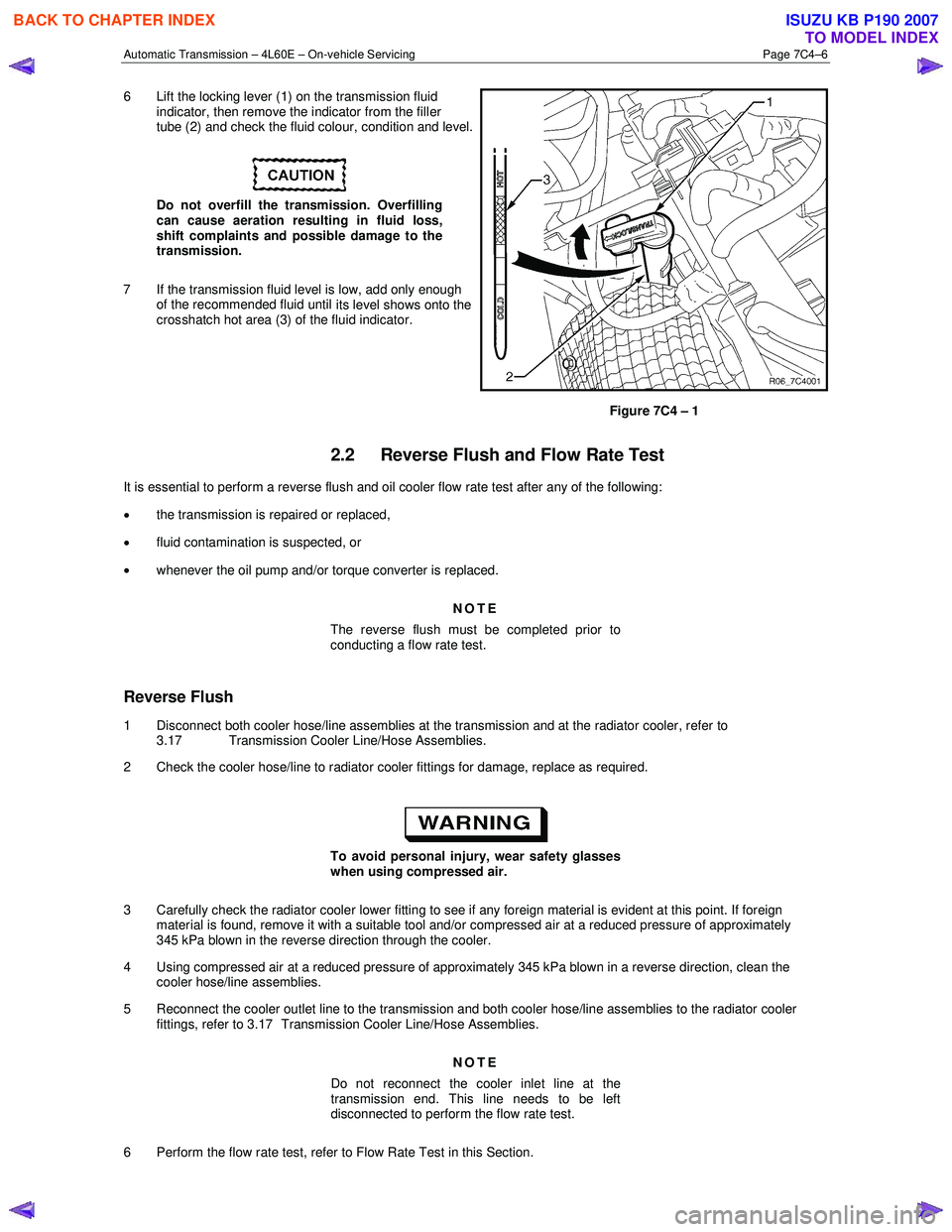
6 Lift the locking lever (1) on the transmission fluid
indicator, then remove the indicator from the filler
tube (2) and check the fluid colour, condition and level.
Do not overfill the transmission. Overfilling
can cause aeration resulting in fluid loss,
shift complaints and possible damage to the
transmission.
7 If the transmission fluid level is low, add only enough of the recommended fluid until
its level shows onto the
crosshatch hot area (3) of the fluid indicator.
Figure 7C4 – 1
2.2 Reverse Flush and Flow Rate Test
It is essential to perform a reverse flush and oil cooler flow rate test after any of the following:
• the transmission is repaired or replaced,
• fluid contamination is suspected, or
• whenever the oil pump and/or torque converter is replaced.
NOTE
The reverse flush must be completed prior to
conducting a flow rate test.
Reverse Flush
1 Disconnect both cooler hose/line assemblies at the transmission and at the radiator cooler, refer to 3.17 Transmission Cooler Line/Hose Assemblies.
2 Check the cooler hose/line to radiator cooler fittings for damage, replace as required.
To avoid personal injury, wear safety glasses
when using compressed air.
3 Carefully check the radiator cooler lower fitting to see if any foreign material is evident at this point. If foreign material is found, remove it with a suitable tool and/or compressed air at a reduced pressure of approximately
345 kPa blown in the reverse direction through the cooler.
4 Using compressed air at a reduced pressure of approximately 345 kPa blown in a reverse direction, clean the cooler hose/line assemblies.
5 Reconnect the cooler outlet line to the transmission and both cooler hose/line assemblies to the radiator cooler fittings, refer to 3.17 Transmission Cooler Line/Hose Assemblies.
NOTE
Do not reconnect the cooler inlet line at the
transmission end. This line needs to be left
disconnected to perform the flow rate test.
6 Perform the flow rate test, refer to Flow Rate Test in this Section.
BACK TO CHAPTER INDEX
TO MODEL INDEX
ISUZU KB P190 2007
Page 3920 of 6020

Automatic Transmission – 4L60E – On-vehicle Servicing Page 7C4–7
NOTE
This will also flush the cooler hose/line
assemblies and cooler with transmission fluid.
7 If the flow rate is satisfactory, reconnect the cooler inlet line to the transmission, refer to 3.17 Transmission Cooler Line/Hose Assemblies.
8 Lower the vehicle, check and top up the transmission fluid to the correct level as required, refer to 2.1 Transmission Fluid.
Flow Rate Test
Do not run the engine any longer than
absolutely necessary, as a fluid level too low
can cause aeration and foaming.
1 Ensure the transmission fluid is at the recommended level or slightly above, refer to 2.1 Transmission Fluid.
2 Disconnect the cooler inlet line at the transmission quick-connect fitting, refer to 3.17 Transmission Cooler Line/Hose Assemblies.
3 Place a suitable size container underneath the disconnected cooler inlet line.
4 W ith the selector lever in the P position, start the engine and observe the fluid flow into the container after all the air bubbles have ceased and a steady flow is evident. Measure the flow rate over 20 seconds and ensure it is within
the specification.
Transmission fluid flow rate specification per 20 Seconds:
Temperature: Ambient ............................................................ 0.7 Litres 86° – 93° C ...................................................... 1.2 Litres
5 If the flow rate is less than the specification, the cause of the low flow rate must be located and rectified. Possible cause could include:
• restricted cooler within the radiator tank,
• kinked or damaged transmission cooler hose/line assemblies, or
• internal transmission fault such as a faulty pump.
6 Reinstall the cooler inlet line to the transmission quick-connect fitting, refer to 3.17 Transmission Cooler Line/Hose Assemblies.
BACK TO CHAPTER INDEX
TO MODEL INDEX
ISUZU KB P190 2007
Page 3921 of 6020
Automatic Transmission – 4L60E – On-vehicle Servicing Page 7C4–8
3 Service Operations
3.1 Fluid Change and Filter Replacement
To avoid personal injury take note of the
following:
• Avoid accidental hot oil spillage by
performing fluid change only when the
transmission fluid is cold.
• Wear safety glasses and gloves when
using compressed air and cleaning fluids.
Remove
1 Raise the vehicle and support in a safe manner, refer to 0A General Information.
2 Clean all dirt from around the oil pan and the transmission case.
3 Place a suitable sized drain tray under the transmission.
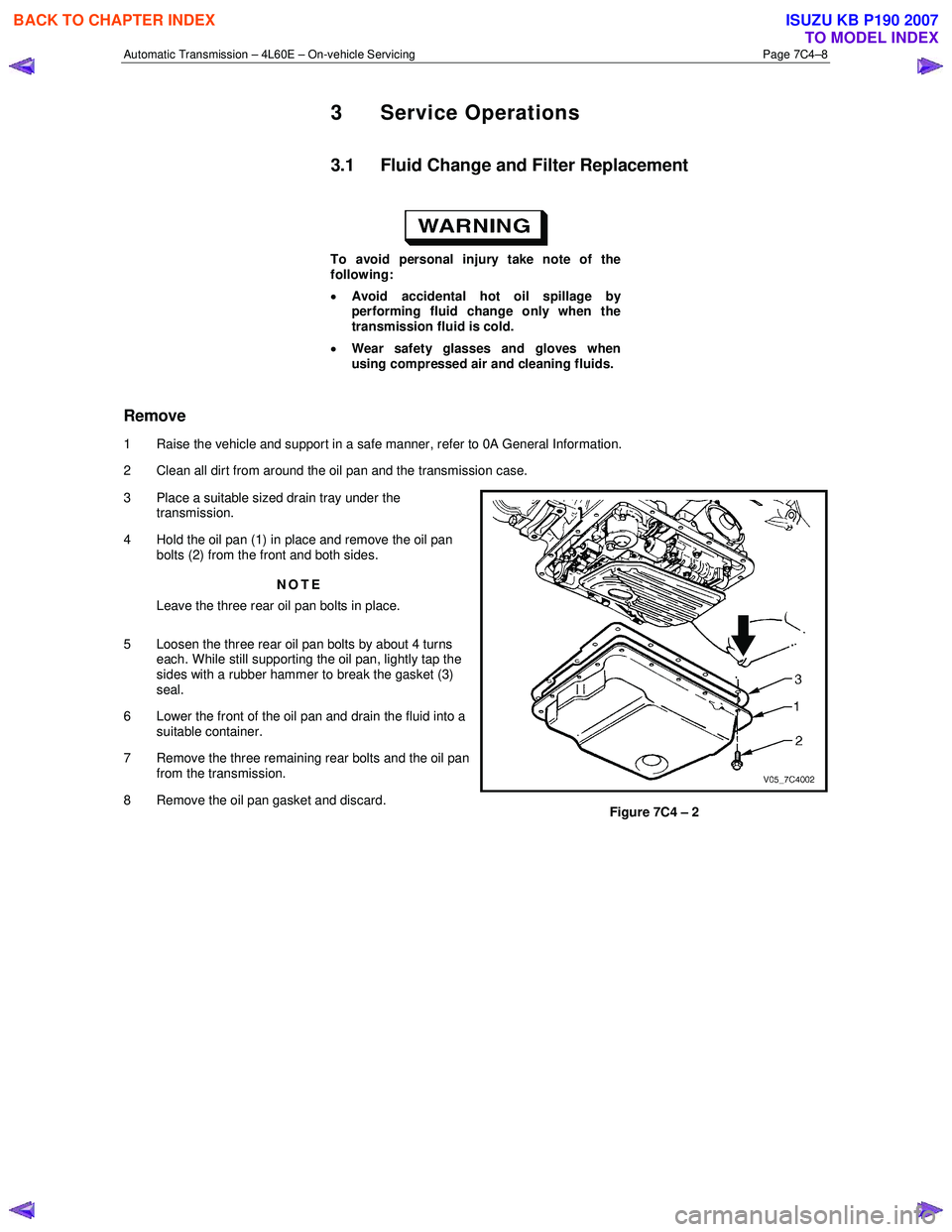
4 Hold the oil pan (1) in place and remove the oil pan bolts (2) from the front and both sides.
NOTE
Leave the three rear oil pan bolts in place.
5 Loosen the three rear oil pan bolts by about 4 turns each. While still supporting the oil pan, lightly tap the
sides with a rubber hammer to break the gasket (3)
seal.
6 Lower the front of the oil pan and drain the fluid into a suitable container.
7 Remove the three remaining rear bolts and the oil pan from the transmission.
8 Remove the oil pan gasket and discard.
Figure 7C4 – 2
BACK TO CHAPTER INDEX
TO MODEL INDEX
ISUZU KB P190 2007
Page 3922 of 6020
Automatic Transmission – 4L60E – On-vehicle Servicing Page 7C4–9
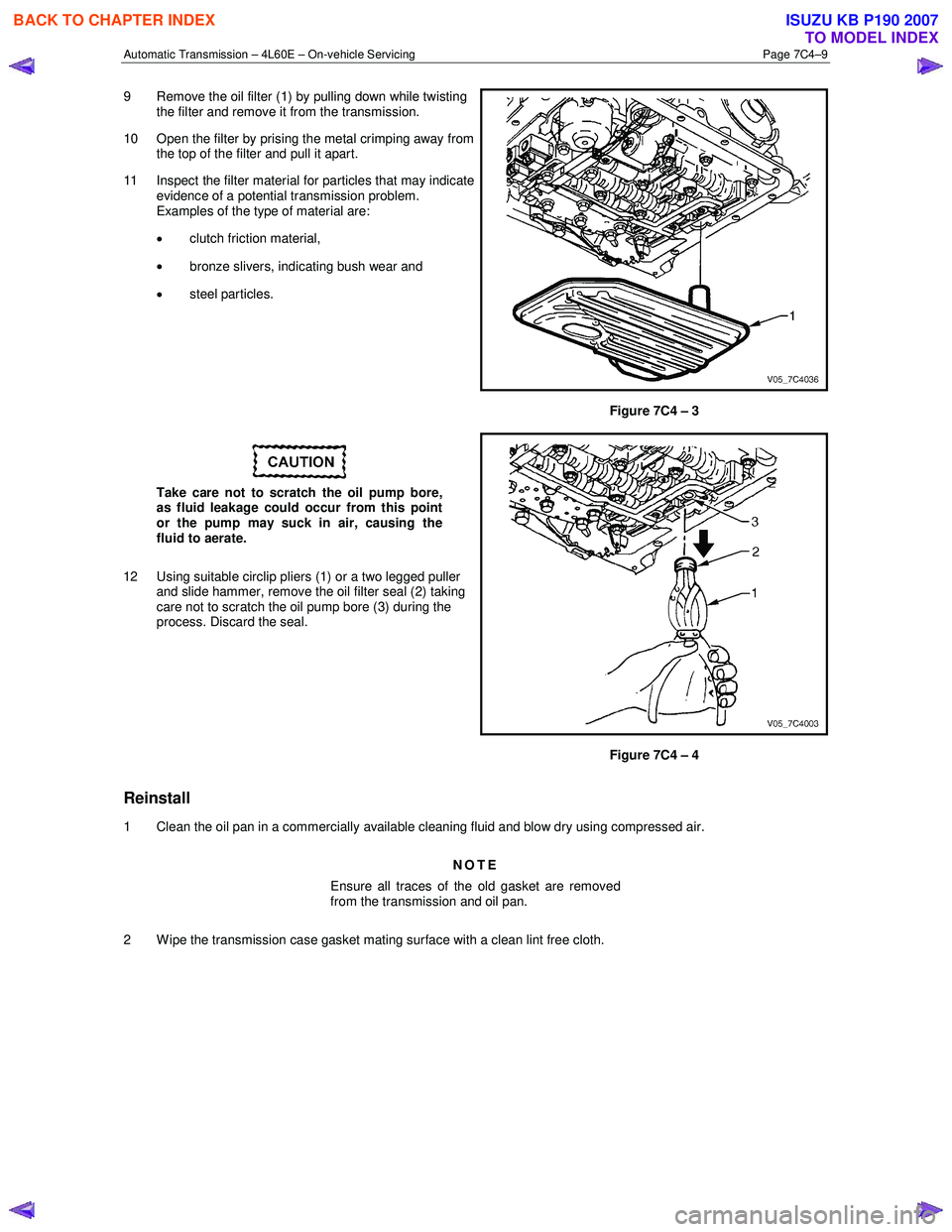
9 Remove the oil filter (1) by pulling down while twisting
the filter and remove it from the transmission.
10 Open the filter by prising the metal crimping away from the top of the filter and pull it apart.
11 Inspect the filter material for particles that may indicate evidence of a potential transmission problem.
Examples of the type of material are:
• clutch friction material,
• bronze slivers, indicating bush wear and
• steel particles.
Figure 7C4 – 3
Take care not to scratch the oil pump bore,
as fluid leakage could occur from this point
or the pump may suck in air, causing the
fluid to aerate.
12 Using suitable circlip pliers (1) or a two legged puller and slide hammer, remove the oil filter seal (2) taking
care not to scratch the oil pump bore (3) during the
process. Discard the seal.
Figure 7C4 – 4
Reinstall
1 Clean the oil pan in a commercially available cleaning fluid and blow dry using compressed air.
NOTE
Ensure all traces of the old gasket are removed
from the transmission and oil pan.
2 W ipe the transmission case gasket mating surface with a clean lint free cloth.
BACK TO CHAPTER INDEX
TO MODEL INDEX
ISUZU KB P190 2007
Page 3923 of 6020

Automatic Transmission – 4L60E – On-vehicle Servicing Page 7C4–10
3 Lubricate a new oil filter seal (1) with clean
transmission fluid and install into the oil pump bore (2)
using a suitable sized socket or piece of tubing.
4 Install a new filter into the transmission case.
5 Check if the magnet is functional and located in the designated position in the oil pan. Install a new gasket
and reinstall the oil pan.
6 Tighten the bolts attaching the oil pan to the correct torque specification.
Oil pan attaching bolt
torque specification ............................................ 12.0 Nm
Figure 7C4 – 5
7 Lower vehicle and add approximately 4.8 litres of automatic transmission fluid.
8 Operate the vehicle for about 24 km or until normal transmission operating temperature is reached, refer to 2.1 Transmission Fluid.
9 Ensure there are no fluid leaks from the oil pan area, rectify as required.
10 Check and top up the transmission fluid to the correct level as required, refer 2.1 Transmission Fluid.
BACK TO CHAPTER INDEX
TO MODEL INDEX
ISUZU KB P190 2007
Page 3933 of 6020
Automatic Transmission – 4L60E – On-vehicle Servicing Page 7C4–20
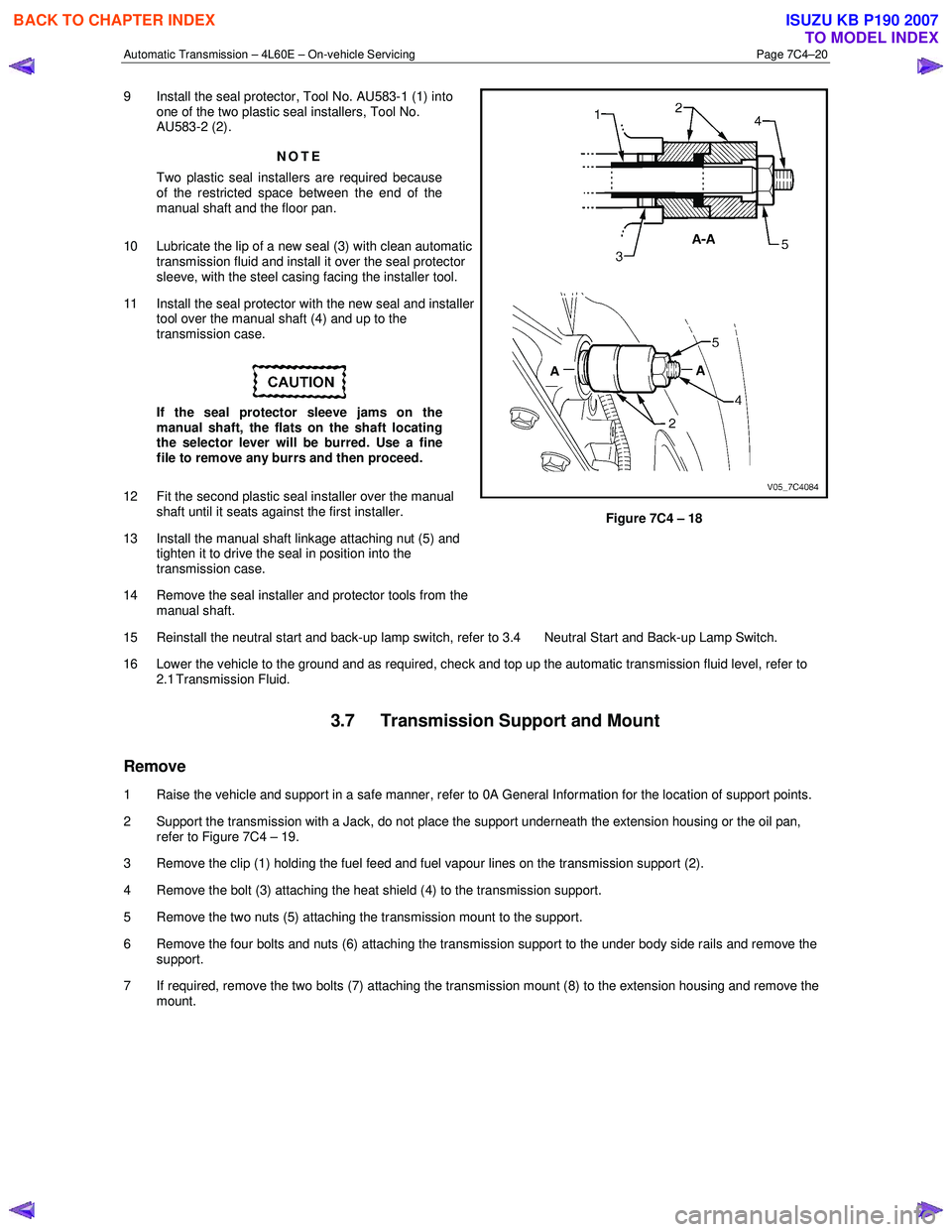
9 Install the seal protector, Tool No. AU583-1 (1) into
one of the two plastic seal installers, Tool No.
AU583-2 (2).
NOTE
Two plastic seal installers are required because
of the restricted space between the end of the
manual shaft and the floor pan.
10 Lubricate the lip of a new seal (3) with clean automatic transmission fluid and install it over the seal protector
sleeve, with the steel casing facing the installer tool.
11 Install the seal protector with the new seal and installer tool over the manual shaft (4) and up to the
transmission case.
If the seal protector sleeve jams on the
manual shaft, the flats on the shaft locating
the selector lever will be burred. Use a fine
file to remove any burrs and then proceed.
12 Fit the second plastic seal installer over the manual shaft until it seats against the first installer.
13 Install the manual shaft linkage attaching nut (5) and tighten it to drive the seal in position into the
transmission case.
14 Remove the seal installer and protector tools from the manual shaft.
Figure 7C4 – 18
15 Reinstall the neutral start and back-up lamp switch, refer to 3.4 Neutral Start and Back-up Lamp Switch.
16 Lower the vehicle to the ground and as required, check and top up the automatic transmission fluid level, refer to 2.1 Transmission Fluid.
3.7 Transmission Support and Mount
Remove
1 Raise the vehicle and support in a safe manner, refer to 0A General Information for the location of support points.
2 Support the transmission with a Jack, do not place the support underneath the extension housing or the oil pan, refer to Figure 7C4 – 19.
3 Remove the clip (1) holding the fuel feed and fuel vapour lines on the transmission support (2).
4 Remove the bolt (3) attaching the heat shield (4) to the transmission support.
5 Remove the two nuts (5) attaching the transmission mount to the support.
6 Remove the four bolts and nuts (6) attaching the transmission support to the under body side rails and remove the support.
7 If required, remove the two bolts (7) attaching the transmission mount (8) to the extension housing and remove the mount.
BACK TO CHAPTER INDEX
TO MODEL INDEX
ISUZU KB P190 2007
Page 3935 of 6020

Automatic Transmission – 4L60E – On-vehicle Servicing Page 7C4–22
3.8 Extension Housing Oil Seal, RWD
Replace
1 Raise the vehicle and support in a safe manner, refer to 0A General Information for the location of support points.
2 Remove the rear propeller shaft, refer to 4A Propeller Shaft.
3 Place a suitable size drip tray underneath rear of transmission.
Take care not to scratch the machined seal
recess in the extension housing as
transmission fluid may weep past the outer
diameter of the installed seal.
4 Using the seal remover, Tool No. E308 (1) or equivalent, prise the oil seal (2) from rear of the
extension housing (3) and discard the seal.
5 Thoroughly clean around the seal bore in the extension housing and ensure there are no burrs.
Figure 7C4 – 20
6 Use the seal installer, Tool No. J21426 (1) and a soft faced hammer to tap a new oil seal (2) into place in
the extension housing (3).
7 Install the rear propeller shaft, refer to 4A Propeller Shaft.
8 Lower the vehicle to the ground and check the fluid level, refer to 2.1 Transmission Fluid.
Figure 7C4 – 21
3.9 Extension Housing and Rear Bush, RWD
Remove
1 Raise the vehicle and support in a safe manner, refer to 0A General Information for the location of support points.
2 As required, remove the following components:
a Rear propeller shaft, refer to 4A Propeller Shaft.
b Transmission support and mount assembly, refer to 3.7 Transmission Support and Mount.
c Vehicle speed sensor, refer to 3.5 Vehicle Speed Sensor.
BACK TO CHAPTER INDEX
TO MODEL INDEX
ISUZU KB P190 2007
Page 3936 of 6020
Automatic Transmission – 4L60E – On-vehicle Servicing Page 7C4–23
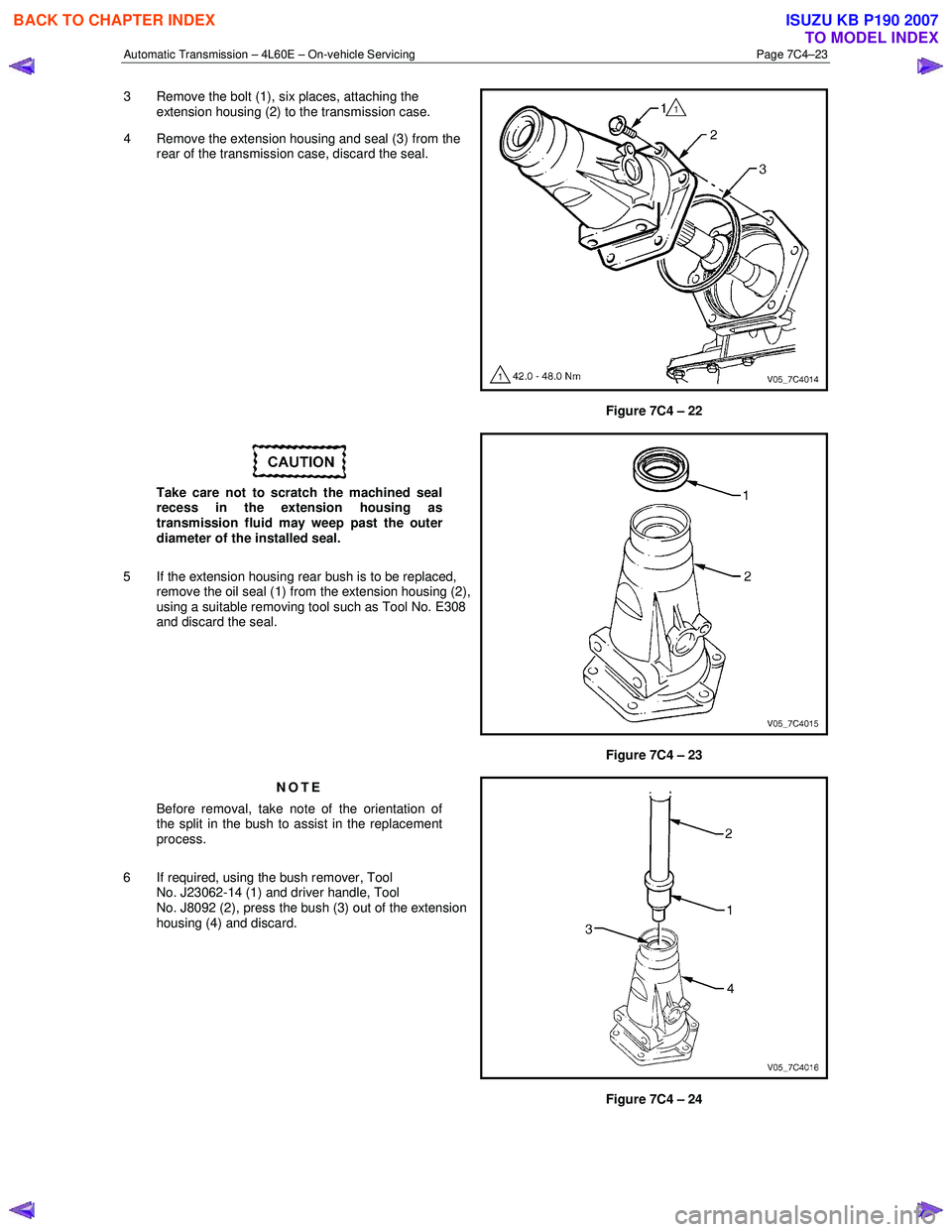
3 Remove the bolt (1), six places, attaching the
extension housing (2) to the transmission case.
4 Remove the extension housing and seal (3) from the rear of the transmission case, discard the seal.
Figure 7C4 – 22
Take care not to scratch the machined seal
recess in the extension housing as
transmission fluid may weep past the outer
diameter of the installed seal.
5 If the extension housing rear bush is to be replaced, remove the oil seal (1) from the extension housing (2),
using a suitable removing tool such as Tool No. E308
and discard the seal.
Figure 7C4 – 23
NOTE
Before removal, take note of the orientation of
the split in the bush to assist in the replacement
process.
6 If required, using the bush remover, Tool No. J23062-14 (1) and driver handle, Tool
No. J8092 (2), press the bush (3) out of the extension
housing (4) and discard.
Figure 7C4 – 24
BACK TO CHAPTER INDEX
TO MODEL INDEX
ISUZU KB P190 2007