Remove engine ISUZU TROOPER 1998 Service Repair Manual
[x] Cancel search | Manufacturer: ISUZU, Model Year: 1998, Model line: TROOPER, Model: ISUZU TROOPER 1998Pages: 3573, PDF Size: 60.36 MB
Page 2113 of 3573

6E±220
4JX1±TC ENGINE DRIVEABILITY AND EMISSIONS
Installation Procedure
1. Install the EVRV.
035RW064
2. Connect the EVRV hose and the EVRV connector.
035RW065
3. Connect the negative battery cable.
Wiring and Connectors
Wiring Harness Service
The ECM harness electrically connects the ECM to the
various solenoids, switches and sensors in the vehicle
engine compartment and passenger compartment.
Replace wire harnesses with the proper part number
replacement.
Because of the low amperage and voltage levels utilized
in powertrain control systems, it is essential that all wiring
in environmentally exposed areas be repaired with crimp
and seal splice sleeves.The following wire harness repair information is intended
as a general guideline only. Refer to
Chassis Electrical for
all wire harness repair procedures.
Connectors and Terminals
Use care when probing a connector and when replacing
terminals. It is possible to short between opposite
terminals. Damage to components could result. Always
use jumper wires between connectors for circuit
checking. NEVER probe through Weather-Pack seals.
Use an appropriate connector test adapter kit which
contains an assortment of flexible connectors used to
probe terminals during diagnosis. Use an appropriate
fuse remover and test tool for removing a fuse and to
adapt the fuse holder to a meter for diagnosis.
Open circuits are often difficult to locate by sight because
oxidation or terminal misalignment are hidden by the
connectors. Merely wiggling a connector on a sensor, or
in the wiring harness, may temporarily correct the open
circuit. Intermittent problems may also be caused by
oxidized or loose connections.
Be certain of the type of connector/terminal before
making any connector or terminal repair. Weather-Pack
and Com-Pack III terminals look similar, but are serviced
differently.
Wire Harness Repair: Twisted
Shielded Cable
Removal Procedure
1. Remove the outer jacket.
2. Unwrap the aluminum/mylar tape. Do not remove the
mylar.
047
Page 2114 of 3573
6E±221 4JX1±TC ENGINE DRIVEABILITY AND EMISSIONS
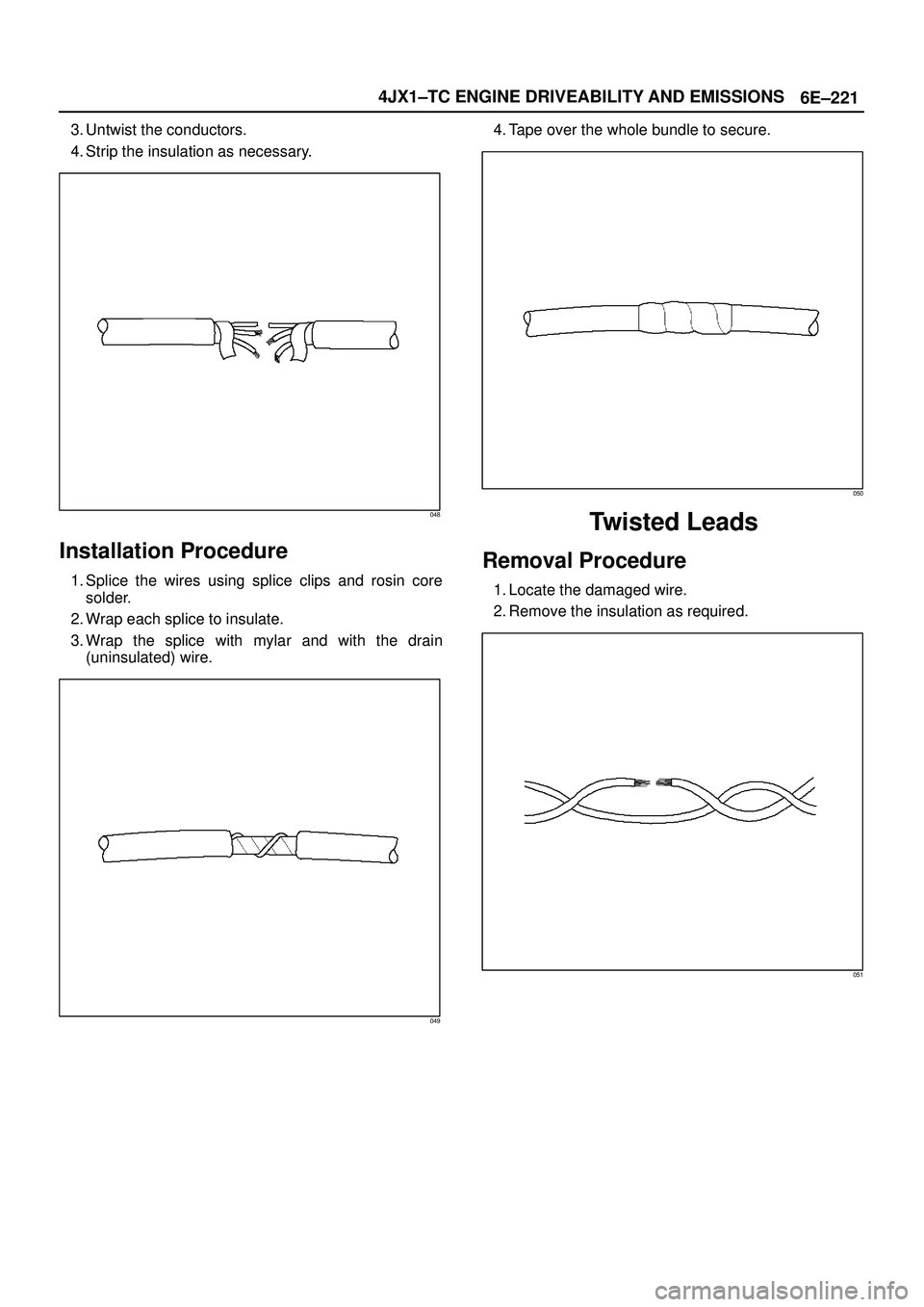
3. Untwist the conductors.
4. Strip the insulation as necessary.
048
Installation Procedure
1. Splice the wires using splice clips and rosin core
solder.
2. Wrap each splice to insulate.
3. Wrap the splice with mylar and with the drain
(uninsulated) wire.
049
4. Tape over the whole bundle to secure.
050
Twisted Leads
Removal Procedure
1. Locate the damaged wire.
2. Remove the insulation as required.
051
Page 2116 of 3573
6E±223 4JX1±TC ENGINE DRIVEABILITY AND EMISSIONS
Weather-Pack Connector
Tools Required
5-8840-0388-0 Weather-Pack II Terminal Remover
Removal Procedure
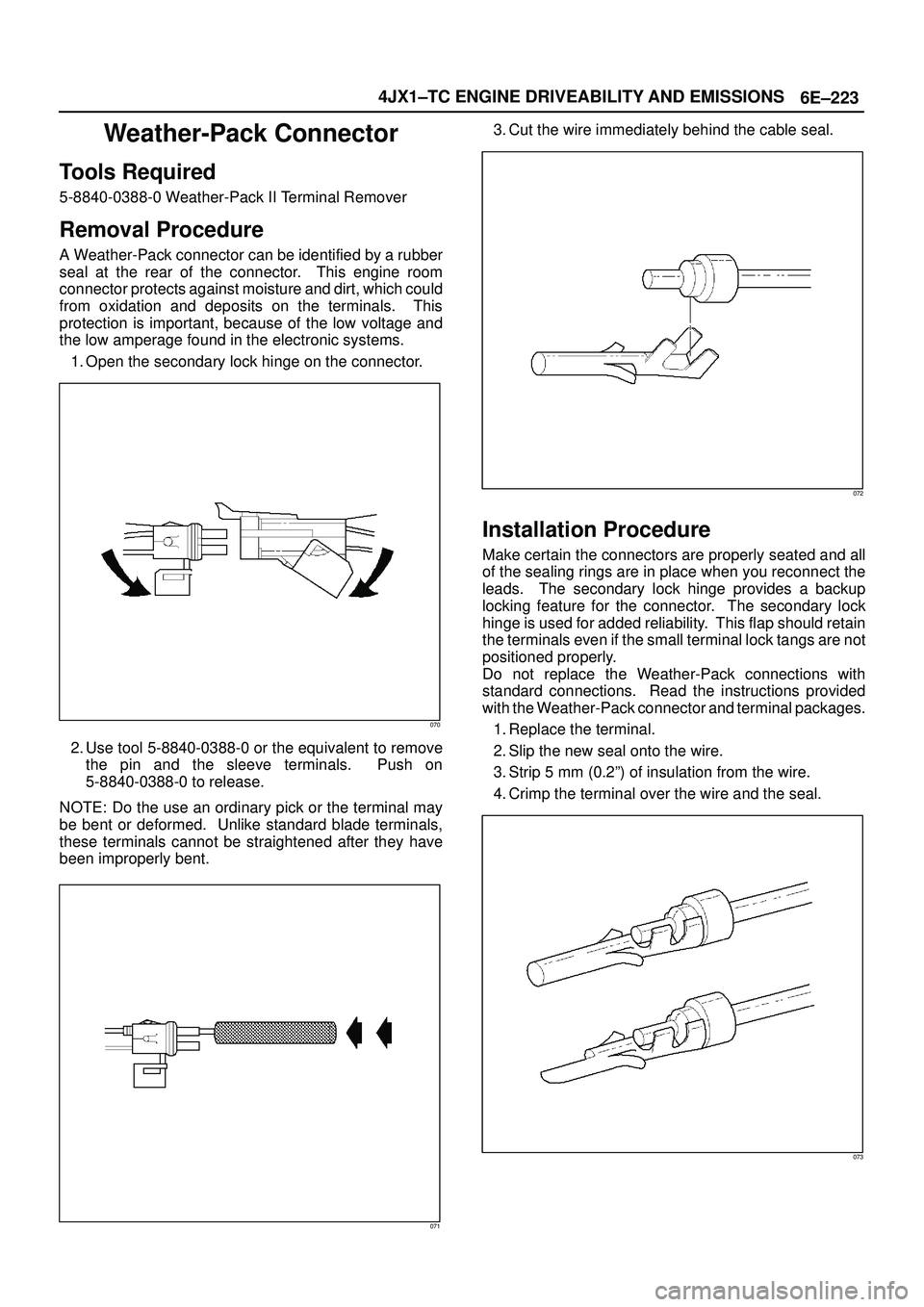
A Weather-Pack connector can be identified by a rubber
seal at the rear of the connector. This engine room
connector protects against moisture and dirt, which could
from oxidation and deposits on the terminals. This
protection is important, because of the low voltage and
the low amperage found in the electronic systems.
1. Open the secondary lock hinge on the connector.
070
2. Use tool 5-8840-0388-0 or the equivalent to remove
the pin and the sleeve terminals. Push on
5-8840-0388-0 to release.
NOTE: Do the use an ordinary pick or the terminal may
be bent or deformed. Unlike standard blade terminals,
these terminals cannot be straightened after they have
been improperly bent.
071
3. Cut the wire immediately behind the cable seal.
072
Installation Procedure
Make certain the connectors are properly seated and all
of the sealing rings are in place when you reconnect the
leads. The secondary lock hinge provides a backup
locking feature for the connector. The secondary lock
hinge is used for added reliability. This flap should retain
the terminals even if the small terminal lock tangs are not
positioned properly.
Do not replace the Weather-Pack connections with
standard connections. Read the instructions provided
with the Weather-Pack connector and terminal packages.
1. Replace the terminal.
2. Slip the new seal onto the wire.
3. Strip 5 mm (0.2º) of insulation from the wire.
4. Crimp the terminal over the wire and the seal.
073
Page 2117 of 3573

6E±224
4JX1±TC ENGINE DRIVEABILITY AND EMISSIONS
5. Push the terminal and the connector to engage the
locking tangs.
070
6. Close the secondary locking hinge.
Com-Pack III
General Information
The Com-Pack III terminal looks similar to some
Weather-Pack terminals. This terminal is not sealed and
is used where resistance to the environment is not
required. Use the standard method when repairing a
terminal. Do not use the Weather-Pack terminal tool
5-8840-0388-0 or equivalent. These will damage the
terminals.
Metri-Pack
Tools Required
5-8840-0632-0 Terminal Remover
Removal Procedure
Some connectors use terminals called Metri-Pack Series
150. These may be used at the engine coolant
temperature (ECT) sensor.
1. Slide the seal (1) back on the wire.2. Insert the 5-8840-0632-0 tool or equivalent (3) in
order to release the terminal locking tang (2).
060
3. Push the wire and the terminal out through the
connector. If you reuse the terminal, reshape the
locking tang.
Installation Procedure
Metri-Pack terminals are also referred to as ªpull-to-seatº
terminals.
1. In order to install a terminal on a wire, the wire must be
inserted through the seal (2) and through the
connector (3).
2. The terminal (1) is then crimped onto the wire.
061
3. Then the terminal is pulled back into the connector to
seat it in place.
Page 2127 of 3573
6F – 4 ENGINE EXHAUST
REMOVAL
1. Battery negative cable.
2. Raise the vehicle and support with suitable safety
stands.
3. Remove front exhaust pipe fixing nuts from engine
side.
4. Remove fixing nuts between front exhaust pipe and
center exhaust pipe, remove front exhaust pipe.
5. Disconnect center exhaust pipe and silencer,
remove center exhaust pipe.
6. Remove fixing nuts from connection part of tail pipe,
remove mounting rubber and remove silencer
bracket, silencer.
7. Remove mounting rubber for tail pipe, remove tail
pipe.
INSTALLATION
1. Install front exhaust pipe and tighten it temporarily.
2. Tighten fixing nuts of front exhaust pipe to the
specified torque. (for engine side)
Torque: 67 N·m (6.8 kg·m/50 lb ft)
3. Tighten fixing nuts of front exhaust pipe to the
specified torque. (for center pipe side)
Torque: 43 N·m (4.4 kg·m/32 lb ft)
4. Install silencer and tighten silencer bracket nuts to
the specified torque.
Torque: 16 N·m (1.6 kg·m/12 lb ft)
5. Install tail pipe and tighten it.
Torque: 43 N·m (4.4 kg·m/32 lb ft)
6. Install mounting rubbers.
Page 2128 of 3573
ENGINE EXHAUST 6F – 5
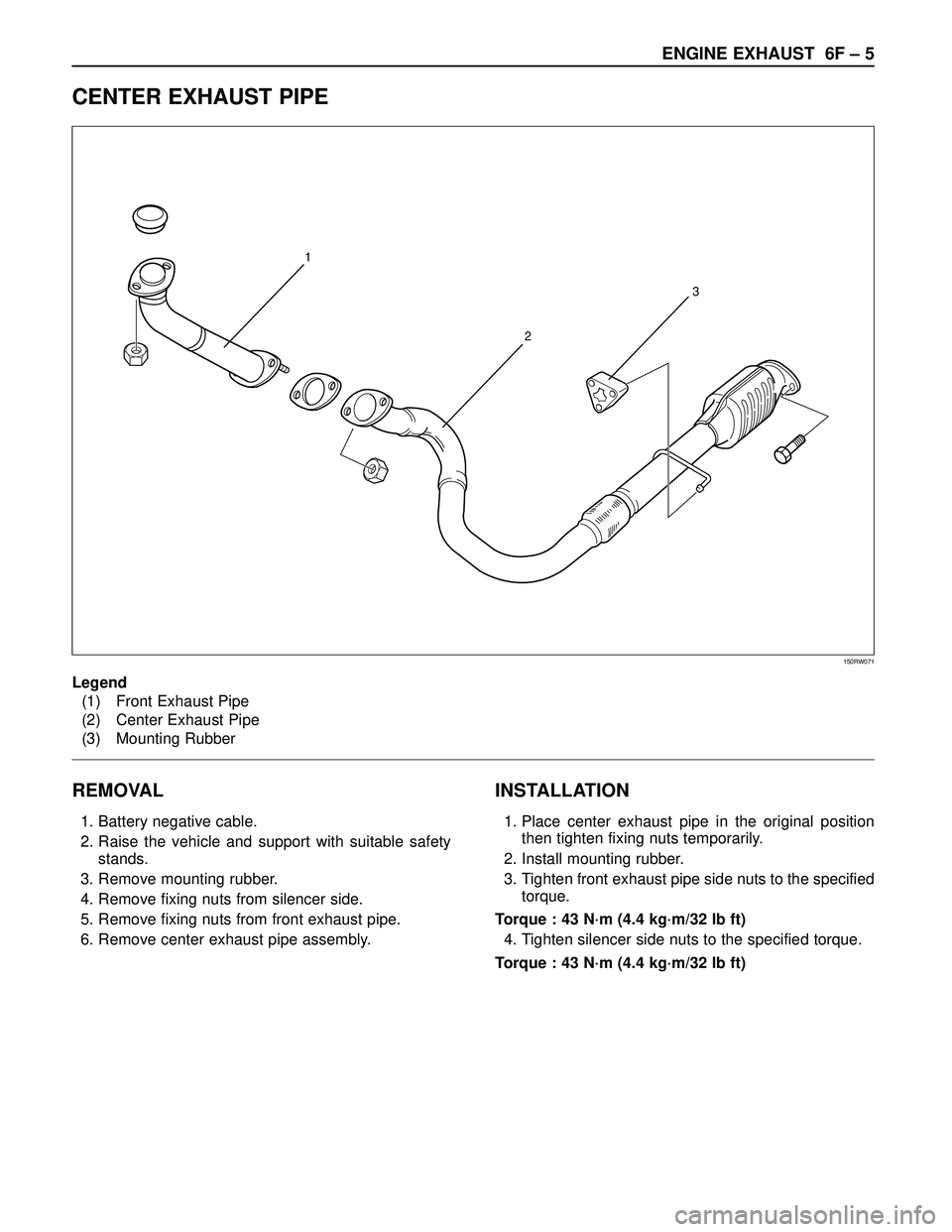
CENTER EXHAUST PIPE
REMOVAL
1. Battery negative cable.
2. Raise the vehicle and support with suitable safety
stands.
3. Remove mounting rubber.
4. Remove fixing nuts from silencer side.
5. Remove fixing nuts from front exhaust pipe.
6. Remove center exhaust pipe assembly.
INSTALLATION
1. Place center exhaust pipe in the original position
then tighten fixing nuts temporarily.
2. Install mounting rubber.
3. Tighten front exhaust pipe side nuts to the specified
torque.
Torque : 43 N·m (4.4 kg·m/32 lb ft)
4. Tighten silencer side nuts to the specified torque.
Torque : 43 N·m (4.4 kg·m/32 lb ft)
3
2 1
Legend
(1) Front Exhaust Pipe
(2) Center Exhaust Pipe
(3) Mounting Rubber
150RW071
Page 2129 of 3573
6F – 6 ENGINE EXHAUST
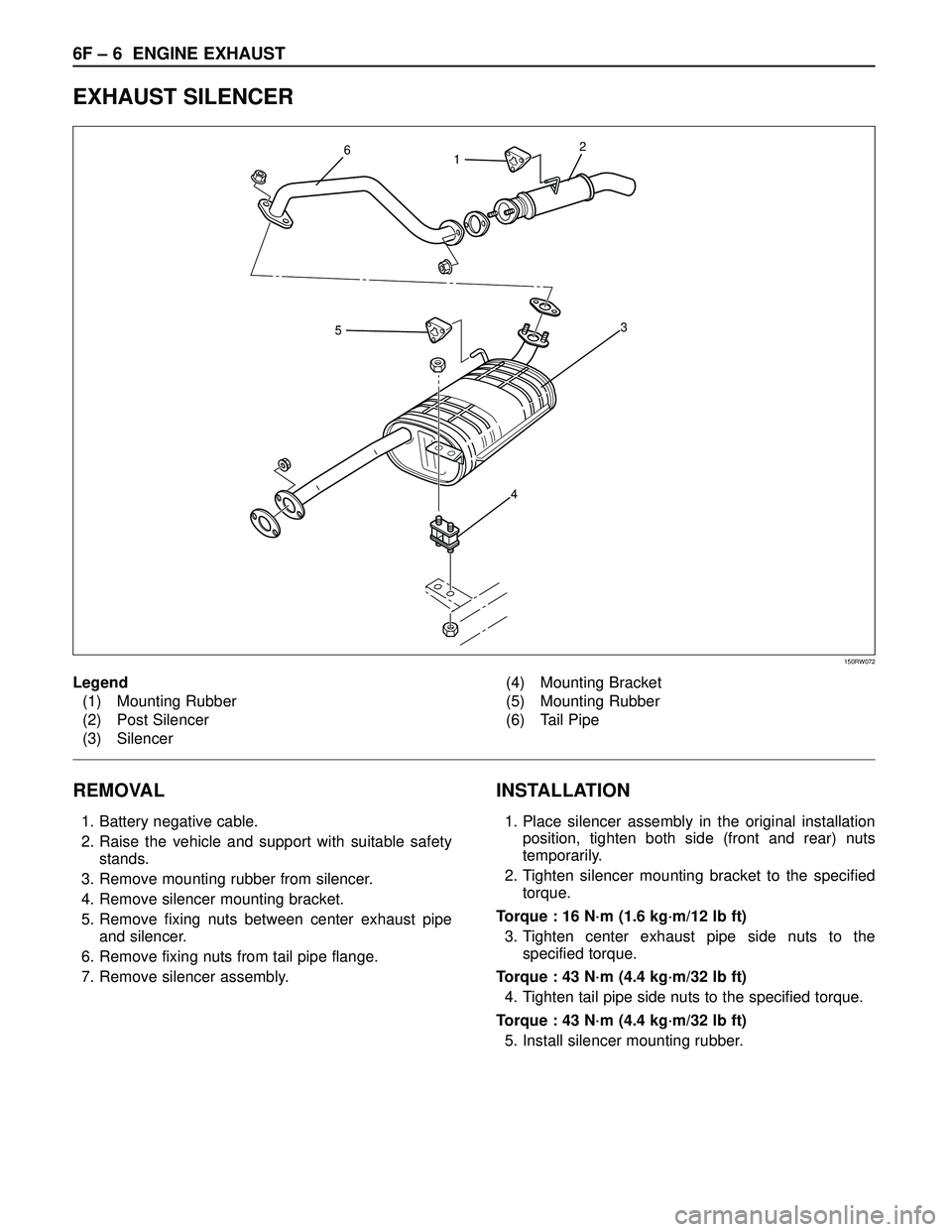
EXHAUST SILENCER
REMOVAL
1. Battery negative cable.
2. Raise the vehicle and support with suitable safety
stands.
3. Remove mounting rubber from silencer.
4. Remove silencer mounting bracket.
5. Remove fixing nuts between center exhaust pipe
and silencer.
6. Remove fixing nuts from tail pipe flange.
7. Remove silencer assembly.
INSTALLATION
1. Place silencer assembly in the original installation
position, tighten both side (front and rear) nuts
temporarily.
2. Tighten silencer mounting bracket to the specified
torque.
Torque : 16 N·m (1.6 kg·m/12 lb ft)
3. Tighten center exhaust pipe side nuts to the
specified torque.
Torque : 43 N·m (4.4 kg·m/32 lb ft)
4. Tighten tail pipe side nuts to the specified torque.
Torque : 43 N·m (4.4 kg·m/32 lb ft)
5. Install silencer mounting rubber.
6
3
4
2
1
5
Legend
(1) Mounting Rubber
(2) Post Silencer
(3) Silencer(4) Mounting Bracket
(5) Mounting Rubber
(6) Tail Pipe
150RW072
Page 2130 of 3573
ENGINE EXHAUST 6F – 7
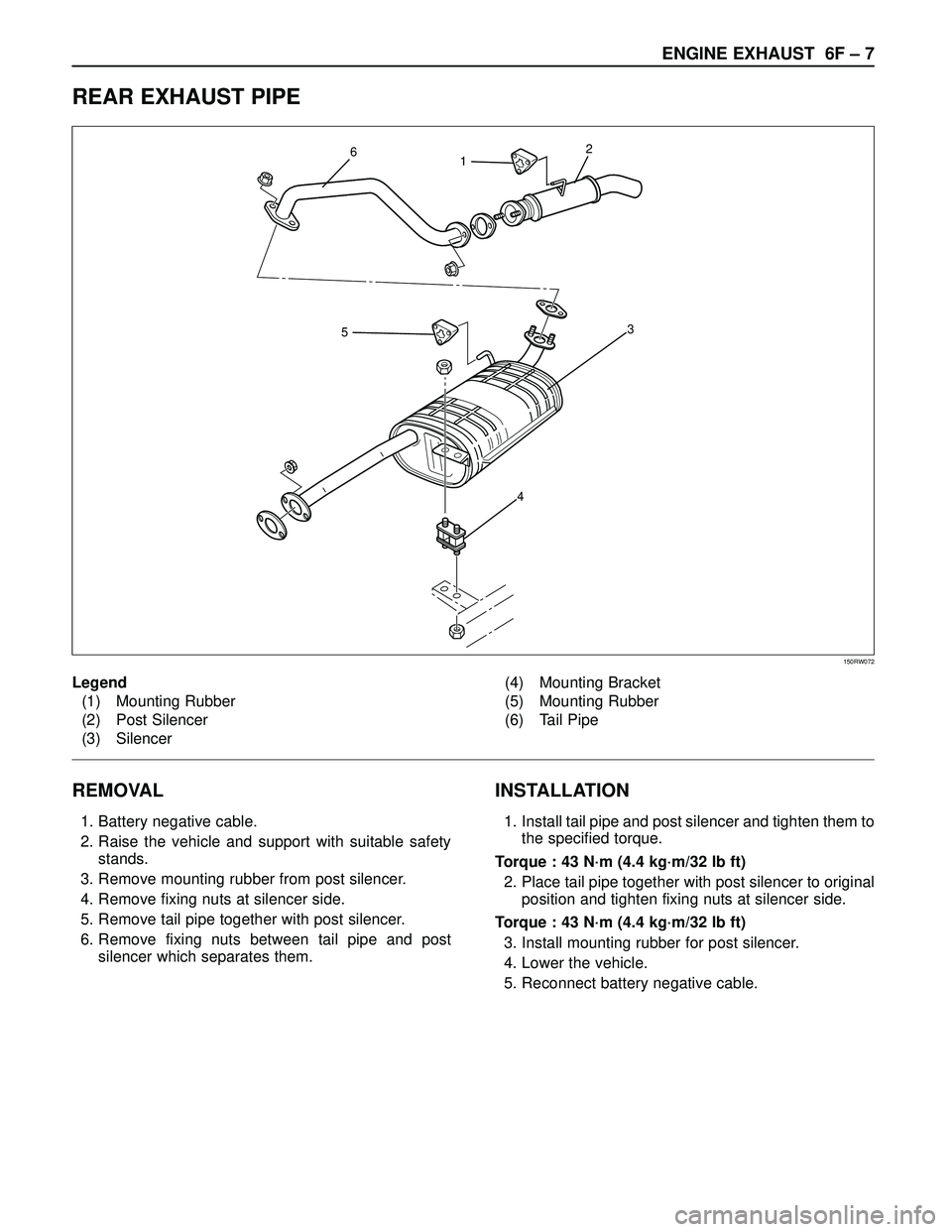
REAR EXHAUST PIPE
REMOVAL
1. Battery negative cable.
2. Raise the vehicle and support with suitable safety
stands.
3. Remove mounting rubber from post silencer.
4. Remove fixing nuts at silencer side.
5. Remove tail pipe together with post silencer.
6. Remove fixing nuts between tail pipe and post
silencer which separates them.
INSTALLATION
1. Install tail pipe and post silencer and tighten them to
the specified torque.
Torque : 43 N·m (4.4 kg·m/32 lb ft)
2. Place tail pipe together with post silencer to original
position and tighten fixing nuts at silencer side.
Torque : 43 N·m (4.4 kg·m/32 lb ft)
3. Install mounting rubber for post silencer.
4. Lower the vehicle.
5. Reconnect battery negative cable.
6
3
4
2
1
5
Legend
(1) Mounting Rubber
(2) Post Silencer
(3) Silencer(4) Mounting Bracket
(5) Mounting Rubber
(6) Tail Pipe
150RW072
Page 2136 of 3573
ENGINE LUBRICATION 6G – 5
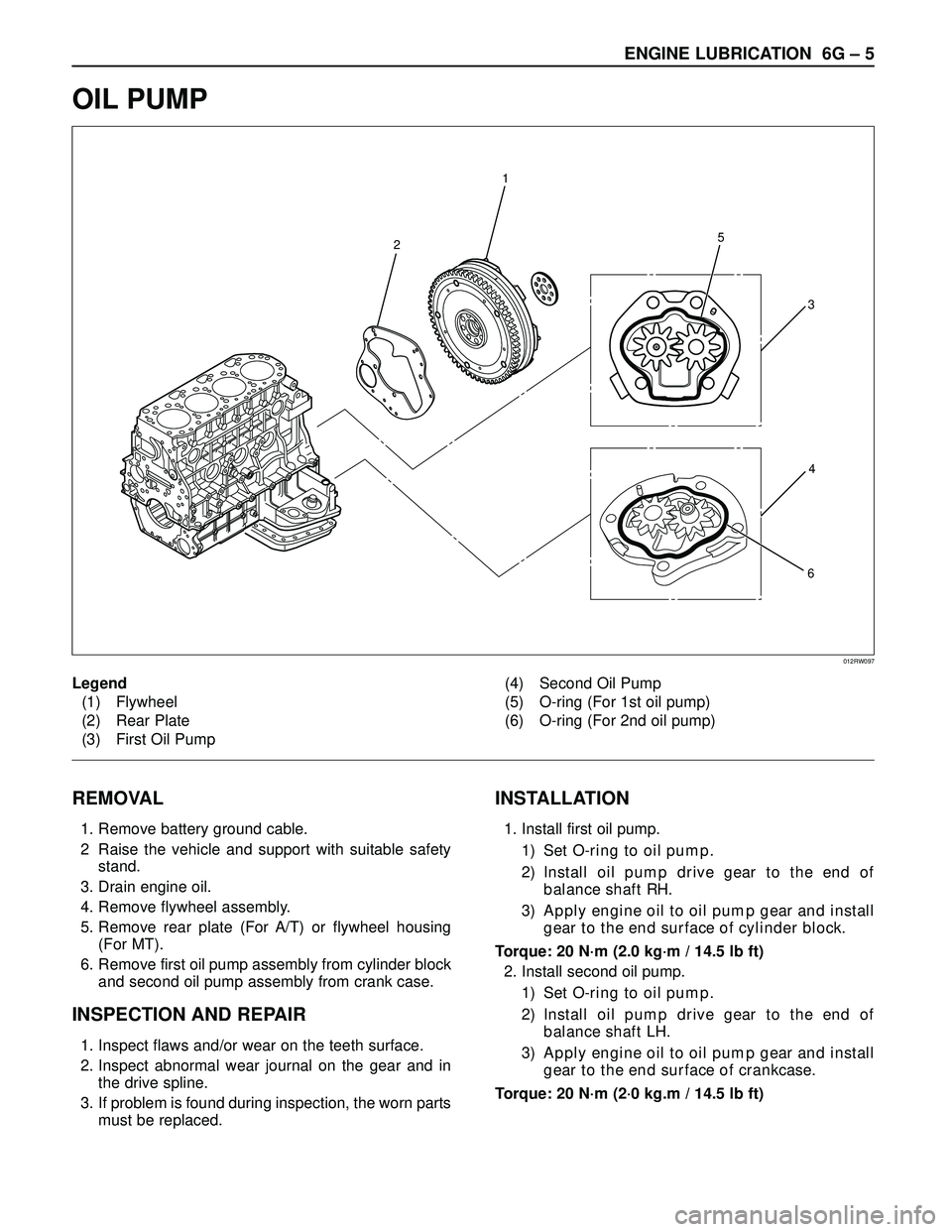
OIL PUMP
REMOVAL
1. Remove battery ground cable.
2 Raise the vehicle and support with suitable safety
stand.
3. Drain engine oil.
4. Remove flywheel assembly.
5. Remove rear plate (For A/T) or flywheel housing
(For MT).
6. Remove first oil pump assembly from cylinder block
and second oil pump assembly from crank case.
INSPECTION AND REPAIR
1. Inspect flaws and/or wear on the teeth surface.
2. Inspect abnormal wear journal on the gear and in
the drive spline.
3. If problem is found during inspection, the worn parts
must be replaced.
INSTALLATION
1. Install first oil pump.
1) Set O-ring to oil pump.
2) Install oil pump drive gear to the end of
balance shaft RH.
3) Apply engine oil to oil pump gear and install
gear to the end surface of cylinder block.
Torque: 20 N·m (2.0 kg·m / 14.5 lb ft)
2. Install second oil pump.
1) Set O-ring to oil pump.
2) Install oil pump drive gear to the end of
balance shaft LH.
3) Apply engine oil to oil pump gear and install
gear to the end surface of crankcase.
Torque: 20 N·m (2·0 kg.m / 14.5 lb ft)
2
1
5
6
3
4
Legend
(1) Flywheel
(2) Rear Plate
(3) First Oil Pump(4) Second Oil Pump
(5) O-ring (For 1st oil pump)
(6) O-ring (For 2nd oil pump)
012RW097
Page 2137 of 3573
6G – 6 ENGINE LUBRICATION
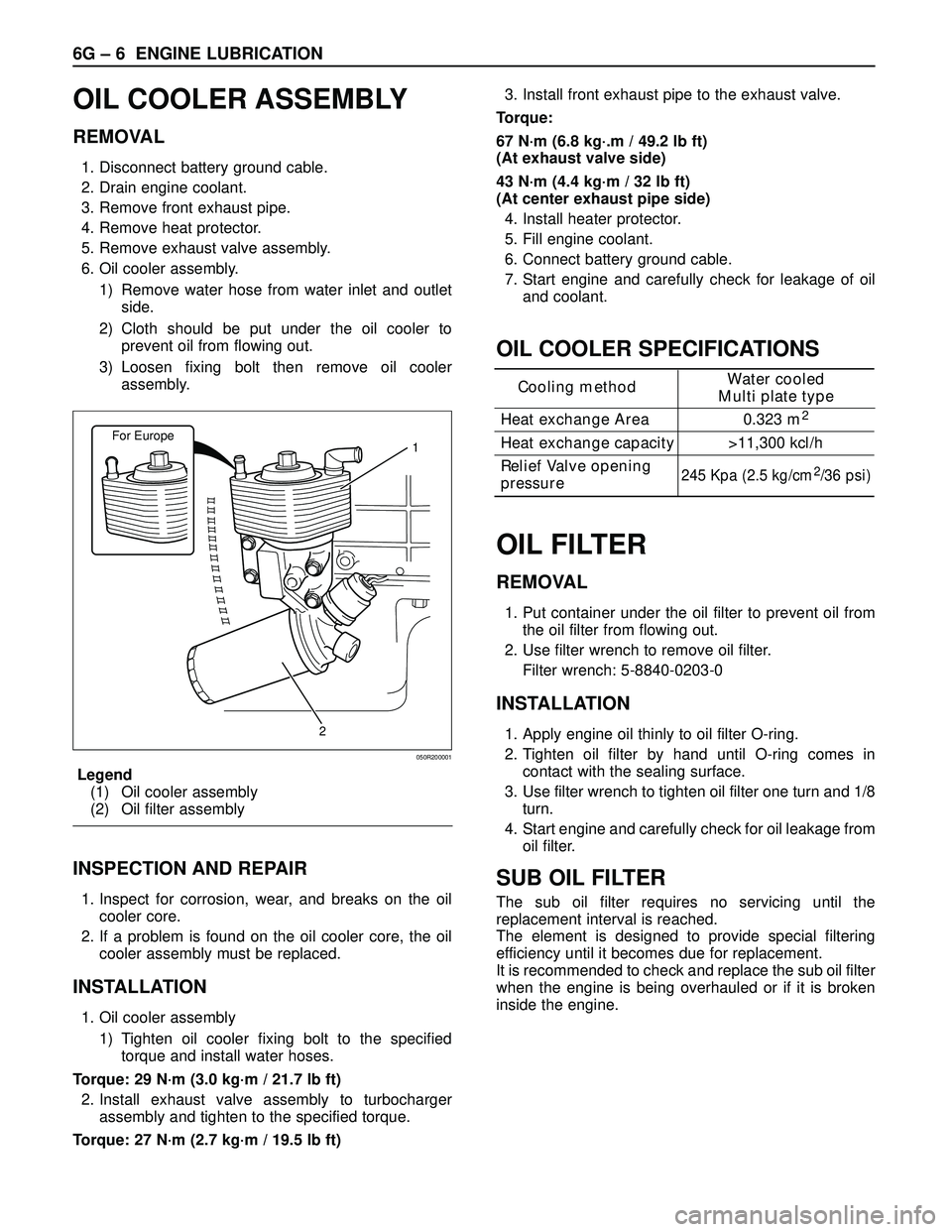
OIL COOLER ASSEMBLY
REMOVAL
1. Disconnect battery ground cable.
2. Drain engine coolant.
3. Remove front exhaust pipe.
4. Remove heat protector.
5. Remove exhaust valve assembly.
6. Oil cooler assembly.
1) Remove water hose from water inlet and outlet
side.
2) Cloth should be put under the oil cooler to
prevent oil from flowing out.
3) Loosen fixing bolt then remove oil cooler
assembly.
Legend
(1) Oil cooler assembly
(2) Oil filter assembly
INSPECTION AND REPAIR
1. Inspect for corrosion, wear, and breaks on the oil
cooler core.
2. If a problem is found on the oil cooler core, the oil
cooler assembly must be replaced.
INSTALLATION
1. Oil cooler assembly
1) Tighten oil cooler fixing bolt to the specified
torque and install water hoses.
Torque: 29 N·m (3.0 kg·m / 21.7 lb ft)
2. Install exhaust valve assembly to turbocharger
assembly and tighten to the specified torque.
Torque: 27 N·m (2.7 kg·m / 19.5 lb ft)3. Install front exhaust pipe to the exhaust valve.
Torque:
67 N·m (6.8 kg·.m / 49.2 lb ft)
(At exhaust valve side)
43 N·m (4.4 kg·m / 32 lb ft)
(At center exhaust pipe side)
4. Install heater protector.
5. Fill engine coolant.
6. Connect battery ground cable.
7. Start engine and carefully check for leakage of oil
and coolant.
OIL COOLER SPECIFICATIONS
Cooling methodWater cooled
Multi plate type
Heat exchange Area 0.323 m
2
Heat exchange capacity >11,300 kcl/h
Relief Valve opening
245 Kpa (2.5 kg/cm2/36 psi)pressure
OIL FILTER
REMOVAL
1. Put container under the oil filter to prevent oil from
the oil filter from flowing out.
2. Use filter wrench to remove oil filter.
Filter wrench: 5-8840-0203-0
INSTALLATION
1. Apply engine oil thinly to oil filter O-ring.
2. Tighten oil filter by hand until O-ring comes in
contact with the sealing surface.
3. Use filter wrench to tighten oil filter one turn and 1/8
turn.
4. Start engine and carefully check for oil leakage from
oil filter.
SUB OIL FILTER
The sub oil filter requires no servicing until the
replacement interval is reached.
The element is designed to provide special filtering
efficiency until it becomes due for replacement.
It is recommended to check and replace the sub oil filter
when the engine is being overhauled or if it is broken
inside the engine.
For Europe1
2
050R200001