brakes JAGUAR X308 1998 2.G User Guide
[x] Cancel search | Manufacturer: JAGUAR, Model Year: 1998, Model line: X308, Model: JAGUAR X308 1998 2.GPages: 2490, PDF Size: 69.81 MB
Page 316 of 2490
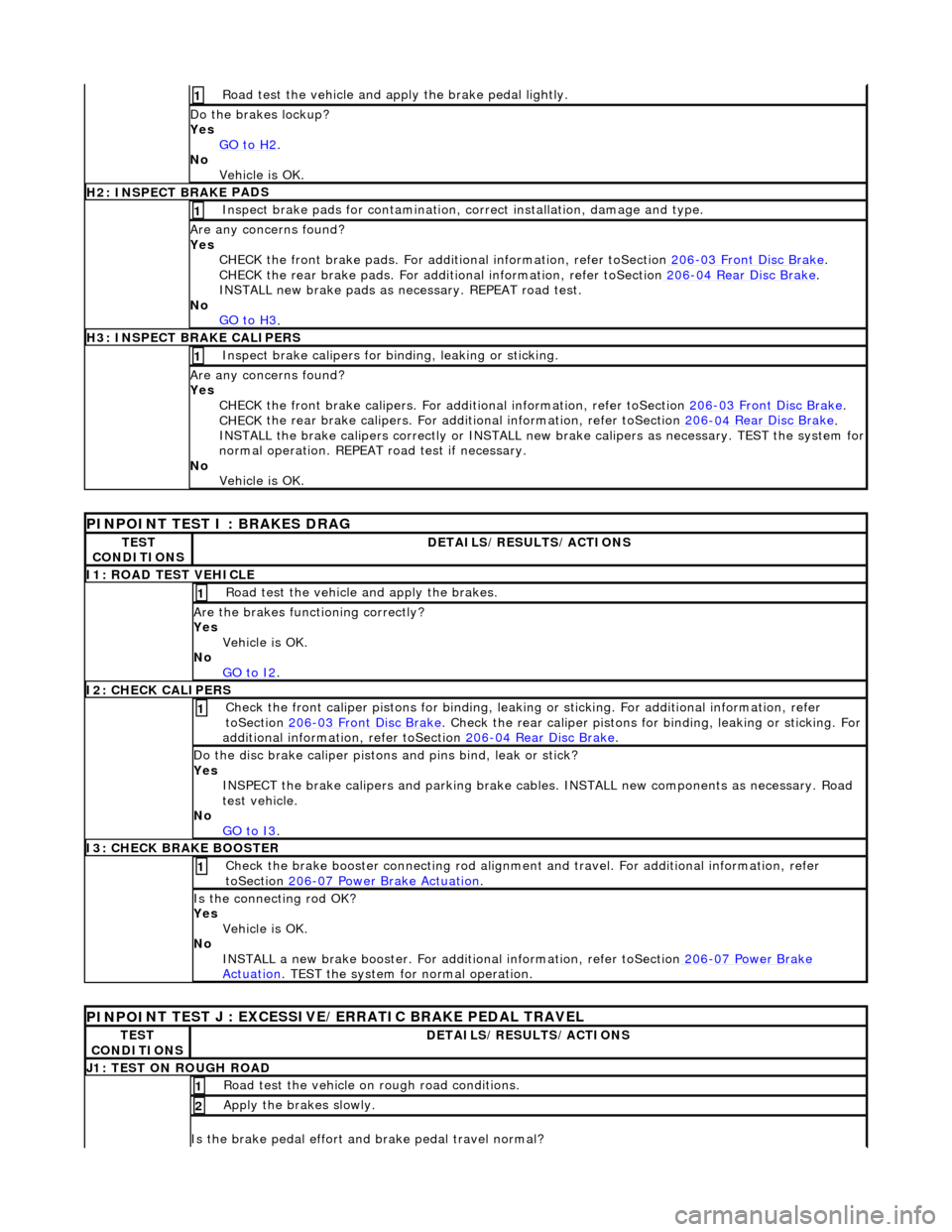
Road test the veh
icle and a
pply the brake pe dal lightly.
1
Do th
e brakes lockup?
Yes GO to H2
.
No
Vehicle is OK.
H2: INSPECT BRAKE PADS
Inspect brake pads for con
t
amination,
correct installation , damage and type.
1
Ar
e any concerns found?
Yes CHECK the front brake pads. For additi onal information, refer toSection 206
-03 Fr
ont Disc Brake
.
CHECK
the rear brake pads. For additi
onal information, refer toSection 206
-04
Rear Disc Brake
.
INST ALL new brake pads as ne ce
ssary. REPEAT
road test.
No GO to H3
.
H3: INSPECT BRAKE CALI
PERS
Inspect brake cali
pers for bindi
ng, leaking or sticking.
1
A
r
e any concerns found?
Yes CHECK the front brake calipers. For addi tional information, refer toSection 206
-03 Fr
ont Disc Brake
.
CHECK
the rear brake calipers. For addi
tional information, refer toSection 206
-04
Rear Disc Brake
.
IN ST
ALL the brake calipers correctly or INSTALL new
brake calipers as necessary. TEST the system for
normal operation. REPEAT road test if necessary.
No Vehicle is OK.
PI
NPOINT TEST I : BRAKES DRAG
TE
S
T
CONDITIONS
D E
TAILS/RESULTS/ACTIONS
I1
:
ROAD TEST VEHICLE
Ro
ad t
est the vehicle
and apply the brakes.
1
Are the brakes
functioning correctly?
Yes Vehicle is OK.
No GO to I2
.
I2
: CHECK CALIPERS
Check the fr
on
t caliper pistons for binding, leakin
g or sticking. For additional information, refer
toSection 206
-03 Fr
ont Disc Brake
. Check the rear cal
i
per pistons for
binding, leaking or sticking. For
additional information, refer toSection 206
-04
Rear Disc Brake
.
1
Do t
h
e disc brake caliper pistons
and pins bind, leak or stick?
Yes INSPECT the brake calipers and pa rking brake cables. INSTALL new co mponents as necessary. Road
test vehicle.
No GO to I3
.
I3
: CHECK BRAKE BOOSTER
Check the brake booster con
n
ecting rod alignment
and travel. For additional information, refer
toSection 206
-0 7
Power Brake Actuation
. 1
Is the co
nnecti
ng rod OK?
Yes Vehicle is OK.
No INSTALL a new brake booster. For addi tional information, refer toSection 206
-07
Power Brake
Actuation. TEST
the system for
normal operation.
PINPO
I
NT TEST J : EXCESSIVE/ERRATIC BRAKE PEDAL TRAVEL
TE
S
T
CONDITIONS
D E
TAILS/RESULTS/ACTIONS
J
1
: TEST ON ROUGH ROAD
R
oad test the vehi
cle on rough road conditions.
1
Apply the brakes slowly. 2
Is th
e brake pedal ef
fort an
d brake pedal travel normal?
Page 319 of 2490
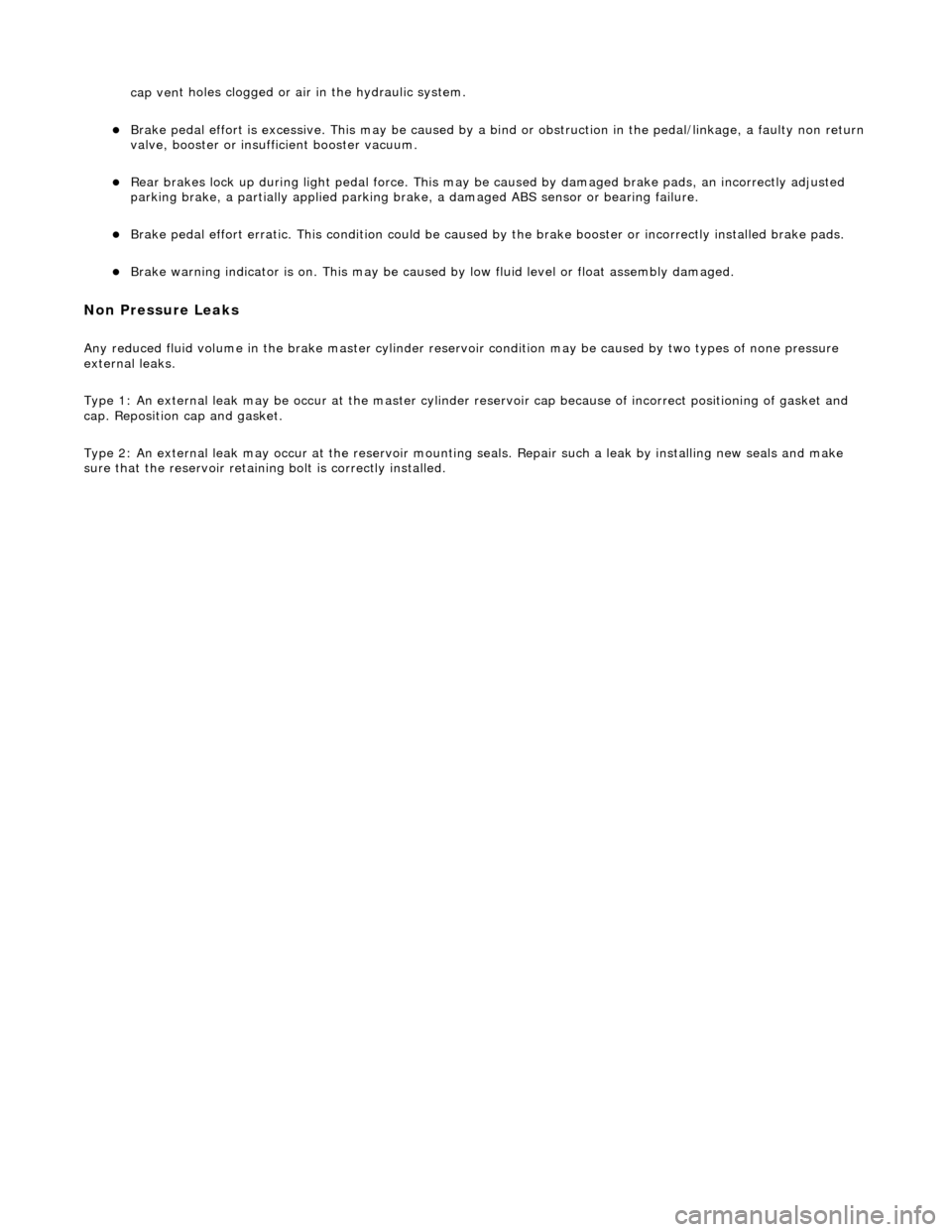
cap ven
t holes clogged or air in the hydraulic system.
Brake ped
al effort is excessive. This ma
y be caused by a bind or obstruction in the pedal/linkage, a faulty non return
valve, booster or insuffi cient booster vacuum.
R
ear brakes lock up during light pedal force. This may
be caused by damaged brake pads, an incorrectly adjusted
parking brake, a partially applied parking brake, a damaged ABS sensor or bearing failure.
Brake ped
al effort erratic. This condition could be caused by the brake booste
r or incorrectly installed brake pads.
Brake warning indicator i
s on. This may be caused
by low fluid level or float assembly damaged.
No
n Pressure Leaks
Any reduced fluid v
olume in the brake ma
ster cylinder reservoir condition may be caused by two types of none pressure
external leaks.
Type 1: An external leak may be occur at the master cylinder reservoir cap because of incorre ct positioning of gasket and
cap. Reposition cap and gasket.
Type 2: An external leak may occur at th e reservoir mounting seals. Repair such a leak by installing new seals and make
sure that the reservoir retainin g bolt is correctly installed.
Page 320 of 2490

Brake Sys
tem - General Informatio
n - Brake System BleedingVehicles
With: Standard Brakes
Gen e
ral Procedures
WARNING: WASH HANDS AFTER HANDLING BRAKE FLUID. IF BRAKE FLUID COMES INTO CONTACT WITH THE EYES,
FLUSH EYES WITH COLD RUNNING WATER. IF IRRITATION PERSISTS SEEK MEDICAL ATTENTION. IF BRAKE FLUID IS
TAKEN INTERNALLY, DRINK WATER AND INDUCE VO MITING. GET MEDICAL ATTENTION IMMEDIATELY.
CAUTION: Remove brake fluid spillage imme diately from paint work with clean water.
1. Position vehi cl
e on a four-post lift.
2. Open engine compartment and fit paint work protection covers
to fenders.
3. NO
TE: Make sure the
brake-fluid level does not fall below the
fluid reservoir 'MIN' (minimum) mark when bleeding the brake
system.
Fill fluid reservoir to the 'MAX' (maximum) mark.
4. Prepare l e
ft-hand front, br
ake-caliper for bleeding.
Remove du
st cap.
Connect b
l
eed pipe
and fluid container to bleed nipple.
5. Bleed the brake.
1. Apply pressure to brake pedal
2. Open bleed nipple.
3. Fully depres s brake pedal.
4. Close bleed nipple.
5. Release brake pedal.
6. Wait two seconds to allow system to prime.
7. Repeat procedure until air- free brake fluid is expelled
from the caliper.
6. Tighten bleed nipple, see torque settings below.
Page 321 of 2490

Front caliper bleed
nipple: 4-6
Nm.
Rear caliper
bleed
nipple: 8-11 Nm.
7. F
ollowing the procedure below,
bleed the brakes in the order
shown:
1. Left-Hand Front,
2. Right-Hand Front,
3. Left- Hand Rear,
4. Right-Hand Rear.
8. CAUTI
ON: Remove brake flui
d spillage immediately from
paint work with clean water.
Fill fluid reservoir.
F
ill reservoir to the 'MAX' mark.
F
it filler cap.
9.
Start e
ngine.
10. Check for correct brake-pedal travel and pressure.
11. Apply brake pedal and check around vehicle for brake fluid
leaks.
12. Make sure brake fluid level is at the 'MAX' mark.
Page 322 of 2490

Brake Sys
tem - General Informatio
n - Brake System BleedingVehicles
With: High Performance Brakes
Gen e
ral Procedures
1. WARNINGS:
IF BRAKE FLUID IS TAKEN INTERNALLY, DRINK WATER
AND INDUCE VOMITING. GET MEDICAL ATTENTION
IMMEDIATELY.
WASH HANDS AFTER HANDLING BRAKE FLUID. IF BRAKE
FLUID COMES INTO CONTACT WITH THE EYES, FLUSH EYES
WITH COLD RUNNING WATER. IF IRRITATION PERSISTS SEEK
MEDICAL ATTENTION.
CAUTION: Remove brake flui d spillage immediately from
paint work with clean water.
Position vehicle on a four-post lift.
2. Op
en engine compartment and fit
paint work protection covers
to fenders.
3. NO
TE: Make sure the
brake-fluid level does not fall below the
fluid reservoir 'MIN' (minimum) mark when bleeding the brake
system.
Fill fluid reservoir to the 'MAX' (maximum) mark.
4. Pr
epare the left-hand front,
brake-caliper for bleeding.
Connect b
leed pipes an
d fluid containers to bleed nipples.
5. Bleed the brake.
1. Apply pressure to brake pedal.
2. Open caliper's outer bleed nipple.
3. Fully depres s brake pedal.
Page 323 of 2490

4
. Close bleed nipple.
5. Release brake pedal.
6. Wait two seconds to allow system to prime.
7. Repeat procedure until air- free brake fluid is expelled
from the bleed nipple.
8. Repeat procedure to ca liper's inner bleed nipple.
6. Tigh
ten bleed nipples to 12-16 Nm.
7. F
ollowing the procedure above,
bleed the brakes in the order
shown:
1. Left-Hand Front,
2. Right-Hand Front,
3. Left- Hand Rear,
4. Right-Hand Rear.
8. CAUTI
ON: Remove brake flui
d spillage immediately from
paint work with clean water.
Fill fluid reservoir.
F
ill reservoir to the 'MAX' mark.
F
it filler cap.
9.
Start e
ngine.
10. Check for correct brake-pedal travel and pressure.
11. Apply brake pedal and check around vehicle for brake fluid
leaks.
12. Make sure brake fluid level is at the 'MAX' mark.
Page 324 of 2490
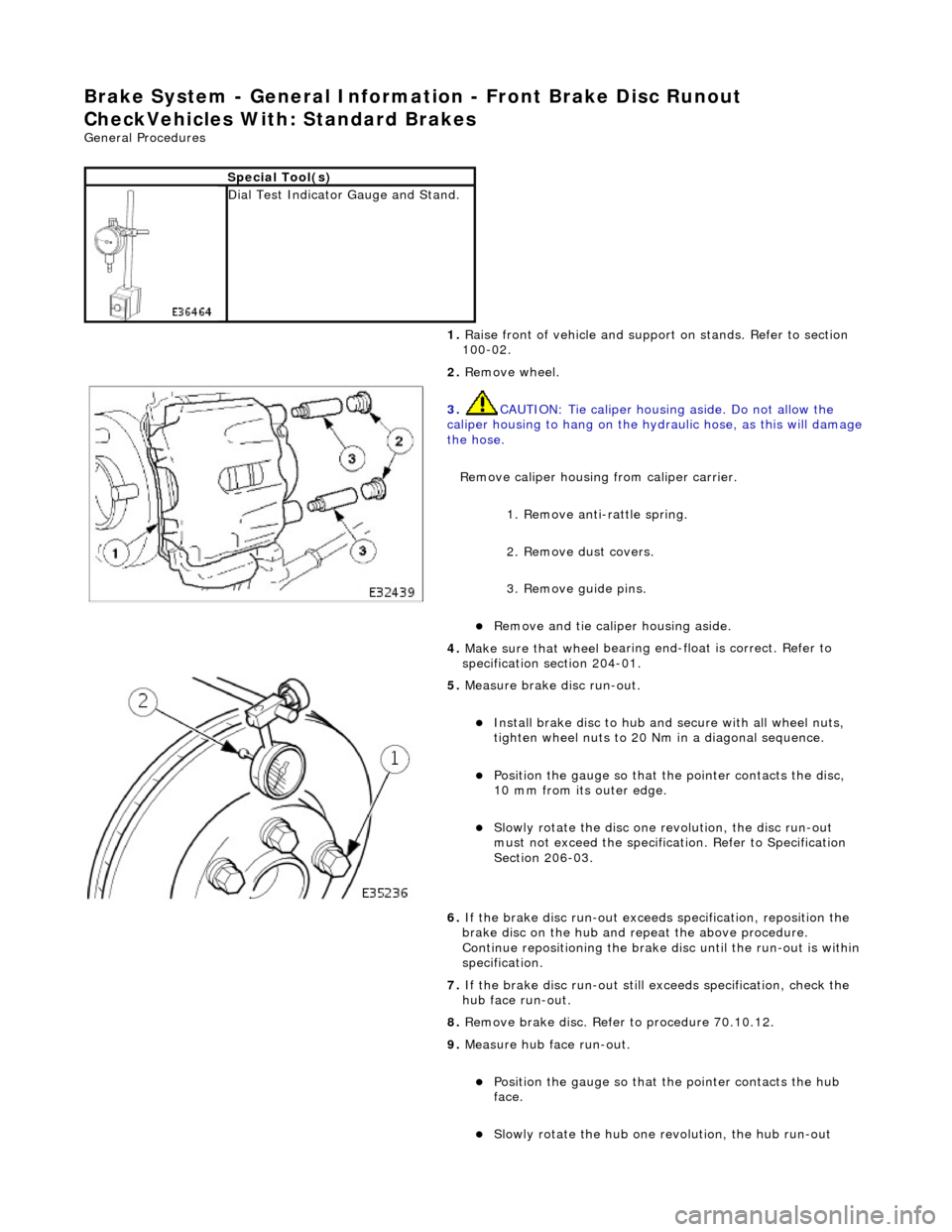
Brake System - Gener
al Information - Front Brake Disc Runout
CheckVehicles With: Standard Brakes
Gen e
ral Procedures
S
p
ecial Tool(s)
Dial Test Indicator
G
auge and Stand.
1. Raise front of vehicle and support on stands. Refer to section
100-02.
2. Remove wheel.
3. CAUT
ION: Tie caliper housing aside. Do not allow the
caliper housing to hang on the hydraulic hose, as this will damage
the hose.
Remove caliper housing from caliper carrier.
1. Remove anti-rattle spring.
2. Remove dust covers.
3. Remove guide pins.
Remove an
d tie caliper housing aside.
4.
Make sure that wheel
bearing en
d-float is correct. Refer to
specification section 204-01.
5. Measure brake d
isc run-out.
Inst
al
l brake disc to hub and secure with all wheel nuts,
tighten wheel nuts to 20 Nm in a diagonal sequence.
Posi
tion the gauge so that the pointer contacts the disc,
10 mm from its outer edge.
Slo w
ly rotate the disc one revolution, the disc run-out
must not exceed the specification. Refer to Specification
Section 206-03.
6. If the brake disc run-out exceeds specification, reposition the
brake disc on the hub and re peat the above procedure.
Continue repositioning the brake di sc until the run-out is within
specification.
7. If the brake disc run-out still exceeds specification, check the
hub face run-out.
8. Remove brake disc. Refer to procedure 70.10.12.
9. Measure hub face run-out.
Posi
tion the gauge so that the pointer contacts the hub
face.
Slo w
ly rotate the hub one revolution, the hub run-out
Page 326 of 2490
Fr
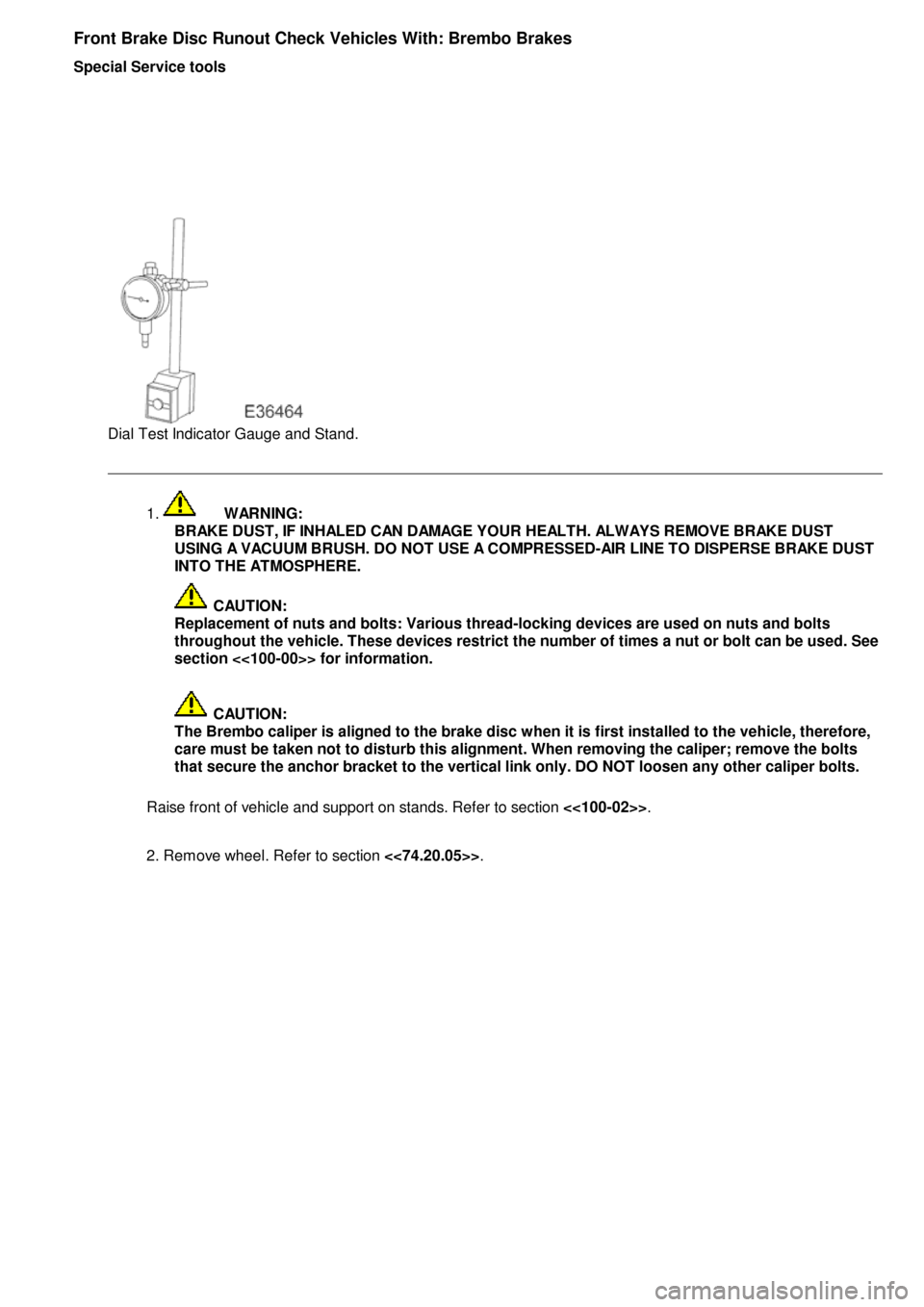
ont Brake Disc Runout Check Vehicles With: Brembo Brakes
Special Service tools
Di
al Test Indicator Gauge and Stand.
1.
WA
RNING:
BRAKE DUST, IF INHALED CAN DAMAGE YOUR HEALTH. ALWAYS REMOVE BRAKE DUST USING A VACUUM BRUSH. DO NOT USE A COMPRESSED-AIR LINE TO DISPERSE BRAKE DUST
INTO THE ATMOSPHERE.
CA
UTION:
Replacement of nuts and bolts: Various thread-locking devices are used on nuts and bolts
throughout the vehicle. These devices restrict the number of times a nut or bolt can be used. See
section <<100-00>> for information.
CA
UTION:
The Brembo caliper is aligned to the brake disc when it is first installed to the vehicle, therefore,
care must be taken not to disturb this alignment. When removing the caliper; remove the bolts
that secure the anchor bracket to the vertical link only. DO NOT loosen any other caliper bolts.
Raise front of vehicle and support on stands. Refer to section <<100-02>>.
2. Remove wheel. Refer to section <<74.20.05>>.
Page 331 of 2490
R
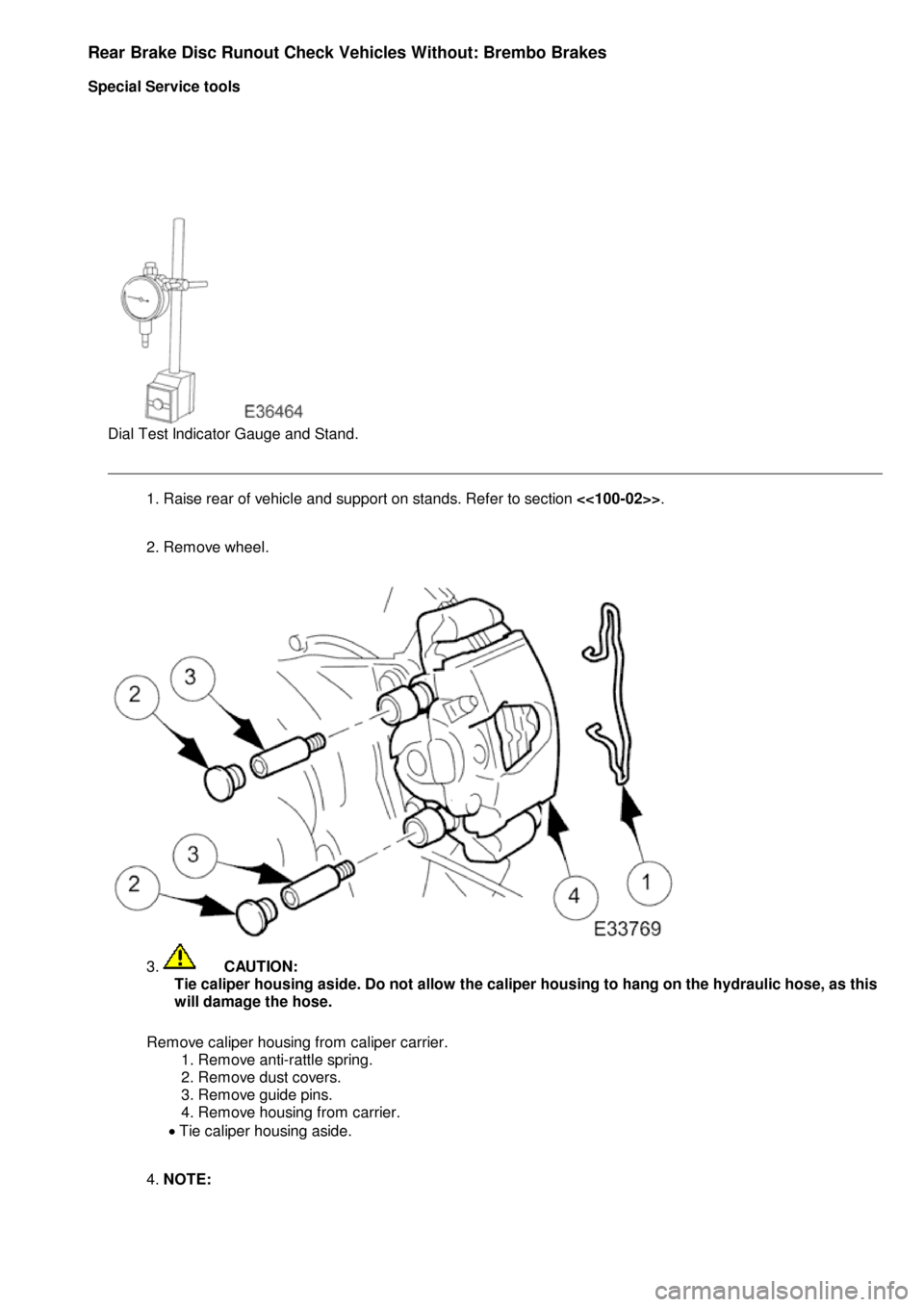
ear Brake Disc Runout Check Vehicles Without: Brembo Brakes
Special Service tools
D
ial Test Indicator Gauge and Stand.
1
. Raise rear of vehicle and support on stands. Refer to section
<<100-02>>.
2. Remove wheel.
3
.
C
AUTION:
Tie caliper housing aside. Do not allow the caliper housing to hang on the hydraulic hose, as this
will damage the hose.
Remove caliper housing from caliper carrier. 1. Remove anti-rattle spring.
2. Remove dust covers.
3. Remove guide pins.
4. Remove housing from carrier.
Tie caliper housing aside.
4. NOTE:
Page 334 of 2490
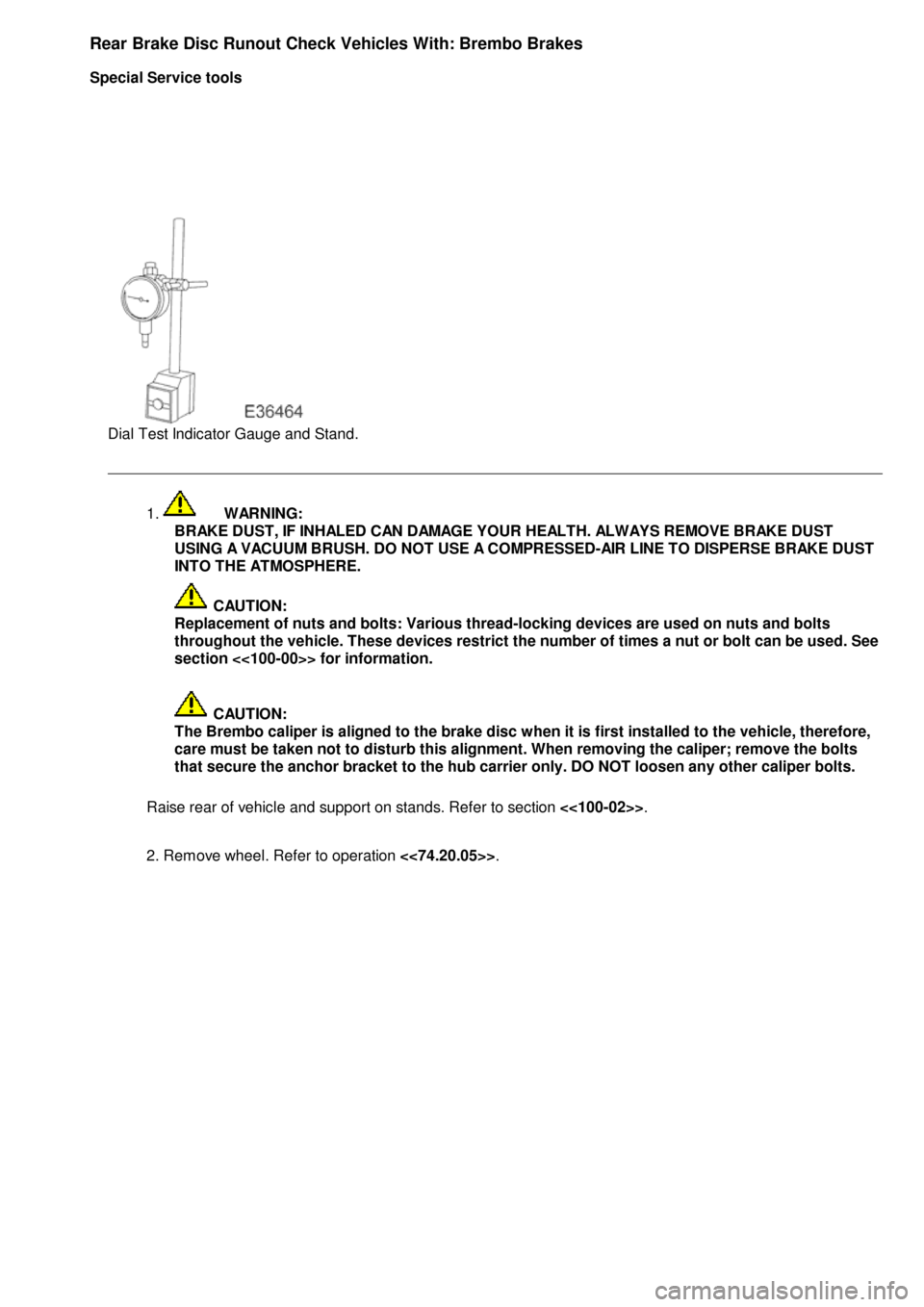
Rear
Brake Disc Runout Check Vehicles With: Brembo Brakes
Special Service tools
Di
al Test Indicator Gauge and Stand.
1.
WA
RNING:
BRAKE DUST, IF INHALED CAN DAMAGE YOUR HEALTH. ALWAYS REMOVE BRAKE DUST USING A VACUUM BRUSH. DO NOT USE A COMPRESSED-AIR LINE TO DISPERSE BRAKE DUST
INTO THE ATMOSPHERE.
CA
UTION:
Replacement of nuts and bolts: Various thread-locking devices are used on nuts and bolts
throughout the vehicle. These devices restrict the number of times a nut or bolt can be used. See
section <<100-00>> for information.
CA
UTION:
The Brembo caliper is aligned to the brake disc when it is first installed to the vehicle, therefore,
care must be taken not to disturb this alignment. When removing the caliper; remove the bolts
that secure the anchor bracket to the hub carrier only. DO NOT loosen any other caliper bolts.
Raise rear of vehicle and support on stands. Refer to section <<100-02>>.
2. Remove wheel. Refer to operation <<74.20.05>>.