wheel JAGUAR X308 1998 2.G Workshop Manual
[x] Cancel search | Manufacturer: JAGUAR, Model Year: 1998, Model line: X308, Model: JAGUAR X308 1998 2.GPages: 2490, PDF Size: 69.81 MB
Page 439 of 2490
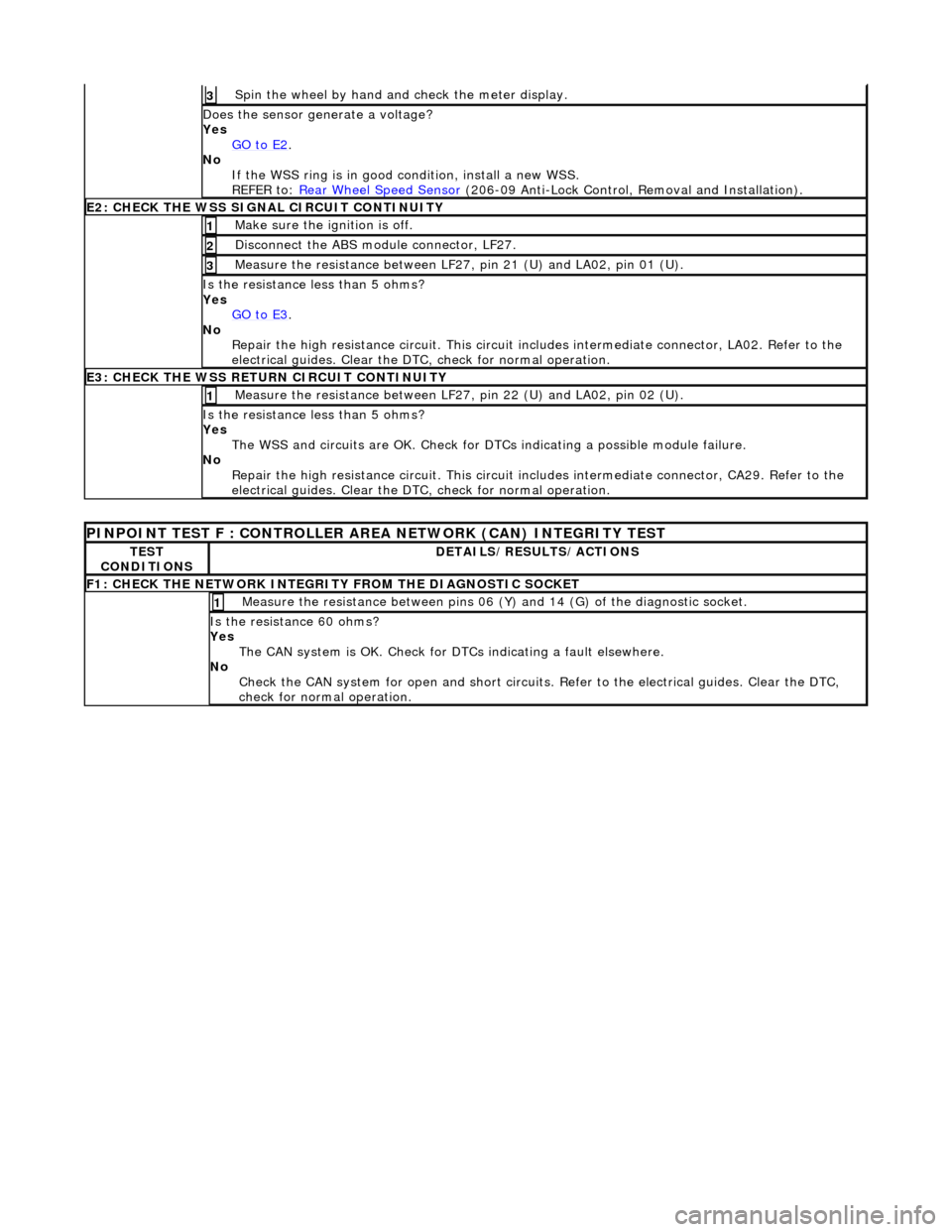
Spin
the wheel by hand and check the meter display.
3
Doe
s the sensor generate a voltage?
Yes GO to E2
.
No
If the WSS ring is in good condition, install a new WSS.
REFER to: Rear Wheel Speed Sensor
(20
6-09 Anti-Lock Control, Removal and Installation).
E2
: CHECK THE WSS SIGNAL CIRCUIT CONTINUITY
Make sure the ignition is off. 1
Di
sconnect the ABS module connector, LF27.
2
Meas
ure the resistance between LF27
, pin 21 (U) and LA02, pin 01 (U).
3
I
s the resistance less than 5 ohms?
Yes GO to E3
.
No
Repair the high resistance circui t. This circuit includes intermediate connector, LA02. Refer to the
electrical guides. Clear the DTC, check for normal operation.
E3
: CHECK THE WSS RETURN CIRCUIT CONTINUITY
Meas
ure the resistance between LF27
, pin 22 (U) and LA02, pin 02 (U).
1
I
s the resistance less than 5 ohms?
Yes The WSS and circuits are OK. Check for DTCs indicating a possible module failure.
No Repair the high resistance circui t. This circuit includes intermediate connector, CA29. Refer to the
electrical guides. Clear the DTC, check for normal operation.
P
INPOINT TEST F : CONT
ROLLER AREA NETWORK (CAN) INTEGRITY TEST
TE
ST
CONDITIONS
D
ETAILS/RESULTS/ACTIONS
F
1: CHECK THE NETWORK INTEGRITY
FROM THE DIAGNOSTIC SOCKET
M
easure the resistance between pins 06 (Y) and 14 (G) of the diagnostic socket.
1
I
s the resistance 60 ohms?
Yes The CAN system is OK. Check for DTCs indicating a fault elsewhere.
No Check the CAN system for open an d short circuits. Refer to the electrical guides. Clear the DTC,
check for normal operation.
Page 440 of 2490
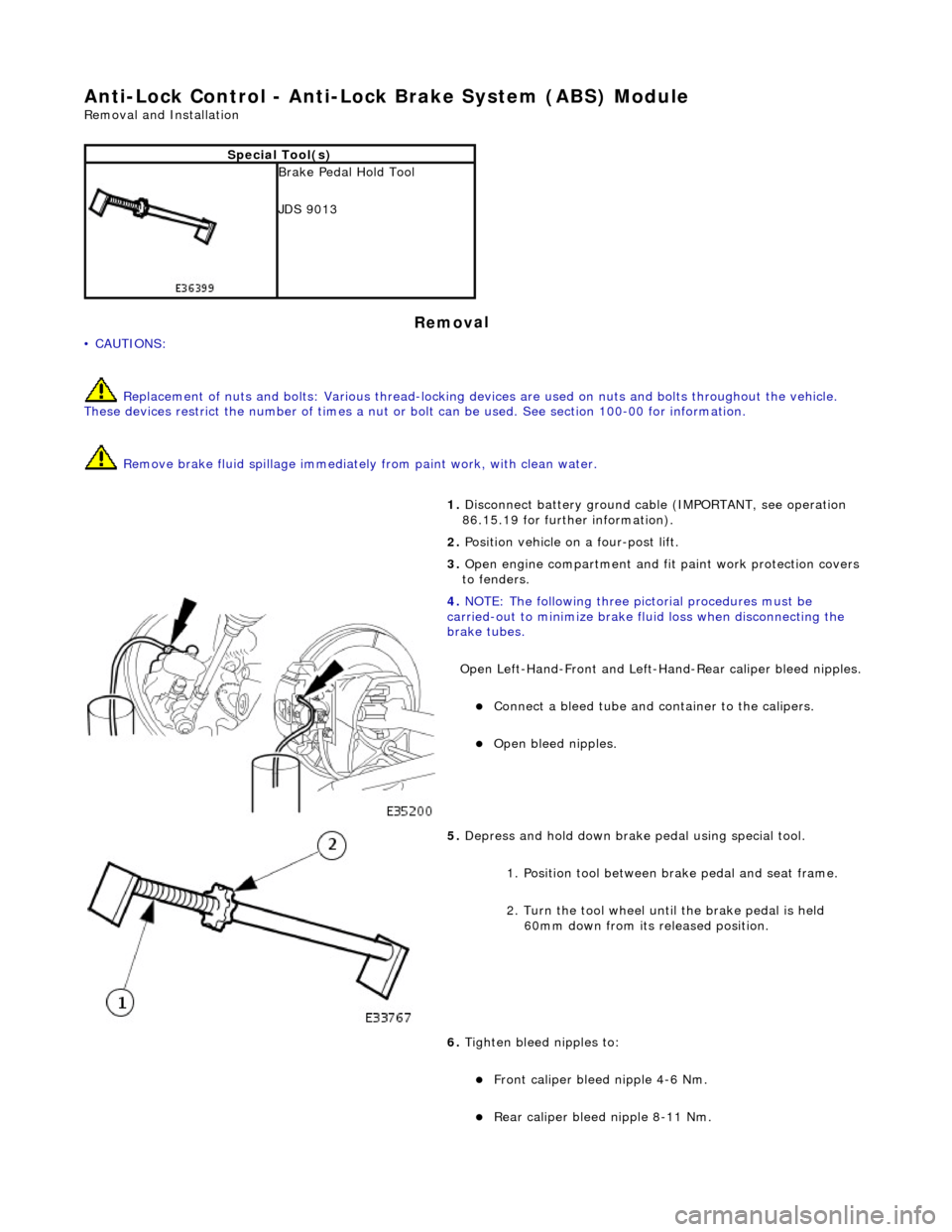
Anti-Lock Control - Anti-Lock Brake System (ABS) Module
Remo
val and Installation
Remov
a
l
• C
A
UTIONS:
Replacement of nuts and bolts: Various thread-locking de vices are used on nuts and bolts throughout the vehicle.
These devices restrict the number of times a nut or bolt can be used. See section 100-00 for information.
Remove brake fluid spilla ge immediately from paint work, with clean water.
Sp
ecial Tool(s)
Brake Pedal
H
old Tool
JDS 9013
1. Disc onne
ct battery ground cable (IMPORTANT, see operation
86.15.19 for further information).
2. Position vehicle on a four-post lift.
3. Open engine compartment and fit paint work protection covers
to fenders.
4. NOTE : Th
e following three pictorial procedures must be
carried-out to minimize brake fl uid loss when disconnecting the
brake tubes.
Open Left-Hand-Front and Left-H and-Rear caliper bleed nipples.
Connect a
bleed tube and co
ntainer to the calipers.
Op
en bleed nipples.
5. Depress and hold down brake pedal u s
ing special tool.
1. Position tool between brake pedal and seat frame.
2. Turn the tool wheel unti l the brake pedal is held
60mm down from its released position.
6. Tighten bleed nipples to:
Front caliper blee d nipple 4-6 Nm.
Rear
caliper bleed nip
ple 8-11 Nm.
Page 444 of 2490

Anti-Lock Control - Front Wheel Speed Sensor
Remo
val and Installation
Remov
a
l
Installation
1.
Ra
ise front of vehicle and support
on stands. Refer to section
100-02.
2. Remove wh
eel speed sensor.
Di
sc
onnect harness connector.
Re
mo
ve bolt.
3. Clean components and mating surfaces.
1. Inst al
l wheel speed sensor.
Posit
i
on sensor.
Install and tigh
ten bolt to 8-1
0 Nm.
Conne
ct
harness connector.
2. Remove stands an d lower vehicle.
Page 445 of 2490
Anti-Lock Control - Hydraulic Contro
l Unit (HCU)
Re
moval and Installation
Remov
al
• C
AUTIONS:
Replacement of nuts and bolts: Various thread-locking de vices are used on nuts and bolts throughout the vehicle.
These devices restrict the number of times a nut or bolt can be used. See section 100-00 for information.
Remove brake fluid spilla ge immediately from paint work, with clean water.
S
pecial Tool(s)
Brake Pedal
Hold Tool
JDS 9013
1. Disc
onnect battery ground cable (IMPORTANT, see operation
86.15.19 for further information).
2. Position vehicle on a four-post lift.
3. Open engine compartment and fit paint work protection covers
to fenders.
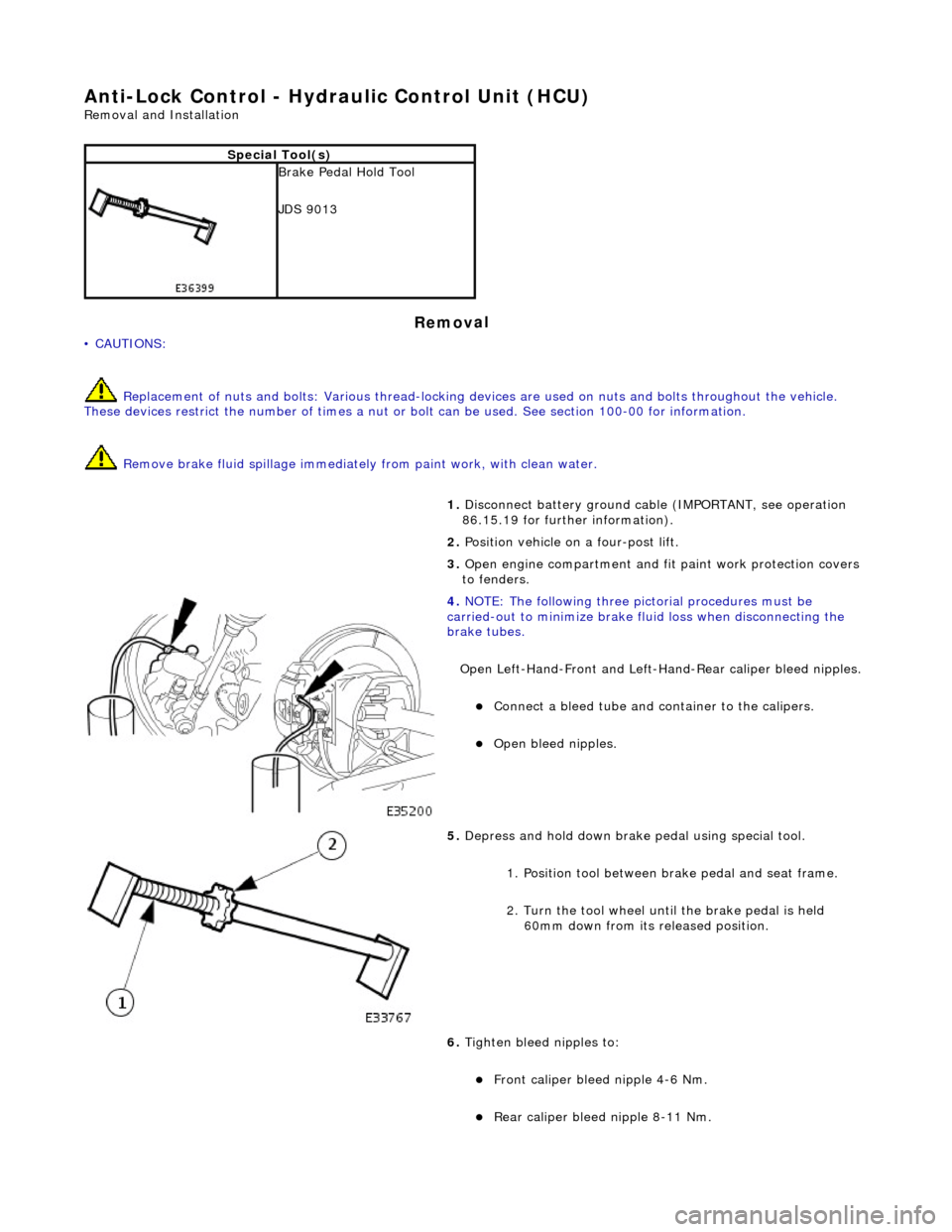
4. NOTE
: The following three pictorial procedures must be
carried-out to minimize brake fl uid loss when disconnecting the
brake tubes.
Open Left-Hand-Front and Left-H and-Rear caliper bleed nipples.
Connect
a bleed tube and co
ntainer to the calipers.
O
pen bleed nipples.
5. Depress and hold down brake pedal u
sing special tool.
1. Position tool between brake pedal and seat frame.
2. Turn the tool wheel unti l the brake pedal is held
60mm down from its released position.
6. Tighten bleed nipples to:
Front caliper blee d nipple 4-6
Nm.
Rear
caliper bleed nipple 8-11 Nm.
Page 449 of 2490

Anti-Lock Control - Rear Wheel Speed Sensor
Re
moval and Installation
Remov
al
Installation
1.
R
aise rear of vehicle and support
on stands. Refer to section
100-02.
2. Re
move wheel speed sensor.
Di
sconnect harness connector.
Re
move bolt.
3. Clean components and mating surfaces.
1. Inst
all wheel speed sensor.
Posit
ion sensor.
Install and tigh
ten bolt to 8-10 Nm.
Conne
ct harness connector.
2. Remove stands an d lower vehicle.
Page 450 of 2490

Anti-Lock Control - Wheel Speed Se
nsor Ring
Re
mo
val and Installation
Remov
a
l
CAUTI
O
N: Replacement of
nuts and bolts: Various thread-locking devices are used on nuts and bolts throughout the
vehicle. These devices restrict the number of times a nut or bolt can be used. See section 100-00 for information.
S p
ecial Tool(s)
Hub Holdin
g Tool
2
04-195 (JD 227)
ABS Rotor Nut Socket
2
06-
066A
1.
Op
en engine compartment and
fit paintwork protectors to
fenders.
2. Raise front of vehicle and support on stands. Refer to section
100-02.
3. Remove front wheel. Re fer to section 204-04.
4. Remove front brake disc. Refer to operation 70.10.12.
5. Remove vertical link and hub assembly. Refer to operation
60.25.38.90.
6. Re
move brake-disc shield from vertical link.
1. Remove screws.
2. Remove disc shield.
7. Using special tool, secure vertical link and hub assembly in a
vice.
Secure special tool
in a vice.
Posit
i
on hub in tool.
Fit and
tighten wheel nuts.
Page 452 of 2490
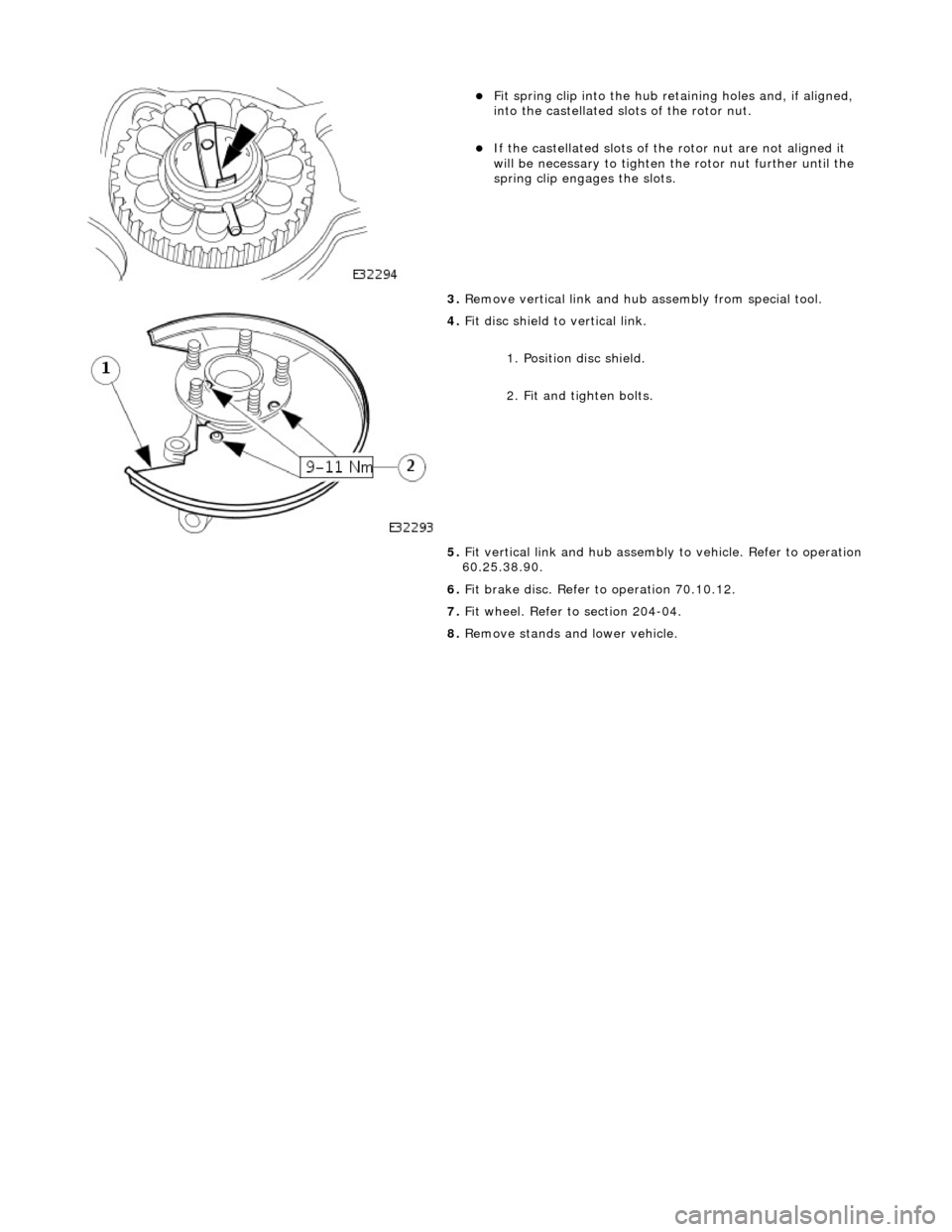
Fit sp
ring clip into the hub retaining holes and, if aligned,
into the castellated slots of the rotor nut.
If t he
castellated slots of the rotor nut are not aligned it
will be necessary to tighten the rotor nut further until the
spring clip engages the slots.
3. Remove vertical link and hub assembly from special tool.
4. Fi
t disc shield to vertical link.
1. Position disc shield.
2. Fit and tighten bolts.
5. Fit vertical link and hub assembly to vehicle. Refer to operation
60.25.38.90.
6. Fit brake disc. Refer to operation 70.10.12.
7. Fit wheel. Refer to section 204-04.
8. Remove stands an d lower vehicle.
Page 453 of 2490
Stee
ring System - General Information -
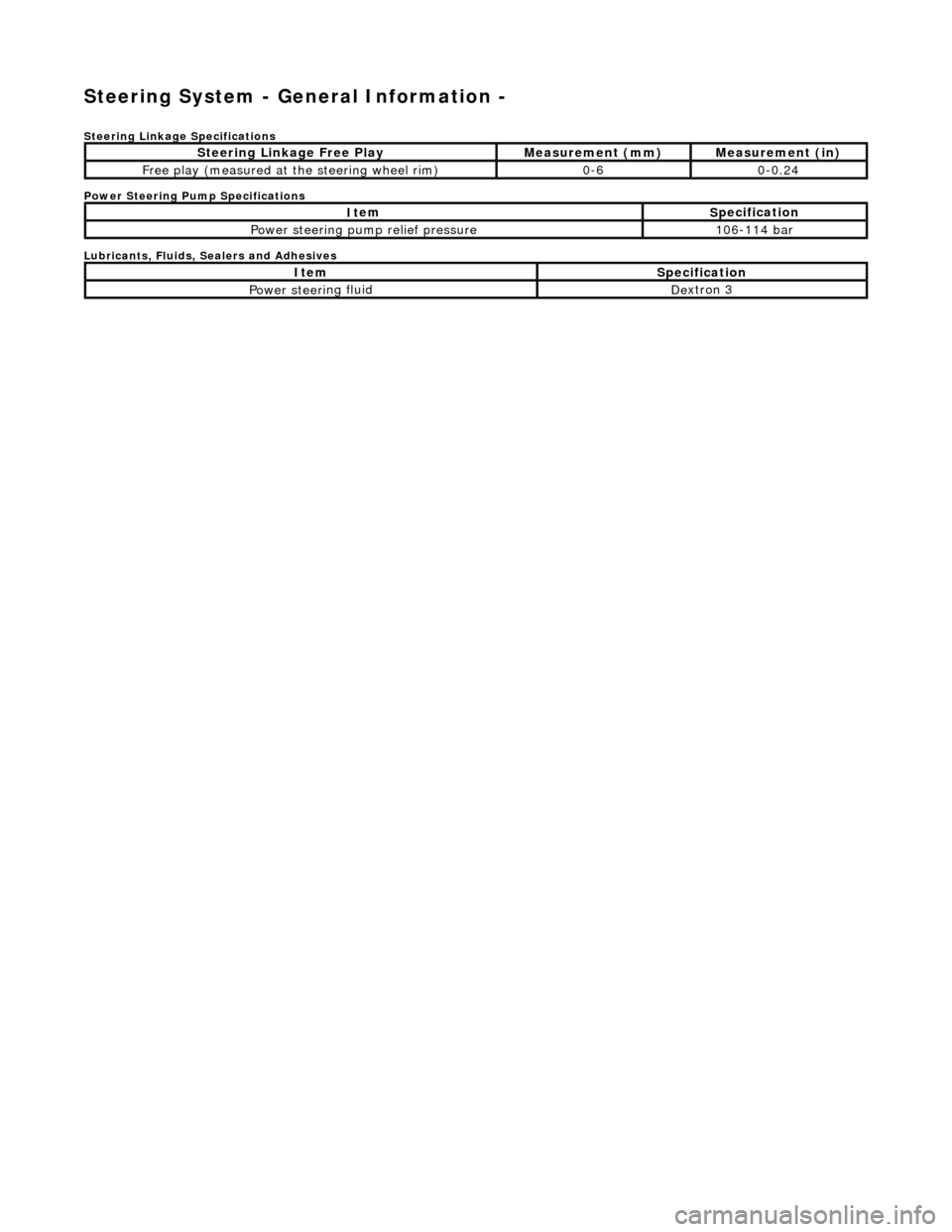
S
teering Linkage Specifications
Power Steering Pump Specifications
Lubricants, Fluids, Sealers and Adhesives
S
teering Linkage Free Play
Meas
urement (mm)
Meas
urement (in)
F
ree play (measured at
the steering wheel rim)
0-
6
0
-0.24
It
em
S
pecification
Power steeri
ng pump relief pressure
10
6-114 bar
It
em
S
pecification
Power steeri
ng fluid
De
xtron 3
Page 455 of 2490
Steering System - General Inform
ation - Steering System
D
iagnosis and Testing
I
nspection and Verification
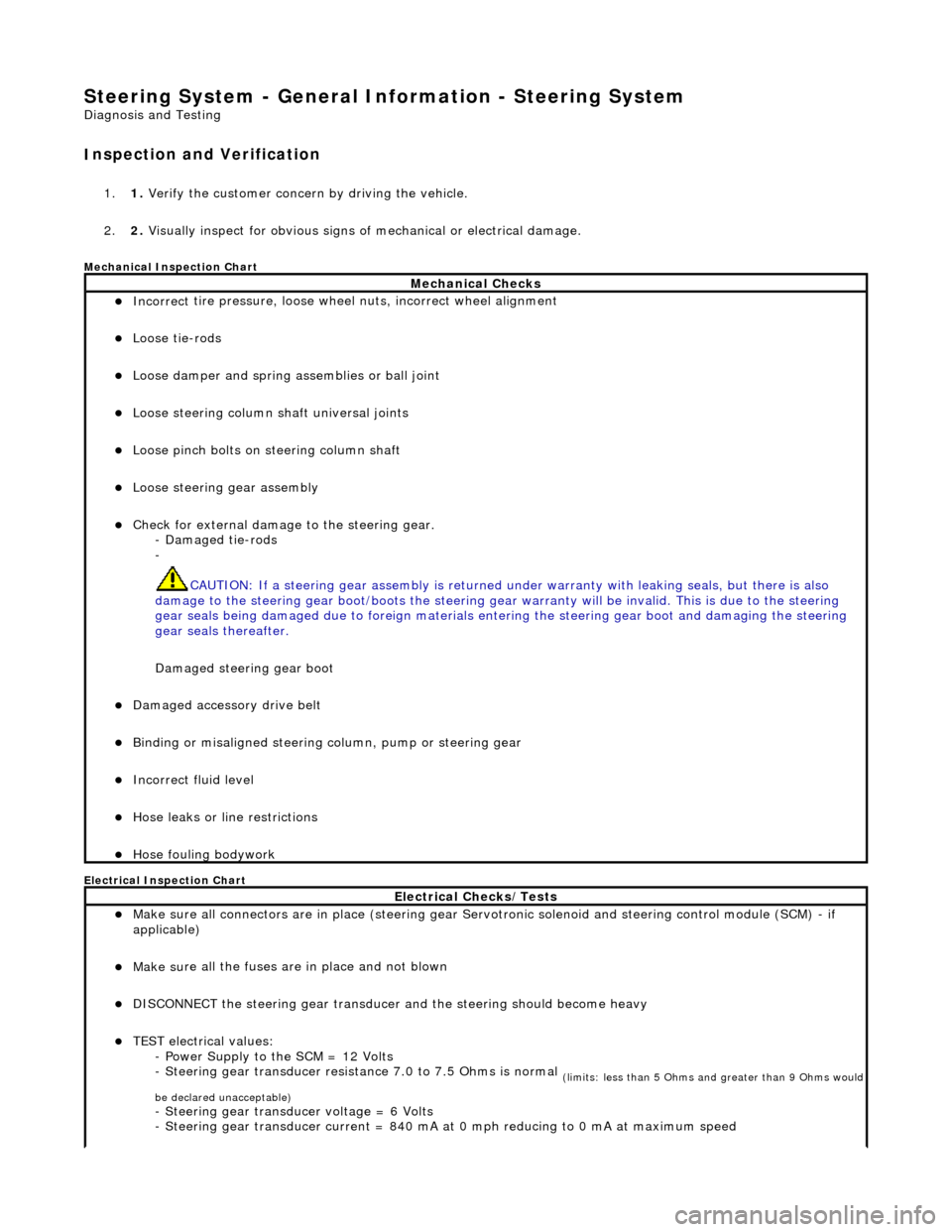
1.
1. Verify t
he customer concern by driving the vehicle.
2. 2. Visually inspect for obvious signs of mechanical or electrical damage.
Mec
hanical Inspection Chart
Electrical Inspection Chart
Mechanical Checks
Incorrect
tire pressure, loose whee
l nuts, incorrect wheel alignment
Loose ti
e-rods
Loose dam
per and spring assemblies or ball joint
Loose s
teering column shaft universal joints
Loose pinc
h bolts on steering column shaft
Loose steeri
ng gear assembly
Check f
or external damage to the steering gear.
- Damaged tie-rods
-
CAUTION: If a steering gear assemb ly is returned under warranty with leaking seals, but there is also
damage to the steering gear boot/boots the steering gear warranty will be invalid. This is due to the steering
gear seals being damaged due to fore ign materials entering the steering gear boot and damaging the steering
gear seals thereafter.
Damaged steering gear boot
Damaged accessory driv
e belt
Bin
ding or misaligned steering co
lumn, pump or steering gear
Incorrect fluid
level
Hose leaks o
r line restrictions
Hose fou
ling bodywork
El
ectrical Checks/Tests
Make sure all
connectors are in plac
e (steering gear Servotronic solenoid and steering control module (SCM) - if
applicable)
Make su
re all the fuses are in place and not blown
D
ISCONNECT the steering gear transducer
and the steering should become heavy
TEST e
lectrical values:
- Power Supply to the SCM = 12 Volts
- Steering gear transducer resist ance 7.0 to 7.5 Ohms is normal
(
limits: less than 5 Ohms and greater than 9 Ohms would
be declared unacceptable)
- Steeri
ng gear transducer voltage = 6 Volts
- Steering gear transducer cu rrent = 840 mA at 0 mph reducing to 0 mA at maximum speed
Page 457 of 2490
•
NOTE: The following steps must be carried out with assistance.
1. 1. With the wheels in the straight ahead po sition, gently turn the steering wheel to the left and the right to check for
free play.
2. 2. Free play should be between 0 and 6 mm (0 and 0.24 in) at the steering wheel rim. If the free play exceeds this
limit, either the ball joints are worn, the lower steering column joints are worn or the backlash of the steering gear
is excessive.
CAUTION: DO NOT attempt to adjust the stee ring gear yoke. Failure to follow this instruction will result in the steering
gear warranty to become invalid.
3. 3. The backlash of the steering gear cannot be adjusted, in stall a new steering gear. For additional information,
REFER to Section 211
-0
2 Power Steering
.
4. 4. Grasp the steering wheel
firm
ly and move it up and down and to the left and right without turning the wheel to
check for column bearing wear, steering wheel or steering column. For additional information,
REFER to Section 211
-0
4 Steering Column
.
Power Steering Fluid Condition Check
1.
1. R
un the engine for 2 minutes.
2. 2. Check the power steering fluid system level.
3. 3. Observe the color and the odor. The color under normal circumstances should be dark reddish, not brown or
black.
4. 4. Allow the fluid to drip onto a faci al tissue and examine the stain.
5. 5. If evidence of solid material is foun d, the power steering fluid system should be drained for further inspection.
6. 6. If fluid contamination or steering co mponent failure is confirmed by the se diment in the power steering fluid
system, REFER to Steering Fault Diagnosis by Symptom Charts in this section.
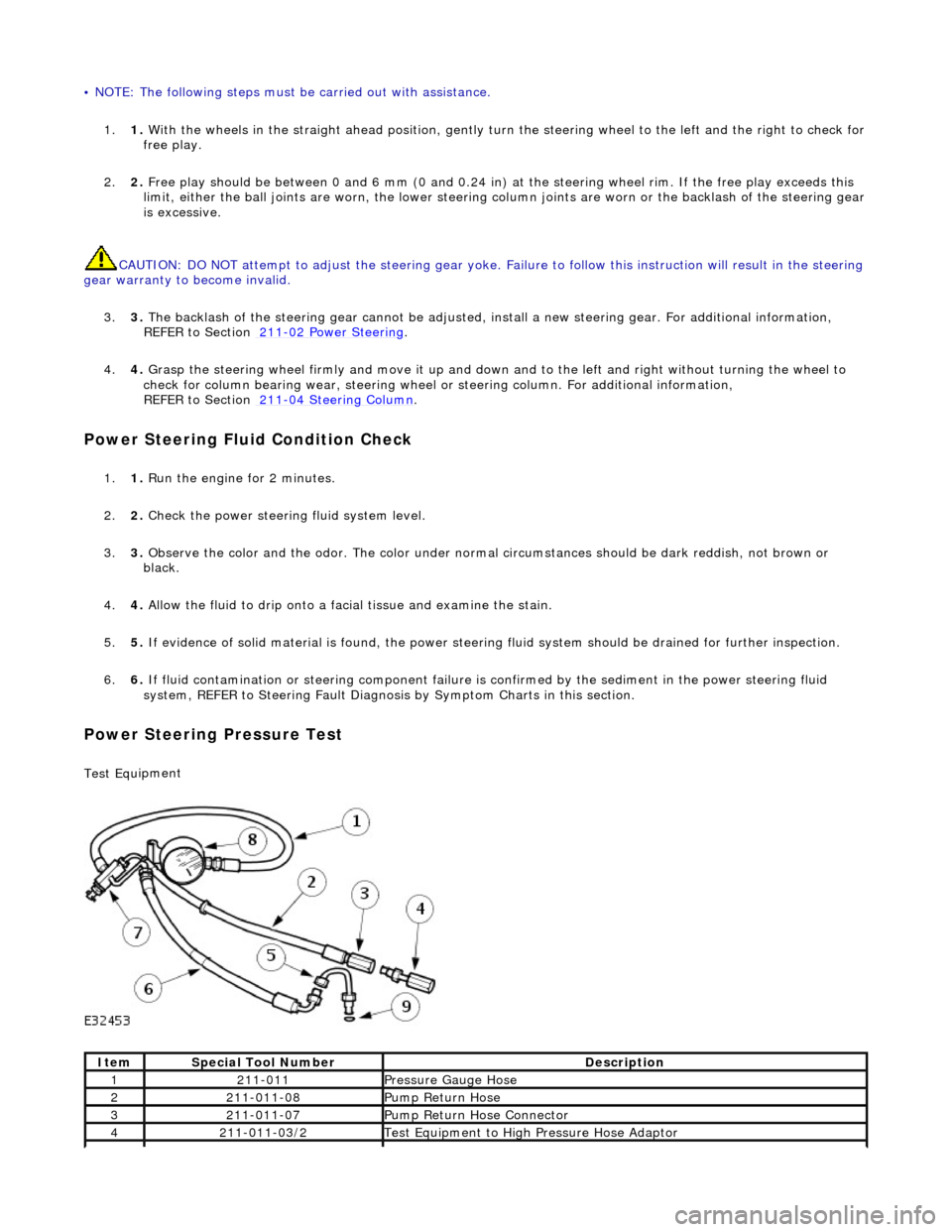
Power Steer
ing Pressure Test
Test Equ
ipment
It
em
S
pecial Tool Number
De
scription
12
11-011
Pres
sure Gauge Hose
221
1-011-08
Pump Return Hose
321
1-011-07
Pump Return Hose Connector
42
11-011-03/2
Test Equ
ipment to High
Pressure Hose Adaptor