power steering JAGUAR X308 1998 2.G Owner's Manual
[x] Cancel search | Manufacturer: JAGUAR, Model Year: 1998, Model line: X308, Model: JAGUAR X308 1998 2.GPages: 2490, PDF Size: 69.81 MB
Page 468 of 2490
Hiss (Swish)
Hiss or Val
ve Hiss is a high-frequency so
und coming from the steering gear when the system is loaded. It is a rushing or
"swish" noise that doesn't change frequency with RPM. Hiss is the general noise generated by the flow of hydraulic fluid
through restrictions in the steer ing system. Restrictions include the rotary stee ring valve, power steering tubes, connectors,
tuning orifices, etc. Hiss can be air- borne and structure-borne, but the structure-borne path through the steering
intermediate shaft is usually dominant.
Moan (Groan)
Moan is the general structu r
e-borne noise of the steering system. Moan is primarily transmitted to the driver via the body
structure through the pump mount, engine mounts, power steering lines and power steering brackets. On some vehicles,
moan is a load humming noise, often present when the wheel is turned and the system is loaded. It may change frequency
with engine RPM and if the sy stem is loaded or unloaded.
Rack Knock (R
ack Slap)
CAU
T
ION: DO NOT attempt to adjust the stee
ring gear yoke. Failure to follow this instruction will result in the steering
gear warranty to become invalid.
Rack Knock is a rattle sound an d steering wheel vibration caused by separation of the steering gear and pinion while driving
over bumps. It is a structure-borne noise transmitted throug h the intermediate shaft and column. Rack knock can also be
heard as a "thump" or impact noise that occurs with the vehicle stationary when the steering wheel is released from a
loaded position and allowed to return to rest . Noise occurs with the engine on or off.
Rattles
Ra
ttles are noises caused by knocking or hitting with components in the steering system. Steering rattles can occur in the
engine compartment, the suspension, or the passenger compartment . Rattles can be caused by loose parts, movable and
flexible parts, and improper clearances.
Squea k
s/Scrapes
Squeaks/Scrapes are noises due
to fri
ction or component rubbi
ng anywhere in the steering system. Squeaks/Scrapes have
appeared in steering linkages and jo ints, in column components and in co lumn and steering wheel trim parts.
Weep
We
ep is an air-borne noise, occasionally
generated when turning the steering across lock at a constant rate. When present
on a vehicle the noise, once initiated can often be maintained across a large proportion of the available steering movement.
Whistle
Wh
istle is similar to hiss but is louder and of a higher frequency. It is also more
of a pure tone noise than hiss. Whistle is
air-borne and is generated by a high flow rate of hydraulic fluid through a small restriction.
Zip
Zip n
o
ise is the air-borne noise
generated by power steerin g pump cavitation when power steering fluid does not flow freely
through the suction hose from the rese rvoir to the pump. Zip primarily occurs during cold weather at start-up.
Steering System Vibrations and Harshne
ss
Buzz
Buzz is a tactile rotary vi
bration felt in
the steering wheel for slow steering inputs. Buzz can also be called a grinding feel
and it is closely related to grunt and is caused by high system gain with low damping. Buzz is generally excited during
parking manoeuvres with low to medium speed steering input.
Page 469 of 2490
Buzz (E
lectrical)
A
different steering buzz can be caused by
pulse width modulated (PWM) electric actuators used in variable assist steering
systems. This buzz is felt by turning the ignition key to run without starting the engine and holding onto the steering wheel.
In extreme cases, the buzz can be felt with the engine running also.
Column/Steering Wheel
Shake
Column shake is a low f
requenc
y vertical vibration excited by primary engine vibrations.
Nibble (Shimm
y)
Steeri
ng nibble is a rotary oscillation or
vibration of the steering wheel, which can be excited at a specific vehicle speed.
Nibble is driven by wheel and tire imbalance exciting a suspensi on recession mode, which then translates into steering gear
travel and finally steering wheel nibble.
Shudder (Judd
er)
Shudder i
s a low frequency oscillation of th
e entire steering system (tire, wheels, st eering gear and linkage, etc.) when the
vehicle is steered during static-park or at low sp eeds. Shudder is very dependent on road surface.
Torque Ri
pple
Torque rippl
e is a concern with Electric Power Steering (EPS) sy
stems. Torque ripple is most evident at static-park steering
the wheel very slowly from lock to lock. Torque ripple is primarily caused by motor commutation.
Torque/Veloc
ity Variation
(Phasing/Effort Cycling)
Steeri
ng wheel torque variation oc
curring twice in one revolution is normally as a result of problems with the lower steering
column (intermediate shaft), but foul cond itions generally result in either constant stiffnes s or single point stiffness.
Depending upon the orientation of the joints, the steering can fe el asymmetric (torque falling off in one direction and rising
in the other) or else it can simply have pronounced peaks and troughs as the steering moves from lock to lock.
Wheel Fight
(Kick Back)
W
heel fight is excess feedback of sudden road forces through th
e steering system and back to the driver. It is evaluated at
all vehicle speeds over cobblestones, rough roads, and potholes . The tires, wheels, and suspension generate forces into the
steering systems. Steering friction, hydraulic damping, hydr aulic compliance, mechanical compliance, steering ratio, and
assist gain all affect how much is transmitted to the driver.
Stee
ring Linkage
CAUTI
ON: Steering gear boots must be
handled carefully to avoid damage. Use new clamps when installing steering
gear boots.
Inspect the boots for cuts, deterioration, tw isting or distortion. Check the steering gear boots to make sure they are tight.
Install new boots or clamps as necessary.
• NOTE: The following steps must be carried out with assistance.
1. 1. With the wheels in the straight ahead po sition, gently turn the steering wheel to the left and the right to check for
free play.
2. 2. Free play should be between 0 and 6 mm (0 and 0.24 in) at the steering wheel rim. If the free play exceeds this
limit, either the ball joints are worn, the lower steering column joints are worn or the backlash of the steering gear
is excessive.
Page 470 of 2490

3.CAUT
ION: DO NOT attempt to adjust the
steering gear yoke. Failure to follow this instruction will result in the
steering gear warranty to become invalid.
3. The backlash of the steering gear cannot be adjusted, in stall a new steering gear. For additional information,
REFER to Section 211
-02
Power Steering
.
4. 4. Grasp the steering wheel firm
ly and move it up an
d down and to the left and right without turning the wheel to
check for column bearing wear, steering wheel or steering column. For additional information,
REFER to Section 211
-04
Steering Column
.
Page 471 of 2490
Stee
ring System - General Informatio
n - Power Steering System Filling
and Bleeding
Gen
eral Procedures
Fluid Level Indica
tor
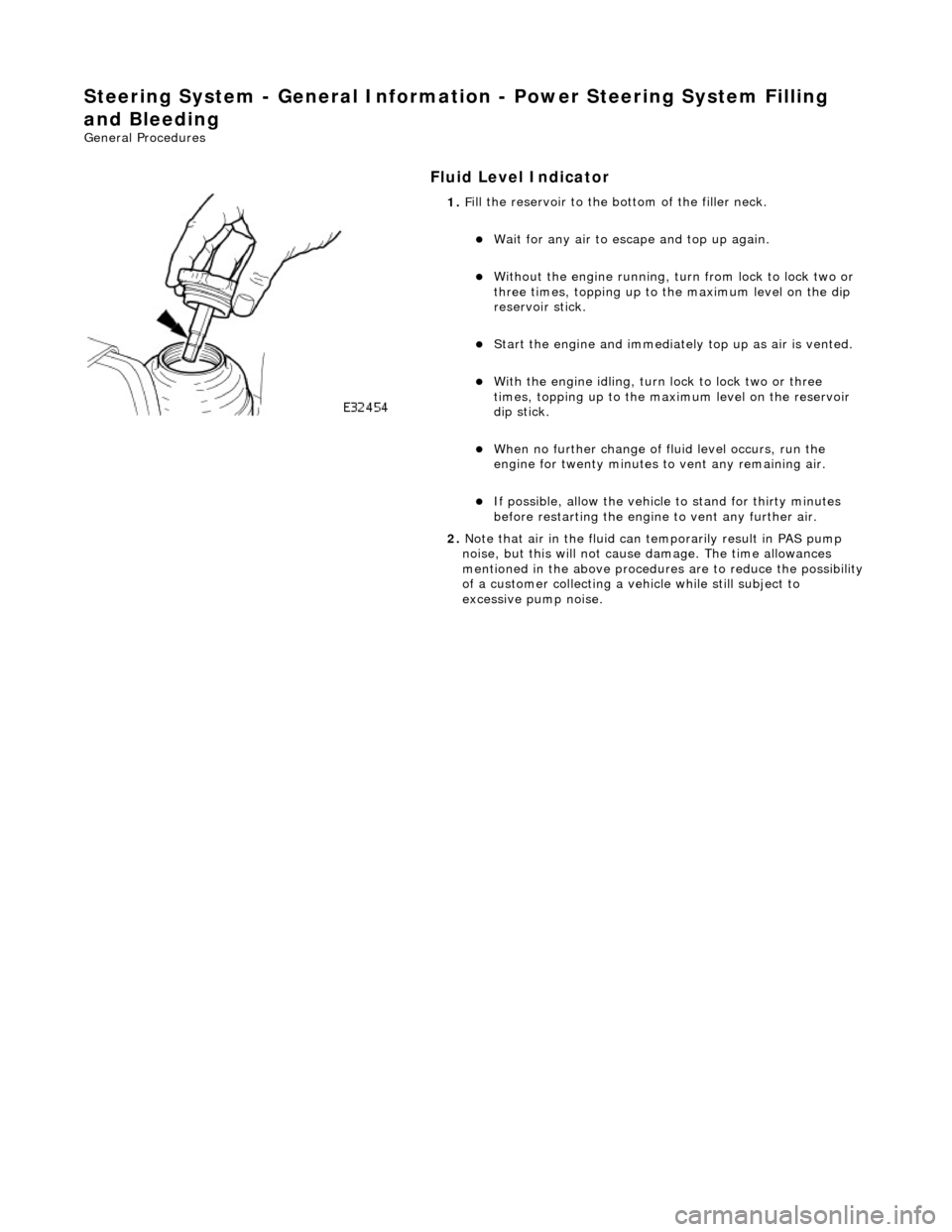
1.
F
ill the reservoir to the bo
ttom of the filler neck.
W
ait for any air to escape and top up again.
W
ithout the engine running, tu
rn from lock to lock two or
three times, topping up to the maximum level on the dip
reservoir stick.
St
art the engine and
immediately top up as air is vented.
W
ith the engine idling, turn
lock to lock two or three
times, topping up to the ma ximum level on the reservoir
dip stick.
W
hen no further change of
fluid level occurs, run the
engine for twenty minutes to vent any remaining air.
If po
ssible, allow the vehicle
to stand for thirty minutes
before restarting the engine to vent any further air.
2. Note that air in the fluid can temporarily result in PAS pump
noise, but this will not cause damage. The time allowances
mentioned in the above procedures are to reduce the possibility
of a customer collecting a vehicle while still subject to
excessive pump noise.
Page 472 of 2490

Steering System - General Information - Power Steeri
ng System Flushing
Gen
e
ral Procedures
• NOTE: If heavy steering or contamination within the power steering system is found, it is necessary to carry out the
system flush procedure as detailed below. If any components have been replaced in the power steering system the
procedure below must be carried out in full.
• NOTE: Some variation in the illustrations may occur, but the essential information is always correct.
1. Remove the power steering fluid reservoir cap.
2. Using a suitable syringe, remove the power steering fluid from
the power steering fluid reservoir.
3. CAUTIO
N: Be prepared to
collect escaping fluids.
• NOTE: Note the orientation of the clip. Detach the power steeri ng fluid reservoir.
De
tach but do not remove the power steering fluid
reservoir.
Re lea
se the power steering fluid return hose from the
power steering fluid reservoir.
If a qui
ck release coupling is fitted to the power
steering return ho se, release the powe r steering fluid
return hose from the coupling by removing the clip.
4. CAUTIO
N: Be prepared to
collect escaping fluids.
• NOTE: Make sure that all openings are sealed. Use new
blanking caps.
Using a suitable blanking cap, cap the power steering
reservoir return pipe.
5. CAUTIO
N: Be prepared to
collect escaping fluids.
• NOTE: Make sure the extended pipe is not kinked or twisted
and is correctly secure d with hose clips.
Attach a suitable pipe to the power steering return hose to
allow the fluid to drain.
Page 473 of 2490

6. NO
TE: The suitable funnel should have the a capacity of 4
litres and O-ring seal
• NOTE: The suitable funnel must be tightly sealed to the
power steering fluid reservoi r to avoid fluid leakage.
Install a suitable funnel onto the power steering fluid
reservoir.
7. WARNING: Do not work on or under a vehicle supported
only by a jack. Always support the vehicle on safety stands.
Raise and support the vehicle with the wheels just clear of the
ground.
8. CAUTI
ONS:
Steps 8 and 9 must be carried out within 2 - 3 seconds of
each other. Failure to follow this instruction may result in damage
to the power steering system.
Be prepared to collect escaping fluids.
Using the suitable funnel, top up the power steering system
with the specified fluid. Make su re the fluid level is maintained
at two thirds full in the funnel.
9. CAUTI
ONS:
Be prepared to collect escaping fluids.
Page 474 of 2490

Do not al
low the power steering fluid level in the power
steering fluid reservoir to fall below the minimum power
steering fluid level. Fa ilure to follow this instruction may result
in damage to the po wer steering system.
Make sure the engine is swit ched off as soon as the full
4 litres of power steering flui d has entered the power steering
fluid reservoir.
Flush the power steering system.
St art
the engine
W
it
h assistance turn the stee
ring slowly lock to lock 3
times at approximately 1 revo lution every 5 seconds.
Continue
to flush the power steering system until 4
litres of power steering fl uid has been added to the
power steering reservoir. This should take
approximately 30 seconds.
10 . CAUTI
ON: Be prepared to
collect escaping fluids.
Remove the suitable funnel.
11 . CAUTI
ON: Be prepared to
collect escaping fluids.
Remove the suitable pipe to th e power steering return hose.
12. CAUTI
ON: Be prepared to
collect escaping fluids.
Page 475 of 2490
•
NOTE: Note the orientation of the clip.
If a quick release coupling is fitt ed to the power steering return
hose, connect the power steerin g fluid return hose to the
coupling by installing the clip.
13. Install a new power steering fl uid reservoir. For additional
information, refer to: (211-02) Power Steering Fluid Reservoi r - 4.2L/3.0L/2.7L Diesel
(Removal and Installation),
Power Steering Fluid Reservoir - 3.0L Diesel (Removal and
Installation).
Page 476 of 2490

Steering System - Gen
eral Informatio
n - Power Steering System Vacuum
Filling and Bleeding
Gen e
ral Procedures
Fluid Ho
ses
1.
Parts L i
st
It
e
m
De
scr
iption
1R
e
turn hose
2High
pressure h
ose
2. If vacuum filling equipment is available, proceed as follows:
Disconnect both the
high pres
sure hose and return hose
from the PAS pump and the re turn hose from the steering
rack.
D rain as much fl
uid as possible from the system by
turning the steering from lock to lock two or three times.
Re conn
ect all hoses.
Fi
ll
the system using the vacuum equipment according to
the manufacturers instructions.
St art
the engine and top up
the fluid as necessary.
Turn the steering from lock to lock two or three ti mes wi
th
the engine running, topping up with fluid as necessary.
If possibl
e, run the engine for twenty minutes to expel any
remaining air.
Page 478 of 2490
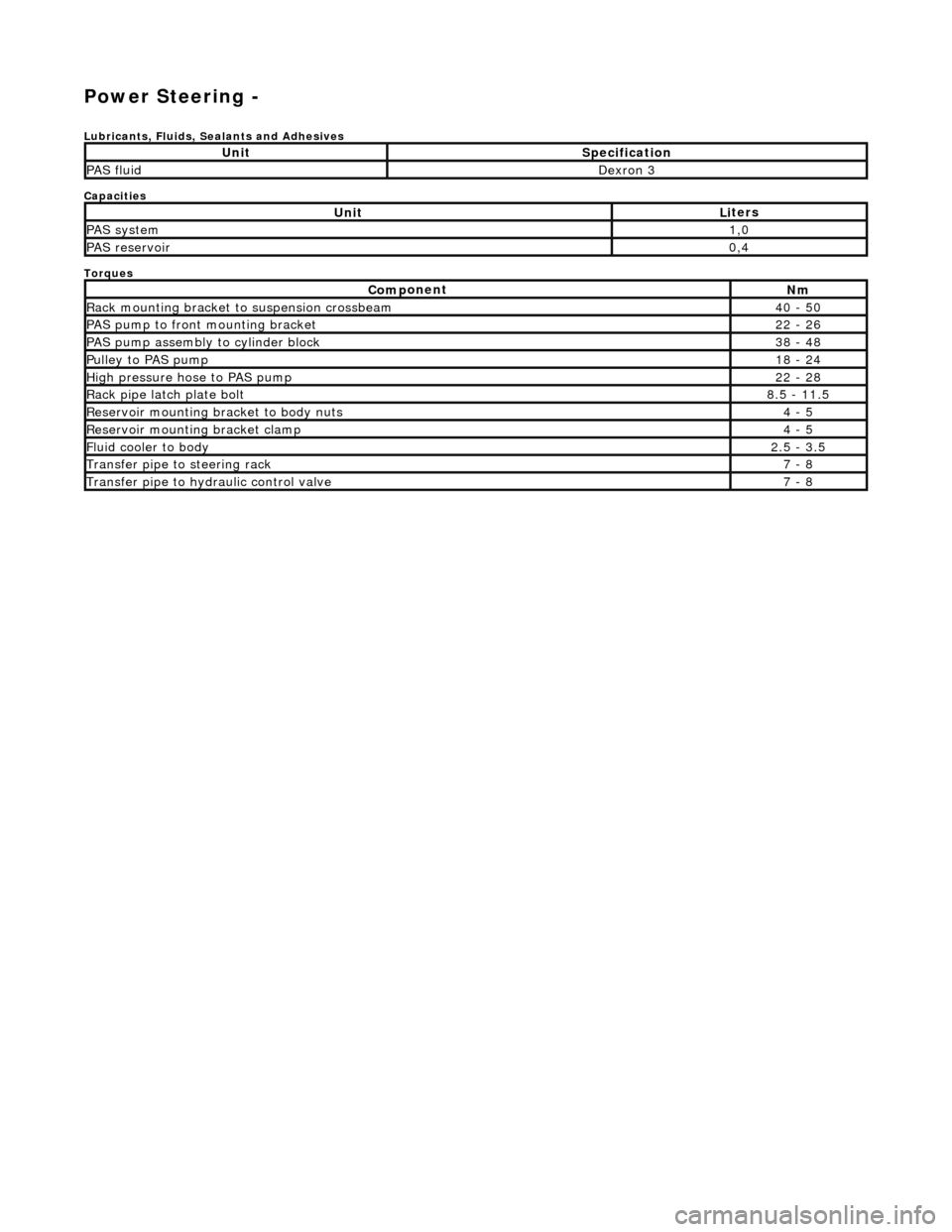
Power Steering -
Lubric
ants, Fluids, Sealants and Adhesives
Capacities
Torques
UnitSp
ecification
PAS flu
i
d
De
xr
on 3
UnitLi
t
ers
PAS syste
m1,0
PAS reservoi
r0,4
Com p
onent
Nm
Rac
k
mountin
g brac
ke
t to suspension crossbeam
40
- 50
PAS pump to front mounti
ng bracket
22
-
26
P
AS pu
mp assembly to cylinder block
38
-
48
Pul
l
ey to PAS pump
18
-
24
Hi
gh pressure hose to PAS pump22 -
28
Rack
pipe latch plate bolt8.5 -
11.5
R
e
servoir mounting bracket to body nuts
4 -
5
R
e
servoir mounting bracket clamp
4 -
5
Fluid cooler to body2.
5 -
3.5
Transfer pipe
to steering rack7 -
8
Transfer pipe
to hydraulic con
trol valve
7 -
8